
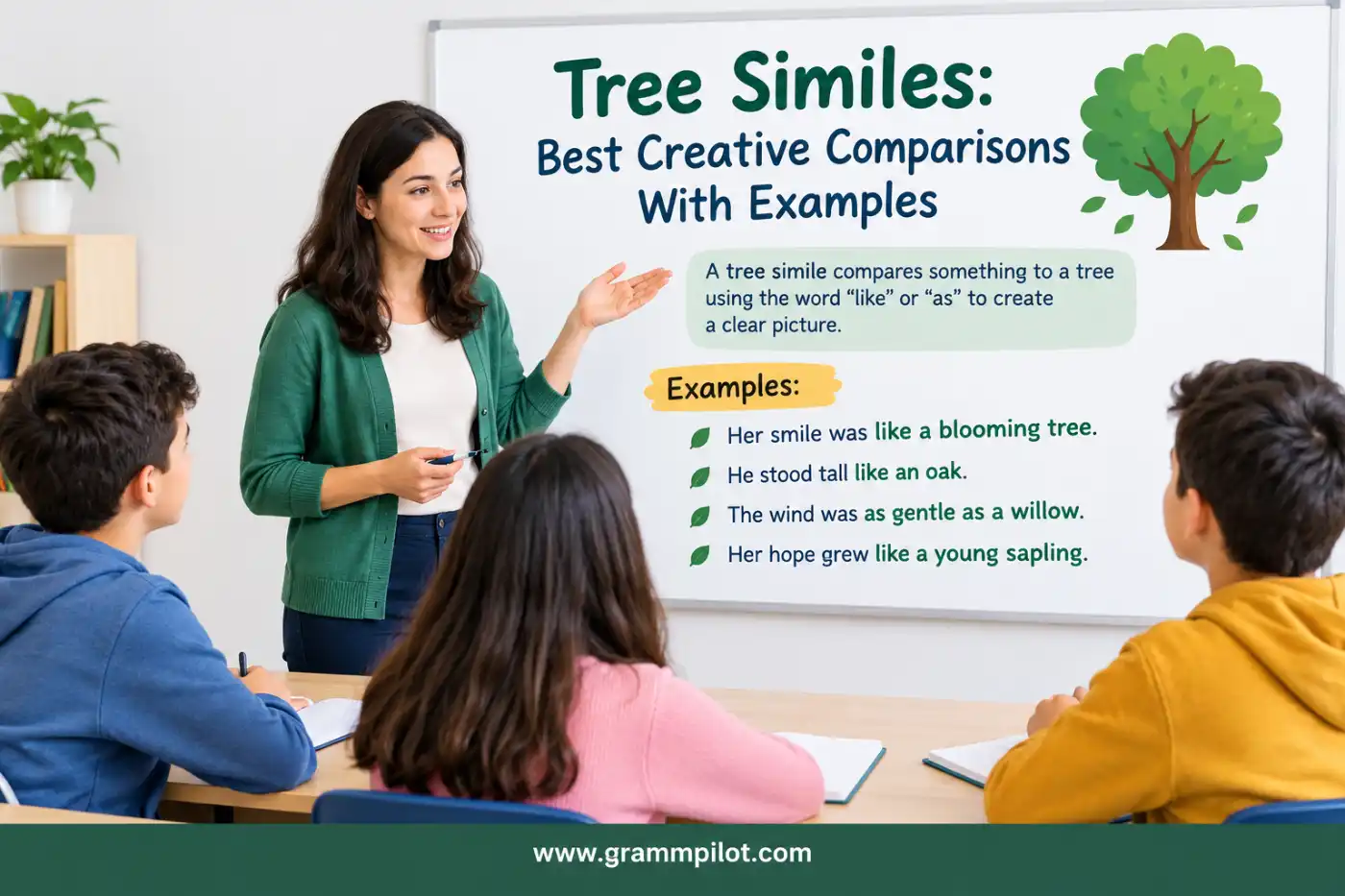
Writing about a tree can be harder than it seems. You may know what the tree looks like, but simply saying “the tree was tall” may not create a strong picture. Tree Similes can help you turn a basic description into something readers can see, feel, and remember. For example, you could write, “The tree was as tall as a tower.” This gives the reader a clearer idea of its height. Tree Similes also work well when you want to describe branches, leaves, roots, age, strength, movement, or mood.
Answer Box: Tree Similes compare a tree or part of a tree to something familiar by using words such as “like” or “as.” They make descriptions more vivid without changing the basic meaning.
In this guide, you’ll learn how to create Tree Similes, which words work best, common mistakes to avoid, and how to use them in essays, stories, poems, emails, and everyday writing.
What Are Tree Similes in Simple English?
Tree Similes are comparisons that help readers imagine a tree more clearly. A simile usually uses “like” or “as” to connect two different things.
For example:
- The tree was like a giant standing in the field.
- The branches spread like open arms.
- The leaves moved like waves.
- The roots were as strong as ropes.
- The old tree stood like a silent guardian.
These examples do more than give facts. They create mental pictures. A good comparison should have a clear connection. If you’re describing a very tall tree, compare it with something tall. If you’re describing moving leaves, compare them with something that moves. Tree Similes can be simple or imaginative. The best choice depends on your audience and the mood of your writing.
Where Does the Word “Simile” Come From?
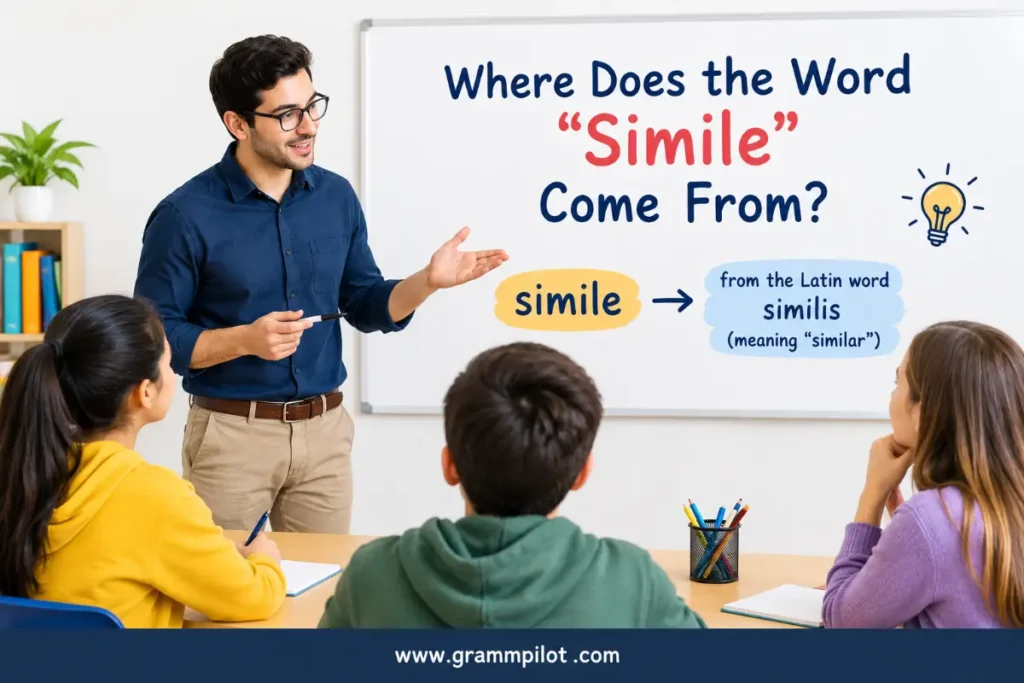
The word “simile” comes from a Latin word meaning “like” or “similar.”
A simile compares two things that are different but share a quality. In English, “like” and “as” are common signals.
For example:
“The tree is like a tower.”
The tree and tower aren’t the same thing. However, both can be tall. The comparison helps explain the tree’s height.
Tree Similes follow this same basic idea. You can compare a tree to a giant, tower, umbrella, guardian, castle, ship, candle, or another familiar object.
What Words Can You Use to Describe a Tree?
You don’t need complicated vocabulary to create effective Tree Similes. Simple words often produce the clearest descriptions.
Simple Words
Useful words include:
- Tall
- Short
- Big
- Small
- Old
- Young
- Strong
- Weak
- Green
- Brown
- Wide
- Thin
- Thick
- Full
- Bare
- Healthy
- Dry
- Rough
- Smooth
- Twisted
Everyday Words
For everyday writing, you can use words such as:
- Leafy
- Shady
- Fresh
- Bright
- Dark
- Huge
- Tiny
- Straight
- Curved
- Heavy
- Soft
- Colorful
- Broken
- Growing
- Flowering
More Formal Words
For school essays or more serious writing, consider:
- Ancient
- Mature
- Dense
- Massive
- Graceful
- Weathered
- Strong
- Natural
- Established
- Towering
You don’t need to use a difficult word just because it sounds impressive. Clear language usually works better.
Fun and Casual Words
Creative writing can use playful descriptions such as:
- Green giant
- Forest giant
- Leafy giant
- Old giant
- Natural umbrella
- Wooden tower
These choices can make Tree Similes more memorable for children and casual readers.
What Are the Main Types of Tree Similes?
Different parts of a tree can inspire different comparisons.
Tree Height
For a tall tree, you might write:
- The tree stood like a tower.
- The tree rose like a skyscraper.
- The tree was as tall as a mountain.
- The tree reached upward like a giant.
Height-based Tree Similes are useful when the size of the tree matters.
Tree Strength
Try comparisons with strong objects:
- The tree stood like a fortress.
- Its trunk was as strong as iron.
- The old tree stood like a solid wall.
- Its roots held the ground like strong ropes.
Tree Age
An old tree can be compared with something that suggests history:
- The tree stood like an ancient monument.
- Its twisted trunk looked like an old sculpture.
- The tree was like a wise old guardian.
These Tree Similes can give a scene a feeling of history.
Branches
Branches can look like arms, fingers, roads, or hands.
Examples:
- The branches stretched like open arms.
- The branches reached out like long fingers.
- The branches spread like a giant umbrella.
Leaves
Leaves can be compared with waves, feathers, stars, or coins.
Examples:
- The leaves moved like green waves.
- The leaves floated like tiny feathers.
- The leaves sparkled like little stars.
Roots
Roots can suggest strength and connection.
Examples:
- The roots spread like underground ropes.
- The roots gripped the soil like strong hands.
- The roots were tangled like old wires.
What Are Tree Similes Based on Intensity?
Not every comparison needs to sound dramatic. Choose the strength of the comparison based on your writing.
Mild Comparisons
Use gentle comparisons for simple descriptions.
- The tree was like a tall pole.
- The leaves moved like small waves.
- The branches looked like thin arms.
Medium Comparisons
These create a stronger image.
- The tree stood like a watchtower.
- The branches spread like giant arms.
- The leaves moved like waves across a lake.
Strong Comparisons
Strong Tree Similes work well in stories, poems, and dramatic scenes.
- The ancient tree towered like a giant over the village.
- Its branches reached outward like the arms of a giant.
- Its roots held the earth like powerful hands.
The comparison should match the mood. Don’t describe a small garden tree as a mountain unless you’re intentionally exaggerating.
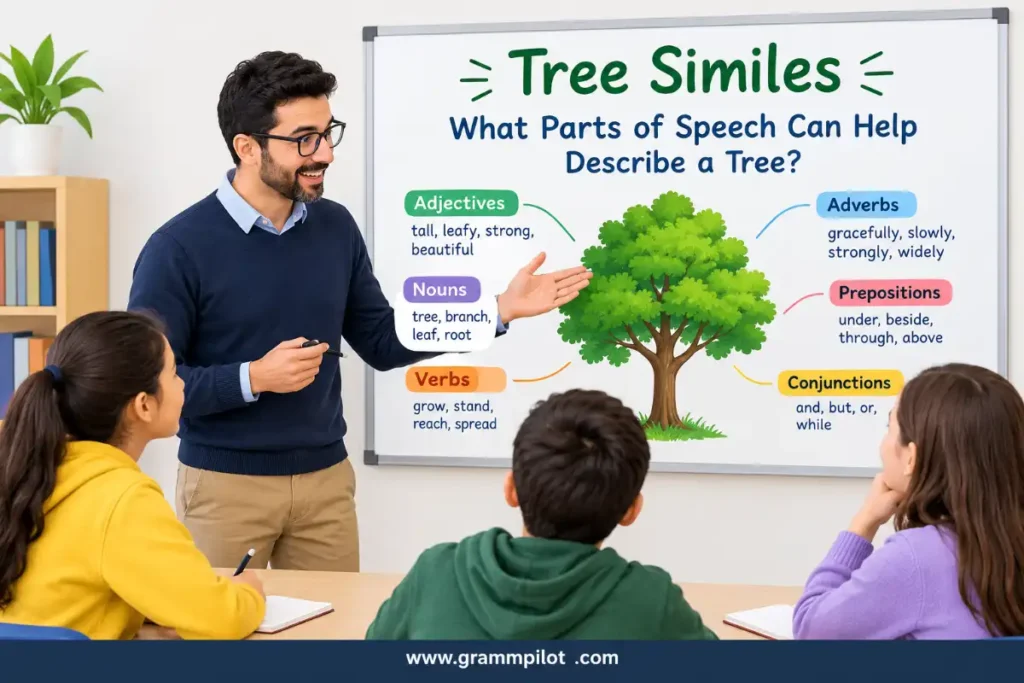
What Parts of Speech Can Help Describe a Tree?
Adjectives
Adjectives tell readers what a tree is like.
Examples:
- Tall
- Ancient
- Green
- Strong
- Twisted
- Beautiful
- Shady
Verbs
Verbs show what the tree or its parts are doing.
Examples:
- Sway
- Bend
- Stretch
- Shake
- Grow
- Reach
- Spread
For example:
“The branches stretched like long arms.”
Nouns
Nouns provide objects for comparisons.
Good choices include:
- Giant
- Tower
- Guardian
- Umbrella
- Fortress
- Castle
- Wave
- Hand
- Finger
- Rope
Adverbs
Adverbs can add information about movement.
Examples:
- Slowly
- Gently
- Quietly
- Wildly
- Gracefully
Are Tree Similes Different in American and British English?
The basic idea of Tree Similes is the same in American and British English.
Some everyday words can differ.
Americans commonly use “fall,” while British English often uses “autumn.” Both can be used in a tree description.
Example:
- American: The leaves fell like golden coins in the fall.
- British: The leaves fell like golden coins in autumn.
Another difference is “yard” and “garden.” American English often uses “yard” for the outdoor area around a home, while British English commonly uses “garden.”
These differences don’t change how similes work.
How Can You Use Tree Similes in a Resume?
A resume is not usually the right place for creative Tree Similes. Professional documents should be clear and direct.
Instead of writing:
“My leadership was like a giant tree.”
Say:
“My leadership provided stability and support for the team.”
However, a creative comparison may work in a portfolio, personal statement, creative-writing application, or presentation when the style allows it.
How Can You Use Tree Similes in an Essay?
Tree Similes can work well in descriptive, personal, and creative essays.
Example:
“The old oak stood like a silent guardian beside the school.”
This gives readers an image while keeping the sentence easy to understand.
Don’t add a simile to every sentence. One strong comparison can be more effective than five weak ones.
How Can You Use Tree Similes in Texting?
Text messages are informal, so you can be playful.
Examples:
- “That tree is like a giant!”
- “Those leaves look like green waves.”
- “The branches look like huge arms.”
Short Tree Similes are especially useful when you’re describing something you can see in a photo or video.
How Can You Use Tree Similes in an Email?
Creative comparisons can work in friendly emails, especially when talking about travel, nature, or a personal experience.
Example:
“The trees outside the hotel looked like giant umbrellas after the rain.”
For a business email, however, direct language is usually better.
How Can You Use Tree Similes in Speaking?
You can use Tree Similes naturally when telling someone about a place.
For example:
“There was this huge tree that looked like a giant standing over the road.”
Spoken comparisons don’t need to be complicated. A familiar image is often easier for listeners to understand.
What Are 20 Original Tree Simile Examples?
Here are 20 examples you can adapt:
- The tree stood like a tower above the small house.
- The old oak looked like a giant watching over the field.
- Its branches spread like open arms.
- The leaves moved like green waves in the wind.
- The roots gripped the soil like strong fingers.
- The tree looked like a giant umbrella over the children.
- Its trunk was as thick as a stone pillar.
- The bare branches looked like crooked fingers.
- The flowers covered the tree like colorful stars.
- The leaves fell like golden coins.
- The tree bent like a dancer during the storm.
- Its branches shook like frightened hands.
- The tree stood like a silent guardian beside the road.
- The dark tree looked like a shadow against the sky.
- The roots spread like ropes beneath the ground.
- The young tree stood like a small soldier in the garden.
- The canopy looked like a green roof.
- The wet leaves shone like tiny mirrors.
- The tree looked like a castle surrounded by vines.
- The branches reached toward the sunlight like curious children.
These examples show how Tree Similes can describe size, movement, age, color, strength, and mood.
How Are “Tree Like a Giant” and “Tree Like a Guardian” Different?
“The tree was like a giant” focuses mainly on size and strength.
“The tree was like a guardian” focuses more on protection and presence.
Both are useful, but they create different feelings.
Tree Similes should match the message you’re trying to communicate. Think about the quality you want readers to notice before choosing your comparison.
How Are “Leaves Like Waves” and “Leaves Like Whispers” Different?
“Leaves like waves” suggests movement. Readers may imagine many leaves moving together in the wind.
“Leaves like whispers” creates a quieter feeling. It can suggest gentle movement and sound.
This is why Tree Similes are not only about appearance. They can also create mood.
How Are “Tree Like a Fortress” and “Tree Like a Pillar” Different?
A fortress suggests strength, protection, and safety.
A pillar suggests height, support, and stability.
If the tree is protecting a place, “fortress” may fit the idea. If you’re focusing on the straight trunk, “pillar” may work better.
What Are Common Mistakes When Writing Tree Similes?
1. Making the comparison unclear
Avoid comparisons that have no obvious connection.
Weak:
“The tree was like a telephone.”
Better:
“The tree was as tall as a telephone pole.”
2. Confusing a simile with a metaphor
A simile usually uses “like” or “as.”
Simile:
“The tree was like a giant.”
Metaphor:
“The tree was a giant.”
Both can be useful, but they are different forms of comparison.
3. Using too many comparisons
Too many Tree Similes can make writing feel crowded.
Choose the strongest comparison and move on.
4. Repeating “like” too often
Instead of writing several sentences with “like,” vary your descriptions.
5. Making every tree enormous
Not every tree needs to be compared with a giant, mountain, or skyscraper.
Small and quiet comparisons can be just as effective.
6. Using dramatic language in formal writing
A school report may need facts instead of creative comparisons. Always consider your audience.
When Should You Not Use a Tree Simile?
Avoid Tree Similes when precision is more important than creativity.
For example, a science report might say:
“The tree is approximately 15 meters tall.”
A simile such as “The tree is as tall as a building” isn’t as precise.
You should also avoid them when the comparison distracts from the main point.
In creative writing, however, Tree Similes can add color and emotion without making the writing difficult.
What Are Opposite Words for Tree Descriptions?
You can use opposite descriptive words to create contrast.
- Tall / Short
- Big / Small
- Old / Young
- Strong / Weak
- Thick / Thin
- Wide / Narrow
- Green / Bare
- Healthy / Damaged
- Full / Empty
- Living / Dead
- Bright / Dark
- Smooth / Rough
- Straight / Twisted
- Fresh / Dry
These words can help you decide what quality your Tree Similes should emphasize.
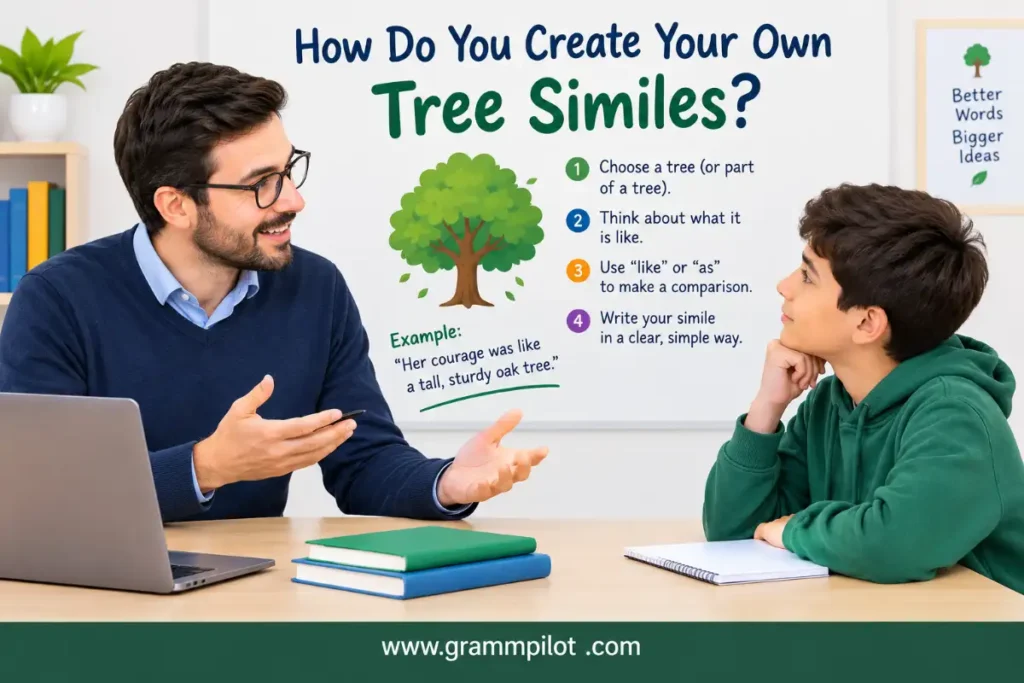
How Do You Create Your Own Tree Similes?
Creating original Tree Similes is easier when you follow a few steps.
Step 1: Choose one quality
Ask yourself what you want to describe.
Is the tree:
- Tall?
- Old?
- Strong?
- Beautiful?
- Frightening?
- Peaceful?
- Moving?
Step 2: Think of something with the same quality
For “tall,” you might think of a tower.
For “peaceful,” you might think of a sleeping person.
Step 3: Make the comparison
Connect your ideas using “like” or “as.”
“The tree stood like a tower.”
Step 4: Add a useful detail
“The tree stood like a tower above the quiet houses.”
Step 5: Check the mood
Ask about the comparison creates the feeling you want.
This simple process can help you create original Tree Similes instead of copying common phrases.
How Can You Make Tree Descriptions More Creative?
Use more than sight.
Sight
“The leaves were like green stars.”
Sound
“The leaves sounded like soft rain.”
Touch
“The bark felt as rough as old stone.”
Movement
“The branches moved like dancers.”
Smell
“The flowering tree smelled like a fresh garden.”
Using different senses makes Tree Similes more interesting and helps readers experience the scene.
What Are Good Tree Similes for Different Moods?
Happy
“The flowering tree looked like a colorful celebration.”
Peaceful
“The tree stood like a quiet guardian beside the lake.”
Sad
“The bare tree looked like a lonely figure.”
Mysterious
“The dark tree stood like a silent shadow.”
Frightening
“The twisted branches reached out like long claws.”
Hopeful
“The young tree rose like a small promise of spring.”
The emotional effect of Tree Similes depends on the objects you choose.
What Are Good Tree Similes for Children?
Children usually understand familiar comparisons best.
Examples include:
- The tree was like a giant.
- The leaves danced like little flags.
- The branches spread like arms.
- The tree looked like a giant umbrella.
- The leaves moved like waves.
- The trunk was as strong as a wall.
Simple Tree Similes are often easier for young readers to understand and remember.
What Are Good Tree Similes for Poetry?
Poetry gives you more freedom to use unusual images.
Examples:
- The tree stood like a lonely traveler.
- Its branches reached like searching hands.
- Its leaves whispered like secret voices.
- The roots slept like hidden ropes beneath the earth.
- The tree rose like a green flame.
Poetic Tree Similes can focus on emotion as much as appearance.
How Can You Avoid Repeating the Same Tree Comparisons?
If you always use “giant,” “tower,” and “umbrella,” your writing may become predictable.
Change the quality you’re describing.
Instead of focusing only on height, describe:
- Movement
- Sound
- Texture
- Age
- Color
- Shape
- Strength
- Mood
- Season
- Location
For example, you can compare leaves with waves, branches with arms, roots with ropes, and bark with stone.
This gives your Tree Similes more variety.
How Can You Use Tree Similes in a Complete Paragraph?
Here’s an example:
The old tree stood beside the empty road like a quiet guardian. Its branches stretched like long arms over the path. In the afternoon wind, its leaves moved like green waves. The rough trunk looked as strong as a stone pillar. Beneath the soil, its roots held the ground like thick ropes. The whole tree gave the quiet place a peaceful feeling.
Notice that each comparison describes a different feature. The paragraph doesn’t repeat the same idea.
How Can You Use Tree Similes Without Sounding Childish?
Use natural comparisons and avoid forcing every sentence to sound dramatic.
Instead of:
“The tree was like the biggest, strongest, most amazing giant in the whole universe.”
Try:
“The old tree stood like a quiet giant over the garden.”
The second sentence is shorter and more believable.
Strong Tree Similes don’t need lots of adjectives. A clear image is usually enough.
Why Are Tree Similes Useful in Creative Writing?
Tree Similes help writers turn simple facts into visual experiences.
Compare:
“The tree was old.”
with:
“The tree stood like an ancient guardian.”
The second sentence gives the reader a stronger picture.
They can also create mood. A tree can seem peaceful, lonely, frightening, powerful, welcoming, or mysterious depending on the comparison.
What Makes a Tree Simile Effective?
An effective comparison usually has three qualities:
- It is clear.
- It has a real connection to the tree.
- It supports the mood or purpose of the writing.
Good Tree Similes don’t need to be complicated.
“The branches spread like open arms” works because branches really can look like arms.
“The leaves moved like waves” works because both leaves and waves can move together in a flowing pattern.
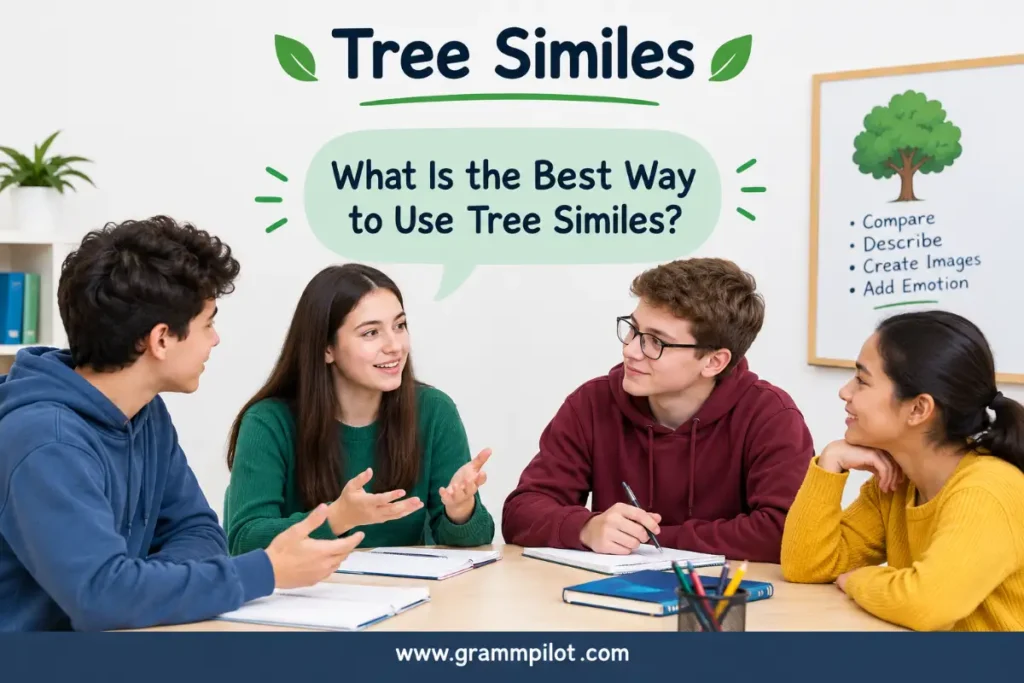
What Is the Best Way to Use Tree Similes?
The best Tree Similes are clear, relevant, and easy to picture. You don’t need complicated vocabulary or unusual comparisons.
Start with the feature you want to describe. Then think of something familiar that shares that quality.
For example:
- Height → tower
- Strength → fortress
- Branches → arms
- Leaves → waves
- Roots → ropes
- Age → ancient guardian
- Shape → umbrella
- Movement → dancer
This method makes Tree Similes easier to create and use naturally.
Conclusion
Tree Similes can turn an ordinary tree description into a clear and memorable picture. They can show height, strength, age, movement, color, texture, and emotion without requiring difficult words. The key is to choose a comparison that actually matches the tree or the feeling you want to create. A tall tree can be like a tower, branches can spread like arms, and leaves can move like waves. You can use these comparisons in stories, poems, essays, personal writing, and casual messages. Keep your comparisons clear and avoid using too many at once. One strong image is often better than several weak ones. With practice, you’ll be able to create natural Tree Similes that make your writing more vivid while still sounding simple and human.
Frequently Asked Questions
1. What is a simple tree simile?
A simple tree simile compares a tree with something familiar using “like” or “as.” For example, “The tree was like a giant.”
2. What are some good Tree Similes for writing?
Good Tree Similes include “The branches spread like open arms,” “The leaves moved like waves,” and “The tree stood like a silent guardian.”
3. What is a simile for a tree in the wind?
You could write, “The tree danced like a graceful dancer in the wind.” Another option is, “The branches moved like waves.”
4. What’s another way to say a tree is very tall?
You can say the tree “stood like a tower,” “rose like a skyscraper,” or “towered like a giant.” These Tree Similes give readers a visual idea of its height.
5. What is a simile for tree branches?
“The branches stretched like open arms” is a simple example. You could also say, “The branches reached out like long fingers.”
6. Can I use Tree Similes in an essay?
Yes. Tree Similes can work well in descriptive and creative essays. However, avoid them when you’re writing a technical or scientific section where exact facts are more important.
7. How can I make a tree description more creative?
Choose one feature, such as height, leaves, roots, or branches, and compare it with something familiar. Then make sure the comparison matches the mood and purpose of your writing.