
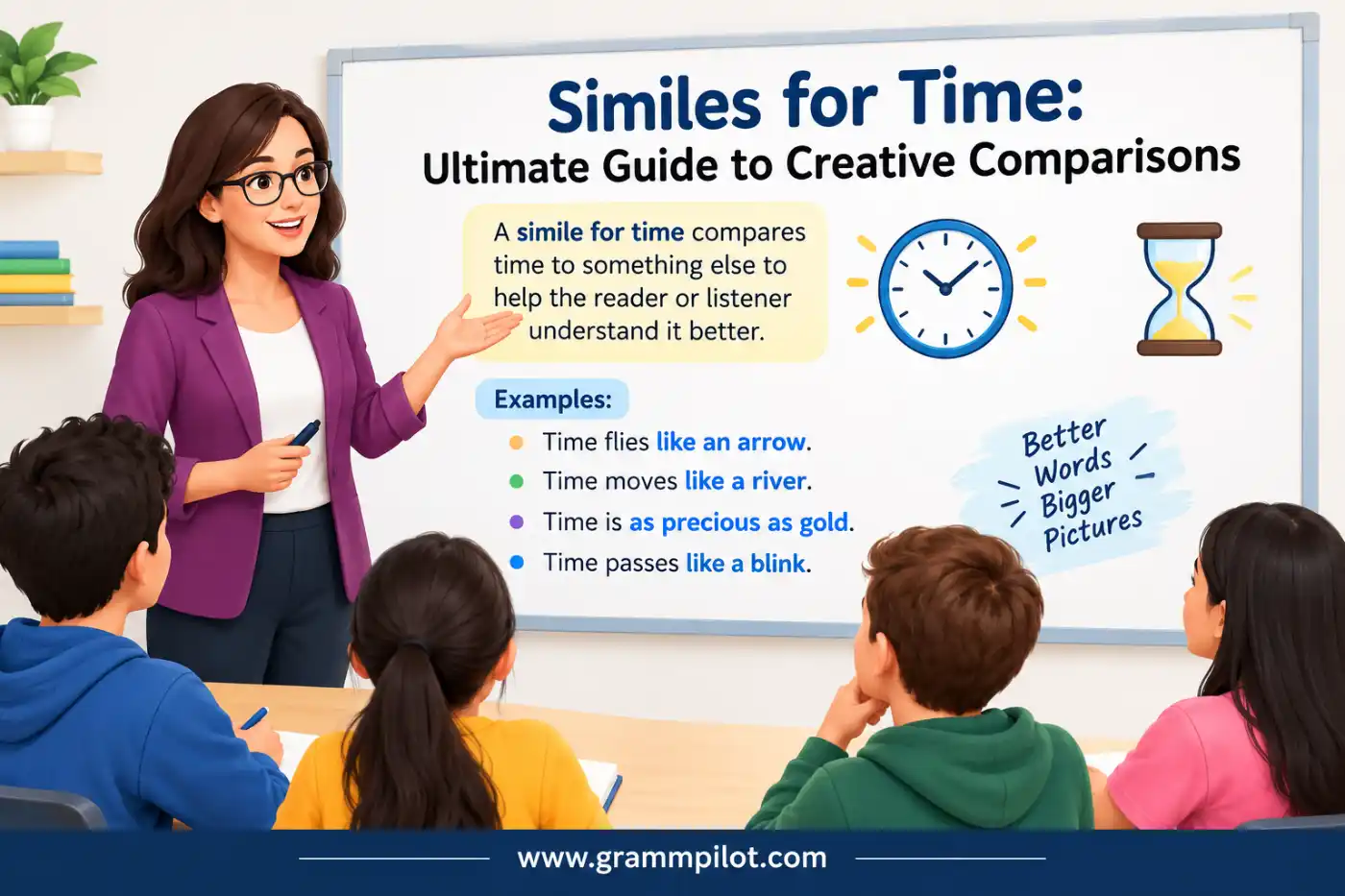
Writing about time can be surprisingly difficult. In an essay, story, poem, text, or speech, saying that time is “fast” may be correct, but it doesn’t always create a strong picture. Similes for Time help readers imagine time through something familiar, such as a river, a bird, a shadow, or a race. A simile compares two different things using words such as like or as. When you compare time to something people can see, hear, or feel, an abstract idea becomes easier to understand.
Answer Box: Similes for Time compare time to familiar things to show how quickly, slowly, steadily, or mysteriously it seems to move. They make descriptions more vivid and emotional.
This guide explains the meaning and background of time-related comparisons, gives more than 30 useful alternatives, and shows how to choose the right comparison for an essay, story, text, email, or conversation.
You can find more examples of figurative language in [Tree Similes].
What Are Similes for Time?
A simile for time is a comparison that describes time by connecting it to another thing.
For example:
Time moved like a river.
Time cannot literally move like a river. The comparison helps the reader imagine a continuous flow.
Another example is:
The summer passed like a shooting star.
The summer didn’t physically travel through the sky. The comparison shows that it seemed to disappear very quickly.
A good time simile usually communicates one main idea:
- Time moves quickly.
- Time seems slow.
- Time passes steadily.
- Time feels endless.
- Time disappears suddenly.
- Time changes things.
- Time waits for no one.
- Time creates distance.
- Time heals or changes emotions.
- Time can feel precious.
The best comparison depends on the feeling you want the reader to experience.
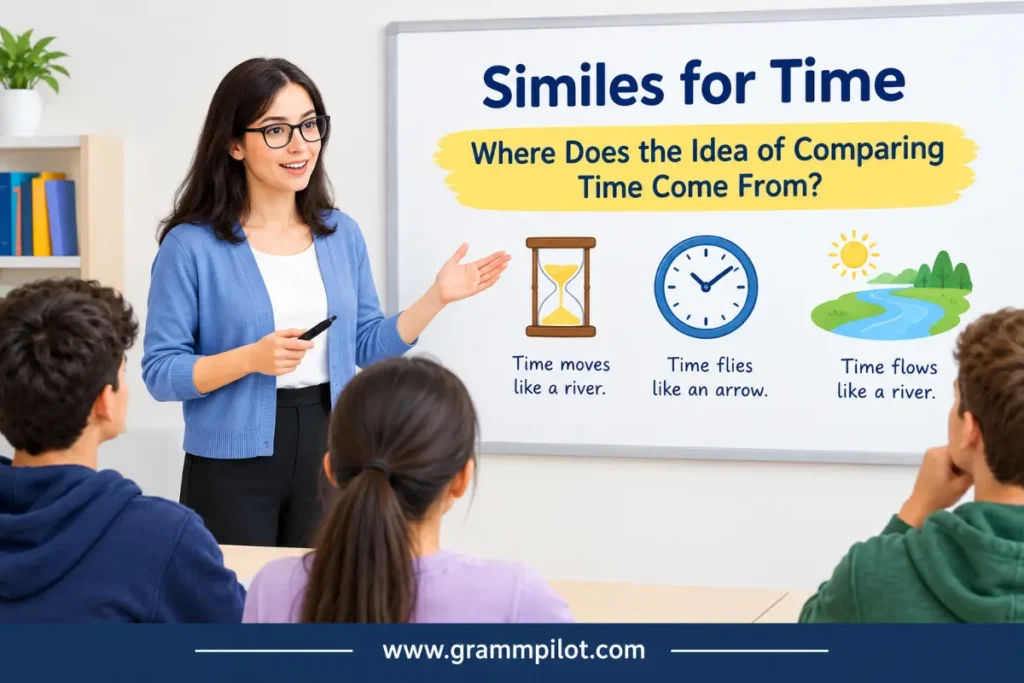
Where Does the Idea of Comparing Time Come From?
The idea of describing time through physical things is very old. People have always needed ways to talk about something they cannot see directly.
Time itself isn’t an object that you can hold. You can’t put an hour on a table or watch a minute walk across a room. Because of this, people often describe time through things they can observe.
Common images include:
- rivers
- roads
- clocks
- shadows
- wind
- seasons
- birds
- waves
- trains
- races
- candles
- flowers
- mountains
- clouds
These comparisons connect an abstract idea with a concrete image.
For example, when someone says “time is a river,” the comparison suggests movement and continuity. When someone says “time is a thief,” that is actually a metaphor rather than a simile because it directly identifies time with a thief.
A simile would be: Time moved like a thief in the night.
That version uses like to make the comparison.
What Does Time Mean in Simple English?
In simple English, time refers to the ongoing sequence in which events happen.
We use time to describe:
- when something happens
- how long something lasts
- how events are ordered
- how old something is
- how much time has passed
- how much time remains
Examples:
I arrived at noon.
The movie lasted two hours.
Three years have passed.
We have ten minutes left.
When writers use figurative language, however, they can describe time in more imaginative ways.
Instead of:
The years passed quickly.
You might write:
The years flew by like birds heading south.
The second sentence creates a picture.
What Are 30+ Useful Alternatives for Describing Time?
Writers don’t always need the exact phrase similes for time when describing time creatively. You can use many related expressions and images.
Here are 36 useful options.
These expressions aren’t all similes. Some are metaphors, idioms, nouns, adjectives, or ordinary descriptions. They’re useful because they give you a wider vocabulary for writing about time.
What Are Similes for Fast-Passing Time?
When time seems to move quickly, choose images that suggest speed, flight, movement, or disappearance.
Examples:
Time flew like a bird escaping a storm.
The afternoon passed like a speeding train.
The weekend vanished like smoke in the wind.
The school year raced by like a runner near the finish line.
The summer disappeared like a drop of water on hot pavement.
These comparisons work because the reader already understands how quickly the image moves or disappears.
More examples for fast time
- Time flew like a bird released from a cage.
- The morning raced by like a train.
- The vacation passed like a shooting star.
- The years disappeared like footprints in the sand.
- The weekend slipped away like water through open hands.
- The evening vanished like mist under the sun.
- The months flew like leaves caught in the wind.
- The holiday rushed past like a car on an empty highway.
What Are Similes for Slow-Passing Time?
Sometimes time feels painfully slow.
This happens when someone is:
- waiting for news
- sitting through a boring meeting
- waiting for an exam to finish
- missing someone
- feeling nervous
- watching the clock
Use slow-moving images.
The minutes crawled like ants across a sidewalk.
The afternoon dragged like a heavy suitcase.
The waiting felt like a turtle crossing a wide road.
The clock moved like a tired snail.
These images make the reader feel the frustration or boredom.
More examples for slow time
- The minutes crawled like ants.
- The hour dragged like a heavy chain.
- The afternoon moved like a tired turtle.
- The final ten minutes stretched like warm taffy.
- The night crawled along like a slow-moving shadow.
- The waiting time felt like a road with no end.
- Each second dragged like a heavy footstep.
- The clock seemed to crawl like a snail.
What Are Similes for Time That Feels Endless?
Sometimes a person doesn’t literally mean that time has no end. They mean that a period feels extremely long.
Try comparisons involving distance, oceans, deserts, or endless roads.
The wait felt as long as a road stretching beyond the horizon.
The night seemed like an ocean with no shore.
Those few minutes felt like a desert with no end.
The silence stretched like a road disappearing into the distance.
These comparisons work particularly well in emotional writing.
What Are Similes for Time in Happy Memories?
Happy memories often make time feel fast.
You can compare time to:
- birds
- butterflies
- bubbles
- sunlight
- music
- wind
- falling leaves
- flowing water
Examples:
Our childhood passed like a summer breeze.
The afternoon disappeared like a bubble in sunlight.
Those happy years flew like colorful birds.
The evening floated by like soft music.
Our vacation passed like a warm breeze through an open window.
These images create a gentle and positive mood.
What Are Similes for Time in Sad Writing?
Sad writing often needs slower or fading images.
Try:
The days crawled like shadows across an empty room.
The years faded like an old photograph.
Time moved like rain on a cold window.
The lonely evening stretched like an empty road.
The months passed like fallen leaves carried away by the wind.
These comparisons can suggest loneliness, loss, memory, or emotional distance.
How Can You Use Similes for Time in an Essay?
In an essay, a comparison should support your main idea rather than distract from it.
Suppose you’re writing about childhood.
Weak:
My childhood was good.
More descriptive:
My childhood passed like a bright summer afternoon.
The comparison adds emotion without becoming too complicated.
For an essay about aging:
The years passed like pages turning in a book.
For an essay about technology:
Technology has changed our lives like a fast-moving river changing the shape of its banks.
For an essay about waiting:
The hours before the results felt like a long road with no visible end.
The best academic writing still needs clarity. Don’t add a poetic comparison to every sentence.
How Can You Use Them in a Story?
Stories give you more freedom.
A character may experience time differently depending on what is happening.
During an exciting event:
The hours flew like birds startled from a tree.
During a frightening wait:
The seconds crawled like insects across the wall.
During a memory:
Those summers returned like faded songs.
During grief:
The days moved like shadows beneath a cloudy sky.
A useful technique is to make the comparison match the character’s emotion.
The clock hasn’t physically changed speed. The character’s experience of time has changed.
Which Expression Works Best in a Resume?
A resume usually isn’t the right place for poetic comparisons.
Avoid sentences such as:
I worked like a machine racing against time.
That sounds dramatic and unusual for a resume.
Instead, use precise language:
- Managed deadlines efficiently.
- Completed projects within the required time frame.
- Reduced processing time.
- Met tight deadlines.
- Improved turnaround time.
If you need figurative language in a personal statement connected to a resume, keep it controlled.
Example:
Over the years, my interest in design grew like a small seed becoming a strong tree.
That can work in a personal essay, but not usually in a standard work-history section.
Which Expression Works Best in an Email?
Professional emails usually benefit from clarity rather than heavy figurative language.
Instead of:
Time is flying like a bird, and we’re racing against it.
write:
We’re approaching the deadline, so we’ll need to complete the remaining work soon.
A mild expression can still work in a friendly email:
I can’t believe how quickly the year has passed.
For business writing, precise language usually has more value than decorative comparisons.
Which Expression Works Best in Speaking?
In conversation, simple expressions sound most natural.
Examples:
Time flies.
The day went by so quickly.
It felt like forever.
The weekend disappeared.
The hours just flew by.
If you’re telling a story, a simple simile can add personality:
The last ten minutes felt like an hour.
That’s natural, clear, and easy to understand.
What Is the Difference Between “Time Flew” and “Time Passed Like a Bird”?
These expressions communicate a similar idea, but they use different figurative structures.
Time flew.
This is a metaphorical expression. Time is described as if it can fly.
Time passed like a bird.
This is a simile because the comparison uses like.
The simile gives you more room to add details:
Time passed like a bird soaring over the mountains.
The metaphor is shorter:
Time flew.
Both can be useful.
“Time Flew” vs. “Time Slipped Away”: What’s Different?
Both can describe time passing quickly, but the emotional effect is different.
Time flew often sounds positive or neutral.
Example:
Time flew during our vacation.
The speaker probably enjoyed the vacation.
Time slipped away can suggest regret or a feeling that the speaker failed to use the time.
Example: I wanted to finish the book, but the evening slipped away.
The first expression emphasizes speed. The second often emphasizes loss.
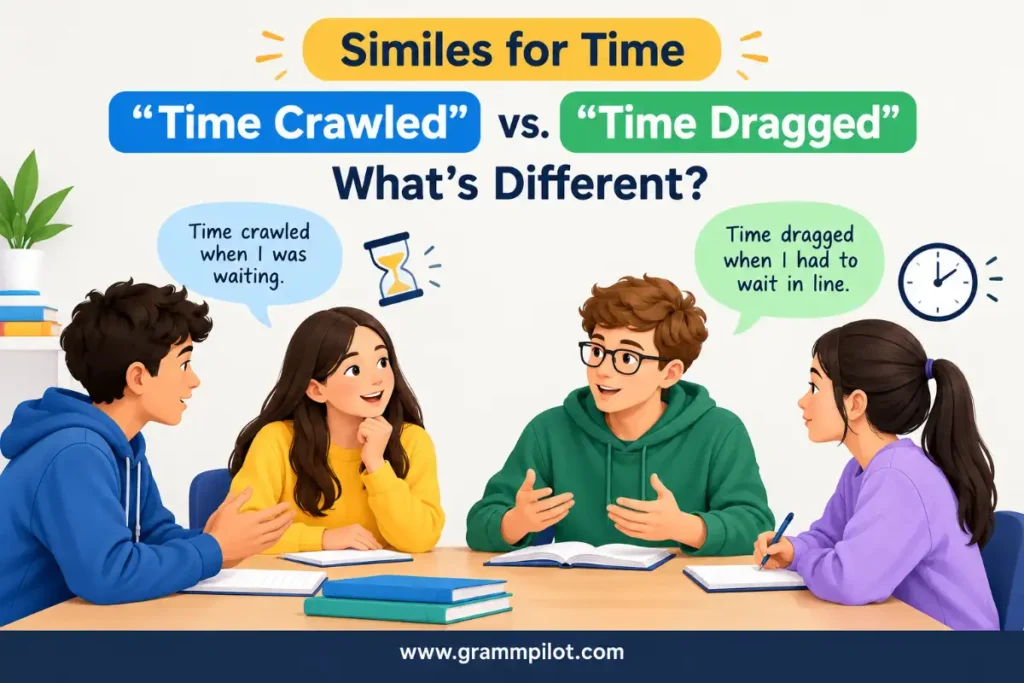
“Time Crawled” vs. “Time Dragged”: What’s Different?
Both describe slow-feeling time.
Time crawled creates a visual image of slow movement.
Example: The minutes crawled during the exam.
Time dragged focuses more on boredom, discomfort, or frustration.
Example: The meeting dragged for hours.
You can use both, but dragged often carries a stronger negative feeling.
How Do Similes Change the Mood of Writing?
The same subject can feel completely different depending on the comparison.
Compare:
The evening passed like a gentle breeze.
This sounds peaceful.
The evening crawled like a wounded animal.
This sounds dark and uncomfortable.
The evening raced like a storm.
This sounds energetic or chaotic.
The event is still an evening. The comparison changes the reader’s emotional response.
This is why figurative language matters in creative writing.
What Are Common Mistakes With Time Similes?
Mistake 1: Mixing unrelated images
Avoid creating a comparison that doesn’t make sense.
Weak: Time flew like a heavy mountain crawling through the ocean.
The images conflict and confuse the reader.
A better version is: wTime flew like a bird across the sky.
Mistake 2: Using too many comparisons
One strong simile can be better than five weak ones.
Weak:
Time flew like a bird, raced like a car, moved like a river, and danced like music.
The reader gets too many images at once.
Better:
Time flew like a bird across the summer sky.
Mistake 3: Choosing the wrong emotional image
If you’re describing a joyful vacation, saying:
The vacation crawled like a tired snail.
makes the vacation sound boring.
Instead:
The vacation flew like a bird in the open sky.
Mistake 4: Forgetting the meaning
A beautiful image isn’t useful if the reader can’t understand the connection.
Choose a comparison with a clear relationship to time.
Mistake 5: Treating every metaphor as a simile
These are not exactly the same.
Time is a river.
This is a metaphor.
Time flows like a river.
This is a simile.
Time flew.
This is a metaphorical expression.
Understanding the difference helps when you’re writing an assignment about figurative language.
When Should You Avoid a Time Simile?
You don’t need a simile in every type of writing.
Avoid heavy figurative language when:
- writing legal documents
- giving technical instructions
- reporting exact measurements
- writing formal procedures
- explaining a scientific result
- giving emergency instructions
- presenting precise business data
For example:
The experiment lasted two hours.
is better than:
The experiment lasted like a long journey through time.
The first sentence gives the exact information the reader needs.
Use figurative language when it improves understanding, mood, or description.
What Are Antonyms and Opposite Ideas?
Time-related descriptions can have opposite meanings.
Fast time includes:
- slow
- lingering
- prolonged
- extended
- drawn-out
slow time includes:
- quick
- rapid
- brief
- fleeting
- instant
For limited time:
- abundant time
- plenty of time
- unlimited time
For remaining time:
- no time left
- finished
- over
- completed
Examples:
The meeting was brief.
The meeting was drawn out.
The moment was fleeting.
The wait felt endless.
These words can help you create stronger contrasts in your writing.
How Can You Choose the Right Comparison?
Start with the feeling.
Ask yourself:
Do I want time to feel fast?
Choose a bird, train, race, wind, shooting star, or falling leaf.
Do I want time to feel slow?
Choose a turtle, snail, heavy chain, long road, or crawling shadow.
Do I want time to feel peaceful?
Choose a river, breeze, soft music, drifting cloud, or calm wave.
Do I want time to feel sad?
Choose fading photographs, falling leaves, shadows, rain, or an empty road.
Do I want time to feel valuable?
Choose something rare, fragile, or precious.
Do I want time to feel endless?
Choose an ocean, desert, horizon, or road with no visible end.
The image should match the emotion.
What Are the Best Objects to Compare With Time?
Some objects work particularly well because their movement or change is easy to imagine.
River
A river suggests continuous movement.
Time flowed like a river through the valley.
Bird
A bird suggests speed and freedom.
Time flew like a bird into the open sky.
Shadow
A shadow suggests quiet movement and passing moments.
Time moved like a shadow across the wall.
Wind
Wind suggests something fast and difficult to hold.
Time passed like wind through an open window.
Sand
Sand can suggest time slipping away.
The years slipped away like sand through my fingers.
Seasons
Seasons suggest natural change.
Time changed everything like the turning seasons.
Clock
A clock provides an obvious connection to time.
The minutes ticked away like footsteps down a hallway.
Road
A road suggests a journey.
Time stretched ahead like a road disappearing over the hills.
Wave
A wave suggests movement that continues and returns.
Time moved like waves along the shore.
Candle
A candle can represent time gradually being used.
The night passed like a candle slowly burning down.
15 More Original Simile Examples
Here are additional examples you can adapt for creative writing.
- Time moved like sunlight sliding across a bedroom wall.
- The years passed like leaves turning with the seasons.
- The final hour stretched like a bridge over deep water.
- Our childhood disappeared like footprints after the tide.
- The morning floated by like a feather on a quiet stream.
- The minutes raced like horses toward the finish line.
- The waiting period crawled like a snail along a garden path.
- The summer vanished like a rainbow after the rain.
- The old memories returned like birds to a familiar tree.
- The night stretched like a dark road beneath the stars.
- The weeks slipped away like coins falling through a hole in a pocket.
- The years rolled by like waves reaching the shore.
- The last few seconds moved like drops of honey.
- The afternoon disappeared like steam from a cup of tea.
- The future waited like a road hidden beyond the hill.
Each comparison creates a slightly different feeling. You can change the object to fit your subject.
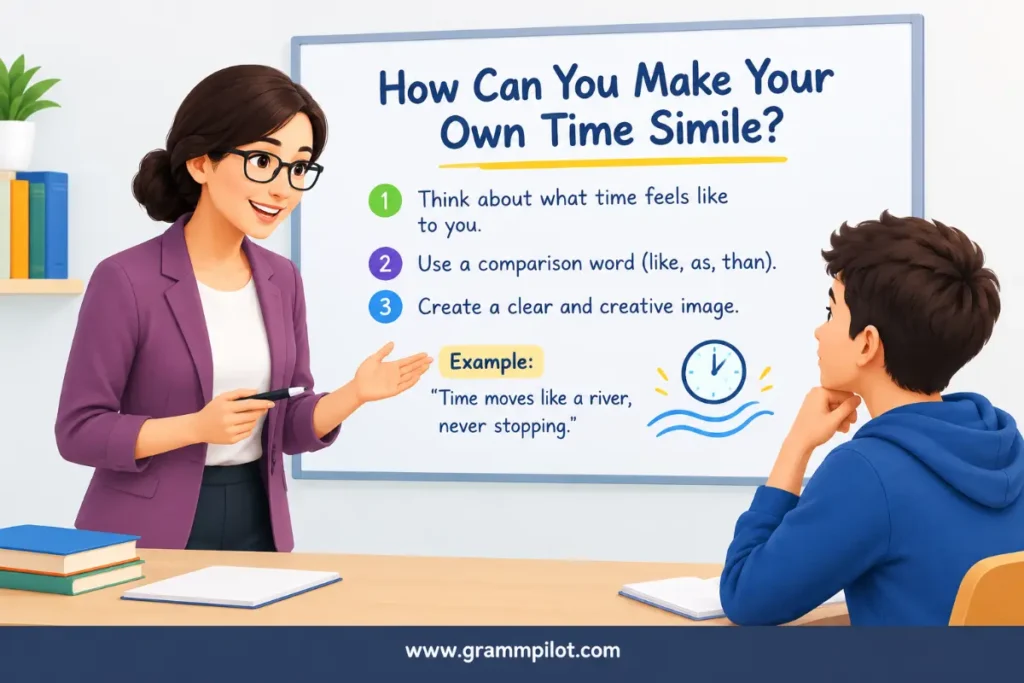
How Can You Make Your Own Time Simile?
Creating an original comparison is easier when you follow three steps.
Step 1: Decide what time feels like
Is it:
- fast?
- slow?
- peaceful?
- frightening?
- exciting?
- sad?
- endless?
- precious?
Step 2: Think of something with the same quality
For fast:
bird, train, wind, race car
For slow:
snail, turtle, heavy chain
For peaceful:
river, breeze, cloud
For sad:
rain, shadow, fading photograph
For endless:
ocean, desert, horizon
Step 3: Connect the two with “like” or “as”
Examples:
Time flew like a bird.
Time crawled like a snail.
You now have a clear simile.
How Can You Make a Time Simile More Original?
Common comparisons can be useful, but original images can make your writing stand out.
Instead of:
Time flew like a bird.
try:
Time flew like a paper airplane caught by a sudden wind.
Instead of:
Time passed like a river.
try:
Time passed like a river carrying autumn leaves toward the sea.
Instead of:
Time moved slowly like a turtle.
try:
The final minutes crawled like a turtle crossing a sun-warmed sidewalk.
Specific details make the image easier to picture.
Should a Simile About Time Be Short or Long?
Usually, a short comparison is easier to understand.
Time flew like a bird.
That’s clear.
A longer comparison can work when you’re writing a story:
Time flew like a frightened bird disappearing beyond the trees before anyone could reach it.
The second version creates a stronger scene, but it also needs more context.
For school essays and everyday writing, start simple. Add detail only when it serves a purpose.
How Do Similes for Time Improve Creative Writing?
A direct sentence tells the reader what happened.
The summer ended quickly.
A simile can show the experience:
The summer disappeared like a bright balloon drifting beyond reach.
The second sentence gives the reader an image.
This is especially useful when describing:
- childhood
- memories
- aging
- waiting
- holidays
- relationships
- seasons
- important events
- deadlines
- change
- loss
The comparison gives an abstract idea a physical shape.
Quick Tips for Using Time Comparisons
Keep these rules in mind:
- Match the image to the emotion.
- Use “like” or “as” for a true simile.
- Don’t overload one sentence with comparisons.
- Choose familiar images when clarity matters.
- Use unusual images when creativity is the goal.
- Don’t force a comparison into formal writing.
- Avoid mixing unrelated images.
- Make sure the reader can understand the connection.
- Use stronger images for emotional writing.
- Keep simple writing simple.
- Read the sentence aloud to check its rhythm.
- Ask if the simile adds something the plain sentence doesn’t.
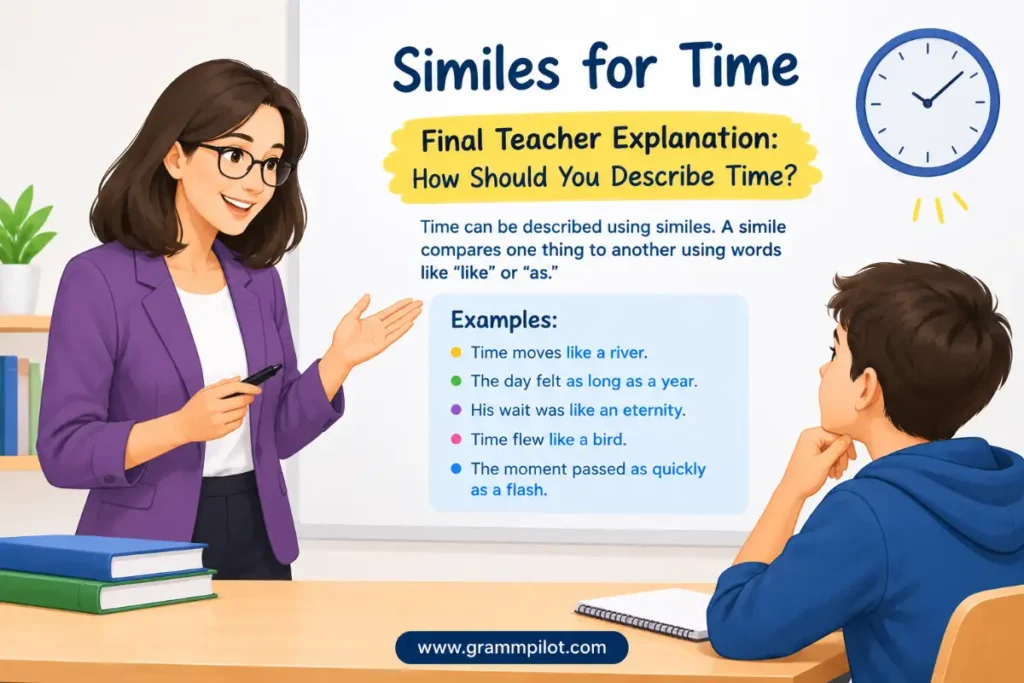
Final Teacher Explanation: How Should You Describe Time?
A good time comparison doesn’t simply make a sentence sound fancy. It tells the reader how time feels.
If time seems fast, use an image connected with speed, flight, or disappearance.
Time flew like a bird.
If time feels slow, choose something that moves slowly.
The minutes crawled like snails.
If time feels peaceful, use a gentle image.
Time flowed like a quiet river.
If time feels painful or endless, use an image that suggests distance or weight.
The waiting stretched like a road without an end.
The strongest Similes for Time are simple enough to understand but vivid enough to create a picture. Think about the emotion first, then choose an object that naturally represents that feeling.
Conclusion
The best time comparisons help readers experience an abstract idea in a concrete way. Similes for Time can show speed, slowness, change, memory, urgency, peace, sadness, or the feeling that a moment will never end. A bird can represent quick movement, a river can suggest steady flow, and sand can show how moments seem to slip away. The key is to choose an image that matches your meaning instead of adding a comparison just to sound creative. For essays and stories, a clear simile can make ordinary sentences more memorable. For emails, resumes, and professional writing, direct language is usually better. When you know the feeling you want to create, finding the right comparison becomes much easier.
Frequently Asked Questions
What are similes for time?
Similes for Time compare time with another thing using words such as “like” or “as.” They help readers picture how quickly, slowly, or emotionally time seems to pass.
What is a good simile for time passing quickly?
“Time flew like a bird across the sky” is a clear example of a simile showing that time passed quickly.
What is a good simile for slow time?
“The minutes crawled like snails” shows that time feels painfully slow.
How can I describe time in a creative way?
Compare time with something that has the same quality, such as a river for steady movement, a bird for speed, or sand for time slipping away.
What’s another way to say “time flew”?
You can say “time raced by,” “time slipped away,” “the hours passed quickly,” or “the moment vanished.”
Are “time flew” and “time flew like a bird” the same?
They communicate a similar idea, but “time flew” is a metaphorical expression, while “time flew like a bird” is a simile.
Can I use Similes for Time in an essay?
Yes, but use them where they add meaning or imagery. In formal essays, keep the comparison clear and avoid using too many figurative expressions.