
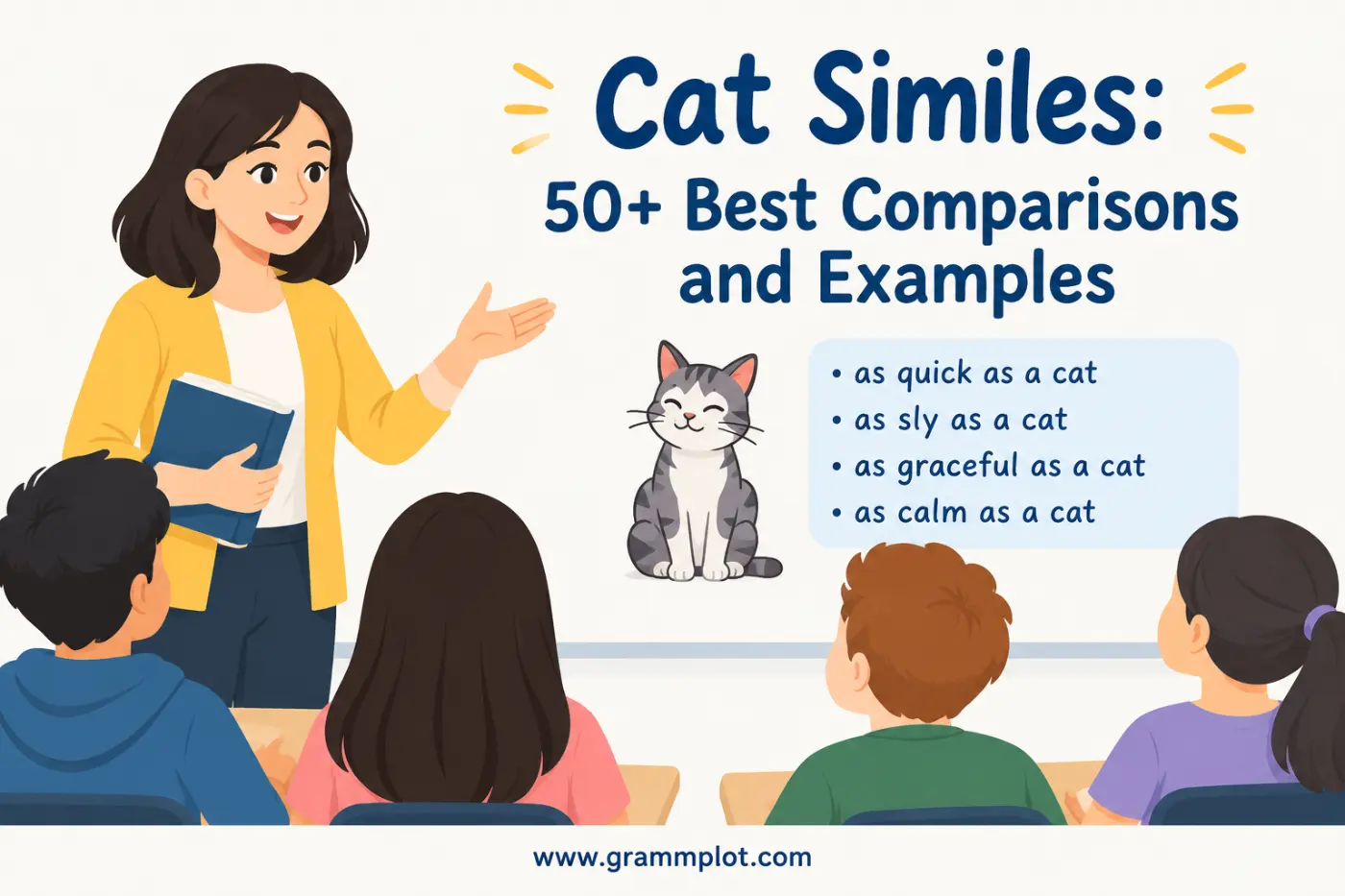
Imagine writing a story about a cat that slips across the kitchen without making a sound. You could write, “The cat walked quietly.” That sentence works, but “The cat moved like a shadow across the kitchen” gives readers a clearer picture. A good comparison helps them see the movement, feel the mood, and imagine the scene. Cat Similes make writing more colorful by comparing a cat’s appearance, movement, personality, or behavior to something familiar. They can describe a playful kitten, a sleepy house cat, a frightened stray, or a graceful animal exploring a garden.
A simile uses words such as like or as to compare two different things. For example, “The kitten was as soft as velvet” compares the kitten’s fur to a smooth, soft fabric. The reader understands the feeling without needing a long description. This guide explains the meaning and origin of similes, shares more than 50 original cat comparisons, and shows how to use them in stories, essays, emails, conversations, and creative writing. You will also learn which comparisons work best for different moods, how similar expressions differ, and which mistakes to avoid.
This idea connects with the figurative expressions explained in Animal Similes.
What Are Cat Similes, and How Do They Work?
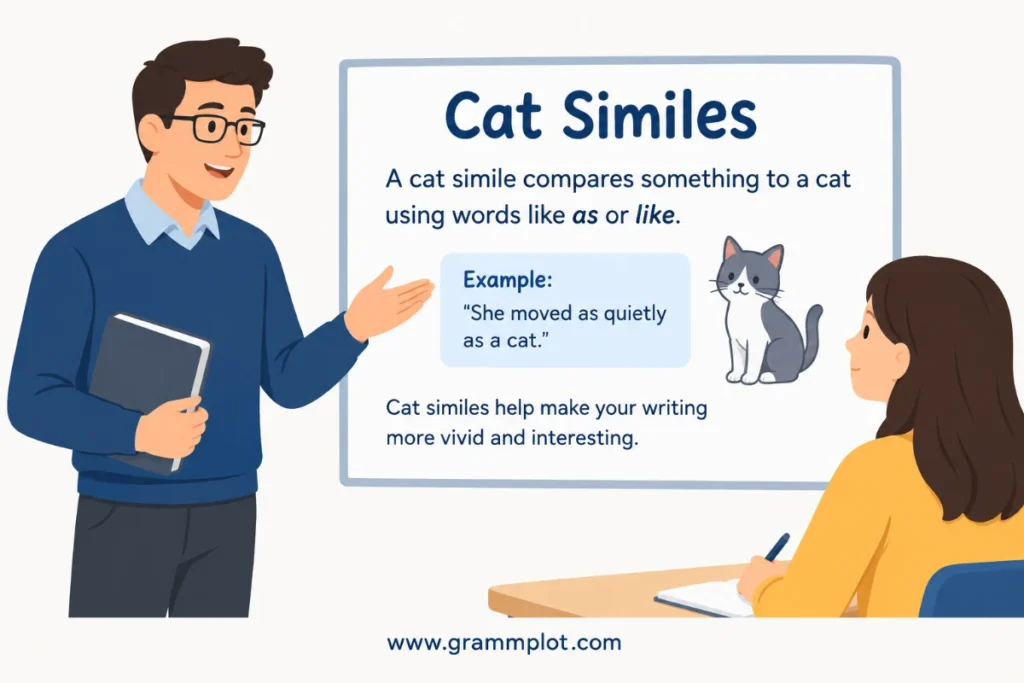
A cat simile is a figure of speech that compares a cat or one of its qualities to another thing using words such as like or as. The comparison helps readers picture a cat’s actions, appearance, or personality more clearly.
Consider these examples:
- The kitten was as curious as a detective.
- The cat slipped through the doorway like smoke.
- Her fur felt as soft as a cloud.
- The playful kitten bounced like a rubber ball.
- The old cat rested like a king on his throne.
Each sentence compares the cat to something different. A detective suggests curiosity, smoke suggests quiet movement, a cloud suggests softness, a rubber ball suggests energy, and a king suggests comfort or pride. The comparison does not have to be literally true. A kitten cannot actually become a rubber ball, and a cat cannot turn into smoke. The reader understands the intended meaning through the shared quality.
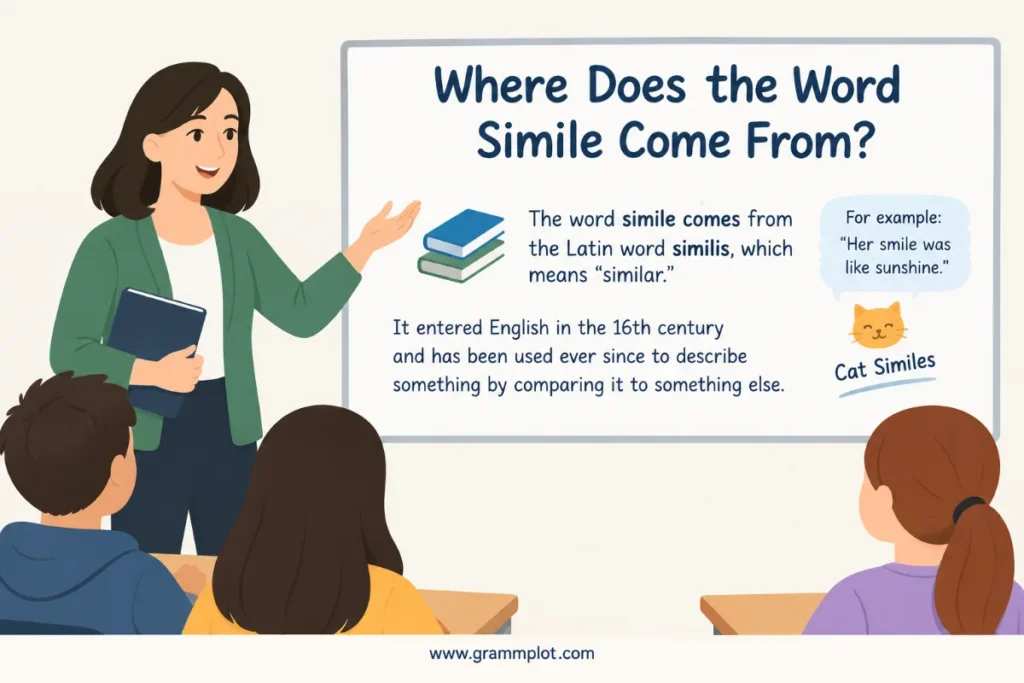
Where Does the Word Simile Come From?
The word simile comes from the Latin word similis, meaning “like” or “similar.” This origin reflects the purpose of a simile: to explain one thing by comparing it with another. Similes have been used in storytelling, poetry, speeches, and everyday conversation for centuries. Writers use them to make unfamiliar ideas easier to understand and familiar scenes more interesting. Cat comparisons work especially well because cats have recognizable qualities. They can be graceful, curious, independent, affectionate, playful, quiet, or unpredictable. These traits give writers plenty of material for creative descriptions.
For example, consider this sentence: “The kitten crept across the floor like a tiny thief.”
The kitten is not stealing anything. The comparison suggests that it is moving quietly, carefully, and perhaps mischievously.
Another example is: “The old cat slept like a stone.”
The phrase emphasizes deep stillness. It does not mean the animal has become a rock.
What Is the Difference Between a Simile and a Metaphor?
A simile makes a comparison using like or as. A metaphor describes one thing as another without directly using those comparison words.
| Simile | Metaphor | Main difference |
|---|---|---|
| The kitten was like a bouncing ball. | The kitten was a bouncing ball. | The simile makes an explicit comparison. |
| The cat moved like smoke. | The cat was smoke in the hallway. | The metaphor presents the image more directly. |
| Her fur was as soft as silk. | Her fur was silk. | The metaphor sounds more direct and figurative. |
| The kitten was as brave as a lion. | The kitten was a little lion. | Both suggest courage, but the structure changes. |
In ordinary writing, a metaphor does not mean the cat literally becomes the object described. Both figures of speech create imaginative connections.
Choose a simile when you want the comparison to be clear and accessible. Choose a metaphor when you want a more direct, dramatic image.
What Are the Best Cat Similes for Different Situations?
The best comparison depends on the quality you want to describe. A kitten chasing a toy needs a different image from an elderly cat resting in the sun.
Here are more than 50 original examples organized by common situations.
What Similes Describe a Cat’s Appearance?
These comparisons help readers picture a cat’s fur, eyes, size, and overall appearance.
- As soft as velvet: The kitten’s fur was as soft as velvet.
- Like a ball of fluff: The tiny white kitten looked like a ball of fluff on the sofa.
- As bright as emeralds: The cat’s green eyes were as bright as emeralds.
- Like a patchwork quilt: The calico cat’s coat looked like a patchwork quilt.
- As white as fresh snow: The white cat stood out against the dark garden.
- Like two golden coins: Her amber eyes shone like two golden coins.
- As sleek as satin: The black cat’s coat looked as sleek as satin.
- Like a little shadow: The dark kitten followed its owner like a little shadow.
- As round as a cushion: The fluffy cat curled into a shape as round as a cushion.
- Like a tiny lion: The kitten’s fluffy mane made it look like a tiny lion.
These comparisons work particularly well in descriptive paragraphs, character introductions, and children’s stories.
What Similes Describe a Cat’s Movement?
Cats can move quickly, slowly, quietly, or with remarkable balance. The right image helps readers picture each action.
- Like a shadow: The cat slipped behind the curtain like a shadow.
- As quick as lightning: The kitten darted across the room as quick as lightning.
- Like a dancer on a stage: The cat stepped across the narrow fence like a dancer on a stage.
- As light as a feather: The kitten landed as light as a feather on the rug.
- Like a winding river: The cat’s tail curled like a winding river.
- As nimble as a gymnast: The young cat climbed the shelves as nimble as a gymnast.
- Like a silent arrow: The cat shot through the open doorway like a silent arrow.
- As steady as a tightrope walker: The cat crossed the garden wall as steady as a tightrope walker.
- Like a spring released: The kitten leaped from its hiding place like a spring released.
- As smooth as flowing water: The cat glided across the room as smooth as flowing water.
Use quick, sharp comparisons for sudden actions and flowing comparisons for graceful movement.
What Similes Describe a Playful Kitten?
Playful cats are energetic, unpredictable, and often interested in anything that moves.
- Like a bouncing ball: The kitten chased the toy like a bouncing ball with fur.
- As lively as a firecracker: The little cat was as lively as a firecracker during playtime.
- Like a tiny tornado: The kitten raced through the living room like a tiny tornado.
- As curious as a detective: The kitten investigated the open box as curious as a detective.
- Like a child at a playground: The young cat climbed and jumped like a child at a playground.
- As energetic as a battery-powered toy: The kitten raced around the room as energetic as a battery-powered toy.
- Like a furry acrobat: The cat twisted in the air like a furry acrobat.
- As unpredictable as the weather: The playful kitten changed direction as unpredictably as the weather.
- Like a tiny explorer: The kitten inspected every corner like a tiny explorer.
- As eager as a student on a field trip: The kitten rushed toward the new toy as eager as a student on a field trip.
These examples suit humorous stories, playful scenes, pet descriptions, and writing about animal behavior.
What Similes Describe a Sleepy Cat?
Resting cats often look peaceful, comfortable, and completely uninterested in moving.
- Like a warm loaf of bread: The cat rested on the blanket like a warm loaf of bread.
- As peaceful as a sleeping baby: The kitten looked as peaceful as a sleeping baby.
- Like a king on a throne: The old cat stretched across the armchair like a king on a throne.
- As still as a statue: The sleepy cat remained as still as a statue in the afternoon sun.
- Like a curled-up comma: The kitten slept like a curled-up comma on the pillow.
- As cozy as a blanket: The cat looked as cozy as a blanket folded beside the fireplace.
- Like a cloud settling on the bed: The fluffy kitten settled like a cloud on the bed.
- As relaxed as a vacationer: The cat stretched out as relaxed as a vacationer on a beach.
- Like a furry pillow: The sleeping kitten looked like a furry pillow.
- As quiet as a winter morning: The cat rested as quietly as a winter morning.
Some of these comparisons are playful rather than literal. That is part of their appeal, especially in informal storytelling.
What Similes Describe an Angry or Frightened Cat?
A cat’s body language can change quickly when it feels threatened. Comparisons can help communicate tension, fear, or anger.
- Like a puffed-up balloon: The frightened cat looked like a puffed-up balloon.
- As tense as a drawn bow: The cat crouched as tense as a drawn bow.
- Like a storm about to break: The angry cat stared like a storm about to break.
- As fierce as a tiger: The small cat looked as fierce as a tiger when protecting its kittens.
- Like a startled rabbit: The kitten jumped back like a startled rabbit.
- As stiff as a board: The frightened cat stood as stiff as a board.
- Like a warning siren: The cat’s loud hiss sounded like a warning siren.
- As watchful as a guard: The cat remained as watchful as a guard near the unfamiliar visitor.
- Like a coiled spring: The cat crouched like a coiled spring before jumping away.
- As wary as a traveler in unfamiliar territory: The stray cat approached the doorway as wary as a traveler in unfamiliar territory.
Descriptions of fear or anger should match the scene. A frightened cat is not necessarily aggressive, and a hissing cat may be trying to protect itself rather than attack.
What Similes Describe an Affectionate Cat?
Cats can show affection through purring, rubbing against people, sitting nearby, or choosing to rest beside someone.
- Like a warm hug: The kitten curled against her hand like a warm hug.
- As gentle as a breeze: The cat brushed against his leg as gently as a breeze.
- Like a loyal companion: The cat followed its owner from room to room like a loyal companion.
- As comforting as a familiar song: The cat’s purr felt as comforting as a familiar song.
- Like a soft whisper: The kitten’s quiet purr sounded like a soft whisper.
- As trusting as a child holding a parent’s hand: The kitten settled in her lap with the trust of a child holding a parent’s hand.
These comparisons are useful when describing the bond between a pet and its owner.
Which Words and Phrases Can You Use for Cat Descriptions?
A useful way to develop original comparisons is to collect words that describe a cat’s qualities. Then pair those words with familiar images that communicate the same idea.
The following word bank contains related descriptive words rather than direct synonyms for the word simile. These terms help you create different comparisons without repeating the same ideas.
| Group | Word or phrase | Meaning | Tone | Example |
|---|---|---|---|---|
| Simple | Soft | Gentle to touch | Neutral | Its fur felt as soft as cotton. |
| Simple | Fast | Moving quickly | Neutral | The cat ran like a racing car. |
| Simple | Sleepy | Ready to sleep | Casual | It looked as sleepy as a child after lunch. |
| Simple | Playful | Enjoying games | Friendly | It jumped like a bouncing ball. |
| Everyday | Cuddly | Pleasant to hug or hold | Warm | It curled up like a plush toy. |
| Everyday | Mischievous | Playfully causing trouble | Humorous | It acted like a tiny prankster. |
| Everyday | Cautious | Avoiding possible danger | Neutral | It approached like a careful explorer. |
| Formal | Vigilant | Watching carefully | Formal | The cat stood like a vigilant sentry. |
| Formal | Composed | Calm and controlled | Formal | It sat like a composed guest. |
| Formal | Stealthy | Moving without being noticed | Formal | It crept like a trained spy. |
| Slang | Zoomies | Sudden bursts of playful energy | Casual | The kitten had the zoomies like a tiny race car. |
| Slang | Nosy | Too interested in other people’s business | Casual | The cat watched the visitors like a neighborhood gossip. |
This word bank gives you a starting point. You can combine the same descriptive quality with different images to suit your audience.
For instance, stealthy could lead to “The cat moved like a secret agent,” while graceful could lead to “The cat crossed the windowsill like a ballet dancer.”
Neither comparison is automatically better. The right choice depends on the mood you want.
How Do You Choose a Cat Simile by Intensity?
Some comparisons are gentle and understated. Others are dramatic, funny, or exaggerated. Matching the intensity to the scene makes your writing feel natural.
What Are Mild Comparisons for Cats?
Mild comparisons work well in school essays, everyday descriptions, and calm scenes.
Examples include:
- As soft as cotton.
- Like a quiet breeze.
- As calm as a lake.
- Like a small shadow.
- As light as a feather.
Example: “The kitten moved like a quiet breeze through the hallway.”
This sentence creates a gentle impression without making the action sound dramatic.
What Are Moderate Comparisons for Cats?
Moderate comparisons make the description more noticeable while remaining believable.
Examples include:
- As curious as a detective.
- Like a graceful dancer.
- As quick as a squirrel.
- Like a tiny explorer.
- As playful as a puppy.
Example: “The cat explored the garden like a tiny explorer searching for treasure.”
The image gives the animal a clear personality and suggests a sense of adventure.
What Are Strong or Dramatic Comparisons for Cats?
Strong comparisons are useful in action scenes, exciting stories, comedy, and dramatic descriptions.
Examples include:
- As fast as lightning.
- Like a miniature tornado.
- As fierce as a tiger.
- Like an arrow released from a bow.
- As silent as the night.
Example: “The kitten shot across the room like an arrow released from a bow.”
The comparison makes the movement feel sudden and powerful.
Use strong comparisons sparingly. If every sentence describes a cat as lightning-fast, unbelievably fierce, or impossibly graceful, the effect becomes less special.
Which Cat Simile Should You Use in Different Types of Writing?
Different situations call for different levels of creativity. A playful text message can use slang, while a school essay may need a clearer and more controlled comparison.
Which Cat Similes Work Best in an Essay?
In an essay, choose comparisons that are easy to understand and directly support your point. Avoid overly casual expressions unless the assignment allows an informal voice.
Good examples:
- “The cat moved as quietly as a shadow.”
- “The kitten was as curious as a young explorer.”
- “The animal rested as peacefully as a sleeping child.”
Example paragraph:
“The kitten explored the garden with great interest. It moved as quietly as a shadow between the flowerpots and investigated each fallen leaf. Its careful movements showed how curious young cats can be.”
The comparison supports the paragraph rather than distracting from it.
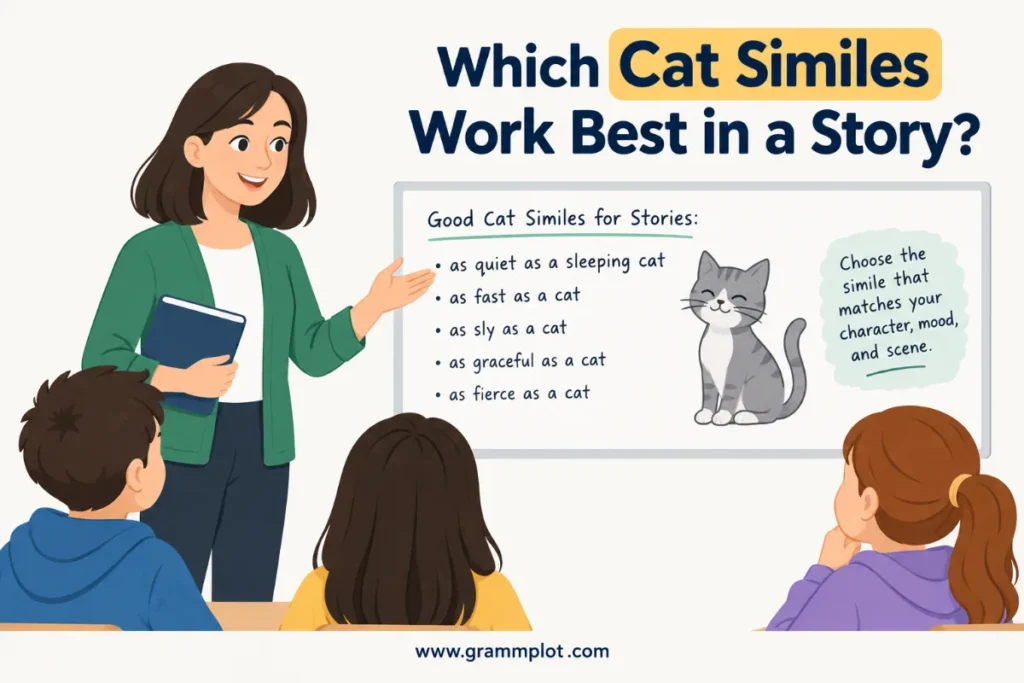
Which Cat Similes Work Best in a Story?
Stories benefit from comparisons that build mood, reveal character, or help the reader imagine an action.
Examples:
- “The stray crept toward the doorway like a thief.”
- “The kitten sprang from the basket like a tiny rocket.”
- “Moonlight rested on the cat’s fur like silver paint.”
Example paragraph:
“Midnight settled over the house. A black cat slipped along the hallway like a shadow, stopping whenever the floor creaked. At the end of the corridor, two bright eyes watched the moonlight.”
The comparisons help establish a mysterious atmosphere.
Which Cat Similes Work Best in Texting?
Text messages can be more playful and personal. Short, funny comparisons often work better than long descriptions.
Examples:
- “My kitten is bouncing around like a pinball.”
- “The cat is curled up like a cinnamon roll.”
- “He has the energy of a tiny tornado.”
- “She is chilling like a queen.”
- “That kitten is acting like a furry detective.”
These expressions suit conversations with friends, pet updates, and social posts.
For example: “I tried to clean my desk, but the kitten kept attacking the pens like a tiny ninja.”
The informal tone makes the message sound natural.
Which Cat Similes Work Best in an Email?
For a casual email to a friend, a warm or humorous comparison can make the message more personal.
Example: “Your kitten looked as comfortable as a king on his throne in the photo you sent.”
For a professional email, use comparisons only when they fit the purpose. A straightforward message about a pet-care appointment, animal shelter project, or veterinary event usually needs clarity more than figurative language.
Example: “The rescued cat moved as cautiously as a visitor entering an unfamiliar room, so we gave it time to settle.”
The comparison adds useful detail without making the email overly decorative.
Which Cat Similes Work Best in Speaking?
When speaking, choose comparisons that listeners can understand immediately. Familiar images usually work better than complicated or unusual ones.
Examples:
- “That kitten is as quick as lightning!”
- “Your cat is curled up like a little ball.”
- “She moves like a dancer.”
- “He is as curious as a detective.”
For example, if a friend asks why you cannot find a toy, you might say, “The kitten has been racing around like a little tornado.”
Short comparisons are easier to remember and sound natural in conversation.
How Can You Use Cat Similes in Real-Life Situations?
A comparison becomes more effective when it matches the situation. Here are additional examples that show how to use figurative language in everyday writing.
- A kitten meeting a new person: The kitten approached the visitor like a cautious explorer entering an unknown cave.
- A cat watching birds: The cat stared through the window like a patient hunter.
- A pet waiting for food: The hungry cat watched the bowl like a customer waiting for a favorite meal.
- A cat climbing a tree: The agile animal climbed the trunk like a skilled mountaineer.
- A kitten chasing a shoelace: The kitten attacked the shoelace like a champion wrestler.
- A cat hiding under a bed: The frightened animal stayed beneath the bed like a soldier taking shelter.
- A cat enjoying sunlight: The old cat stretched in the sunshine like a traveler relaxing on a warm beach.
- A kitten exploring a cardboard box: The kitten inspected the box like an archaeologist examining an ancient discovery.
- A cat jumping onto a counter: The cat landed on the counter like a gymnast sticking a accurate landing.
- A cat following its owner: The kitten followed him like a tiny bodyguard.
Notice how the comparison changes with the situation. A cat watching birds may seem patient and focused, while the same cat reacting to a loud vacuum cleaner may seem startled and hurried.
What Is the Difference Between Similar Cat Comparisons?
Two comparisons can describe the same general quality while creating different pictures. Understanding these small differences helps you choose more precise language.
“Quiet as a Mouse” vs. “Quiet as a Shadow”
Both expressions suggest silence, but they create different images.
| Comparison | Main idea | Best use | Example |
|---|---|---|---|
| Quiet as a mouse | Making little noise and avoiding attention | A timid or careful cat | The kitten crept toward the sofa, quiet as a mouse. |
| Quiet as a shadow | Moving almost unnoticed | A cat slipping through a dark room | The black cat passed through the hallway, quiet as a shadow. |
The mouse comparison emphasizes quietness and caution. The shadow comparison emphasizes movement that is difficult to notice.
Both are useful, but the second may be more effective when describing a cat’s stealthy movement.
“Soft as Silk” vs. “Soft as Velvet”
These comparisons describe texture, but they suggest slightly different sensations.
| Comparison | What it suggests | Example |
|---|---|---|
| Soft as silk | Smooth, fine, and delicate | The kitten’s fur felt soft as silk. |
| Soft as velvet | Soft, rich, and plush | The cat’s thick coat felt soft as velvet. |
Silk suggests smoothness, while velvet suggests a plush surface. Either may work for a cat’s coat, depending on the texture you want the reader to imagine.
“Curious as a Cat” vs. “Curious as a Detective”
Both expressions describe a desire to discover something, but the focus differs.
“Curious as a cat” is a familiar expression that emphasizes general curiosity. It can be used for people or animals.
“The kitten was curious as a detective” creates a more specific image. It suggests that the kitten is investigating clues, inspecting objects, and searching for answers.
Example:
“The kitten examined the open cupboard like a detective investigating a mysterious case.”
This version is especially useful when you want to turn ordinary pet behavior into a small story.
Are Cat Similes Different in American and British English?
Most common cat comparisons are understood in both American and British English. Expressions such as “as soft as silk,” “like a shadow,” and “as quick as lightning” work across both varieties.
Differences are more likely to appear in vocabulary, cultural references, and informal expressions than in the basic structure of a simile.
| Feature | American English | British English |
|---|---|---|
| Basic comparison structure | Uses like and as | Uses like and as |
| Common speed comparison | As fast as lightning | As quick as lightning |
| Everyday cat reference | Kitten, house cat | Kitten, moggy in informal contexts |
| Informal description | A cat with the zoomies | A cat with the zoomies |
| Main writing advice | Match the audience and context | Match the audience and context |
The word moggy is an informal British term for a cat, especially an ordinary domestic cat. It is not a simile by itself, but it may appear in a comparison such as “The little moggy curled up like a warm loaf of bread.”
There is no universal rule that a particular cat comparison belongs only to the United States or the United Kingdom. Familiarity can vary by region, age, and personal experience.
If you are writing for a broad audience, choose images that most readers can picture easily.
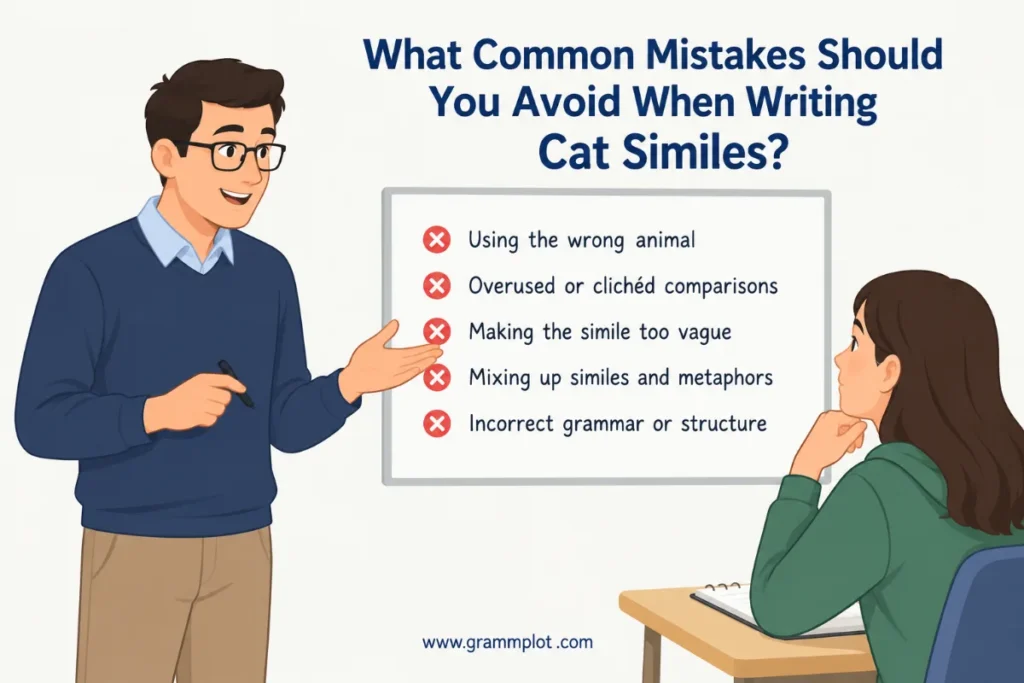
What Common Mistakes Should You Avoid When Writing Cat Similes?
Creative comparisons are useful, but they can become confusing if they are poorly matched or overused.
Mistake 1: Using a Comparison That Does Not Fit
A simile should share a meaningful quality with the thing being described.
Unclear: “The sleepy cat was as loud as a library.”
The sentence creates a confusing picture because libraries are usually associated with quietness.
Better: “The sleepy cat was as quiet as an empty library.”
The revised comparison fits the intended mood.
Mistake 2: Forgetting the Comparison Word
A simile commonly uses like or as to make the comparison clear.
Simile: “The kitten ran like a racing car.”
Metaphor: “The kitten was a racing car.”
Both can work as figurative language, but they are different structures. Do not label a metaphor as a simile just because it compares two things.
Mistake 3: Mixing Too Many Comparisons
Too many images in one sentence can make the description difficult to follow.
Overloaded: “The cat moved like smoke, danced like a star, raced like lightning, and floated like a cloud.”
Better: “The cat moved like smoke through the narrow hallway.”
Choose the comparison that best supports the action.
Mistake 4: Using the Same Comparison Repeatedly
Repeating “as fast as lightning” in every paragraph makes the writing predictable.
Try changing the image to suit the action:
- The kitten shot across the room like an arrow.
- The cat darted behind the chair in a flash.
- The playful animal raced around the garden like a miniature sports car.
Variety works best when each comparison adds a new detail.
Mistake 5: Making the Meaning Too Complicated
A comparison should help readers understand the scene, not force them to solve a puzzle.
Unclear: “The cat moved like the memory of a distant ocean.”
This could work in experimental poetry, but it may confuse readers in a simple descriptive paragraph.
Clearer: “The cat moved like a gentle wave across the sofa.”
Use unusual comparisons when they support the style and purpose of your writing.
When Should You Avoid Using a Cat Simile?
A comparison is not always necessary. Avoid adding one when:
- The sentence already communicates the meaning clearly.
- The writing needs to be brief and factual.
- The comparison distracts from important information.
- The same image appears several times nearby.
- The tone is serious and a playful comparison would feel inappropriate.
For example, a veterinary instruction should clearly explain how to care for an animal rather than rely on decorative language. Creative comparisons are best used when they make the message clearer or more engaging.
What Are the Antonyms of Words Used to Describe Cats?
A simile does not have one direct antonym because it is a type of comparison, not a single descriptive quality. However, you can use opposite words to create contrasting images.
| Descriptive word | Opposite or contrasting word | Example |
|---|---|---|
| Quiet | Noisy | The cat was as noisy as a rattling cart. |
| Fast | Slow | The elderly cat moved as slowly as a drifting cloud. |
| Soft | Rough | The rough surface felt unlike the kitten’s soft fur. |
| Graceful | Clumsy | The kitten stumbled like a toddler learning to walk. |
| Playful | Inactive | The tired cat lay still like a forgotten cushion. |
| Curious | Uninterested | The cat ignored the toy like a visitor passing an empty shop. |
| Brave | Fearful | The frightened kitten hid like a mouse in a storm. |
| Gentle | Rough | The excited kitten handled the toy like a tiny wrestler. |
| Alert | Sleepy | The cat looked as drowsy as a child after a long day. |
| Friendly | Aloof | The distant cat watched the visitors like a stranger at a crowded station. |
Opposites are useful when you want to show change or contrast. For example, a kitten may begin the story as timid as a mouse and later become as bold as a lion.
What Are the Quickest Tips for Choosing a Good Cat Simile?
Use these practical tips whenever you need a fresh comparison.
- Identify the main quality. Decide if you are describing speed, softness, curiosity, fear, affection, or another trait.
- Choose a familiar image. Think of something that shares the quality, such as a shadow for quiet movement or a spring for sudden energy.
- Match the mood. A funny story can use a kitten comparison involving a pinball, while a serious story may need a quieter image.
- Use clear language. A comparison should make the scene easier to picture.
- Vary your vocabulary. Avoid using the same image for every cat or every action.
- Read the sentence aloud. If the comparison sounds awkward, simplify it.
- Keep the audience in mind. Children, casual readers, and academic audiences may respond to different styles.
- Do not exaggerate every detail. Save dramatic images for moments that deserve attention.
- Use specific behavior. A cat investigating a box needs a different comparison from one sleeping on a pillow.
- Check the meaning. Make sure the two things share a quality that readers can recognize.
How Can You Create Your Own Cat Simile?
You do not need to memorize every example. You can create original comparisons by following a simple three-step method.
Step 1: Name the quality.
Suppose you want to describe a kitten that jumps suddenly.
Quality: sudden movement.
Step 2: Think of something with that quality.
Possible images include a spring, a rocket, or an arrow.
Step 3: Connect the two with like or as.
- The kitten jumped like a released spring.
- The kitten shot forward like a tiny rocket.
- The kitten sprang toward the toy like an arrow.
Each version describes a similar action, but the image creates a slightly different mood.
Try the same method with other qualities:
| Cat quality | Possible image | Original comparison |
|---|---|---|
| Quiet | A shadow | The cat moved like a shadow along the wall. |
| Soft | Cotton | The kitten felt as soft as cotton. |
| Curious | A detective | The kitten searched the cupboard like a detective. |
| Sleepy | A warm loaf | The cat curled up like a warm loaf of bread. |
| Graceful | A dancer | The cat crossed the table like a dancer on a stage. |
| Playful | A pinball | The kitten bounced around like a pinball. |
The best original comparisons often come from noticing small details. Watch how a cat moves its tail, stretches its paws, reacts to sounds, or explores a new space. Those observations can inspire images that feel personal rather than copied.
Conclusion
Cat Similes help writers turn simple observations into vivid descriptions. Instead of saying that a cat is quiet, playful, soft, or quick, you can compare its behavior to something readers already know. A cat might move like a shadow, bounce like a ball, feel as soft as velvet, or sit like a king on a throne. Each comparison creates a different picture. The most effective choice depends on your purpose. Use gentle comparisons for peaceful scenes, energetic images for playful kittens, and dramatic language when a story needs tension.
In essays, keep the meaning clear. In stories and casual messages, you can experiment with humor and unusual images. Remember that a comparison should add meaning rather than simply make a sentence longer. Observe the cat, identify its most interesting quality, and choose an image that matches it. With practice, you can create fresh descriptions that make your writing clearer, more memorable, and more enjoyable to read.
Frequently Asked Questions
1. What are Cat Similes?
Cat Similes are comparisons that describe a cat or its behavior using like or as. For example, “The kitten was as soft as velvet” compares its fur to a smooth fabric.
2. What’s another way to describe a cat using a simile?
You can describe a cat as moving like a shadow, sleeping like a log, or jumping like a spring. Choose the comparison that best matches the cat’s action or personality.
3. What is a good simile for a playful kitten?
A good simile is “The kitten bounced around like a pinball.” It describes quick, unpredictable movement in a playful way.
4. How do you describe a cat’s eyes in a simile?
You could write, “The cat’s green eyes shone like emeralds.” This comparison emphasizes their color and brightness.
5. What is the difference between a cat simile and a metaphor?
A simile uses like or as to compare two things, while a metaphor describes one thing as another. “The cat moved like smoke” is a simile, while “The cat was smoke in the hallway” is a metaphor.
6. Can I use cat similes in a school essay?
Yes, cat comparisons can make descriptive essays more engaging when they support the main idea. Choose clear, relevant images and avoid adding so many that they distract from your point.
7. How can I make my own cat similes?
First, identify a quality such as speed, softness, or curiosity. Then think of something with that quality and connect the two using like or as, such as “The kitten explored the garden like a tiny detective.”