
Have you ever been confused by Sale vs Sail while typing an email, school essay, online listing, or text message and paused because you weren’t sure about to write sale or sail? You’re not alone. These two words sound exactly the same, but they have completely different meanings. Many English learners search for Sale vs Sail because they’re homophones—words that sound alike but have different spellings and definitions. Choosing the wrong one can confuse your reader, especially in business writing or everyday conversations.
Quick Answer
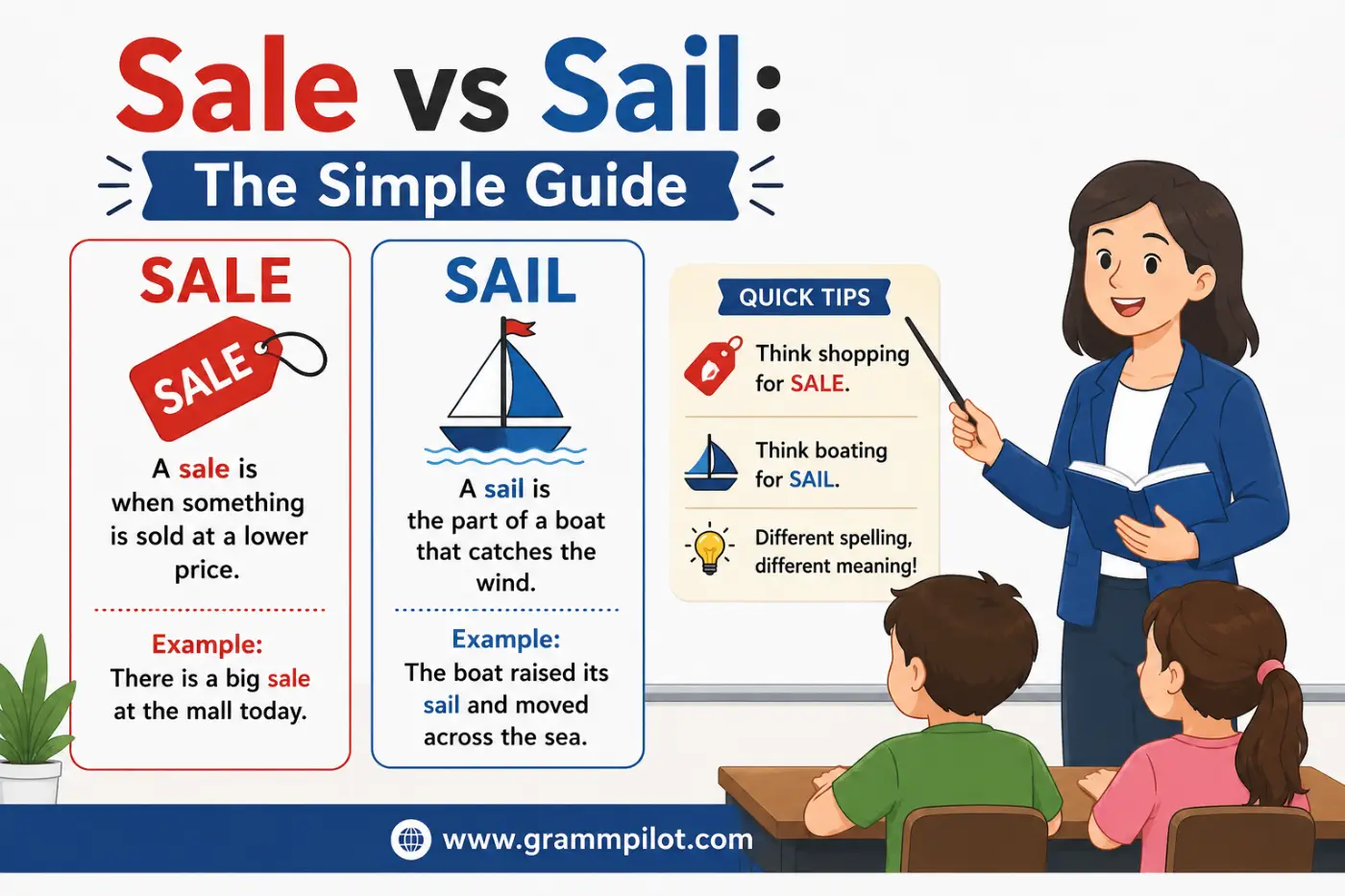
“Sale” refers to selling something or a discount event. “Sail” means traveling on water using a boat or using the wind to move a vessel. Although they sound identical, they are never interchangeable.
In this guide, you’ll learn their meanings, history, pronunciation, synonyms, real-life examples, common mistakes, regional notes, and simple tips so you’ll never mix them up again.
If you enjoy figurative language, you’ll also like our guide to [Similes for Music].
What Does “Sale” Mean?
Sale is a noun. It refers to the act of selling something or an event where products or services are offered to customers, often at reduced prices. You see this word every day in stores, online shops, advertisements, and business documents.
Simple Definition
Sale = the exchange of goods or services for money, or a special event where items are sold, often at a discount.
Common Uses of “Sale”
- A store sale
- A house sale
- A car sale
- A garage sale
- A yard sale
- A holiday sale
- A flash sale
- An online sale
- A clearance sale
- A successful sale
Everyday Examples
- The clothing store is having a sale this weekend.
- We bought a new TV during the Black Friday sale.
- The house is finally up for sale.
- She made her first sale on Monday.
- Our biggest sale happened in December.
- The shoes are on sale for only $40.
- The company reported record sales this year.
- He celebrated after closing an important sale.
- The furniture sale ends tonight.
- They advertised the summer sale online.
Notice that sale almost always relates to buying, selling, money, or business.
What Does “Sail” Mean?
Sail can be both a verb and a noun.
As a verb, it means to travel across water in a boat or ship, especially one powered by sails or wind.
As a noun, it refers to the large piece of fabric that catches the wind and moves a sailboat.
Simple Definition
Sail = to travel on water or the cloth that helps a boat move with the wind.
Sail as a Verb
Examples:
- We will sail across the lake tomorrow.
- They love to sail every summer.
- The ship will sail at sunrise.
- She learned to sail when she was twelve.
- We’re sailing around the island.
Sail as a Noun
Examples:
- The wind filled the sail.
- One sail was damaged during the storm.
- The captain repaired the torn sail.
- The white sails looked beautiful against the blue sky.
- Lower the sail before entering the harbor.
Although both meanings are connected, one describes an action while the other names part of a boat.
Sale vs Sail: What’s the Main Difference?
The easiest way to remember the difference is to think about money versus water.
| Feature | Sale | Sail |
|---|---|---|
| Main meaning | Selling goods or services | Traveling on water |
| Part of speech | Noun | Verb and noun |
| Related to shopping | Yes | No |
| Related to boats | No | Yes |
| Connected with money | Yes | Usually no |
| Connected with the ocean | No | Yes |
Easy Comparison
Sale
- The laptop is on sale.
- We had a successful sale.
- The store announced a holiday sale.
Sail
- We plan to sail tomorrow morning.
- The ship will sail at noon.
- The strong wind filled the sail.
A simple memory trick is:
- Sale = Store
- Sail = Ship
Both words start with the same sound, but the second letter gives you a clue:
- Sale has a, like cash and market.
- Sail has ai, like air and wave, reminding you of wind moving a boat.
Sale vs Sail: Where Do These Words Come From?
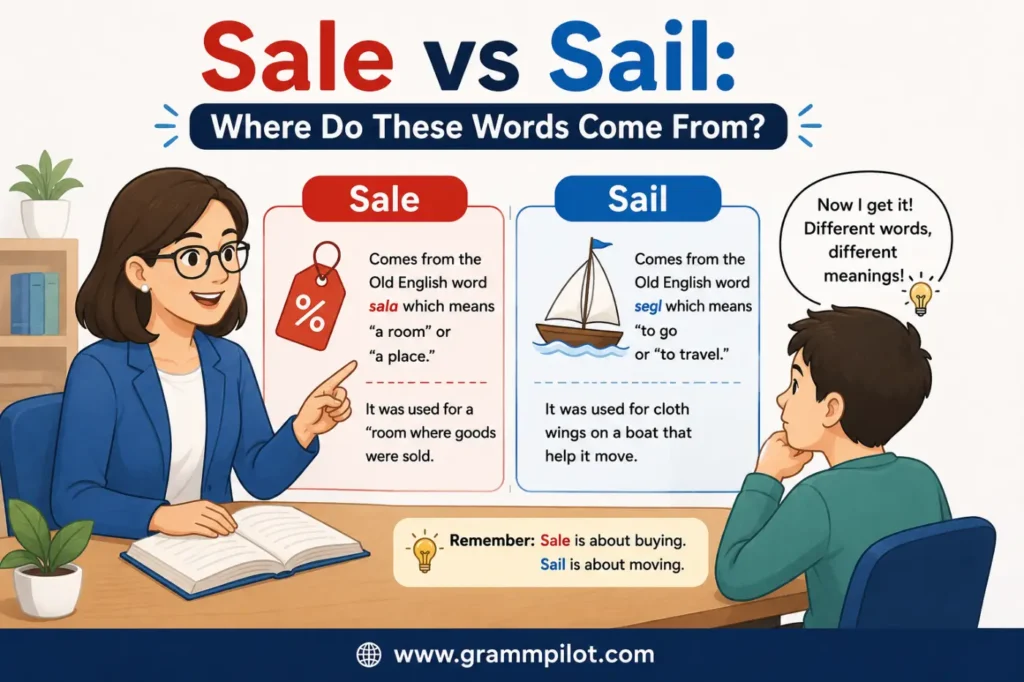
Many people comparing Sale vs Sail don’t realize that these words have completely different origins, even though they sound identical.
Origin of “Sale”
The word sale comes from the Old English word sala, which referred to the act of selling goods. It developed from older Germanic languages connected with trade, buying, and exchanging property.
Over hundreds of years, English speakers expanded its meaning to include:
- selling products
- business transactions
- discount events
- property transfers
Today, it’s one of the most common business words in English.
Origin of “Sail”
The word sail comes from the Old English word segel, meaning the cloth attached to a boat that catches the wind. Later, English speakers began using sail as a verb because boats moved by using sails.
That’s why today we can say:
- to sail across the ocean
- a sailboat
- raise the sail
- sailing lessons
Even though sale and sail sound exactly alike, they come from different historical roots and have never shared the same meaning.
Master Synonym List “Sale vs Sail”
The best synonym depends on if you’re talking about shopping or boats.
Simple Synonyms for “Sale”
| Word | Meaning | Tone | Example |
|---|---|---|---|
| deal | a good offer | Casual | I found a great deal. |
| discount | reduced price | Everyday | The shoes have a discount. |
| bargain | very low price | Casual | That’s a bargain. |
| offer | special price | Neutral | This offer ends today. |
| promotion | marketing event | Business | The promotion starts Friday. |
| markdown | price reduction | Retail | The markdown saved me money. |
| clearance | final price reduction | Retail | Clearance items sell quickly. |
| special | limited-time offer | Everyday | Today’s special is 30% off. |
| transaction | act of buying or selling | Formal | The transaction was completed. |
| purchase | buying something | Neutral | It was my best purchase. |
Everyday Synonyms for “Sail”
| Word | Meaning | Tone | Example |
|---|---|---|---|
| cruise | travel on water | Casual | We cruised along the coast. |
| voyage | long sea journey | Neutral | The voyage lasted a week. |
| travel | move from place to place | Everyday | They traveled by boat. |
| float | stay on water | Casual | The boat floated quietly. |
| navigate | guide a boat | Formal | She navigated safely. |
| row | move a boat with oars | Everyday | We rowed across the lake. |
| paddle | move with a paddle | Casual | They paddled the canoe. |
| drift | move with the current | Neutral | The boat drifted slowly. |
| cross | travel over water | Everyday | We crossed the river. |
| journey | travel somewhere | Neutral | Their journey began at dawn. |
Formal Synonyms “Sale vs Sail”
These words are more common in business writing, reports, literature, or professional communication.
Formal Synonyms for “Sale”
| Word | Meaning | Tone | Example |
|---|---|---|---|
| exchange | transfer of goods for money | Formal | The exchange was completed legally. |
| transfer | change of ownership | Formal | The property transfer took place yesterday. |
| disposal | selling assets | Formal | The company approved the asset disposal. |
| liquidation | selling assets to pay debts | Formal | The business entered liquidation. |
| distribution | supplying goods | Business | Product distribution increased this year. |
| retail event | organized selling period | Business | The retailer planned a major retail event. |
| commercial transaction | business deal | Very Formal | Every commercial transaction was recorded. |
| merchandising | selling products | Business | Merchandising improved customer interest. |
Formal Synonyms for “Sail”
| Word | Meaning | Tone | Example |
|---|---|---|---|
| navigate | steer a vessel | Formal | The captain navigated the harbor carefully. |
| voyage | travel across water | Formal | The voyage lasted two weeks. |
| embark | begin a journey | Formal | They embarked on a sea expedition. |
| traverse | travel across | Formal | The ship traversed the Atlantic Ocean. |
| cruise | travel by ship | Neutral | They cruised around the islands. |
| proceed | continue forward | Formal | The vessel proceeded south. |
| depart | leave a port | Formal | The ferry departed at sunrise. |
| steer | guide direction | Formal | She steered the yacht through calm water. |
Slang and Informal Alternatives “Sale vs Sail”
These expressions are common in conversations, text messages, and casual speech.
| Word | Meaning | Tone | Example |
|---|---|---|---|
| steal | an amazing bargain | Slang | That jacket was a steal! |
| cheap | low-priced | Casual | We found cheap tickets online. |
| score | get a great deal | Slang | I scored new sneakers for half price. |
| snag | buy quickly | Slang | I snagged the last laptop. |
| off | discounted | Casual | Everything is 20% off today. |
| hit the water | start boating | Informal | Let’s hit the water this weekend. |
| cast off | leave the dock | Informal | The crew cast off before sunrise. |
| set sail | begin a sea journey | Everyday | They set sail after breakfast. |
| shove off | leave | Informal | It’s time to shove off. |
| head out | leave for somewhere | Casual | We’re heading out on the boat soon. |
Altogether, these tables include more than 30 related words, giving you plenty of alternatives depending on your audience and situation.
Synonyms by Intensity (Mild → Strong)
Not every situation needs the strongest word. Here’s how similar words compare.
For “Sale”
| Intensity | Word | Example |
|---|---|---|
| Very Mild | offer | The store announced a new offer. |
| Mild | discount | There’s a discount today. |
| Mild | deal | I found a great deal. |
| Medium | bargain | That’s an incredible bargain. |
| Medium | promotion | The promotion lasts all week. |
| Strong | clearance | It’s a huge clearance event. |
| Strong | liquidation | The company is holding a liquidation sale. |
For “Sail”
| Intensity | Word | Example |
|---|---|---|
| Very Mild | float | The boat floated quietly. |
| Mild | travel | They traveled by boat. |
| Mild | sail | We’ll sail tomorrow. |
| Medium | cruise | They cruised along the coast. |
| Medium | navigate | The captain navigated safely. |
| Strong | voyage | The explorers began a long voyage. |
| Very Strong | traverse | The ship traversed the ocean during winter. |
Choose the word that matches the situation. A family trip usually doesn’t need a dramatic word like traverse, while a history book may prefer it.
Sale vs Sail: Synonyms by Part of Speech
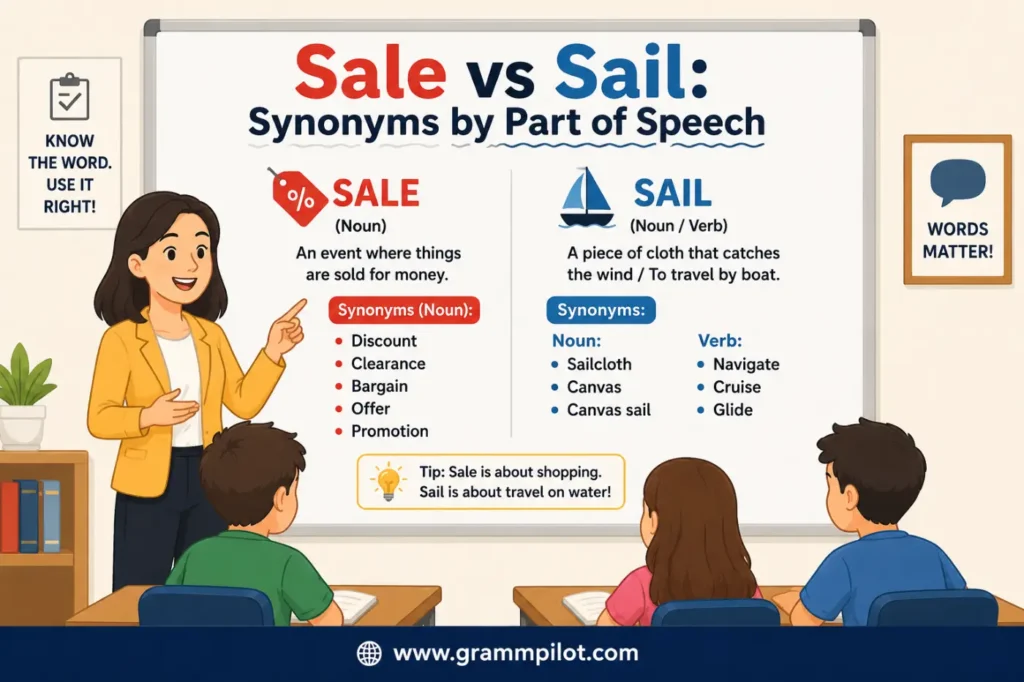
Because sale and sail have different grammar roles, their synonyms also differ.
Nouns Related to “Sale”
- deal
- bargain
- discount
- promotion
- offer
- transaction
- exchange
- markdown
- clearance
- purchase
- retail event
- auction
Verbs Related to “Sail”
- sail
- cruise
- navigate
- travel
- row
- paddle
- steer
- drift
- voyage
- embark
- depart
- cross
Nouns Related to “Sail”
- sailboat
- yacht
- vessel
- ship
- mast
- rigging
- voyage
- expedition
- fleet
- harbor
Is There a Difference Between American and British English?
When it comes to Sale vs Sail, American English and British English use both words almost exactly the same way.
Examples used in both countries include:
- Summer sale
- Clearance sale
- House for sale
- Sail across the lake
- Sailing club
- Set sail
The biggest differences are in surrounding vocabulary rather than the words themselves.
American English
- Yard sale
- Vacation
- Harbor (American spelling)
British English
- Car boot sale
- Holiday
- Harbour (British spelling)
The meanings of sale and sail stay exactly the same on both sides of the Atlantic.
Sale vs Sail: Which Word Should You Use in Different Situations?
Choosing the correct word becomes easy when you think about the context.
Sale vs Sail on a Resume
A resume almost always uses sale, not sail, unless you’re applying for a maritime job.
Examples:
- Increased annual sales by 25%.
- Managed retail sales team.
- Closed over 300 customer sales.
If you’re applying as a yacht instructor or ship captain, then sail may appear naturally.
Example: Experienced in sailing and coastal navigation.
Sale vs Sail in an Essay
Use sale when discussing business, economics, shopping, or marketing.
Example: he annual book sale attracted hundreds of visitors.
Use sail when writing about travel, history, geography, or adventure.
Example: Early explorers sailed across dangerous oceans.
Sale vs Sail in Emails
Professional emails often include sale.
Examples:
- The summer sale begins Monday.
- Thank you for your recent sale.
- Our sales report is attached.
Travel or boating emails may include sail.
Examples:
- We plan to sail on Saturday.
- The yacht will sail at 9 a.m.
Sale vs Sail in Text Messages
Examples with sale:
- That store has a huge sale!
- Everything’s on sale today.
- Let’s shop before the sale ends.
Examples with sail:
- We’re going to sail this weekend.
- Want to go sailing tomorrow?
- The boat will sail at sunrise.
Sale vs Sail in Everyday Speaking
Native speakers rarely confuse these words because the context makes the meaning clear.
Examples:
- I bought this shirt during a sale.
- The house is for sale.
- We’ll sail across the bay tomorrow.
- They love to sail every summer.
Although they sound identical, the surrounding words immediately tell listen
Example Sentences “Sale vs Sail”
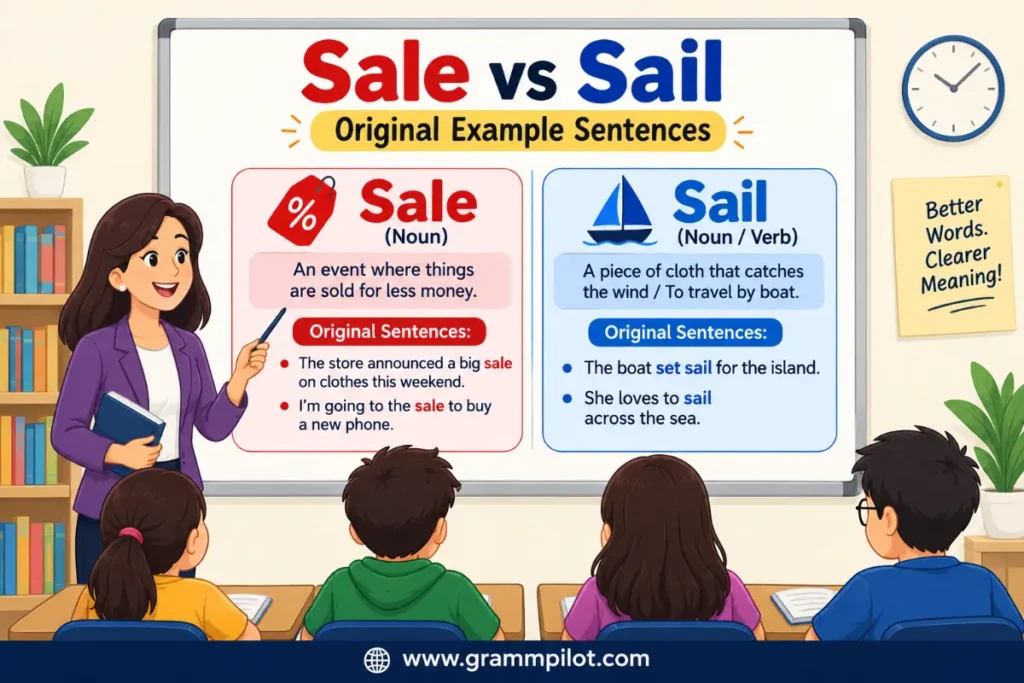
Here are real-world examples that show how sale and sail are used in different situations.
- The electronics store is having a sale this weekend.
- We found a great deal during the holiday sale.
- Their house is officially for sale.
- She celebrated after making her first sale as a real estate agent.
- Every employee received a bonus after the record sales this quarter.
- The ship will sail at sunrise tomorrow.
- We learned to sail during our summer vacation.
- The captain raised the sail before leaving the harbor.
- They hope to sail around the island before sunset.
- Strong winds filled the sails, helping the boat move quickly.
- Our favorite bookstore announced a clearance sale.
- The ferry will sail across the river every hour.
- She bought the jacket because it was on sale.
- The children watched a small boat sail across the lake.
- The annual garage sale attracted hundreds of visitors.
These examples show that sale always relates to buying or selling, while sail always relates to boats, ships, or traveling on water.
Sale vs Sell: What’s the Difference?
Many learners confuse sale and sell because they are closely related.
| Sale | Sell |
|---|---|
| A noun | A verb |
| Refers to the act or event of selling | Refers to the action of giving something in exchange for money |
| “The store has a sale.” | “The store sells computers.” |
Examples:
- The furniture sale starts Friday.
- They sell furniture every day.
A simple trick:
- Sale = the event.
- Sell = the action.
Sail vs Row: What’s the Difference?
These words both describe traveling on water, but they aren’t the same.
| Sail | Row |
|---|---|
| Uses wind or sails | Uses oars |
| Usually larger boats | Often smaller boats |
| Wind provides movement | Human effort provides movement |
Examples:
- We sailed across the bay.
- We rowed across the pond.
Common Mistakes (And How to Avoid Them)
These mistakes appear frequently in school assignments, emails, advertisements, and social media posts.
Mistake 1: Using “sail” instead of “sale”
❌ The store is having a big sail.
✅ The store is having a big sale.
Remember: Stores don’t sail. They have sales.
Mistake 2: Using “sale” instead of “sail”
❌ We will sale across the lake.
✅ We will sail across the lake.
If you’re talking about boats or traveling on water, always choose sail.
Mistake 3: Confusing “sale” with “sell”
❌ The company made many sells.
✅ The company made many sales.
Or:
✅ The company sells many products.
Mistake 4: Forgetting the Correct Part of Speech
Sale is almost always a noun.
Sail can be either:
- a noun (the cloth on a boat)
- a verb (to travel on water)
Examples:
- Raise the sail.
- We sail every weekend.
Mistake 5: Relying Only on Pronunciation
Since both words sound exactly alike, spell-check won’t always catch the mistake.
Sale vs Sail: When Should You NOT Use These Words?
Even though these words are common, they don’t fit every situation.
Avoid sale when:
- You’re describing a boat trip.
- You’re talking about wind-powered travel.
- You mean the verb sell.
Avoid sail when:
- You’re discussing discounts.
- You’re talking about shopping.
- You’re describing business transactions.
Choosing the correct word makes your writing much clearer.
Antonyms
Although neither word has one accurate opposite, these words often express the opposite idea.
Opposites of “Sale”
| Word | Meaning |
|---|---|
| purchase | buying instead of selling |
| buying | obtaining goods |
| acquisition | gaining ownership |
| retention | keeping instead of selling |
| keeping | not selling |
Opposites of “Sail”
| Word | Meaning |
|---|---|
| dock | remain at the harbor |
| anchor | stop moving |
| land | return to shore |
| stay | remain in one place |
| stop | end movement |
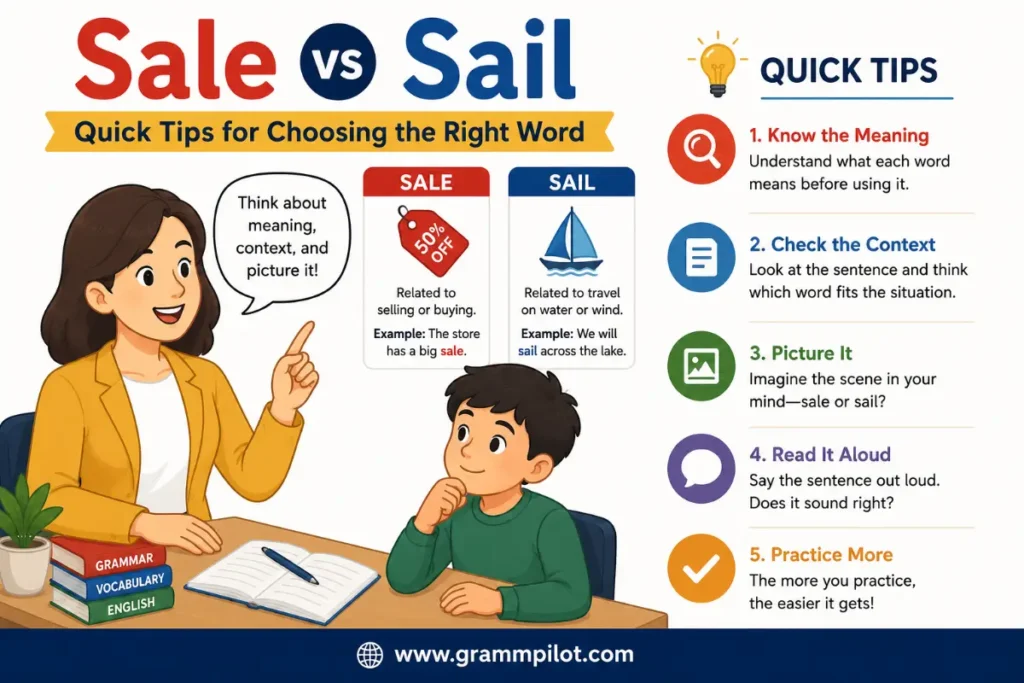
Quick Tips for Choosing the Right Word
Whenever you’re unsure, remember these simple rules.
- Think shopping? Use sale.
- Think boats? Use sail.
- If money is involved, it’s almost always sale.
- If water or wind is involved, it’s almost always sail.
- Sale is a noun.
- Sail can be both a noun and a verb.
- Read the sentence aloud and picture what’s happening. If you imagine a store, choose sale. If you imagine the ocean, choose sail.
Conclusion
Understanding Sale vs Sail is easier once you connect each word to its purpose. Sale belongs to the world of shopping, business, and exchanging goods for money. Sail belongs to boats, ships, wind, and traveling across water. Even though they sound exactly the same, they have completely different meanings and should never be swapped.
A simple memory trick can help you every time. Think of a sale in a store and a sail on a boat. Once you associate each word with its own picture, you’ll rarely confuse them again. About you’re writing an email, preparing a school assignment, posting online, or having a conversation, choosing the correct spelling will make your English clearer and more confident.
Frequently Asked Questions
1. Is “sale” and “sail” the same word?
No. In Sale vs Sail, the words sound the same but have different spellings and meanings. Sale relates to selling, while sail relates to boats and water travel.
2. Which is correct: “for sale” or “for sail”?
For sale is correct when something is available to buy. “For sail” is incorrect unless you’re talking about a boat’s sail in a very specific context.
3. Can “sail” be both a noun and a verb?
Yes. Sail is a verb when it means traveling on water and a noun when it refers to the cloth that catches the wind on a boat.
4. What’s another way to say “sale”?
Depending on the situation, you can use discount, deal, offer, promotion, clearance, bargain, or markdown.
5. Why do “sale” and “sail” sound the same?
They’re homophones. English has many words that share the same pronunciation but have different spellings and meanings.
6. Is “Sale vs Sail” a common grammar question?
Yes. Sale vs Sail is a common spelling question because both words are pronounced the same, making them easy to confuse in writing.
7. How can I remember the difference between sale and sail?
Think of a shopping mall for sale and a sailboat for sail. This simple image makes the correct spelling much easier to remember.