
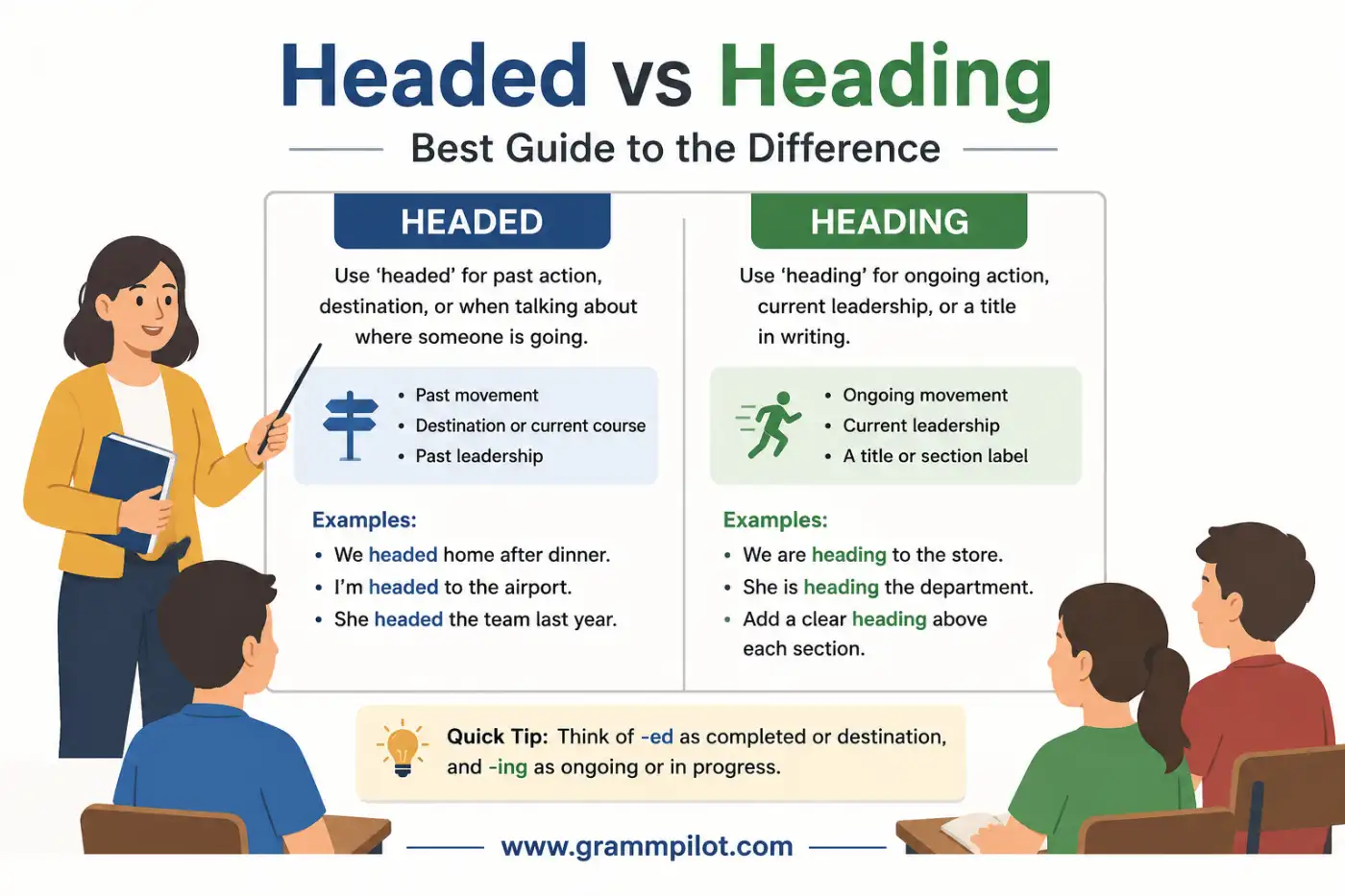
When you’re writing an email, polishing a resume, finishing an essay, or sending a quick text, you may stop at words like headed vs heading. They look almost identical, but they don’t always work in the same places. One small ending can change the meaning and grammar of a sentence. Headed usually describes a direction, destination, leadership role, or a completed action. Heading usually describes movement that is happening, a leadership role, or a title or label in writing.
The easiest way to remember the difference is this: headed often tells where someone or something is going or who is in charge, while heading often focuses on an action in progress or a title.
This guide explains their meanings, origins, grammar, synonyms, regional differences, common mistakes, and the best choice for resumes, essays, emails, texts, and everyday speech. You’ll also see real examples that show how the two forms work in context.
If you’re working on choosing the right word, explore [Sale vs Sail].
Headed vs Heading: What do “headed” and “heading” mean?
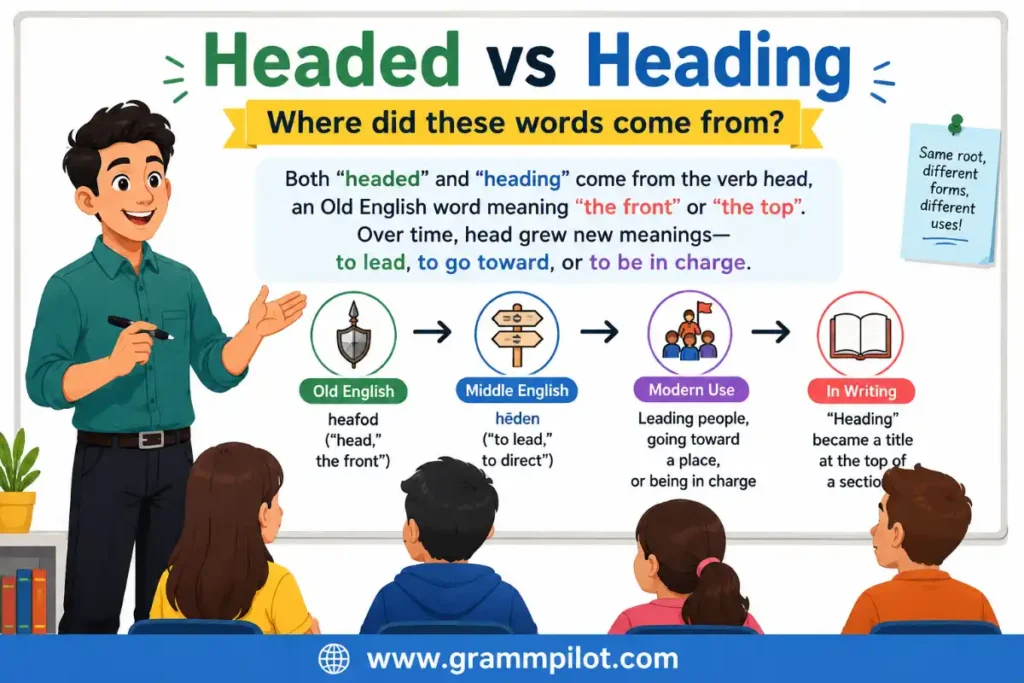
Both words come from the verb head, which has several related meanings. It can mean to move toward a place, lead a group, point in a direction, or place something at the top.
The endings -ed and -ing help show how the word functions in a sentence.
| Word | Basic idea | Common use |
|---|---|---|
| Headed | Went or is going toward something; led or was in charge | Direction, destination, leadership |
| Heading | Going toward something; leading; a title or label | Ongoing movement, leadership, writing |
Consider these examples:
- I’m headed home.
- I’m heading home.
Both sentences are natural. They usually mean that the speaker is going home. However, the grammatical focus is slightly different. I’m heading home presents the movement as an action in progress. I’m headed home often presents the speaker as being on the way or having home as the destination.
Now look at a different use:
- Maria headed the committee.
- Maria is heading the committee.
The first sentence can describe a completed or simple past action. The second describes her current leadership. There is one more important meaning: The article has a heading called “Common Errors.” Here, heading is a noun. It means a title or label. You can’t replace it with headed.
Headed vs Heading: Where did these words come from?
Both forms are built from the word head, which has a long history in English. The noun head originally referred to the body part. Over time, English speakers extended the word to describe the front or top part of something. From there, it developed meanings connected with leadership and direction. If someone was at the front of a group, that person could be said to head the group. If a person moved at the front or toward a particular place, the verb could also describe that movement.
The verb head eventually became common in phrases such as:
- head north
- head home
- head toward the station
- head a team
- head a department
The forms headed and heading simply reflect different grammatical forms of that verb. The word heading also developed an important writing-related meaning. A heading appears at the top of a section and tells readers what the section is about. This meaning is closely connected to the older idea of something being at the “head” or top.
That’s why heading can have several meanings today:
- Moving toward a place.
- Leading a group.
- A title or section label.
- The direction something is moving.
The surrounding sentence usually makes the intended meaning clear.
What is the difference between headed and heading?
The central difference is grammatical form and emphasis.
Headed is the past participle or past-tense form of head. It can describe something that happened in the past, a current state or destination, or movement toward a place.
Heading is the present participle or gerund form. It often describes an action that is happening, but it can also act as a noun.
Compare these sentences:
- We headed to Chicago yesterday.
- We are heading to Chicago now.
The first describes a past action. The second describes an action in progress.
But English also allows: We are headed to Chicago. Here, headed works naturally with are and describes the group’s destination or current course. So don’t think of the difference as simply “past versus present.” That’s too limited.
A better rule is: Heading commonly emphasizes an ongoing action or works as a noun, while headed commonly describes a destination, direction, completed action, or resulting state.
Headed vs Heading: Master synonym list for these words
The best synonym depends on what you mean. You wouldn’t replace heading with traveling in every sentence, and you wouldn’t replace headed with directed unless the context supports it.
Simple and everyday alternatives
| Word | Meaning | Tone | Example |
|---|---|---|---|
| Going | Moving toward a place | Very casual | I’m going home. |
| Moving | Changing location | Neutral | We’re moving toward the exit. |
| Traveling | Going from one place to another | Neutral | She’s traveling west. |
| Leaving | Going away from a place | Everyday | We’re leaving now. |
| Coming | Moving toward the speaker or a place | Everyday | He’s coming this way. |
| Walking | Moving on foot | Everyday | We’re walking downtown. |
| Driving | Traveling by car | Everyday | I’m driving to work. |
| Riding | Traveling by bike, horse, or vehicle | Everyday | She’s riding to school. |
More precise alternatives
| Word | Meaning | Tone | Example |
|---|---|---|---|
| Approaching | Moving closer to something | Neutral | The train is approaching the station. |
| Advancing | Moving forward | Formal | The team is advancing toward the next stage. |
| Proceeding | Continuing in a direction or process | Formal | We are proceeding north. |
| Entering | Going into a place | Neutral | They are entering the building. |
| Departing | Leaving a place | Formal | The flight is departing soon. |
| Returning | Going back | Neutral | We’re returning home tonight. |
| Arriving | Reaching a destination | Neutral | We’re arriving at noon. |
| Directing | Guiding toward a place or goal | Formal | She is directing the group toward the exit. |
Leadership alternatives
| Word | Meaning | Tone | Example |
|---|---|---|---|
| Leading | Being in charge or guiding others | Neutral | She is leading the team. |
| Managing | Controlling or organizing work | Professional | He manages the department. |
| Guiding | Helping people move toward a goal | Neutral | She is guiding the students. |
| Supervising | Overseeing people or work | Professional | He supervises the staff. |
| Directing | Controlling or guiding an activity | Formal | She directs the project. |
| Running | Being responsible for an organization or activity | Everyday | He runs the company. |
| Overseeing | Watching and managing work | Professional | She oversees operations. |
| Commanding | Having authority over people | Strong/Formal | He commands the unit. |
Informal and slang alternatives
| Word | Meaning | Tone | Example |
|---|---|---|---|
| On my way | Traveling toward a destination | Casual | I’m on my way home. |
| Off to | Leaving for a destination | Casual | I’m off to the store. |
| Making my way | Moving toward a place | Casual | I’m making my way downtown. |
| Rolling | Traveling, often casually | Slang | We’re rolling to the beach. |
| Going over | Moving to another place | Casual | I’m going over to Jake’s house. |
| Taking off | Leaving | Casual | We’re taking off soon. |
This larger synonym range matters because the closest replacement isn’t always the best one. A resume may need leading or managing, while a text message may sound more natural with on my way.
Headed vs Heading: Which synonyms show mild or strong meaning?
Not all movement or leadership words have the same strength.
Mild movement
These words describe ordinary movement without adding much detail:
- going
- moving
- walking
- traveling
- heading
Example: We’re heading downtown after lunch.
The sentence doesn’t tell us much about the speed or urgency.
Moderate movement
These words add a clearer sense of progress or direction:
- approaching
- advancing
- proceeding
- traveling toward
- moving toward
Example: The hikers are advancing toward the summit.
The verb advancing suggests purposeful forward movement.
Strong movement
These terms can suggest urgency, force, or a clear change:
- rushing
- racing
- charging
- speeding
- storming
Example: The runners were racing toward the finish line.
You wouldn’t normally use racing when you simply mean someone is going somewhere.
Mild leadership
For ordinary leadership, consider:
- guiding
- leading
- managing
- supervising
Example: She is leading a small research team.
Strong leadership
These words suggest greater authority:
- directing
- commanding
- controlling
- overseeing
Example: The officer was commanding the operation.
The right word should match the actual level of authority.
Can “headed” and “heading” be different parts of speech?
Yes. This is one of the most useful points to understand.
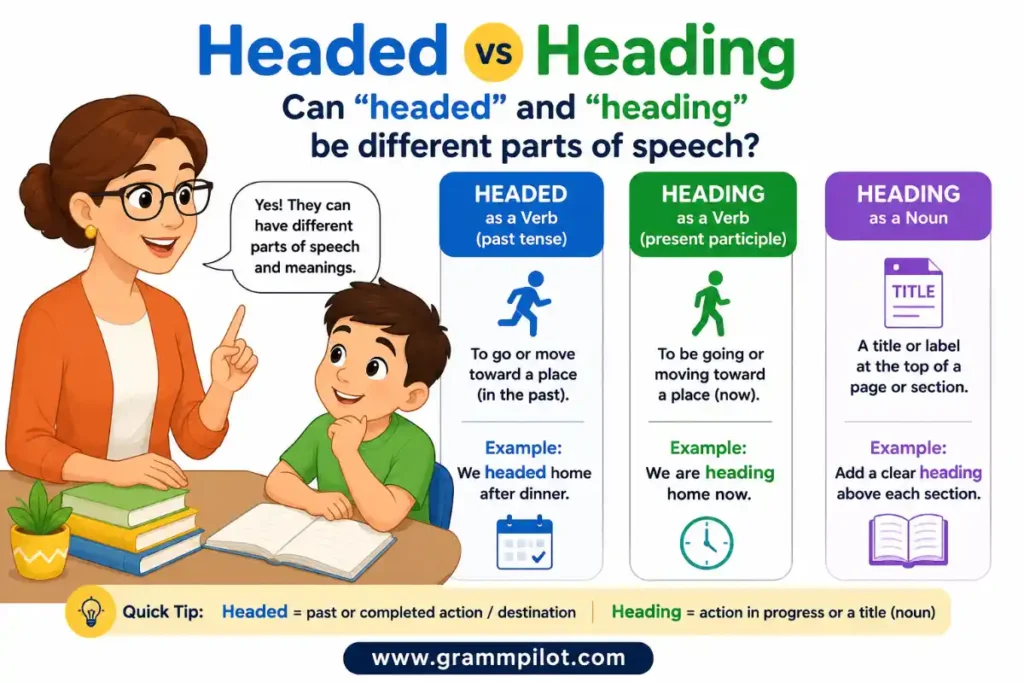
Headed as a verb
Headed can function as a past-tense verb.
Example: We headed toward the beach after breakfast.
Here, headed tells us what the subject did.
It can also appear as a past participle: They have headed home.
Headed as an adjective-like form
In phrases such as I’m headed home, the word describes the person’s current destination or course.
Examples:
- I’m headed to work.
- We’re headed north.
- She’s headed back to school.
- The company is headed in a new direction.
Heading as a verb
Heading can describe an action in progress.
We’re heading to the airport.
It can also follow certain verbs: They kept heading west.
Heading as a noun
This is where the two words clearly separate. A heading is a title or label in a document.
Examples:
- Add a heading above the paragraph.
- The main heading should be easy to read.
- This heading introduces the next section.
- Use clear headings in your report.
You cannot use headed in these examples.
Headed vs Heading: which one should you use?
The choice becomes easier when you identify the meaning first.
| If you mean… | Use | Example |
|---|---|---|
| Moving toward a place | Either may work | We’re headed/heading home. |
| Past movement | Headed | We headed home early. |
| Action happening now | Heading | We’re heading home now. |
| A destination or current course | Headed | I’m headed for the airport. |
| A title in writing | Heading | The heading needs editing. |
| Current leadership | Heading | She is heading the department. |
| Past leadership | Headed | She headed the department last year. |
The biggest trap is assuming that -ed always means past and -ing always means present. English is more flexible than that.
What should you use on a resume?
Use “heading” when describing current leadership
If you’re currently responsible for a team or department, heading can be appropriate.
Example: Heading a team of eight designers, I manage project schedules and client communication.
However, leading or managing often sounds more specific and professional.
Leading a team of eight designers, I manage project schedules and client communication.
The second version tells the reader more directly what your role involves.
Use “headed” for past leadership
If the role is completed: I headed the marketing department from 2022 to 2025.
You could also write: I led the marketing department from 2022 to 2025.
For most resumes, led is shorter and stronger.
Resume tip
Don’t choose a word just because it sounds formal. Choose the verb that accurately describes what you did.
| Situation | Strong choice |
|---|---|
| You managed employees | Managed |
| You guided a team | Led |
| You were responsible for a department | Headed |
| You supervised daily work | Supervised |
| You controlled a project | Directed |
Headed vs Heading: Which word works best in an essay?
Use “heading” for section titles
Academic writing often uses heading as a noun.
Heading: Causes of Climate Change
More naturally, you might simply write: Causes of Climate Change
That title is a heading.
Use “headed” for past movement or leadership
The explorers headed toward the coast before sunset.
Or:
The committee was headed by Professor Adams.
Notice the second construction. Here, headed by means led by.
Use “heading” for an action in progress
The researchers are heading toward a different conclusion.
This can be useful when the writer wants to emphasize a developing direction rather than a finished result.
Which word works best in a text message?
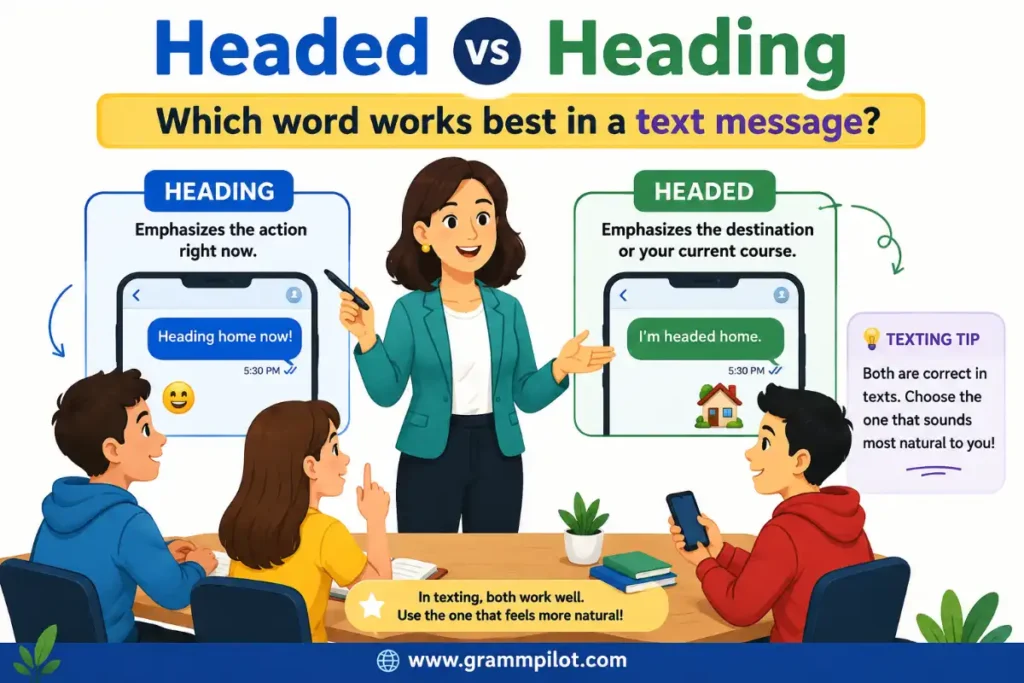
For casual texting, both forms are common.
Heading often sounds active and conversational: Heading home now.
Heading to the mall. Want anything?
Headed is also natural:
I’m headed home.
We’re headed to your place.
A very casual alternative is:
On my way home.
In texting, the best choice is usually the one that sounds natural for the relationship and situation.
Which word works best in an email?
Use “heading” for current plans
I’m heading to the office after lunch. This sounds natural in a professional email.
Use “headed” for destination or status
I’m headed to the client meeting now.
Both forms can work, but the meaning may shift slightly.
Compare: I’m heading to the meeting.
This emphasizes the action of going.
I’m headed to the meeting.
This emphasizes the destination or current course. For formal emails, either is acceptable when the context is clear.
Which word works best in speaking?
In ordinary American English, both are extremely common.
A speaker might say:
Where are you heading? Or: Where are you headed?
Both ask about someone’s destination. There’s a slight difference in feel:
- Where are you heading? focuses on the direction or journey.
- Where are you headed? often focuses more directly on the destination.
In everyday conversation, the difference is small enough that native speakers often use either one.
Headed vs Heading: What are the main differences side by side?
Headed vs Heading — movement
| Headed | Heading |
|---|---|
| Often emphasizes destination | Often emphasizes movement |
| Can describe past action | Often describes ongoing action |
| Can describe current course | Can describe current movement |
| Works in “headed home” | Works in “heading home” |
Examples:
We headed home after dinner.
The trip happened in the past.
We are heading home after dinner.
The movement is presented as an ongoing or planned action.
We are headed home.
The destination is emphasized.
Headed vs Heading — leadership
| Headed | Heading |
|---|---|
| Often past leadership | Often current leadership |
| Can mean “led” | Can mean “leading” |
| “She headed the team.” | “She is heading the team.” |
Example:
Daniel headed the department for five years.
His leadership is presented as a completed period.
Daniel is heading the department this year.
His leadership is current.
Headed vs Heading — writing
Here the difference is much clearer.
Heading is a noun meaning a title or section label.
Correct: The report has five main headings.
Incorrect: The report has five main headeds.
Only heading works in this meaning.
12+ real-life examples
Here are examples from work, school, travel, family life, and everyday conversation.
- I’m heading to the grocery store after work.
- We headed home when the weather got worse.
- She is heading the customer service team this year.
- He headed the project before moving to another department.
- The bus is heading downtown.
- The hikers are headed toward the lake.
- Add a clear heading above each section of your essay.
- The company is heading in a positive direction.
- Are you heading to the party tonight?
- Where are you headed after class?
- We headed north before sunrise.
- I’m headed back to the office now.
- The coach is heading the training program.
- The article needs a stronger main heading.
- The students are heading toward the library.
- She headed the committee during the final stage of the project.
- We’re heading out for dinner at seven.
- The team is headed for a difficult match.
- He is heading the meeting this afternoon.
- The report’s final heading should be “Recommendations.”
These examples show why context matters. The two forms overlap in movement sentences, but they aren’t interchangeable in every grammatical role.
Close synonym comparison: heading vs going
Heading and going are often interchangeable, but heading can make the direction or destination feel more important.
| Heading | Going |
|---|---|
| Often suggests a direction or destination | General movement |
| Slightly more descriptive | Very common and neutral |
| “I’m heading home.” | “I’m going home.” |
Compare: I’m going to the library.
This simply says you’re traveling there. I’m heading to the library.
This gives a slightly stronger sense of direction or movement toward that destination. Neither is wrong.
Close synonym comparison: headed vs bound
Headed and bound can both describe a destination.
We are headed for New York.
We are bound for New York.
But bound for sounds more formal or literary. It is also common in travel-related language.
Headed for trouble is a familiar expression in everyday English.
Bound for trouble is possible, but it has a different feel and is much less conversational.
So:
- Everyday: We’re headed for the airport.
- More formal or literary: The train is bound for Boston.
Close synonym comparison: heading vs leading
These words overlap when someone is in charge, but they’re not identical.
Leading strongly suggests guiding people. She is leading the team. The word leading is usually more direct for resumes and professional descriptions.
Heading can mean being the person in charge of a group or department. She is heading the team. Use heading when you want to emphasize responsibility for a department, group, project, or organization.
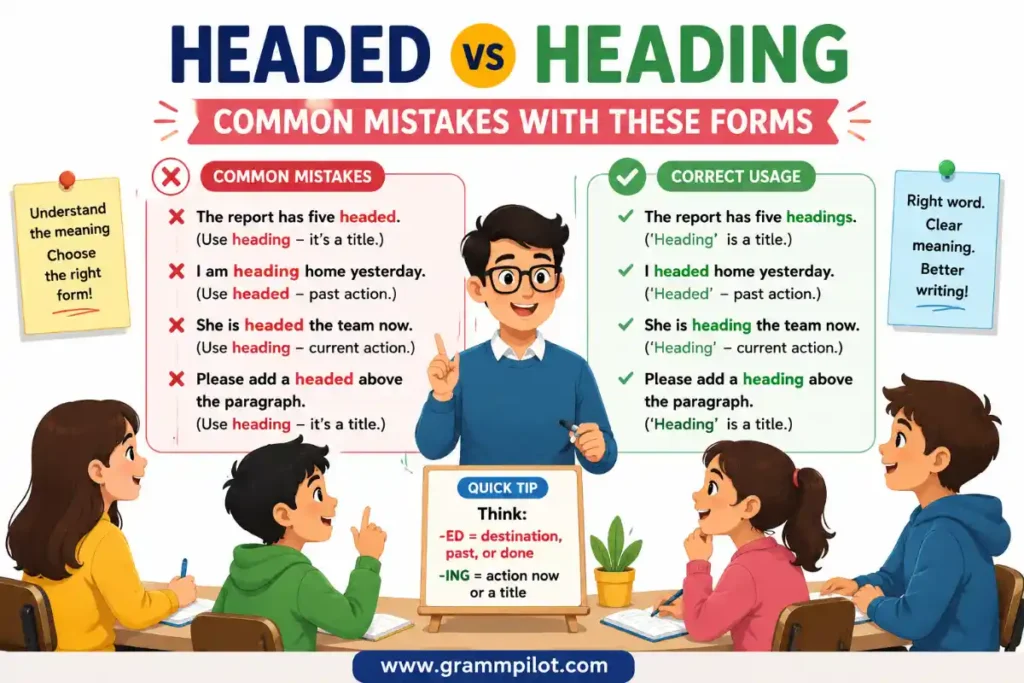
Headed vs Heading: Common mistakes with these forms
Mistake 1: Using “headed” as a writing title
Incorrect: Headed: Common Grammar Errors
If you mean a section title, use: Heading: Common Grammar Errors
Or simply: Common Grammar Errors
Mistake 2: Thinking “heading” always means movement
It doesn’t. The heading is too long.
Here, heading is a noun meaning a title.
Mistake 3: Thinking “headed” always means past
This isn’t always true. I’m headed home.
This describes a current situation.
The word doesn’t necessarily mean that the action happened in the past.
Mistake 4: Treating the two forms as identical
They overlap in sentences such as:
I’m headed home.
I’m heading home.
But they aren’t interchangeable everywhere.
You can’t say: The report has five headed.
You need: The report has five headings.
Mistake 5: Choosing a synonym without checking the meaning
Replacing headed with led can change the sentence.
We headed toward the station.
does not mean: We led toward the station.
The first describes movement. The second would suggest leadership and sounds unnatural in that context.
Mistake 6: Using “heading” when you mean completed leadership
If the sentence describes a finished role, headed or led may be better.
She headed the department from 2020 to 2024.
But: he is heading the department this year.
The tense and meaning are different.
When should you NOT use “headed”?
Avoid headed when you specifically need the noun meaning “title.”
Use heading instead:
- The heading is missing.
- Change the heading.
- Write a heading for this paragraph.
- The document has several headings.
Also avoid headed when the sentence needs a clear leadership verb but you’re describing an ongoing role and the construction doesn’t support it.
For example, instead of: She headed the department this year.
you may prefer: She is heading the department this year.
The second clearly marks the current role.
When should you NOT use “heading”?
Avoid heading when you need a past-tense action.
Incorrect: Yesterday, we heading to the beach.
Correct: Yesterday, we headed to the beach.
Also, don’t use heading as a noun when you mean the act of going somewhere unless the sentence structure supports that meaning.
What are the antonyms?
The opposite depends on the meaning.
For movement
Possible opposites include:
- staying
- remaining
- stopping
- returning
- retreating
- backing away
Example: We were heading toward the building.
Possible opposite: We stayed outside the building.
For leadership
Possible opposites include:
- following
- obeying
- supporting
- assisting
Example: She is heading the team.
Opposite idea: She is following the team leader.
For a heading
A heading doesn’t have one simple antonym. You could describe the absence of a heading as:
- body text
- main text
- paragraph text
- unlabeled text
US vs. UK usage
There is no major American-versus-British spelling difference between headed and heading.
Both forms are standard in US and UK English.
You may see differences in related vocabulary, pronunciation, or preferred expressions, but the basic grammar remains the same.
For example, both American and British speakers can say: I’m heading home.
and: I’m headed home.
The writing-related noun heading is also standard in both varieties: Use a clear heading for each section.
Regional context can influence which expression sounds more natural, but you don’t need a different spelling for American English.
Why does “headed home” sound so natural?
English has several common expressions in which headed describes a person’s current destination.
Examples include:
- headed home
- headed downtown
- headed north
- headed back
- headed to work
- headed for the airport
- headed toward the station
In these constructions, headed often works almost like an adjective describing someone’s current course.
That’s why: I’m headed home.
doesn’t sound strange even though headed has an -ed ending. The sentence isn’t necessarily saying, “I already went home.” It is saying, “Home is where I’m going.” This is one reason the simple rule “-ed means past, -ing means present” doesn’t fully explain English grammar.
Why does “heading home” also work?
Because heading emphasizes the activity of moving toward the destination.
I’m heading home.
The speaker is describing what they are doing.
The distinction is often subtle:
I’m heading home.
Focus: the action or journey.
I’m headed home.
Focus: the destination or current course.
In normal conversation, the two can be nearly identical.
Quick tips for choosing the right word
Use these shortcuts when you’re unsure.
Tip 1: Is it a title?
Use heading.
The heading should be bold.
Tip 2: Did the movement happen in the past?
Use headed.
We headed home at midnight.
Tip 3: Is the movement happening now?
Heading is a natural choice.
We’re heading to school.
Tip 4: Are you describing someone’s destination?
Headed is often natural.
I’m headed to the airport.
Tip 5: Are you describing current leadership?
Use heading with a form of be.
She is heading the department.
Tip 6: Are you describing past leadership?
Use headed.
She headed the department last year.
Tip 7: Don’t rely only on the ending
The -ed and -ing endings don’t tell the whole story. Check the sentence’s meaning and grammar.
A simple decision table
| Ask yourself | Best choice |
|---|---|
| Is it a section title? | Heading |
| Did someone lead a group in the past? | Headed |
| Is someone leading a group now? | Heading |
| Did someone travel somewhere in the past? | Headed |
| Is someone currently moving somewhere? | Heading |
| Are you describing a current destination? | Headed |
| Are you talking casually about going somewhere? | Either may work |
Headed vs Heading: the easiest memory trick
Think of the two endings this way:
-ED → completed, resulting, or destination-focused
-ING → ongoing, developing, or noun form
This isn’t a perfect rule for every sentence, but it’s a useful starting point.
Remember these three examples: We headed home yesterday.
Past movement.
We are heading home now.
Ongoing movement.
The heading says “Conclusion.”
A title.
If you remember those three patterns, most everyday uses become much easier.
Final teacher explanation
The words headed and heading are related forms of the verb head, but their grammatical jobs aren’t always the same.
Headed commonly describes a past action, a destination, or a current course. It can also describe someone who led a group in the past. Heading commonly describes movement in progress, current leadership, or a title in a document. The most important exception to a simple tense rule is the phrase headed home or headed to work. Here, headed can describe a current destination even though it ends in -ed. When the two forms both describe movement, the difference may be very small. Heading tends to emphasize the action, while headed often emphasizes the destination or course. In everyday speech, either can sound completely natural.
If you’re editing a resume or formal document, choose the most precise verb rather than the fanciest one. Leading, managing, directing, or supervising may communicate a professional role better than either form.

Conclusion
The key to Headed vs Heading is to look at the job the word is doing in the sentence. Headed can describe past movement, a current destination, or past leadership. Heading can describe an action in progress, current leadership, or a document title.
When you’re talking about travel, both can sometimes work: “I’m heading home” and “I’m headed home” are both natural. When you’re talking about a title, however, only heading fits. For professional writing, choose the form that makes the timing, direction, or role clear.
A quick check of the sentence’s meaning will usually give you the answer. Don’t let the similar spelling fool you.
Frequently Asked Questions
What is the main difference between headed vs heading?
Headed often describes a destination, past action, or completed leadership, while heading often describes ongoing movement, current leadership, or a title.
Is “I am headed home” grammatically correct?
Yes, “I am headed home” is grammatically correct and very common in American English. It describes your current destination or course.
Is “I am heading home” correct too?
Yes, “I am heading home” is also correct. It puts slightly more focus on the action of going home.
What’s another way to say “heading home”?
You can say going home, on my way home, or headed home. The best option depends on how casual or specific you want to sound.
Is heading a noun or a verb?
Heading can be either a noun or a verb. As a noun, it means a title or section label; as a verb, it can describe ongoing movement or leadership.
Can headed mean “leading”?
Yes, headed can mean “led” when it describes past leadership, as in “She headed the department for five years.”
Which is correct for a section title: headed or heading?
Heading is correct because a heading is the title or label of a section.