
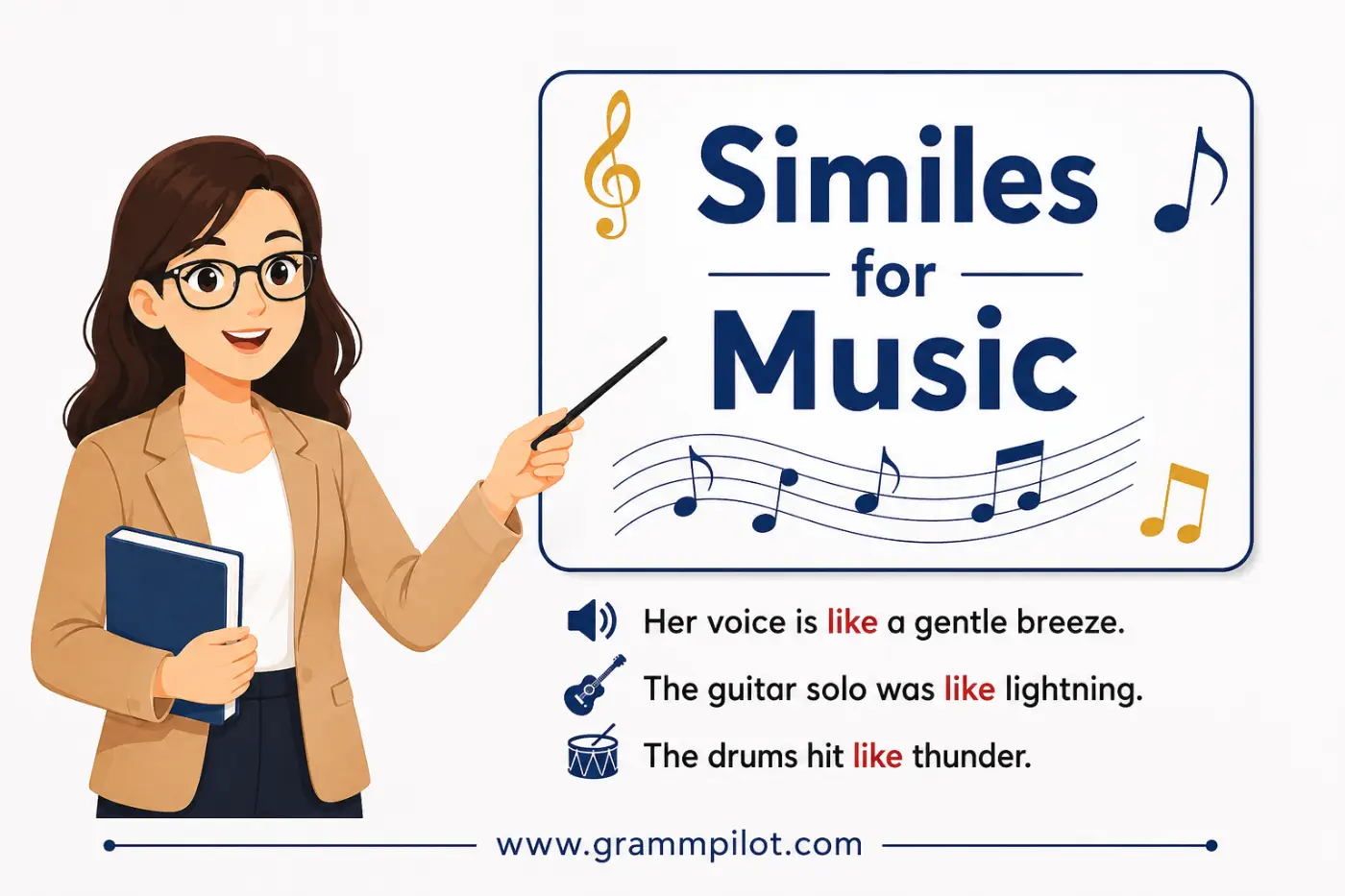
Have you ever been writing an essay, poem, story, speech, social media caption, or even a simple text and struggled to describe music in a creative way? Instead of saying a song was “good” or “beautiful,” you might want words that paint a stronger picture. That’s where Similes for Music can make your writing more interesting and memorable. Writers, students, teachers, and song lovers often search for Similes for Music because similes help readers imagine what music feels like, not just what it sounds like. A well-chosen comparison can turn an ordinary sentence into one people remember.
Quick Answer
A simile for music compares music to something else using words like “like” or “as.” It helps describe how music sounds, feels, or affects people in a vivid and easy-to-understand way.
In this guide, you’ll learn what similes for music are, where they come from, dozens of creative examples, related words, real-life uses, common mistakes, and practical tips for choosing the perfect comparison in any situation.
For more creative ways to describe an idea, explore [Angry Similes].
Similes for Music: What Are Similes for Music?
A simile compares one thing to another using the words like or as. When you use a simile to describe music, you help readers imagine how the music sounds, feels, or moves people.
Instead of saying: The music was beautiful.
You can write: The music was like a gentle river, flowing smoothly through the room.
The second sentence creates a much clearer picture in the reader’s mind.
Simple Definition
Similes for music compare music to something familiar using “like” or “as” to make the description more vivid and memorable.
Similes for Music: Why Do Writers Use Similes for Music?
They’re common in:
- Essays
- Poems
- Stories
- Song reviews
- Speeches
- Novels
- Blog posts
- Song lyrics
Everyday Examples
- Her voice was as smooth as silk.
- The piano sounded like falling rain.
- The melody flowed like a quiet river.
- The guitar echoed like distant thunder.
- The choir sang like angels.
- The rhythm beat like a heartbeat.
- The violin cried like the wind.
- The music wrapped around us like a warm blanket.
- The chorus rose like the morning sun.
- The notes danced like butterflies.
These comparisons help readers hear and feel the music without actually listening to it.
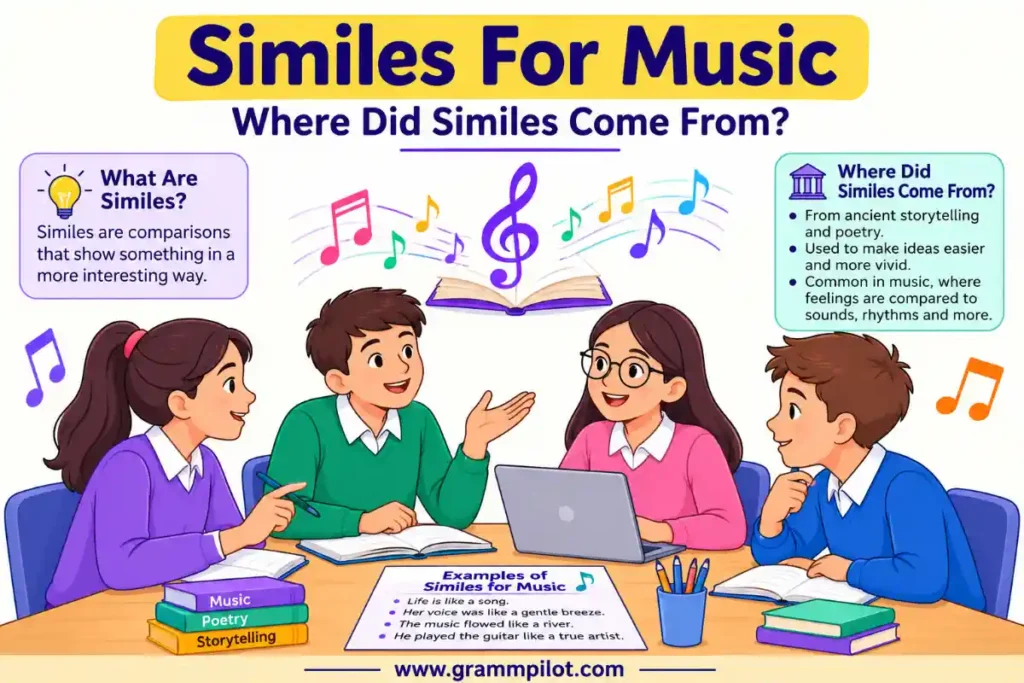
Similes for Music: Where Did Similes Come From?
Many people use similes every day without knowing their history. The word simile comes from the Latin word similis, meaning similar or alike. For thousands of years, storytellers have used similes to explain ideas by comparing them with things people already understand. Music has always inspired these comparisons because sound is difficult to describe directly. Instead of saying music is “nice,” writers compare it to nature, emotions, weather, light, or movement.
That’s why you’ll often read expressions such as:
- Music flowed like water.
- Her voice was as sweet as honey.
- The drums rolled like thunder.
- The melody floated like a feather.
These comparisons make writing richer and more expressive.
Plain-English Meaning
When people search for Similes for Music, they’re usually looking for creative comparisons that describe one or more of these qualities:
- Sound
- Volume
- Emotion
- Beauty
- Rhythm
- Speed
- Harmony
- Mood
- Energy
- Feeling
Good similes don’t just tell readers about music—they help readers experience it.
Master List of Words Related to Music Descriptions
Although similes are comparisons rather than synonyms, these descriptive words can help you build stronger similes.
Simple Words
| Word | Meaning | Tone | Example |
|---|---|---|---|
| beautiful | pleasant to hear | Neutral | Beautiful music filled the room. |
| soft | quiet and gentle | Everyday | Soft music helped me relax. |
| loud | high volume | Everyday | Loud music shook the walls. |
| calm | peaceful | Neutral | Calm music played during dinner. |
| happy | cheerful | Casual | Happy music made everyone smile. |
| sad | emotional | Everyday | Sad music touched my heart. |
| sweet | pleasant | Neutral | Her sweet voice sounded amazing. |
| gentle | smooth | Neutral | Gentle piano music played softly. |
Everyday Descriptive Words
| Word | Meaning | Tone | Example |
|---|---|---|---|
| catchy | easy to remember | Casual | The song is very catchy. |
| relaxing | calming | Everyday | Relaxing music helps me study. |
| energetic | full of energy | Everyday | Energetic music filled the stadium. |
| cheerful | joyful | Neutral | Cheerful tunes welcomed guests. |
| emotional | full of feeling | Neutral | The performance was emotional. |
| lively | exciting | Casual | The band played lively music. |
| peaceful | quiet and calming | Neutral | Peaceful melodies filled the garden. |
| uplifting | encouraging | Neutral | Uplifting songs inspire people. |
Formal Words
| Word | Meaning | Tone | Example |
|---|---|---|---|
| harmonious | pleasant together | Formal | The harmonious voices blended perfectly. |
| melodic | having a pleasing tune | Formal | The piece was highly melodic. |
| rhythmic | having a clear beat | Formal | The rhythmic drums echoed loudly. |
| expressive | showing emotion | Formal | The expressive performance impressed everyone. |
| resonant | deep and rich | Formal | His resonant voice filled the hall. |
| lyrical | musical and poetic | Formal | The violin produced lyrical phrases. |
| dynamic | changing in energy | Formal | The concert was dynamic throughout. |
| captivating | holding attention | Formal | The captivating melody stayed with me. |
Slang and Informal Words
| Word | Meaning | Tone | Example |
|---|---|---|---|
| awesome | excellent | Informal | That song is awesome. |
| epic | extremely impressive | Slang | The soundtrack was epic. |
| fire | outstanding | Slang | This beat is fire. |
| lit | exciting | Slang | The concert was lit. |
| sick | amazingly good | Slang | That guitar solo was sick. |
| banger | excellent song | Slang | That’s a real banger. |
| jam | favorite song | Informal | This is my favorite jam. |
| vibe | atmosphere created by music | Casual | I love the vibe of this song. |
These words can help you build your own similes.
For example:
- The melody was as peaceful as a quiet lake.
- The chorus hit like a wave crashing onto the shore.
- The beat was like a racing heartbeat.
- Her voice floated like morning mist over the hills.
50 Creative Similes for Music
Here are original similes you can use in essays, stories, speeches, poems, and everyday writing.
| Simile | Best Used For |
|---|---|
| As soft as a whisper | Quiet music |
| Like a gentle breeze | Calm melodies |
| Like flowing water | Smooth music |
| As sweet as honey | Beautiful singing |
| Like birds at sunrise | Cheerful songs |
| Like falling rain | Peaceful piano |
| As bright as sunshine | Happy music |
| Like dancing leaves | Light melodies |
| Like ocean waves | Relaxing sounds |
| As warm as a hug | Comforting songs |
| Like a heartbeat | Strong rhythm |
| Like fireworks | Exciting music |
| As light as a feather | Gentle singing |
| Like sparkling stars | Magical melodies |
| As clear as crystal | Pure vocals |
| Like fresh spring air | Refreshing music |
| Like a rainbow after rain | Hopeful songs |
| Like mountain echoes | Deep sounds |
| As peaceful as snowfall | Slow instrumentals |
| Like a flowing river | Continuous melody |
| As colorful as a painting | Rich orchestras |
| Like a cozy fireplace | Warm background music |
| As graceful as ballet | Elegant classical music |
| Like wind through the forest | Natural sound |
| As exciting as a race | Fast-paced songs |
| Like waves on the beach | Relaxing rhythm |
| Like a bird taking flight | Inspiring music |
| As smooth as silk | Soft vocals |
| Like a shooting star | Brief but unforgettable music |
| As fresh as morning dew | New melodies |
| Like blooming flowers | Growing harmonies |
| As comforting as home | Familiar songs |
| Like moonlight on water | Dreamy music |
| As lively as a festival | Party music |
| As bold as lightning | Powerful rock music |
| Like a warm cup of cocoa | Cozy background music |
| As endless as the ocean | Long instrumental pieces |
| Like laughter in a room | Joyful singing |
| Like clouds floating by | Slow relaxing tunes |
| As rich as chocolate | Deep orchestral sound |
| Like a child’s smile | Pure music |
| As timeless as the stars | Classic songs |
| As unforgettable as first love | Emotional music |
Similes by Intensity (Gentle → Powerful)
Not every piece of music creates the same feeling. Some songs are calm and relaxing, while others are loud and exciting. These similes are grouped from the softest feeling to the strongest.
| Intensity | Simile | Best For |
|---|---|---|
| Very Gentle | As soft as a whisper | Lullabies, quiet piano |
| Very Gentle | Like floating clouds | Peaceful instrumentals |
| Gentle | Like falling snow | Calm background music |
| Gentle | As smooth as silk | Soft vocals |
| Gentle | Like a gentle breeze | Acoustic songs |
| Medium | Like flowing water | Pop or classical music |
| Medium | Like birds singing at dawn | Happy melodies |
| Medium | As warm as sunshine | Cheerful songs |
| Strong | Like rolling thunder | Rock or drum solos |
| Strong | As powerful as a waterfall | Orchestra music |
| Very Strong | Like an erupting volcano | Heavy metal or intense film music |
| Very Strong | As explosive as fireworks | Grand concert finales |
Choose the simile that matches the mood instead of using the same comparison every time.
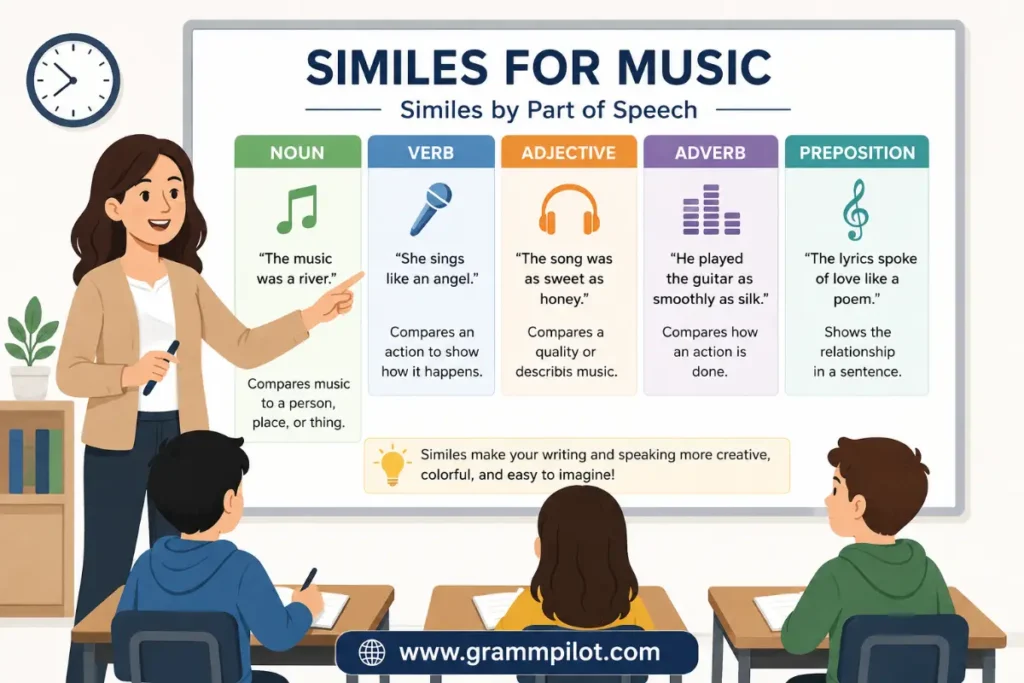
Similes for Music: Similes by Part of Speech
Although similes themselves are comparisons, they’re often built around different parts of speech.
Adjectives for Music
These describe what the music is like.
- beautiful
- gentle
- peaceful
- emotional
- joyful
- dramatic
- energetic
- soothing
- powerful
- uplifting
- haunting
- magical
Example: The melody was as peaceful as a quiet lake.
Verbs That Pair Well with Similes
These describe what the music does.
- flows
- echoes
- dances
- floats
- rises
- whispers
- roars
- sparkles
- glides
- explodes
- surrounds
- comforts
Example: The melody flowed like a river through the valley.
Nouns Commonly Compared to Music
Many similes compare music with familiar objects or experiences.
- river
- breeze
- rain
- thunder
- heartbeat
- sunshine
- stars
- butterflies
- ocean
- clouds
- silk
- honey
- feathers
- waves
- fire
These images help readers picture the feeling of the music.
Are Similes for Music Different in American and British English?
Not really. The structure of similes stays the same in both American and British English.
For example, speakers in both countries naturally say:
- As soft as a whisper.
- Like a gentle breeze.
- As smooth as silk.
- Like rolling thunder.
- As sweet as honey.
The only small differences may come from local vocabulary.
American English
- Like a baseball crowd.
- As lively as a Fourth of July parade.
British English
- Like a football crowd.
- As cheerful as a village fête.
The simile itself doesn’t change—only the cultural reference might.
Similes for Music: Which Simile Works Best in Different Situations?
Choosing the right comparison depends on where you’re writing.
Best Similes for Music in an Essay
Essays usually need clear, creative language without sounding too dramatic.
Examples:
- The melody flowed like a quiet river.
- The singer’s voice was as clear as crystal.
- The orchestra sounded like waves rolling onto the shore.
Best Similes for Music in a Story
Stories benefit from vivid imagery.
Examples:
- The violin cried like the lonely wind.
- The drums echoed like distant thunder.
- The song wrapped around the room like a warm blanket.
Best Similes for Music in Text Messages
Keep them short and fun.
Examples:
- That song is like sunshine.
- This beat hits like fireworks.
- Her voice is as smooth as silk.
Best “Similes for Music” in Emails
Professional writing usually calls for simple comparisons.
Examples:
- The performance was as smooth as silk.
- The background music was like a gentle breeze, creating a relaxing atmosphere.
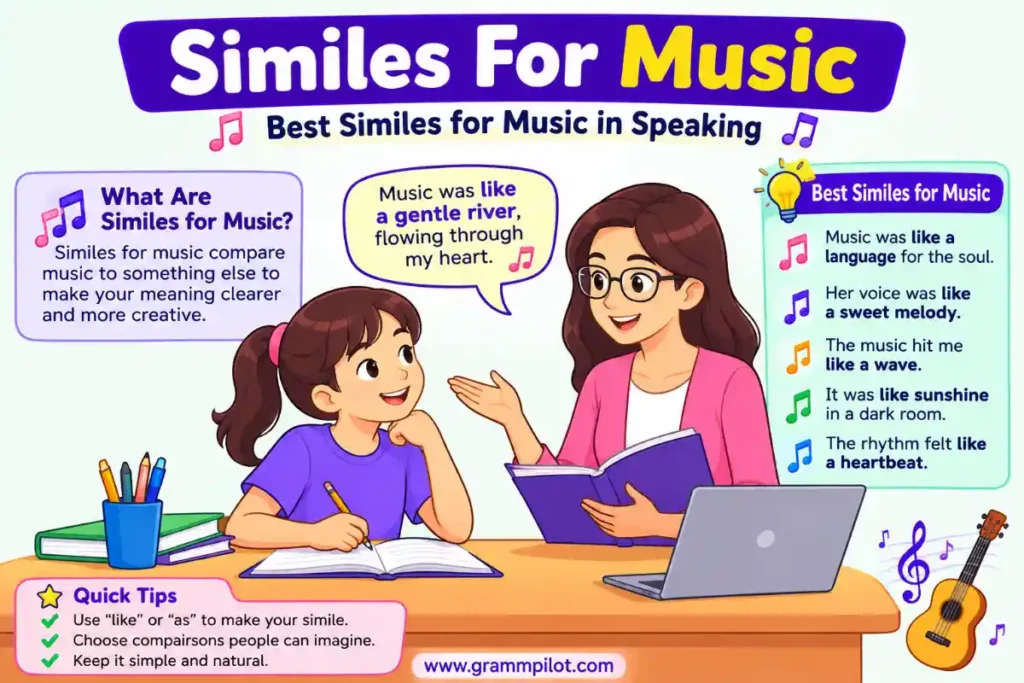
Best Similes for Music in Speaking
Natural conversations often use familiar comparisons.
Examples:
- His voice is like butter.
- The beat is like a heartbeat.
- That song feels like summer.
- The piano sounds like falling rain.
Simple similes are usually the easiest for listeners to understand.
Original Example Sentences “Similes for Music”
Here are original examples showing how you can naturally use similes for music.
- The violin sounded like the wind whispering through the trees.
- Her singing was as sweet as honey.
- The piano flowed like a peaceful river.
- The choir sang like angels welcoming the morning.
- The beat pounded like a racing heart.
- The melody drifted like clouds across the sky.
- His guitar solo exploded like fireworks in the night.
- The lullaby wrapped around the baby like a warm blanket.
- The orchestra rose like the sun over the mountains.
- The drums rolled like distant thunder before a storm.
- The flute floated like a feather on the breeze.
- The chorus sparkled like stars on a clear night.
- The concert echoed like waves crashing on the shore.
- The music comforted me like an old friend.
- The final note lingered like the last light of sunset.
Each sentence paints a picture instead of simply saying the music was “good.”
Simile vs Metaphor: What’s the Difference?
Many learners confuse these two figures of speech.
| Simile | Metaphor |
|---|---|
| Uses like or as | Doesn’t use like or as |
| Makes a direct comparison | Says one thing is another |
| “The music was like rain.” | “The music was rain.” |
| Easier for beginners | More poetic |
Both are useful, but similes are often easier to understand.
Simile vs Personification
These two writing tools also sound similar but work differently.
| Simile | Personification |
|---|---|
| Compares two things | Gives man qualities to non-human things |
| Uses like or as | Doesn’t need comparison words |
| “The melody flowed like water.” | “The melody danced through the room.” |
A sentence can even use both: The melody danced like butterflies in the spring air.
Common Mistakes
Many students make these errors when creating similes.
Mistake 1: Forgetting “Like” or “As”
❌ The music a gentle breeze.
✅ The music was like a gentle breeze.
Mistake 2: Choosing a Comparison That Doesn’t Fit
❌ The lullaby was like an exploding volcano.
Unless you’re joking, this comparison doesn’t match a quiet lullaby.
A better choice is: ✅ The lullaby was like a soft whisper.
Mistake 3: Overusing the Same Simile
Instead of writing “as sweet as honey” again and again, try:
- like morning birds
- as warm as sunshine
- like flowing water
- as smooth as silk
Variety makes your writing stronger.
Mistake 4: Mixing Different Images
❌ The music was like thunder floating like a feather.
Those images don’t fit together. Choose one clear comparison.
Mistake 5: Making Similes Too Long
A good simile is usually short and easy to picture. Instead of a very long comparison, keep it simple and natural.
Similes for Music: When Should You NOT Use Similes for Music?
Similes are helpful, but they don’t fit every situation.
Avoid using them when:
- You’re writing technical music theory or scientific research.
- A simple description is clearer than a comparison.
- The comparison confuses readers instead of helping them.
Antonyms
A simile doesn’t have a direct opposite, but some words express the opposite qualities of musical descriptions.
Opposites of Positive Music Descriptions
| Positive Word | Opposite |
|---|---|
| beautiful | ugly |
| harmonious | discordant |
| peaceful | chaotic |
| gentle | harsh |
| soothing | irritating |
| joyful | depressing |
| uplifting | discouraging |
| melodic | tuneless |
| relaxing | stressful |
| expressive | emotionless |
These opposite words can also help you create stronger comparisons.
For example:
- The music was as harsh as grinding metal.
- The performance felt like a storm with no end.
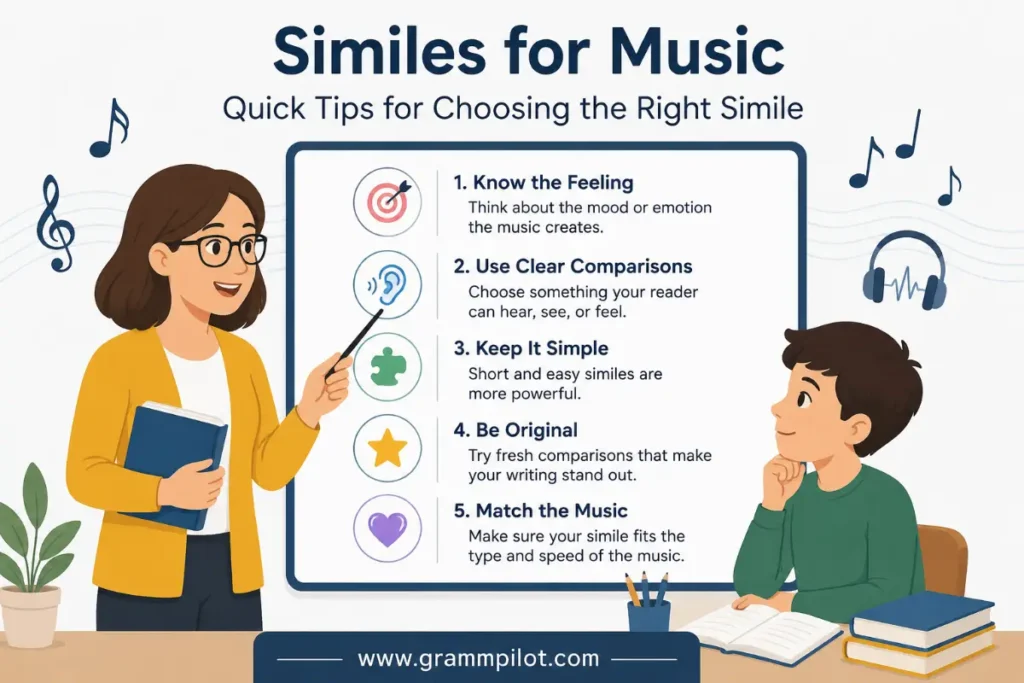
Quick Tips for Choosing the Right Simile
Use these simple tips whenever you’re describing music.
- Match the simile to the mood of the music.
- Compare music to things people already know.
- Keep your comparisons short and easy to picture.
- Don’t force a simile into every sentence.
- Avoid mixing several unrelated images in one comparison.
- Choose positive comparisons for happy music and darker comparisons for sad or dramatic music.
- Read your sentence aloud. If it sounds natural, you’ve probably chosen a good simile.
Conclusion
Learning Similes for Music is one of the easiest ways to make your writing more colorful and engaging. Instead of simply saying a song is “good” or “beautiful,” you can compare it to flowing water, gentle rain, bright sunshine, rolling thunder, or countless other familiar images. These comparisons help readers imagine the sound and emotion behind the music.
The best similes are simple, clear, and appropriate for the mood you’re describing. Whether you’re writing a school essay, poem, story, speech, song review, or social media caption, using Similes for Music thoughtfully will make your words more vivid and memorable. Practice creating your own comparisons, and you’ll soon find that describing music becomes much easier and far more creative.
Frequently Asked Questions
1. What are similes for music?
Similes for music are comparisons that use like or as to describe how music sounds, feels, or affects people. They make writing more vivid and easier to imagine.
2. What’s another way to describe beautiful music?
You can describe beautiful music with comparisons such as as sweet as honey, like a gentle breeze, like flowing water, or as smooth as silk.
3. Can I use similes for music in school essays?
Yes. Teachers often encourage descriptive language because it makes essays more interesting and helps readers picture what you’re describing.
4. What’s the difference between a simile and a metaphor?
A simile uses like or as to compare two things, while a metaphor says one thing is another without using those comparison words.
5. How do I write my own simile for music?
Think about how the music makes you feel, then compare it to something familiar. For example, peaceful music might be like a calm lake, while energetic music might be like fireworks lighting up the sky.
6. Are Similes for Music useful in poetry?
Absolutely. Similes for Music are widely used in poetry because they help readers experience sounds, emotions, and imagery in a more creative way.
7. Can I use similes in everyday conversations?
Yes. Simple comparisons like “Her voice is as smooth as silk” or “That song hits like a wave” sound natural in everyday speech.