
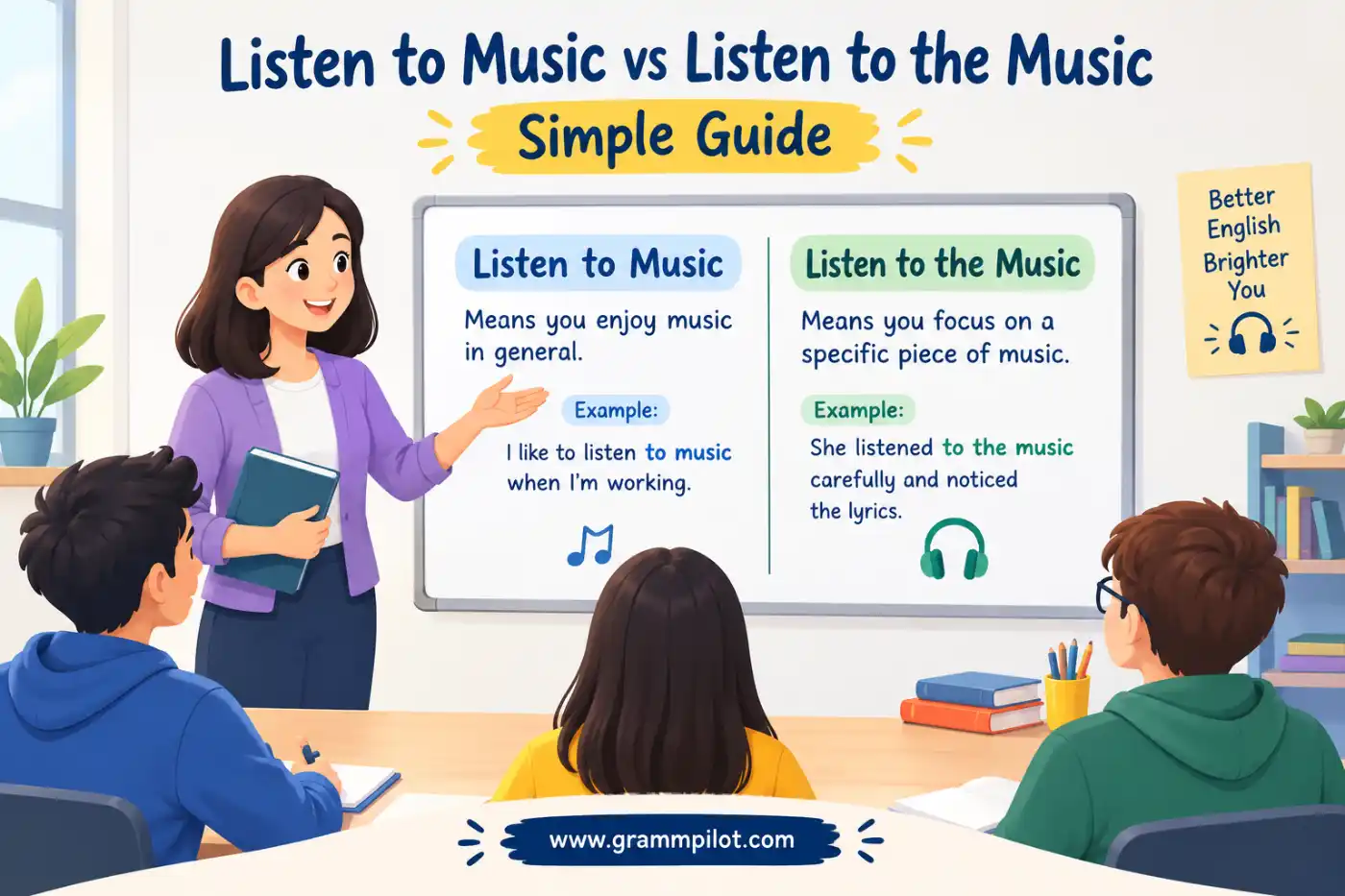
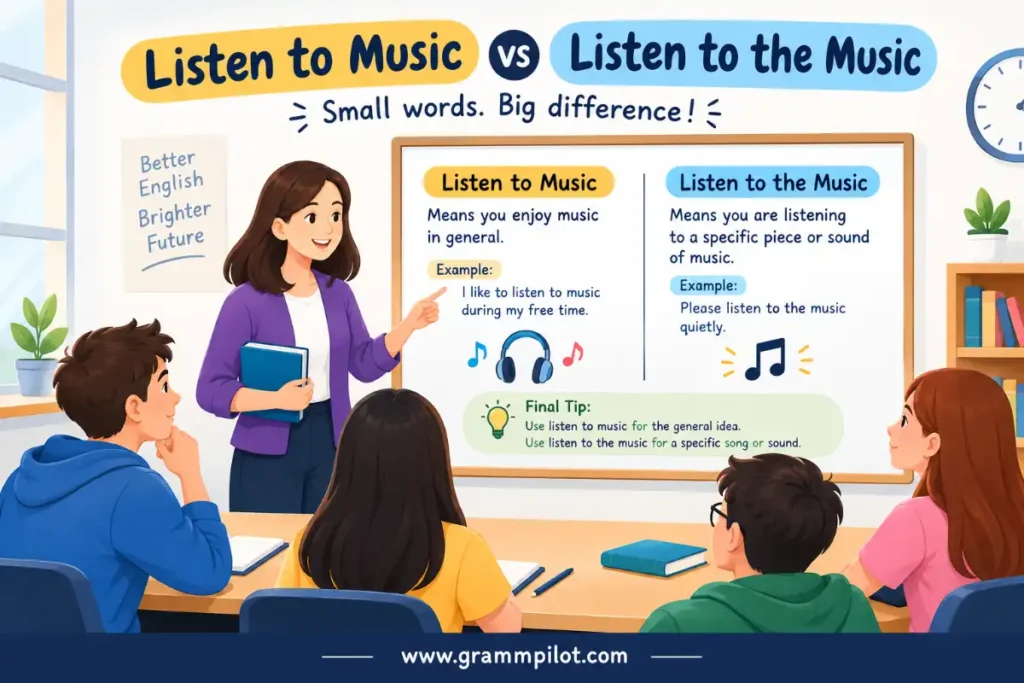
Have you ever stopped while writing an email, essay, resume, or text because you weren’t sure about to write “listen to music” or “listen to the music”? Both phrases are correct, but they don’t always mean exactly the same thing. The small word the can change what you’re pointing to. Listen to Music vs Listen to the Music is mainly a question of general activity versus a specific piece, performance, or collection of music. Use listen to music when talking about music in general.
Use listen to the music when you mean particular music that the listener already knows about or can identify. That difference is simple once you see how English uses articles. The same pattern appears with many other nouns, too. You might say “I like coffee” for coffee in general but “I drank the coffee” for a specific cup. This guide explains why both expressions work, where they come from, how their meanings differ, and which wording sounds best in an essay, email, resume, text, or conversation. You’ll also find examples, synonym choices, common mistakes, and quick rules you can remember.
Another useful spelling guide is [Correct or Correctly].
Why does the word “the” matter here?
English uses the to point to something specific.
For example:
- I like music.
- I like the music in this movie.
In the first sentence, music is considered generally. In the second, the speaker has a particular type or piece of music in mind. This is part of a larger English grammar pattern. Uncountable nouns often appear without an article when we discuss them generally:
- I like coffee.
- She enjoys art.
- He listens to music.
- We study history.
- They love nature.
The same nouns can take the when a specific example is meant:
- I drank the coffee you made.
- She loved the art in the gallery.
- He listened to the music from the film.
- We discussed the history of the building.
- They enjoyed the nature around the lake.
So the important question isn’t simply if the is grammatically possible. It is. The real question is: Are you talking about music generally, or are you identifying particular music? That question will usually give you the correct choice.
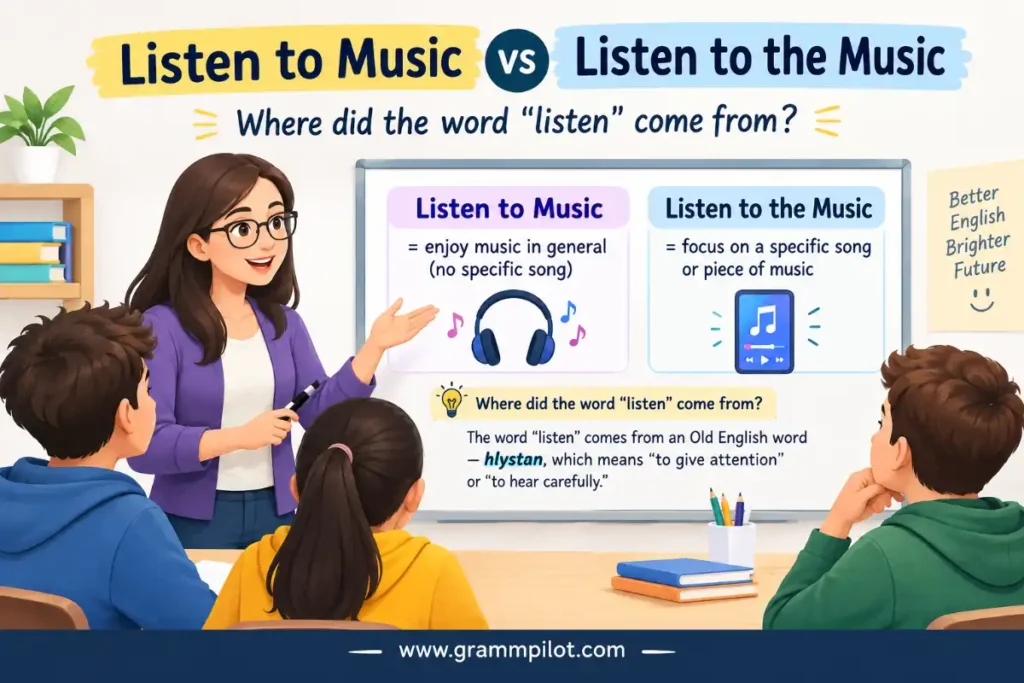
Listen to Music vs Listen to the Music: Where did the word “listen” come from?
The verb listen has deep Germanic roots. It developed from Old English forms related to paying attention to sound and hearing carefully. English has used forms of the word for centuries. There is an important difference between hear and listen, too. Hear usually describes receiving sound through your ears without necessarily making an effort. Listen suggests intentional attention.
For example:
- I heard a strange noise outside.
- I listened to the strange noise carefully.
You can hear music coming from a room without choosing to pay attention to it. If you deliberately focus on that music, you’re listening to it. That’s why English normally says: listen to music The preposition to connects the action of listening with the sound or thing being listened to.
You can also listen to:
- a song
- a podcast
- a teacher
- a speech
- the radio
- an audiobook
- an interview
- an announcement
- a conversation
For example:
- Please listen to me.
- She listened to the podcast.
- We listened to the speaker.
- They listened to the radio.
Listen to Music vs Listen to the Music: Where did the word “music” come from?
The word music comes through French and Latin from the Greek mousikē, a word connected with the Muses, the figures associated with arts and learning in ancient Greek culture. Over time, the word developed into the English music, referring broadly to organized or expressive sound. Today, music can refer to many forms of sound and artistic expression:
- classical music
- pop music
- rock music
- jazz music
- country music
- electronic music
- folk music
- film music
- background music
- instrumental music
Because music is normally an uncountable noun when used in its general sense, we don’t usually say a music when we mean music as a broad category.
We say:
- I love music.
- She listens to music every day.
- Music helps me relax.
When referring to an individual item, English normally uses words such as song, track, piece, or composition:
- I like this song.
- She played a beautiful piece of music.
- He added a new track to the playlist.
Is one expression more correct than the other?
No. Both are grammatically correct. The choice depends on meaning and context.
Listen to music is correct when you mean music generally. Listen to the music is correct when you mean specific music. A common mistake is thinking that the makes one version more grammatically correct. It doesn’t. The article simply changes the reference. Think about the difference this way: No article = category or idea
The = identifiable example or specific thing
This rule works in many other sentences:
- I love music.
- I love the music in this restaurant.
- She studies history.
- She studies the history of this town.
- He enjoys art.
- He enjoys the art in the museum.
The same article principle is at work.
What are the best synonyms for “listen”?
There isn’t one perfect replacement for listen in every situation. Your choice depends on how carefully, casually, or formally you want to describe the action. Here is a broad synonym guide.
Master synonym list
| Word or phrase | Meaning | Tone | Example |
|---|---|---|---|
| listen | Pay attention to sound | Simple | I listen to music at night. |
| follow | Listen while understanding or tracking information | Everyday | I followed the interview closely. |
| check out | Listen to or try something casually | Slang/Casual | Check out this new track. |
| play | Put recorded music on so it can be heard | Everyday | She played her favorite album. |
| enjoy | Listen with pleasure | Everyday | We enjoyed the live music. |
| consider | Think carefully about spoken information | Formal | The committee considered the speaker’s comments. |
| observe | Notice carefully | Formal | The researcher observed the participants. |
| heed | Pay careful attention, especially to advice or warnings | Formal | He heeded the warning. |
| absorb | Take in information or sound fully | Formal | She absorbed every detail of the lecture. |
| monitor | Listen or watch carefully for changes | Formal | Staff monitored the radio channel. |
| eavesdrop | Listen secretly to another person’s conversation | Negative | He tried to eavesdrop on them. |
| overhear | Hear something unintentionally | Neutral | I overheard their conversation. |
| attune yourself to | Become sensitive to particular sounds or signals | Formal | She attuned herself to the rhythm. |
| jam to | Listen to or enjoy music enthusiastically | Slang | We jammed to old rock songs. |
Not every word above can replace listen to music directly. For example, hear music changes the meaning because hearing doesn’t necessarily involve intentional attention. Eavesdrop is much more specific and usually involves secretly listening to people. A good synonym must match the situation, not just share a general dictionary connection.
Which listening words are mild, strong, or intense?
Different words can suggest different levels of attention.
Mild attention
These can suggest limited or ordinary attention:
- hear
- catch
- notice
- tune in
- follow
Example: I caught part of the song before I left.
The speaker didn’t necessarily listen closely.
Moderate attention
These suggest deliberate attention:
- listen
- pay attention to
- focus on
- follow closely
- appreciate
Example: She listened carefully to the instructions.
The action is intentional.
Strong attention
These suggest deep concentration or appreciation:
- absorb
- savor
- attend to
- concentrate on
- take in
Example: He absorbed every note of the live performance.
This suggests a much deeper level of attention than simply hearing music in the background.
Secret or negative listening
Some words have a special meaning:
- eavesdrop
- overhear
For example:
I overheard them talking.
This means you heard their conversation without intentionally listening to it.
I eavesdropped on their conversation.
This means you intentionally listened to a private conversation, usually without permission. Those words should not be treated as ordinary synonyms for listen.
Listen to Music vs Listen to the Music: What are the synonyms by part of speech?
The word listen is mainly a verb, but related forms can help you vary your writing.
Verbs
- listen
- hear
- notice
- follow
- attend
- observe
- appreciate
- absorb
- monitor
- overhear
- eavesdrop
Examples:
- She listened to the song.
- He heard the music from outside.
- They appreciated the performance.
- We followed the interview.
Nouns
- listener
- hearing
- attention
- audience
- appreciation
- reception
Examples:
- The listener enjoyed the song.
- Her careful attention impressed the teacher.
- The audience became quiet during the performance.
Adjectives
- attentive
- observant
- focused
- receptive
- engaged
- musical
Examples:
- She was an attentive listener.
- The students remained focused during the presentation.
- He is very receptive to new ideas.
How does American English use these expressions?
In American English, listen to music is completely natural for general habits and preferences.
For example:
- I listen to music on my way to work.
- She listens to music before bed.
- We listen to music when we cook.
Listen to the music is also common when the music is identifiable.
For example:
- Listen to the music in the next room.
- Listen to the music behind the dialogue.
- Listen to the music at the beginning of the video.
There isn’t a major American-English rule that makes one phrase correct and the other incorrect. The same basic article distinction applies in British English and other major varieties of English. Regional speakers may differ in vocabulary, pronunciation, or conversational style, but the general difference between music and the music remains stable.

What should you use in a resume?
A resume usually benefits from precise, professional wording. However, listen to music isn’t usually a strong resume phrase unless listening is directly connected to the job or skill you’re describing. If you’re describing a professional activity, use a more precise verb.
For example:
- I regularly listen to industry podcasts to stay informed.
- I listen to customer feedback carefully and use it to improve service.
- I listen to training materials during my commute.
For a resume, words such as analyze, review, monitor, evaluate, or respond to may be stronger when they accurately describe the activity. Don’t replace listen with a more formal word just to sound impressive. Accuracy matters more than complexity.
What should you use in an essay?
For an essay, listen to music is usually best when discussing music as a general activity.
Example: Many students listen to music while studying because it can make routine tasks feel more enjoyable.
If you’re discussing a specific piece, use the music: The music in the film creates a tense mood during the final scene.
The choice should reflect your meaning.
An essay also gives you room to vary your vocabulary:
- listen to music
- hear a melody
- study a composition
- analyze a performance
- appreciate an arrangement
- examine a soundtrack
Still, don’t replace a simple word with a complicated one when the simple word is clearer.
What should you use in a text message?
Texting is informal, so listen to music is the most natural choice for a general statement.
Examples:
- I love listening to music at night.
- Do you listen to music while studying?
- I usually listen to music on the bus.
Use the music when both people know what music you’re talking about:
- Did you listen to the music I sent?
- Listen to the music in this clip.
- I can’t stop thinking about the music from that movie.
Text messages depend heavily on shared context. If your friend already knows which song you’re talking about, the music can sound perfectly natural.
What should you use in an email?
The answer depends on if the email is personal or professional.
In a personal email: I usually listen to music while cooking.
For a specific reference: Did you listen to the music I attached to my last message?
In a professional email, make the reference clear: Please listen to the recording before tomorrow’s meeting.
Here, the recording is specific, so the article is necessary.
If you’re giving general advice, you might write: Employees may listen to music during their breaks.
The meaning is general, so no the is needed.
What should you use when speaking?
In everyday conversation, both forms are common.
Suppose a friend asks: What do you do when you relax?
You might answer: I listen to music.
You’re talking about a general habit.
Now imagine you’re standing outside a concert hall. You hear a song coming from inside.
You might say: Listen to the music!
Now you’re directing your friend’s attention to particular sounds. The situation itself helps establish the difference.
What are some real-life examples?
Here are examples from everyday situations.
- I listen to music while cleaning my apartment.This describes a regular habit.
- Can you listen to the music in the background?The speaker means particular music that is currently playing.
- My sister listens to music before she goes to sleep.Music is a general category.
- Did you listen to the music I sent you yesterday?The listener knows which music because it was sent yesterday.
- Some people listen to music while exercising.This is a general statement about people.
- Listen to the music coming from that room.The speaker points to specific sounds.
- I don’t listen to music very often.This describes a general preference.
- We listened to the music from the old movie.The music is identified by its connection to a particular movie.
- She listens to music during her morning commute.This is a routine.
- Everyone became quiet when they heard the music.The context can make the music identifiable.
- He listens to jazz music when he needs to concentrate.Jazz music is being discussed as a general type.
- He asked us to listen to the music in the final scene.The music is specific and identifiable.
- I can hear music from the neighbor’s house.The speaker notices sound without necessarily focusing on it.
- I sat down and listened to the music for an hour.The speaker deliberately focused on particular music.
- They love listening to music together.This describes a general shared activity.
“Listen” vs “hear” — what is different?
These two verbs are related, but they aren’t interchangeable in every sentence.
| Listen | Hear |
|---|---|
| Usually involves intentional attention | Often happens without deliberate effort |
| Describes an active choice | Describes perception of sound |
| Often takes to | Usually doesn’t take to |
| I listened to the song. | I heard the song. |
| She listened to the teacher. | She heard the teacher. |
Compare:
I heard music from the street.
This tells us that music reached the speaker’s ears.
I listened to the music from the street.
This suggests the speaker intentionally paid attention to it.
The distinction becomes especially useful in writing because it lets you show how someone actively focused on a sound.
“Listen to music” vs “listen to the music” — what’s different?
The clearest distinction is reference.
| General | Specific |
|---|---|
| I listen to music. | I listen to the music you recommended. |
| She listens to music every day. | She listened to the music in the film. |
| We enjoy listening to music. | We enjoyed listening to the music at the concert. |
The general form works well for:
- habits
- hobbies
- preferences
- broad statements
- general facts
The specific form works well for:
- a known song or soundtrack
- music playing nearby
- music previously mentioned
- music associated with a particular event
- music identified by a phrase after the noun
A useful test is to ask:
“Could I point to which music I mean?”
If the answer is no, you probably mean music generally.
If the answer is yes, the music may be the better choice.

Listen to Music vs Listen to the Music: What are the most common mistakes?
Mistake 1: Adding “the” when talking about music generally
Incorrect for a general meaning: I love the music.
This isn’t always wrong, but it sounds incomplete if you’re trying to say you love music as a general category.
Better: I love music.
If you mean specific music, then the is appropriate: I love the music in this movie.
Mistake 2: Removing “the” from a specific reference
Suppose your friend sent you a song and asks if you listened to it.
You could say: Yes, I listened to the music you sent me.
Removing the would make the sentence sound unnatural: I listened to music you sent me.
The second version can sometimes work in special contexts, but the definite article is normally preferred when referring to clearly identified music.
Mistake 3: Saying “listen music”
This is a common learner error. Standard English normally requires to after listen when you identify what is being listened to.
Correct:
I listen to music.
Correct:
She listened to the song.
Correct:
Listen to me.
Not standard: I listen music.
Mistake 4: Confusing “hear” with “listen”
Don’t assume they mean exactly the same thing. I heard the song can mean the sound reached me. I listened to the song suggests I deliberately paid attention.
Mistake 5: Using a synonym that changes the meaning
For example, eavesdrop doesn’t mean simply “listen carefully.” It means to listen secretly to a private conversation. Likewise, overhear usually means hearing something unintentionally. A thesaurus can provide related words, but context determines if they actually fit.
When should you not use “listen to”?
Don’t use listen to when you actually mean that someone merely became aware of a sound.
For example: I heard a strange noise outside.
This is often better than: I listened to a strange noise outside. If you didn’t intentionally focus on the noise, heard is more accurate. use listen to when you mean watching something visually, either.
You can:
- listen to a podcast
- watch a video
- read an article
- view a photograph
A video may contain speech, so you can listen to the speaker in the video, but you don’t normally “listen to a video” when you mean the visual content.
What are the antonyms of “listen”?
There isn’t one perfect antonym in every context, but several words can express the opposite idea.
- ignore — deliberately pay no attention
- disregard — choose not to consider something
- tune out — stop paying attention, especially to sound
- miss — fail to hear or notice
- overlook — fail to notice something
- neglect — fail to give proper attention
Examples:
- He ignored the warning.
- She tuned out the background noise.
- I missed the last part of the announcement.
- They disregarded the instructions.
For music specifically, tune out is a useful conversational expression:
I tuned out the music and focused on my work.
What is the easiest rule to remember?
Here’s the short version:
Music in general → listen to music
Specific music → listen to the music
You can also remember it with two questions:
“What kind of activity?”
→ listen to music
“Which music?”
→ listen to the music
For example:
What do you enjoy?
“I enjoy listening to music.”
Which music should I listen to?
“Listen to the music I sent you.”
This simple question-and-answer method is especially useful for English learners.
What should English learners remember about articles?
The bigger lesson goes beyond music.
English articles often help listeners understand if a noun is general or specific.
Compare:
- I like music.
- I like the music in this restaurant.
- She loves coffee.
- She loves the coffee you made.
- He studies history.
- He studies the history of our city.
- We enjoy nature.
- We enjoyed the nature around the lake.
The article isn’t random. It helps identify the speaker’s intended meaning.
Of course, English has exceptions and more complicated article rules. Still, the general-versus-specific pattern is one of the most useful starting points. .
Can you say “listening to music”?
Yes. Listening to music is simply the -ing form of listen to music.
It can function in several ways:
- I am listening to music.
- Listening to music helps me relax.
- She enjoys listening to music.
- He was listening to music while driving.
Likewise, the specific version can become:
- I am listening to the music.
- Listening to the music helped me focus.
- She enjoyed listening to the music in the theater.
The article rule doesn’t disappear when the verb changes form.
What about “listen to a music”?
Usually, no.
When music means the general art or sound category, it is uncountable.
So we say:
I listen to music.
Not:
I listen to a music.
If you want to identify one individual musical work, use a countable noun:
- a song
- a track
- a piece
- a composition
- a recording
For example:
I listened to a song on the radio.
She played a beautiful piece of music.
He sent me a new track.
This is an important distinction for English learners because many languages treat nouns differently from English.
A final teacher test “Listen to Music vs Listen to the Music”
If you’re unsure which phrase to use, replace music with song in your mind.
Ask if you’re talking about one identifiable song or songs generally.
For example:
I listen to music while studying.
Think:
I listen to songs while studying.
The meaning is general.
Now:
Listen to the music in this scene.
Think:
Listen to the song in this scene.
The reference is specific.
This mental test won’t solve every article question in English, but it works very well for this particular distinction.
Conclusion
The choice between Listen to Music vs Listen to the Music depends on if you’re talking about music generally or particular music. Use listen to music for habits, preferences, and broad statements. Use listen to the music when the listener can identify the music from the context, such as a song in a video, music from a movie, or a recording someone previously mentioned.
Remember that listen normally takes to, while hear describes sound reaching your ears without necessarily requiring deliberate attention. Once you focus on the difference between general and specific meaning, the choice becomes much easier. Keep your wording simple, think about your intended meaning, and let the context guide the article.
Frequently Asked Questions
1. What is the difference between listen to music and listen to the music?
Listen to music means listening to music generally, while listen to the music refers to particular music that can be identified from context.
2. Is “listen to music” grammatically correct?
Yes, listen to music is grammatically correct and is the normal choice when talking about music as a general activity or preference.
3. When should I use “the music”?
Use the music when you’re referring to specific music, such as music in a movie, a song someone sent you, or music currently playing nearby.
4. What’s another way to say “listen to music”?
You can say hear music, enjoy music, play music, or tune in, but each expression has a slightly different meaning, so they aren’t perfect substitutes.
5. Should I say “listen music” or “listen to music”?
Say listen to music because standard English normally requires the preposition to after listen when you identify what is being heard.
6. Is “listen to the music” more correct than “listen to music”?
No. Both are correct; the right choice depends on if you mean music generally or specific music.
7. Can I use these expressions in formal writing?
Yes. Both forms are appropriate in formal writing when they accurately express the intended meaning, although a more precise verb may sometimes work better depending on the subject.