
Have you ever written an email, essay, or formal message and stopped at a simple question? You may know you want to request information, but should you ask the question or pose the question? That small choice can change the tone of your sentence. The difference between Ask vs Pose is mainly about style and context. Both can relate to questions, but they do not always work in the same way.
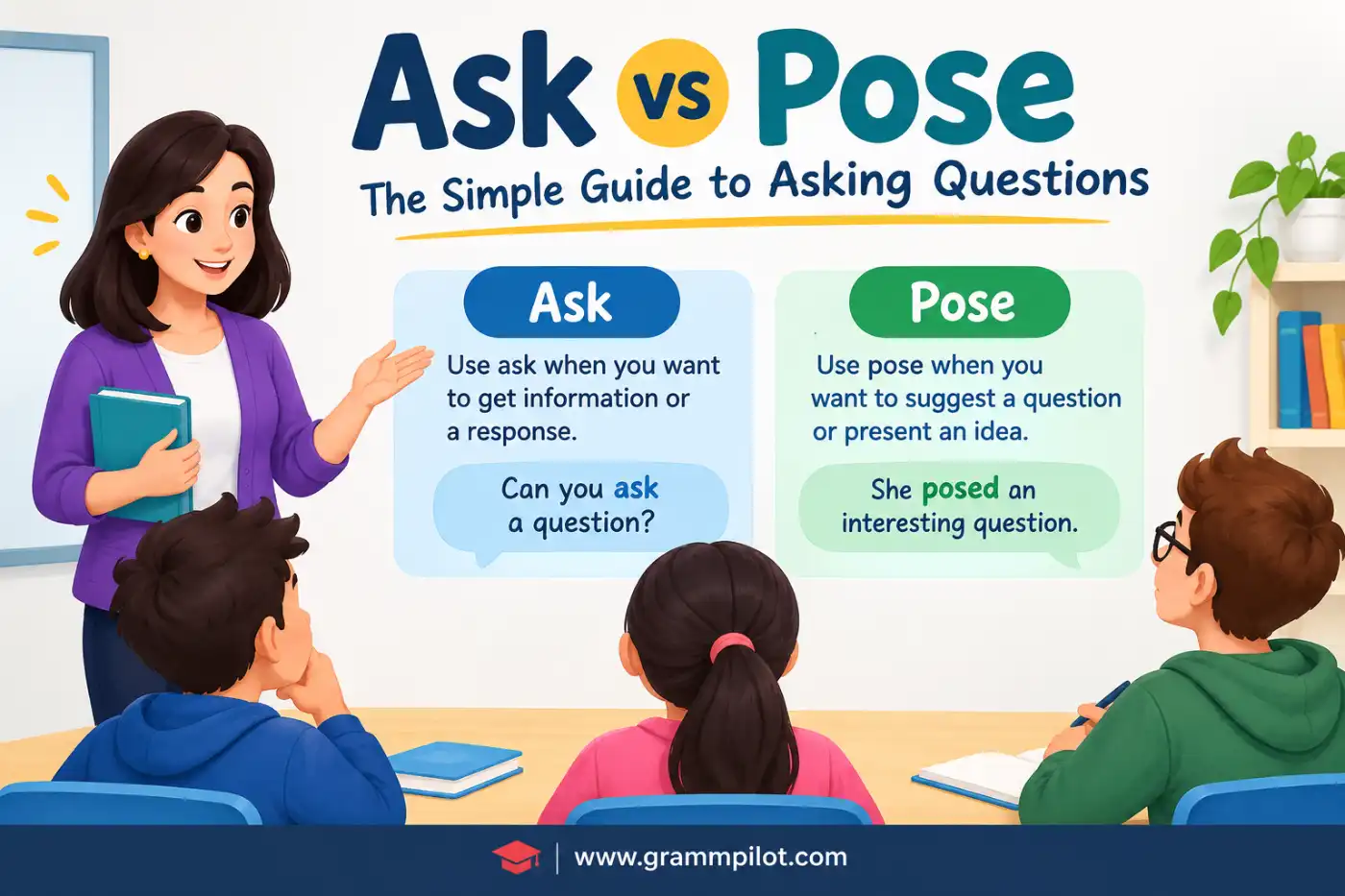
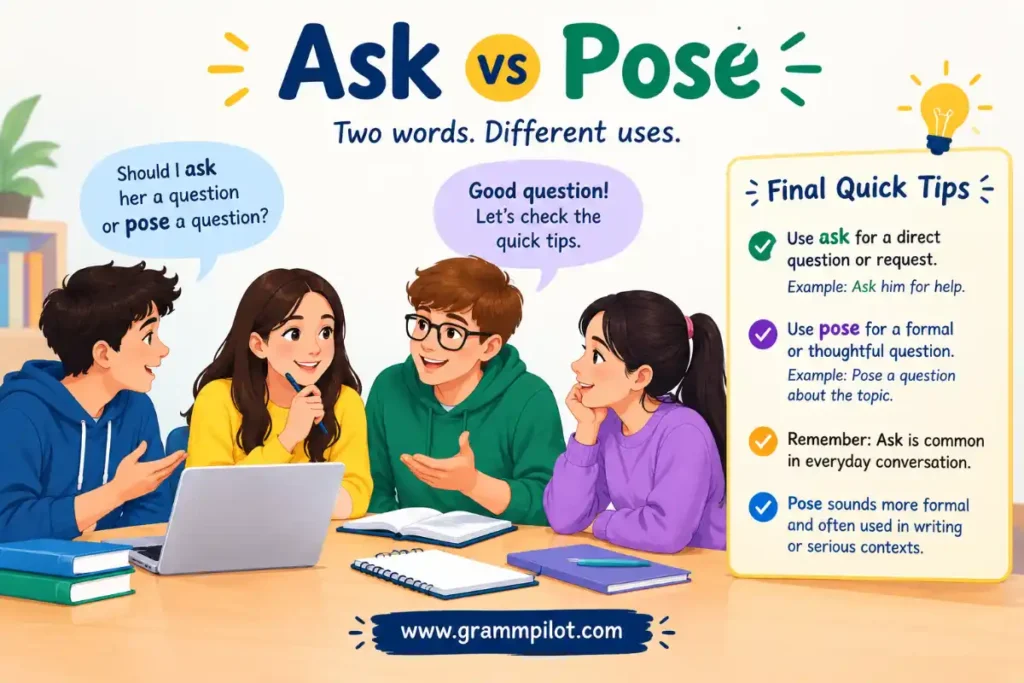
Ask is the everyday word for requesting information, help, permission, or something else. Pose is more formal and usually means presenting or putting forward a question, problem, or idea for others to consider.
This guide explains the meanings, origins, synonyms, tone differences, real examples, common mistakes, regional notes, and the best choice for emails, essays, resumes, texts, and conversations.
If you often second-guess your spelling, [Listen to Music vs Listen to the Music] is worth reading.
What do ask and pose mean?
At first glance, ask and pose may look like close synonyms. In some sentences, they are. However, their main meanings are different.
What does ask mean?
Ask usually means to request something or seek information.
You can ask:
- A question
- For help
- For permission
- For advice
- Someone to do something
- For a price
- For directions
Examples:
- I asked her a question.
- Can I ask for your advice?
- He asked the teacher for help.
- She asked me to wait.
- We asked for permission.
Ask is one of the most flexible words in English. It works in casual conversations, professional emails, classrooms, and formal writing.
What does pose mean?
Pose has several meanings, but when discussing questions, it usually means to present or put forward a question, problem, or idea for consideration.
Examples:
- The teacher posed an interesting question.
- The article poses an important problem.
- She posed a difficult question to the group.
- The speaker posed a challenge for the audience.
Pose often sounds more formal, thoughtful, or academic than ask. A person may ask, “What time is it?” But a writer may pose a question such as, “What does success really mean?”
That difference matters.
Where do the words ask and pose come from?
Knowing a word’s history can make its modern meaning easier to understand.
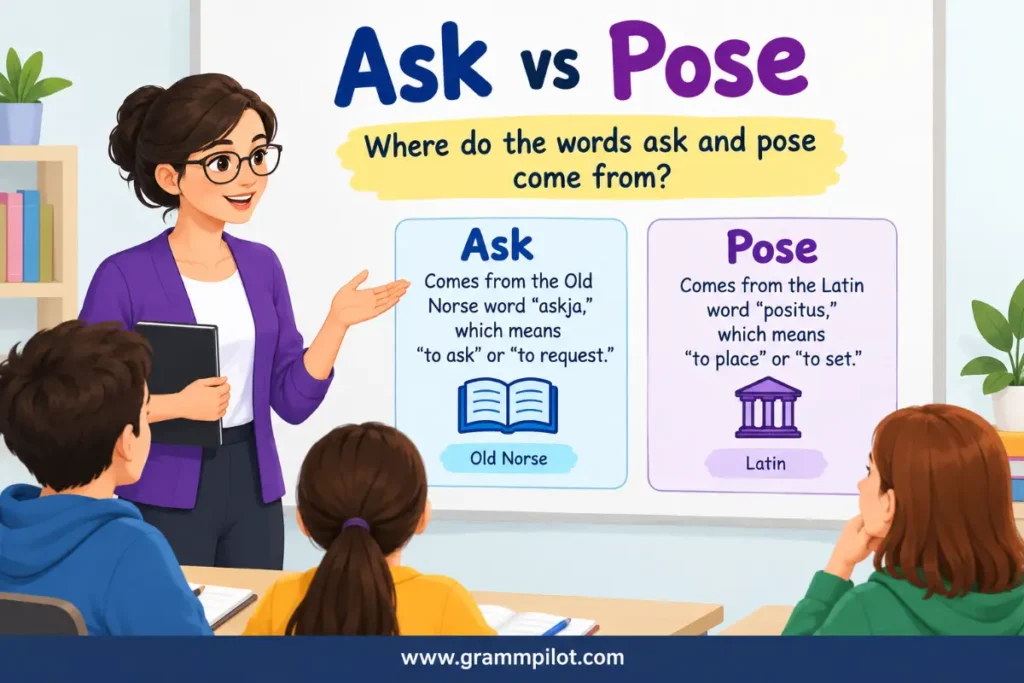
The origin of ask
Ask comes from Old English. It has been part of English for many centuries and has long carried the basic idea of requesting, seeking, or questioning. That old meaning still appears clearly in modern English.
When you ask, you are trying to get something:
- Information
- Help
- Permission
- Advice
- An answer
- An action
This is why ask works in so many situations.
The origin of pose
Pose came into English through French and ultimately has roots connected to the idea of placing or putting something in a position. That original sense helps explain its modern meaning.
When you pose a question, you are almost placing that question in front of someone for them to think about. Imagine putting a question on a table and saying, “Here is something for us to consider.”
That is close to the feeling of pose. The word still has other meanings too:
- To pose for a photograph
- To pose a threat
- To pose as someone else
- To pose a question
- To pose a problem
Because pose has several meanings, context is especially important.
Ask vs Pose: What are the best synonyms for ask and pose?
The best synonym depends on what you are trying to say. There is no single replacement that works in every sentence. Below is a broad synonym list grouped by tone and use.
Master synonym list for ask and pose
| Word | Meaning | Tone | Example |
|---|---|---|---|
| Ask | Seek information or request something | Neutral | I asked for directions. |
| Question | Ask for information or challenge something | Neutral/Formal | She questioned his decision. |
| Inquire | Ask for information | Formal | I inquired about the schedule. |
| Seek | Try to obtain information or help | Formal | She sought advice. |
| Query | Ask a question or raise a doubt | Formal | The reader queried the result. |
| Investigate | Ask questions to discover facts | Neutral/Formal | Police investigated the claim. |
| Consult | Ask someone for expert advice | Formal | We consulted a lawyer. |
| Appeal | Make a serious request | Formal | They appealed for support. |
| Beg | Ask strongly or emotionally | Strong | He begged for another chance. |
| Plead | Ask urgently or emotionally | Strong | She pleaded for help. |
| Implore | Beg in a very serious way | Very strong/Formal | He implored them to listen. |
| Urge | Strongly encourage or request | Strong | They urged him to leave. |
| Find out | Ask or investigate to learn | Everyday | I’ll find out tomorrow. |
| Hit up | Contact someone and ask informally | Slang | I’ll hit up Sam for details. |
| Pick someone’s brain | Ask for ideas or knowledge | Informal | Can I pick your brain about marketing? |
| Pop the question | Ask a major question, often about marriage | Informal/Idiomatic | He finally popped the question. |
| Sound out | Ask someone informally to learn their opinion | Informal | She sounded out her coworkers. |
| Probe | Ask deeply to discover more | Formal | The lawyer probed the witness. |
| Interrogate | Ask many serious questions | Strong/Formal | Detectives interrogated the suspect. |
| Pose | Present a question or issue | Formal | The essay poses a challenge. |
A synonym should match your purpose, not just your dictionary definition.
Ask vs Pose: Simple synonyms for everyday situations
These words are easy to use in normal conversations:
- Ask
- Question
- Check
- Find out
- Bring up
- Talk to
- Request
- Invite
Examples:
- I need to ask my manager.
- Let me check with my sister.
- I’ll find out what happened.
- She brought up an interesting topic.
- We requested more information.
Everyday and informal alternatives
These options sound natural in conversation:
- Bring up
- Check
- Find out
- Sound out
- Pick someone’s brain
- Hit up
- Reach out to
- Talk to
Examples:
- I’ll reach out to the team tomorrow.
- Can I pick your brain for a minute?
- She brought up the problem during lunch.
- Let’s sound out a few people before deciding.
Be careful with slang. A phrase like “hit up” may sound fine in a text but not in a formal business letter.
Formal alternatives for professional and academic writing
These words often work well in essays, reports, and professional communication:
- Inquire
- Request
- Seek
- Query
- Consult
- Raise
- Present
- Put forward
- Pose
- Appeal
- Probe
Examples:
- The report raises an important issue.
- The researcher posed a new question.
- I would like to inquire about the position.
- The committee put forward several recommendations.
- She sought advice from an expert.
Slang and casual alternatives
Slang can add personality, but it should match your audience.
- Hit up
- Pick someone’s brain
- Pop the question
- Get the scoop
- Ask around
- Give someone a shout
Examples:
- I’ll ask around and see what people think.
- Give her a shout when you get home.
- Let’s get the scoop from Alex.
- Can I pick your brain about this?
Avoid these phrases in formal essays unless you are quoting natural speech.
Synonyms by intensity: mild to strong
The strength of your word can change the emotional meaning.
Mild
These words sound neutral:
- Ask
- Check
- Inquire
- Question
- Bring up
Example: She asked about the meeting time.
Moderate
These words suggest more purpose or importance:
- Request
- Seek
- Query
- Consult
- Raise
- Pose
Example: The writer posed an important question.
Strong
These words show urgency or pressure:
- Urge
- Appeal
- Challenge
- Probe
- Press
Very strong or emotional
These words suggest desperation or intense feeling:
- Beg
- Plead
- Implore
Example: He pleaded for another opportunity.
Choosing a stronger word can make your sentence more dramatic, so use it carefully.
Ask vs Pose: Are ask and pose the same part of speech?
Both ask and pose are commonly used as verbs.
Ask as a verb
Examples:
- Ask a question.
- Ask for help.
- Ask someone to leave.
Ask can also appear in noun phrases, especially in informal business language:
- That’s a big ask.
In that sentence, ask means a request or something difficult to expect from someone.
Pose as a verb
Examples:
- Pose a question.
- Pose a problem.
- Pose a threat.
- Pose for a photo.
- Pose as someone else.
Pose can also be a noun:
- The model held a pose.
- She struck a dramatic pose.
This is another reason why pose needs careful context.
How do Americans and British speakers use ask and pose?
Both words are widely understood in the United States and the United Kingdom.
There is no major US-versus-UK difference in the basic meanings.
In American English
Ask is extremely common in everyday speech:
- Ask your teacher.
- Ask for help.
- Ask a question.
Pose is more likely to appear in:
- Academic writing
- Journalism
- Speeches
- News reports
- Serious discussions
In British English
The pattern is broadly similar. Ask remains the normal everyday choice, while pose often sounds more formal or deliberate. One regional difference is more about surrounding vocabulary than these two words themselves. For example, a British speaker might say “make an enquiry” in some formal settings, while an American speaker may more often say “make an inquiry” or simply “ask.”
The main rule stays the same: use ask for ordinary requests and questions, and use pose when presenting a question or issue for thought.
Ask vs Pose: What’s the best word for a resume?
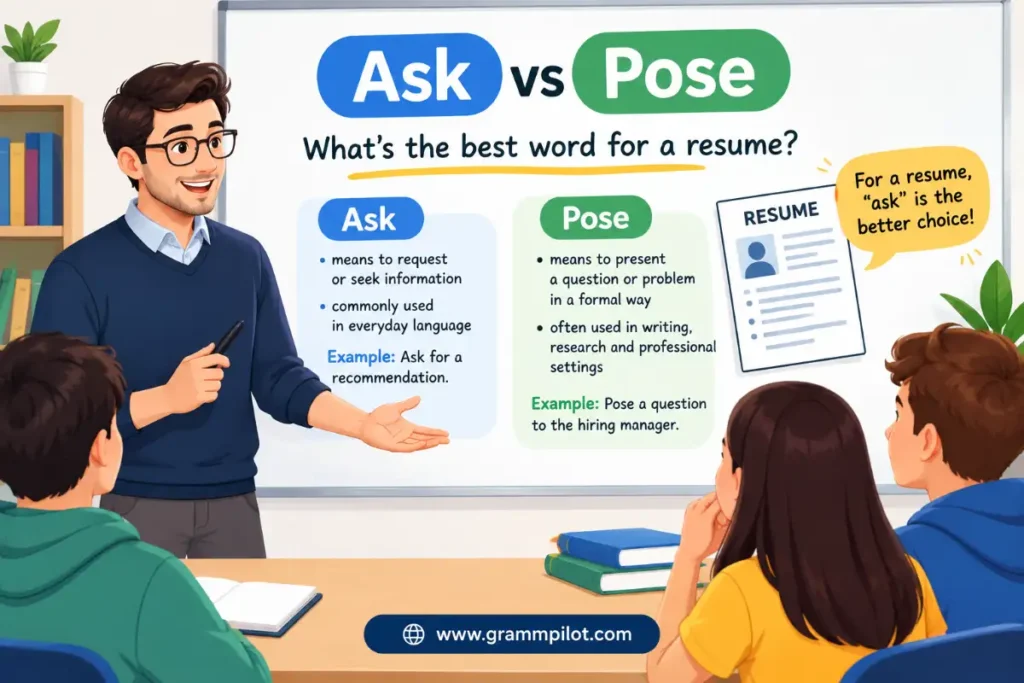
Your resume should use strong, clear action verbs. In most cases, ask and pose are not the strongest choices for describing your work.
When ask works on a resume
Ask can work when describing communication or information gathering, but a more specific verb may be better.
Less strong: Asked customers about their needs.
Better: Consulted customers to identify their needs.
Another option: Gathered customer feedback to improve service.
When pose works on a resume
Pose is uncommon on resumes, but it may work in research or leadership roles.
Example: Posed critical questions that guided the research project.
Still, verbs such as analyzed, evaluated, investigated, developed, led, and improved may be more powerful depending on the situation.
Best resume tip: Choose a verb that clearly shows what you did and what result you produced.
What’s the best word for an essay?
Essays often need a more formal tone.
Use ask in an essay when the question itself matters
Example: The article asks About technology improves communication.
This sounds clear and natural.
Use pose when presenting a thoughtful issue
Example: The article poses an important question about privacy.
This sounds slightly more academic.
Use raise for issues and concerns
Example: The study raises concerns about air pollution.
Use examine or investigate for research
Example:
- This essay examines the causes of the problem.
- The study investigates how sleep affects learning.
For formal writing, do not choose a complicated word just to sound intelligent. Clear writing is usually stronger.
What’s the best word for speaking?
When speaking naturally, ask is almost always the safest choice.
Examples:
- I want to ask you something.
- Ask the doctor.
- Don’t be afraid to ask questions.
Use pose when the discussion is serious or intellectual:
- Let me pose a question to the group.
This sentence works well during:
- A speech
- A debate
- A classroom discussion
- A meeting
- A presentation
In ordinary conversation, ask is usually more natural.
Ask vs pose in real-life examples
The best way to understand these words is to see them in different situations.
At school
- Maria asked her teacher for extra help before the exam.
- The professor posed a question that started a long classroom discussion.
- Don’t be afraid to ask when you don’t understand something.
- The assignment poses an interesting challenge for students.
At work
- I asked my manager about the meeting could be moved.
- The report poses serious questions about the company’s future.
- The customer asked for a refund.
- During the meeting, James raised a concern about the budget.
For an email
- I would like to ask about the status of my application.
- The email posed several questions that required detailed answers.
- She requested a copy of the final report.
- We asked the client for feedback.
In daily conversation
- Can I ask you a personal question?
- He asked around for a good mechanic.
- The documentary poses a difficult question: Who should control personal data?
- My sister asked me to pick up groceries.
In writing and research
- The researcher posed a new theory.
- The study asks about social media affects sleep.
- The article raises questions about online privacy.
- The lawyer questioned the witness carefully.
Notice how ask often involves a person wanting an answer, action, or help. Pose often presents something for broader thought.
Ask a question vs pose a question: what’s different?
This is one of the closest comparisons.
| Ask a question | Pose a question |
|---|---|
| Seek an answer directly | Present a question for consideration |
| Common in speech | Common in formal writing |
| Neutral tone | More thoughtful or formal |
| Can be simple or serious | Often sounds deliberate |
| Very common | Less common |
Compare:
- I asked the teacher a question about the homework.
- The speaker posed a question about the future of education.
The first situation is personal and direct. The second invites an audience to think.
Both are correct. The context changes the best choice.
Pose vs raise: what’s the difference?
These words are close, but they focus on different actions.
Pose
Usually means present something for consideration.
- The author posed an interesting question.
- The situation poses a serious challenge.
Raise
Usually means bring a topic, issue, concern, or question into a discussion.
- She raised an important point.
- The report raised concerns about safety.
Compare:
- The speaker posed a question.
- A member of the audience raised a question.
Both work, but pose focuses on presenting the question, while raise focuses on bringing it into the discussion.
Pose vs present: what’s the difference?
Present is broader than pose.
You can present:
- A report
- An idea
- Evidence
- A plan
- A question
Pose is more limited and often focuses on:
- Questions
- Problems
- Challenges
- Threats
Examples:
- She presented her research findings.
- She posed an important question.
You would not normally say:
- She posed her research findings.
That sounds wrong because pose does not work as a general replacement for present.
Can you pose a request?
Usually, no.
This is a common mistake because people sometimes think pose means “ask” in every situation.
Correct:
- I asked for help.
- I made a request for help.
- I requested help.
Usually incorrect or unnatural:
- I posed for help.
You can pose a question, problem, challenge, or threat. You generally do not pose for a drink, a favor, permission, or directions.
Common mistakes people make with ask and pose
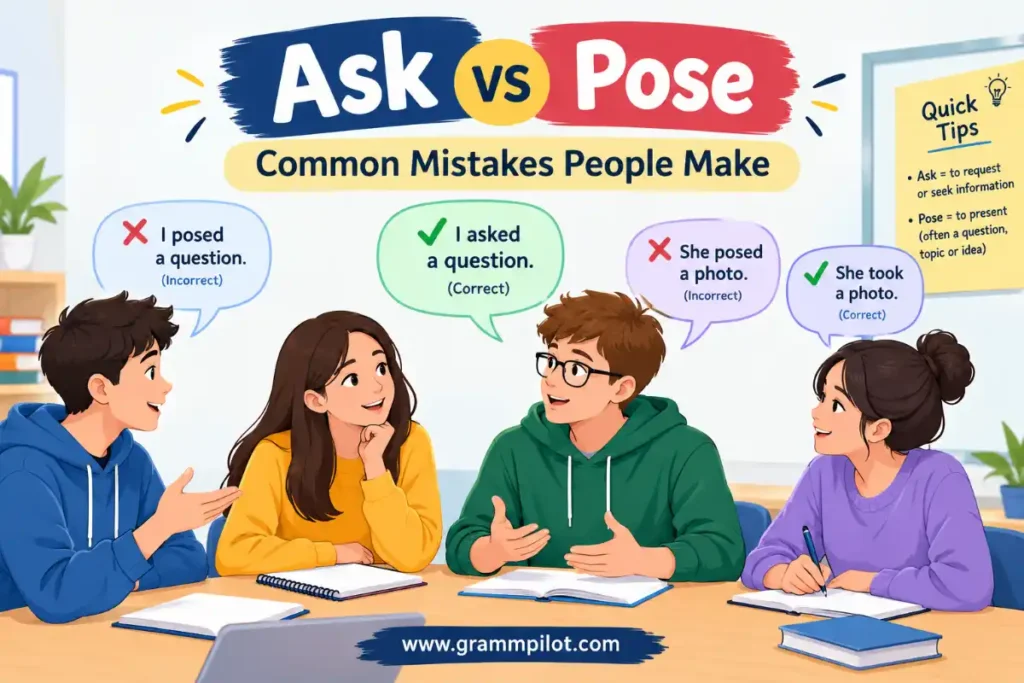
Mistake 1: Using pose for every type of request
Incorrect: I posed my teacher for help.
Correct: I asked my teacher for help.
Why? Because pose is not a general word for requesting something.
Mistake 2: Using ask when you mean request formally
This is not always wrong, but the tone may be too casual.
Casual: I want to ask for a meeting.
More professional:I would like to request a meeting.
Mistake 3: Forgetting the correct pattern with ask
Common patterns include:
- Ask someone a question.
- Ask someone for something.
- Ask someone to do something.
Examples:
- Ask her a question.
- Ask her for help.
- Ask her to call me.
Incorrect patterns can sound confusing: Ask to her a question.
Correct: Ask her a question.
Mistake 4: Using pose without a suitable object
Pose usually needs something specific.
Correct:
- She posed a question.
- The problem poses a challenge.
Unclear:
- She posed yesterday.
That sentence only works if you mean she took a position for a photograph.
Mistake 5: Using a formal word in a casual situation
Imagine texting a friend: I wish to inquire if you are attending the party.
It is correct, but it sounds stiff.
A natural version: Are you coming to the party?
Always think about your audience.
Mistake 6: Thinking a longer word is always better
Words like inquire, query, and pose may sound formal, but they are not automatically better.
Simple:
- I asked my teacher for help.
This is clear and natural.
There is no need to replace ask with a more complicated word unless the context calls for it.
When should you not use pose?
Avoid pose when you mean:
Asking for something
Use:
- Ask
- Request
- Request for
Example: She asked for a glass of water.
Seeking casual information
Use ask or check.
Example: Ask Tom what time the movie starts.
Making a normal personal request
Use ask.
Example: Can I ask you a favor?
Pose sounds best when you are presenting an idea, issue, or question for thought.
What are the antonyms of ask and pose?
Antonyms can be difficult because the opposite depends on the meaning.
Antonyms related to ask
Possible opposites include:
- Answer
- Reply
- Respond
- Tell
- Give
Example: One person asks; another person answers.
Antonyms related to pose a question
Possible opposites may include:
- Answer
- Resolve
- Settle
- Explain
- Clarify
Example: The article poses a question, then tries to answer it.
These are not accurate dictionary opposites in every situation, but they show the contrast between presenting a question and providing a solution.
How do you choose the right word quickly?
Use this simple checklist.
Choose ask when:
- You want information.
- You want help.
- You want permission.
- You want someone to do something.
- You are speaking casually.
- You are writing a normal email.
- You need a flexible everyday word.
Examples:
- Ask for directions.
- Ask for help.
- Ask a question.
- Ask for permission.
Choose pose when:
- You are presenting a serious question.
- You are introducing a problem.
- You want an academic tone.
- You are writing a report or essay.
- You want people to think about an issue.
Examples:
- Pose a question.
- Pose a problem.
- Pose a challenge.
- Pose a threat.
Choose request when:
- You are formally asking for something.
Example:
- I would like to request a meeting.
Choose inquire when:
- You are formally seeking information.
Example:
- I am writing to inquire about the program.
Choose raise when:
- You are bringing up an issue or concern.
Example:
- She raised an important concern.
This kind of context-based choice is more useful than memorizing long synonym lists.
A teacher’s final explanation
If you remember only one thing, remember this: ask is the wider word.
You can ask for:
- Help
- Advice
- Permission
- Information
- Directions
- A favor
- An answer
Pose does not work in all those situations.
Pose is narrower. It is mainly used when someone presents:
- A question
- A problem
- A challenge
- A threat
- An issue
So, when you’re unsure, ask yourself one simple question:
Am I requesting something from someone, or am I putting an idea in front of people to think about?
If you are requesting or seeking information, choose ask.
If you are presenting a serious question or issue for thought, choose pose.
That small test will help you make the right choice in most situations.
Final quick tips for choosing the right word
- Use ask for everyday questions and requests.
- Use pose for thoughtful questions and serious issues.
- Use request in formal situations when asking for something.
- Use inquire when formally seeking information.
- Use raise when bringing up a concern or issue.
- Use consult when seeking expert advice.
- Don’t replace ask with pose unless the object fits naturally.
- Choose tone based on your audience.
- Keep casual writing simple.
- Use formal vocabulary only when it improves clarity.
Conclusion
Understanding Ask vs Pose is mostly about understanding purpose and tone. Ask is the everyday choice when you want information, help, permission, or action. Pose is more formal and usually introduces a question, problem, challenge, or issue that deserves thought.
You don’t need to memorize every synonym to write well. Start by asking what you really mean. Are you requesting something? Use ask. Are you presenting an idea for discussion? Pose may be the better choice. With practice, the difference will begin to feel natural, and your emails, essays, conversations, and professional writing will sound clearer and more precise.
Frequently Asked Questions
1. What is the difference between ask and pose?
Ask means to request information, help, permission, or something else. Pose usually means to present a question, problem, or idea for others to consider.
2. Can I say “pose a question”?
Yes. “Pose a question” is correct and common, especially in formal, academic, or thoughtful discussions. It means to present a question for people to think about or answer.
3. Can pose replace ask in every sentence?
No. In Ask vs Pose, pose cannot replace ask when you are requesting help, permission, advice, or another ordinary favor. You can ask for help, but you normally do not pose for help.
4. What’s another way to say ask?
Another way to say ask is inquire, request, question, seek, query, consult, or raise, depending on the context. Informal alternatives include check, ask around, or pick someone’s brain.
5. Is pose more formal than ask?
Yes, pose usually sounds more formal and deliberate than ask. It is common in essays, speeches, reports, classroom discussions, and serious conversations.
6. Should I use ask or pose in an essay?
Both can work. Use ask when simply describing a question, and use pose when presenting an important question or issue for consideration.