
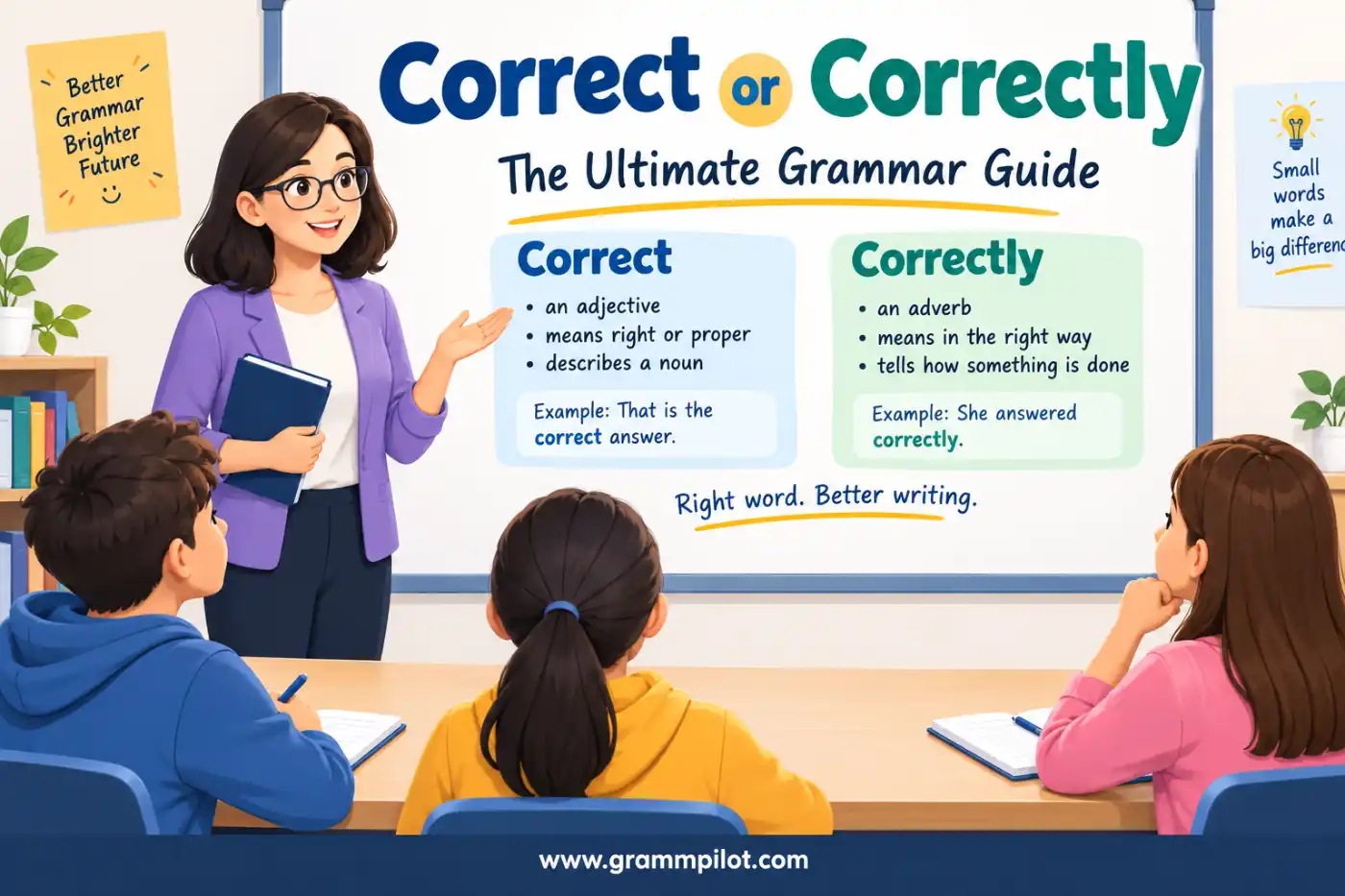
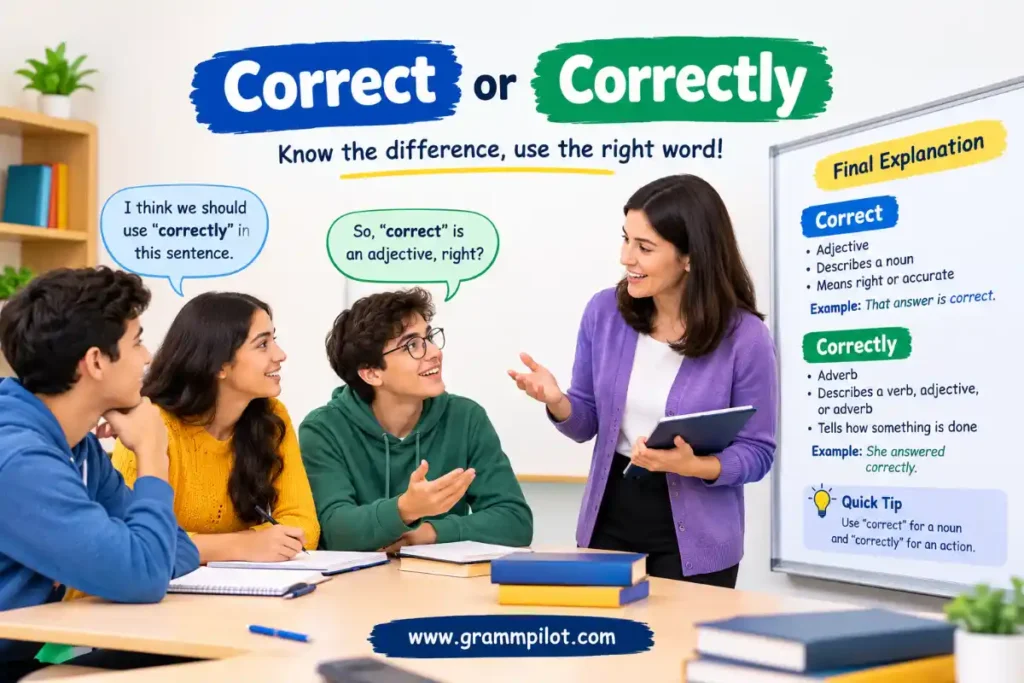
Have you ever written an email, text, essay, or school assignment and wondered about to say “Do it correct” or “Do it correctly”? Both words come from the same base word, so the choice can feel confusing. The difference between Correct or Correctly depends on the job the word does in a sentence. Correct is usually an adjective, while correctly is an adverb. That means they describe different things.
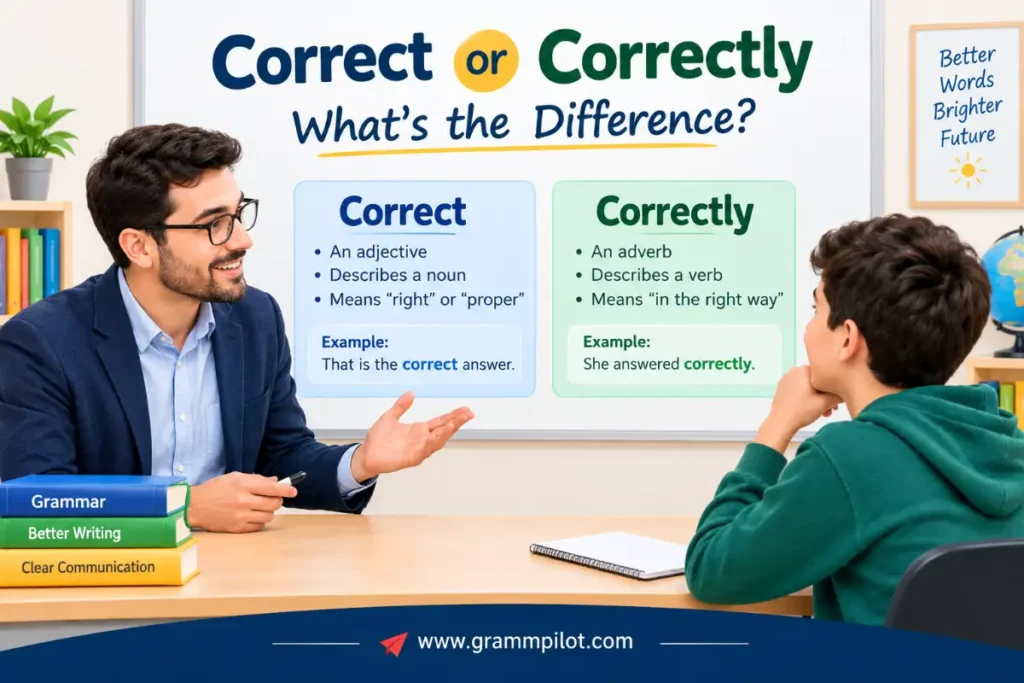
Correct describes a noun or pronoun, while correctly describes an action or verb. Use “correct” for something that is right or accurate and “correctly” for an action done in the right way.
This guide explains the difference, word origins, grammar rules, synonyms, examples, common mistakes, regional usage, and the best choice for emails, essays, resumes, texting, and everyday speech.
If you’re learning how to use comparisons effectively, take a look at [Similes for Death].
What does correct mean?
As an adjective, correct means right, accurate, true, or free from an error.
Examples:
- That is the correct answer.
- Your spelling is correct.
- We made the correct decision.
- Is this address correct?
- Her calculation was correct.
The word tells us something about a person, object, answer, statement, or idea.
Correct as a verb
Correct can also function as a verb. In this use, it means to fix an error or tell someone that something is wrong.
Examples:
- The teacher corrected my essay.
- Please correct the spelling mistake.
- She corrected his pronunciation.
- The editor corrected several errors.
Here, correct is an action.
Correct as a noun
The noun form is less common in everyday English, but correct can appear in expressions such as: “The correct” in contrast to “the incorrect” in specialized contexts.
More commonly, English uses nouns such as correction, correctness, or accuracy.
What does correctly mean?
Correctly is an adverb. It usually means in a correct, accurate, or proper way.
Examples:
- She answered the question correctly.
- Please spell my name correctly.
- He installed the software correctly.
- The machine wasn’t working correctly.
- You pronounced the word correctly.
The word explains how an action was performed.
A useful question to ask is: How did the person do it?
If the answer is “correctly,” you probably need the adverb.
For example:
- How did she answer? Correctly.
- How did he spell the word? Correctly.
- How did they complete the form? Correctly.
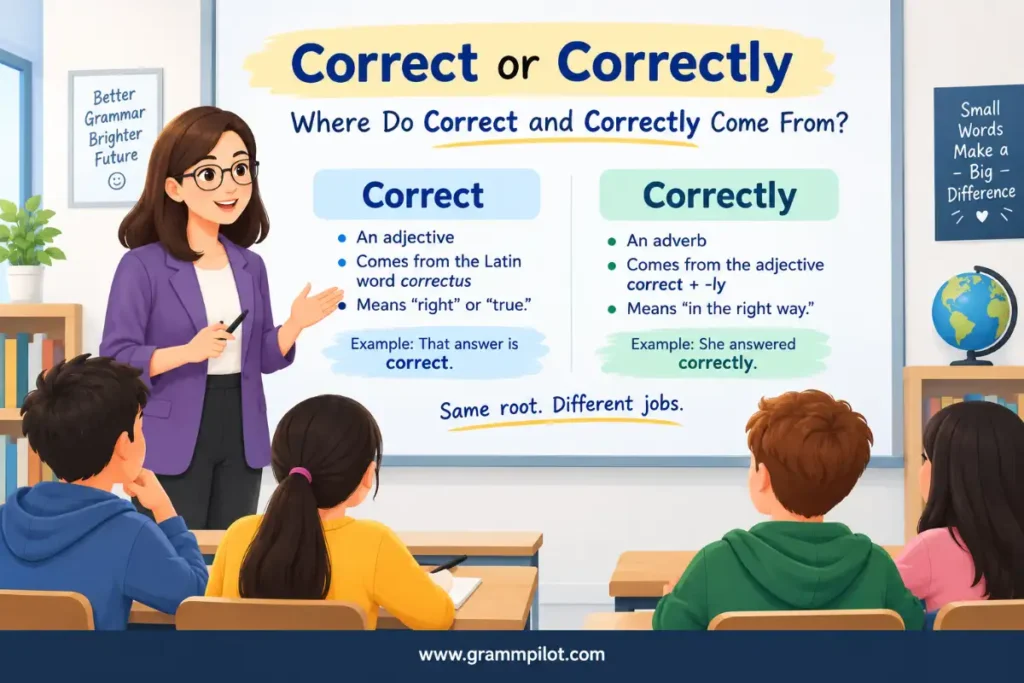
Where do correct and correctly come from?
Understanding the history of a word can make its meaning easier to remember.
The origin of correct
Correct comes from Latin corrigere, meaning “to make straight,” “set right,” or “correct.” The word entered English through French. The original idea of making something right is still visible today. When you correct a mistake, you make something right. When something is correct, it is already right.
How correctly developed
Correctly is formed from correct + -ly.
The ending -ly commonly turns an adjective into an adverb.
For example:
- Quick → quickly
- Careful → carefully
- Accurate → accurately
- Correct → correctly
So the form itself provides a useful clue.
Correct = describes something.
Correctly = describes how something is done.
Correct or correctly: which one is right?
Both are correct words. The right choice depends on the sentence.
Use correct before a noun
Examples:
- The correct answer
- The correct spelling
- The correct address
- The correct information
- The correct method
- The correct procedure
Here, correct acts as an adjective.
Use correctly after or around a verb
Examples:
- Answer correctly.
- Spell the name correctly.
- Use the tool correctly.
- Complete the form correctly.
- Explain the idea correctly.
Here, correctly describes the action.
Compare these sentences
- She gave the correct answer.
- She answered the question correctly.
Both sentences communicate a similar idea, but their grammar is different.
What are the main grammar rules?
The most useful rule is simple:
Rule 1: Correct usually describes a noun
Examples:
- That is the correct answer.
- He chose the correct option.
- This is the correct spelling.
Ask yourself: What is correct?
If the answer is a noun, correct is likely the right choice.
Rule 2: Correctly usually describes an action
Examples:
- She answered correctly.
- He spelled it correctly.
- They completed the task correctly.
Ask yourself: How was the action done?
If the answer is “in the right way,” correctly is likely appropriate.
Rule 3: Linking verbs often take adjectives
After verbs such as be, seem, look, feel, become, appear, adjectives often describe the subject.
Examples:
- Your answer is correct.
- That doesn’t seem correct.
- Everything looks correct.
- The information appears correct.
You wouldn’t normally replace the adjective with an adverb: Your answer is correctly.
That is incomplete or incorrect if you mean “Your answer is right.”
Why do people say “do it correctly”?
The verb do describes an action. We need a word that tells us how the action should be performed.
So: Do it correctly.
This means: Do it in the right way.
The word correctly modifies the action “do.”
Compare Do the correct exercise.
Here, correct describes the noun “exercise.”
This distinction is one of the easiest ways to remember the rule.
Why is “do it correct” usually considered wrong?
In standard American English, “Do it correct” is generally considered nonstandard when correct is intended to be an adjective modifying the action.
The standard form is: Do it correctly.
However, you may sometimes hear adjective forms used after verbs in informal speech or regional varieties of English. That doesn’t make them appropriate for every writing situation. For schoolwork, professional emails, formal writing, and standard edited English, use: Do it correctly.
This is clearer and safer.
Correct or correctly in everyday examples
Let’s look at the difference in real situations.
School
- She chose the correct answer.
- She answered the question correctly.
- Please write the correct date.
- Make sure you spell the word correctly.
Work
- We need the correct information.
- Please enter the information correctly.
- Is this the correct file?
- You completed the form correctly.
- Please confirm that the address is correct.
- Please enter your details correctly.
- I want to make sure I understood your instructions correctly.
Technology
- Select the correct setting.
- The program isn’t working correctly.
- Make sure the cable is connected to the correct port.
- The software was installed correctly.
Everyday conversation
- Is this the correct bus?
- Did I pronounce your name correctly?
- You’re correct.
- You guessed correctly.
Correct or correctly in a sentence: side-by-side examples
| Correct | Correctly |
|---|---|
| That is the correct answer. | You answered correctly. |
| This is the correct file. | You selected the file correctly. |
| Use the correct method. | You used the method correctly. |
| Her information is correct. | She entered the information correctly. |
| That is the correct spelling. | You spelled it correctly. |
| We chose the correct option. | We chose the option correctly. |
| His pronunciation is correct. | He pronounced the word correctly. |
| The calculation is correct. | She calculated the result correctly. |
| This is the correct procedure. | They followed the procedure correctly. |
| Your interpretation is correct. | You interpreted the passage correctly. |
The pattern becomes much easier to see when the words are placed side by side.
What are the best synonyms for correct and correctly?
There are many useful alternatives, but each has a slightly different meaning or tone.
Synonyms for correct as an adjective
| Word | Meaning | Tone | Example |
|---|---|---|---|
| Right | Not wrong | Everyday | That’s the right answer. |
| Accurate | Free from factual errors | Formal | The report is accurate. |
| True | Based on fact | Neutral | The statement is true. |
| Exact | Completely precise | Neutral/Formal | Give me the exact number. |
| Precise | Very exact | Formal | Her measurements are precise. |
| Proper | Suitable or correct | Neutral/Formal | Use the proper procedure. |
| Valid | Logically or officially acceptable | Formal | That’s a valid argument. |
| Sound | Reasonable and reliable | Formal | That’s a sound decision. |
| Appropriate | Suitable for the situation | Formal | Choose an appropriate response. |
| Legitimate | Valid or lawful | Formal | The concern is legitimate. |
| Error-free | Without mistakes | Neutral | The document is error-free. |
| Factual | Based on facts | Formal | The information is factual. |
| Reliable | Can be trusted | Neutral | The source is reliable. |
| Precise | Exact and carefully stated | Formal | The wording is precise. |
| Proper | Done according to accepted standards | Neutral | Follow the proper process. |
Synonyms for correctly as an adverb
| Word | Meaning | Tone | Example |
|---|---|---|---|
| Properly | In the right way | Neutral | Install it properly. |
| Accurately | Without factual or measurement errors | Formal | Record the data accurately. |
| Precisely | Exactly | Formal | Follow the instructions precisely. |
| Exactly | In an exact way | Neutral | That’s exactly what happened. |
| Appropriately | In a suitable way | Formal | Respond appropriately. |
| Accurately | With factual correctness | Formal | The form was completed accurately. |
| Right | In the correct way | Casual | You did it right. |
| Successfully | With the intended result | Neutral | The program ran successfully. |
| Accurately | Without any noticeable error | Neutral | She performed the task accurately. |
| Faithfully | In a way that closely follows an original | Formal | The text was translated faithfully. |
Be careful with synonyms. Successfully, for example, does not always mean correctly.
A person can perform something successfully but still make a mistake in the process.
Synonyms by intensity
Not every alternative has the same strength.
Mild
These are simple and natural:
- Right
- Proper
- Correct
- Properly
- Right
Examples:
- You did it right.
- Use the proper form.
Moderate
These emphasize accuracy:
- Accurate
- Correct
- Properly
- Accurately
- Appropriately
Examples:
- The information is accurate.
- Please complete the form properly.
Strong
These suggest a very high level of precision:
- Exact
- Precise
- Precisely
- Accurately
- Exactly
Examples:
- Give me the exact number.
- Follow the instructions precisely.
Don’t use a stronger word unless its meaning fits.
For example, “correct” does not always mean “aaccurate.” Something can be correct without being accurate.
Correct or right: what’s the difference?
Right and correct are often interchangeable when they mean “not wrong.”
Compare:
- Your answer is correct.
- Your answer is right.
Both sound natural.
However, right is generally more conversational, while correct can sound more precise or formal.
| Correct | Right |
|---|---|
| More neutral/formal | More conversational |
| Common in school and professional contexts | Extremely common in everyday speech |
| Often emphasizes accuracy | Can also mean morally or personally appropriate |
Examples:
- The correct answer is B.
- That’s right!
A teacher may say: Your answer is correct.
A friend may say: You’re right.
Correct vs accurate: what’s the difference?
These words are close but not identical.
Correct means not wrong.
Accurate means matching facts, measurements, or reality closely.
For example:
- Your answer is correct.
- The measurement is accurate.
You can also say:
- The information is correct.
- The information is accurate.
But accurate often puts more emphasis on factual precision.
Example
Suppose someone says: The meeting starts at 3 p.m.
If that statement matches the actual schedule, it is correct.
If a measurement says: The table is 120.02 cm long.
The measurement can be described as accurate if it closely reflects the actual length.
Correct vs proper: what’s the difference?
Correct often means factually or grammatically right.
Proper often means suitable, acceptable, or according to a particular rule or standard.
Compare:
- This is the correct answer.
- Wear the proper safety equipment.
“Correct safety equipment” is possible, but “proper safety equipment” often sounds more natural because the focus is suitability.
Similarly:
- Please use the correct spelling.
- Please use the proper procedure.
Context decides which word sounds best.
Correct vs exact: what’s the difference?
Correct means right.
Exact means completely precise or matching something precisely.
For example:
- Your answer is correct.
- Give me the exact answer.
The first says the answer is not wrong.
The second suggests that the speaker wants a precise answer, not an approximation.
Compare:
- The correct time is around 5 p.m.
- The exact time is 5:17 p.m.
Something can be correct without being exact.
Correctly vs accurately: what’s the difference?
Correctly is broad. Accurately focuses more strongly on factual precision.
Examples:
- She answered the question correctly.
- She recorded the measurement accurately.
You could say: She answered the question accurately.
That works when the question requires factual precision.
But correctly can apply to many actions that aren’t measurements.
For example: Please pronounce the name correctly.
“Accurately” could work in some contexts, but correctly is much more natural.
Correctly vs exactly: what’s the difference?
These words are not always interchangeable.
Correctly means in the right way.
Exactly means precisely or without difference.
Compare:
- You answered the question correctly.
- You repeated my words exactly.
The first focuses on correctness. The second focuses on exact matching. You can answer a question correctly without using the exact words expected by someone else.
What is the best word for a resume?
Resumes need precise, professional language.
The adjective correct may be useful when describing information or records: Maintained correct customer records.
However, this may sound less powerful than a specific achievement.
Better: Maintained accurate customer records.
Or: Verified customer records for accuracy.
For actions, correctly may appear in a resume, but strong action verbs are often better.
Instead of: Correctly entered customer information.
Consider:
- Entered customer information accurately.
- Verified customer information.
- Maintained accurate records.
A resume should show what you did, not simply say that you did it correctly.
What is the best word for an essay?
In essays, both forms are common. Use correct to describe an idea, fact, answer, or interpretation.
Examples:
- The correct interpretation depends on the historical context.
- This is the correct explanation of the theory.
Use correctly to describe an action or process.
Examples:
- The author correctly identifies the main cause.
- The researcher correctly interprets the data.
In academic writing, alternatives such as accurately, appropriately, precisely, and properly can sometimes provide more specific meaning.
What is the best word for texting?
In casual texting, simple language usually sounds best.
Examples:
- Did I do it right?
- Is this correct?
- Did I spell it correctly?
- Tell me if I got it right.
“Did I do it correctly?” is accurately grammatical, but “Did I do it right?” is more casual.
Choose based on your relationship and the tone of the conversation.
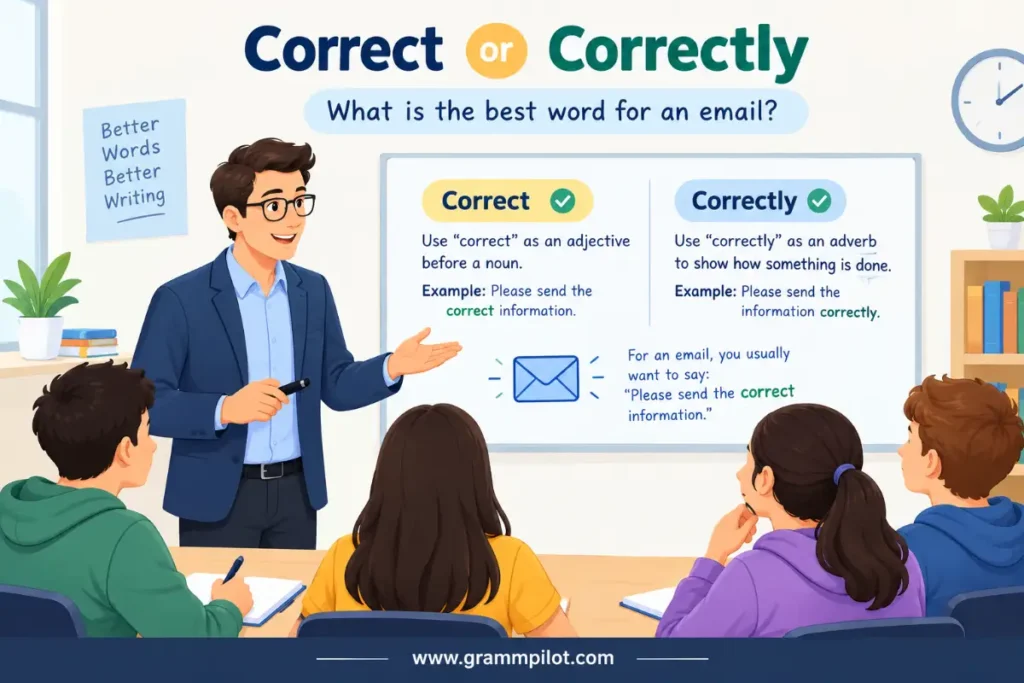
What is the best word for an email?
For professional emails, both words are useful.
Examples:
- Please confirm that the information is correct.
- Please make sure the information is entered correctly.
- I want to ensure that I have the correct address.
- Please let me know if I understood your instructions correctly.
A useful professional phrase is: “Please confirm that…”
For example: Please confirm that the attached information is correct.
Another is: “I want to make sure…”
For example: I want to make sure I completed the form correctly.
These expressions sound polite and natural.
What is the best word for speaking?
In everyday speech, correct and correctly are both common.
Examples:
- You’re correct.
- That’s correct.
- You did it correctly.
- Did I say that correctly?
- Is this correct?
In casual American English, right and rightly behave differently.
People commonly say: You did it right.
They rarely say: You did it rightly.
“Rightly” exists, but it has different uses and sounds more formal or literary. So don’t assume every adjective can simply be changed into an adverb with the same everyday meaning.
15+ original examples you can copy and study
Here are examples from different real-life situations.
- The teacher marked my answer as correct.
- I want to make sure I completed the application correctly.
- Please select the correct option.
- Did I spell your name correctly?
- The address on the package is correct.
- She entered the numbers correctly.
- We need the correct information before making a decision.
- He didn’t install the program correctly.
- Your explanation is correct, but it needs more detail.
- The student correctly identified the main idea.
- Please use the correct form when submitting your request.
- The machine isn’t operating correctly.
- I hope I understood your message correctly.
- That’s the correct way to pronounce the word.
- She followed the instructions correctly.
- The report contains the correct figures.
- He calculated the total correctly.
- Is this the correct website for registration?
These examples show that the distinction is not about which word means “right.” It’s about what the word modifies.
Common mistakes with correct and correctly
Mistake 1: “You did it correct.”
Standard edited English usually prefers: You did it correctly. Why? Because correctly describes the action “did.”
Mistake 2: “Your answer is correctly.”
Correct: Your answer is correct.
Why? Correct describes “answer.”
The verb “is” is a linking verb, so the adjective fits here.
Mistake 3: “Please write your name correct.”
Better: Please write your name correctly.
The adverb tells us how the writing should be done.
Mistake 4: “This is the correctly answer.”
Correct: This is the correct answer.
Correct describes the noun “answer.”
Mistake 5: “She explained it correct.”
Standard form: She explained it correctly.
The adverb modifies “explained.”
Mistake 6: Overusing correctly
Not every sentence needs it.
Instead of: She correctly gave the correct answer correctly.
Write: She gave the correct answer.
The shorter sentence is much cleaner.
When can “correct” appear after a verb?
This can be confusing because English has some patterns where adjectives appear after verbs.
With linking verbs, adjectives are normal:
- The answer is correct.
- The information seems correct.
- That doesn’t look correct.
- The result appears correct.
Here, the adjective describes the subject.
But after an ordinary action verb, an adverb is normally needed:
- She answered correctly.
- He worked correctly.
- They completed the task correctly.
A helpful test is to identify if the verb connects the subject to a description or expresses an action.
Are there cases where “correct” works as an adverb?
Yes, but this is less common in modern standard American English.
For example, correct can be used in certain informal or regional expressions, and dictionaries recognize adverbial uses in some varieties of English.
However, if you’re writing:
- A school assignment
- A professional email
- A resume
- A formal report
- An academic essay
Correctly is usually the safest choice when you need an adverb meaning “in the right way.”
For example: Please do it correctly.
This avoids ambiguity and follows standard formal usage.
Correct or correctly in questions
Questions often make the distinction easy to see.
Use correct to describe a thing
- Is this the correct answer?
- Is my name correct?
- Is this information correct?
- Is that the correct address?
Use correctly to describe an action
- Did I answer correctly?
- Did I spell it correctly?
- Did I pronounce it correctly?
- Did I understand you correctly?
Notice the pattern: Is + correct
versus Did + verb + correctly
Correct or correctly in commands
Commands also follow the same pattern.
Use correct with nouns
- Choose the correct answer.
- Use the correct form.
- Select the correct option.
Use correctly with actions
- Answer correctly.
- Spell it correctly.
- Enter the information correctly.
- Follow the instructions correctly.
You can even combine them: Choose the correct answer and enter it correctly.
That sentence contains both words because they perform different grammatical jobs.
How does the choice change the meaning?
Sometimes the difference is subtle. Compare: Use the correct method. This tells you to choose the right method.
Use the method correctly.
This tells you to perform the method properly. You could choose the correct method but use it incorrectly. For example, imagine a cooking technique. You may select the correct technique but perform one of its steps incorrectly. So the two forms can communicate different information.
Correct vs correctly: a simple memory trick
Try this two-question test.
Ask “What?”
If the answer is a noun, use correct.
- What is correct?
- The answer.
- The spelling.
- The address.
- The information.
Ask “How?”
If the answer describes an action, use correctly.
- How did she answer?
- Correctly.
- How did he spell it?
- Correctly.
- How did they complete it?
- Correctly.
This simple test works in many everyday sentences.
What are the antonyms?
The opposite of correct is usually:
- Incorrect
- Wrong
- False
- Inaccurate
- Improper
- Invalid
- Mistaken
Examples:
- The answer is incorrect.
- Your information is inaccurate.
- That statement is false.
The opposite of correctly can be:
- Incorrectly
- Wrongly
- Inaccurately
- Improperly
- Mistakenly
Examples:
- She answered incorrectly.
- The form was filled out incorrectly.
- He interpreted the statement inaccurately.
Again, the adjective and adverb forms often follow the same grammatical pattern.
Quick comparison chart
| If you mean… | Use | Example |
|---|---|---|
| Right answer | Correct | That’s the correct answer. |
| Right information | Correct | The information is correct. |
| Right spelling | Correct | The spelling is correct. |
| Action done in the right way | Correctly | You spelled it correctly. |
| Accurate action | Correctly | She recorded the data correctly. |
| Suitable procedure | Correct | Follow the correct procedure. |
| Properly performing a procedure | Correctly | Follow the procedure correctly. |
| A person is right | Correct | You’re correct. |
| A person performed an action properly | Correctly | You answered correctly. |
Conclusion
The easiest way to remember Correct or Correctly is to focus on what you are describing. Correct usually describes a person, thing, answer, fact, or other noun. Correctly describes an action and tells the reader that something was done in the right way. Compare “That is the correct answer” with “You answered correctly.” Both sentences are natural, but the words have different jobs.
When you’re unsure, ask yourself two questions: What is right? Use correct. How was the action done? Use correctly. This quick test works for school assignments, emails, resumes, conversations, and most everyday writing. Once you notice the noun-versus-action pattern, choosing between the two becomes much easier.
Frequently Asked Questions
1. Is it correct or correctly?
Both are correct words, but they have different grammatical jobs. Use correct mainly as an adjective and correctly as an adverb.
2. Should I say “do it correct” or “do it correctly”?
In standard English, say “do it correctly.” Correctly describes how the action should be performed.
3. Is “you are correct” grammatically correct?
Yes. “You are correct” is grammatically correct and means “You are right.” Here, correct is an adjective describing the pronoun “you.”
4. What’s another way to say correctly?
Common alternatives include properly, accurately, precisely, appropriately, exactly, and right, depending on the context. For example, “You did it correctly” can become “You did it properly.”
5. Is “correct” an adjective or an adverb?
Correct is most commonly an adjective in standard modern English, but it can also function as a verb and has some adverbial uses. In formal writing, use correctly when you need the adverb meaning “in the right way.”
6. Can I say “answer correctly”?
Yes. “Answer correctly” is correct because correctly describes the action of answering. For example, “Read each question carefully and answer correctly.”
7. Is “correctly” more formal than “correct”?
Not exactly. The two words have different grammatical functions rather than simply different levels of formality. Correct is the adjective, while correctly is the usual adverb.