
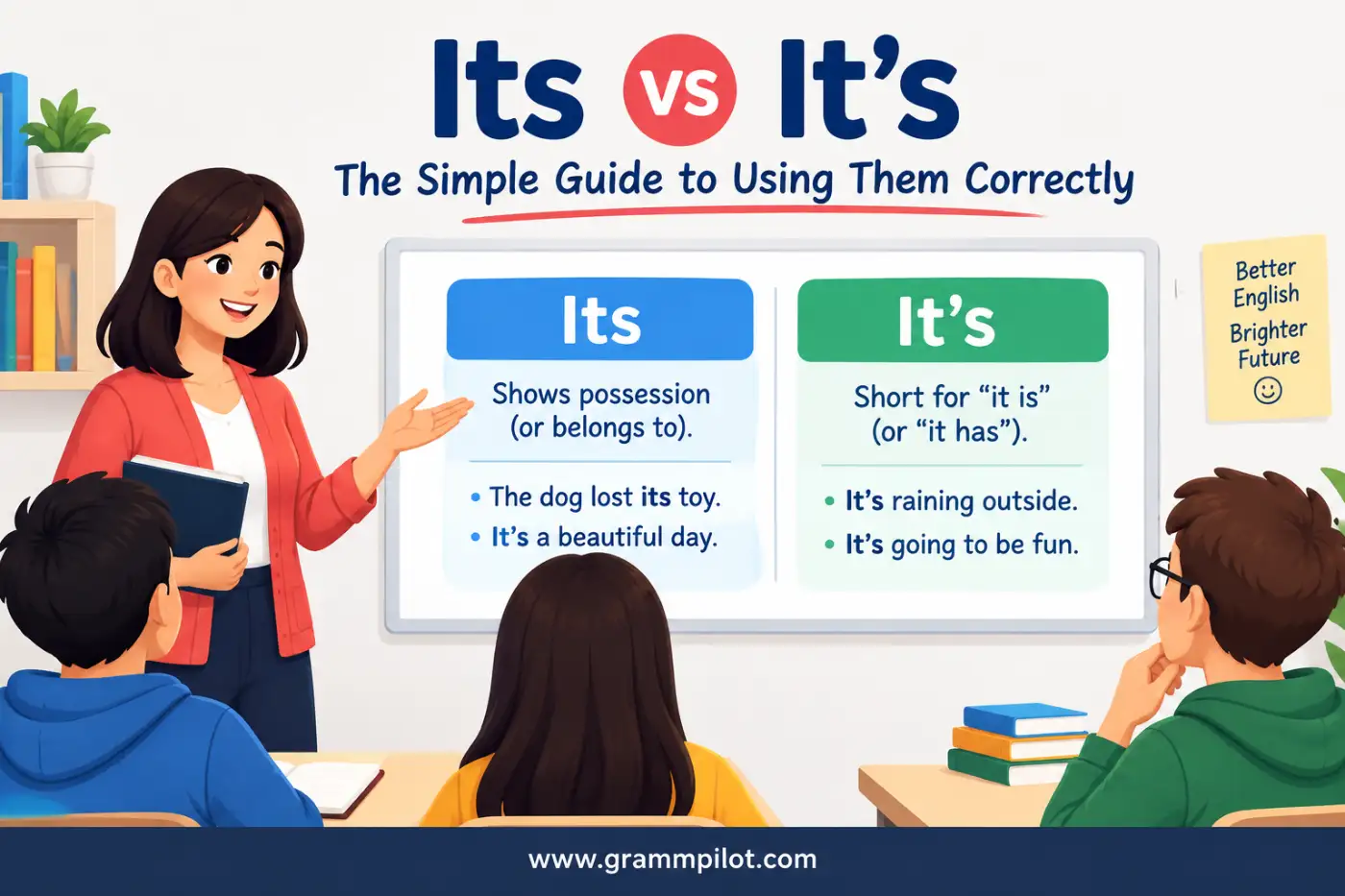
Have you ever stopped while writing an email, school essay, resume, or text message because you couldn’t remember about to write its or it’s? That tiny apostrophe causes a surprising number of mistakes. Its vs It’s is confusing because the two words look almost identical, but they have completely different jobs. The problem often starts with a common assumption: apostrophes show possession. That is true for many nouns, such as Sarah’s book or the company’s office.
However, it’s does not show possession. In fact, the version without the apostrophe is the possessive form. The simple rule is easy once you know it: its means “belonging to it,” while it’s means “it is” or “it has.” This guide explains the meaning, word history, grammar rules, real-life examples, common mistakes, memory tricks, regional notes, and the easiest way to choose the correct form in any situation.
Another useful word comparison is [Lay vs Lie].
What Does “Its” Mean?
Its is a possessive determiner. It shows that something belongs to or is connected with a thing, animal, organization, place, or idea.
Look at these examples:
- The dog wagged its tail.
- The company changed its policy.
- The phone lost its signal.
- The tree dropped its leaves.
- The school updated its website.
- The car needs its tires replaced.
In each sentence, something belongs to the noun being discussed. The dog has the tail. The company has the policy. The tree has the leaves. You can compare its with other possessive words:
- my
- your
- his
- her
- our
- their
- its
All of these words show possession or connection.
How Can You Test if “Its” Is Correct?
Ask yourself if something belongs to the thing you are talking about.
For example: The bird spread its wings.
The wings belong to the bird, so its is correct. Another useful comparison is:
- his book
- her book
- their book
- its book
The grammar pattern is the same.
Its vs It’s: What Does “It’s” Mean?
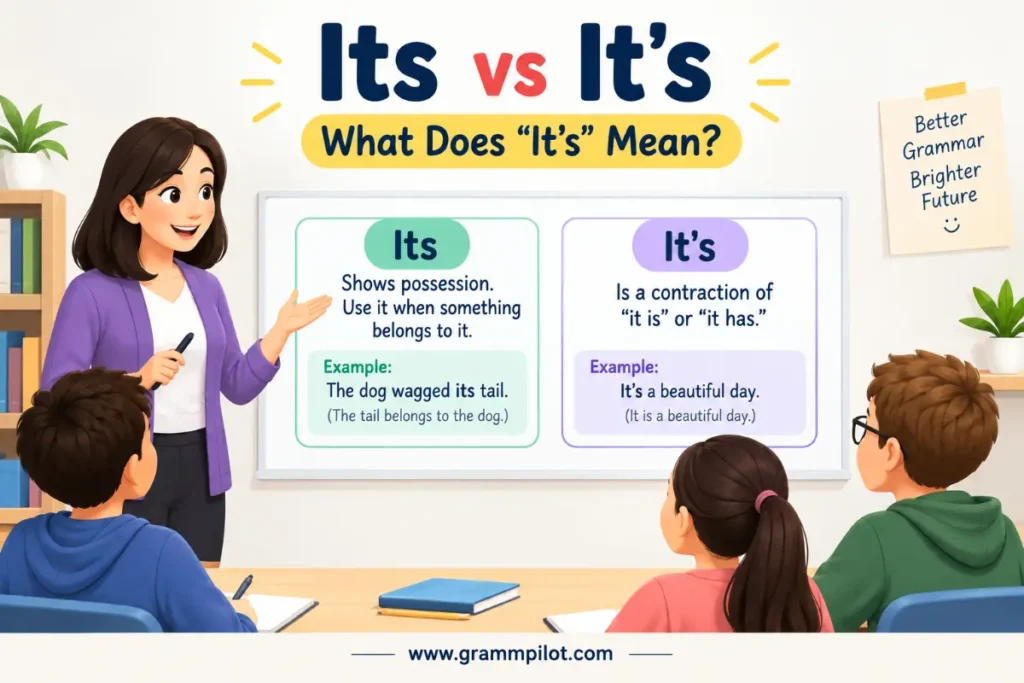
It’s is a contraction. A contraction combines two words into one shorter form.
It’s can mean:
- It is
- It has
Examples:
- It’s raining. = It is raining.
- It’s cold outside. = It is cold outside.
- It’s a good idea. = It is a good idea.
- It’s been a long day. = It has been a long day.
- It’s already started. = It has already started.
The apostrophe shows that letters have been removed.
How Can You Test if “It’s” Is Correct?
Replace it’s with either:
- it is
- it has
If the sentence still makes sense, it’s is correct.
Example: It’s difficult to understand.
Replace it: It is difficult to understand.
The sentence still works.
Now look at this: The car lost it’s wheel.
Try the same test: The car lost it is wheel.
That does not make sense.
The correct sentence is: The car lost its wheel.
This replacement test is one of the fastest ways to solve Its vs It’s mistakes.
Its vs It’s: Where Did “Its” and “It’s” Come From?
The history behind these words helps explain why so many people get confused. English often uses apostrophes to show possession with regular nouns:
- John’s phone
- the teacher’s desk
- the baby’s toy
- the company’s website
Because writers see this pattern so often, they may assume that the possessive form of it should also use an apostrophe. But pronouns follow a different pattern. Look at these possessive forms:
| Pronoun | Possessive Form |
|---|---|
| I | my |
| you | your |
| he | his |
| she | her |
| we | our |
| they | their |
| it | its |
Notice something important: possessive pronouns and possessive determiners usually do not use apostrophes.
We write:
- yours
- hers
- ours
- theirs
- its
We do not write:
- your’s
- her’s
- our’s
- their’s
- it’s when we mean possession
Over time, English established its as the possessive form, while it’s became a contraction of it is or it has. That is why the rule may seem backward at fi
What Is the Main Difference Between Its and It’s?
The difference becomes simple when you separate possession from contraction.
| Word | Meaning | Grammar Job | Example |
|---|---|---|---|
| its | belonging to it | Possessive determiner | The bird spread its wings. |
| it’s | it is / it has | Contraction | It’s flying south. |
Here is an even quicker guide:
| If You Mean | Use |
|---|---|
| belonging to it | its |
| it is | it’s |
| it has | it’s |
Compare These Two Sentences
Its color is bright.
Here, the color belongs to the object or animal.
It’s bright.
Here, the meaning is: It is bright.
One apostrophe changes the meaning and grammar.
Its vs It’s: What Are the Best Related Words and Alternatives?
Because its and it’s are grammar forms, they do not have ordinary synonyms in the same way that words like happy or angry do.
Still, related phrases can sometimes help you rewrite a sentence.
| Word or Phrase | Meaning | Tone | Example |
|---|---|---|---|
| belonging to it | owned by it | Simple | The part belonging to it was damaged. |
| connected to it | linked with it | Everyday | We discussed problems connected to it. |
| related to it | associated with it | Everyday | The issues related to it were solved. |
| within it | inside something | Neutral | Several files were stored within it. |
| of the system | connected with a system | Technical | The system changed its settings. |
| this is | points to something nearby | Everyday | This is useful. |
| here’s the thing | introduces an explanation | Casual | Here’s the thing: we need help. |
| that’s | shortened expression | Casual | That’s enough. |
| the object | a physical thing | Formal | The object changed its shape. |
| the company | a business | Business | The company updated its website. |
| the problem is | introduces an issue | Everyday | The problem is that it’s expensive. |
| it seems to be | shows uncertainty | Neutral | It seems to be correct. |
| it appears to be | cautious description | Formal | It appears to be working. |
These phrases are not always accurate replacements.
For example: The company changed its policy.
You could write: The company changed the policy connected with it.
That version is longer and less natural. In most cases, its is the better choice.
How Do Related Words Change by Intensity?
The words its and it’s do not have intensity levels on their own. They are grammar forms. However, the words around them can make a sentence sound mild, neutral, or strong.
Mild or Neutral Choices
- its purpose
- its role
- its features
- it is useful
- it has changed
Example: The system has its limits.
More Specific Choices
- its main problem
- its biggest advantage
- its primary goal
- its strongest feature
Example: Its biggest advantage is speed.
Strong Choices
- its greatest weakness
- its most serious problem
- its strongest advantage
- its complete failure
Example: Its most serious problem is poor security.
The intensity comes from words such as biggest, greatest, and most serious.
What Part of Speech Are “Its” and “It’s”?
Understanding their grammar roles can make the difference much easier.
“Its” Is a Possessive Determiner
A possessive determiner comes before a noun and shows ownership or connection.
Examples:
- its name
- its color
- its purpose
- its history
- its benefits
- its design
- its owner
Notice that a noun usually follows its.
Example: The company changed its rules.
The word rules is the noun.
“It’s” Is a Contraction
It’s combines:
- it + is
- it + has
Examples:
It’s cold outside.
It is cold outside.
It’s been repaired.
It has been repaired.
You will often see it’s before:
- an adjective
- a verb ending in -ing
- a past participle
- a noun phrase
Examples:
- It’s interesting.
- It’s raining.
- It’s finished.
- It’s a good idea.
- It’s been difficult.
Is There a Difference Between US and UK English?
There is no major grammar difference between American and British English when using its and it’s.
Both varieties follow the same basic rule:
- its shows possession
- it’s means it is or it has
For example:
The company changed its policy. This is correct in both American and British English. The vocabulary around the sentence may change.
American English:
The company changed its vacation policy.
British English:
The company changed its holiday policy.
The grammar rule remains the same.
What Should You Use on a Resume?
Use “Its” When Showing Possession
A resume may discuss companies, projects, departments, systems, or products.
Examples:
- The company improved its customer service process.
- The project reached its final stage ahead of schedule.
- The department achieved its annual goals.
- The business expanded its online presence.
Use “It’s” Carefully
Contractions are grammatically correct, but resumes often sound more professional when they use direct language.
Instead of: It’s important to communicate clearly.
Try: Strong communication skills are essential.
Or: Clear communication improved team performance.
A resume should be concise and focused.
What Should You Use in an Essay?
Use “Its” for Possession
Examples:
- The novel develops its main theme slowly.
- The government changed its policy.
- The experiment produced its expected result.
- The argument has its weaknesses.
- The country improved its education system.
Consider Full Forms Instead of “It’s”
Some academic styles prefer fewer contractions.
Instead of: It’s clear that the policy failed.
You can write: It is clear that the policy failed.
Instead of: It’s been discussed for years.
Write: It has been discussed for years.
Both versions are grammatically correct. Always follow your teacher’s or publication’s style requirements.
What Should You Use When Texting?
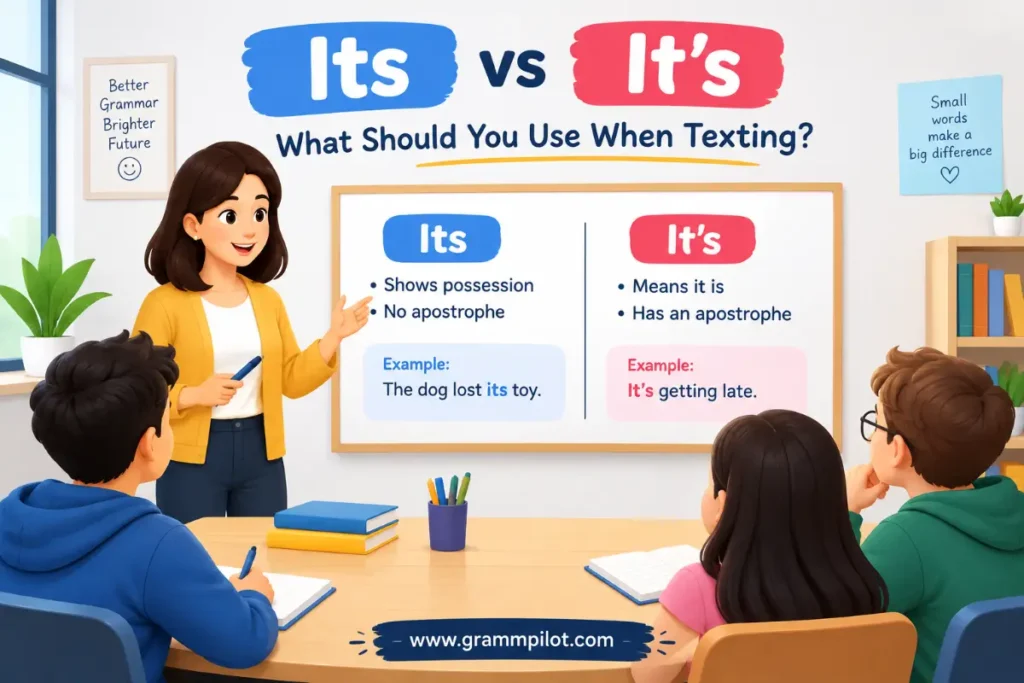
Text messages are informal, so contractions are common.
Examples:
- It’s okay.
- It’s on the way.
- It’s been a long day.
- I think it’s funny.
- It’s not a problem.
But possession still requires its.
Correct: The app changed its design.
Incorrect: The app changed it’s design.
The conversation may be casual, but the grammar rule remains the same.
What Should You Use in an Email?
The answer depends on the meaning.
Professional Email Examples
The company has updated its privacy policy. The organization changed its procedures last month. The system completed its security check.
Friendly Email Examples
It’s great to hear from you. It’s been a pleasure working with you. I think it’s a great idea.
Formal Email Examples
It is important to review the agreement carefully. The organization has revised its procedures. Clear writing matters more than if you use contractions.
20 Real-Life Examples of Its and It’s
At Home
- The refrigerator lost its power during the storm.
- It’s making a strange sound.
- The lamp has its own switch.
- It’s too dark in this room.
- The washing machine finished its cycle.
At School
- The school changed its attendance policy.
- It’s important to read the instructions.
- The book has its strengths and weaknesses.
- It’s been assigned for next week’s class.
- The teacher explained its main purpose.
On Work
- The company improved its training program.
- It’s easier to understand the new system now.
- The project reached its final stage.
- It’s already receiving positive feedback.
- The department completed its yearly review.
With Technology
- My phone lost its internet connection.
- It’s trying to reconnect.
- The app changed its privacy settings.
- It’s been updated twice this month.
- The computer finished its update.
How Can Both Forms Appear in One Sentence?
Using both forms together is one of the best ways to understand the difference.
Example One
It’s losing its color.
Meaning: It is losing the color that belongs to it.
Example Two
It’s important for a company to protect its reputation.
Meaning: It is important for a company to protect the reputation connected with the company.
Example Three
It’s changing its approach.
Meaning: It is changing its own approach.
Example Four
It’s finished its work.
The first word means: It has finished.
The second word shows that the work belongs to the thing being discussed.
Example Five
It’s clear that the animal has found its way home. The first word means it is. The second word shows possession.
It’s vs That’s: What’s the Difference?
Both are contractions, but they begin with different words.
“It’s”
Usually means:
- it is
- it has
Example: It’s raining.
“That’s”
Usually means:
- that is
- that has
Example: That’s my car.
Use it when the thing is already understood from context.
Use that when identifying or pointing to something.
Its vs Itself: What’s the Difference?
These words have completely different jobs.
“Its” Shows Possession
The machine completed its cycle. The cycle belongs to the machine.
“Itself” Refers Back to the Subject
The machine turned itself off. The machine performed the action on itself.
Compare:
The computer updated its software.
The software belongs to the computer.
The computer restarted itself. The computer performed the action.
Can “It’s” Mean “It Has”?
Yes.
Correct examples include: It’s been a difficult year.
This means: It has been a difficult year.
Another example: It’s already started.
This means: It has already started.
Context helps you understand which meaning is intended.
Be Careful When Rewriting
Consider: It has a blue cover.
You cannot automatically change this to: It’s a blue cover.
The meaning changes.
The first sentence says something possesses a blue cover. The second sentence says something is a blue cover. This is why the replacement test matters.
What Are the Most Common Mistakes?
Mistake 1: Using “It’s” for Possession
Incorrect: The company changed it’s policy.
Correct: The company changed its policy.
The policy belongs to the company.
Mistake 2: Forgetting the Apostrophe in a Contraction
Incorrect: Its raining outside.
Correct: It’s raining outside.
The sentence means: It is raining outside.
Mistake 3: Trusting Pronunciation
Both forms sound the same. You cannot hear the apostrophe. Always check the meaning.
Mistake 4: Assuming Every Apostrophe Shows Possession
Apostrophes have different jobs. They can show possession or missing letters. In it’s, the apostrophe represents missing letters.
Mistake 5: Using the Wrong Test
For its, think about possession.
For it’s, test:
- it is
- it has
Keeping these tests separate prevents many errors.
Mistake 6: Adding an Apostrophe Because the Word “Looks Right”
Some writers see it’s and assume it looks more grammatical. But punctuation must match meaning. The cat cleaned its paws. This is correct because the paws belong to the cat.
When Should You NOT Use “Its”?
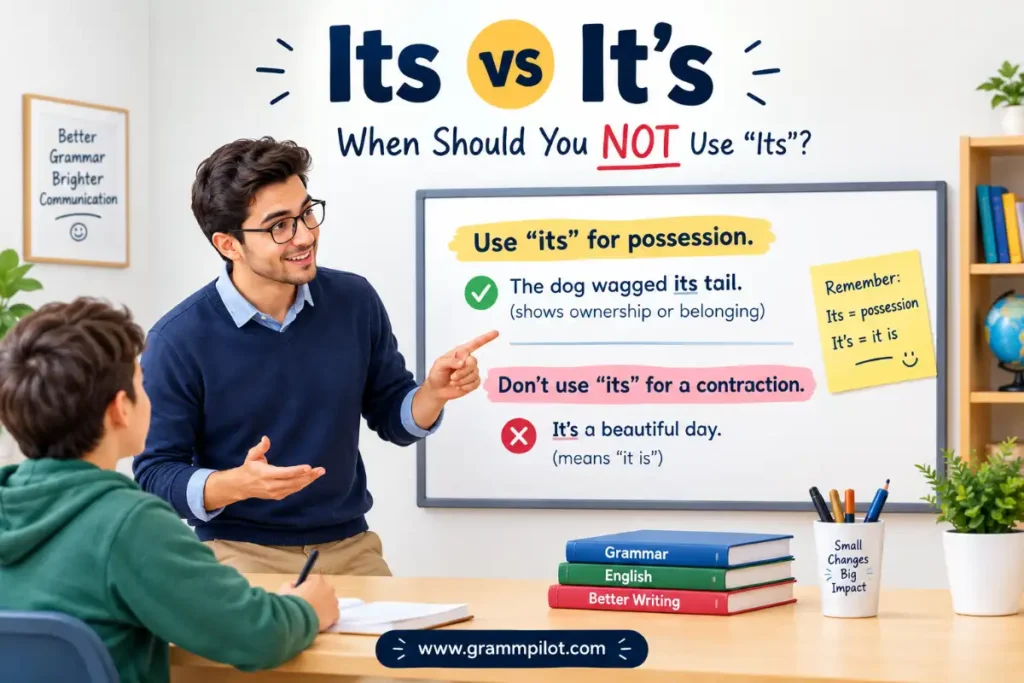
Do not use its when you mean it is or it has.
Incorrect: Its going to rain.
Correct: It’s going to rain.
Incorrect: Its been a great week.
Correct: It’s been a great week.
Also, avoid using its when you are referring to a person and another pronoun is needed.
Incorrect: Maria forgot its keys.
Correct: Maria forgot her keys.
Or: Alex forgot their keys.
When Should You NOT Use “It’s”?
Do not use it’s to show possession.
Incorrect: The book lost it’s cover.
Correct: The book lost its cover.
Try the test: The book lost it is cover.
That does not work. The book lost the cover belonging to it, so its is correct.
Do “Its” and “It’s” Have Antonyms?
No. These words do not have direct antonyms because they are grammar forms. However, opposite ideas can appear in the surrounding sentence.
Instead of:
- belonging to it
- connected to it
- related to it
You might use:
- belonging to someone else
- unrelated to it
- separate from it
Example:
The company protected its data. A different idea would be: The data belonged to another company. The opposite depends on the complete meaning.
How Do You Choose the Right Word Quickly?
Use this simple process.
Step 1: Read the Whole Sentence
Do not look only at the word.
Ask: What am I trying to say?
Step 2: Try “It Is”
Example: It’s cold.
Change it to: It is cold.
It works, so it’s is correct.
Step 3: Try “It Has”
Example: It’s been repaired.
Change it to: It has been repaired.
It works.
Step 4: Check for Possession
Example: The house lost its roof.
Try: The house lost it is roof.
That does not work. The roof belongs to the house, so use its.
What Is the Best Memory Trick?
Here is the easiest rule:
It’s has an apostrophe because it replaces letters in “it is” or “it has.” Its has no apostrophe because it shows possession.
Another helpful comparison:
| Possessive Word | Uses an Apostrophe? |
|---|---|
| yours | No |
| hers | No |
| ours | No |
| theirs | No |
| its | No |
This pattern makes the rule easier to remember.
A Second Memory Trick
Think: It’s = it is.
The apostrophe shows that letters are missing. Then remember:
- its tail
- its name
- its purpose
- its color
Nothing is missing, so no apostrophe is needed.
How Can Students Practice?
Try these exercises.
Practice Set One
- The dog hurt ___ paw.
- ___ time to leave.
- The company announced ___ decision.
- ___ been a busy week.
- The computer restarted on ___ own.
Answers:
- its
- It’s
- its
- It’s
- its
Practice Set Two
- The movie has ___ problems.
- ___ difficult to explain.
- The bird opened ___ wings.
- ___ already too late.
- The school changed ___ schedule.
Answers:
- its
- It’s
- its
- It’s
- its
Practice Set Three
Rewrite the contraction.
- It’s a good idea.
- It’s been raining.
- It’s important to listen.
Answers:
- It is a good idea.
- It has been raining.
- It is important to listen.
Can “It’s” Start a Sentence?
Yes. Starting a sentence with it’s is completely normal.
Examples:
- It’s easy to make this mistake.
- It’s important to stay calm.
- It’s been a long day.
- It’s difficult to know the answer.
This pattern is common when making a general statement.
In formal writing, you may choose the full form:
It is important to review the evidence.
Both versions are correct.
Can “Its” Start a Sentence?
Yes.
Examples:
Its purpose is simple.
Its history is complicated.
This structure is common in essays, reports, and explanations.
Is “Its” Singular or Plural?
Its is connected to the pronoun it, which is generally singular.
However, it can refer to a group treated as one unit.
Example:
The team changed its strategy.
A team contains several people, but the group is treated as one unit.
In some British English contexts, collective nouns may take plural agreement:
The team changed their strategy.
In standard American English, this is more common:
The team changed its strategy.
Can “Its” Refer to a Company?
Yes.
Companies and organizations are often treated as singular entities.
Examples:
- The company announced its plans.
- The organization revised its policy.
- The university expanded its campus.
- The business improved its customer service.
This usage is especially common in American English.
Quick Tips for Choosing the Right Form
Keep these tips in mind:
- Use its when something belongs to or is connected with it.
- Use it’s when you mean it is or it has.
- Replace it’s with the full words to test it.
- Remember that possessive pronouns do not usually use apostrophes.
- Read the entire sentence before deciding.
- Do not rely on pronunciation.
- Expand contractions in formal writing if the style requires it.
- Check every use of it’s when proofreading.
- Practice sentences that use both forms.
- Focus on meaning before punctuation.
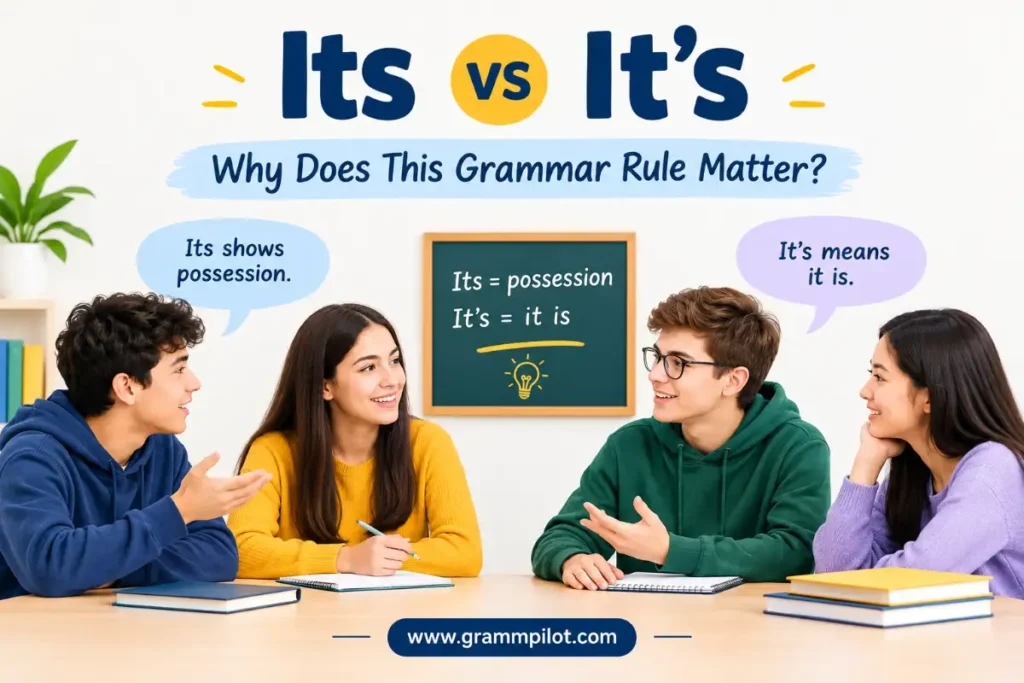
Why Does This Grammar Rule Matter?
A mistake between its and it’s usually does not stop people from understanding your sentence. Still, correct grammar makes your writing look more polished and professional.
This matters in:
- school assignments
- college applications
- resumes
- professional emails
- business documents
- blog posts
- reports
- website content
Small grammar details can affect how carefully your writing is judged. The good news is that this mistake is easy to avoid. Do not guess based on the apostrophe.
Ask: Does something belong to it?
Use its. Can I say “it is” or “it has”?
Use it’s.
Conclusion
Its vs It’s becomes much easier when you focus on meaning instead of guessing based on the apostrophe. Its shows possession or connection, while it’s is a contraction of it is or it has. The easiest habit is to test the sentence by replacing the contraction with the full words.
You don’t need complicated grammar rules to get this right. Read the sentence, identify if you are showing possession, and use the replacement test when needed. With a little practice, you will spot the difference quickly and write both forms correctly in emails, essays, schoolwork, professional documents, and everyday conversations.
Frequently Asked Questions
1. Is “its” possessive or is “it’s” possessive?
Its is the possessive form, while it’s is a contraction of it is or it has. For example, “The dog wagged its tail” is correct because the tail belongs to the dog.
2. Why doesn’t “its” have an apostrophe?
Its follows the pattern of possessive words such as his, hers, ours, and theirs, which do not use apostrophes. The apostrophe in it’s shows missing letters instead.
3. What’s another way to say “it’s”?
You can usually say it is or it has, depending on the sentence. For example, “It’s raining” means “It is raining,” while “It’s been difficult” means “It has been difficult.”
4. How do I know about to use its or it’s?
Use the replacement test. If the word can become “it is” or “it has,” use it’s. If it shows possession or connection, use its.
5. Is “it’s” correct in formal writing?
Yes, it’s is grammatically correct. However, some formal writing styles prefer full forms such as it is or it has.
6. Can “its” refer to a company or organization?
Yes. You can write, “The company changed its policy” or “The organization announced its plans.” This is common in standard American English.