
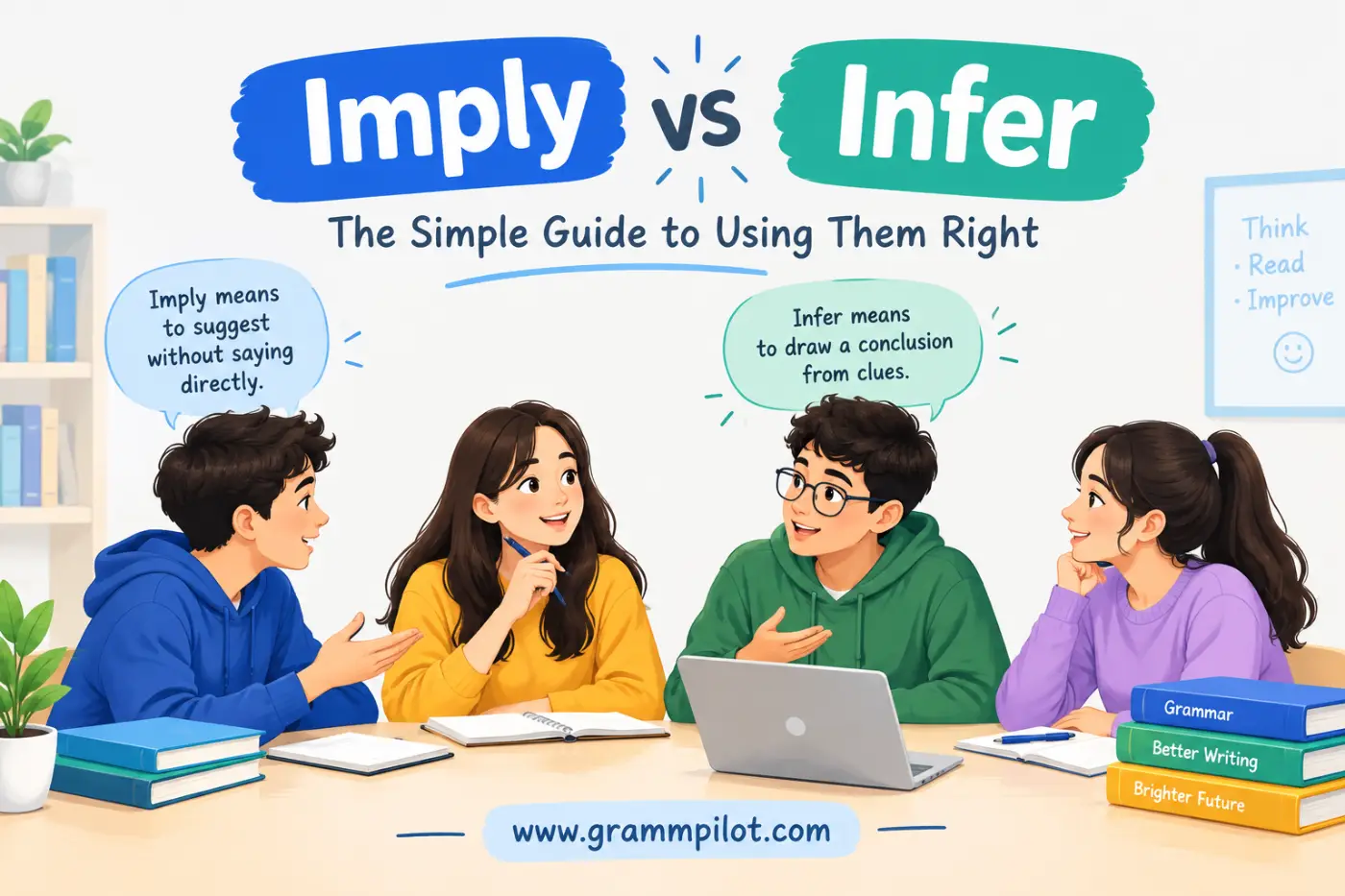
Have you ever read an email, text message, or essay and wondered what someone really meant? Maybe your teacher wrote, “This section needs more detail,” and you guessed they wanted a complete rewrite. Or a friend texted, “I guess some people remember birthdays,” and you understood they were upset. This is where Imply vs Infer becomes important. These two words are closely connected, but they are not the same. Many students, writers, and even native English speakers mix them up.
Quick Answer:
To imply means to suggest something without saying it directly. To infer means to understand or figure out what someone means based on clues.
Knowing the difference can improve your writing, speaking, reading, and test scores. In this guide, you’ll learn the meanings, origins, synonyms, examples, common mistakes, and practical tips that make these words easy to remember.
This is one of many English word pairs that learners confuse [Its vs It’s] for another example.
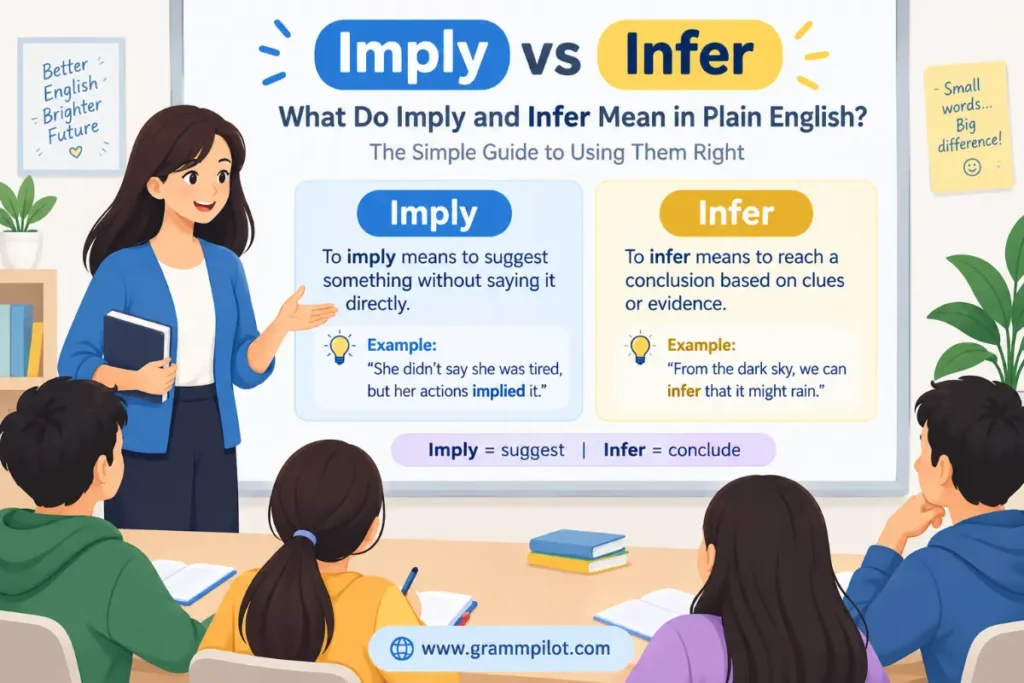
What Do Imply and Infer Mean in Plain English?
The easiest way to remember these words is this:
- The speaker or writer implies.
- The listener or reader infers.
Think of it like throwing and catching:
| Action | Person | Example |
|---|---|---|
| Imply | Speaker or writer | “The teacher implied that the test would be difficult.” |
| Infer | Listener or reader | “The students inferred that they should study more.” |
One person sends a hidden message. The other person understands it.
Imply vs Infer: Where Do These Words Come From?
Most grammar websites skip this part, but word origins can help you remember meanings.
The Origin of Imply
Imply comes from the Latin word implicare, meaning “to fold in” or “to involve.” The idea is that a speaker folds a hidden meaning into their words without stating it directly.
Example: “I’ve noticed the kitchen is still messy.”
The speaker may be implying:
- Please clean the kitchen.
- I’m unhappy about the mess.
Imply vs Infer: The Origin of Infer
Infer comes from the Latin word inferre, meaning “to bring in” or “to conclude.”
A listener brings together clues and reaches an understanding.
Example: “The lights are off, and no cars are outside.”
You infer: “No one is home.”
Imply vs Infer: What’s the Main Difference?
| Feature | Imply | Infer |
|---|---|---|
| Who does it? | Speaker/writer | Listener/reader |
| Meaning | Suggest indirectly | Understand indirectly |
| Action | Sending clues | Receiving clues |
| Part of speech | Verb | Verb |
| Example | “She implied she was tired.” | “I inferred she wanted to leave.” |
A quick memory trick:
Imply = I Put Meaning
Infer = I Figure Out Meaning
Master Synonym List “Imply vs Infer”
Simple and Everyday Synonyms
| Word | Meaning | Tone | Example |
|---|---|---|---|
| Suggest | Hint at an idea | Neutral | “He suggested a change.” |
| Hint | Give a clue | Casual | “She hinted at a surprise.” |
| Mean | Intend | Neutral | “What did you mean?” |
| Signal | Show indirectly | Neutral | “The smile signaled approval.” |
| Indicate | Point to something | Neutral | “The signs indicate rain.” |
| Show | Reveal | Casual | “His actions showed concern.” |
| Guess | Form an idea | Casual | “I guessed the answer.” |
| Figure out | Understand | Casual | “She figured out the problem.” |
| Read into | Interpret | Informal | “Don’t read too much into it.” |
Formal Synonyms
| Word | Meaning | Tone | Example |
|---|---|---|---|
| Insinuate | Suggest indirectly | Formal | |
| Convey | Communicate | Formal | |
| Communicate | Express ideas | Formal | |
| Indicate | Point toward | Formal | |
| Demonstrate | Show clearly | Formal | |
| Deduce | Reach a conclusion | Formal | |
| Conclude | Decide from evidence | Formal | |
| Interpret | Explain meaning | Formal | |
| Derive | Obtain understanding | Formal | |
| Extrapolate | Predict from facts | Academic |
Informal and Slang Expressions
| Word | Meaning | Tone | Example |
|---|---|---|---|
| Drop a hint | Suggest casually | Informal | |
| Get the idea | Understand | Informal | |
| Catch on | Understand | Informal | |
| Pick up on | Notice | Informal | |
| Read the room | Understand social clues | Slang | |
| Take the hint | Understand suggestion | Casual |
Synonyms by Intensity
For Imply
| Mild | Medium | Strong |
|---|---|---|
| Mention | Suggest | Hint |
| Indicate | Signal | Insinuate |
| Refer to | Convey | Strongly imply |
For Infer
| Mild | Medium | Strong |
|---|---|---|
| Guess | Figure out | Deduce |
| Understand | Interpret | Conclude |
| Assume | Determine | Extrapolate |
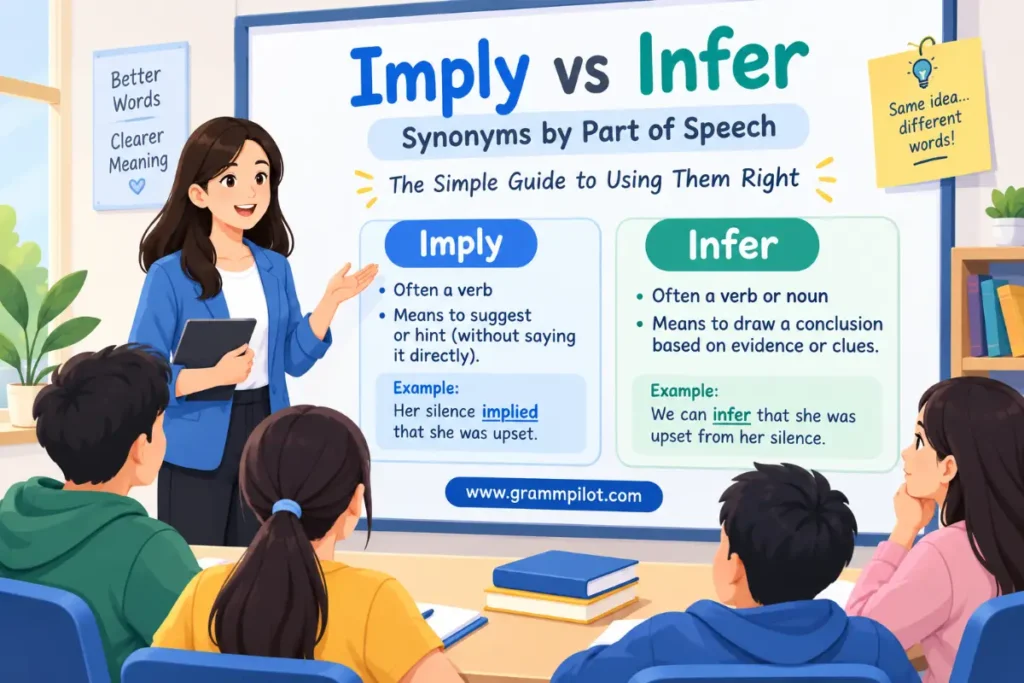
Imply vs Infer: Synonyms by Part of Speech
Verbs
- Imply
- Infer
- Suggest
- Hint
- Indicate
- Deduce
- Interpret
- Conclude
- Convey
Nouns
- Implication
- Inference
- Suggestion
- Conclusion
- Hint
- Interpretation
Adjectives
- Implied
- Inferred
- Suggestive
- Indirect
- Interpretive
Are There US and UK Differences?
There is no major difference between American and British English when using these words.
However:
- American English often uses figure out in everyday speech.
- British English may use gather in some situations.
Example:
US: “I figured he was busy.”
UK: “I gathered he was busy.”
The meanings stay the same.
Which Word Works Best in Different Situations?
Resume Writing
Use clear language instead of hidden meanings.
Better: “Managed a team of five employees.”
Less effective :”My experience implies leadership skills.”
Essays and Academic Writing
Formal words work best.
Example:
“The author implies that society values wealth too highly.”
“The reader can infer criticism from the text.”
Emails
Professional emails should avoid unclear implications.
Instead of: “Some reports are late.”
Write: “Please submit your reports by Friday.”
Text Messages
Texting often includes implied meanings.
Example:
Text: “It’s getting late.”
Possible implication: “I want to leave.”
Inference: The other person understands the hidden message.
Everyday Speaking
People imply things constantly.
Examples:
- “The trash is full.”
- “I’m freezing.”
- “The store closes soon.”
Listeners infer the real message.
Real-Life Example Sentences
Here are more than ten original examples.
- The teacher implied that extra studying would help.
- I inferred that the quiz would be difficult.
- Her smile implied approval.
- We inferred good news from his expression.
- The dark clouds implied rain.
- Drivers inferred that traffic would be heavy.
- The article implied criticism of the policy.
- Readers inferred the author’s opinion.
- My friend implied she wanted help.
- I inferred that she was stressed.
- The coach implied that effort mattered more than talent.
- The team inferred they needed to practice harder.
- His silence implied disagreement.
- I inferred that he did not support the plan.
Imply vs Suggest: What’s Different?
Example:
Suggest: “I suggest taking notes.”
Imply: “You might remember things better if you wrote them down.”
Infer vs Assume: What’s Different?
Many people confuse these words.
| Infer | Assume |
|---|---|
| Uses evidence | May lack evidence |
| Based on clues | Often a guess |
| More accurate | Less certain |
Example:
Infer: “The lights are off, so I infer nobody is home.”
Assume: “I assume nobody is home.”
The first uses evidence. The second may not.

Imply vs Infer: Common Mistakes People Make
Using Infer Instead of Imply
Wrong: “The speaker inferred that prices would rise.”
Correct: “The speaker implied that prices would rise.”
Assuming and Inferring Are the Same
Inference uses clues.
Assumption may not.
Overusing Hidden Meaning
Clear communication is usually better.
Instead of implying too much, say exactly what you mean.
When Should You NOT Use These Words?
Avoid them when:
- You are giving direct instructions.
- Legal writing requires exact wording.
- Safety instructions need complete clarity.
- Professional communication must avoid misunderstanding.
Example:
Instead of: “The notice implied danger.”
Write: “The notice warned of danger.”
Antonyms
Opposites of Imply
- State
- Declare
- Explain
- Announce
- Express directly
Opposites of Infer
- Ignore
- Misunderstand
- Overlook
- Misinterpret
Quick Tips for Choosing the Right Word
- Speakers imply.
- Listeners infer.
- Think: send versus receive.
- Hidden message versus understanding.
- Infer needs clues.
- Imply creates clues.
- If evidence exists, infer may fit better.
- If you are communicating indirectly, imply is usually correct.
Easy Memory Tricks
The “I” Trick
Imply = I Put meaning into words.
Infer = I Figure meaning out.
The Arrow Trick
Speaker → implies → message → listener → infers
Imply vs Infer: Why Understanding These Words Matters
Knowing the difference helps with:
- School essays
- Reading comprehension
- Standardized tests
- Professional emails
- Literature analysis
- Everyday conversations
Many exam questions depend on understanding implied meanings and making correct inferences.
Final Teacher Explanation
Here’s the easiest way to remember Imply vs Infer: the speaker or writer implies, while the listener or reader infers.
When you imply something, you don’t say it directly. You give the other person a clue. When you infer something, you use that clue to figure out the meaning.
For example, if a teacher says, “Some students might want to review this chapter tonight,” the teacher implies that the chapter is important. If you think, “The teacher probably expects this on the test,” you infer that meaning.
So remember this simple rule: Imply = put the meaning into the message. Infer = figure the meaning out. Once you know who is sending the message and who is receiving it, choosing the right word becomes much easier.
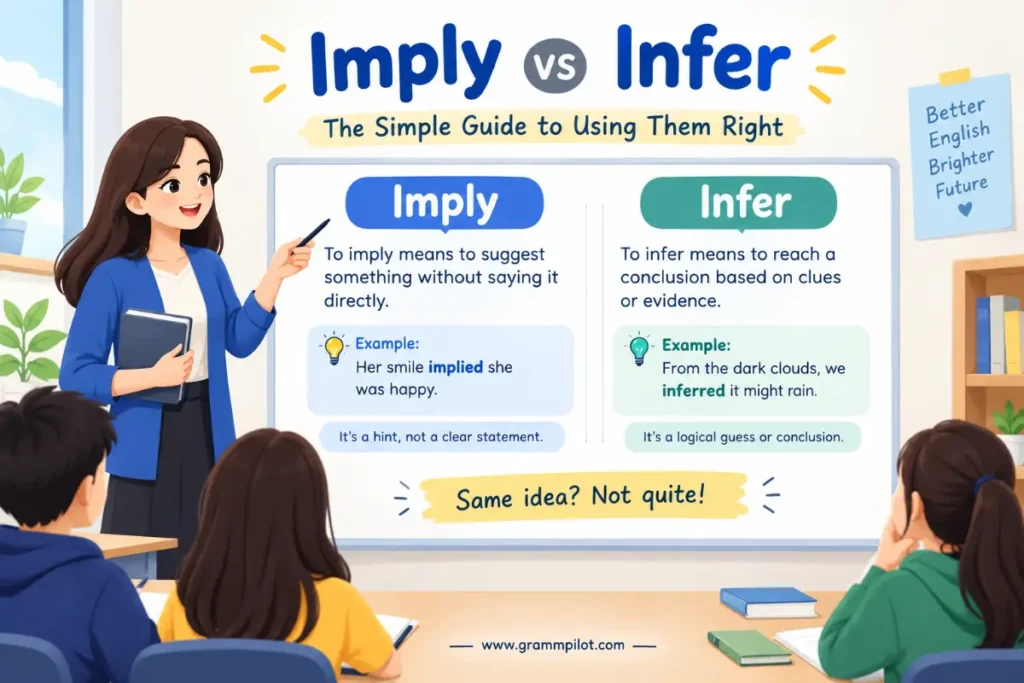
Conclusion
Understanding Imply vs Infer is easier than many people think. One person gives clues, and another person understands them. Speakers imply, while listeners infer.
This small grammar point can make a big difference in writing, reading, and communication. Once you remember the “send and receive” idea, choosing the correct word becomes much simpler. Keep practicing with real examples, and soon these two words will feel natural.
Frequently Asked Questions
1. Is infer the same as imply?
No. In Imply vs Infer, imply means to suggest something, while infer means to understand the suggestion.
2. What’s another way to say imply?
Common alternatives include suggest, hint, indicate, and insinuate.
3. What’s another way to say infer?
You can use deduce, conclude, interpret, or figure out.
4. Can imply and infer be used interchangeably?
No. One is done by the speaker, and the other is done by the listener.
5. Is infer stronger than assume?
Yes. Infer usually involves evidence, while assume may be a guess.
6. Why do people confuse imply and infer?
They happen in the same communication process, so many people mix up who is sending and who is receiving the message.
7. How can I remember the difference?
Remember: speakers imply and listeners infer.