

Have you ever paused while writing an email, school essay, text message, or social media post because you couldn’t decide between lay and lie? You’re not alone. Lay vs Lie is one of the most confusing grammar topics in English because the words have similar meanings and their past tense forms make the problem even harder. The basic difference is simple: lay means to put something down and needs an object, while lie means to rest or recline and does not need an object. For example, you lay a book on the table, but you lie on the bed. The confusion usually begins when we move into the past: yesterday, you laid the book down, but yesterday, you lay on the bed. This guide explains the meaning, word history, verb forms, real-life examples, common mistakes, memory tricks, synonyms, and practical tips for using both words correctly.
For a closer look at another tricky spelling pattern, read[ Adapter vs Adaptor].
What Is the Main Difference Between Lay and Lie?
The easiest way to understand these verbs is to ask one question: Is someone putting something down, or is the subject resting by itself?
Use lay when someone puts or places something somewhere.
Use lie when a person or thing rests in a flat position.
| Verb | Basic Meaning | Needs an Object? | Example |
|---|---|---|---|
| lay | put or place something down | Yes | Lay the book on the desk. |
| lie | rest or recline | No | I want to lie down. |
An object is the thing receiving the action.
In this sentence: She laid the phone on the table.
The phone is the object. Someone is placing something somewhere.
Now look at this: She lay on the sofa.
There is no object. She is simply resting.
That one difference is the key to understanding the two verbs.
What Does “Lay” Mean?
Lay usually means to put, place, or set something down.
Examples:
- Lay the keys on the counter.
- Please lay your bag beside the chair.
- The farmer lays seeds in the soil.
- She laid the baby in the crib.
- He has laid the documents on my desk.
The important point is that lay usually needs something to receive the action.
You lay:
- a book
- a phone
- a bag
- a baby
- a blanket
- a plan
Someone or something is being placed.
What Does “Lie” Mean?
Lie usually means to rest, recline, or be in a flat position.
Examples:
- I want to lie down.
- The cat is lying on the sofa.
- The keys lie on the floor.
- She lay in bed all morning.
- The dog has lain under the table for hours.
Unlike lay, the verb lie does not normally need an object.
You are not doing something to another object. The subject itself is resting or remaining somewhere.
What Are the Main Forms of “Lie”?
This is where many people become confused.
| Tense | Form |
|---|---|
| Base form | lie |
| Present participle | lying |
| Past tense | lay |
| Past participle | lain |
Examples:
- Present: I lie down every afternoon.
- Present continuous: I am lying down.
- Past: Yesterday, I lay down.
- Present perfect: I have lain down.
The tricky part is easy to see: Lay is the present tense of one verb and the past tense of another.
That is why Lay vs Lie can confuse even experienced writers.

Where Did the Words “Lay” and “Lie” Come From?
These verbs have been part of English for centuries. Both words come from old Germanic language roots. Their meanings developed separately:
- lay became connected with putting or placing something down.
- lie became connected with resting or remaining in a position.
Over time, their verb forms became similar. That similarity is the main reason modern English learners often mix them up. English also has another verb called lie, meaning “to tell an untruth.”
For example: He lied about the money.
That is a completely different verb.
Its forms are:
| Tense | Form |
|---|---|
| Present | lie |
| Present continuous | lying |
| Past | lied |
| Past participle | lied |
So English has two different verbs spelled lie:
- Lie down = recline or rest.
- Lie about something = say something untrue.
Context usually makes the meaning clear.
How Can You Remember Lay vs Lie?
Here is the easiest memory trick:
Lay requires an object. Lie does not.
Ask: Am I laying something down? If yes, use a form of lay. Example: Please lay the book on the desk.
You are placing the book.
Now ask: Is the subject resting by itself? If yes, use a form of lie. Example: I need to lie down.
You are resting. No object is being placed.
What Are the Most Common Synonyms for Lay?
The best synonym depends on the sentence.
Simple Alternatives for “Lay”
| Word | Meaning | Tone | Example |
|---|---|---|---|
| put | place something | Simple | Put the book on the desk. |
| place | put carefully | Neutral | Place the keys here. |
| set | put in a position | Everyday | Set the cup down. |
| rest | place gently | Neutral | Rest the phone on the table. |
| position | place in a certain spot | Formal | Position the box carefully. |
| arrange | put in order | Neutral | Arrange the papers neatly. |
| deposit | put somewhere officially | Formal | Deposit the document in the box. |
| install | put something into place | Technical | Install the new part. |
| locate | put in a particular place | Formal | Locate the device near the door. |
| stack | place in a pile | Everyday | Stack the books here. |
Everyday Alternatives
- put down
- set down
- place down
- leave
- rest
- drop off
- put aside
- move
Examples:
Put your bag down.
Set the glass on the table.
Leave the package by the door.
Formal Alternatives
- place
- position
- arrange
- deposit
- situate
- establish
- install
Example: The technician positioned the equipment near the entrance.
Casual Alternatives
- put
- set
- stick
- drop
- toss
Be careful with casual alternatives. They may change the meaning.
For example: Lay the book on the table.
and: Toss the book on the table.
Both involve moving the book, but toss suggests a rougher action.
What Are the Best Synonyms for Lie?
The meaning of lie also changes depending on context.
Simple Alternatives for “Lie”
| Word | Meaning | Tone | Example |
|---|---|---|---|
| rest | relax in a position | Neutral | Rest on the bed. |
| recline | lean or lie back | Formal | Recline in the chair. |
| relax | rest comfortably | Everyday | Relax on the sofa. |
| stretch out | lie fully extended | Casual | Stretch out on the bed. |
| rest flat | lie horizontally | Simple | Rest flat on your back. |
| lounge | relax comfortably | Casual | Lounge on the couch. |
| remain | stay in a position | Formal | The papers remain on the desk. |
| rest | remain in a place | Neutral | The village rests near the river. |
| be located | exist in a place | Formal | The town lies near the coast. |
| stay | remain somewhere | Everyday | The keys stayed on the floor. |
Everyday Alternatives
- lie down
- rest
- relax
- stretch out
- sleep
Formal Alternatives
- recline
- remain
- be situated
- be located
Casual Alternatives
- chill
- kick back
- stretch out
- flop down
These are not always exact replacements.
For example: I need to lie down.
You could say: I need to rest.
That works in many situations.
However: The city lies near the coast.
You would not usually say: The city rests near the coast.
Instead, you might say: The city is located near the coast.
How Do These Alternatives Change by Intensity?
Mild
- sit
- rest
- put
- place
Example: Rest the book on the table.
Moderate
- lay down
- recline
- arrange
- position
Example: Recline comfortably in the chair.
Strong or More Active
- toss
- drop
- stretch out
- collapse
Example: After the race, he collapsed on the grass.
The intensity comes from the action word, not from the basic grammar rule.
What Is the Difference Between “Lay Down” and “Lie Down”?
This is one of the most common questions.
“Lay Down” Means Put Something Down
Examples:
- Lay down the book.
- Lay down your phone.
- The worker laid down the tools.
Something is being placed.
“Lie Down” Means Rest Yourself
Examples:
- I need to lie down.
- Please lie down for a few minutes.
- The dog is lying down.
The person or animal is resting.
A useful comparison is:
Lay down the blanket.
Lie down on the blanket.
The first sentence is about placing the blanket. The second sentence is about resting.
Lay vs Lie in the Past Tense
This is the hardest part.
Past Tense of “Lay” Is “Laid”
Present: I lay the phone on the desk.
Past: Yesterday, I laid the phone on the desk.
Past Tense of “Lie” Is “Lay”
Present: I lie down after lunch.
Past: Yesterday, I lay down after lunch.
This is where people often write: Yesterday, I laid down.
That is only correct if you laid something down.
For example: Yesterday, I laid the book down.
The book is the object.
But: Yesterday, I lay down.
There is no object, so this is the correct past tense of lie.
What Is the Difference Between Laid and Lain?
These words often cause another level of confusion.
“Laid”
Laid is the past tense and past participle of lay.
Examples:
- She laid the papers on the desk.
- He has laid the tools beside the door.
- They had laid the foundation before winter.
“Lain”
Lain is the past participle of lie when it means to rest.
Examples:
- I have lain awake for hours.
- The book has lain on the table all day.
- She had lain in bed before getting up.
In everyday American English, people often avoid lain because it sounds formal or old-fashioned.
They may rewrite the sentence:
Instead of: I have lain awake all night.
They might say: I have been awake all night.
Both can communicate the idea, although the grammar structure is different.
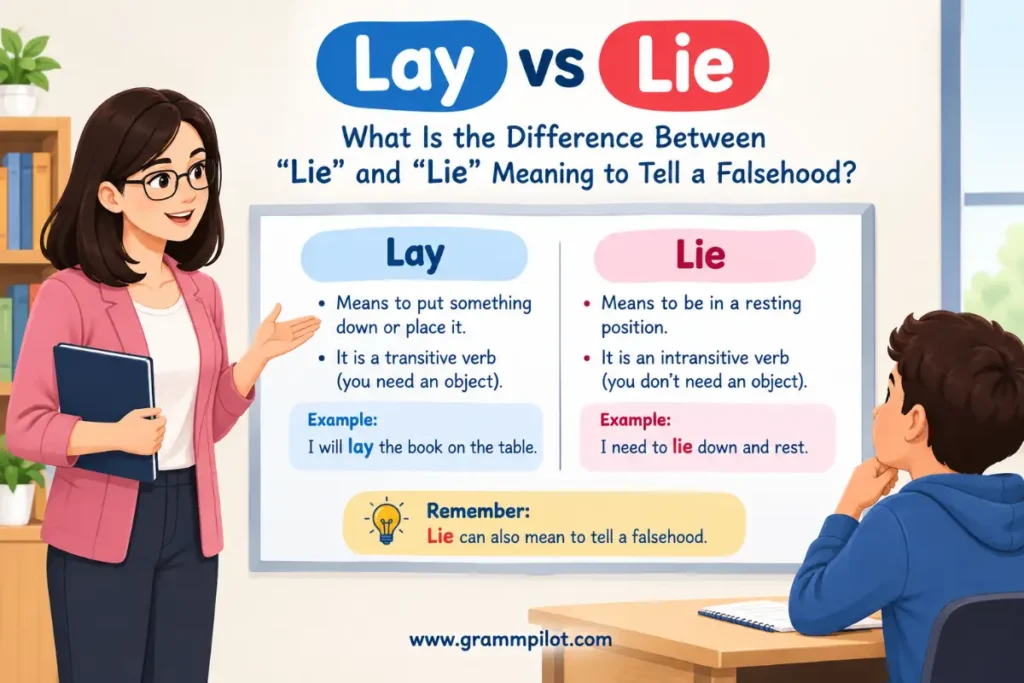
What Is the Difference Between “Lie” and “Lie” Meaning to Tell a Falsehood?
English has two verbs with the same spelling.
Lie = Rest or Recline
Forms:
- lie
- lay
- lain
Example: I lie down when I am tired.
Past: Yesterday, I lay down early.
Lie = Tell Something Untrue
Forms:
- lie
- lied
- lied
Example: Don’t lie to me.
Past: He lied about the accident.
This difference is important because laid and lied cannot replace each other.
Incorrect: He lay about the accident.
Correct: He lied about the accident.
Which Word Should You Use in an Essay?
Use “Lay” When Something Is Being Placed
Examples:
- The researchers laid the materials on the table.
- The author laid the foundation for the argument.
- The government laid out a new plan.
Use “Lie” When Something Rests or Exists Somewhere
Examples:
- The problem lies in the lack of information.
- The village lies near the river.
- The answer lies in careful research.
These uses are common in formal writing.
For example: The solution lies in better communication.
Here, lies means “exists” or “is found.”
Which Word Should You Use in a Resume?
Resumes usually avoid situations where you need to choose between these two words. Still, related expressions can appear.
Examples:
- Laid the foundation for a new training program.
- Developed and laid out a project plan.
- Identified where the main problem lay.
In a professional resume, stronger action verbs are often better.
Instead of: Laid documents on the manager’s desk.
Try: Prepared and delivered documents to management.
The goal is not simply grammatical correctness. The sentence should also sound useful and professional.
Which Word Should You Use in Text Messages?
In casual writing, people often say:
- I’m going to lay down.
- I need to lay down.
Strict grammar says these should usually be:
- I’m going to lie down.
- I need to lie down.
However, the incorrect use of lay for lie is common in everyday speech.
For formal writing, schoolwork, professional emails, or published content, use the standard forms.
Which Word Should You Use in an Email?
In professional emails, choose the verb based on meaning.
Examples:
Please lay the documents on my desk.
The problem lies in the missing information.
I have laid the files in the shared folder.
For a more natural business tone, you can often use clearer alternatives:
Please place the documents on my desk.
The problem is the missing information.
I uploaded the files to the shared folder.
Clear writing is often better than using a complicated verb form.
Which Word Should You Use When Speaking?
In everyday speech, many native speakers mix lay and lie.
You may hear: I’m going to lay down.
This is common, but standard grammar prefers: I’m going to lie down.
Because spoken English is informal, mistakes may not cause confusion. Still, knowing the standard rule helps when writing.
20 Real-Life Examples of Lay and Lie
At Home
- Please lay the keys on the counter.
- I want to lie on the sofa.
- She laid the blanket on the bed.
- The cat lay beside the window yesterday.
- He has laid his clothes on the chair.
- The dog has lain there all afternoon.
At School
- Lay your notebook on the desk.
- The book lies open on the table.
- The teacher laid the papers beside the computer.
- The answer lies in the final paragraph.
- She lay on the grass after gym class.
When At Work
- Please lay the contract on my desk.
- The responsibility lies with the manager.
- They laid the equipment in the storage room.
- The problem has lain unresolved for months.
- The team laid out a detailed plan.
During Travel
- The village lies near the mountains.
- He laid his suitcase beside the door.
- We lay on the beach all afternoon.
- Please lay your passport somewhere safe.
Lie vs Recline: What’s the Difference?
Both can describe resting.
Lie
Usually means resting in a flat or horizontal position.
I need to lie down.
Recline
Usually means leaning or resting backward.
She reclined in the chair.
You can recline without lying completely flat. That makes recline more specific.
Lie vs Rest: What’s the Difference?
Lie
Focuses on body position.
He lay on the floor.
Rest
Focuses on relaxation or taking a break.
He rested after work.
A person may rest while sitting, standing, or lying down. So the words overlap but are not identical.

What Are the Most Common Mistakes?
Mistake 1: Saying “I Need to Lay Down”
Standard grammar prefers: I need to lie down. You are resting yourself. You are not placing an object somewhere.
Mistake 2: Saying “Yesterday I Laid Down”
If you mean you rested, the standard form is: Yesterday, I lay down. Use laid only when something was placed. Correct: Yesterday, I laid the phone down.
Mistake 3: Forgetting the Object
Look at these examples: Lay the blanket down.
Correct because the blanket is the object. Lie down.
Correct because the person is resting.
Mistake 4: Using “Lied” Instead of “Lay”
Incorrect: Yesterday, I lied on the bed.
That means you told an untruth while on the bed, depending on context.
Correct: Yesterday, I lay on the bed.
Mistake 5: Using “Laid” as the Past Tense of Resting
Incorrect: She laid on the couch all day.
Correct: She lay on the couch all day.
There is no object.
When Should You NOT Use “Lay”?
Do not use lay when the subject is simply resting and no object is involved.
Incorrect: I need to lay down.
Correct: I need to lie down.
Also avoid using lay when describing a location:
Incorrect: The town lays near the coast.
Correct: The town lies near the coast.
When Should You NOT Use “Lie”?
Do not use lie when someone is placing an object.
Incorrect: Lie the book on the table.
Correct: Lay the book on the table.
Also remember the past tense.
Incorrect: Yesterday, I lied on the couch.
Correct: Yesterday, I lay on the couch.
Unless you mean you told a lie while sitting there.
Do Lay and Lie Have Antonyms?
Neither verb has one perfect opposite in every situation.
The opposite depends on meaning.
Possible Opposites of “Lay”
- pick up
- lift
- remove
- take away
- raise
Example: Lay the book down.
Possible opposite: Pick the book up.
Possible Opposites of “Lie”
- stand
- sit up
- rise
- get up
Example: Lie down.
Possible opposite: Get up.
Context always matters.
How Can You Choose the Right Word Quickly?
Use this four-step method.
Step 1: Look for an Object
Ask: What is being placed?
Example: She laid the phone down.
What is being placed? The phone.
Use lay or one of its forms.
Step 2: Check Whether Someone Is Resting
Example: She lay down.
The person is resting. Use lie or one of its forms.
Step 3: Check the Time
If the action happened in the past:
- lay → laid
- lie → lay
Example:
Today: I lie down.
Yesterday: I lay down.
Step 4: Read the Full Sentence Again
The object test usually makes the correct answer clear.
What Is the Best Memory Trick?
Try this sentence: You lay something down, but you lie down yourself.
Another useful trick: Lay needs a thing. Lie needs only you.
Examples: Lay the phone down.
The phone is the thing.
Lie down.
You are the person resting.
For the past tense, remember: Yesterday I laid the book down, but yesterday I lay down myself.
Practice that sentence a few times. It helps many learners remember the difference.
Can “Lay” Have Other Meanings?
Yes. English uses lay in several expressions.
Lay an Egg
The hen lays eggs.
Lay a Foundation
The workers laid the foundation.
Lay a Plan
More commonly: They laid out a plan.
Lay Blame
She laid the blame on poor planning.
Lay Down Rules
The manager laid down clear rules.
In these expressions, lay still usually involves putting, establishing, or directing something.
Can “Lie” Have Other Meanings?
Yes.
Lie Somewhere
The town lies near the coast.
This means the town is located there.
The Answer Lies In
The solution lies in better planning.
This means the solution exists or can be found in something.
Let Sleeping Dogs Lie
This common expression means to leave a problem alone instead of causing more trouble. The word lie here connects with remaining in a position.
Does American English Use Lay and Lie Differently From British English?
The basic grammar rules are the same in American and British English.
Both use:
- lay / laid / laid for placing something
- lie / lay / lain for reclining
However, informal speech in different regions may use lay where formal grammar expects lie.
For example: I’m going to lay down.
You may hear this often in casual American conversation.
Standard written English still prefers: I’m going to lie down.
The same grammar rule is useful for school, work, publishing, and professional communication.
Quick Tips for Choosing the Right Verb
Keep these rules in mind:
- Use lay when placing something.
- Use lie when resting yourself.
- Lay usually needs an object.
- Lie usually does not need an object.
- The past tense of lay is laid.
- The past tense of reclining lie is lay.
- The past participle of reclining lie is lain.
- Do not confuse reclining lie with lie meaning “tell an untruth.”
- In casual speech, people may mix them, but formal writing should follow the standard rule.
- When unsure, use the object test.
A Quick Practice Quiz
Choose the correct word.
- Please ___ the book on the desk.
- I need to ___ down for a while.
- Yesterday, she ___ on the sofa.
- He ___ the keys on the counter.
- The town ___ near the river.
- The dog has ___ there all afternoon.
- They ___ the papers on the table yesterday.
- The answer ___ in the details.
- Please ___ your bag beside the chair.
- We ___ on the beach yesterday.
Answers
- lay
- lie
- lay
- laid
- lies
- lain
- laid
- lies
- lay
- lay

Conclusion
Lay vs Lie becomes much easier when you focus on the action. Lay means to put or place something and usually needs an object. Lie means to rest, recline, or remain somewhere and usually does not need an object. The past tense forms are the tricky part: laid is the past of lay, while lay is the past of reclining lie. The best way to remember the rule is simple: you lay something down, but you lie down yourself. Practice the object test whenever you feel unsure. With a little repetition, these confusing verbs will become much easier to use correctly in everyday and professional writing.
Frequently Asked Questions
1. What is the difference between lay and lie?
Lay means to put something down and usually needs an object, while lie means to rest or recline and usually does not need an object. For example, you lay a book down, but you lie down on a bed.
2. Is it “lay down” or “lie down”?
Use lie down when you mean to rest yourself. Use lay down when you mean to put something down, such as “Lay down the phone.”
3. What is the past tense of lie down?
The past tense of reclining lie is lay. You would say, “Yesterday, I lay down early.”
4. What is the past tense of lay?
The past tense of lay is laid. For example, “She laid the book on the table yesterday.”
5. Why is Lay vs Lie so confusing?
The confusion happens because lay is the present tense of one verb and the past tense of another. Their similar meanings and changing verb forms make the rule difficult for many writers.
6. What’s another way to say “lie down”?
Depending on the situation, you can say rest, recline, stretch out, or relax. The best choice depends on whether you mean a flat position, leaning back, or simply taking a break.
7. Is “I need to lay down” grammatically correct?
In standard English, “I need to lie down” is correct because you are resting yourself. You use lay when placing another object somewhere.