
Have you ever written an email, school essay, or social media post and stopped to wonder whether you should write In the Street vs On the Street? These two phrases look almost identical, yet they don’t always mean the same thing. Choosing the wrong one can make your sentence sound unnatural, especially when speaking with native English speakers. Many English learners become confused because both expressions talk about streets. However, American English and British English sometimes prefer different wording, and certain situations require one phrase instead of the other.
Answer Box:
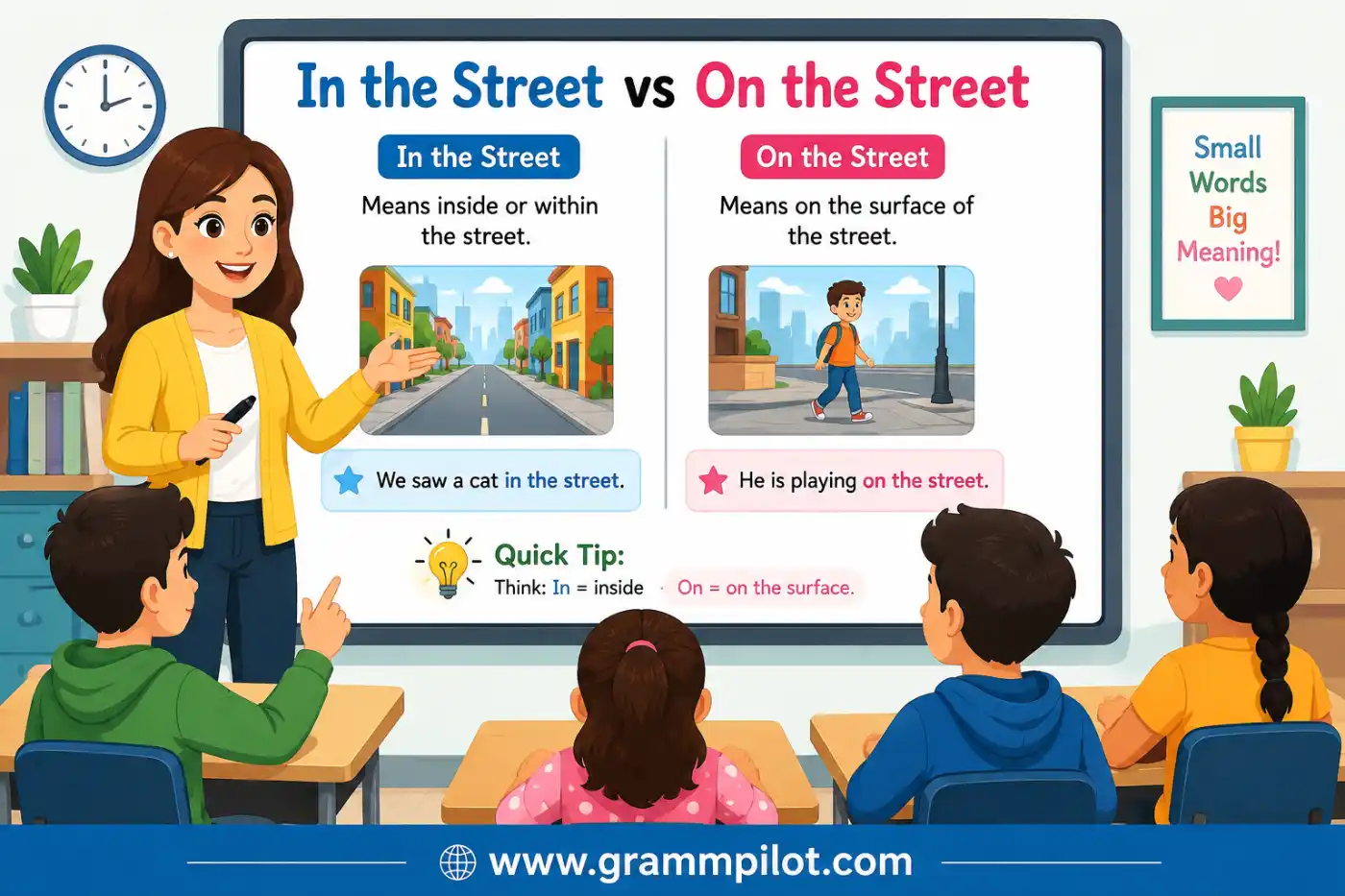
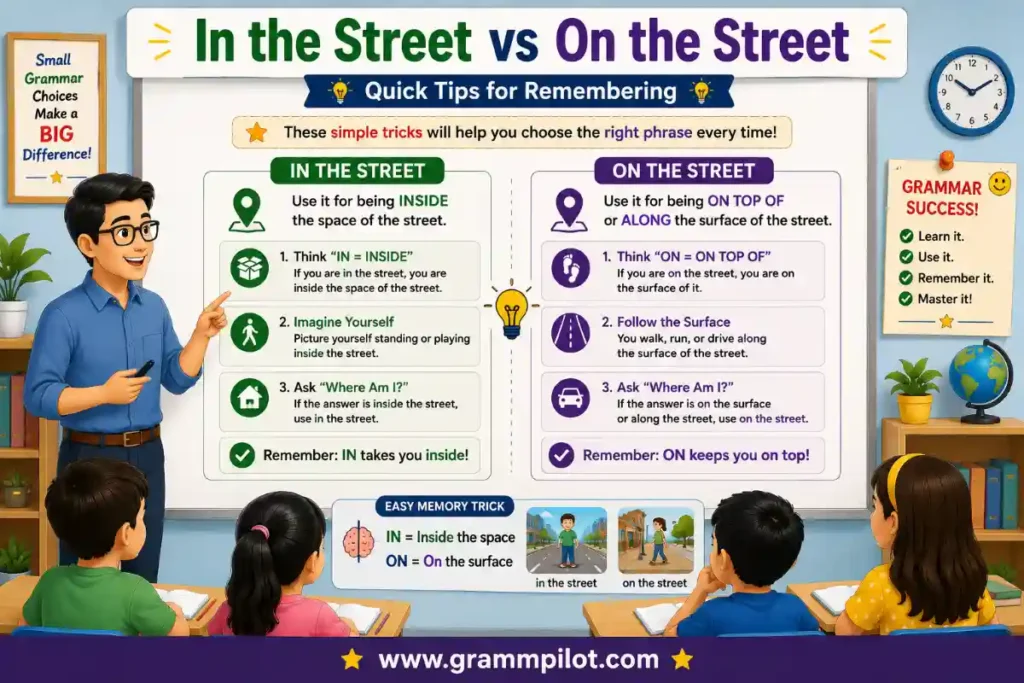
On the street is the standard expression in most everyday situations, especially in American English, when talking about location or something happening along a street. In the street usually means inside the roadway itself or standing where vehicles normally travel. The correct choice depends on the context.
In this guide, you’ll learn In the Street vs On the Street using simple explanations, grammar rules, real-life examples, regional differences, and practical tips that make choosing the right phrase easy.
Another common grammar mistake is covered in [It Worth It or It Is Worth It].
What Is the Difference Between In the Street vs On the Street?
The easiest way to understand In the Street vs On the Street is to think about where someone or something is located.
| Expression | Basic Meaning | Common Situation |
|---|---|---|
| In the street | Inside the roadway | Standing or moving where cars drive |
| On the street | Located along or outside a street | General location, address, or everyday activity |
Look at these examples.
- The children were playing in the street.
- My office is on the street near the bank.
The first sentence describes children physically occupying the road. The second sentence simply tells you where the office is located.
In the Street vs On the Street Meaning in Plain English
Learning the basic meanings first makes everything else much easier.
What Does “In the Street” Mean?
The phrase in the street usually means inside the road where traffic moves.
Examples:
- Don’t play in the street.
- A bicycle was lying in the street.
- The dog ran in the street.
- Workers were repairing a pipe in the street.
These examples describe something physically inside the roadway.
What Does “On the Street” Mean?
The phrase on the street usually refers to a place along a street, near a street, or somewhere on that street.
Examples:
- She lives on the street next to the library.
- We met on the street after work.
- There’s a new coffee shop on the street.
- I saw him on the street yesterday.
In these sentences, the focus is the general location rather than being inside the traffic lane.
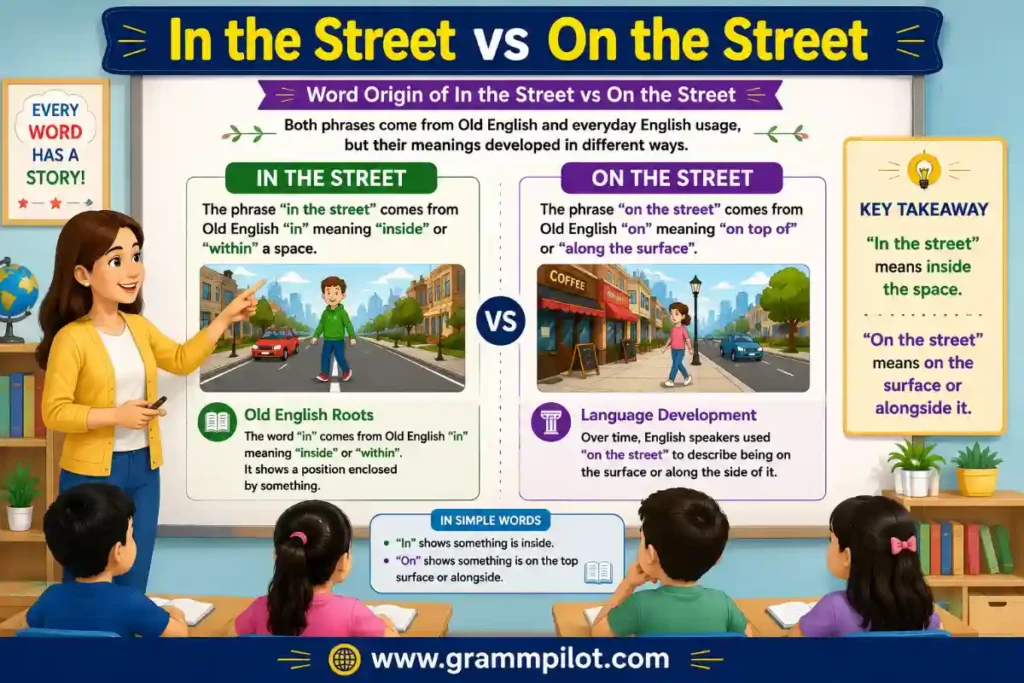
Word Origin of In the Street vs On the Street
Understanding where these expressions came from helps explain why English uses both.
Where Does “Street” Come From?
The word street comes from the Latin word strata, meaning a paved road. As English developed, the word street became the standard name for roads found in towns and cities. Over time, English speakers created different prepositional phrases to describe different positions related to a street.
Why Do We Say “In the Street”?
The preposition in often describes something located inside a space.
That’s why English speakers say:
- A car is in the garage.
- Fish swim in the water.
- Children are playing in the street.
The phrase suggests someone or something is occupying the roadway itself.
Why Do We Say “On the Street”?
The preposition on often describes location connected with a surface or place.
Examples include:
- On the wall
- On the table
- On Main Street
Because addresses and locations are connected with streets, English naturally developed the expression on the street.
Why Do People Confuse In the Street vs On the Street?
Several reasons explain why learners mix these expressions.
Both Mention the Same Place
Since both phrases include the word street, many learners assume they are always interchangeable. In reality, the preposition changes the meaning.
Different Countries Prefer Different Usage
American English generally favors on the street for most location-related situations. British English uses both expressions, although the meaning still depends on context.
Direct Translation Causes Problems
Many languages use only one preposition when talking about streets. When learners translate directly into English, choosing the correct phrase becomes more difficult.
Movies and TV Shows Use Both
English-language films often include both expressions. Without understanding the context, learners may believe the phrases always mean exactly the same thing.
The One Simple Rule for In the Street vs On the Street
Here’s an easy classroom rule.
Ask yourself: Is someone actually standing, walking, or lying inside the roadway?
If yes, choose in the street.
Examples:
- The children are playing in the street.
- A broken tree branch is in the street.
- Someone left a bicycle in the street.
Now ask: Are you simply describing where something is located?
If yes, choose on the street.
Examples:
- There’s a bookstore on the street.
- We met on the street yesterday.
- My apartment is on the street near the station.
Thinking about the exact location helps you make the right choice.
In the Street vs On the Street Grammar Rule
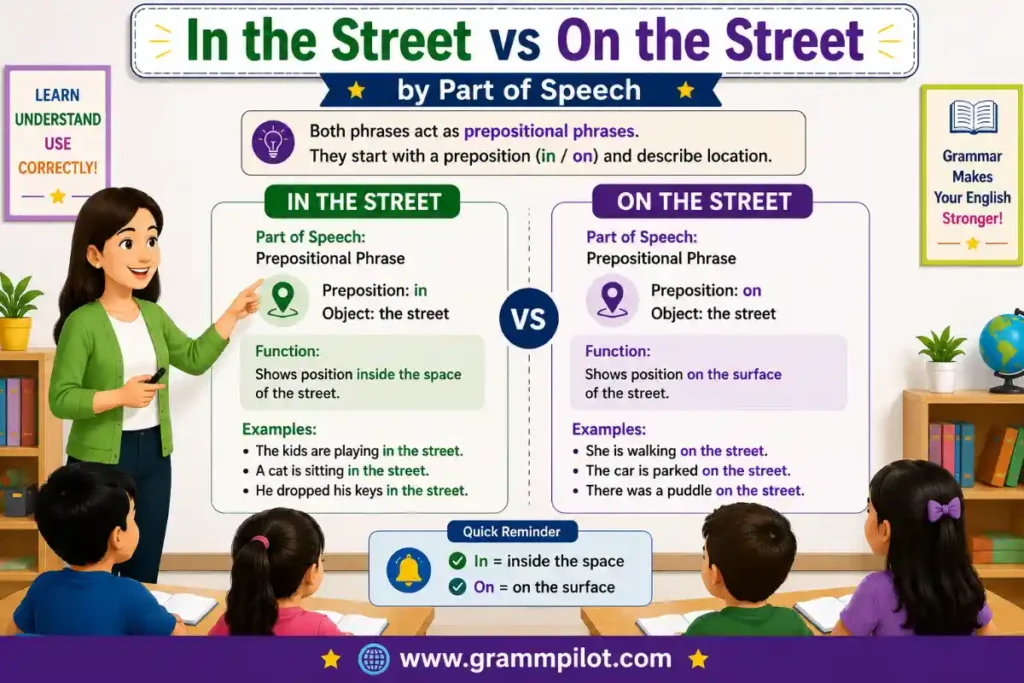
Both expressions are prepositional phrases. The difference comes from the preposition.
“In the Street”
The preposition in emphasizes being inside an area.
Examples:
- Children shouldn’t play in the street.
- Water collected in the street after the storm.
- The accident happened in the street.
- Workers stood in the street directing traffic.
“On the Street”
The preposition on emphasizes location connected with a street.
Examples:
- We live on the street behind the park.
- I met her on the street.
- The restaurant is on the street across from the museum.
- Many shops are located on the street.
Although both phrases include street, each creates a different picture.
In the Street vs On the Street Quick Comparison
| Feature | In the Street | On the Street |
|---|---|---|
| Inside the roadway | ✅ Yes | ❌ Usually no |
| General location | Sometimes | ✅ Yes |
| Talking about addresses | Rare | ✅ Yes |
| Talking about traffic | ✅ Common | Sometimes |
| Everyday American English | Less common | Very common |
| Everyday British English | Common in certain contexts | Common |
Keeping this table in mind makes choosing the right expression much easier.
Is In the Street vs On the Street Used Differently Around the World?
Regional English influences these expressions.
American English
American speakers usually prefer on the street when discussing general locations.
Examples:
- I saw him on the street.
- The restaurant is on the street beside the hotel.
- There’s a parade on the street today.
When someone is physically in traffic, Americans also use in the street.
Example: A child was standing in the street.
British English
British English uses both expressions naturally.
Examples:
- Children shouldn’t play in the street.
- We met on the street after lunch.
British speakers may use in the street slightly more often than Americans when referring to activities taking place in the roadway.
International English
English learners around the world should understand both expressions. The important point is not the country but the meaning. If something occupies the roadway, in the street usually fits. If you’re talking about a location along the street, on the street is generally the better choice.
Master Synonym List Related to “Street Location”
Understanding related expressions helps you avoid repeating the same phrase too often.
Everyday Synonyms
| Word or Phrase | Meaning | Tone | Example |
|---|---|---|---|
| Along the street | Beside the road | Everyday | Many trees grow along the street. |
| By the road | Near the roadway | Everyday | We waited by the road. |
| Near the street | Close to the road | Everyday | The school is near the street. |
| At the roadside | Next to the road | Everyday | The car stopped at the roadside. |
| Beside the street | Along the edge | Everyday | Benches stand beside the street. |
| Outside | Not inside a building | Everyday | The children played outside. |
| On the sidewalk | Walking area beside the street | Everyday | Stay on the sidewalk. |
| At the corner | Street intersection | Everyday | Meet me at the corner. |
Formal Synonyms
| Word or Phrase | Meaning | Tone | Example |
|---|---|---|---|
| Adjacent to the roadway | Next to the road | Formal | The office is adjacent to the roadway. |
| Along the thoroughfare | Along a public road | Formal | Shops line the thoroughfare. |
| Roadside | Located beside a road | Formal | Roadside parking is available. |
| Street-side | Facing the street | Formal | We reserved a street-side table. |
| Public roadway | Official road | Formal | Construction blocked the public roadway. |
| Traffic lane | Area used by vehicles | Formal | Workers closed one traffic lane. |
| Pedestrian area | Area for walkers | Formal | The pedestrian area was crowded. |
| Curbside | Next to the curb | Formal | Curbside pickup is available. |
In the Street vs On the Street Synonyms Grouped by Everyday Use
Expanding your vocabulary helps you understand In the Street vs On the Street more naturally. Although these phrases describe locations connected to a street, several related expressions fit different situations.
Simple and Everyday Alternatives
| Word or Phrase | Meaning | Tone | Example |
|---|---|---|---|
| Along the street | Following the side of a street | Everyday | Trees grow along the street. |
| By the street | Close to the street | Everyday | We parked by the street. |
| Near the road | Close to a roadway | Everyday | The hotel is near the road. |
| At the corner | At a street intersection | Everyday | Meet me at the corner. |
| On the sidewalk | On the walking path | Everyday | Please stay on the sidewalk. |
| Beside the road | Next to the road | Everyday | They waited beside the road. |
| Outside | Not inside a building | Everyday | Everyone gathered outside. |
| Around the block | Nearby neighborhood streets | Everyday | We walked around the block. |
Formal Alternatives
| Word or Phrase | Meaning | Tone | Example |
|---|---|---|---|
| Adjacent to the roadway | Next to the road | Formal | The office is adjacent to the roadway. |
| Along the thoroughfare | Along a public road | Formal | Shops line the thoroughfare. |
| Street-side | Facing the street | Formal | They requested a street-side table. |
| Roadside | Beside a road | Formal | Roadside assistance arrived quickly. |
| Public roadway | Official traffic route | Formal | The public roadway remained closed. |
| Traffic lane | Vehicle lane | Formal | Workers repaired the traffic lane. |
| Pedestrian zone | Area for walkers | Formal | Cars cannot enter the pedestrian zone. |
| Curbside | Next to the curb | Formal | Curbside pickup begins at noon. |
Informal Alternatives
| Word or Phrase | Meaning | Tone | Example |
|---|---|---|---|
| Out front | In front of a building | Informal | I’ll wait out front. |
| Down the street | A short distance away | Informal | The bakery is down the street. |
| Right outside | Immediately outside | Informal | Your ride is right outside. |
| Around here | Nearby | Informal | There’s a park around here. |
| Out on the road | Traveling on a road | Informal | He’s out on the road today. |
| Across the street | On the opposite side | Informal | She lives across the street. |
| Up the street | Farther along the street | Informal | The pharmacy is up the street. |
| Just outside | Slightly beyond the entrance | Informal | I’ll meet you just outside. |
In the Street vs On the Street by Intensity
Not every location phrase creates the same picture. Some describe exact positions, while others refer to general areas.
Exact Position
- in the roadway
- in traffic
- in the middle of the street
- inside the traffic lane
- in the road
Example: The ball rolled into the middle of the street.
Nearby Position
- beside the road
- by the street
- near the sidewalk
- along the street
- curbside
Example: Several bicycles were parked beside the road.
General Location
- on the street
- down the street
- across the street
- around the block
- nearby
Example: We found a great restaurant down the street.
Choosing the right phrase gives readers a clearer picture of the location.
In the Street vs On the Street by Part of Speech
Although the focus keyphrase contains prepositions, understanding the grammar behind the words makes the choice easier.
| Part of Speech | Examples |
|---|---|
| Noun | street, road, sidewalk, roadway |
| Preposition | in, on, beside, along |
| Verb | walk, stand, cross, drive |
| Adverb | nearby, outside, ahead, across |
Remember these simple grammar facts.
- In usually shows something inside an area.
- On usually shows location connected with a surface or place.
- Both phrases are prepositional phrases used to describe location.
Which Phrase Works Best in Different Situations?
The best expression depends on what you’re trying to describe.
In the Street vs On the Street in a Resume
Most resumes don’t mention streets often, but location descriptions may appear.
Examples:
- Assisted customers at events held on the street.
- Directed traffic during construction in the street.
Professional writing should describe the exact situation.
In the Street vs On the Street in Essays
Academic writing often discusses safety, transportation, or city planning.
Examples:
Children should avoid playing in the street because of traffic.
Many festivals take place on the street during the summer.
Using the correct phrase makes essays more accurate.
In the Street vs On the Street in Business Emails
Clear communication matters in professional writing.
Examples:
Please meet me on the street outside the main entrance.
Construction workers are currently in the street, so expect delays.
Our office is on the street opposite the library.
Several delivery trucks are parked in the street while unloading equipment.
Context determines which phrase sounds natural.
In the Street vs On the Street in Text Messages
Friends usually choose simple, natural wording.
Examples:
I’m waiting on the street.
Don’t stand in the street.
Meet me across the street.
There’s a food truck down the street.
Short messages still benefit from choosing the correct expression.
In the Street vs On the Street in Everyday Conversation
Native speakers naturally switch between these phrases depending on the situation.
Imagine someone asks: Where’s the restaurant?
A natural answer is: It’s on the street next to the post office.
Now imagine another situation. Where’s the dog?
A natural reply is: It’s running in the street.
The first answer describes location. The second describes position inside the roadway.
In the Street vs On the Street Examples From Real-Life Situations
The following examples show how these expressions appear naturally in everyday English.
- Children shouldn’t play in the street.
- We met on the street after work.
- A broken branch was lying in the street.
- My apartment is on the street near the supermarket.
- Police closed the road because debris covered the street.
- Several musicians performed on the street during the festival.
- The cyclist fell in the street after hitting a pothole.
- She opened a small bakery on the street beside the bank.
- Workers repaired a water pipe in the street all morning.
- I recognized my teacher on the street yesterday afternoon.
- A stray cat wandered in the street before someone rescued it.
- Tourists enjoyed watching artists on the street.
- Heavy rain left standing water in the street.
- We found a quiet café on the street behind the museum.
- Emergency crews responded quickly because a truck stopped in the street.
These examples cover travel, education, business, daily life, safety, and city living while showing how naturally both expressions fit different contexts.
Is In the Street vs On the Street a Common Grammar Question?
Yes. English learners often ask about In the Street vs On the Street because both expressions refer to streets but describe different kinds of locations.
A simple way to remember the difference is this:
- Choose in the street when something is physically inside the roadway.
- Choose on the street when talking about a location, address, business, event, or general place along the street.
Thinking about where the person or object actually is will help you choose the correct phrase confidently.
In the Street vs On the Street Compared With Similar Expressions
Learning In the Street vs On the Street becomes much easier when you compare these phrases with other common expressions about roads, sidewalks, and locations. Each one has its own purpose, and understanding the difference helps you sound more natural.
In the Street vs On the Road
These expressions describe different places.
| In the Street | On the Road |
|---|---|
| Inside a street, usually in a town or city | Traveling or located on a road |
| Often refers to the roadway itself | Can refer to highways, country roads, or travel |
Examples:
- A fallen tree blocked traffic in the street.
- My parents are on the road to Chicago.
The first sentence describes a specific location, while the second describes travel.
In the Street vs On the Sidewalk
These phrases describe different positions.
| In the Street | On the Sidewalk |
|---|---|
| Inside the roadway | On the walking path beside the road |
| May involve traffic | Safe area for pedestrians |
Examples:
- Don’t run in the street.
- Please wait on the sidewalk.
Choosing the right phrase gives a much clearer picture.
In the Street vs At the Corner
These expressions answer different questions.
| In the Street | At the Corner |
|---|---|
| Describes position inside the roadway | Describes a meeting point or intersection |
Examples:
- The accident happened in the street.
- I’ll meet you at the corner.
The first focuses on where something occurred. The second identifies a specific location.
On the Street vs Along the Street
These expressions are similar but not identical.
| On the Street | Along the Street |
|---|---|
| General location | Spread beside or throughout the street |
| Often refers to one place | Often refers to several places |
Examples:
- There’s a bakery on the street.
- Trees grow along the street.
The meaning changes slightly because along suggests movement or distribution.
On the Street vs Across the Street
Many learners confuse these phrases.
| On the Street | Across the Street |
|---|---|
| Somewhere on that street | On the opposite side of the street |
Examples:
- We met on the street after work.
- The pharmacy is across the street.
The second phrase gives more exact direction.
In the Street vs On the Street in Everyday English
Native speakers naturally choose one phrase or the other depending on the situation.
You’ll hear sentences like these:
- Children shouldn’t play in the street.
- I saw my neighbor on the street yesterday.
- A truck stopped in the street.
- Several musicians performed on the street during the festival.
Paying attention to the picture created by the sentence makes the correct choice easier.
In the Street vs On the Street in School Writing
Students often write about neighborhoods, transportation, or safety.
Examples:
- Never leave toys in the street where drivers cannot see them.
- Many local businesses are located on the street near the library.
- Volunteers cleaned litter in the street after the parade.
- Visitors enjoyed shopping on the street during the weekend market.
Using the correct phrase improves clarity in essays.
In the Street vs On the Street in Professional Writing
Business communication also depends on context.
Examples:
- Construction equipment remains in the street until repairs are complete.
- Our office is on the street opposite the train station.
- Delivery vehicles temporarily stopped in the street.
- Customers waited on the street outside the store before opening.
Modern professional writing favors precise location descriptions.
In the Street vs On the Street in News Reports
Journalists often use both expressions because they describe different situations.
Examples:
- Emergency crews found debris in the street after the storm.
- Hundreds of people gathered on the street to celebrate the championship.
- Police redirected traffic around a vehicle parked in the street.
- Reporters interviewed residents on the street throughout the afternoon.
News writing depends heavily on accurate location words.
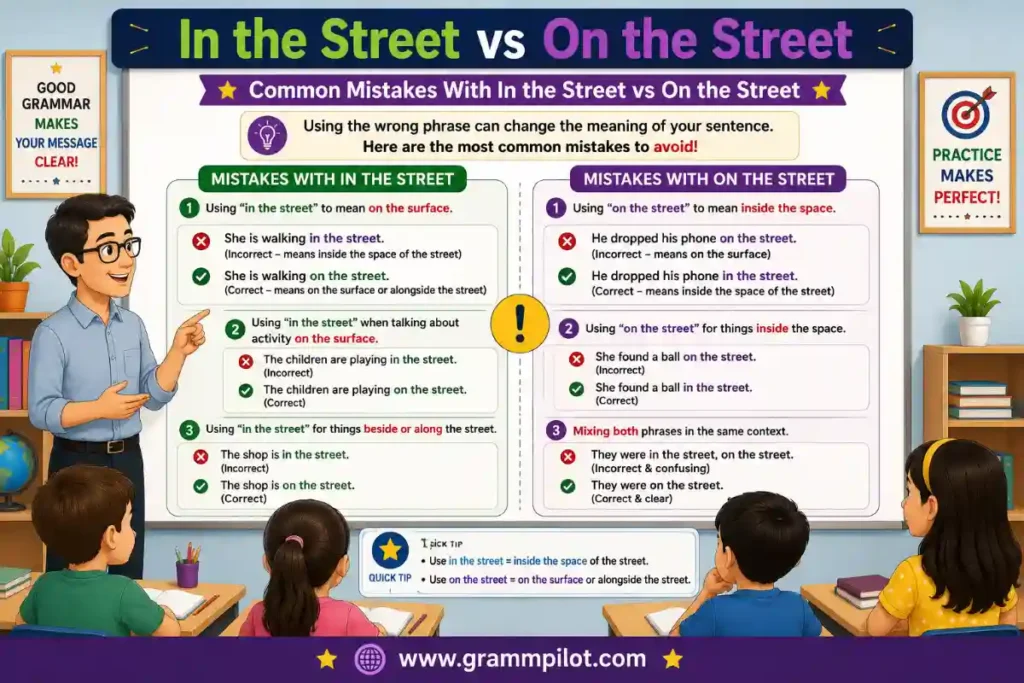
Common Mistakes With In the Street vs On the Street
These are the mistakes English learners make most often.
Mistake 1: Using “On the Street” for Everything
Some learners think on the street works in every sentence. Not always. If something is physically inside the roadway, in the street is usually the better choice.
Mistake 2: Using “In the Street” for Building Locations
When talking about a shop, office, restaurant, or address, on the street is generally correct.
Correct: There’s a bookstore on the street.
Less natural: There’s a bookstore in the street.
Mistake 3: Ignoring the Picture
Imagine the scene before choosing the phrase.
Ask yourself: Is it inside the roadway?
Or is it simply located along the street?
That question usually leads to the correct answer.
Mistake 4: Forgetting Regional Differences
British and American English may use these expressions a little differently, but the basic meaning remains the same. Understanding the context is more important than memorizing regional preferences.
Mistake 5: Translating Directly From Another Language
Many languages use only one preposition for streets. English does not. Instead of translating word for word, think about the exact location being described.
Quick Tips for Choosing Between In the Street vs On the Street
These simple reminders can help every time you write.
- Think about where the person or object actually is.
- Use in the street for the roadway itself.
- Choose on the street for general locations and addresses.
- Imagine whether traffic could drive through that space.
- Read the entire sentence before deciding.
- Keep your wording consistent in longer pieces of writing.
- Watch how newspapers and books use each phrase.
- Practice with real-life situations instead of memorizing rules.
- Proofread your work before submitting it.
- When describing businesses or homes, on the street is usually the safer choice.
In the Street vs On the Street Practice Sentences
Read each sentence and decide which phrase fits best.
1. The children were playing ________.
Correct answer: in the street, because they were physically in the roadway.
2. We found a small café ________ near the museum.
Best answer: on the street, since the sentence describes a location.
3. A large branch fell ________ after the storm.
Choose: in the street, because the branch is lying in the roadway.
4. My dentist’s office is ________ beside the library.
Correct choice: on the street, because it identifies a place.
5. Drivers slowed down after seeing a bicycle ________.
Answer: in the street, since the bicycle is blocking part of the road.
6. Several artists performed ________ during the festival.
Best choice: on the street, because the sentence describes a public event.
7. Water remained ________ after heavy rain.
Use: in the street, as the water is inside the roadway.
8. I met my old teacher ________ yesterday afternoon.
Choose: on the street, because it refers to meeting someone in a general public location.
9. Workers repaired a damaged pipe ________ all morning.
Correct answer: in the street, since the repair happened in the roadway.
10. The new bookstore opened ________ across from the park.
Best answer: on the street, because the sentence describes where the business is located.
Practicing with realistic examples helps you understand the small but important difference between these expressions, making your English sound more natural, accurate, and confident in both writing and conversation.
Common Situations Where People Use In the Street vs On the Street Incorrectly
Understanding In the Street vs On the Street becomes much easier when you see how these expressions are used in everyday situations. Most mistakes happen because writers focus only on the word street instead of the exact location being described.
While Giving Directions
When explaining where a building is, on the street is usually the correct choice.
Correct:
- The pharmacy is on the street next to the bank.
- Our office is on the street opposite the post office.
When talking about something physically blocking traffic, use in the street.
Examples:
- A broken truck is in the street.
- Workers are repairing a water pipe in the street.
During School Writing
Students often write about safety or their neighborhoods.
Correct:
- Children should not play in the street.
- There are many small shops on the street near my school.
- We saw a parade on the street last weekend.
- The soccer ball rolled in the street after the kick.
Choosing the right phrase helps your writing sound natural.
In Business Emails
Professional writing should describe locations clearly.
Examples:
- Please meet me on the street outside the main entrance.
- Construction crews are working in the street, so parking is limited.
- Our new office is on the street beside the hotel.
- Delivery vehicles cannot stop in the street during rush hour.
The correct preposition makes directions easier to understand.
In Everyday Conversation
Native speakers switch naturally between these expressions.
Examples:
- I met Sarah on the street yesterday.
- Someone left a bicycle in the street.
- There’s a great bakery on the street near my apartment.
- A fallen tree blocked traffic in the street.
Notice that the meaning changes because the location changes.
Antonyms Related to In the Street vs On the Street
Sometimes you need to describe the opposite idea by showing that someone or something is not in a public street.
| Word or Phrase | Meaning |
|---|---|
| Indoors | Inside a building |
| Inside | Within an enclosed place |
| At home | In one’s house |
| Off the road | Away from traffic |
| Off the street | Away from public streets |
| In a building | Located inside a structure |
| Private property | Not in a public area |
| Inside the yard | Within a private outdoor space |
Related Opposites in Context
Depending on your sentence, these expressions may also fit.
- Inside the house
- In the garden
- In the driveway
- Off the sidewalk
- Away from traffic
- Inside the office
- In the parking garage
- Within the property
The best opposite depends on the location you’re describing.
Quick Tips for Remembering In the Street vs On the Street
You don’t need to memorize long grammar rules. These practical reminders are enough.
- Think about the exact location first.
- Use in the street when something is inside the roadway.
- Choose on the street for businesses, addresses, or general locations.
- Imagine whether cars could drive through that space.
- Read the whole sentence before selecting the preposition.
- Stay consistent throughout your writing.
- Watch how newspapers and books use these expressions.
- Practice with real-life examples instead of isolated rules.
- Proofread important documents before submitting them.
- When talking about a shop or home, on the street is usually the natural choice.
Final Teacher Explanation
Imagine a student asks:
“Should I write in the street or on the street?”
The answer depends on the picture your sentence creates.
If someone or something is physically inside the roadway where vehicles travel, choose in the street.
If you’re describing a general location, an address, a business, or meeting someone along a street, choose on the street.
Look at these examples.
- The children were playing in the street.
- I met my neighbor on the street this morning.
Both sentences are correct because each describes a different situation.
Once you focus on the location rather than memorizing rules, In the Street vs On the Street becomes much easier to understand.
Conclusion
This help in recognizing the exact location you want to describe. Although the phrases look similar, they create different meanings. In the street usually refers to something physically in the roadway, while on the street is the natural choice for addresses, businesses, public locations, or meeting someone along a street. Knowing this small distinction makes your English clearer and more natural.
As you continue practicing, don’t rely on memorization alone. Instead, imagine the scene in your mind before choosing the preposition. With regular reading and everyday practice, using In the Street vs On the Street correctly will become second nature, helping your writing and speaking sound more confident and accurate.
Frequently Asked Questions
1. What is the difference between In the Street vs On the Street?
In the street usually means inside the roadway where vehicles travel, while on the street refers to a general location, address, or place along a street.
2. Is “on the street” more common than “in the street”?
Yes. In modern English, especially American English, on the street is more common because it is used for locations, businesses, and everyday conversations.
3. When should I use “in the street”?
Use in the street when someone or something is physically in the road, such as a child playing, a parked vehicle blocking traffic, or debris after a storm.
4. Can I use both expressions in British English?
Yes. British English uses both expressions, but the choice still depends on the meaning and context rather than personal preference.
5. What’s another way to say “on the street”?
Depending on the sentence, you can say along the street, by the street, near the road, roadside, across the street, down the street, or at the corner.
6. Why do learners confuse In the Street vs On the Street?
Many languages use only one preposition for streets, so learners often translate directly into English. Understanding the location being described helps avoid this mistake.
7. How can I remember In the Street vs On the Street easily?
Use this simple memory trick:
- In the street = inside the roadway
- On the street = along or connected with the street
Picture the scene before choosing the preposition, and the correct answer usually becomes obvious.