
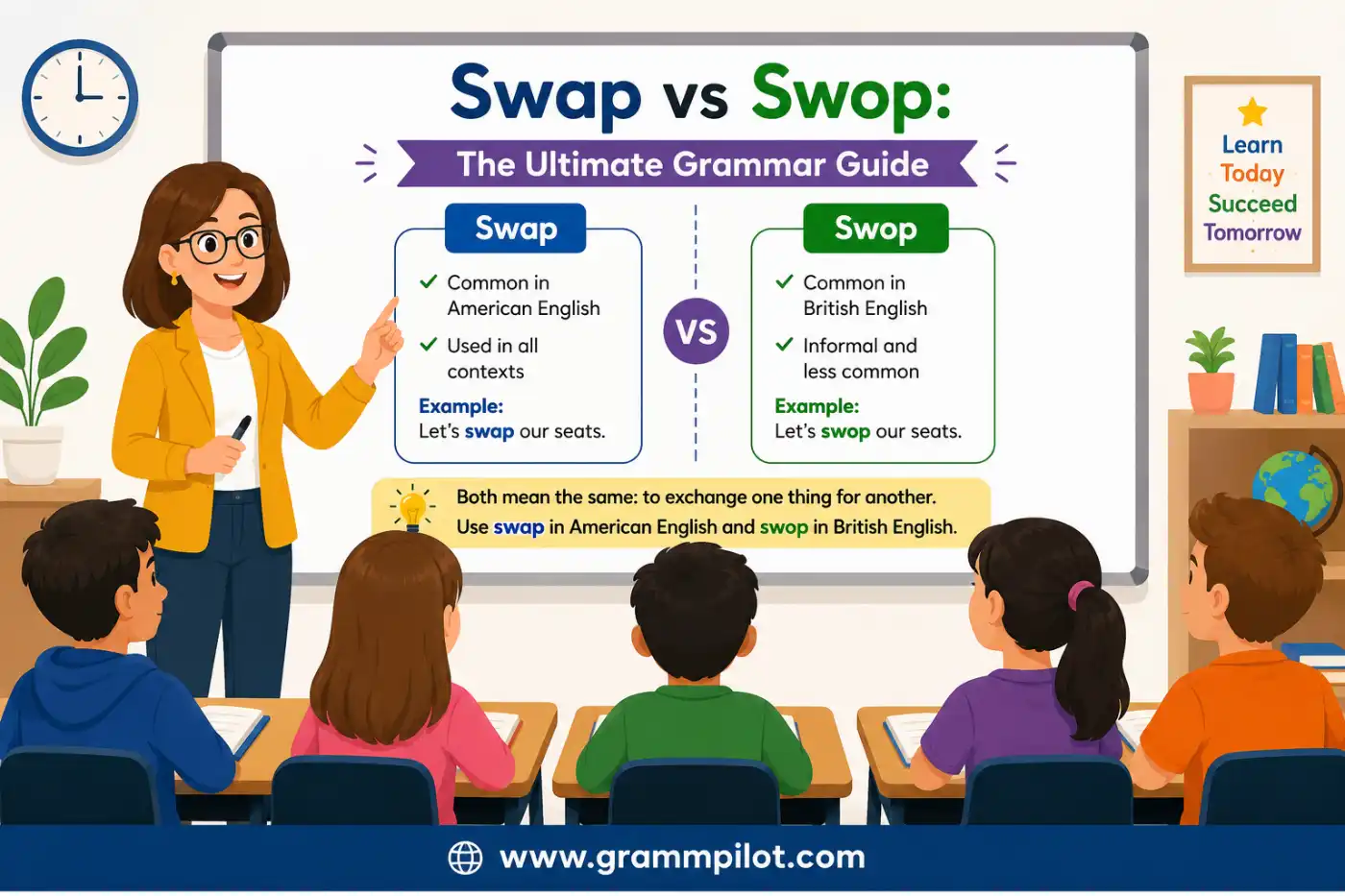
Have you ever typed a message, written an email, or posted online and wondered whether to use Swap vs Swop? Both words look very similar, and both appear in dictionaries, but they are not used equally. Many English learners—and even native speakers—aren’t sure which spelling is correct. The confusion becomes even greater because you may see swap almost everywhere, while swop appears much less often. If both words exist, why is one so much more common? The answer lies in regional English, modern usage, and writing style.
Answer Box:
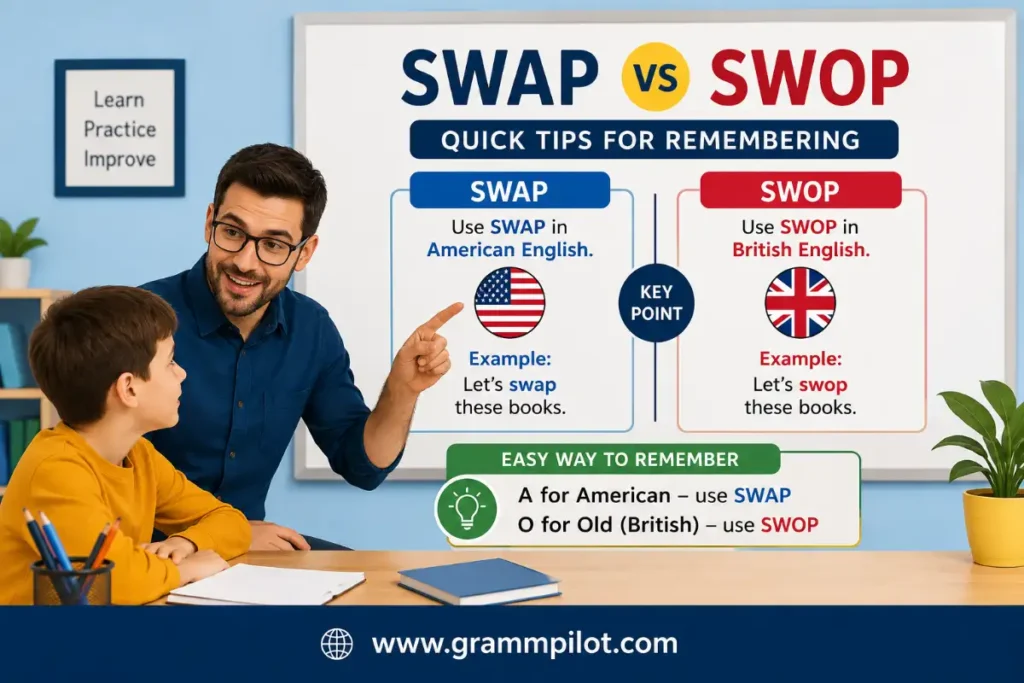
Swap is the standard and most widely accepted spelling in both American and modern British English. Swop is an older British spelling that is still recognized but is rarely used today. In most situations, swap is the better choice.
In this guide, you’ll learn Swap vs Swop through simple explanations, grammar rules, word origins, examples, regional differences, and practical tips that make choosing the correct spelling easy.
For more practical grammar examples, explore [In the Street vs On the Street].
What Is the Difference Between Swap vs Swop?
The easiest way to understand Swap vs Swop is to compare how each word is used today.
| Word | Meaning | Modern Usage |
|---|---|---|
| Swap | To exchange one thing for another | Very common |
| Swop | Older spelling of swap | Rare |
Both words mean the same thing.
Examples:
- Let’s swap seats.
- Can we swap our lunch boxes?
Older British writing may also contain: Let’s swop places. Although the meaning stays the same, swap is now the preferred spelling almost everywhere.
Swap vs Swop Meaning in Plain English
Understanding the meaning first makes the spelling easier to remember.
What Does “Swap” Mean?
The word swap means to exchange one thing for another.
Examples:
- We swapped books after class.
- Can you swap shifts with me?
- They swapped phone numbers.
- I’ll swap my sandwich for your salad.
The exchange is usually mutual, meaning both people give and receive something.
What Does “Swop” Mean?
The word swop has exactly the same meaning.
Examples:
- They decided to swop hats.
- She asked to swop rooms.
Although these sentences are correct, modern writers would almost always replace swop with swap.
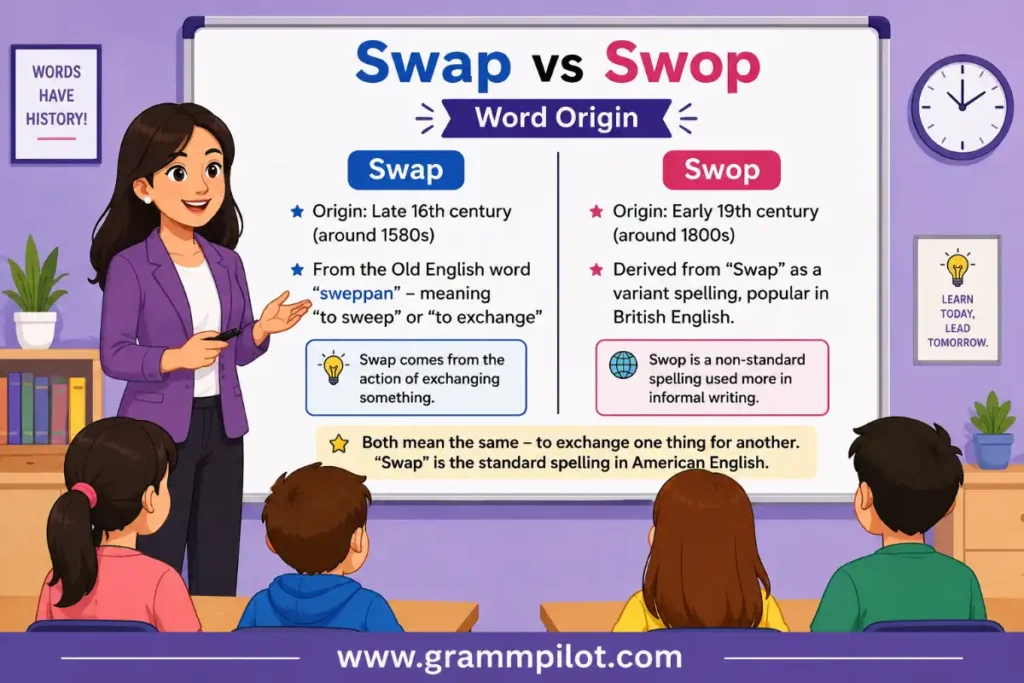
Word Origin of Swap vs Swop
Knowing where these spellings came from helps explain why both still appear in English.
Where Does “Swap” Come From?
The word swap entered English several centuries ago. Language experts believe it developed from older Northern English dialects, where it meant to exchange, strike, or trade. As English spread around the world, swap became the standard spelling. Today, you’ll find it in newspapers, books, websites, schools, businesses, and official documents.
Where Does “Swop” Come From?
The spelling swop appeared mainly in British English. For many years, both spellings existed side by side. Eventually, dictionaries, publishers, and schools began favoring swap, causing swop to become much less common. Today, swop survives mostly in older books, historical writing, or a few British publications.
Why Did “Swap” Become More Popular?
Language naturally changes over time. Publishers preferred one standard spelling. Schools taught the more common version. Dictionaries highlighted swap as the primary spelling. As a result, millions of English speakers gradually adopted swap, while swop became uncommon.
Why Do People Confuse Swap vs Swop?
Several reasons explain the confusion.
Both Spellings Exist
Unlike many spelling mistakes, swop is a real English word. Because dictionaries still recognize it, learners assume both spellings are equally common.
Older Books Use “Swop”
Readers sometimes discover swop in classic British novels or older newspapers. Seeing both spellings creates uncertainty.
Online Content Isn’t Always Updated
Some websites still use swop, especially older pages written years ago. That makes it difficult for learners to know which spelling modern English prefers.
The Pronunciation Is Identical
Both words are pronounced exactly the same. Without hearing a spelling difference, many people don’t realize that one form has become far more common.
The One Simple Rule for Swap vs Swop
Here’s the easiest classroom rule.
Ask yourself: Are you writing modern English?
If the answer is yes, choose swap.
Examples:
- Let’s swap desks.
- We swapped tickets.
- Can we swap places?
Now ask:
Am I quoting an older British source or preserving historical spelling?
If yes, swop may appear.
Example: The original newspaper reported that the players agreed to swop jerseys.
Outside historical or quoted material, swap is almost always the better choice.
Swap vs Swop Grammar Rule
Grammar doesn’t change between these spellings.
“Swap” Can Be a Verb
Examples:
- We swap ideas every week.
- They swapped seats.
- I’ll swap my notebook with yours.
- Can we swap classrooms?
“Swap” Can Also Be a Noun
Examples:
- The book swap starts tomorrow.
- Our school organized a clothing swap.
- The toy swap was successful.
- Everyone enjoyed the holiday gift swap.
“Swop” Follows the Same Grammar
Because swop has the same meaning, it can also function as a verb or noun.
Examples:
- They planned a swop.
- Let’s swop books.
Even so, modern English strongly prefers swap.
Swap vs Swop Quick Comparison
| Feature | Swap | Swop |
|---|---|---|
| Meaning | Exchange something | Exchange something |
| Part of Speech | Noun and verb | Noun and verb |
| American English | Standard | Rare |
| Modern British English | Standard | Rare |
| Seen in older British writing | Yes | More common |
| Best choice today | ✅ Yes | ❌ Usually no |
Keeping this comparison in mind makes the spelling decision much easier.
Is Swap vs Swop Used Differently Around the World?
Regional English plays a role in Swap vs Swop, but modern usage has become much more consistent.
American English
American English almost always uses swap.
Examples:
- We swapped cars.
- Let’s swap phone numbers.
- They organized a book swap.
Finding swop in modern American writing is extremely uncommon.
British English
British English historically accepted both spellings.
Today, however, most British newspapers, schools, publishers, and businesses also prefer swap.
Examples:
- Can we swap shifts?
- They swapped houses for the holidays.
You may still see swop in older books or historical documents, but it is no longer the normal spelling.
International English
Around the world, English learners are generally taught swap. Whether you’re writing for school, work, websites, exams, or social media, swap is the spelling readers expect.
Master Synonym List for “Swap”
Learning related words expands your vocabulary and helps you avoid repetition.
Everyday Synonyms
| Word or Phrase | Meaning | Tone | Example |
|---|---|---|---|
| Exchange | Give one thing for another | Everyday | We exchanged gifts. |
| Trade | Exchange items | Everyday | They traded baseball cards. |
| Switch | Replace one thing with another | Everyday | Let’s switch seats. |
| Change | Replace or exchange | Everyday | We changed partners. |
| Replace | Put one thing in place of another | Everyday | Replace the old battery. |
| Give and take | Mutual exchange | Informal | Good teamwork requires give and take. |
| Share | Use together | Everyday | The children shared toys. |
| Pass around | Move among people | Everyday | Pass the papers around. |
Formal Synonyms
| Word or Phrase | Meaning | Tone | Example |
|---|---|---|---|
| Exchange | Mutual transfer | Formal | The companies exchanged information. |
| Transfer | Move ownership or position | Formal | Assets were transferred legally. |
| Substitute | Replace one item with another | Formal | Substitute the original document. |
| Reassign | Give to another person | Formal | Managers reassigned responsibilities. |
| Reallocate | Distribute differently | Formal | Resources were reallocated. |
| Interchange | Exchange systematically | Formal | The parts are interchangeable. |
| Convert | Change into another form | Formal | Points can be converted into rewards. |
| Barter | Exchange goods without money | Formal | Villagers bartered food for tools. |
Swap vs Swop Synonyms Grouped by Everyday Use
Expanding your vocabulary makes it easier to understand Swap vs Swop in different situations. While swap is the preferred spelling today, many related words can express the idea of exchanging something.
Simple and Everyday Synonyms
| Word or Phrase | Meaning | Tone | Example |
|---|---|---|---|
| Exchange | Give one thing and receive another | Everyday | We exchanged gifts. |
| Trade | Swap items or services | Everyday | They traded baseball cards. |
| Switch | Change places or positions | Everyday | Let’s switch seats. |
| Change | Replace one thing with another | Everyday | I changed my schedule. |
| Replace | Put something new instead | Everyday | Replace the old battery. |
| Share | Use together | Everyday | The children shared their toys. |
| Pass | Give to another person | Everyday | Please pass the notebook. |
| Rotate | Take turns using something | Everyday | We rotate responsibilities each week. |
Formal Synonyms
| Word or Phrase | Meaning | Tone | Example |
|---|---|---|---|
| Transfer | Move ownership or responsibility | Formal | The files were transferred securely. |
| Substitute | Use one item instead of another | Formal | Substitute whole wheat flour. |
| Reassign | Give a task to someone else | Formal | The manager reassigned the project. |
| Reallocate | Distribute resources differently | Formal | Funds were reallocated. |
| Interchange | Exchange systematically | Formal | The machine has interchangeable parts. |
| Convert | Change into another form | Formal | Points can be converted into rewards. |
| Barter | Exchange goods without money | Formal | Farmers bartered crops. |
| Reposition | Move to a different place | Formal | The equipment was repositioned. |
Informal Alternatives
| Word or Phrase | Meaning | Tone | Example |
|---|---|---|---|
| Swap around | Exchange several things | Informal | We swapped around our desks. |
| Switch over | Move from one thing to another | Informal | Let’s switch over after lunch. |
| Mix up | Exchange accidentally or intentionally | Informal | We mixed up our bags. |
| Trade off | Exchange for an advantage | Informal | Every decision has trade-offs. |
| Flip | Exchange quickly | Informal | They flipped seats. |
| Hand over | Give to another person | Informal | Hand over the keys. |
| Trade places | Exchange positions | Informal | Let’s trade places. |
| Change over | Move to another option | Informal | The team changed over to a new system. |
Swap vs Swop by Intensity
Some related words describe a simple exchange, while others suggest a bigger or more formal change.
Mild Exchange
- share
- pass
- rotate
- hand over
- switch
`Example: Let’s switch chairs for today’s activity.
Moderate Exchange
- swap
- exchange
- trade
- substitute
- replace
Example:
They swapped books after finishing the assignment.
Strong or Formal Exchange
- transfer
- convert
- reallocate
- reassign
- barter
Example:
The organization transferred resources to another department.
Choosing the right synonym depends on what is being exchanged and how formal your writing needs to be.
Swap vs Swop by Part of Speech
Both spellings work the same grammatically, although swap is the preferred modern form.
| Part of Speech | Examples |
|---|---|
| Noun | swap, exchange, trade, transfer |
| Verb | swap, exchange, switch, replace |
| Adjective | interchangeable, replaceable, transferable |
| Adverb | mutually, equally, freely |
Remember these simple grammar points.
- Swap can be both a noun and a verb.
- Swop can also be a noun and a verb, but it is rarely used today.
- Modern English strongly prefers swap in nearly every situation.
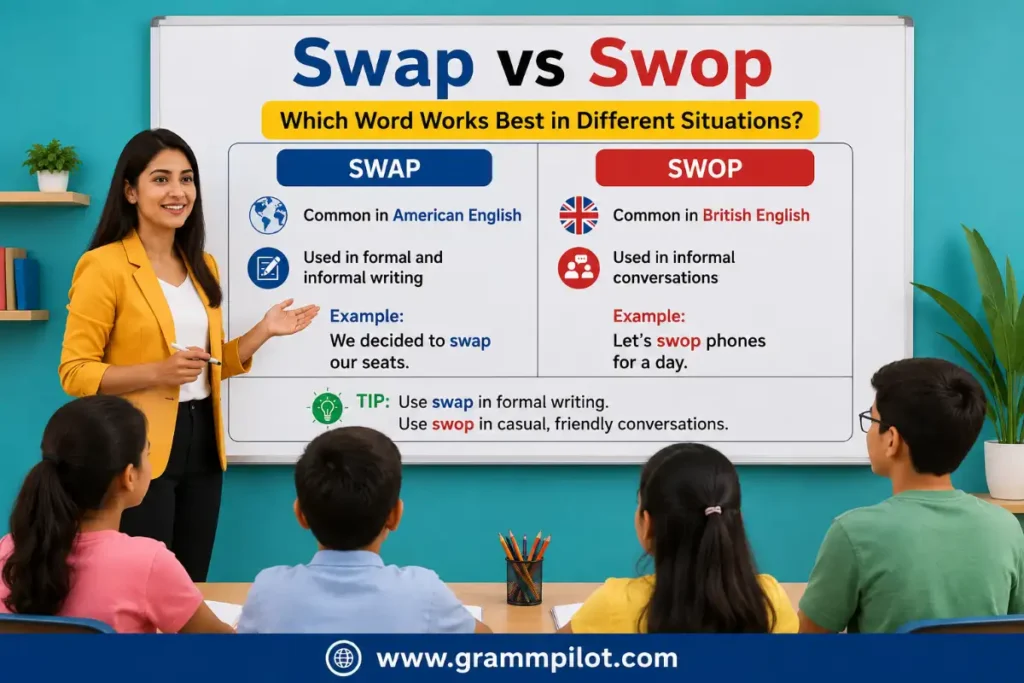
Which Word Works Best in Different Situations?
Choosing the right word depends on where you’re writing and who will read it.
Swap vs Swop on a Resume
Resumes usually avoid casual wording.
Instead of saying: I swapped responsibilities with coworkers.
A stronger version is: I transferred responsibilities during team restructuring.
If you need to describe exchanging shifts or duties, swap is acceptable in less formal situations.
Swap vs Swop in Essays
Academic writing generally prefers formal vocabulary.
Examples:
Students exchanged ideas during the discussion.
Researchers swapped samples for comparison.
Because swop looks outdated, swap is the better spelling for modern essays.
Swap vs Swop in Business Emails
Professional communication should be clear and current.
Examples:
Can we swap meeting times?
Please exchange the signed documents before Friday.
The team swapped project assignments after the planning meeting.
Our departments exchanged updated reports yesterday.
Modern business writing almost never uses swop.
Swap vs Swop in Text Messages
Casual conversations frequently use swap.
Examples:
Can we swap seats?
Let’s swap phones for a minute.
Want to swap lunches?
I’ll swap with you tomorrow.
Using swop in text messages may confuse younger readers because many have never seen the older spelling.
Swap vs Swop in Everyday Conversation
Native speakers naturally use swap in many situations.
Imagine someone says: I don’t like this seat.
A natural reply is: Let’s swap places.
Now imagine another conversation: Can I borrow your pen?
You might answer: Sure, let’s swap pens for a while.
These examples sound natural because swap is part of everyday English.
Swap vs Swop Examples From Real-Life Situations
Here are examples showing how swap appears naturally in different situations.
- We swapped seats before the movie started.
- My brother and I often swap books.
- The players swapped jerseys after the match.
- Let’s swap phone numbers.
- They swapped classrooms during the renovation.
- We swapped recipes at the family gathering.
- The children swapped toys without arguing.
- She swapped shifts with a coworker.
- Our neighbors swapped holiday decorations.
- The students swapped project ideas.
- I swapped my notebook for a newer one.
- The companies swapped useful information.
- Friends often swap travel stories.
- We swapped gifts during the celebration.
- The teachers swapped lesson plans to share ideas.
These examples show that swap works naturally in conversations, schools, workplaces, sports, travel, and daily life.
Is Swap vs Swop a Common Spelling Question?
Yes. Many English learners search for Swap vs Swop because both spellings appear in dictionaries and older books.
Fortunately, remembering the correct choice is easy.
- Use swap for modern English.
- Recognize swop as an older British spelling.
- Choose swap for school assignments, business writing, emails, websites, exams, and everyday communication.
Following this simple rule will help your writing look current, professional, and natural.
Swap vs Swop Compared With Similar Words
Learning Swap vs Swop becomes much easier when you compare these spellings with other words that describe exchanging or replacing something. Although several terms have similar meanings, each one fits a different situation.
Swap vs Exchange
These two words are close in meaning, but they are not always interchangeable.
| Swap | Exchange |
|---|---|
| More common in everyday English | More common in formal writing |
| Sounds friendly and conversational | Sounds professional and official |
| Often used in daily conversations | Frequently used in business and academic writing |
Examples:
- Let’s swap seats before the show starts.
- The two companies exchanged contracts.
Both describe giving one thing and receiving another, but exchange usually sounds more formal.
Swap vs Trade
People often use these words together, yet they can carry different meanings.
| Swap | Trade |
|---|---|
| Usually involves a simple exchange | Often involves buying, selling, or business |
| Common in daily conversation | Common in commerce and sports |
Examples:
- We swapped phone numbers.
- Farmers traded vegetables at the market.
A trade may involve money or business, while a swap is often a straightforward exchange.
Swap vs Switch
Although these verbs are similar, they are not identical.
| Swap | Switch |
|---|---|
| Two people or things exchange places | One thing changes to another |
| Usually involves both sides | May involve only one side |
Examples:
- We swapped desks.
- She switched the lights off.
A swap normally requires two items or people, whereas a switch can happen without another person.
Swap vs Replace
These expressions are sometimes confused.
| Swap | Replace |
|---|---|
| Exchange one item for another | Put one item in place of another |
| Both sides usually receive something | One item simply takes another’s place |
Examples:
- We swapped jackets for fun.
- The mechanic replaced the broken tire.
Replacing does not always involve an exchange.
Swap vs Barter
These words describe exchanging goods, but the context differs.
| Swap | Barter |
|---|---|
| Informal exchange | Exchange without using money |
| Common in everyday life | Common in economic or historical discussions |
Examples:
- Friends swap books.
- Villagers bartered food for tools.
Bartering is a specific type of exchange.
Swap vs Swop in Everyday English
Today’s English speakers overwhelmingly choose swap.
You’ll often hear:
- Let’s swap seats.
- Can we swap shifts?
- They swapped gifts.
- We swapped ideas after class.
Although swop still exists in some dictionaries, most modern speakers rarely use it outside older texts or historical quotations.
Swap vs Swop in School Writing
Students should almost always write swap.
Examples:
- Students swapped science projects for peer review.
- The class swapped reading assignments.
- Teams swapped ideas during the discussion.
- Partners swapped worksheets before checking answers.
Teachers expect the modern spelling in assignments.
Swap vs Swop in Professional Writing
Business communication values consistency and modern language.
Examples:
- Employees may swap work shifts with approval.
- Departments swapped updated reports.
- Team members swapped responsibilities during the project.
- Managers approved a schedule swap.
Using swap keeps professional writing current and easy to understand.
Swap vs Swop in Technology
Technology provides many everyday examples.
Consider these situations:
- Users can swap SIM cards between phones.
- Designers swapped images before publishing the website.
- Developers swapped test servers during maintenance.
- Gamers swapped controllers during the competition.
Technology companies almost always use swap instead of swop.
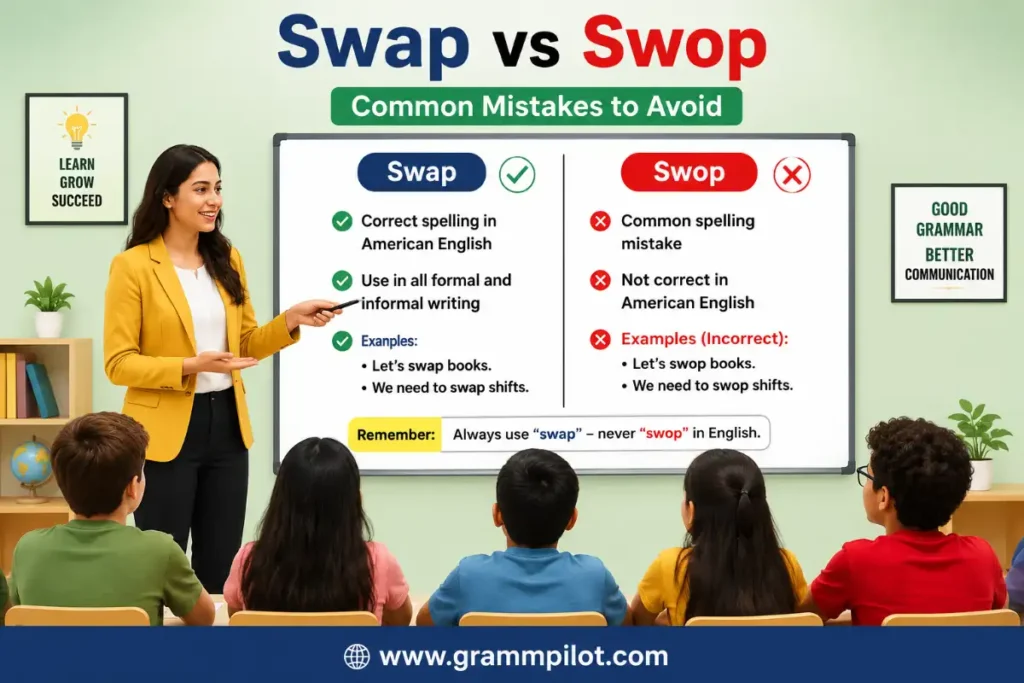
Common Mistakes With Swap vs Swop
Writers occasionally make mistakes because both spellings are legitimate English words.
Mistake 1: Thinking Swop Is the Modern Standard
Many learners assume both spellings are equally common. Actually, swap is the accepted modern spelling in American English and modern British English.
Mistake 2: Using Swop in Academic Writing
Older British books may contain swop, but schools and universities almost always expect swap today. Choosing the modern spelling avoids unnecessary confusion.
Mistake 3: Believing Swap Is Only a Verb
Some people forget that swap also functions as a noun.
Correct examples:
- We organized a book swap.
- The clothing swap attracted hundreds of visitors.
The same word works as both a noun and a verb.
Mistake 4: Confusing Swap With Switch
These words overlap but are not identical.
A swap usually means two things exchange places.
A switch often means changing from one option to another.
Understanding the difference improves your vocabulary.
Mistake 5: Ignoring the Audience
If you’re writing for modern readers, swap is almost always the safest choice. Historical quotations and older British documents are among the few situations where swop still appears naturally.
Quick Tips for Choosing Between Swap vs Swop
Keep these simple reminders in mind whenever you write.
- Choose swap for modern English.
- Recognize swop as an older British spelling.
- Use swap in emails, essays, and business documents.
- Follow the spelling preferred by modern dictionaries.
- Read historical quotations exactly as they were written.
- Avoid changing quoted material unnecessarily.
- Match your spelling throughout the entire document.
- Think about your audience before deciding.
- Proofread carefully before publishing.
- When unsure, pick swap.
These practical habits make the correct spelling easy to remember.
Swap vs Swop Practice Sentences
Read each sentence before checking the explanation.
1. Can we ________ seats before class begins?
Best answer: swap, because it is the standard modern spelling.
2. The children decided to ________ toys after lunch.
Correct choice: swap, since modern English strongly prefers this spelling.
3. The museum displayed an old newspaper using the word ________.
Answer: swop, because the sentence refers to historical writing.
4. We organized a book ________ at school.
Use: swap, as the noun is common in modern English.
5. Employees may ________ shifts with manager approval.
Choose: swap, because workplace communication uses the modern spelling.
6. The novel preserved the original spelling ________.
The correct answer is: swop, since older British texts sometimes used that form.
7. My sister and I often ________ recipes.
Best choice: swap, because this is everyday English.
8. Several classmates ________ notebooks before the lesson.
Answer: swapped, the past tense of swap.
9. The article quoted a sentence containing the word ________.
Choose: swop, because the spelling appears in an original historical quotation.
10. Most dictionaries recommend ________ for modern writing.
Correct answer: swap, since it is the standard spelling used worldwide today.
Practicing with realistic examples helps you recognize when historical spelling is appropriate and when modern English clearly favors swap, making your writing more accurate, natural, and professional.
Common Situations Where People Use Swap vs Swop Incorrectly
Understanding Swap vs Swop is mostly about knowing your audience and choosing the modern spelling. The following situations show where writers commonly make mistakes.
While Writing Emails
Business and personal emails should use modern English.
Correct:
- Can we swap our meeting times?
- Let’s swap the presentation order.
Avoid:
- Can we swop our meeting times?
Although swop isn’t technically wrong, it looks outdated and may confuse readers.
During School Assignments
Teachers and examiners expect the standard spelling.
Correct:
- Students swapped worksheets before checking their answers.
- The class held a book swap.
Using swap helps your writing match modern dictionaries and style guides.
In Business Documents
Professional writing values consistency.
Examples:
- The departments agreed to swap responsibilities.
- Employees may swap work shifts with approval.
- The teams swapped project updates.
- Managers approved the equipment swap.
You’ll rarely see swop in modern reports, contracts, or workplace communication.
In Everyday Conversation
Native speakers almost always say swap.
Examples:
- Let’s swap seats.
- Can we swap jackets?
- They swapped phone numbers after the event.
- We swapped ideas during lunch.
Even in the UK, swap has become the normal spelling for everyday use.
Antonyms of Swap
Sometimes you need to express the opposite idea.
Here are useful antonyms.
| Word or Phrase | Meaning |
|---|---|
| Keep | Continue to have something |
| Retain | Keep possession of something |
| Hold | Continue holding something |
| Preserve | Keep unchanged |
| Maintain | Keep in the same condition |
| Save | Keep for future use |
| Store | Put away for later |
| Keep unchanged | Leave as it is |
Opposites of “Swap” in Context
Depending on the situation, these expressions may fit better.
- Keep your own
- Leave unchanged
- Stay the same
- Hold onto
- Refuse to exchange
- Keep possession
- Continue using
- Remain with
Choosing the right opposite helps make your meaning clear.
Quick Tips for Remembering Swap vs Swop
You don’t need to memorize long spelling rules. Instead, remember these practical tips.
- Use swap in modern English.
- Think of swop as an older British spelling.
- Choose swap for essays, emails, websites, and business writing.
- Keep quoted historical text exactly as it appears.
- Stay consistent throughout your document.
- Check modern dictionaries if you’re unsure.
- Remember that swap works as both a noun and a verb.
- Match your spelling to today’s readers.
- Proofread before publishing.
- When in doubt, use swap.
These habits will help you avoid nearly every spelling mistake related to this word.
Final Teacher Explanation
Imagine a student asks:
“Should I write swap or swop?”
The answer is simple.
If you’re writing modern English, choose swap.
Although swop appears in some older British books and dictionaries, it has largely disappeared from everyday writing.
Compare these examples.
- Let’s swap seats before class.
- The old newspaper used the spelling swop.
Both are correct in their own context.
The first follows modern English.
The second preserves historical spelling.
Once you remember that difference, Swap vs Swop becomes an easy spelling choice..
Conclusion
Understanding Swap vs Swop doesn’t have to be difficult. Although both spellings share the same meaning, swap has become the accepted standard in modern English across the United States, the United Kingdom, and most other English-speaking regions. Swop still appears in older British books and historical sources, but it is rarely used in current writing. Choosing swap will make your writing look natural, professional, and up to date.
Whenever you’re unsure which spelling to use, think about your audience and the purpose of your writing. For nearly every modern situation—from school assignments and business emails to websites and everyday conversations—Swap vs Swop has one clear winner: swap. Keeping this simple rule in mind will help you write with confidence every time.
Frequently Asked Questions
1. What is the difference between Swap vs Swop?
Swap is the standard modern spelling used in American English and modern British English. Swop is an older British spelling that is now rarely used.
2. Is “swop” a real English word?
Yes. Swop is a genuine English word, but it is considered an outdated or uncommon spelling in modern usage.
3. Should I use swap or swop in formal writing?
Use swap. It is the spelling recommended for essays, business documents, websites, and professional communication.
4. Why do some older books use “swop”?
Many older British publications used swop before swap became the preferred spelling. Modern publishers now almost always choose swap.
5. What’s another word for “swap”?
Common alternatives include exchange, trade, switch, replace, substitute, transfer, interchange, and barter, depending on the context.
6. Do British people still use “swop”?
Most modern British writers use swap. While swop is still recognized, it is uncommon in today’s newspapers, books, schools, and workplaces.
7. How can I remember Swap vs Swop easily?
Use this simple memory trick:
- Swap = today’s standard spelling
- Swop = older British spelling
If you’re writing for a modern audience, choose swap almost every time.