
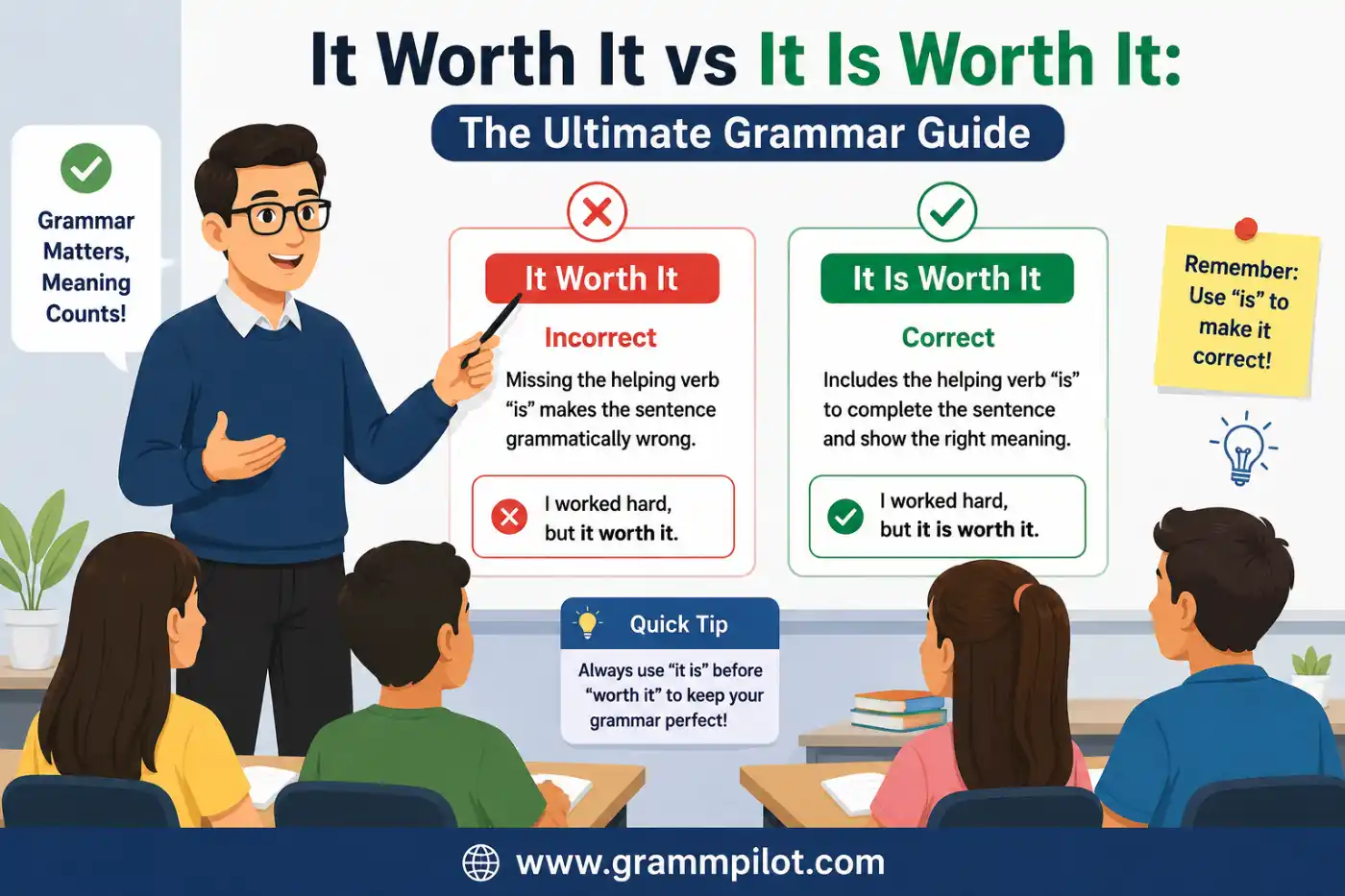
Have you ever written an email, text message, or school assignment and paused because you weren’t sure about to write It Worth It or It Is Worth It? This is one of the most common grammar mistakes in English. Many learners leave out the word is, making the sentence sound incomplete. The confusion usually happens because some languages don’t require a linking verb like is. As a result, learners translate directly into English and accidentally write it worth it, even though native speakers almost always say it is worth it.
Answer Box:
It is worth it is the correct and complete English expression. It worth it is grammatically incorrect because the sentence is missing the verb is.
In this guide, you’ll learn through simple grammar rules, word origins, real-life examples, common mistakes, regional notes, and practical tips that will help you use the correct expression confidently.
You may also want to review [Has Run vs Has Ran] for another related grammar rule.
What Is the Difference Between?
The easiest way to understand It Worth It or It Is Worth It is to remember that English sentences usually need a verb.
| Expression | Grammar | Correct? |
|---|---|---|
| It worth it | Missing the verb is | ❌ No |
| It is worth it | Complete sentence | ✅ Yes |
Examples:
- It is worth it to study every day.
- It is worth it to save money for the future.
Incorrect:
- It worth it to study every day.
- It worth it to save money.
The only difference is one small word, but that word makes the sentence grammatically complete.
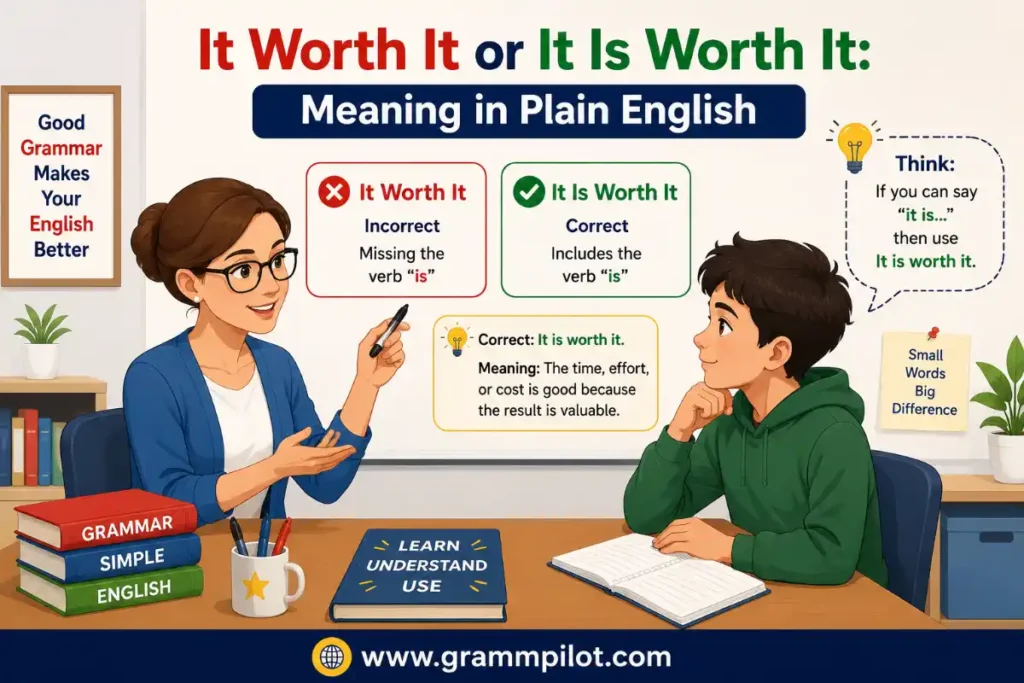
It Worth It or It Is Worth It: Meaning in Plain English
Before learning grammar rules, it’s helpful to understand what the expression actually means.
What Does “It Is Worth It” Mean?
The phrase it is worth it means that something is valuable enough to justify the time, money, effort, or difficulty involved.
Examples:
- It is worth it to practice English every day.
- The long drive was worth it.
- Buying a quality laptop is worth it.
- The extra effort is worth it.
In each sentence, the result makes the effort worthwhile.
What About “It Worth It”?
The expression it worth it has the same intended meaning, but it is grammatically incomplete. Native speakers immediately notice that the verb is is missing. Instead, they naturally say:
- It is worth it.
- It’s worth it.
The contraction it’s is simply a shorter form of it is.
Word Origin of It Worth It or It Is Worth It
Understanding the history of the word worth makes the grammar easier to remember.
Where Does “Worth” Come From?
The word worth comes from Old English. Originally, it referred to value, price, or importance. Over time, English speakers began using worth to describe if something deserved the effort or cost.
Examples:
- The painting is worth thousands of dollars.
- The trip is worth the money.
- The experience is worth remembering.
Although the meaning has expanded, the grammar has remained the same.
Why Do We Need the Word “Is”?
English requires a linking verb before adjectives and many descriptive expressions.
That’s why we say:
- The book is interesting.
- The lesson is helpful.
- The trip is worth it.
Without the verb is, the sentence is incomplete.
Why Do People Confuse Between?
There are several reasons why learners make this mistake.
Some Languages Omit the Linking Verb
Many languages allow sentences without words like is. When learners translate directly into English,
they accidentally write: It worth it.
Instead of: It is worth it.
Fast Typing Causes Mistakes
People often type quickly in text messages or social media posts. Sometimes they accidentally leave out is. Even though readers may understand the meaning, the sentence is still grammatically incorrect.
Spoken English Uses Contractions
Native speakers usually say: It’s worth it.
Because the contraction is so common, learners sometimes forget that it’s actually means it is.
Social Media Doesn’t Always Follow Grammar Rules
Online comments often contain grammar mistakes. Seeing it worth it on social media doesn’t make it correct. Modern English grammar still requires the linking verb.
The One Simple Rule for It Worth It or It Is Worth It
Here’s the easiest classroom rule.
Ask yourself: Does my sentence already have a verb?
If the answer is no, add is.
Examples:
- It is worth it.
- It is worth waiting.
- It is worth trying.
- It is worth the effort.
If your sentence begins with it, you’ll usually need is before worth. A helpful shortcut is this: Replace it is with it’s.
Examples:
- It’s worth it.
- It’s worth the time.
- It’s worth every dollar.
If it’s sounds natural, then it is is the correct full form.
It Worth It or It Is Worth It Grammar Rule
The grammar is actually very simple.
“It” Is the Subject
Examples:
- It is raining.
- It is cold.
- It is worth it.
The word it functions as the subject.
“Is” Is the Linking Verb
The verb is connects the subject to the description.
Examples:
- The movie is exciting.
- The lesson is useful.
- It is worth it.
Removing the verb breaks the sentence.
“Worth” Functions as an Adjective
The word worth describes value.
Examples:
- The experience is worth the effort.
- The project is worth the investment.
- The wait is worth it.
- The practice is worth your time.
Because worth is used as an adjective here, it needs the linking very
Quick Comparison” It Worth It or It Is Worth It”
| Feature | It Worth It | It Is Worth It |
|---|---|---|
| Complete sentence | ❌ No | ✅ Yes |
| Includes a verb | ❌ No | ✅ Yes |
| Correct grammar | ❌ No | ✅ Yes |
| Used by native speakers | Rarely | Yes |
| Suitable for school writing | ❌ No | ✅ Yes |
| Suitable for business writing | ❌ No | ✅ Yes |
Keeping this table in mind makes the correct choice easy.
Is It Worth It or It Is Worth It Used Differently Around the World?
The grammar stays the same in every major variety of English.
American English
American speakers always use:
- It is worth it.
- It’s worth it.
Examples:
- It’s worth the money.
- It is worth waiting.
The version without is is considered incorrect.
British English
British English follows the same grammar rule.
Examples:
- It’s worth the effort.
- It is worth the trip.
- It’s worth reading that book.
The sentence still requires the linking verb.
International English
If you’re writing English for school, work, travel, or exams, the same rule applies. Always include is. That simple habit will make your writing sound natural everywhere English is spoken.
Master Synonym List for “Worth It”
Learning similar expressions helps you avoid repeating the same phrase too often.
Simple and Everyday Synonyms
| Word or Phrase | Meaning | Tone | Example |
|---|---|---|---|
| Valuable | Has value | Everyday | The experience was valuable. |
| Useful | Helpful | Everyday | The lesson was useful. |
| Beneficial | Gives advantages | Everyday | Daily reading is beneficial. |
| Rewarding | Gives satisfaction | Everyday | Teaching is rewarding. |
| Meaningful | Has importance | Everyday | It was a meaningful conversation. |
| Helpful | Gives assistance | Everyday | The advice was helpful. |
| Good value | Worth the cost | Everyday | The course was good value. |
| Worthwhile | Deserving time or effort | Everyday | The project was worthwhile. |
Formal Synonyms
| Word or Phrase | Meaning | Tone | Example |
|---|---|---|---|
| Advantageous | Produces benefits | Formal | The investment was advantageous. |
| Profitable | Produces gains | Formal | The decision proved profitable. |
| Productive | Produces useful results | Formal | The meeting was productive. |
| Justified | Reasonable because of the result | Formal | The expense was justified. |
| Valuable investment | Worth the resources | Formal | Training was a valuable investment. |
| Cost-effective | Worth the money spent | Formal | The solution was cost-effective. |
| Efficient | Produces good results | Formal | The method was efficient. |
| Practical | Useful in real situations | Formal | The suggestion was practical. |
Synonyms Grouped by Everyday Use
Expanding your vocabulary helps you avoid repeating the same expression while still expressing the same basic idea. Although It Is Worth It is the correct phrase, many other words and expressions can communicate a similar meaning depending on the context.
Simple and Everyday Synonyms
| Word or Phrase | Meaning | Tone | Example |
|---|---|---|---|
| Worthwhile | Deserving time or effort | Everyday | The volunteer work was worthwhile. |
| Valuable | Having great value | Everyday | The experience was valuable. |
| Useful | Helpful in practice | Everyday | The workshop was useful. |
| Helpful | Gives support or benefit | Everyday | Your advice was helpful. |
| Rewarding | Gives satisfaction | Everyday | Teaching young children is rewarding. |
| Good value | Worth the money spent | Everyday | The course was good value. |
| Beneficial | Produces good results | Everyday | Daily exercise is beneficial. |
| Meaningful | Full of purpose | Everyday | It was a meaningful discussion. |
Formal Synonyms
| Word or Phrase | Meaning | Tone | Example |
|---|---|---|---|
| Advantageous | Brings benefits | Formal | The agreement was advantageous. |
| Cost-effective | Good value for the cost | Formal | The solution was cost-effective. |
| Practical | Useful in real situations | Formal | The training was practical. |
| Productive | Produces positive results | Formal | The meeting was productive. |
| Justified | Reasonable because of the outcome | Formal | The expense was justified. |
| Efficient | Gives good results with little waste | Formal | The system proved efficient. |
| Profitable | Produces gains | Formal | The investment became profitable. |
| Valuable investment | Worth the resources used | Formal | Education is a valuable investment. |
Informal Alternatives
| Word or Phrase | Meaning | Tone | Example |
|---|---|---|---|
| Totally worth it | Definitely deserving the effort | Informal | The concert was totally worth it. |
| Worth every minute | Every moment was valuable | Informal | The trip was worth every minute. |
| Worth every penny | Money was well spent | Informal | The laptop was worth every penny. |
| A good deal | Good value | Informal | That phone is a good deal. |
| Pays off | Gives a good result | Informal | Hard work pays off. |
| Worth the hassle | Deserves the trouble | Informal | The vacation was worth the hassle. |
| A smart choice | A wise decision | Informal | Buying early was a smart choice. |
| Time well spent | Good use of time | Informal | Reading that book was time well spent. |
By Intensity
Not every expression shows the same level of value. Some suggest small benefits, while others show very strong value.
Mild Value
- useful
- helpful
- practical
- beneficial
- meaningful
Example:
The workshop was useful for beginners.
Moderate Value
- worthwhile
- rewarding
- worth the effort
- worth the time
- good value
Example:
Learning another language is worth the effort.
Strong Value
- worth every penny
- absolutely worth it
- highly rewarding
- extremely valuable
- completely justified
Example:
Years of practice were absolutely worth it after winning the championship.
Choosing the right expression helps your writing sound more natural and accurate.
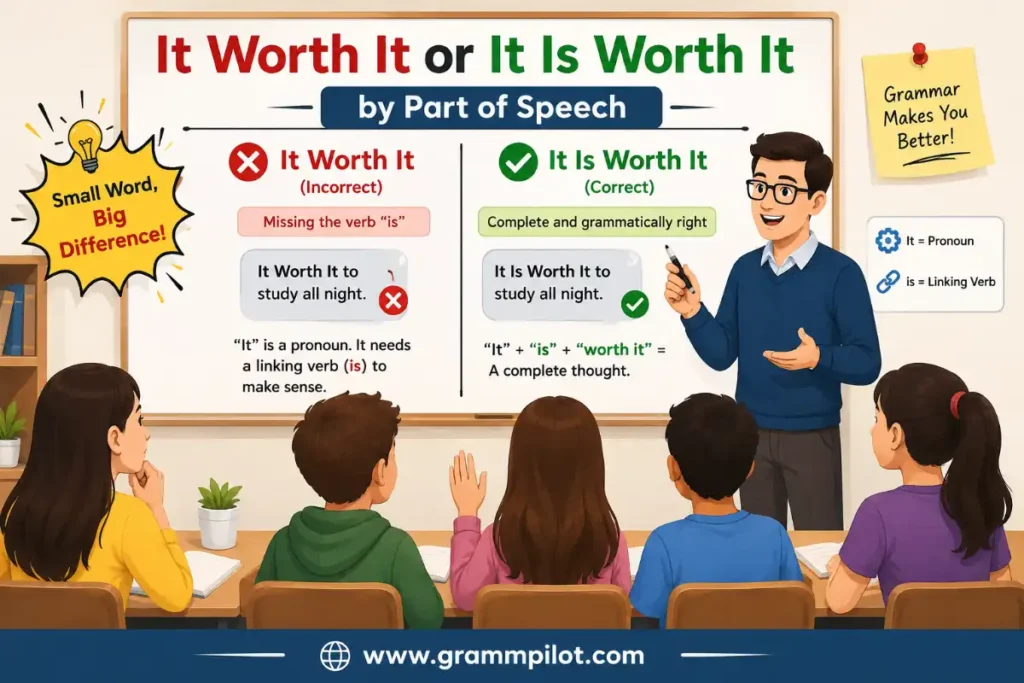
It Worth It or It Is Worth It by Part of Speech
Understanding the grammar behind this expression makes it easier to avoid mistakes.
| Part of Speech | Examples |
|---|---|
| Subject | it |
| Linking verb | is |
| Adjective | worth, worthwhile, valuable |
| Noun | value, benefit, reward |
| Verb | deserve, justify, benefit, reward |
Remember these simple grammar points.
- It acts as the subject.
- Is is the linking verb.
- Worth describes value.
- The sentence becomes incomplete if is is removed.
Which Expression Works Best in Different Situations?
Choosing the correct wording depends on where you’re writing.
It Worth It or It Is Worth It on a Resume
Resumes usually avoid conversational expressions.
Instead of writing:
- It is worth it to complete professional training.
A stronger option is:
- Professional training provided valuable skills.
If you do use the phrase, always write it is worth it, never it worth it.
Use Of This Word in Essays
Academic writing values complete grammar.
Examples:
- It is worth it to spend extra time proofreading an essay.
- Reading every day is worth the effort because it improves vocabulary.
- Learning grammar is worth the time for clear communication.
Essays should always use the complete expression.
Use Of This Word in Business Emails
Professional emails should sound clear and polished.
Examples:
- It is worth it to review the contract before signing.
- The additional testing is worth the extra time.
- It’s worth scheduling another meeting to discuss the proposal.
- The investment is worth it because it improves productivity.
Business writing should never omit the linking verb.
Use Of This Phrase in Text Messages
Casual conversations often use contractions.
Examples:
- It’s worth it.
- It’s worth the wait.
- It’s definitely worth trying.
- It’s worth every dollar.
Even in texting, it worth it remains incorrect.
Use Of This Word in Everyday Conversation
Native speakers naturally include the linking verb.
Imagine someone asks:
Should I buy this course?
A natural reply is:
It’s worth it.
Now imagine another conversation.
Is the long drive really necessary?
You might answer:
Yes, it is worth it.
Notice that native speakers always include is or the contraction it’s.
Examples From Real-Life Situations
Here are examples showing how the correct expression appears naturally.
- It is worth it to practice English every day.
- The extra study time is worth it before an important exam.
- It’s worth it to arrive early at the airport.
- The expensive camera is worth it for professional photographers.
- Waiting a few more minutes is worth it.
- Daily exercise is worth the effort.
- The online course is worth every dollar.
- Learning grammar is worth the time.
- The family vacation was worth every minute.
- Reading one chapter each day is worth it.
- The promotion was worth the hard work.
- Saving money each month is worth the discipline.
- The new computer is worth the investment.
- Volunteering was worth the experience.
- Building strong language skills is worth the patience.
These examples show how naturally the expression fits conversations, education, travel, work, shopping, and everyday life.
Is It Worth It or It Is Worth It a Common Grammar Mistake?
Yes. Many English learners search for It Worth It or It Is Worth It because leaving out the verb is is a very common error.
Fortunately, the correction is simple.
- It is worth it ✅ Correct
- It’s worth it ✅ Correct
- It worth it ❌ Incorrect
Whenever you write this expression, quickly check if the sentence includes is or it’s. That one small habit will help your English sound natural, complete, and grammatically correct.
Compared With Similar Expressions
Understanding It Worth It or It Is Worth It becomes much easier when you compare it with other common English expressions. Many of these phrases have similar meanings, but they are used in different situations.
It Is Worth It vs It Is Worthwhile
These expressions are closely related, but they are not identical.
| It Is Worth It | It Is Worthwhile |
|---|---|
| Refers to a specific situation or action | Describes something generally valuable |
| More common in everyday speech | More common in formal writing |
Examples:
- The long trip is worth it.
- Volunteering is worthwhile.
The first sentence refers to one experience.
The second describes an activity in general.
It Is Worth It vs It Pays Off
Both expressions talk about getting a good result.
| It Is Worth It | It Pays Off |
|---|---|
| Focuses on value | Focuses on the final reward |
| Can refer to money, time, or effort | Usually refers to effort producing success |
Examples:
- Studying every day is worth it.
- Hard work pays off.
The meaning is similar, but the emphasis changes.
It Is Worth It vs It Is Valuable
These expressions overlap but have different uses.
| It Is Worth It | It Is Valuable |
|---|---|
| Describes if effort is justified | Describes something’s value |
| Often follows an experience | Can describe objects, ideas, or people |
Examples:
- The extra practice is worth it.
- Your advice is valuable.
One talks about effort.
The other talks about value.
It Is Worth It vs It Is Beneficial
People sometimes confuse these expressions.
| It Is Worth It | It Is Beneficial |
|---|---|
| Suggests the result justifies the effort | Suggests something provides benefits |
Examples:
- The difficult training is worth it.
- Regular exercise is beneficial.
Both are positive, but they focus on different ideas.
It Is Worth It vs It Makes Sense
These expressions are related but not interchangeable.
| It Is Worth It | It Makes Sense |
|---|---|
| Worth the cost, time, or effort | Logical or reasonable |
Examples:
- Buying quality tools is worth it.
- Waiting until tomorrow makes sense.
One describes value.
The other describes logic.
It Worth It or It Is Worth It in Everyday English
Native speakers almost always use the complete expression.
You’ll hear sentences like these:
- It’s worth it.
- It is worth the money.
- The extra effort is worth it.
- The wait was worth it.
You’ll almost never hear educated native speakers say it worth it because the sentence is missing the verb.
It Worth It or It Is Worth It in School Writing
Students frequently use this expression in essays and assignments.
Examples:
- It is worth it to revise your work before submitting it.
- Reading every day is worth the effort.
- Learning grammar is worth the time.
- It is worth it to practice writing regularly.
Complete grammar makes school writing stronger.
In Professional Writing
Business communication should always use the correct form.
Examples:
- The investment is worth it.
- It is worth it to review the proposal carefully.
- Additional training is worth the expense.
- It’s worth scheduling another meeting before making the final decision.
Professional readers expect complete sentences.
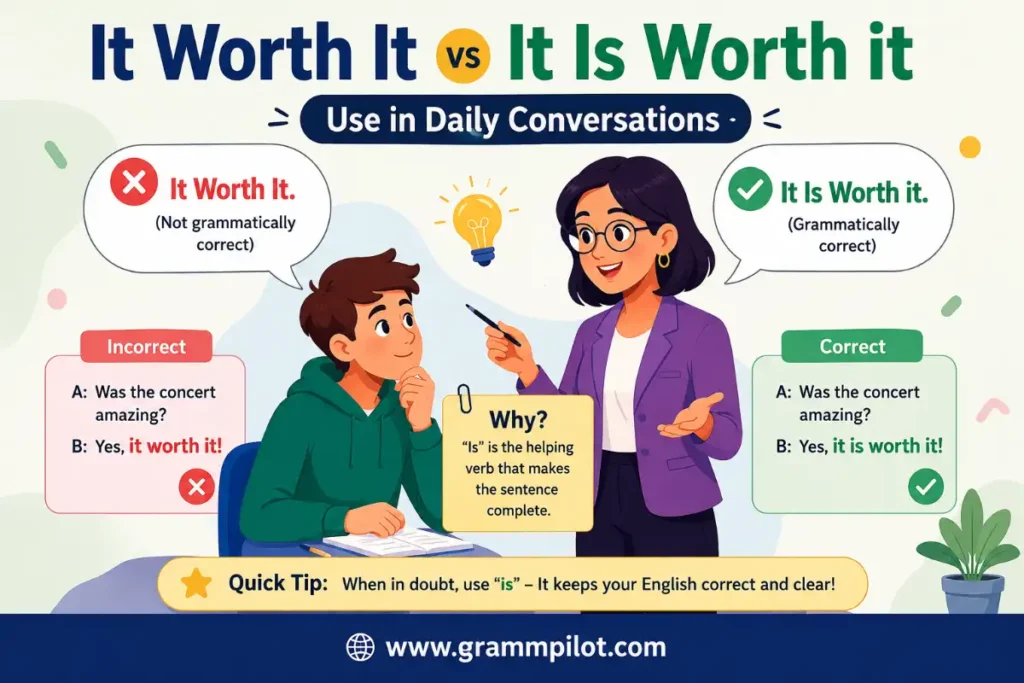
Daily Conversations
Friends and family often use contractions.
Examples:
- It’s worth it.
- It’s worth waiting.
- It’s worth trying.
- It’s worth buying.
Although the wording becomes shorter, the grammar remains correct because it’s means it is.
Common Mistakes
English learners often repeat the same grammar mistakes.
Mistake 1: Leaving Out “Is”
This is the most common mistake.
Incorrect:
- It worth it.
Correct:
- It is worth it.
- It’s worth it.
Always include the linking verb.
Mistake 2: Thinking “Worth” Is a Verb
Some learners believe worth works like a verb.
It doesn’t.
Worth describes value, so it needs a linking verb.
Correct:
- The trip is worth it.
Not:
- The trip worth it.
Mistake 3: Copying Social Media Grammar
Internet comments often contain incomplete sentences.
Just because many people write it worth it online doesn’t mean it is correct English.
Formal writing should always follow standard grammar.
Mistake 4: Forgetting Contractions
Some learners know it’s worth it but forget that it’s means it is.
Understanding contractions helps prevent grammar mistakes.
Mistake 5: Translating Directly From Another Language
Many languages do not require a linking verb in this type of sentence.
English does.
Instead of translating word for word, remember the complete English structure.
Quick Tips for Choosing Between It
Keep these practical reminders in mind whenever you write.
- Every English sentence needs a complete structure.
- Add is after it before worth.
- Use it’s in casual conversation.
- Avoid copying incorrect grammar from social media.
- Read your sentence aloud before submitting it.
- If the sentence sounds incomplete, check for the linking verb.
- Remember that worth is not a verb.
- Practice using complete sentences every day.
- Proofread emails and assignments carefully.
- When unsure, write it is worth it.
- Read each sentence and choose the correct expression.
Practice Sentences
1. Learning English ________ for your future career.
Correct answer: is worth it, because the sentence needs the linking verb.
2. The expensive course ________ after getting a better job.
Best answer: is worth it, since the result justifies the cost.
3. Buying quality shoes ________ if you walk every day.
Choose: is worth it, because the sentence requires a complete verb structure.
4. The long wait at the restaurant ________.
Correct choice: was worth it, because the action happened in the past.
5. Practicing grammar every day ________.
Answer: is worth it, since regular practice brings long-term benefits.
6. The extra hours of study ________ before the final exam.
Best answer: are worth it, because the subject is plural.
7. Watching the documentary ________ because I learned so much.
Choose: was worth it, as the event already happened.
8. Saving money each month ________ over time.
Correct answer: is worth it, because the sentence talks about an ongoing habit.
9. The difficult project ________ after the team succeeded.
Best choice: was worth it, since the project is complete.
10. Every minute spent improving your writing ________.
Answer: is worth it, because the sentence describes a general truth.
Working through realistic examples helps you recognize the correct grammar automatically, making your writing sound clearer, more natural, and more professional in conversations, school assignments, emails, and everyday English.
Common Situations Where People Confuse
It becomes much easier when you see how native speakers use the expression in everyday situations. Most mistakes happen because writers accidentally leave out the linking verb is.
While Writing Emails
Professional emails should always use complete grammar.
Correct:
- It is worth it to review the report before sending it.
- The extra meeting is worth it if it solves the problem.
Incorrect:
- It worth it to review the report.
- It worth it to attend the meeting.
Business writing should always include is.
During School Assignments
Teachers expect grammatically complete sentences.
Correct:
- It is worth it to spend extra time proofreading an essay.
- Learning new vocabulary is worth it.
Incorrect:
- It worth it to study every day.
Using the correct expression improves both grammar and writing quality.
In Business Documents
Formal documents require standard English.
Examples:
- The investment is worth it because it increases productivity.
- Additional staff training is worth it for long-term success.
- The software upgrade is worth it despite the higher cost.
- It is worth it to complete the project carefully.
Avoid incomplete expressions in professional writing.
In Everyday Conversation
Native speakers often use contractions.
Examples:
- It’s worth it.
- It’s definitely worth it.
- It’s worth the wait.
- It’s worth every dollar.
Although the sentence becomes shorter, the grammar remains correct because it’s means it is.
Antonyms Related to It Is Worth It
Sometimes you need to express the opposite idea.
| Word or Phrase | Meaning |
|---|---|
| Not worth it | Doesn’t justify the effort |
| Waste of time | Time was not used well |
| Waste of money | Money was spent poorly |
| Pointless | Has no useful purpose |
| Useless | Provides no value |
| Unhelpful | Does not improve the situation |
| Unnecessary | Not needed |
| Ineffective | Does not produce results |
Opposite Expressions in Context
Depending on your sentence, these alternatives may work better.
- Not worthwhile
- Doesn’t pay off
- Not beneficial
- Doesn’t make sense
- Poor investment
- Bad value
- Not recommended
- Better avoided
Choosing the right opposite makes your writing more precise.
Quick Tips for Remembering
You don’t need to memorize complicated grammar rules. These simple tips are enough.
- Always check if your sentence has a verb.
- Write it is worth it in formal writing.
- Use it’s worth it in everyday conversations.
- Never remove the linking verb is.
- Remember that worth is not a verb.
- Read your sentence aloud before submitting it.
- Proofread emails and school assignments carefully.
- Ignore incorrect grammar you may see on social media.
- Practice writing complete English sentences.
- When you’re unsure, choose it is worth it.
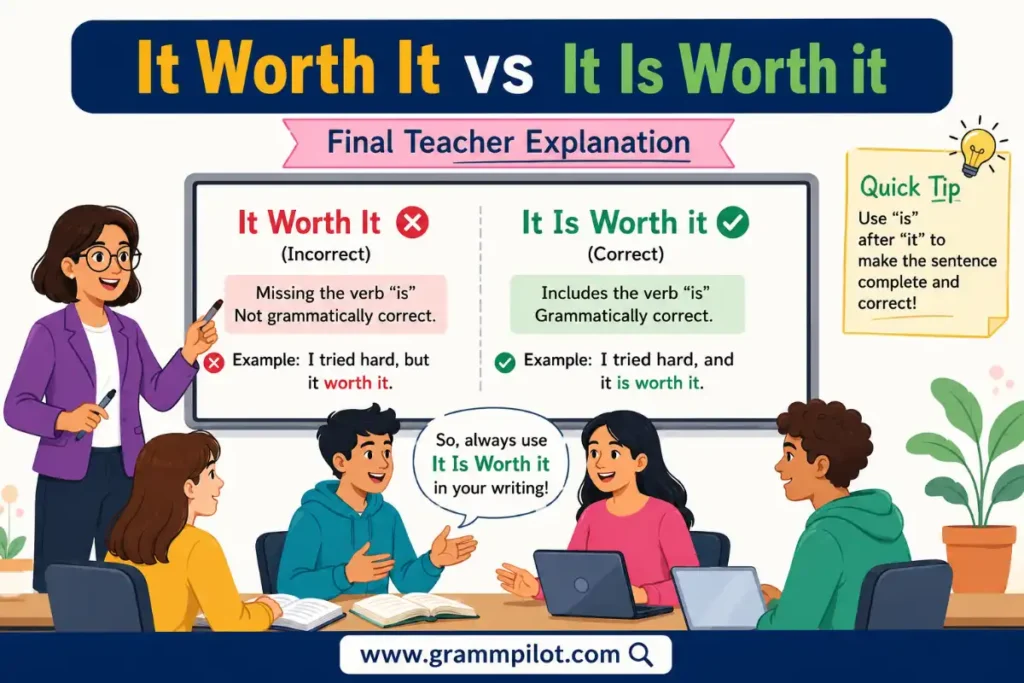
Final Teacher Explanation
Imagine a student asks:
“Should I write it worth it or it is worth it?”
The answer is simple.
English sentences normally need a subject and a verb.
The word it is the subject.
Given word is is the linking verb.
The word worth describes value.
That means the complete expression is:
- It is worth it.
You can also use the contraction:
- It’s worth it.
Look at these examples.
- It is worth it to study every day.
- It’s worth the extra effort.
Both are correct because they include the linking verb.
Once you remember this rule, It Worth It or It Is Worth It becomes an easy grammar choice.
Final Answer
Here’s the easiest rule to remember:
- It worth it ❌ Incorrect because the verb is missing.
- It is worth it ✅ Correct in formal and everyday English.
- It’s worth it ✅ Correct contraction for casual writing and speech.
Whenever you write this expression, make sure the sentence includes is or it’s. That one small word makes your grammar complete and natural.
Conclusion
Using It Worth It or It Is Worth It correctly is easier than many learners think. The key is remembering that English sentences usually need a linking verb before an adjective or descriptive phrase. Since worth is not a verb, the correct form is it is worth it or the contraction it’s worth it. Leaving out is creates an incomplete sentence, even if readers understand your meaning.
The next time you’re writing an email, essay, text message, or social media post, pause for a quick grammar check. If your sentence begins with it and is followed by worth, make sure is is there as well. Building this simple habit will make your English sound smoother, more natural, and more professional.
Frequently Asked Questions
1. What is the difference between It Worth It or It Is Worth It?
It is worth it is the correct and complete English expression. It worth it is incorrect because it leaves out the linking verb is.
2. Is “It worth it” ever correct?
No. In standard English grammar, it worth it is not considered correct because the sentence is incomplete.
3. Can I say “It’s worth it” instead of “It is worth it”?
Yes. It’s worth it is the contracted form of it is worth it and is very common in everyday conversation and informal writing.
4. Why do English learners write “It worth it”?
Many learners translate directly from languages that do not use a linking verb like is in similar sentences, which leads to this common grammar mistake.
5. What’s another way to say “It is worth it”?
Depending on the context, you can say it’s worthwhile, it’s valuable, it pays off, it’s beneficial, it’s rewarding, or it’s a good investment.
6. Is “It is worth it” formal or informal?
It works in both. It is worth it is suitable for formal writing, while it’s worth it is common in informal speech and casual writing.
7. How can I remember this word?
Use this simple memory trick:
- It is worth it = Correct
- It’s worth it = Correct
- It worth it = Incorrect
If you can replace the phrase with it’s, you know the sentence needs is.