
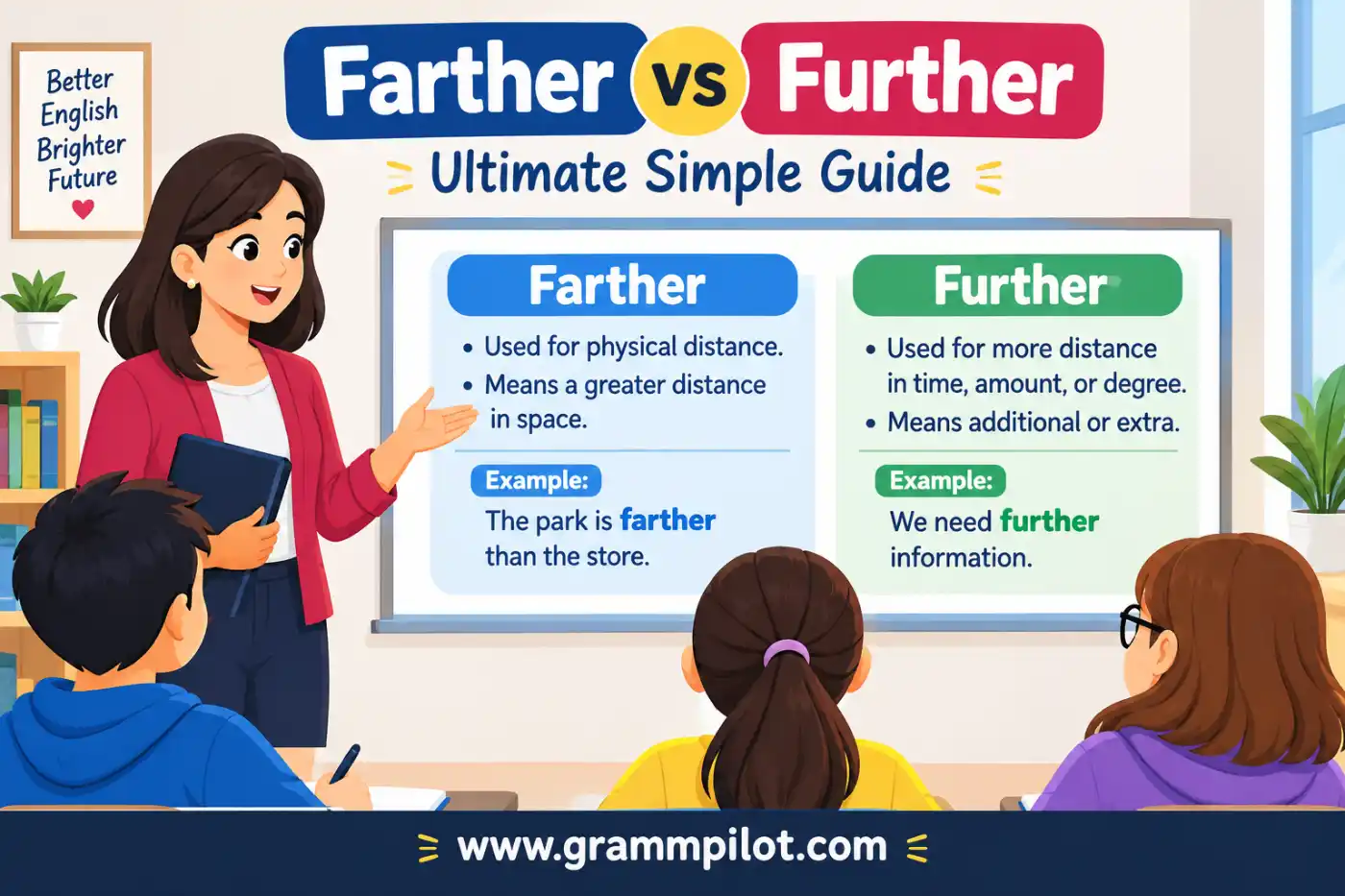
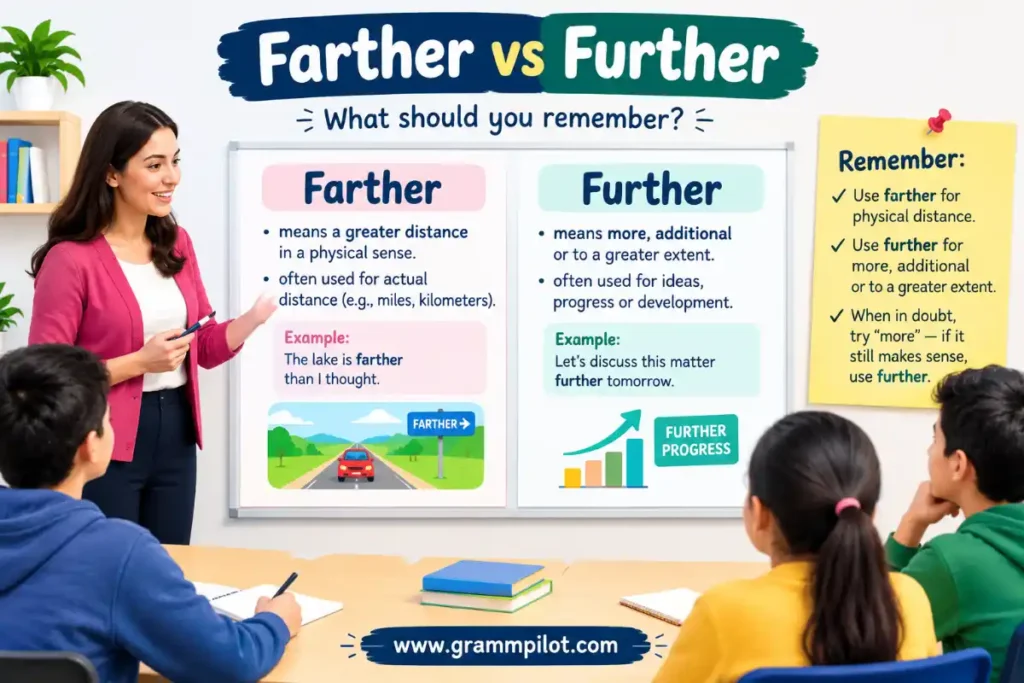
You’re writing an email, essay, resume, or text, and you pause over one small choice: farther vs further? Both words are related to the idea of distance, and in everyday English, they sometimes overlap. That makes the choice confusing even for strong writers. Farther vs Further becomes much easier when you separate physical distance from ideas such as additional information, progress, or degree. Traditionally, farther refers to physical distance, while further usually refers to figurative distance or something additional.
Quick answer: Use farther for physical distance when you want to follow the traditional distinction. Use further for additional information, greater extent, or figurative progress. Modern English also commonly uses further for physical distance.
That basic rule is useful, but it doesn’t tell the whole story. This guide explains the origins, meanings, synonyms, grammar, regional usage, common mistakes, context-specific choices, and subtle differences between these two words.
These aren’t the only English words that cause confusion. See [Imply vs Infer] for another common example.
What is the difference between farther vs further?
The traditional difference is based on the type of distance involved.
Farther usually describes physical distance. Further usually describes figurative distance, degree, progress, or something additional.
Consider these examples:
We walked farther than we expected.
The sentence describes actual physical movement.
We discussed the problem further.
The sentence describes additional discussion.
Here is another comparison:
| Word | Main traditional use | Example |
|---|---|---|
| Farther | Physical distance | The school is farther from my house. |
| Further | Additional or figurative meaning | We need further information. |
| Further | Physical distance in modern usage | How much further do we have to drive? |
The last example is important. Modern English doesn’t always maintain a strict separation between the two words. Further is commonly used for physical distance, especially in conversation. If you’re writing formal English and want the clearest traditional distinction, farther for physical distance and further for everything else is a reliable approach.
Farther vs Further: What does farther mean in plain English?
Farther means at, to, or by a greater physical distance. It is closely connected with actual space.
For example:
The library is farther from the station than the bookstore.
We drove farther than we planned.
The hikers traveled farther into the mountains.
In each sentence, you can imagine measuring the distance.
You don’t need an exact number. A sentence can use farther even when the distance is approximate.
The restaurant is farther down the street.
You don’t know the exact number of feet or miles, but you’re still talking about physical location
Can farther describe a physical location?
Yes.
It can compare two locations or describe a place that is more distant.
The farther house has a red roof.
The farther end of the field was covered in snow.
The farther village is difficult to reach.
This adjective use is less common than the adverbial use, but it is grammatically possible.
Farther vs Further: What does further mean in plain English?
Further can mean additional, more, to a greater extent, or beyond an existing point.
It is often used for ideas rather than physical space.
Examples:
We need further information.
The teacher ask
|ed for further explanation.
Let’s discuss this further.
In these examples, there is no literal road or physical distance. The word refers to something beyond what has already been provided.
How do you use further for additional information?
This is one of the most common uses of further.
You will often see:
- further information
- further details
- further explanation
- further evidence
- further research
- further assistance
- further questions
- further discussion
- further consideration
- further action
For example: Please contact the office for further information.
This means: Please contact the office for additional information.
Another example: Further research is needed before we can reach a conclusion.
Here, further means more or additional research.
How do you use further for progress?
Further can also describe movement through an idea, process, project, or argument.
Examples:
The discussion went further than expected.
The researcher developed the theory further.
The company wants to take the project further.
The “distance” here is figurative. Nobody is necessarily moving through physical space.
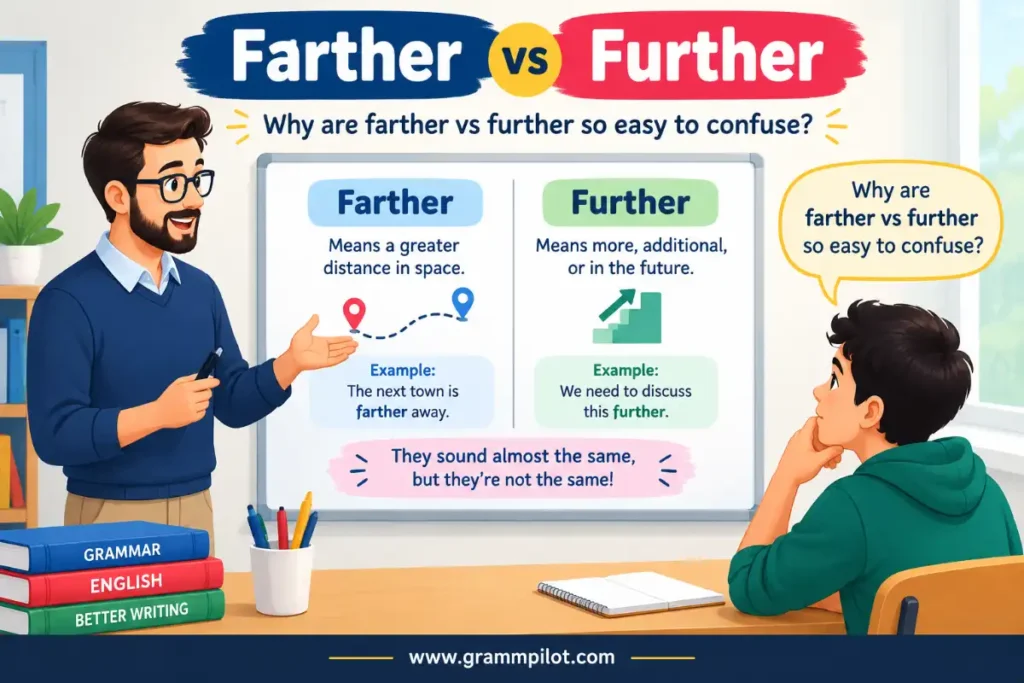
Why are farther vs further so easy to confuse?
There are several reasons. First, the words are closely related. Second, both have a connection to far. Third, both can function as comparative forms. Fourth, further has developed meanings that go beyond literal distance. Fifth, modern speakers frequently use further for physical distance. This means the traditional rule is helpful, but real English usage is more flexible.
For example: How much farther do we have to walk?
follows the traditional distinction.
So does: How much further do we have to walk?
The second version is also extremely common in modern English. Neither sentence is likely to confuse a listener.
Where did farther come from?
Farther developed from the word far, which refers to distance. The ending -er creates a comparative form, giving the general idea of “more far” or “at a greater distance.” Historically, farther became strongly associated with physical distance. That association remains useful today.
When you say: The next town is farther away.
you are comparing physical distances.
The same is true in: She ran farther than I did.
The word connects naturally with measurable or observable physical space.
Where did further come from?
Further also developed from the same general family of distance-related words. Over time, its meaning expanded. Instead of describing only physical distance, it began to express ideas such as:
- additional
- more
- beyond
- continued
- to a greater extent
- onward
- deeper into a subject
That broader meaning explains why further is now common in academic, business, legal, and everyday writing. For example: Further investigation revealed new evidence. The investigation isn’t physically traveling somewhere. It is continuing or becoming more extensive.
Is further correct for physical distance?
Yes.
This is one of the most important points to understand. Modern English frequently uses further for physical distance.
For example:
How much further is the hotel?
The gas station is further down the road.
Walk further along the path.
These sentences are common and natural. Many speakers don’t make a strict distinction between physical and figurative distance. So saying that further is always wrong for physical distance would be inaccurate. If you’re following the traditional distinction, use farther. If you’re describing common modern usage, further can also work.
Is farther used for figurative distance?
It can appear in figurative contexts, but further is generally the clearer choice when the meaning is abstract.
Compare:
The argument went further than expected. This sounds natural because the argument developed beyond its starting point. The argument went farther than expected.
This can be understood, but it is less common for abstract ideas.
When discussing:
- arguments
- research
- discussions
- plans
- explanations
- theories
- progress
further is usually the better choice.
What is the easiest memory trick for farther?
Think:
Farther = physical far.
If you can picture yourself measuring the distance with a map, ruler, odometer, measuring tape, or GPS, farther is a good traditional choice.
For example:
We drove farther today.
The next town is farther away.
She jumped farther than her opponent.
The physical-distance connection makes the word easy to remember.
What is the easiest memory trick for further?
Think:
Further = additional.
If you could replace the word with more, extra, or additional, use further.
For example:
We need further information.
→ We need additional information.
Let’s discuss the matter further.
→ Let’s discuss the matter more.
Further research is needed.
→ Additional research is needed.
This replacement test works surprisingly well.
What is the master synonym list for farther vs further?
Because the two words have several meanings, their synonyms depend on context.
| Word | Meaning | Tone | Example |
|---|---|---|---|
| Distant | Far away | Neutral | The village is distant. |
| Remote | Far from other places | Neutral/Formal | They live in a remote area. |
| Away | At a distance | Everyday | The store is two miles away. |
| Beyond | Past a point | Neutral | The trail continues beyond the bridge. |
| Ahead | Farther along a route | Everyday | The station is farther ahead. |
| Onward | Continuing forward | Formal/Literary | The travelers moved onward. |
| More | A greater amount | Simple | We need more information. |
| Extra | More than already available | Everyday | We need extra time. |
| Continued | Continuing over time | Neutral | Continued study is necessary. |
| Deeper | More advanced or thorough | Neutral | We need deeper analysis. |
| Beyond | Past an existing limit | Neutral | The issue goes beyond the report. |
| Again | Another time | Everyday | Let’s review it again. |
| On | Continuing | Everyday | Let’s move on. |
| Forward | Toward greater progress | Neutral | The project moved forward. |
| Additional | More beyond what exists | Formal | Further research provides additional evidence. |
| Greater extent | More fully or deeply | Formal | The issue deserves examination to a greater extent. |
| Beyond | Outside an existing range | Neutral | The findings go beyond the original scope. |
| Extra | Additional | Casual | Do you need extra help? |
| More deeply | To a greater depth | Neutral | The subject deserves to be explored more deeply. |
These aren’t all accurate one-word replacements.
For example, remote describes location, while farther is often used to compare distance.
Likewise, additional works well for further information but not for farther down the road.
Context always matters.
What are synonyms for farther from mild to strong?
Physical-distance alternatives can vary in intensity.
What are mild alternatives to farther?
Try:
- away
- ahead
- beyond
- farther along
- farther away
Examples:
The store is farther ahead.
The station is farther along the road.
These are natural and conversational.
What are stronger alternatives to farther?
Use expressions such as:
- much farther
- considerably farther
- significantly farther
- substantially farther
- much more distant
Examples:
The second campsite is considerably farther from the river.
Their new office is substantially farther from downtown.
These expressions emphasize the size of the distance difference.
What are synonyms for further from mild to strong?
What are simple alternatives to further?
Use:
- more
- extra
- additional
- again
Example:
We need further information.
→ We need more information.
What are formal alternatives?
Try:
- additional
- continued
- greater
- more extensive
- to a greater extent
- beyond
Example:
Further research is required.
→ Additional research is required.
What alternatives suggest stronger progress?
For figurative development, you might use:
- deeper
- beyond
- more extensively
- significantly
- progressively
Example:
The study takes the discussion further.
→ The study takes the discussion beyond its earlier limits.
The second version is stronger because it suggests crossing an established boundary.
What parts of speech are farther vs further?
Both words can function as adverbs and adjectives.
How is farther used as an adverb?
It modifies a verb and indicates greater distance.
We walked farther.
She ran farther than I did.
They drove farther than expected.
How is farther used as an adjective?
It can modify a noun.
The farther side of the field was muddy.
We chose the farther route.
This adjective use is less common in everyday conversation.
How is further used as an adverb? It can describe continued or greater extent.
The research goes further than previous studies.
How is further used as an adjective? This is very common when further means additional.
Further information is available.
We need further evidence.
Further discussion will take place tomorrow.
Understanding the grammar helps you recognize which meaning is intended.
What is the difference between farther and more distant?
These expressions are closely related.
The town is farther away.
The town is more distant.
The first is more common in everyday English.
The second can sound more formal or descriptive.
For example: Researchers selected a more distant location.
This sounds appropriate in academic or technical writing.
We drove farther than expected.
This sounds natural in ordinary conversation.
What is the difference between further and beyond?
Both can express the idea of going past an existing point. However, beyond often emphasizes crossing a boundary or limit.
The discussion went further.
This means it continued or developed more.
The discussion went beyond the original topic.
This emphasizes that it moved outside the original subject.
Another example: We need to examine the issue further.
This means more examination is needed.
The issue goes beyond the scope of this report.
This means the issue extends outside the report’s limits.
What is the difference between further and more?
More is much broader and more common.
Further can often replace more in formal contexts, especially when talking about continuation or additional information.
Compare:
We need more information.
We need further information.
Both are correct.
The first is simpler. The second sounds somewhat more formal. But further has meanings that more cannot always express.
Let’s discuss the matter further.
This means continue the discussion.
Let’s discuss the matter more.
This is possible, but it can sound less polished or less precise depending on the context.
Which word is best for a resume?
Further is usually more useful on a resume. Resumes often discuss additional training, continued development, research, and progress.
Examples:
Further developed communication skills through client presentations.
Conducted further research into customer behavior.
Further improved team performance through structured training.
Completed further training in project management.
Farther is less common because resumes rarely need to compare physical distances.
It could still appear in a geographic context.
Managed operations across locations farther from the main office.
Here, the word clearly refers to physical distance.
Which word is best for an essay?
Both words have useful roles in essays. Use farther for physical distance:
The settlement was located farther from the river than historians had believed.
Use further for analysis, evidence, and argument:
Further research supports this conclusion.
The author develops this idea further in the final chapter.
Further evidence is needed to support the claim.
Academic writing frequently uses further because essays often discuss abstract ideas rather than literal movement.
Which word is best for texting?
In texting, further is very common.
You might write:
“How much further?”
“Don’t go any further.”
“Can we talk about this further?”
“I’ll send further details later.”
For casual physical distance, people often don’t worry about the traditional distinction.
If you want to be especially precise, use farther for literal distance: “The next store is farther away.”
Both forms are widely understood.
Which word is best for email?
Further is especially common in professional email.
Common phrases include:
Please contact me for further information.
Let me know if you need further assistance.
I would be happy to discuss this further.
We can provide further details upon request.
Further discussion may be necessary.
Here, further means additional or continued.
Use farther when the email genuinely discusses physical distance.
Our new office is farther from the airport.
What are common mistakes with farther vs further?
Mistake 1: Writing farther information
Incorrect: Please contact us for farther information.
Correct: Please contact us for further information.
Information is additional, not physical distance.
Mistake 2: Writing farther details
Incorrect: For farther details, visit our website.
Correct: For further details, visit our website.
This is one of the easiest errors to catch.
Mistake 3: Writing further when you want the traditional physical-distance form
In careful formal writing: The runner traveled farther than five miles.
is the traditional choice.
You may see: The runner traveled further than five miles.
This is common in modern English, but farther keeps the physical-distance distinction clear.
Mistake 4: Assuming further is always wrong for physical distance
This is another common mistake.
How much further do we have to go?
is natural and widely used.
Don’t assume that every physical-distance use of further is grammatically unacceptable.
Mistake 5: Using farther for figurative progress
Consider: The researcher took the theory farther.
This can be understood, but: The researcher took the theory further.
is generally more natural because the distance is conceptual.
When should you not use farther?
Avoid farther when the intended meaning is clearly additional.
Don’t write:
farther information
farther research
farther discussion
Instead, use:
further information
further research
further discussion
further assistance
These are standard expressions.
When should you not use further?
If you’re writing in a setting where the traditional distinction is expected, choose farther for clear physical distance.
For example: The second town is farther away.
This is a clean and traditional choice.
Still, remember that modern English uses further for physical distance very often. The issue is usually one of preference and precision, not basic comprehension.
What are the antonyms of farther?
The opposite of farther depends on the sentence.
Common possibilities include:
- nearer
- closer
- closer by
- less distant
- nearby
Examples:
The second house is farther away.
The first house is closer.
The hikers went farther into the forest.
There isn’t one universal antonym for every sentence.
What are the antonyms of further?
Because further has several meanings, its opposites vary.
Possible antonyms include:
- less
- earlier
- previous
- reduced
- limited
- stopped
- halted
- withdrawn
For physical or figurative movement: further ↔ closer
For additional meaning: further ↔ existing/current
For continued action: further ↔ halted
The sentence determines the best opposite.
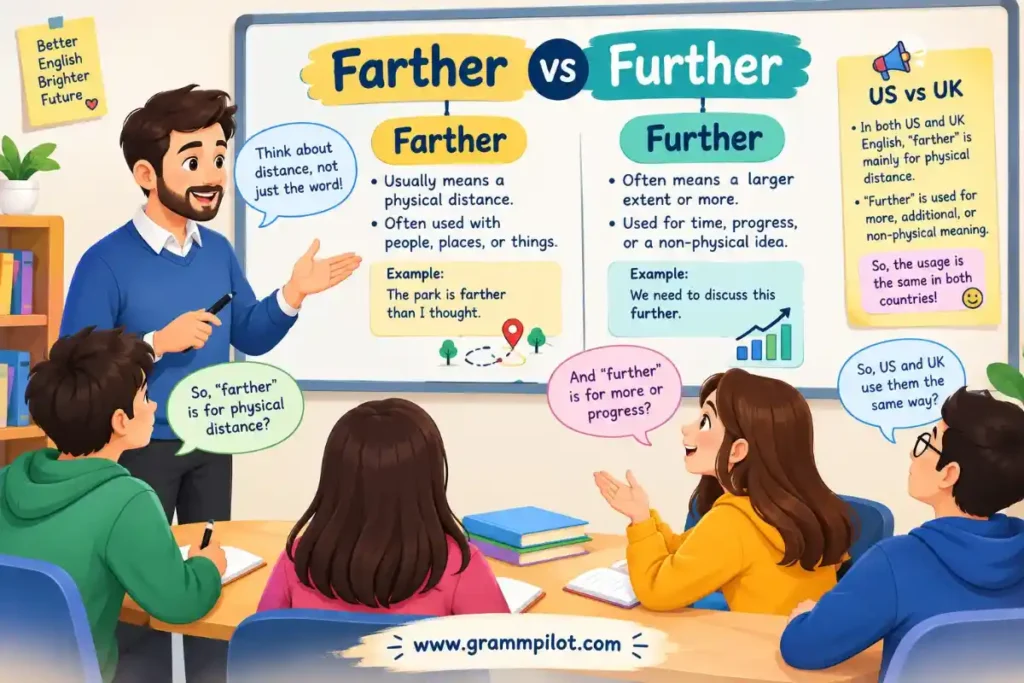
Are there US and UK differences?
There is no simple US-versus-UK spelling difference.
Both American and British English use:
farther
and
further
Both varieties recognize the traditional distinction between physical and figurative distance.
Both also use further for physical distance in many contexts.
For example:
How much further do we have to go?
is natural in both varieties.
American English may be especially flexible about using further for literal distance, but the form is not limited to one variety.
For formal writing in either variety, the traditional distinction remains a useful guide.
Why do we say “farther away”?
Because the phrase traditionally emphasizes physical distance.
For example:
The airport is farther away than the train station.
The word compares physical locations.
However, further away is also common in modern English.
You may hear:
The airport is further away than I thought.
This is not unusual.
If you’re following the traditional distinction, farther away is the clearest choice.
Is “go farther” or “go further” correct?
Both can be correct, depending on meaning and style.
Go farther traditionally refers to physical movement.
We went farther down the trail.
Go further can refer to continued progress or abstract development.
The discussion needs to go further.
But modern English also commonly says:
We can’t go any further.
when referring to physical movement.
So the traditional distinction is useful, but actual usage has more flexibility.
Farther vs Further: What quick tips help you choose the right word?
Use these questions before choosing.
Is the distance physical?
If yes, farther is the traditional choice.
We drove farther.
Does the word mean additional?
Use further.
We need further information.
Does it mean more deeply or extensively?
Use further.
The study examines the issue further.
Does it describe continued progress?
Use further.
The project has moved further than expected.
Can you replace it with “additional”?
If yes, choose further.
Further details
→ additional details
Can you replace it with “more distant”?
If yes, farther is likely the traditional choice.
Farther from the station
→ more distant from the station
Are you writing formal English?
When literal distance is involved, farther can provide extra clarity.
When the meaning is additional or abstract, further is the natural choice.
What should you remember about farther vs further?
The simplest rule is:
Farther = physical distance.
Further = additional or figurative distance.
For example:
We walked farther.
The distance is physical.
We discussed the matter further.
The discussion is abstract.
The store is farther down the road.
The location is physical.
We need further evidence.
The evidence is additional.
But there’s one modern-usage point worth remembering: further can also describe physical distance, especially in everyday speech.
So don’t treat the traditional rule as an absolute law. Think of it as a reliable guide for choosing the clearest word.
Conclusion
Farther vs Further is easiest to understand when you start with the traditional distinction. Farther usually describes greater physical distance, while further commonly means additional, continued, or more extensive. This makes sentences such as “We walked farther” and “We need further information” easy to separate. Modern English is more flexible, though, and further is widely used for physical distance in expressions such as “How much further?” For formal writing, using farther for physical distance and further for abstract or additional meanings is a clear and dependable approach. When you’re unsure, try the replacement test: if the word means more distant, choose farther; if it means additional, choose further. With that simple habit, the difference becomes much easier to manage.
Frequently Asked Questions
1. What is the difference between farther vs further?
Farther traditionally refers to physical distance, while further usually refers to additional information, figurative distance, or greater extent. Modern English also commonly uses further for physical distance.
2. Should I say farther or further away?
“Farther away” is the traditional choice for physical distance, but “further away” is also common in modern English. Both are widely understood.
3. Is it further information or farther information?
The correct standard phrase is “further information.” Here, further means additional information rather than greater physical distance.
4. What’s another way to say further?
You can often say “more,” “additional,” “beyond,” or “to a greater extent” instead of further. The best substitute depends on the sentence.
5. Is further research correct?
Yes, “further research” is completely correct. It means additional research or more research into a subject.
6. Is farther only used for physical distance?
Farther is traditionally used for physical distance, but real-world usage can be more flexible. For figurative meanings, further is usually the more natural choice.
7. Can I use further for physical distance?
Yes, you can use further for physical distance, especially in everyday modern English. “How much further do we have to go?” is a common and natural example.