
If you’re writing an email, school essay, resume, or quick text, you may pause over Smoothe vs Smooth. Both spellings look possible, but modern English strongly favors one of them. Knowing the difference can help you avoid a small spelling mistake that may distract your reader.
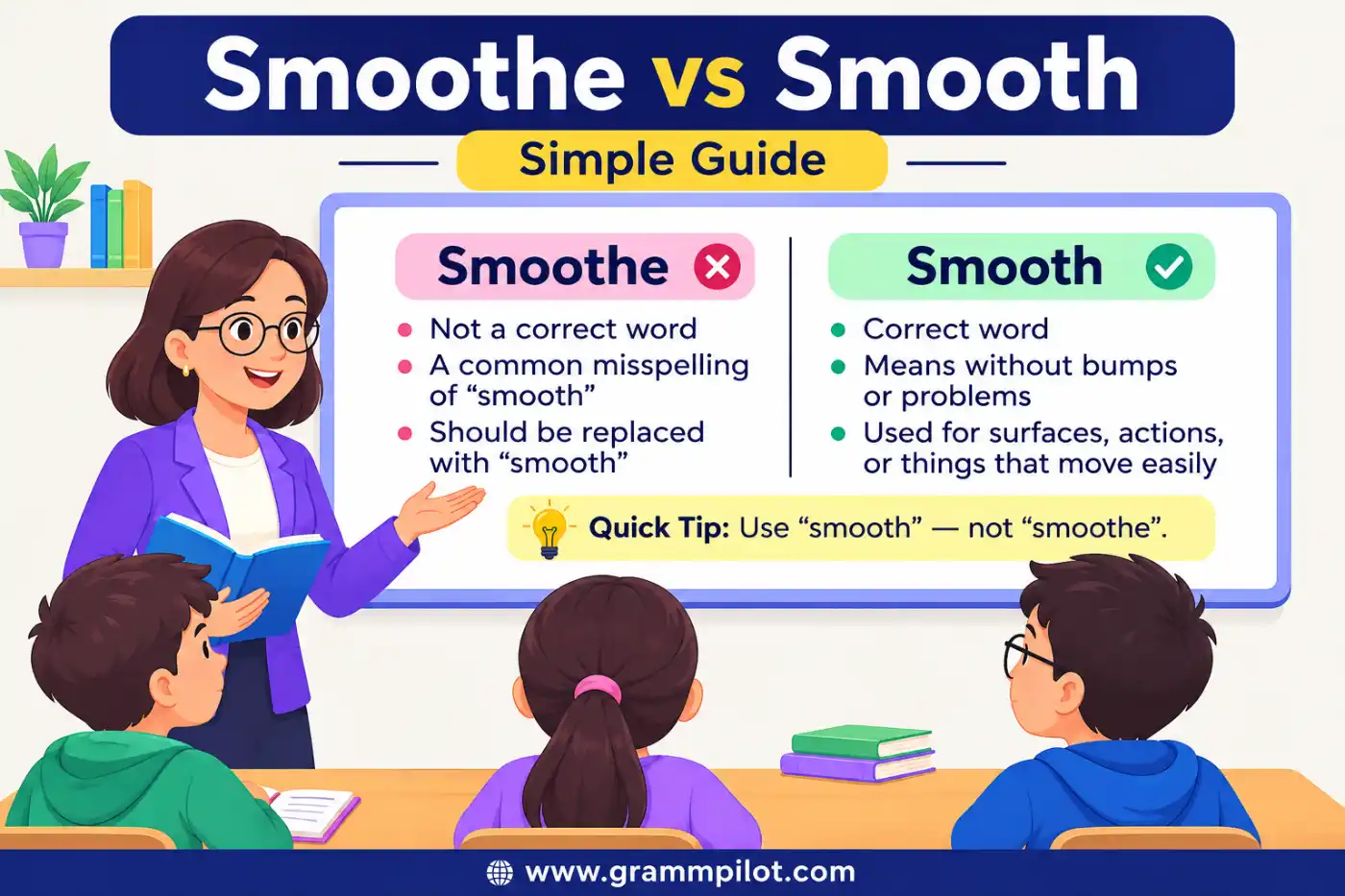
Smooth is the standard modern spelling. Smoothe is an older or uncommon form and is rarely the right choice for everyday writing.The word smooth has several meanings. It can describe a surface, sound, movement, process, person, or piece of writing. It can also work as a verb, so learning how to use it correctly is more useful than simply memorizing its spelling.
This guide covers the meaning, history, grammar, synonyms, examples, common mistakes, and best word choices for resumes, essays, emails, texting, and everyday speech.
Another word with a confusing spelling pattern is discussed in [Gases or Gasses].
Smoothe vs Smooth: What does smooth mean in plain English?
Smooth generally means free from roughness, bumps, interruptions, or difficulty. For a physical surface, it means something feels even rather than rough.
Examples:
- The table has a smooth surface.
- The stone feels smooth.
- She wore a smooth silk dress.
- The cream left her skin smooth.
The word can also describe something that happens without problems.
Examples:
- We had a smooth meeting.
- The transition was smooth.
- The registration process was smooth.
- His presentation was smooth and confident.
As a verb, smooth means to make something even or to reduce a problem.
Examples:
- Smooth the paper with your hand.
- She smoothed her dress.
- He smoothed the wrinkles from the shirt.
- They worked to smooth the transition.
- Her apology helped smooth things over.
So, the basic idea behind smooth is even, easy, natural, or free from roughness, depending on the context.
Is smoothe a real word?
Yes, but its status is different from smooth.
Smoothe has appeared in English as an older or alternative spelling of smooth. Historical English spelling was not always standardized, so writers sometimes used forms that look unusual today. That history explains why you may occasionally see smoothe in older writing.
However, modern standard English normally uses smooth.
| Sentence | Modern status |
|---|---|
| Please smooth the surface. | Standard |
| Please smoothe the surface. | Uncommon or old-fashioned |
| Her skin is smooth. | Standard |
| Her skin is smoothe. | Not standard modern usage |
For a school paper, resume, email, article, website, or business document, smooth is the better choice. It’s possible for a word to have historical evidence while still being a poor choice for modern writing. That’s the situation with smoothe.
Smoothe vs Smooth: Where did smooth come from?
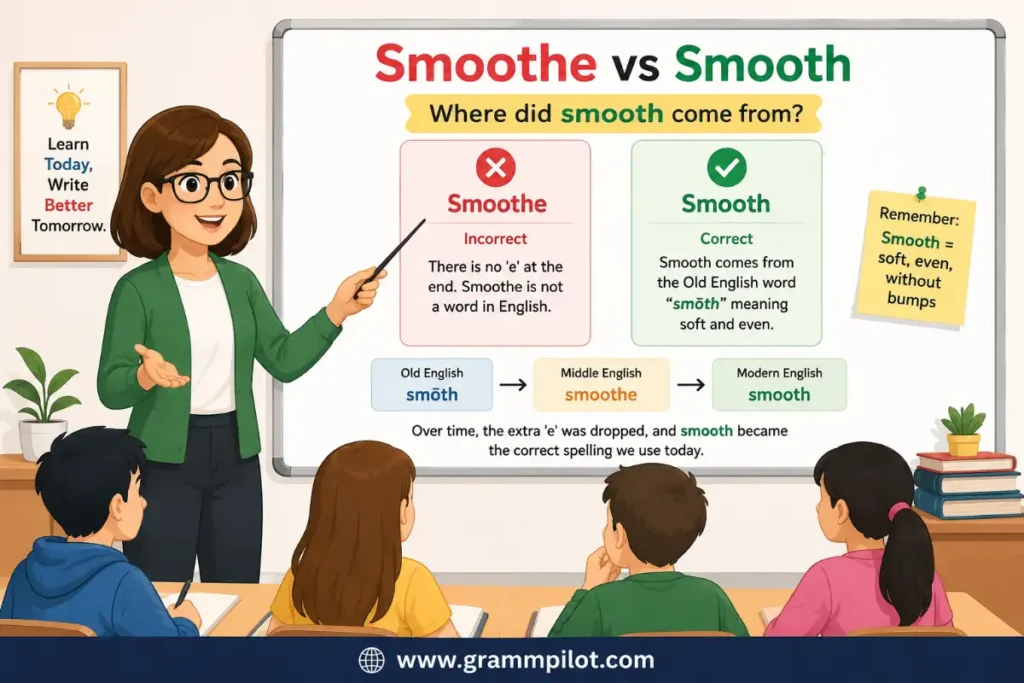
The history of smooth goes back many centuries. Merriam-Webster traces the adjective to Middle English smothe and ultimately to Old English smōth. The word has been part of English for a very long time, and its verb use developed later. Older spelling helps explain why forms such as smoothe may appear in historical texts. English spelling wasn’t always fixed. Before modern dictionaries and widespread spelling standards, writers could spell the same word in different ways.
Over time, smooth became the established modern form. This is useful to remember when you come across unusual spellings in older books. A historical spelling isn’t necessarily a spelling mistake. It may simply reflect the language conventions of that period.
Why does smoothe look like the right spelling?
The spelling smoothe can look natural because English contains words such as:
- soothe
- bathe
- breathe
- clothe
- loathe
A writer may think that smooth should work the same way. But English spelling doesn’t always follow appearance.
The modern base word is simply:
smooth
Its common forms include:
- smooth
- smooths
- smoothed
- smoothing
- smoothly
Examples:
- She smooths the fabric before sewing.
- He smoothed the paper.
- They are smoothing out the problem.
- The project went smoothly.
Dictionaries also recognize smoothes as an alternative third-person verb form. The key point is that you don’t need to turn smooth into smoothe to use it as a verb.
Is smooth an adjective or a verb?
Smooth can be both an adjective and a verb.
Smooth as an adjective
An adjective describes a noun.
Examples:
- a smooth surface
- smooth skin
- a smooth road
- a smooth voice
- a smooth transition
- a smooth performance
In each case, smooth describes a quality.
For example: The wooden table has a smooth surface.
The word smooth tells us what the surface feels like.
Smooth as a verb
A verb describes an action.
Examples:
- Smooth the paper.
- Smooth the fabric.
- She smoothed her hair.
- He smoothed the wrinkles from his shirt.
- We need to smooth the transition.
As a verb, smooth can refer to a physical action or an abstract action.
For example, you can physically smooth a piece of paper. You can also smooth a disagreement by saying or doing something that reduces tension.
What are the main meanings of smooth?
The word has several useful meanings.
1. Free from roughness
This is the most physical meaning.
Examples:
- The glass feels smooth.
- The stone has a smooth surface.
- The lotion makes the skin smooth.
2. Even or level
Something can be smooth because it has no bumps or irregular areas.
Example:
- The road is smooth after the repairs.
3. Easy and problem-free
A process can be smooth when it happens without major difficulties.
Examples:
- The move to the new office was smooth.
- We had a smooth transition.
- The event went smoothly.
4. Natural and connected
Speech and writing can be smooth when they flow naturally.
Examples:
- Her speech was smooth.
- The paragraph has a smooth transition.
- His explanation sounded smooth and natural.
5. Calm and confident
A person can be described as smooth when they appear relaxed, confident, and socially skilled.
Example: He’s a smooth speaker.
This meaning can be positive, neutral, or slightly humorous depending on the situation.
6. Pleasant in sound or movement
Music, voices, and physical actions can also be smooth.
Examples:
- The singer has a smooth voice.
- The dancer’s movements were smooth.
- The car gave us a smooth ride.
These meanings are different, but they all connect to the general idea of ease, continuity, or lack of roughness.
What are the best synonyms for smooth?
There isn’t one accurate synonym for smooth. The best replacement depends on the meaning you want.
| Word | Meaning | Tone | Example |
|---|---|---|---|
| Even | Without bumps or uneven areas | Simple | The surface is even. |
| Flat | Level with no raised areas | Simple | The board is flat. |
| Soft | Pleasantly gentle to touch | Simple | The fabric is soft. |
| Easy | Not difficult | Everyday | The process was easy. |
| Calm | Peaceful and controlled | Everyday | She remained calm. |
| Clear | Easy to understand | Everyday | His explanation was clear. |
| Natural | Not forced or awkward | Everyday | Her response sounded natural. |
| Gentle | Soft or careful | Everyday | Use a gentle motion. |
| Fluid | Moving naturally and continuously | Formal | Her writing is fluid. |
| Graceful | Smooth and attractive in movement | Formal | Her movements were graceful. |
| Consistent | Stable and regular | Formal | The quality remained consistent. |
| Uninterrupted | Without breaks | Formal | Service was uninterrupted. |
| Effortless | Appearing very easy | Formal | She gave an effortless performance. |
| Seamless | Without noticeable breaks | Formal | The transition was seamless. |
| Suave | Smooth and confident socially | Formal | He has a suave manner. |
| Slick | Very polished or clever | Informal | That was a slick presentation. |
| Cool | Calm and confident | Informal | She stayed cool under pressure. |
| Silky-smooth | Extremely smooth | Informal | The sauce was silky-smooth. |
These words overlap, but they are not interchangeable in every sentence. A flat surface isn’t necessarily soft. A clear explanation isn’t necessarily fluid. A polished presentation may be more carefully prepared than a merely smooth one. Good vocabulary means choosing the word that gives the reader the exact idea.
Smoothe vs Smooth: Which synonyms are mild and which are strong?
Some alternatives to smooth are neutral. Others create a much stronger impression.
Mild and neutral synonyms
These are safe for everyday writing:
- even
- steady
- clear
- calm
- natural
- easy
- gentle
Example: Her explanation was clear and natural.
Moderately strong synonyms
These suggest a higher level of quality:
- polished
- fluid
- refined
- graceful
- streamlined
- effortless
- sleek
Example: The final presentation was polished and professional.
Strong or expressive synonyms
These create a stronger image:
- silky
- silky-smooth
- flawless
- exceptionally polished
- seamless
Use strong words carefully.
For example, flawless suggests that something has no mistakes at all. If there are small problems, polished may be more accurate.
Smoothe vs Smooth: What synonyms work as different parts of speech?
The grammatical role of a word matters when you choose a replacement.
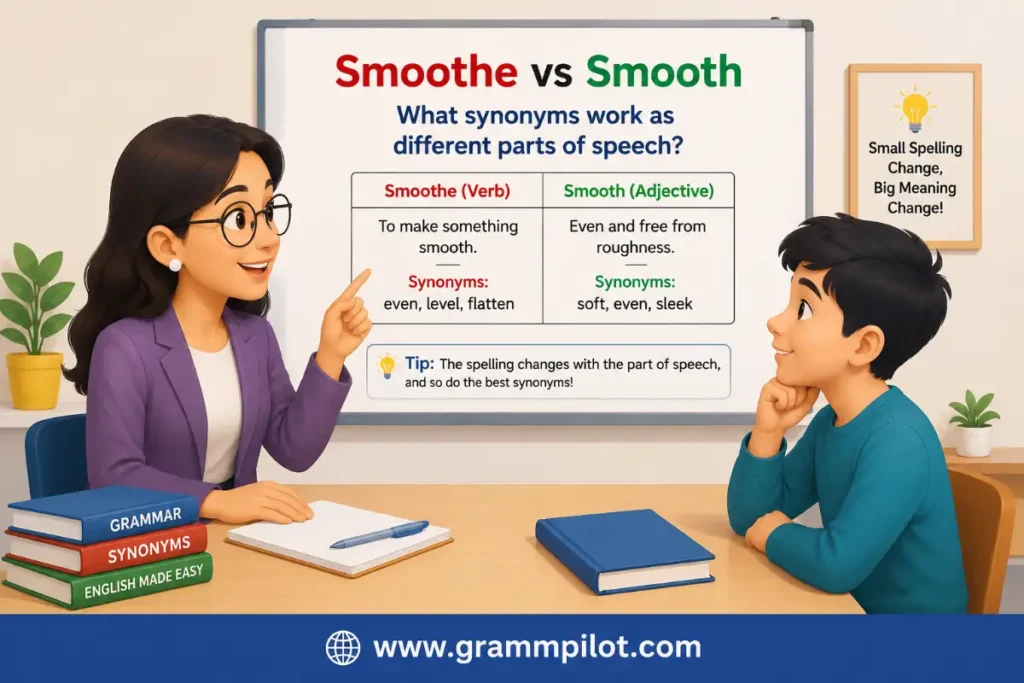
| Part of speech | Useful alternatives | Example |
|---|---|---|
| Adjective | even, polished, fluid, sleek | The surface is even. |
| Verb | polish, flatten, soften, streamline | They streamlined the process. |
| Noun | ease, polish, fluidity | The ease of the process helped. |
| Adverb | smoothly, naturally, easily, effortlessly | The event went smoothly. |
You cannot always replace one word with another simply because the meanings are related.
For example: The meeting went smoothly.
You cannot replace smoothly with polished.
Instead, you could write: The meeting was polished and well organized.
The grammar changes because the two words perform different jobs.
Smooth vs polished: what’s the difference?
Smooth and polished are close in meaning, especially when discussing writing, presentations, or professional work.
However, they emphasize different qualities.
| Smooth | Polished |
|---|---|
| Focuses on ease or flow | Focuses on refinement |
| Can describe physical surfaces | Often describes work or performance |
| Can describe movement | Often suggests preparation |
| Can mean problem-free | Often suggests careful editing |
Compare these sentences: Her presentation was smooth.
This means the presentation flowed naturally and didn’t feel awkward. Her presentation was polished. This suggests that she prepared carefully and refined the presentation. A presentation can be smooth without being highly polished. It can also be polished while still having an awkward moment.
Smooth vs seamless: what’s the difference?
Seamless often describes something that happens without noticeable breaks.
Compare: We had a smooth transition.
The transition went well.
We had a seamless transition.
The transition had almost no noticeable interruption.
Seamless is common in writing about:
- technology
- software
- customer service
- business processes
- design
- transitions
However, seamless can sound too strong if a process had several small problems.
In that case, smooth may be more accurate.
Smooth vs easy: what’s the difference?
These words can overlap when talking about difficulty. The instructions were easy. This focuses on how little effort the reader needed. The process was smooth. This focuses on how well the entire process worked. A process can be complicated but still smooth. For example, a visa application may require many steps. If every step is clearly explained and everything happens without problems, you can still call the process smooth.
Smooth vs fluid: what’s the difference?
Fluid often emphasizes natural movement or connection. Her writing is smooth.
This means her writing is easy and pleasant to read. This suggests that the ideas and sentences move naturally from one point to another.
Fluid is particularly useful for:
- writing
- speech
- conversation
- movement
- artistic performance
- changing situations
Is there a US or UK spelling difference?
There is no major modern US-versus-UK spelling difference here.
Smooth is the standard spelling in both American and British English.
Smoothe may appear in older or uncommon material, but it isn’t a standard British spelling that American writers need to replace.
There is a related issue with the verb forms smooths and smoothes. Both can be found in English:
The cream smooths the skin.
The cream smoothes the skin.
Dictionaries recognize smoothes as an alternative form.
But this is different from the base-word question.
The standard base form is: smooth
Not: smoothe
What is the best word for a resume?
On a resume, smooth can describe communication, transitions, teamwork, or business processes.
Examples:
- Helped ensure a smooth onboarding process.
- Coordinated a smooth transition to new software.
- Supported smooth communication between departments.
- Created procedures for a smoother workflow.
However, resume writing is usually stronger when it explains what you actually accomplished.
Instead of: Helped make the process smooth.
Try: Streamlined the approval process and reduced delays.
Streamlined is more specific because it suggests that you made the process more efficient.
Another option is: Coordinated a faster and more organized approval process.
Specific language gives employers a clearer picture of your contribution.
What is the best word for an essay?
Smooth works well when discussing transitions, writing style, or the development of an argument.
Examples:
- The author creates a smooth transition between the two ideas.
- The story moves through several smooth changes in tone.
- The final paragraph provides a smooth ending.
However, academic writing often benefits from more precise vocabulary.
Consider:
- coherent
- logical
- connected
- consistent
- fluid
- well organized
For example: The essay has a coherent structure.
This tells the reader more than: The essay is smooth.
Use smooth when you genuinely mean ease or flow. Use a more specific term when you mean logic, organization, or consistency.
What is the best word for texting?
In texting, smooth sounds natural and familiar.
Examples:
- That was a smooth move.
- Hope your trip goes smooth.
- Your presentation was really smooth.
- Everything went pretty smooth.
In formal standard English, smoothly is usually preferred when describing how an action happens.
For example: I hope your trip goes smoothly.
Casual texting may use smooth in this position because texting often follows conversational speech.
This doesn’t mean you should change smooth to smoothe. The latter is a spelling issue, not a casual form.
What is the best word for an email?
Smooth is useful in professional emails.
Examples:
- I hope the transition goes smoothly.
- We want to ensure a smooth handoff.
- Thank you for helping make the process smoother.
- Please let me know if you need anything to ensure a smooth transition.
For a more formal tone, you can use words such as:
- efficiently
- successfully
- consistently
- without interruption
We hope the transition goes smoothly. The second version is more formal, but the first sounds more natural in many workplace emails.
Smoothe vs Smooth: What is the best word for speaking?
In conversation, smooth is extremely flexible.
You can describe:
- a smooth voice
- a smooth ride
- smooth music
- smooth movements
- a smooth conversation
- a smooth performance
- a smooth transition
The meaning changes according to the noun.
For example: She has a smooth voice.
This usually means her voice sounds pleasant and easy to listen to.
But: He’s a smooth operator.
This describes someone who is socially confident and persuasive. It can be positive, playful, or slightly suspicious depending on the context.
What are some real-life examples?
School
The teacher used a smooth transition from the lecture to the group activity.
Resume
I helped create a smooth onboarding process for new employees.
Thank you for helping make the transition smooth.
Essay
The writer uses a smooth transition between the two main arguments.
Workplace
The team planned the schedule carefully to ensure a smooth handoff.
Travel
Our flight was delayed, but the rest of the trip was smooth.
Cooking
Blend the soup until it becomes smooth and creamy.
Clothing
She smoothed the wrinkles from her jacket before the interview.
Technology
The latest update should make the application run more smoothly.
Conversation
His apology helped smooth things over.
Sports
The runner’s smooth stride helped him maintain his pace.
Music
The singer has a warm, smooth voice.
These examples show how widely the word can be used.
Smoothe vs Smooth: What are the most common mistakes?
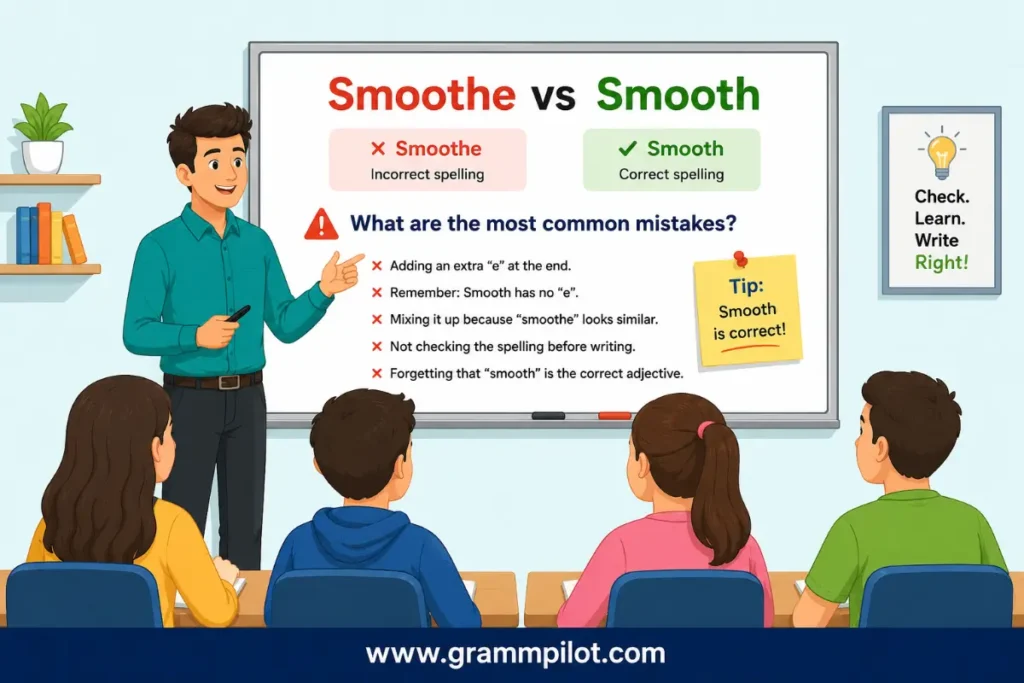
Using smoothe as the normal spelling
A common mistake is writing: Please smoothe the paper.
For modern standard English, write: Please smooth the paper.
Thinking smooth is only an adjective
It can also be a verb.
Adjective: The table is smooth.
Verb: Smooth the table.
Confusing smooth and smoothly
Use smooth when describing something: The process was smooth.
Use smoothly when describing how something happened: The process went smoothly.
Using smooth when a more precise word would help
Instead of: We made the process smooth.
You might write: We streamlined the process.
Or: We simplified the process.
These alternatives explain what changed.
Assuming every synonym means exactly the same thing
Easy, polished, fluid, seamless, and smooth overlap, but each has a different emphasis.
Choose the word that communicates your intended meaning.
When should you not use smooth?
Sometimes another word is more accurate.
Flat: when you mean a surface has no raised areas. The board is flat.
Easy: when you mean something requires little effort.
The instructions were easy to follow.
polished: when you mean something has been carefully refined.
Her final report was polished.
streamlined: when you mean a process has been made more efficient.
We streamlined the registration syste
coherent when you mean ideas connect logically. His argument was coherent.
Use fluid when you mean ideas or movements flow naturally.
Her writing was fluid.
Precise vocabulary usually produces stronger writing than simply choosing a more impressive-sounding word.
What are the antonyms of smooth?
The opposite depends on the meaning.
For physical surfaces
- rough
- bumpy
- uneven
- jagged
- coarse
- lumpy
Example: The road was rough and bumpy.
For processes
- difficult
- chaotic
- interrupted
- problematic
- complicated
- troublesome
Example: The launch was complicated and chaotic.
For social situations
- awkward
- tense
- uncomfortable
- hostile
Example: The conversation became tense.
For movement
- jerky
- shaky
- abrupt
- uneven
Example: The camera movement was jerky.
So there isn’t one universal opposite of smooth. The correct antonym depends on the meaning.
Smoothe vs Smooth: Quick tips for choosing the right word
- Talking about texture? Use smooth for a surface without roughness.
- Talking about a process? Use smooth when it happens without major problems.
- Describing how an action happens? Use smoothly.
- Talking about efficiency? Consider streamlined.
- Talking about professional quality? Consider polished.
- Talking about logical writing? Consider coherent.
- Talking about natural movement? Consider fluid.
- Unsure about the spelling? Choose smooth.
- Writing a resume? Describe a measurable result instead of using vague praise.
- Writing academically? Pick the most precise word.
- Writing a text? Smooth is natural and widely understood.
- Reading an old text? Don’t automatically assume smoothe is an error. Historical context matters.
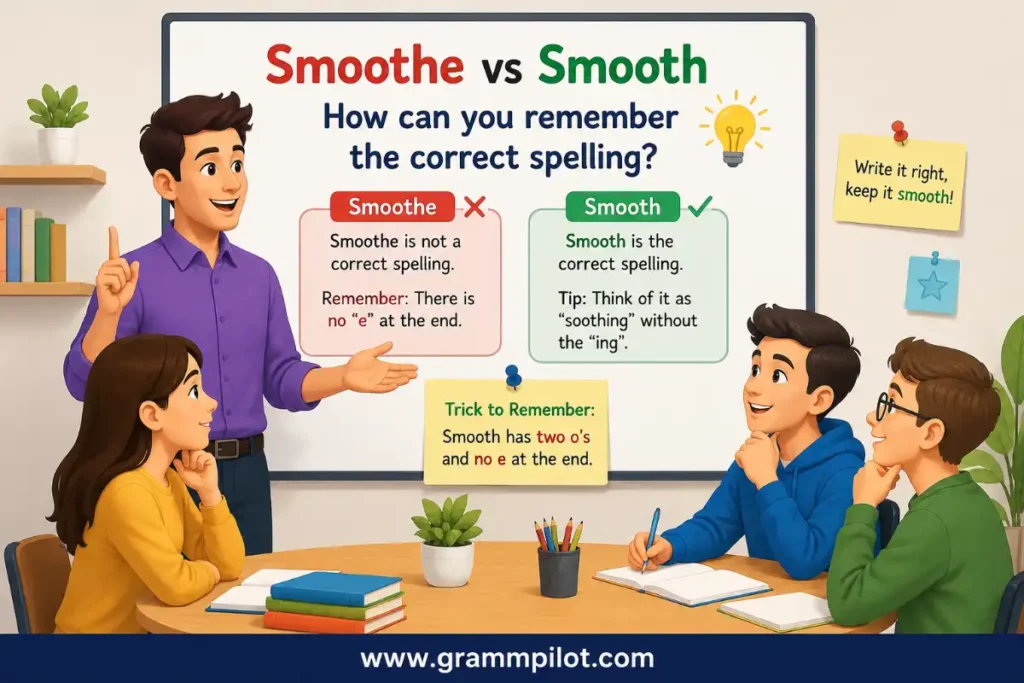
Smoothe vs Smooth: How can you remember the correct spelling?
The easiest method is to memorize the modern base word:
smooth
Then build the common forms from it:
- smooth
- smooths
- smoothed
- smoothing
- smoothly
You don’t need an extra e in the base form.
When you’re writing for a modern audience, this simple rule will cover almost every situation.
Conclusion
The main lesson from Smoothe vs Smooth is simple: use smooth in modern standard English. It is the normal spelling for both the adjective and verb, and it works in school writing, workplace communication, resumes, emails, websites, and everyday conversation. Smoothe has historical usage, but it is uncommon today and may look dated or misspelled to many readers.
It’s also helpful to understand the different meanings of smooth. It can describe texture, movement, writing, speech, behavior, or a process. When a more exact word is needed, consider alternatives such as polished, fluid, clear, streamlined, or seamless. Once you focus on the exact meaning you want, choosing the right word becomes much easier.
Frequently Asked Questions
1. Is smooth vs smoothe the correct spelling?
Smooth is the standard modern spelling. Smoothe is an older or uncommon form and is usually not the best choice for current writing.
2. Is smoothe a real English word?
Yes, but it is uncommon in modern English. It has historical use as an alternative form of smooth, while modern writers generally prefer smooth.
3. What’s another way to say smooth?
You can use words such as even, polished, fluid, clear, sleek, easy, refined, steady, natural, or streamlined. The best alternative depends on the meaning.
4. Can smooth be used as a verb?
Yes, smooth can be a verb. In “Smooth the paper,” it means to make the paper even or remove wrinkles.
5. Should I write smooths or smoothes?
Both forms are used, but smooths is a common modern form. Smoothes is also recognized as an alternative verb form.
6. Is smooth an adjective or a verb?
It can be either one. In “smooth skin,” it is an adjective, while in “smooth the paper,” it is a verb.
7. Why does smoothe look like the correct spelling?
It looks natural because English has words such as soothe and bathe that use an extra e. However, the standard modern base spelling is smooth.