
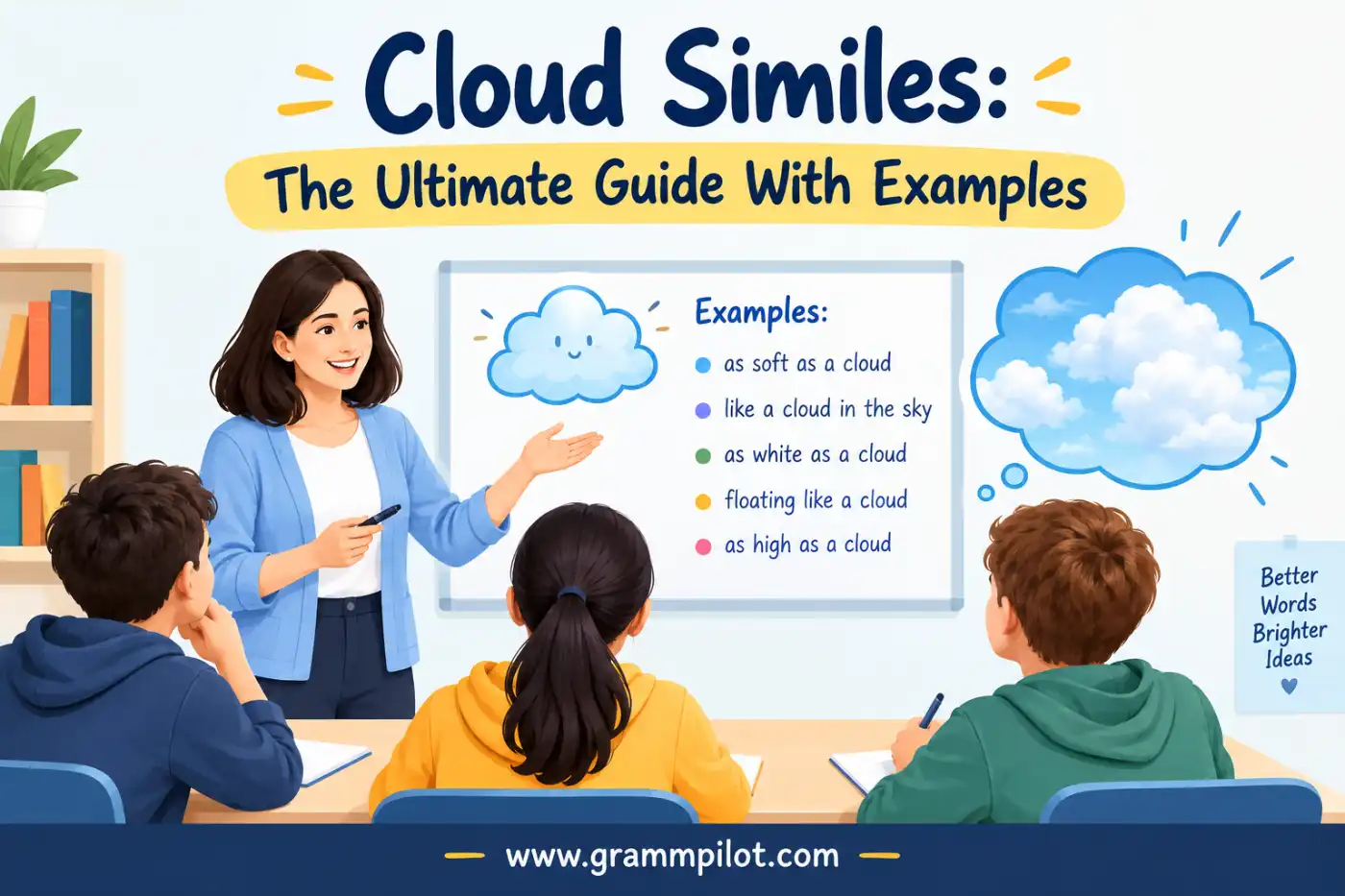
You’re writing an essay, story, poem, text message, or social media caption. You look at the sky and want to describe the clouds, but words like “nice,” “white,” or “big” feel too plain. Cloud Similes can help you turn an ordinary description into a picture your reader can clearly imagine.
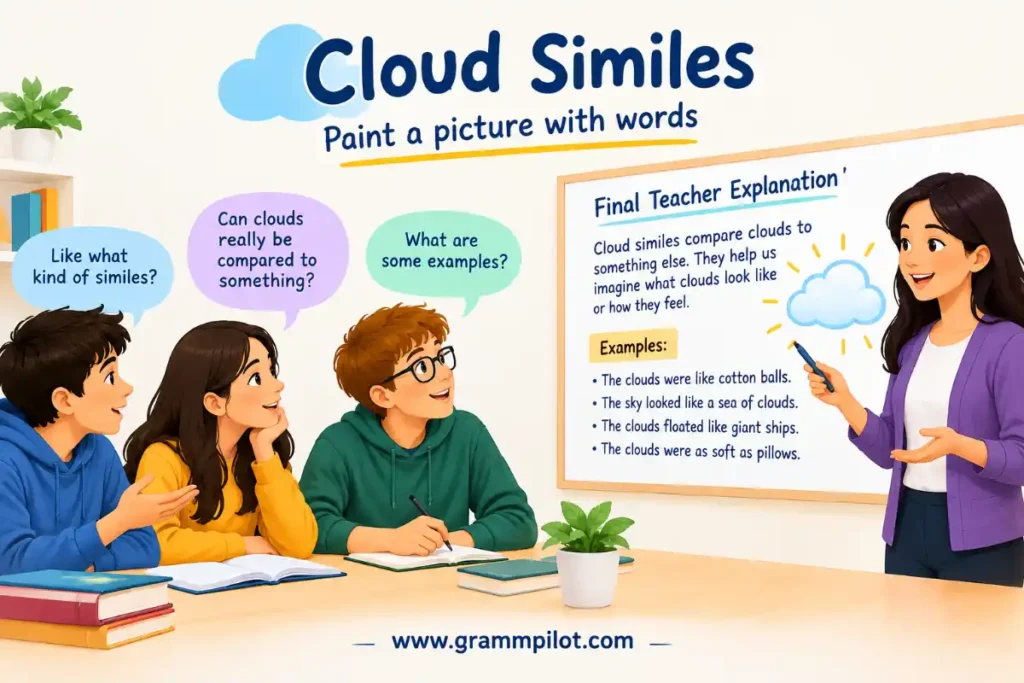
Cloud similes compare clouds to familiar things by using words such as “like” or “as.” They help describe a cloud’s shape, color, size, movement, texture, or mood in a vivid and easy-to-understand way.
A cloud might look like cotton, smoke, a blanket, mountains, feathers, waves, castles, pillows, or something completely unexpected. The best comparison depends on what you see and the feeling you want your words to create. This guide explains what these comparisons mean, where similes come from, the best words for describing clouds, examples for different situations, close-word differences, common mistakes, antonyms, and simple tips for choosing the right image.
Another commonly confused pair worth knowing is [Ask vs Pose].
Cloud Similes: What Does a Cloud Simile Mean?
A simile is a figure of speech that compares two different things. Most similes use the words like or as.
For example:
- The clouds were like piles of cotton.
- Dark clouds covered the sky like a heavy blanket.
- The clouds moved as slowly as ships at sea.
- Thin clouds stretched across the sky like white ribbons.
The purpose of a simile is simple: it helps the reader picture something more clearly. Clouds are always changing. A cloud that looks like a rabbit at one moment may look like a mountain a few minutes later. Because clouds have different shapes, colors, and movements, they are accurate for creative comparisons.
Compare these two sentences:
Plain: The clouds were large and white.
With imagery: The clouds floated above us like enormous piles of cotton.
The second sentence gives the reader more to imagine. It suggests softness, size, color, and movement. That is why Cloud Similes are useful in descriptive writing. They can make a simple sky scene feel more alive without requiring difficult vocabulary.
Cloud Similes: Where Does the Word “Simile” Come From?
The word simile comes from the Latin word similis, which means “similar” or “like.” People have used comparisons for thousands of years. Before cameras, videos, and weather apps, people often had to explain what they saw through stories and spoken language. Comparing one thing to another made descriptions easier to understand. Imagine telling someone: “There was a large white thing moving slowly across the sky.” Now compare that with: “There was a cloud moving across the sky like a giant white ship.” The second sentence is easier to picture. Cloud imagery also has a long history in poetry, stories, religious writing, songs, and everyday speech. People have always looked upward and noticed the sky changing.
Clouds can suggest many ideas:
- Peace
- Freedom
- Hope
- Change
- Mystery
A white cloud may feel calm and peaceful. A dark cloud may suggest trouble. Golden clouds may create a warm feeling. Fast-moving clouds can suggest change or urgency. The comparison you choose affects the emotional meaning of your sentence.
Cloud Similes: What Are the Best Words for Describing Clouds?
Before creating a strong simile, it helps to know useful descriptive words. The table below includes more than 30 words and expressions grouped by tone and everyday use.
| Word | Meaning | Tone | Example |
|---|---|---|---|
| Fluffy | Soft and full | Simple | Fluffy clouds filled the sky. |
| Puffy | Rounded and full | Everyday | Puffy clouds floated above the park. |
| White | Light in color | Neutral | White clouds drifted overhead. |
| Dark | Having little light | Serious | Dark clouds gathered before the storm. |
| Bright | Full of light | Positive | Bright clouds reflected the morning sun. |
| Soft | Gentle in appearance | Positive | Soft clouds rested above the hills. |
| Thick | Dense and heavy-looking | Neutral | Thick clouds blocked the sunlight. |
| Thin | Not dense | Neutral | Thin clouds moved across the moon. |
| Light | Delicate or not dense | Positive | Light clouds drifted in the wind. |
| Billowing | Rising and swelling outward | Formal | Billowing clouds rose over the horizon. |
| Towering | Extremely tall | Formal | Towering clouds appeared before the storm. |
| Floating | Moving gently | Simple | White clouds floated overhead. |
| Stormy | Related to bad weather | Strong | The afternoon sky looked stormy. |
| Golden | Having a gold-like color | Positive | Golden clouds appeared at sunset. |
| Pink | Light red in color | Everyday | Pink clouds reflected the evening sun. |
| Purple | Purple in color | Poetic | Purple clouds formed at dusk. |
| Massive | Extremely large | Strong | Massive clouds filled the afternoon sky. |
| Feathery | Similar to feathers | Poetic | Feathery clouds floated high above. |
| Swirling | Moving in circles | Dramatic | Swirling clouds formed before the rain. |
You do not need to use difficult words all the time. A simple word that accuratey matches the scene is usually better than a fancy word that feels unnatural.
Cloud Similes: Which Cloud Words Are Mild, Strong, or Dramatic?
Words create different levels of emotion. Some sound gentle, while others feel powerful or threatening.
Mild and Gentle Cloud Descriptions
Use these when the sky looks peaceful:
- Soft
- Light
- Wispy
- Delicate
- Feathery
- Floating
- Drifting
- Cottony
- Pale
- Silvery
Example: The clouds moved across the morning sky like soft feathers.
These words work well in peaceful stories, poems, travel writing, and school descriptions.
Medium-Strength Cloud Descriptions
Use these when the clouds are noticeable but not frightening:
- Puffy
- Thick
- Rolling
- Billowing
- Bright
- Massive
- Dramatic
- Gathering
Example: The clouds rolled over the hills like slow ocean waves.
These words give the scene more energy without making it sound dangerous.
What Parts of Speech Help Describe Clouds?
Strong descriptions often use more than one type of word.
Adjectives for Clouds
Adjectives tell us what clouds look like.
Examples:
- Fluffy clouds
- Dark clouds
- Wispy clouds
- Golden clouds
- Towering clouds
- Heavy clouds
Example sentence: Golden clouds floated above the lake at sunset.
Verbs for Clouds
Verbs show what clouds are doing.
Useful verbs include:
- Drifted
- Floated
- Gathered
- Rolled
- Moved
- Spread
- Covered
- Loomed
- Rose
- Swallowed
- Broke apart
- Raced
Example: Dark clouds gathered over the town.
Nouns for Cloud Comparisons
Nouns give you objects to compare with clouds.
Useful choices include:
- Cotton
- Feathers
- Blankets
- Mountains
- Waves
- Smoke
- Ships
- Castles
- Pillows
- Wool
- Curtains
- Islands
- Towers
- Oceans
- Walls
- Ribbons
- Paint
- Foam
Example: The clouds looked like floating islands.
Adverbs for Cloud Movement
Adverbs can show how clouds move.
Examples:
- Slowly
- Quietly
- Gently
- Rapidly
- Silently
- Smoothly
Example: The clouds drifted slowly across the afternoon sky.
Using these word types together can make your writing detailed without making it complicated.
Cloud Similes: Are Cloud Words Different in US and UK English?
Most cloud descriptions work the same way in American and British English.
A cloud is still a cloud, and comparisons such as “like cotton,” “like a blanket,” or “like smoke” are widely understood.
One small spelling difference is:
- US English: gray
- UK English: grey
Both forms are correct.
Regional experience can also affect the comparisons people naturally choose.
Someone living near the ocean may compare clouds to:
- Waves
- Ships
- Foam
- Islands
Someone living in the countryside may compare them to:
- Sheep
- Wool
- Fields
- Hills
This is one reason cloud descriptions can feel personal. The sky is universal, but the things it reminds us of are not always the same.
What Is the Best Cloud Description for an Essay?
In an essay, clear language usually works best.
Good choices include:
- Like a blanket
- Like rolling waves
- Like mountains
- Like cotton
- Like smoke
Example:
The dark clouds spread across the sky like a thick blanket, blocking the afternoon sunlight.
This works because the reader quickly understands what the writer means.
For a school essay, avoid using a comparison just because it sounds impressive. The image should help the sentence, not distract from it.
Best Tip for Essays
Choose a familiar comparison that matches the cloud’s appearance.
For example: The clouds stretched across the sky like thin ribbons.
This is simple, visual, and easy to understand.
What Is the Best Cloud Description for a Story?
Stories give you more freedom because imagery can help create mood.
For a peaceful scene: The clouds floated like white ships across a quiet blue ocean.
When a sad scene: Gray clouds hung over the town like a curtain that refused to open.
For a frightening scene: The storm clouds rolled toward us like a dark army.
The important thing is to match the comparison to the story’s mood. A silly comparison can ruin a serious scene. A frightening comparison may feel strange in a happy children’s story. Always think about the emotion you want the reader to feel.
What Is the Best Cloud Description for Texting?
Text messages are short, so keep the language natural.
Examples:
- The clouds look like cotton today.
- The sky looks like a giant painting.
- Those clouds look like mountains.
- The sunset clouds look like pink cotton candy.
- The whole sky looks covered with a blanket.
A natural text could say: “Look outside! The clouds look like giant piles of whipped cream.”
You don’t need formal language when you’re texting a friend.
What Is the Best Cloud Description for Speaking?
When speaking, choose comparisons people can understand immediately.
Good choices include:
- Like cotton
- Like a blanket
- Like smoke
- Like waves
- Like mountains
Example: “Those clouds look like giant mountains.”
You can also make your speech sound more natural by connecting it to what the other person can see.
“See those clouds? They look like huge piles of whipped cream.”
Cotton vs. Pillow: What’s the Difference?
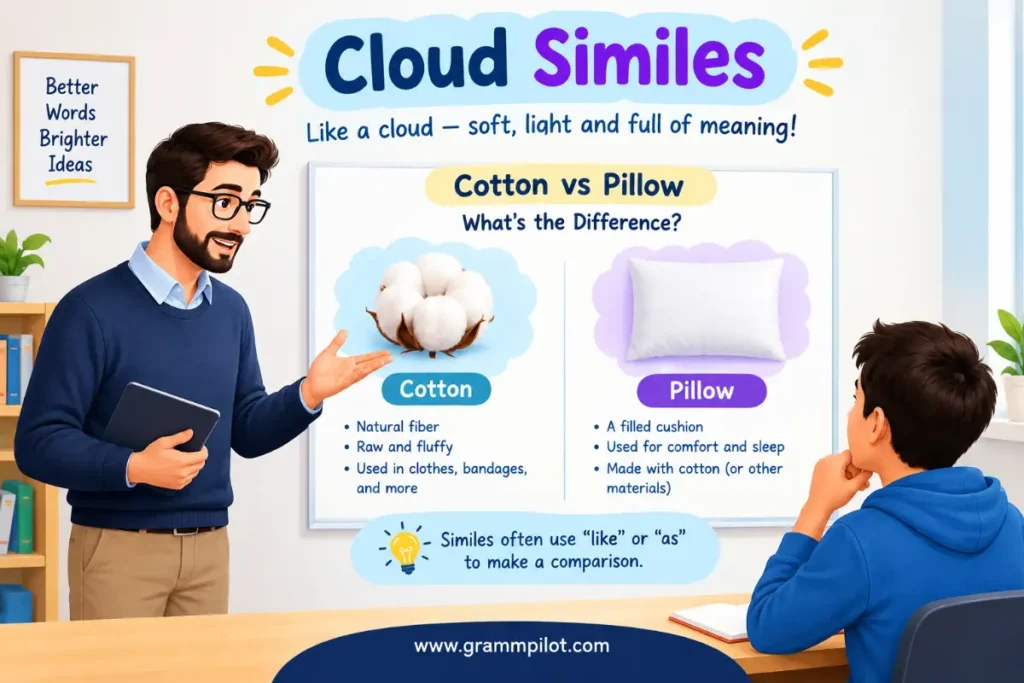
Both comparisons suggest softness, but they create different pictures.
| Comparison | Main Image | Best Use | Feeling |
|---|---|---|---|
| Like cotton | Light, fluffy, loose | Small or scattered clouds | Gentle |
| Like a pillow | Large, soft, rounded | Thick puffy clouds | Comfortable |
Compare:
The clouds looked like balls of cotton.
This suggests something light and fluffy.
The clouds looked like giant pillows.
This suggests something larger, fuller, and softer.
Neither comparison is wrong. Look at the cloud’s size and shape before choosing.
Smoke vs. Darkness: What’s the Difference?
Both can describe threatening skies, but they focus on different qualities.
| Comparison | Main Image | Best Use | Feeling |
|---|---|---|---|
| Like smoke | Moving, spreading, swirling | Gray or uneven clouds | Mystery or danger |
| Like darkness | Heavy and light-blocking | Thick storm clouds | Fear or gloom |
Example:
Gray clouds spread across the hills like smoke.
This focuses on movement and shape.
Dark clouds covered the sky like darkness itself.
This focuses on lost light and a heavy mood.
Small word choices can create major differences in how readers imagine a scene.
Blanket vs. Curtain: What’s the Difference?
Both suggest that clouds cover the sky.
A blanket usually feels soft, wide, and complete.
Example:
Clouds covered the sky like a thick blanket.
Depending on the context, this can feel cozy, calm, or heavy.
A curtain suggests something closing, hiding, or blocking.
Example:
Gray clouds fell across the city like a curtain.
This feels more dramatic.
Use “blanket” when you want softness or full coverage. Use “curtain” when you want to suggest something being hidden or closed off.
Cloud Similes: What Are the Most Popular Cloud Comparisons?
Some images appear often because they are easy to understand.
Clouds Like Cotton
This works best for white, fluffy clouds.
Example: The clouds were like cotton floating across the sky.
Clouds Like Pillows
This works well for large, rounded clouds.
Example: Puffy clouds rested above the hills like giant pillows.
Clouds Like a Blanket
Use this when clouds cover most of the sky.
Example: A gray layer of clouds covered the city like a blanket.
Clouds Like Waves
Use this for clouds that roll or move in layers.
Example:Clouds rolled across the sky like waves on the sea.
Clouds Like Mountains
Use this for tall or powerful storm clouds.
Example: The clouds rose like mountains before the rain began.
Clouds Like Smoke
This works for dark, spreading, or twisting clouds.
Example: The clouds moved across the valley like smoke from a distant fire.
Clouds Like Feathers
Use this for thin, high, delicate clouds.
Example: The clouds stretched across the blue sky like white feathers.
Clouds Like Ships
This comparison works well for slow-moving clouds.
Example: The clouds sailed across the sky like ships on a silent ocean.
Clouds Like Castles
Use this for imaginative or magical writing.
Example: At sunset, the clouds looked like golden castles in the sky.
Clouds Like Cotton Candy
This playful comparison works especially well for pink clouds.
Example: The sunset clouds looked like pink cotton candy.
How Do You Choose the Right Simile for a Cloud?
Look carefully before choosing your comparison.
Ask yourself several questions.
What Shape Is the Cloud?
Is it:
- Round?
- Long?
- Tall?
- Flat?
- Broken apart?
- Layered?
- Curved?
A round cloud may look like cotton or a pillow.
A long cloud may look like a ribbon, road, or brushstroke.
A tall cloud may look like a mountain or tower.
What Color Is It?
White clouds may suggest:
- Cotton
- Wool
- Feathers
- Foam
Pink or orange clouds may suggest:
- Fire
- Cotton candy
- Paint
- Gold
Dark clouds may suggest:
- Smoke
- Mountains
- Walls
- Curtains
How Is It Moving?
Slow movement may suggest:
- Ships
- Boats
- Feathers
- Floating leaves
Fast movement may suggest:
- Waves
- Racing animals
- Flowing smoke
What Mood Do You Want?
For peace:
- Feather
- Cotton
- Pillow
- Blanket
For mystery:
- Smoke
- Curtain
- Shadow
When beauty:
- Painting
- Gold
- Silver
- Castle
Cloud Similes: What Are Some Common Mistakes When Using Cloud Comparisons?
A simile can improve writing, but a poor comparison can confuse the reader.
Don’t Use a Comparison That Doesn’t Match
If the cloud is thin and narrow, comparing it to a huge mountain may not make sense.
Look at the actual shape first.
Better: Thin clouds stretched like white ribbons.
Don’t Use Too Many Similes in One Paragraph
Too many comparisons can make writing feel crowded.
For example: The clouds were like cotton, like pillows, like sheep, like mountains, and like whipped cream.
This gives the reader too many pictures at once.
Choose the strongest image.
Don’t Repeat the Same Comparison
If every cloud is “like cotton,” your writing becomes predictable.
Try different images.
Instead of: The clouds looked like cotton.
You could write: Thin clouds looked like feathers.
Or: Dark clouds rolled like waves.
Don’t Force a Simile Into Formal Writing
Creative comparisons are useful, but not every document needs them.
A weather report should usually say: Heavy clouds are expected this afternoon.
Not: The sky will be attacked by an army of dark blankets.
The second sentence may be entertaining, but it does not fit a standard weather report.
When Should You Avoid Cloud Similes?
Do not use a comparison simply because you think every description needs one.
Sometimes plain language is better.
Example: Clouds covered the sky, and rain began fifteen minutes later.
That sentence is clear and direct.
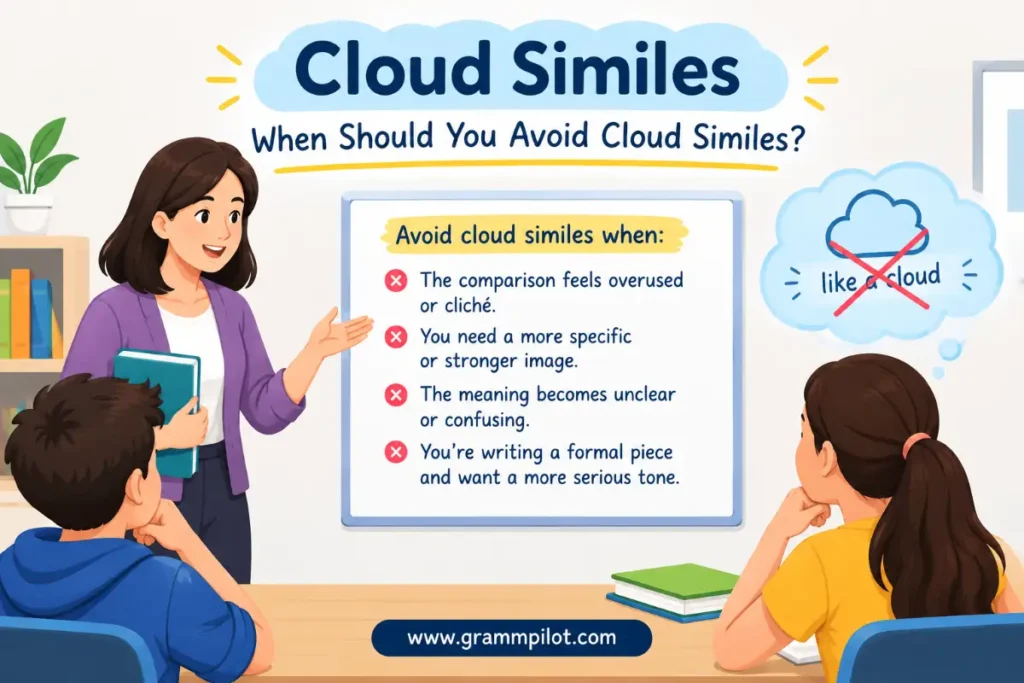
Avoid a simile when:
- You are writing technical information.
- The comparison may confuse the reader.
- Your audience needs direct facts.
- You already have several images in the paragraph.
- The comparison sounds forced.
- The object does not match the cloud’s appearance.
- The sentence becomes longer without becoming clearer.
A simile should add value. If removing it makes the sentence stronger, you probably did not need it.
What Are the Antonyms of Common Cloud Descriptions?
Clouds themselves do not have one direct opposite, but many words used to describe them do.
| Cloud Description | Possible Opposite |
|---|---|
| Dark | Bright |
| Thick | Thin |
| Heavy | Light |
| Stormy | Clear |
| Gloomy | Cheerful |
| Massive | Small |
| Dense | Sparse |
| Low | High |
| Threatening | Peaceful |
| Gray | Bright or colorful |
| Covered | Clear |
| Ominous | Hopeful |
These opposites can help you create contrast.
Example:
The morning began under dark, heavy clouds, but by noon the sky was bright and clear.
Contrast makes descriptions more interesting because it shows change.
How Can You Make a Cloud Simile Sound More Original?
Original writing does not always require unusual vocabulary. Often, originality comes from paying attention.
Instead of asking:
“What comparison sounds impressive?”
Ask:
“What does this cloud honestly remind me of?”
Maybe it looks like:
- A sleeping whale
- Torn paper
- Melted wax
- A spilled paintbrush
- A floating island
- A trail of dust
- A row of sheep
- A dragon’s breath
- Crumpled paper
- A broken wall
- A pile of laundry
- A sleeping giant
- A brushstroke
- A river of smoke
The most interesting comparisons often come from specific observations.
For example: The clouds looked like torn pieces of paper scattered across a blue desk.
That is more specific than simply saying the clouds looked beautiful.
How Do You Use Cloud Similes in Poetry?
Poetry allows more freedom and imagination.
You can focus on:
- Sound
- Rhythm
- Color
- Mood
- Symbolism
- Emotion
Example: The clouds moved like tired travelers across the fading sky.
This describes movement, but it also gives the clouds a feeling of exhaustion.
Another example: White clouds slept like sheep on the blue hills of the sky.
This creates a calm image. Poetry often works best when the comparison has two jobs. It should help readers see something while also helping them feel something.
A dark cloud can represent sadness.
A breaking cloud can represent hope.
A moving cloud can represent time passing.
A bright cloud can represent peace or possibility.
The meaning depends on the poem.
How Do You Use Cloud Comparisons in a School Assignment?
A school assignment often rewards clear observation.
Use this simple process:
- Look at the cloud.
- Notice its shape.
- Notice its color.
- Notice its texture.
- Notice how it moves.
- Choose something familiar with similar qualities.
- Use “like” or “as.”
For example:
Observation: The cloud is white, round, and soft-looking.
Possible comparison: Cotton or a pillow.
Sentence: The cloud floated above the school like a giant piece of cotton.
Another example:
Observation: The clouds are dark, thick, and moving toward the city.
Possible comparison: A wall.
Sentence: Dark clouds moved toward the city like a giant wall.
This method is easy and reliable for students.
What Are Some Quick Tips for Choosing the Right Word?
Use these tips whenever you describe the sky.
- Match the shape first. A long cloud needs a different comparison from a round one.
- Think about color. White, gray, pink, orange, and black clouds create different images.
- Notice movement. Drifting clouds and racing clouds need different language.
- Match the mood. Peaceful scenes need gentle comparisons. Storm scenes can use stronger ones.
- Keep it natural. If the comparison feels confusing, simplify it.
- Use familiar objects. Readers quickly understand cotton, blankets, waves, and smoke.
- Avoid repetition. Change your imagery when the scene changes.
- Do not over-explain. A good simile should work quickly.
- Read it aloud. If the sentence sounds awkward, rewrite it.
- Choose one strong image. One memorable comparison is better than several weak ones.
- Think about your audience. A comparison for a child may be different from one for a formal essay.
- Use your own observations. Personal details can make descriptions feel fresher.
Can You Create Your Own Cloud Similes?
Yes. In fact, your own observations can create the strongest descriptions.
Try this simple exercise.
Look at a cloud and complete these sentences:
- It looks like __.
- It moves like __.
- Its color reminds me of __.
- It makes the sky feel like __.
- It changes shape like __.
You might write:
It looks like a pile of torn paper.
It moves like a slow ship.
Its color reminds me of old silver.
It makes the sky feel like a closed room.
Now turn the ideas into a sentence:
The thin gray clouds drifted like torn pieces of paper across the silver sky.
You do not need complicated vocabulary. Careful observation.
Final Checklist Before Using a Cloud Simile
Before you finish your sentence, ask:
- Does the comparison match the cloud’s shape?
- Does it match the cloud’s color?
- Can the reader picture it quickly?
- Does it fit the tone of my writing?
- Is it different from images I already used?
- Does it create a useful picture or feeling?
- Is it appropriate for my audience?
- Would a simpler comparison work better?
- Have I avoided repeating the same image?
- Does the sentence still sound natural when read aloud?
If the answer is yes, your description is probably ready.
Conclusion
Cloud Similes can make ordinary descriptions more vivid by connecting clouds with familiar things readers already understand. A cloud can resemble cotton, feathers, waves, mountains, smoke, blankets, or countless other objects. The strongest comparison depends on the cloud’s shape, color, movement, and the mood you want to create.
The best approach is simple: observe first and compare second. Do not choose a complicated image just to sound creative. Pick the comparison that feels natural and helps the reader clearly see the scene. With a strong vocabulary, careful observation, and a little imagination, even an ordinary sky can become a memorable part of your writing.
Frequently Asked Questions
1. What are Cloud Similes?
Cloud Similes are comparisons that describe clouds by comparing them to familiar objects or experiences using words such as “like” or “as.” They help readers imagine a cloud’s shape, movement, color, size, or mood more clearly.
2. What’s another way to say a cloud looks soft?
You can say a cloud looks like cotton, a pillow, wool, foam, whipped cream, or a feather. Choose the image that best matches the cloud’s size and shape.
3. What is a good simile for white clouds?
A common choice is “white clouds like pieces of cotton.” You can also compare them to feathers, pillows, sheep, whipped cream, foam, or floating ships.
4. What is a good simile for dark storm clouds?
Dark storm clouds can be compared to mountains, smoke, walls, curtains, towers, or a threatening army. Stronger images usually work best when the weather feels dangerous or dramatic.
5. Can I use Cloud Similes in an essay?
Yes. Cloud Similes can make descriptive essays more vivid when used naturally and in moderation. Choose clear comparisons that match the scene, and avoid placing too many images in one paragraph.
6. What is the difference between a simile and a metaphor about clouds?
A simile compares clouds using “like” or “as,” such as “The clouds were like cotton.” A metaphor makes a direct comparison, such as “The clouds were cotton in the sky.”