
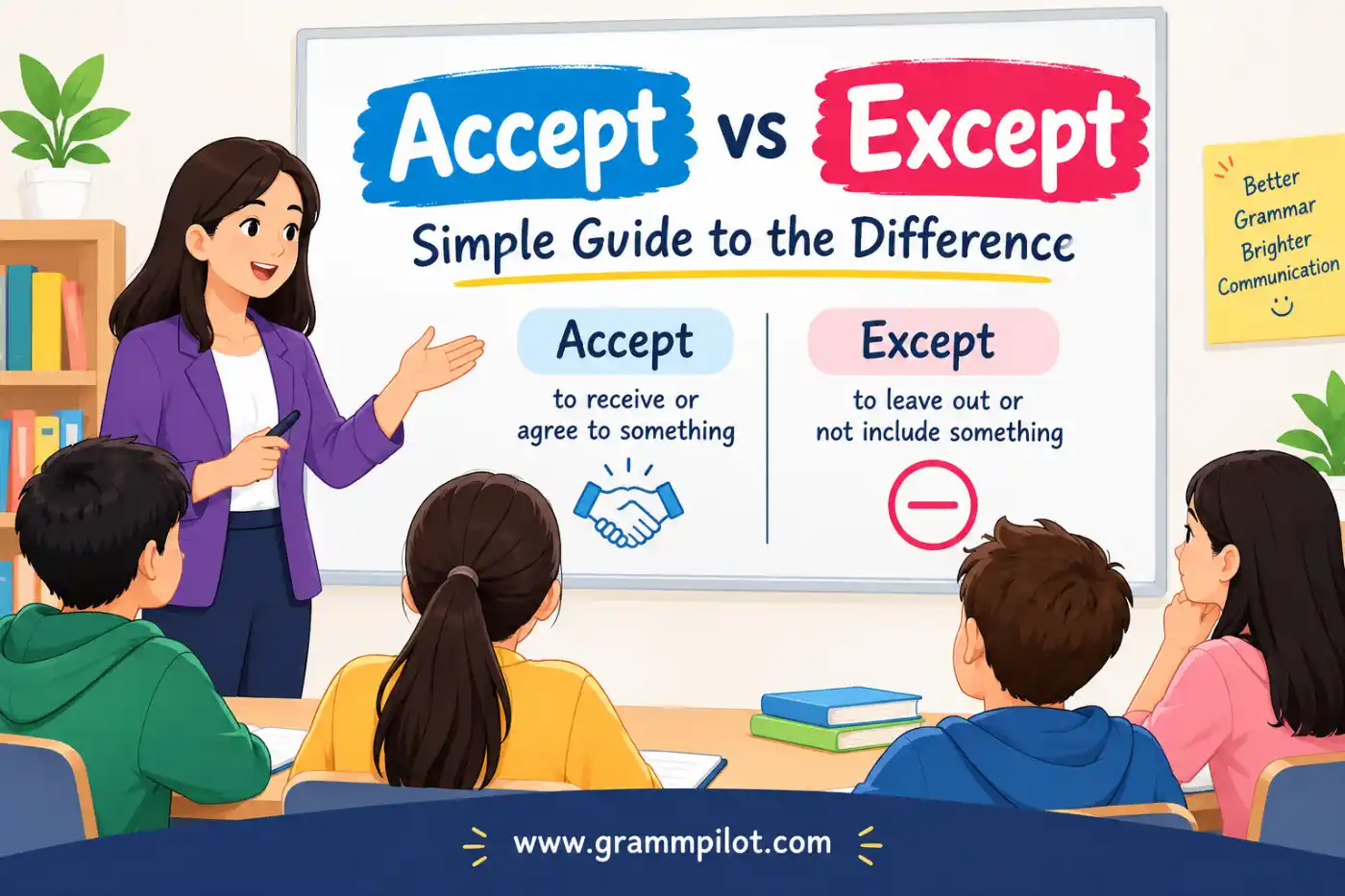
You’re writing an email, checking an essay, updating a resume, or sending a quick text when you pause at a sentence: “I can ___ the offer” or “Everyone came ___ Ali.” The words look almost identical, yet choosing the wrong one can completely change the meaning. That is why Accept vs Except is one of the most confusing spelling pairs in English. The good news is that the difference is clear once you understand what each word does. Accept usually means to receive, agree to, approve, or say yes to something. Except usually means excluding someone or something from a group.
Quick Answer: Accept means to receive, agree, or say yes. Except means excluding or leaving something out.
One useful memory trick can help too: accept is connected with agreeing or allowing, while except points to something being left out. This guide explains the word origins, meanings, synonyms, grammar, real examples, common mistakes, context-based choices, and easy ways to remember the difference.
Looking for more ways to make your writing expressive? Read [Cloud Similes].
What Does Accept Mean?
Accept is most often a verb. It means to willingly receive something, agree to something, approve something, or recognize something as true.
Here are some common meanings.
When receiving something
- I accepted the package.
- She accepted the gift.
- The store accepts credit cards.
To agree to something
- He accepted the job offer.
- They accepted our invitation.
- We accepted the terms.
To believe or recognize something
- She accepted the truth.
- He accepted that he had made a mistake.
- The team accepted the results.
The basic idea is that something is being taken in, agreed to, or allowed.
What Does Except Mean?
Except usually means excluding or not including.
Examples:
- Everyone passed except Tom.
- I like all fruits except bananas.
- The office is open every day except Sunday.
- Nobody knew except the manager.
The basic idea is:
Everything is included, but one thing is left out.
For example:
“All students except Emma completed the test.”
This means every student completed it, but Emma did not.
What Is the Origin of Accept?
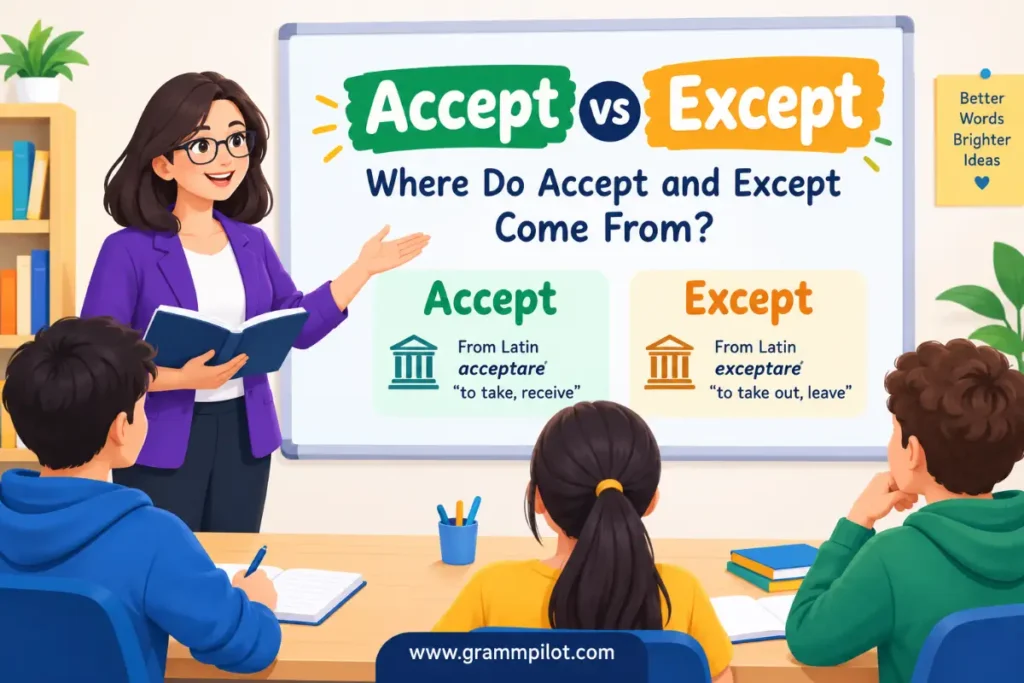
Accept comes from the Latin word accipere, which carried the idea of receiving or taking something.
Over time, English developed several related meanings:
- receive something
- agree to something
- approve something
- recognize something
- tolerate something
That is why accept can work in many different situations.
You can accept:
- a gift
- an invitation
- an offer
- an apology
- responsibility
- an idea
- a fact
- payment
The central meaning remains connected to receiving or agreeing.
What Is the Origin of Except?
Except comes from Latin roots connected to the idea of taking something out or leaving something aside.
That history still appears clearly in its modern meaning.
When you say:
“Everyone except David attended.”
You are mentally taking David out of the group.
That gives you a useful memory picture:
- Accept = bring in or take in
- Except = leave out
How Can You Remember Accept vs Except?
A simple trick is to focus on the first letters after the opening vowel sound.
Accept has “cc”
Think of accept as:
A = Agree
This is not a formal grammar rule, but it can help you remember the main idea.
- Accept an offer
- Accept an apology
- Accept a gift
Except has “x”
Think of the x as marking something out.
Except = exclude
Examples:
- Everyone except me
- Every day except Friday
- Nothing except water
Another memory sentence is:
Accept means agree. Except means exclude.
That short sentence is often enough to stop the confusion.
Accept vs Except: What Are the Best Synonyms for Accept?
The right synonym depends on what you mean. Accept can describe receiving, agreeing, approving, tolerating, or recognizing something.
Simple Synonyms
| Word | Meaning | Tone | Example |
|---|---|---|---|
| Take | Receive something | Simple | Take the gift. |
| Get | Receive | Casual | I got the offer. |
| Agree | Say yes | Everyday | I agree to the plan. |
| Allow | Permit something | Neutral | We allow pets. |
| Receive | Get something | Neutral | Receive the package. |
| Keep | Take and retain | Simple | Keep the change. |
| Welcome | Receive gladly | Positive | We welcome feedback. |
Everyday Synonyms
| Word | Meaning | Tone | Example |
|---|---|---|---|
| Say yes | Agree to something | Casual | She said yes to the offer. |
| Go with | Choose or agree with | Casual | I’ll go with your idea. |
| Take on | Accept responsibility | Casual | He took on the role. |
| Be okay with | Tolerate or agree | Casual | I’m okay with the change. |
| Give in to | Stop resisting | Informal | He gave in to the request. |
| Go along with | Agree or cooperate | Informal | She went along with the plan. |
| Welcome | Receive positively | Friendly | We welcome suggestions. |
Formal Synonyms
| Word | Meaning | Tone | Example |
|---|---|---|---|
| Approve | Officially agree | Formal | The board approved it. |
| Consent to | Agree formally | Formal | She consented to the terms. |
| Acknowledge | Recognize as true | Formal | He acknowledged the problem. |
| Admit | Accept as true | Neutral | She admitted the mistake. |
| Endorse | Publicly support | Formal | The group endorsed the policy. |
| Ratify | Officially approve | Formal | The council ratified the agreement. |
| Authorize | Give permission | Formal | The manager authorized payment. |
| Concur | Agree with | Formal | I concur with the decision. |
| Assent | Formally agree | Formal | The members assented. |
Informal or Slang-Like Alternatives
| Word | Meaning | Tone | Example |
|---|---|---|---|
| Buy it | Believe an idea | Informal | I don’t buy that excuse. |
| Go for it | Agree to try something | Casual | Go for it! |
| Take it | Receive or understand | Casual | I’ll take it. |
| Roll with it | Accept a situation | Informal | We’ll roll with it. |
| Be cool with | Be comfortable with | Informal | I’m cool with that. |
| Sign off on | Approve | Informal/Business | The manager signed off on it. |
These words are not perfect replacements in every sentence. Context matters.
Accept vs Except: What Are the Best Synonyms for Except?
Because except usually means “excluding,” its synonym list is different.
Simple Alternatives
| Word | Meaning | Tone | Example |
|---|---|---|---|
| Excluding | Leaving out | Neutral | Everyone excluding Sam came. |
| But | Except for | Everyday | Everyone but Sam came. |
| Other than | Not including | Neutral | Other than rain, the trip was great. |
| Aside from | Leaving out | Everyday | Aside from Monday, I’m free. |
| Leaving out | Not including | Simple | Leaving out Tom, everyone agreed. |
Everyday Alternatives
| Word | Meaning | Tone | Example |
|---|---|---|---|
| Apart from | Separate from | Neutral | Apart from that, we’re ready. |
| Other than | Not including | Natural | Other than coffee, I drink tea. |
| Besides | In addition or except for, depending on context | Everyday | Besides that issue, it’s fine. |
| Save | Except | Old-fashioned/Literary | Everyone save one person agreed. |
| But for | Except for | Formal/Fixed phrase | But for rain, we would’ve gone. |
Formal Alternatives
| Word | Meaning | Tone | Example |
|---|---|---|---|
| Excluding | Not including | Formal | Fees excluding tax apply. |
| With the exception of | Leaving out | Formal | All departments, with the exception of HR, closed. |
| Exempting | Freeing from inclusion | Formal | The rule applies, exempting minors. |
| Omitting | Leaving something out | Formal | The report was published, omitting names. |
| Exclusive of | Not including | Formal | The price is exclusive of tax. |
Accept vs Except: What Is the Best Synonym for Accept by Meaning?
The word accept changes slightly depending on the situation.
If You Mean “Receive”
Best choices include:
- receive
- take
- get
- collect
Example: “I accepted the package.”
Possible rewrite: “I received the package.”
If You Mean “Tolerate”
Best choices include:
- tolerate
- allow
- put up with
- endure
Example: “I won’t accept that behavior.”
Possible rewrite: “I won’t tolerate that behavior.”
Synonyms by Intensity: Mild to Strong
Synonyms can carry different levels of force.
Accepting an Idea or Proposal
| Intensity | Word | Meaning |
|---|---|---|
| Mild | Consider | Think about it |
| Mild | Allow | Permit it |
| Medium | Accept | Agree to take it |
| Medium | Approve | Officially agree |
| Strong | Endorse | Publicly support |
| Strong | Ratify | Formally make it official= |
Excluding Something
| Strength | Expression | Meaning |
|---|---|---|
| Mild | Other than | Not including |
| Neutral | Except | Leaving out |
| Clear | Excluding | Specifically not including |
| Strong/Formal | With the exception of | Clearly identifies an exclusion |
| Official | Exempting | Removes something from a rule |
Accept by Part of Speech and Related Forms
The main forms of accept include:
| Form | Word | Example |
|---|---|---|
| Verb | accept | I accept the offer. |
| Past tense | accepted | She accepted the job. |
| Present participle | accepting | They are accepting applications. |
| Noun | acceptance | His acceptance was immediate. |
| Adjective | acceptable | This solution is acceptable. |
| Noun | acceptability | We tested the product’s acceptability. |
Common word combinations
- accept an offer
- accept an apology
- accept responsibility
- accept payment
- accept criticism
- accept defeat
- accept the truth
- accept a challenge
Except by Part of Speech and Related Forms
Except is most often a preposition, but related forms include:
| Form | Word | Example |
|---|---|---|
| Preposition | except | Everyone except Ali came. |
| Conjunction | except | I’d go, except I’m busy. |
| Verb | except | The rule excepts certain cases. |
| Noun | exception | There is one exception. |
| Adjective | exceptional | She did exceptional work. |
| Adjective | excepted | The excepted items are listed below. |
Common expressions
- except for
- with the exception of
- no exceptions
- make an exception
- take exception to
- except when
- except that
Accept vs Except: Which Word Should You Use in an Email?
Emails often contain both words.
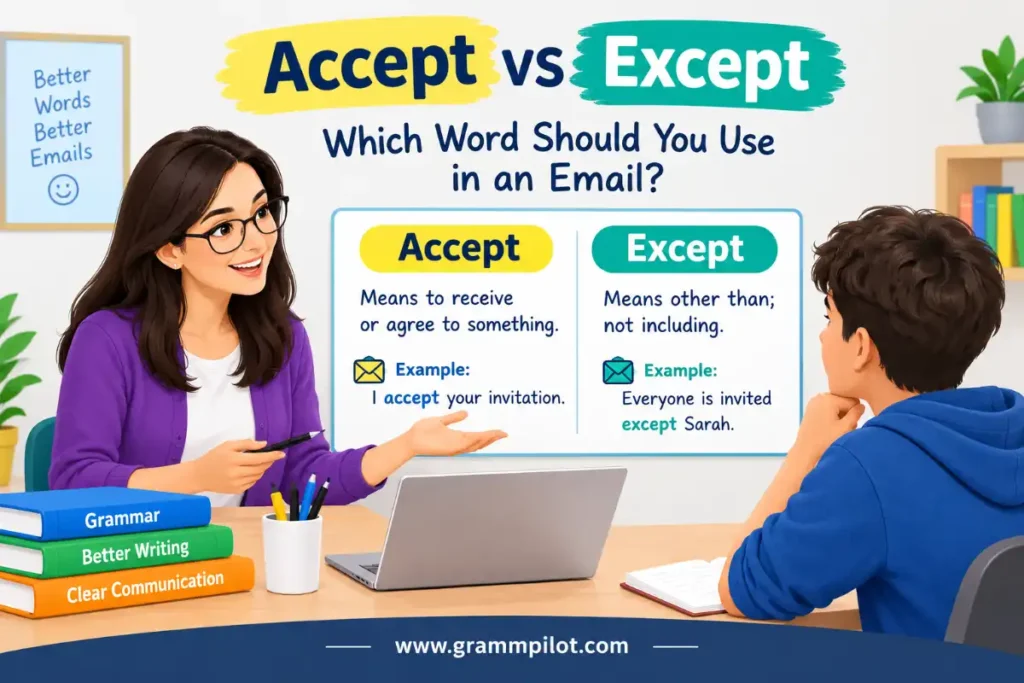
Use Accept When You Mean Agree or Receive
Examples:
- I accept your invitation.
- We accept the revised terms.
- Thank you. I accept the position.
Use Except When You Mean Excluding
Examples:
- The team is available every day except Friday.
- Everyone replied except one client.
- The office accepts payments except cash.
Be especially careful with professional emails. One incorrect letter can change the message.
Incorrect: “I except your offer.”
Correct: “I accept your offer.”
Which Word Is Best for a Resume?
Resumes usually avoid conversational sentences, but the words can still appear.
Use Accept
Example: “Accepted increased responsibilities during a period of company growth.”
This shows that the person took on responsibilities.
You may also write: “Accepted a leadership role.”
Use Except
Except is less common on a resume because resumes usually focus on achievements rather than exclusions.
If necessary: “Managed all project tasks except payroll.”
However, a clearer rewrite may be better:
“Managed project tasks, while payroll was handled by the finance team.”
Accept vs Except: Which Word Should You Use in an Essay?
Academic writing often uses both words.
Accept in an Essay
Use it when discussing agreement, evidence, ideas, or facts.
Example: “Most researchers accept that further study is needed.”
Except in an Essay
Use it when identifying an exclusion.
Example:
“All participants completed the survey except two.”
A formal alternative is:
“All participants completed the survey, with the exception of two.”
That version is longer, so use it only when the tone requires it.
Which Word Is Best for Texting?
Texting usually favors simple, direct English.
Accept
- I accept your apology.
- Okay, I’ll accept the offer.
- I can accept that.
Except
- Everyone’s coming except Mia.
- I’m free every day except Tuesday.
- I like everything except olives.
The short rule still works:
Accept = say yes or receive.
Except = leave out.
Which Word Sounds Best When Speaking?
In speech, the words sound different, so they are usually easier to understand than your/you’re or there/their/they’re.
Accept
Usually pronounced with a soft s sound near the middle:
ak-SEPT
Except
Usually begins with an ex sound:
ik-SEPT
Even so, speakers can confuse them because they look similar and often appear in similar types of sentences.
How Do You Use Accept in Real Sentences?
Here are original examples from everyday situations.
- I gladly accepted the invitation to dinner.
- The company accepted my application.
- She accepted the award with a smile.
- We accepted the new deadline.
- He finally accepted that the plan had failed.
- The store accepts cash and credit cards.
- I can’t accept being treated unfairly.
- They accepted responsibility for the mistake.
- The university accepted her into the program.
- My friend accepted my apology.
- The manager accepted the revised report.
- She learned to accept things she couldn’t control.
- We accepted the challenge and started the project.
- The museum accepts donations.
- He accepted the job after thinking about it for two days.
Each sentence involves receiving, agreeing, recognizing, or allowing.
Accept vs Except: How Do You Use Except in Real Sentences?
Here are more examples.
- Everyone arrived except Daniel.
- I enjoy most vegetables except peas.
- The library is open every day except Sunday.
- Nothing changed except the ending.
- All rooms except one were full.
- I have no complaints except the long wait.
- The children were ready except the youngest one.
- Everyone agreed except two members.
- The restaurant serves everything except breakfast after 11 a.m.
- Except for the rain, the trip was perfect.
- Nobody knew about the surprise except my sister.
- The rule applies to everyone except new employees.
- I can work any day except Friday.
- Everything was finished except the final report.
- The store was empty except for one customer.
Each sentence removes someone or something from a larger group.
Accept vs Receive: What’s the Difference?
These words are related but not identical.
| Accept | Receive |
|---|---|
| Often suggests willingness or agreement | Simply means getting something |
| Can be emotional or official | Often more neutral |
| Can mean agree to an offer | Can mean physically get an offer |
| “I accepted the gift.” | “I received the gift.” |
Consider:
“I received the invitation.”
This means the invitation arrived.
“I accepted the invitation.”
This means you agreed to attend.
That is a major difference.
You can receive something without accepting it.
Example: “I received the offer, but I didn’t accept it.”
Accept vs Approve: What’s the Difference?
These words are close, especially in formal situations.
| Accept | Approve |
|---|---|
| Agree to receive or allow | Officially agree or give permission |
| Can be personal | Often used by authorities or groups |
| “I accepted the offer.” | “The board approved the offer.” |
A person may accept a job offer. A manager may approve a request. The meanings overlap, but the roles are different.
Accept vs Agree: What’s the Difference?
Agree usually means sharing an opinion or consenting to something. Accept often means agreeing to receive, recognize, or allow something.
Compare:
“I agree with you.”
You share the person’s opinion.
“I accept your suggestion.”
You agree to use or consider the suggestion.
You normally say:
- agree with someone
- agree to something
- accept something directly
Examples:
“I agree with the teacher.”
“I agree to the terms.”
Except vs Excluding: What’s the Difference?
These words often communicate the same basic idea.
Except is usually shorter and more natural in everyday English.
“Everyone except Ali came.”
Excluding can sound more formal or technical.
“The price is $100, excluding tax.”
In simple conversation, except is usually the easier choice.
Except vs Besides: What’s the Difference?
This pair can be tricky because besides may mean either “in addition to” or, in some contexts, “other than.”
Compare:
“Besides Sara, Tom came too.”
This means Sara came, and Tom also came.
“Everyone came except Sara.”
This means Sara did not come.
Because besides can suggest addition, it is not always a safe replacement for except. Use except when you clearly mean exclusion.
Except vs Apart From: What’s the Difference?
Apart from can sometimes mean “except for,” but it can also mean “in addition to.”
Example: “Apart from David, everyone agreed.”
This usually means David did not agree.
Accept vs Except: What Are the Most Common Mistakes?
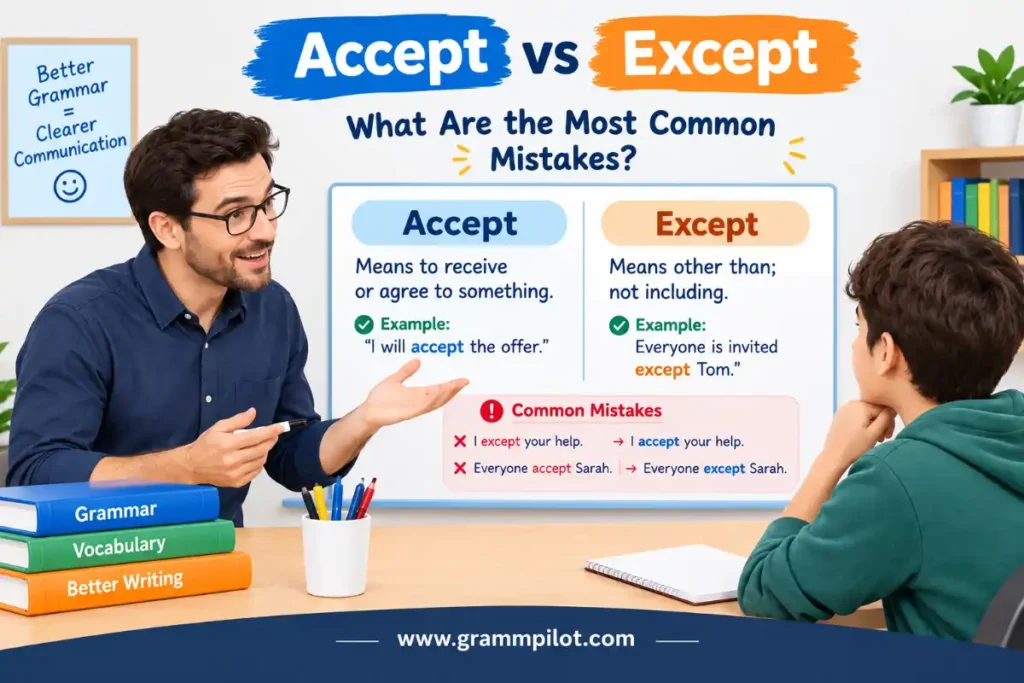
Mistake 1: Writing “except” when you mean agree
Incorrect: “I except your apology.”
Correct: “I accept your apology.”
You are receiving or agreeing to the apology.
Mistake 2: Writing “accept” when you mean leave out
Incorrect: “Everyone accept John came.”
Correct: “Everyone except John came.”
John is being excluded.
Mistake 3: Using Except When You Mean “Acceptable”
Incorrect: “This behavior is exceptable.”
Correct: “This behavior is acceptable.”
Acceptable comes from accept.
Mistake 4: Confusing “Except” With “Expectation”
These words have completely different meanings.
- except = excluding
- expect = believe something will happen
- expectation = something you believe or hope will happen
Example: “I expect everyone except John to attend.”
This sentence contains both ideas.
Mistake 5: Using “Except” Without a Clear Group
The word usually works best when there is something from which an item is excluded.
Clear: “Everyone except Mia agreed.”
Less clear: “Except Mia.”
In casual conversation, a short answer may work, but complete writing usually needs more context.
When Should You Not Use Accept?
Don’t use accept when you mean to leave something out.
Incorrect: “I like every color accept yellow.”
Correct: “I like every color except yellow.”
Also, don’t use accept when you mean merely to receive something without showing agreement.
Compare:
“I received the letter.”
“I accepted the letter.”
The first means it arrived. The second may suggest you willingly took it.
When Should You Not Use Except?
Don’t use except when you mean to agree, receive, or tolerate.
Incorrect: “She excepted the job offer.”
Correct: “She accepted the job offer.”
Also, be careful when you mean expect, which is another common spelling confusion.
Incorrect: “I except him to arrive soon.”
Correct: “I expect him to arrive soon.”
Are Accept and Except Used Differently in US and UK English?
The main meanings are the same in American and British English.
Both varieties use:
accept for receiving, agreeing, approving, or tolerating
except for excluding
Some differences may appear in style or formality, but the basic grammar does not change.
American English
Common examples:
- The store accepts credit cards.
- Everyone came except Mike.
British English
The same structures work:
- The shop accepts card payments.
- Everyone came except Mike.
The main differences come from vocabulary choices around the words, not from the words themselves.
What Is the Best Word for Formal Writing?
For formal writing, choose based on meaning.
Formal alternatives to Accept
- approve
- authorize
- acknowledge
- consent to
- ratify
- endorse
Example: “The committee approved the recommendation.”
Formal alternatives to Except
- excluding
- with the exception of
- exempting
- exclusive of
Example: “The policy applies to all employees, with the exception of temporary contractors.”
Don’t choose a longer phrase just because it sounds formal. Except is already clear and professional.
What Is the Best Word for Casual Writing?
Simple English is usually best.
Use:
- accept
- agree
- take
- okay with
For exclusion, use:
- except
- but
- other than
Examples:
“I accept your apology.”
“Everyone came except Jake.”
These are clear without sounding overly formal.
How Do You Choose the Right Word Quickly?
Ask yourself one question.
Is someone taking, receiving, agreeing, or allowing?
Use accept.
Examples:
- accept an offer
- accept a gift
- accept an apology
- accept responsibility
- accept payment
Is something being left out?
Use except.
Examples:
- everyone except Ali
- every day except Sunday
- everything except coffee
- no one except me
This quick decision works in most situations.
A Fast Accept vs Except Test
Try filling in the blank.
- I gladly ________ your invitation.
- Everyone ________ Adam was ready.
- The company will ________ applications until Friday.
- I eat every fruit ________ grapefruit.
- She refused to ________ the offer.
- The park is open every day ________ Monday.
- We ________ credit cards.
- Nobody knew ________ my brother.
- He learned to ________ the truth.
- All students ________ two completed the task.
Answers
- accept
- except
- accept
- except
- accept
- except
- accept
- except
- accept
- except
What Are the Main Antonyms of Accept?
The best antonym depends on the meaning.
When Accept Means Agree
- reject
- refuse
- decline
- deny
Example:
“She accepted the offer.”
“She declined the offer.”
When Accept Means Tolerate
- resist
- oppose
- reject
- refuse
Example:
“I won’t accept unfair treatment.”
“I will oppose unfair treatment.”
When Accept Means Receive
- refuse
- reject
- return
Example:
“He accepted the package.”
“He refused the package.”
What Are the Antonyms of Except?
Because except means excluding, its opposites depend on sentence structure.
Possible contrasts include:
- include
- including
- all
- without exclusion
Example: “Everyone except Sam attended.”
Opposite idea: “Everyone, including Sam, attended.”
The direct opposite concept is usually include.
Quick Tips for Choosing the Right Word
Here are the easiest rules to remember.
Tip 1: Think “yes” for accept
If the sentence involves saying yes, agreeing, receiving, or allowing, choose accept.
“I accept the invitation.”
Tip 2: Think “leave out” for except
If someone or something is not included, choose except.
“Everyone except John came.”
Tip 3: Use the A and X memory trick
- Accept = Agree
- Except = Exclude
Can Accept and Except Appear in the Same Sentence?
Yes, and seeing both together can make the difference very clear.
Examples:
- I accept all suggestions except personal attacks.
- The company accepts all applications except incomplete forms.
- She accepted everyone except one person.
- We accept most payment methods except checks.
- The teacher accepted every excuse except the one that was clearly false.
In each sentence:
Accept means receive, allow, or agree.
Except identifies what is excluded.
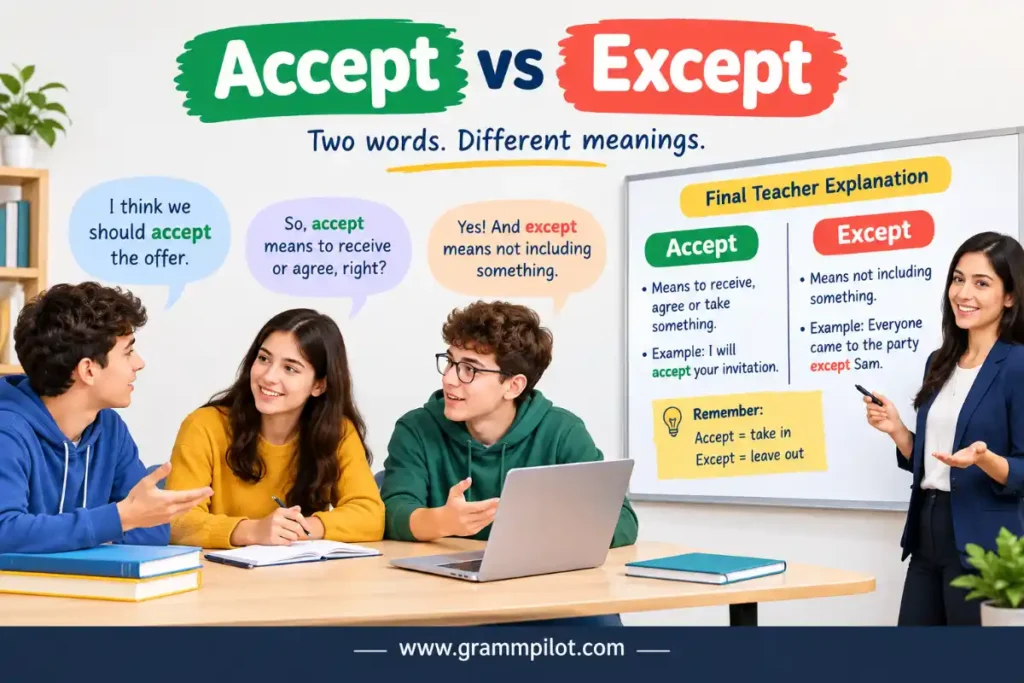
Final Teacher Explanation
Think of these two words as opposites in direction. Accept often moves something inward. You receive it, agree to it, recognize it, or allow it. Except moves something outward. You remove it from a group or leave it out.
For example: “The company accepted the proposal.”
The proposal was taken in and approved.
“The company considered every proposal except one.”
One proposal was left out.
That mental picture is simple but useful. When writing, pause and ask:
Am I taking something in?
Use accept.
Am I leaving something out?
Use except.
Once you connect each word with its main action, the spelling difference becomes much easier to remember.
Conclusion
Understanding Accept vs Except comes down to recognizing two very different ideas. Accept is about receiving, agreeing, approving, recognizing, or allowing something. Except is about exclusion—someone or something is left out of a group, rule, or situation.
A quick memory trick can help: accept means agree or receive, while except means exclude. Look at the meaning of the sentence before choosing the spelling. If something is being welcomed or agreed to, use accept. If something is being left out, use except. With a little practice, this pair becomes much easier to handle in emails, essays, schoolwork, professional writing, and everyday messages.
Frequently Asked Questions
1. What is the simple difference between accept and except?
Accept vs Except is easy to remember once you know the meanings: accept means receive or agree, while except means exclude or leave out.
2. Is it “everyone accept John” or “everyone except John”?
The correct phrase is “everyone except John” because John is being excluded from the group.
3. How do I remember accept vs except?
Remember: accept = agree, while except = exclude. The “x” in except can remind you of crossing something out.
4. What’s another way to say accept?
Depending on the context, you can say receive, agree to, approve, acknowledge, consent to, or welcome.
5. What’s another way to say except?
Common alternatives include excluding, other than, apart from, aside from, and with the exception of.
6. Can accept and except be used in the same sentence?
Yes. For example: “We accept all forms of payment except personal checks.” The first word means allow, while the second means excluding.