
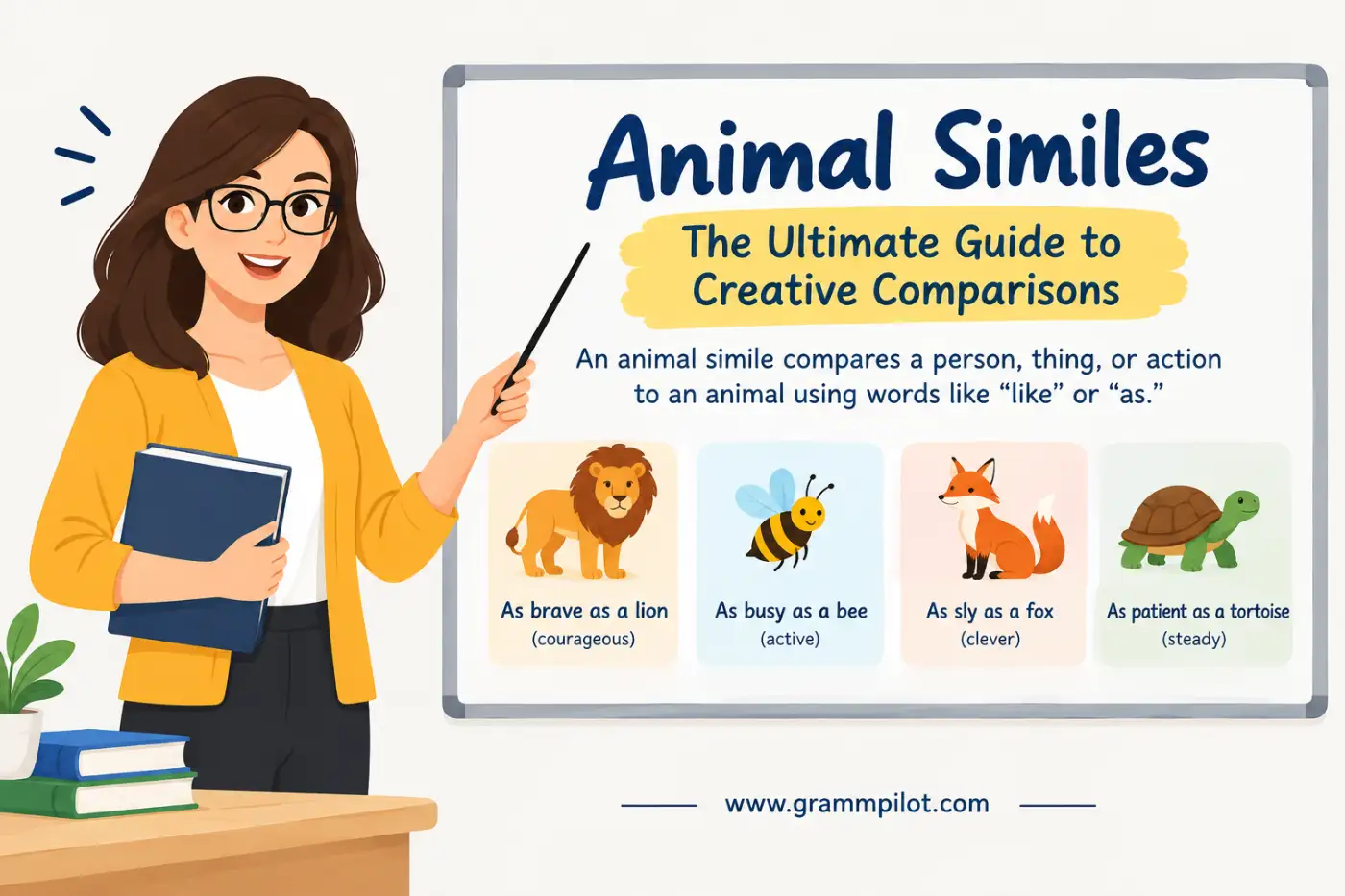
Imagine you’re writing a school essay about a brave firefighter, a quiet child, or a friend who runs faster than everyone else. You want your words to create a clear picture in the reader’s mind. Instead of saying, “The firefighter was brave,” you could write, “The firefighter was as brave as a lion.” That small change makes your sentence more vivid. Animal Similes help writers describe people, animals, feelings, and actions by comparing them to familiar creatures. A lion can suggest courage, a fox can suggest cleverness, and a rabbit can suggest speed. These comparisons make ordinary sentences more interesting and easier to remember.
Writers use animal comparisons in stories, poems, classroom assignments, everyday conversations, and even text messages. However, the best comparison depends on the meaning you want to express. A fox may represent cleverness, but calling someone a fox can suggest different things depending on the situation. An animal simile is a figure of speech that compares a person, thing, feeling, or action to an animal, usually with the words “like” or “as.” For example, “She was as gentle as a lamb” compares someone’s gentle nature to a lamb.
If you’re working on choosing the right word, explore Scrap or Scrape.
What Are Animal Similes, and How Do They Work?
An animal simile compares something with an animal to make a description clearer, stronger, or more imaginative. It connects a quality people recognize in an animal with a quality found in a person, object, or situation.
Consider these two sentences:
- Plain: The boy was very fast.
- More vivid: The boy ran like a cheetah.
The second sentence gives readers a stronger sense of speed because cheetahs are widely known for running quickly.
A simile does not mean that the person literally becomes an animal. It creates a mental picture by connecting two different things.
What words usually appear in an animal comparison?
Most traditional similes use like or as.
Examples:
- She swims like a fish.
- He is as stubborn as a mule.
- The children scattered like startled rabbits.
- The guard watched the entrance like a hawk.
- My little brother was as playful as a puppy.
Some expressions are established comparisons in English, such as “busy as a bee” and “quiet as a mouse.” Others are original descriptions that writers create for a particular scene.
The most effective comparisons have a clear purpose. They should help the reader understand a quality, imagine an action, or feel the mood of a scene.
Where Did Animal Similes Come From?
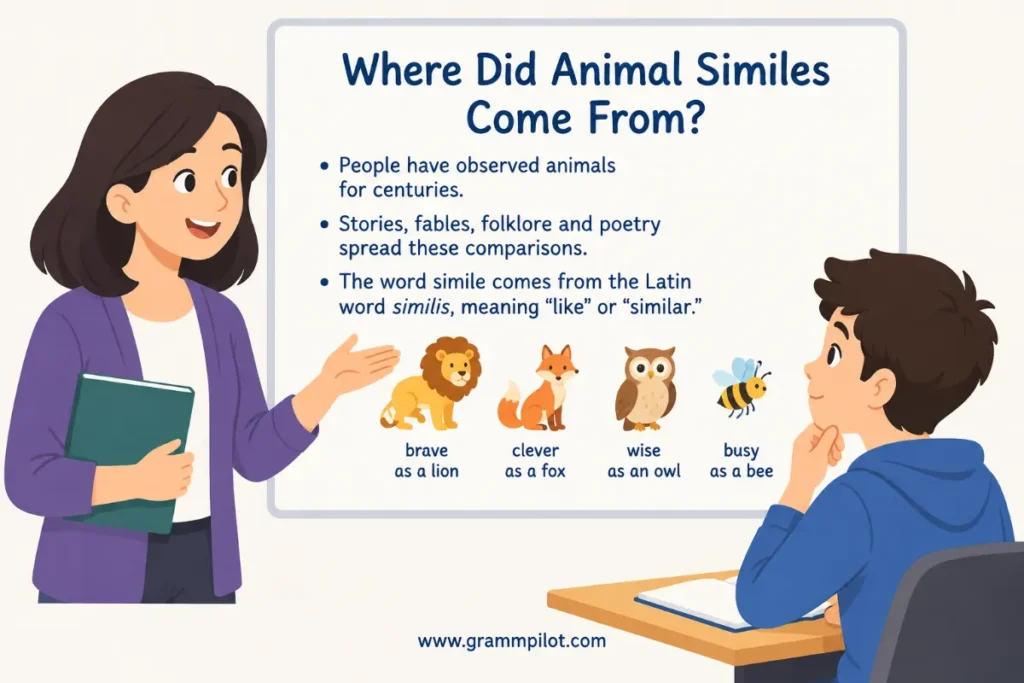
Animal comparisons have existed in human speech for centuries. People have long watched animals and used their behavior to explain human qualities. A lion’s strength, a fox’s cleverness, a dog’s loyalty, and a bee’s activity became familiar ideas in many English expressions. Stories, fables, folklore, poetry, and everyday conversations helped these associations spread. The word simile comes from the Latin word similis, meaning “like” or “similar.” The term describes a comparison between different things that share a particular quality.
Animal comparisons are also common in traditional fables. In these stories, animals often act like people and represent recognizable human traits. A fox may outsmart another character, while a tortoise may succeed through patience rather than speed. However, animal meanings are not universal. Different cultures may connect the same creature with different qualities. Even within English-speaking communities, an animal can have positive or negative associations depending on the context. For example, comparing someone to a lamb often suggests gentleness. Comparing someone to a wolf might suggest danger, independence, or loyalty, depending on the sentence. Understanding these associations helps you choose comparisons that communicate your intended meaning.
What Are the Best Animal Similes for Different Qualities?
The following examples are useful for essays, stories, poems, speeches, and everyday conversations. Each one identifies the quality being described and explains why the comparison works.
| Animal simile | Meaning | Example sentence |
|---|---|---|
| As brave as a lion | Very courageous | The firefighter was as brave as a lion. |
| As busy as a bee | Always active | Mom was as busy as a bee before the party. |
| As strong as an ox | Very strong | The farmer was as strong as an ox. |
| As blind as a bat | Unable to see clearly | Without her glasses, she felt as blind as a bat. |
| As graceful as a swan | Moving elegantly | The dancer was as graceful as a swan. |
| As fierce as a tiger | Very powerful or aggressive | The team played as fiercely as tigers. |
| As wise as an owl | Showing wisdom | Grandpa was as wise as an owl. |
| As light as a feather | Extremely light | The kitten felt as light as a feather. |
| As loyal as a dog | Faithful and dependable | His friend was as loyal as a dog. |
| As nervous as a rabbit | Easily frightened or anxious | I felt as nervous as a rabbit before the interview. |
| As busy as an ant | Constantly working | The volunteers were as busy as ants. |
| As playful as a dolphin | Energetic and cheerful | The children were as playful as dolphins at the beach. |
| As patient as a tortoise | Willing to wait and continue steadily | He was as patient as a tortoise while learning piano. |
Some of these are familiar expressions, while others are creative comparisons. Writers can adapt them to fit the setting, character, and intended meaning. One important point: an expression can be imaginative without being a traditional saying. You do not need to memorize every example. Learning how the comparisons work will help you create your own.
How Can You Group Animal Similes by Meaning?
Grouping comparisons by the quality they describe makes them easier to remember and use. Instead of learning a long list, start with the idea you want to communicate.
What comparisons describe courage and strength?
Use a lion, ox, tiger, or bulldog when you want to suggest courage, physical strength, or determination.
- As brave as a lion: The young soldier was as brave as a lion.
- As strong as an ox: The workers were as strong as oxen.
- As fierce as a tiger: The captain was as fierce as a tiger during the match.
- As determined as a bulldog: She was as determined as a bulldog when solving the problem.
Choose the comparison carefully. Physical strength and emotional courage are different qualities, even when the same animal can suggest both.
Which animal comparisons describe intelligence?
Foxes and owls often represent different kinds of intelligence.
- As sly as a fox: The clever thief found a way past the guards.
- As wise as an owl: My teacher gave us thoughtful advice.
- As sharp as a hawk: The detective noticed a tiny clue.
A fox often suggests cleverness used to gain an advantage. An owl usually suggests wisdom and good judgment. These meanings overlap, but they are not identical.
What comparisons describe speed and movement?
Cheetahs, rabbits, and horses can help describe fast movement. Snails and tortoises can suggest slow, steady progress.
- He ran like a cheetah toward the finish line.
- The child hopped around like a rabbit.
- The old truck moved as slowly as a snail.
- She worked steadily like a tortoise and finished the project.
Use the animal that best fits the action. A rabbit works well for quick, energetic movement, while a tortoise is useful when you want to emphasize patience and persistence.
Which comparisons describe kindness and gentleness?
Lambs, doves, and puppies can help create a warm, friendly impression.
- As gentle as a lamb: The nurse spoke gently to the frightened child.
- As peaceful as a dove: The quiet garden felt peaceful.
- As affectionate as a puppy: The dog greeted its owner excitedly.
These descriptions work especially well in stories about family, friendship, care, and trust.
What comparisons describe noise and talking?
Use a mouse for quietness and a parrot for frequent talking.
- As quiet as a mouse: He entered the room without making a sound.
- As chatty as a parrot: My friend talked throughout the journey.
- As loud as a roaring lion: The crowd cheered when the team scored.
The last example is a creative comparison rather than a fixed expression. That is perfectly acceptable when the meaning is clear.
How Do Animal Comparisons Change from Mild to Strong?
Not every situation needs a dramatic comparison. A mild description may be suitable for a school assignment, while a stronger one may work better in an adventure story.
| Intensity | Comparison | Best use |
|---|---|---|
| Mild | As quiet as a mouse | A peaceful scene |
| Mild | As gentle as a lamb | A caring person |
| Mild | Like a curious kitten | A person exploring something |
| Moderate | As busy as a bee | A full schedule |
| Moderate | As quick as a rabbit | Fast movement |
| Moderate | As sly as a fox | Clever behavior |
| Strong | As brave as a lion | Courage under pressure |
| Strong | As fierce as a tiger | Powerful action |
| Strong | As strong as an ox | Great physical strength |
| Very strong | Like a charging bull | Uncontrolled force or determination |
| Very strong | Like a wolf defending its pack | Protective behavior |
Intensity depends on context, not just the animal. A lion can suggest courage in one sentence and aggression in another.
For instance, “She faced the challenge like a lion” praises courage. “He attacked the problem like a charging bull” may suggest impressive energy, but it can also imply that he acted without thinking.
Read the full sentence aloud. If the comparison feels too dramatic for the situation, choose a milder one.
Which Animal Comparisons Work Best in Different Writing Situations?
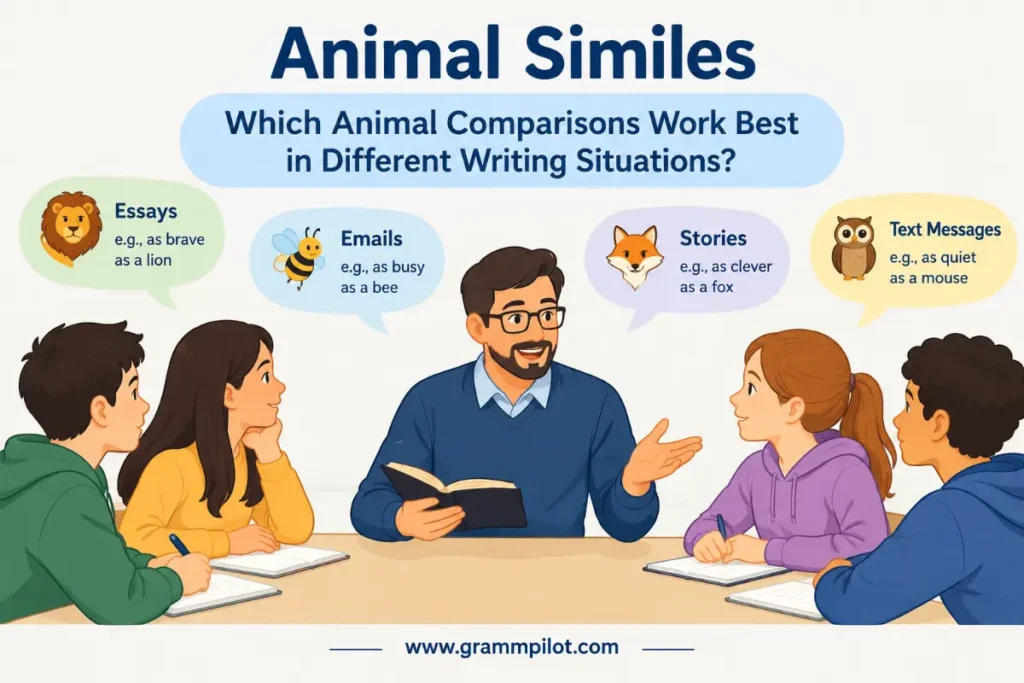
The right expression depends on your audience and purpose. A playful comparison may suit a text message but feel out of place in a formal report.
Which animal comparisons work best in an essay?
In school essays, choose comparisons that are clear, relevant, and easy to understand. Avoid using an animal comparison in every paragraph.
Examples:
- The athlete was as determined as a bulldog.
- The young leader was as brave as a lion.
- The children moved like excited puppies when the school bell rang.
An essay about a character can use these comparisons to reveal personality. An essay about wildlife, however, may need factual descriptions rather than figurative language.
Which comparisons are suitable for emails?
Professional emails should focus on clear communication. An animal comparison can add humor to an informal message, but it may sound unprofessional in a serious workplace discussion.
Informal example: “Our team has been as busy as bees getting ready for the event.”
More formal alternative: “Our team has been working hard to prepare for the event.”
Use the first sentence when writing to colleagues who appreciate a friendly tone. Use the second when writing a formal report or contacting someone you do not know well.
What animal comparisons work in text messages?
Text messages allow more playful language, especially between friends and family.
Examples:
- “I’m as hungry as a wolf right now!”
- “You’ve been as quiet as a mouse today.”
- “The kids are running around like puppies.”
These expressions work because the tone is casual. Be careful when describing another person as a fox, pig, snake, or wolf, since some animal labels can sound insulting.
Which comparisons are best for creative writing?
Stories and poems allow more freedom. You can use familiar expressions or invent new ones that fit your scene.
Examples:
- The frightened horse trembled like a leaf caught in a storm.
- Her thoughts darted like sparrows across a rooftop.
- The old dog followed him like a shadow.
- The children swarmed around the ice cream cart like hungry bees.
The last three examples are creative comparisons. They work because they connect a recognizable animal action with a specific scene.
How can you use animal comparisons while speaking?
In conversation, short familiar expressions are usually easiest to understand.
Examples:
- “He’s as stubborn as a mule.”
- “She’s as busy as a bee.”
- “That kid runs like a rabbit.”
Do not force a comparison into every conversation. A simple statement often sounds more natural, especially when you are speaking in a serious or sensitive situation.
What Are the Differences Between Similar Animal Comparisons?
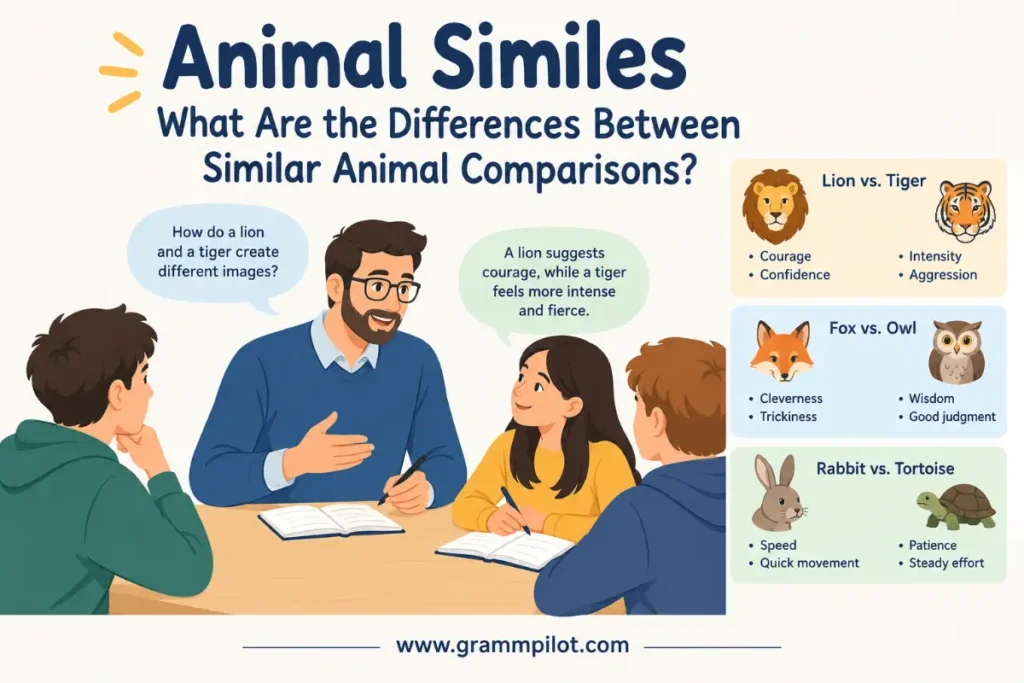
Some comparisons appear similar but communicate different ideas. Understanding their differences helps you choose words more precisely.
Lion vs. Tiger: What’s the Difference?
Both animals can suggest courage and power, but they often create different impressions.
| Comparison | Main idea | Example |
|---|---|---|
| As brave as a lion | Courage and confidence | She was as brave as a lion when she spoke up. |
| As fierce as a tiger | Intensity and aggression | The team played as fiercely as a tiger. |
Choose a lion when courage is the main quality. Choose a tiger when you want to emphasize intensity, aggression, or powerful action.
These associations are common in English, not strict rules. A writer can use either animal differently when the surrounding context supports the meaning.
Fox vs. Owl: Which One Suggests Intelligence?
| Comparison | Main idea | Example |
|---|---|---|
| As sly as a fox | Cleverness, often with a tricky side | The fox-like negotiator found a clever advantage. |
| As wise as an owl | Wisdom and sound judgment | Her grandmother was as wise as an owl. |
A fox is a useful image for someone who thinks quickly or finds a clever way around an obstacle. An owl is a better choice for someone who gives thoughtful advice.
Calling a person sly can sound critical. Calling someone wise is usually complimentary.
Rabbit vs. Tortoise: Speed or Patience?
| Comparison | Main idea | Example |
|---|---|---|
| As quick as a rabbit | Fast movement | He was as quick as a rabbit on the court. |
| As patient as a tortoise | Steady effort and patience | She practiced as patiently as a tortoise. |
These comparisons focus on different strengths. Speed helps someone react quickly; patience helps someone continue without rushing.
A tortoise can also represent slow progress, but slow does not always mean patient. Use a description that matches the behavior you want to show.
Dog vs. Wolf: How Do Their Meanings Differ?
Dogs often suggest loyalty, friendliness, and companionship. Wolves may suggest independence, danger, wildness, or loyalty to a group.
- As loyal as a dog: He supported his friend through difficult times.
- Like a wolf protecting its pack: She defended her family when they needed help.
The second example is a creative simile. The intended meaning comes from the details of the sentence, not simply from the animal’s name.
What Are Common Mistakes When Using Animal Comparisons?
Figurative language can improve writing, but a poorly chosen comparison can confuse readers or change the tone.
Mistake 1: Choosing an animal that does not fit the quality
Incorrect idea: “He was as slow as a cheetah.”
This comparison is confusing if you mean that someone moves slowly, because cheetahs are known for speed.
Better: “He moved as slowly as a snail.”
You can deliberately reverse an animal’s usual association for humor, but the sentence should make that intention clear.
Mistake 2: Mixing two comparisons in one sentence
Confusing example: “She was as brave as a lion and as sly as a fox when she moved like a fish through the argument.”
The sentence contains too many unrelated images. Readers may struggle to understand the main point.
Better: “She was as brave as a lion when she defended her friend.”
Choose one strong comparison unless several images serve a clear purpose.
Mistake 3: Treating every animal comparison as a compliment
Calling someone “as sly as a fox” may suggest intelligence, but it can also suggest dishonesty. Describing someone as “as stubborn as a mule” usually criticizes their unwillingness to change.
Think about the impression your words create before using them to describe a real person.
Mistake 4: Using too many similes
A paragraph filled with comparisons can feel exaggerated.
Overloaded example: “He ran like a rabbit, fought like a tiger, watched like a hawk, and shouted like a lion.”
Improved version: “He ran like a rabbit toward the finish line.”
Use a comparison when it adds something meaningful. Let the rest of the writing carry its own weight.
Mistake 5: Confusing similes with metaphors
A simile usually compares things using like or as.
- Simile: She is as busy as a bee.
- Metaphor: She is a busy bee.
Both examples use figurative language, but the second makes a more direct comparison.
When should you avoid animal comparisons?
Avoid them when they might offend someone, weaken a serious message, or make important information less clear.
For example, a formal performance review should describe specific behaviors rather than call an employee a mule. A medical instruction should use literal language instead of a creative comparison that could be misunderstood.
In sensitive conversations, direct and respectful wording is often the best choice.
What Are Some Original Animal Similes for Everyday Situations?
Original comparisons can make your writing sound personal rather than copied from a list. Try matching an animal’s recognizable behavior with the action or feeling you want to describe.
- The toddler followed his mother like a duckling following its mother across a pond.
- Her ideas fluttered like butterflies in a sunny garden.
- The puppy bounced around the yard like a ball with four legs.
- The tired hikers moved like turtles climbing a steep hill.
- The goalkeeper watched the ball like a hawk watching its prey.
- The excited students buzzed like bees before the school trip.
- His laugh burst out like a seal barking beside the water.
- The frightened kitten hid like a mouse beneath the sofa.
- The determined runner pushed forward like a horse climbing a hill.
- The curious child explored the garden like a fox searching for clues.
- The crowd moved like a flock of birds when the doors opened.
- Her fingers moved like quick little spiders across the keyboard.
- The old dog stayed beside his owner like a shadow on a sunny day.
- The children raced across the playground like wild ponies.
- The tiny bird sang like a performer on a grand stage.
These examples are creative rather than established sayings. You can use this same approach to develop descriptions for your own characters and situations.
What Are the Opposites of Common Animal Comparisons?
Animal comparisons do not always have exact antonyms. Instead, you can use words that express the opposite quality.
| Quality | Animal comparison | Opposite description |
|---|---|---|
| Courage | As brave as a lion | Fearful or timid |
| Speed | As quick as a rabbit | Slow as a snail |
| Activity | As busy as a bee | Idle or inactive |
| Gentleness | As gentle as a lamb | Harsh or aggressive |
| Wisdom | As wise as an owl | Foolish or unwise |
| Strength | As strong as an ox | Weak or frail |
| Quietness | As quiet as a mouse | Loud or noisy |
| Patience | As patient as a tortoise | Impatient or restless |
| Loyalty | As loyal as a dog | Disloyal or unfaithful |
| Cleverness | As sly as a fox | Naive or easily fooled |
These are contrasts in meaning, not fixed pairs of opposite expressions. Choose the word that fits the situation instead of trying to create an animal-based opposite for every simile.
How Can You Create Your Own Animal Similes?
You can create a useful comparison in three simple steps.
Step 1: Identify the quality. Decide what you want readers to notice: speed, courage, kindness, fear, excitement, or patience.
Step 2: Choose an animal with a recognizable association. A cheetah can suggest speed, a lamb can suggest gentleness, and an owl can suggest wisdom.
Step 3: Connect the animal to the situation. Use like or as to make the comparison clear.
For example:
- Quality: Excitement
- Animal: Puppy
- Sentence: “The children bounced around like excited puppies before the picnic.”
You can make the comparison more original by adding details. Instead of writing, “He was as fast as a rabbit,” try, “He darted like a rabbit through the narrow gap between the players.”
The second sentence describes a specific action. That detail makes the image easier to picture.
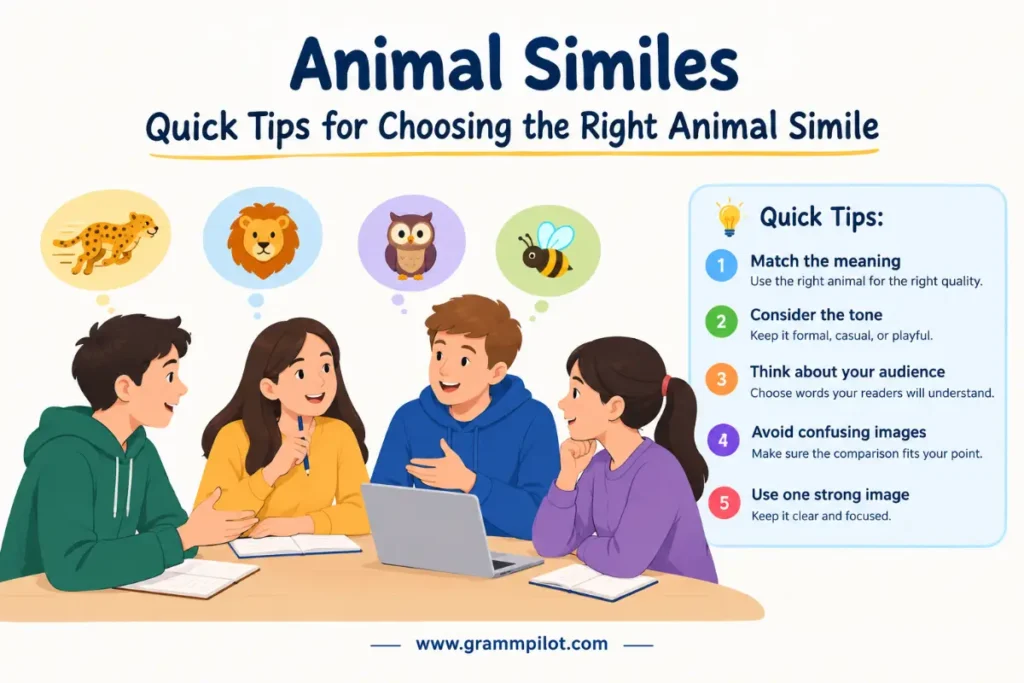
Quick Tips for Choosing the Right Animal Simile
- Match the meaning: Use a lion for courage, not ordinary quietness.
- Consider the tone: A playful puppy comparison suits a friendly story better than a formal complaint.
- Think about your audience: Familiar expressions are often best for younger readers and English learners.
- Avoid confusing images: Make sure the comparison supports the point you are making.
- Use one strong image: A clear simile is usually more effective than several competing comparisons.
- Check cultural meaning: An animal may have different associations in different communities.
- Prefer clarity over cleverness: Readers should understand the quality you are describing.
- Try an original comparison: Use a familiar animal behavior in a new setting.
- Read your sentence aloud: If it sounds unnatural, simplify it.
- Use literal language when needed: Instructions, reports, and sensitive messages often need precision more than creativity.
Conclusion
Animal Similes can turn plain descriptions into memorable images when you choose the right animal and connect it to a clear quality. A lion can represent courage, a bee can suggest constant activity, and a tortoise can remind readers of patience and steady progress. However, these comparisons are not interchangeable. The best choice depends on your sentence, audience, and purpose. When writing an essay, focus on comparisons that help explain a character or idea. In a text message, a playful expression may be enough. In formal communication, clear and direct wording may work better than figurative language. You can also create your own comparisons instead of relying only on familiar sayings. Start with one quality, choose an animal that represents it, and build a sentence around a specific action. With practice, your descriptions will become clearer, more creative, and easier for readers to remember.
Frequently Asked Questions
1. What are animal similes in simple English?
Animal Similes compare people, things, or actions to animals using words such as like or as. For example, “He runs like a cheetah” compares someone’s speed to a cheetah’s speed.
2. What are 10 common animal similes?
Ten common examples include as brave as a lion, as busy as a bee, as sly as a fox, as gentle as a lamb, as quiet as a mouse, as stubborn as a mule, as wise as an owl, as strong as an ox, as slow as a snail, and as proud as a peacock.
3. What’s another way to say someone is as brave as a lion?
You could say the person is courageous, fearless, bold, or as brave as a tiger. The best alternative depends on whether you want a simple description or a vivid comparison.
4. How do you write your own animal simile?
First, choose a quality such as speed, patience, or kindness. Then select an animal associated with that quality and connect the two with like or as.
5. What is the difference between an animal simile and a metaphor?
A simile usually compares two things using like or as, while a metaphor makes a direct comparison. “She is as busy as a bee” is a simile, while “She is a busy bee” is a metaphor.
6. Can animal similes be used in school essays?
Yes, animal comparisons can make essays more descriptive and interesting. Use them when they support your point, and avoid adding so many that they distract readers.
7. Are animal comparisons the same in American and British English?
Many familiar comparisons are understood in both American and British English, including “busy as a bee” and “quiet as a mouse.” However, some expressions and animal associations vary by region, culture, and context.