
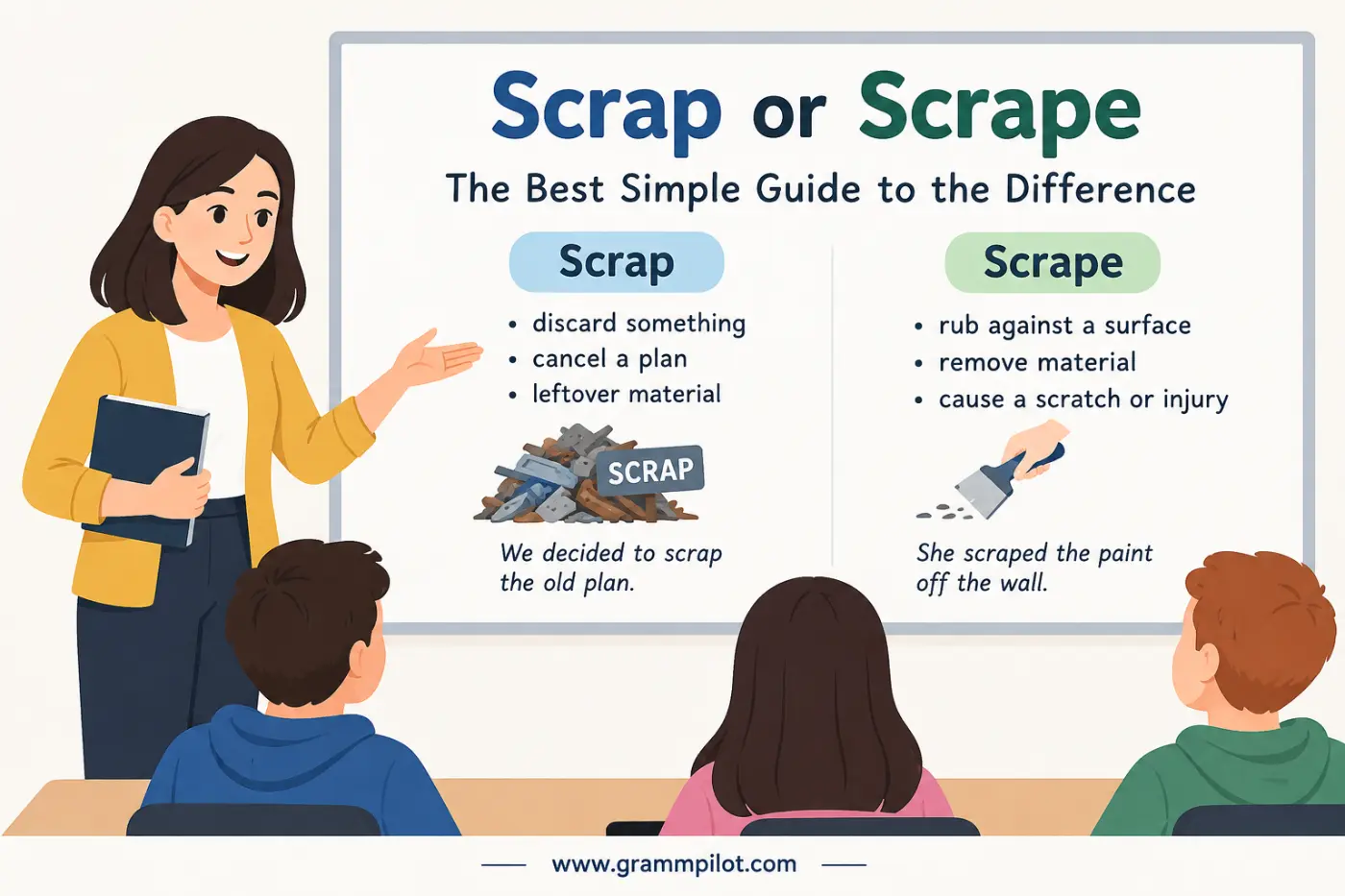
When writing an email, completing an essay, or describing a damaged car, you might pause and wonder about to use scrap or scrape. Both words look and sound similar, but they have different meanings. Choosing the wrong one can change what your sentence says. The easiest way to remember the difference is to connect each word with an action. Scrap usually means to throw something away, cancel a plan, or refer to discarded material. Scrape means to rub or drag something against a surface, often causing damage, or to remove something from a surface.
Answer box: Use scrap when you mean discard, cancel, or discarded material. Use scrape when you mean rub against a surface, scratch something, or remove material by dragging a tool across it.
These words appear in everyday conversations, workplace emails, school assignments, news reports, and informal messages. They can also function as different parts of speech, which makes their correct use worth learning. This guide explains their meanings, origins, synonyms, levels of intensity, common mistakes, and differences in real-life situations. You’ll also learn how to choose the right word for professional writing and casual conversation.
If you want to improve your sentence structure, take a look at Reset or Resetted.
What Is the Difference Between Scrap and Scrape?
The main difference is that scrap relates to discarding or canceling, while scrape relates to rubbing, scratching, or removing something from a surface.
| Word | Main meaning | Part of speech | Example |
|---|---|---|---|
| Scrap | Discard or abandon something | Verb | We decided to scrap the old design. |
| Scrap | Discarded material or leftover pieces | Noun | The mechanic collected the metal scrap. |
| Scrape | Rub against a surface or remove material | Verb | Don’t scrape the paint off the door. |
| Scrape | A shallow scratch or abrasion | Noun | He got a scrape on his knee. |
Notice how the words describe different actions.
If a company cancels a product launch, it scraps the launch. If a worker removes dried paint from a wall, the worker scrapes the paint away.
When should you use scrap?
Use scrap when talking about:
- Throwing away something that is no longer useful.
- Canceling a plan, project, or proposal.
- Discarded metal, paper, fabric, or other materials.
- A small fight or disagreement, especially in informal speech.
Examples:
- The school decided to scrap the outdated rule.
- We sold the scrap metal to a recycling center.
- The two players got into a brief scrap.
When should you use scrape?
Use scrape when talking about:
- Rubbing something against a hard or rough surface.
- Removing dirt, paint, or another substance with a tool.
- Causing a shallow injury.
- Collecting the last small amount of something.
Examples:
- I scraped ice off the windshield.
- The chair scraped against the floor.
- She scraped her elbow on the pavement.
- We scraped together enough money for the trip.
A useful shortcut is to ask if the action involves discarding something or rubbing against something. That question usually gives you the answer.
Where Did Scrap and Scrape Come From?
Understanding the history of these words can help you remember why their meanings differ.
What is the origin of scrap?
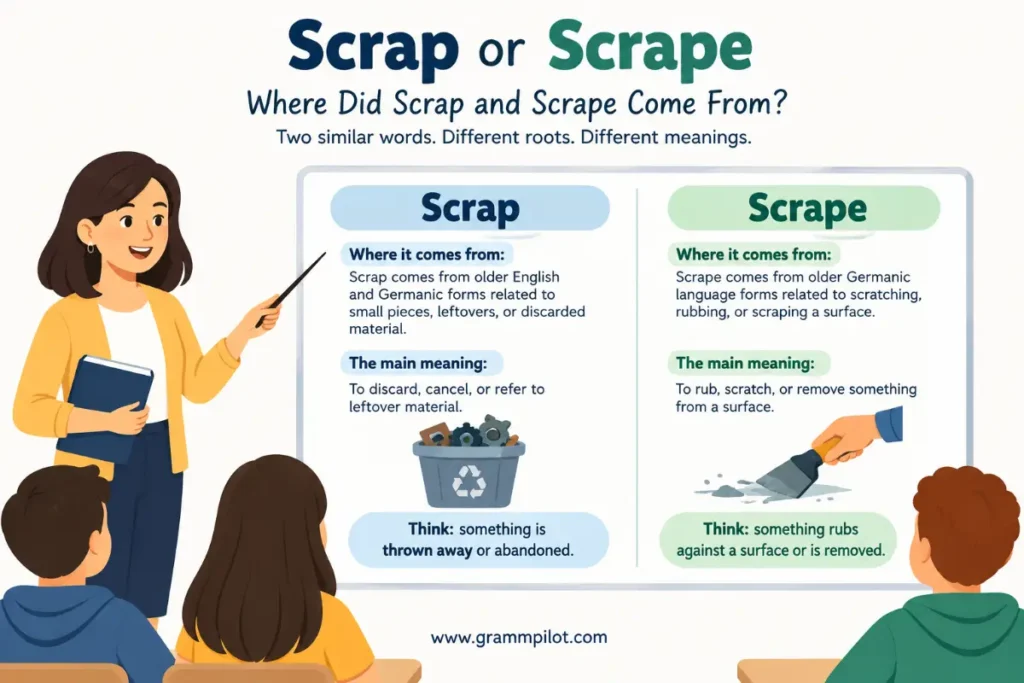
Scrap developed from older English and related Germanic forms associated with small pieces, fragments, or leftovers. Over time, it became a common word for discarded material and, as a verb, for getting rid of something.
Today, the word appears in recycling, manufacturing, business, and everyday conversation.
Examples:
- The factory sold its scrap steel.
- The manager scrapped the original proposal.
- We used scraps of fabric to repair the cushion.
The central idea is something unwanted, leftover, or abandoned.
What is the origin of scrape?
Scrape comes from older Germanic language forms associated with scratching, scraping, or rubbing a surface. Its modern meaning still focuses on physical contact and the removal of material.
Examples:
- He scraped mud off his boots.
- The blade scraped the surface of the wood.
- The child got a scrape while playing outside.
The central idea is friction: one thing moves against another, often leaving a mark or removing a substance.
How can their origins help you remember them?
Think of the main action behind each word.
- Scrap: Something is rejected, discarded, or abandoned.
- Scrape: Something rubs against a surface or removes material.
For instance, a carpenter might scrape paint from a wooden door and throw the removed pieces into the scrap bin. Both words fit the same situation, but they describe different actions.
What Are the Best Synonyms for Scrap and Scrape?
Synonyms can help you avoid repetition, but not every alternative fits every sentence. The best choice depends on the meaning, tone, and strength of the action.
The following tables group useful alternatives by how people commonly use them.
What simple words can replace scrap and scrape?
| Word | Meaning | Tone | Example |
|---|---|---|---|
| Drop | Stop pursuing something | Everyday | Let’s drop the idea. |
| Toss | Throw something away | Casual | Toss the broken piece. |
| Dump | Get rid of something | Informal | They dumped the old furniture. |
| Cancel | Stop a planned event | Neutral | We canceled the meeting. |
| Remove | Take something away | Neutral | Remove the damaged panel. |
| Rub | Move against a surface | Everyday | Rub the stain gently. |
| Scratch | Mark a surface | Everyday | Don’t scratch the table. |
| Drag | Pull across a surface | Neutral | Drag the box carefully. |
These words work well in everyday speech because their meanings are familiar. However, cancel is usually better for an appointment, while scratch is more precise for a surface mark.
What everyday synonyms are useful?
| Word | Meaning | Tone | Example |
|---|---|---|---|
| Discard | Throw something away | Neutral | Discard the damaged packaging. |
| Abandon | Stop supporting or pursuing something | Neutral | They abandoned the proposal. |
| Ditch | Get rid of something | Informal | We ditched the old plan. |
| Reject | Refuse to accept something | Neutral | The board rejected the proposal. |
| Eliminate | Remove something completely | Neutral | Eliminate the unnecessary step. |
| Wipe | Clean by rubbing | Everyday | Wipe the dust from the shelf. |
| Shave | Remove a thin layer | Neutral | Shave a little wood from the edge. |
| Abrade | Wear away through friction | Technical | The rough surface abraded the coating. |
Use abandon when a plan or effort is left behind, and reject when someone refuses to accept an idea. For physical surfaces, wipe suggests cleaning, while abrade describes wearing material away through friction.
What formal synonyms work in professional writing?
| Word | Meaning | Tone | Example |
|---|---|---|---|
| Terminate | Bring something to an end | Formal | The company terminated the agreement. |
| Discontinue | Stop providing or doing something | Formal | The manufacturer discontinued the product. |
| Withdraw | Remove or take back something submitted | Formal | The team withdrew its proposal. |
| Revoke | Officially take back permission or authority | Formal | The agency revoked the license. |
| Abolish | Officially end a system or practice | Formal | The council abolished the outdated policy. |
| Excise | Cut or remove something | Formal or technical | The editor excised the repeated paragraph. |
| Strip | Remove a layer or covering | Neutral | Workers stripped the old paint. |
| Extract | Remove something from a larger whole | Formal | The technician extracted the damaged component. |
These alternatives are not interchangeable in every context. A company may discontinue a product, withdraw a proposal, or revoke a license. Choosing the exact verb makes professional writing clearer.
What informal or slang words can replace them?
| Word | Meaning | Tone | Example |
|---|---|---|---|
| Bin | Throw something away | Informal, especially British English | Bin the broken packaging. |
| Chuck | Throw away | Casual | Chuck that empty box. |
| Ditch | Abandon or get rid of | Casual | Let’s ditch the first draft. |
| Scrap | Have a small fight | Informal | The two rivals had a scrap. |
| Scuff | Leave a surface mark through rubbing | Everyday | My shoes scuffed the floor. |
| Pick | Remove something in small pieces | Everyday | Pick the dried glue off. |
| Chip | Break away a small piece | Everyday | The tool chipped the edge. |
| Scour | Clean or rub vigorously | Neutral | Scour the pan to remove residue. |
Some of these alternatives describe related actions rather than exact synonyms. For example, scuff usually refers to a surface mark, while chip means breaking off a small piece.
Which Word Should You Choose Based on Intensity?
The right word can also depend on how strong or serious the action is. A light surface mark needs a different description from deep damage, just as dropping an idea differs from permanently ending a major program.
What words describe mild actions?
For minor changes or light contact, choose words that don’t suggest a major problem.
| Word | Best use | Example |
|---|---|---|
| Adjust | Make a small change | We adjusted the original design. |
| Revise | Improve or change something | She revised the first draft. |
| Rub | Apply light friction | Rub the mark with a soft cloth. |
| Scuff | Make a light surface mark | The bag scuffed the wall. |
If you’re making a small change to an essay, revise is usually more accurate than saying you discarded the entire essay.
What words describe moderate actions?
These verbs suggest a clearer change, removal, or interruption.
| Word | Best use | Example |
|---|---|---|
| Remove | Take something away | Remove the damaged section. |
| Reject | Refuse a suggestion | The team rejected the proposal. |
| Scratch | Leave a visible mark | The key scratched the car door. |
| Abandon | Stop pursuing something | They abandoned the original schedule. |
What words describe strong or complete actions?
Use stronger words when the action is final, forceful, or extensive.
| Word | Best use | Example |
|---|---|---|
| Cancel | Stop a planned event | They canceled the entire event. |
| Terminate | Bring an arrangement to an end | The firm terminated the contract. |
| Destroy | Damage something beyond use | The fire destroyed the equipment. |
| Strip | Remove a covering or layer | Workers stripped the paint completely. |
| Abrade | Wear material away through friction | Sandpaper abraded the surface. |
Intensity is not only about physical force. A word like terminate sounds formal and decisive, while ditch sounds casual. Match the word to both the action and the situation.
How Do Scrap and Scrape Work as Different Parts of Speech?
Both words can be nouns and verbs. Recognizing their grammatical role helps you use them correctly in sentences.
How do you use scrap as a noun?
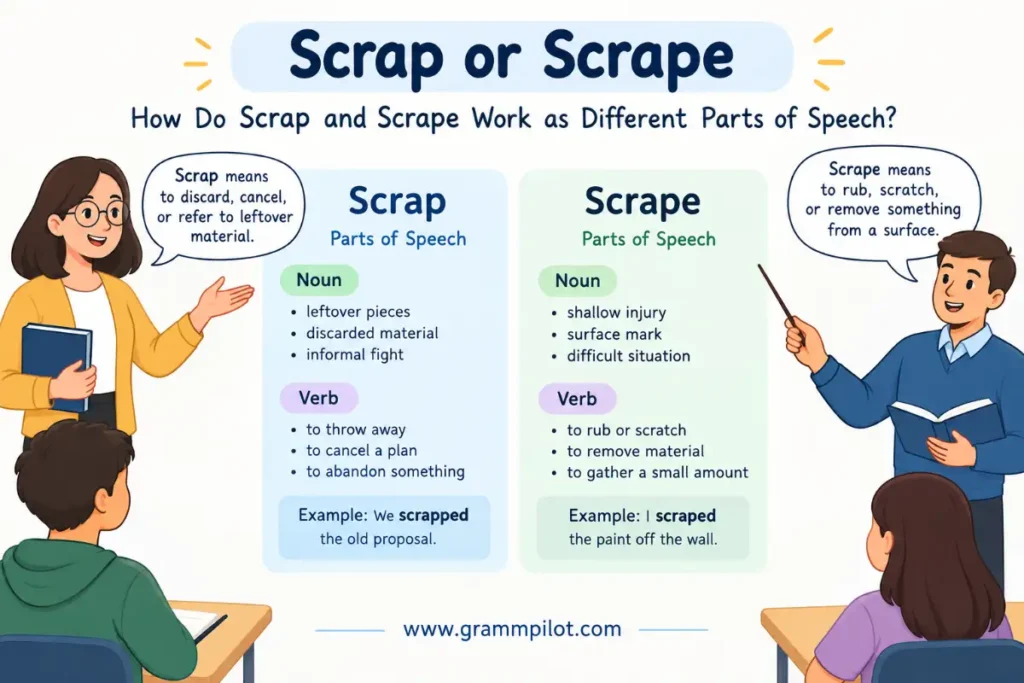
As a noun, scrap can mean a leftover piece of material, a small amount of food, or an informal fight.
Examples:
- The artist created a collage from paper scraps.
- There wasn’t a scrap of evidence to support the claim.
- The two boxers had a brief scrap outside the gym.
The plural scraps often refers to small pieces or leftovers.
How do you use scrap as a verb?
As a verb, scrap means to discard something or decide not to continue with it.
Examples:
- The company will scrap the outdated machine.
- We scrapped our travel plans because of the storm.
- The editor scrapped the paragraph that repeated an earlier point.
In these examples, the word doesn’t describe rubbing or scratching.
How do you use scrape as a noun?
As a noun, scrape can mean a shallow injury, a surface mark, or an awkward difficulty.
Examples:
- The fall left a scrape on his knee.
- There was a scrape on the side of the car.
- I got into a scrape after missing the deadline.
The expression in a scrape is informal and means being in a difficult or troublesome situation.
How do you use scrape as a verb?
As a verb, scrape describes rubbing, scratching, or removing something from a surface.
Examples:
- Scrape the remaining dough from the bowl.
- The shovel scraped along the concrete.
- She scraped mud off the bottom of her shoes.
It can also mean gathering just enough of something, often with effort.
Example: We scraped together enough money to replace the broken refrigerator.
Are Scrap and Scrape Different in American and British English?
The basic meanings are largely the same in American and British English. Both varieties use scrap for discarded material or abandoning a plan and scrape for rubbing or removing material from a surface.
The differences are mainly in related vocabulary and informal expressions.
| Situation | American English | British English |
|---|---|---|
| Throwing something away | Throw it away; toss it | Throw it away; bin it |
| Canceling a proposal | Scrap the proposal | Scrap the proposal |
| Removing dirt from a surface | Scrape off the dirt | Scrape off the dirt |
| Having a minor fight | Have a fight or scuffle | Have a scrap |
| Discarded material | Scrap metal | Scrap metal |
In British English, bin it is a common informal way to say “throw it away.” The noun scrap can also refer to a fight, especially in informal speech.
These regional differences don’t change the core spelling rule. Use scrap for discarding and scrape for rubbing or removing material.
Which Word Should You Use in a Resume?
In a resume, choose precise and professional verbs. Neither word is usually the best choice when you can describe your achievement more clearly.
Use scrap only when discussing a project that was discontinued or an outdated process that was eliminated. Use scrape only when the work involved physically removing or collecting material.
Better resume examples:
- Eliminated outdated procedures to improve workflow efficiency.
- Discontinued an underperforming service after reviewing customer feedback.
- Removed damaged materials during equipment maintenance.
- Collected and organized data from multiple sources.
Avoid vague statements such as “Scrapped old work methods.” A stronger version explains what changed and why.
Example: “Eliminated outdated reporting steps, reducing the time required to prepare weekly reports.”
Which Word Should You Use in an Essay?
In academic writing, choose words that express the action accurately. Both words are correct, but their meanings are quite different.
Use scrap when discussing the cancellation of a proposal, policy, theory, or plan.
Example: The committee decided to scrap the original proposal after reviewing the evidence.
Use scrape when describing a physical process or a surface mark.
Example: The researcher scraped the residue from the sample container for further testing.
In a formal essay, you may prefer alternatives such as discard, abandon, remove, or abrade, depending on the sentence.
Don’t replace every instance of a word with a synonym simply to sound academic. Accuracy matters more than variety.
Which Word Should You Use in Texting?
In casual messages, both spellings are common, but the intended meaning still matters.
Use scrap when you want to abandon an idea or cancel an arrangement.
- “Let’s scrap the plan and watch a movie instead.”
- “They scrapped the trip because the weather looks bad.”
Use scrape when something rubs against a surface or you need to remove something.
- “I scraped my knee when I fell.”
- “Can you scrape the ice off the window?”
If you’re texting about a small fight, scrap may also work in informal English.
Example: “Those two got into a scrap after the match.”
Which Word Should You Use in an Email?
Professional emails benefit from clear, direct language. If a project is being canceled, scrap may be appropriate, although cancel, discontinue, or withdraw can sound more precise.
Example:
“We’ve decided to scrap the original proposal and develop a simpler version.”
If you’re describing physical work, scrape is the correct choice.
Example:
“Please scrape the old adhesive from the surface before applying the new material.”
For sensitive workplace communication, consider about a more neutral alternative would sound better.
Instead of “We are scrapping your idea,” write:
“We’ve decided not to proceed with the current proposal.”
This wording communicates the decision without sounding unnecessarily harsh.
Which Word Should You Use When Speaking?
In conversation, the surrounding words usually make the intended meaning clear.
Use scrap when discussing plans, unwanted materials, or an informal fight.
Examples:
- “We should scrap that idea.”
- “The mechanic sold the scrap.”
- “They had a little scrap after the game.”
Use scrape when describing contact with a surface or removing something.
Examples:
- “I scraped the side of my car.”
- “Can you scrape the mud off your shoes?”
- “The chair legs scrape against the floor.”
If someone doesn’t understand what you mean, add a little context. Saying “I scraped it” is less clear than saying “I scraped the paint off the door.”
What Are 12 Real-Life Examples of Scrap and Scrape?
These examples show how the two words work in different situations.
1. At work: The director decided to scrap the proposal because it exceeded the budget.
2. At school: The teacher scrapped the first quiz format and replaced it with short-answer questions.
3. During home repairs: I scraped the loose paint off the window frame before repainting it.
4. After an accident: The cyclist had a small scrape on his arm but no serious injury.
5. In recycling: The factory separated usable metal from scrap.
6. While cooking: She scraped the last bit of sauce from the pan.
7. During travel planning: We had to scrap our weekend trip because our flight was canceled.
8. In an office email: Please scrape the old label from the container before adding the new one.
9. During a renovation: The workers scraped wallpaper adhesive from the wall.
10. In a business meeting: The team decided to scrap the feature that customers rarely used.
11. In casual conversation: My brother scraped his shoe against the curb and left a mark.
12. In a sports story: The two players got into a brief scrap before the referee separated them.
The important lesson is that the surrounding action determines the correct spelling. Plans and discarded materials often call for scrap. Friction, scratches, and removing substances call for scrape.
Scrap vs. Scrape: What’s the Difference in Meaning?
Although the words look similar, they describe different actions. Comparing them side by side makes the distinction easier to see.
Scrap vs. discard: What’s different?
Both words can describe getting rid of something, but discard is more general and often sounds more neutral.
| Scrap | Discard |
|---|---|
| Often suggests abandoning or canceling something | Usually means getting rid of something unwanted |
| Common in business and informal speech | Common in everyday and formal writing |
| We scrapped the original plan. | We discarded the damaged documents. |
Use scrap when emphasizing the decision to abandon a plan or project. Use discard when focusing on removing something that is no longer needed.
Scrape vs. scratch: What’s different?
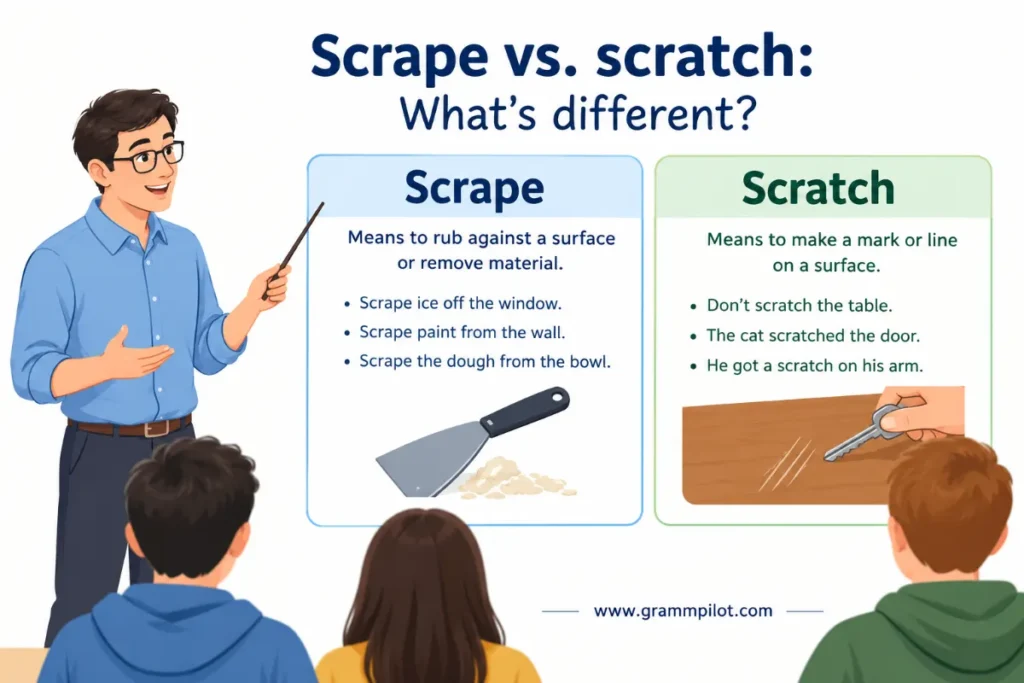
Both words can describe surface damage, but they don’t always mean the same thing.
| Scrape | Scratch |
|---|---|
| Often involves rubbing or dragging against a surface | Often involves making a narrow mark with a sharp or rough object |
| I scraped mud off the boot. | I scratched the table with a key. |
| The shovel scraped the ground. | The cat scratched the door. |
A scrape may remove a layer of material or create a broad abrasion. A scratch often leaves a narrow line, although the exact result depends on the surface and action.
Scrap vs. cancel: Which is more appropriate?
Both words can refer to stopping a plan, but cancel is often the more direct choice for appointments and scheduled events.
- “We canceled the appointment.” This is the natural choice for a scheduled meeting.
- “We scrapped the proposal.” This suggests abandoning the idea or deciding not to develop it further.
Use the verb that matches the type of decision you’re describing.
What Are the Most Common Mistakes With Scrap and Scrape?
Several mistakes happen because the words look almost identical.
Mistake 1: Using scrap for a surface scratch
Incorrect: “I scrap my knee when I fall.”
Correct: “I scrape my knee when I fall.”
The verb scrape describes the injury caused by rubbing against a rough surface. The past tense is scraped.
Mistake 2: Using scrape to describe a canceled plan
Incorrect: “We decided to scrape the project.”
Correct: “We decided to scrap the project.”
The intended meaning is to abandon the project, not rub it against a surface.
Mistake 3: Confusing scrap metal with scraped metal
“Scrap metal” refers to discarded metal or metal intended for recycling.
“Scraped metal” describes metal that has been scraped or rubbed. It doesn’t automatically mean the metal is waste.
Mistake 4: Using the wrong past tense
The past tense of scrap is scrapped. The past tense of scrape is scraped.
- The company scrapped the plan.
- The worker scraped the paint away.
Notice the double p in scrapped and the single p in scraped.
Mistake 5: Assuming similar spelling means similar meaning
These words are not interchangeable simply because they share most of their letters.
Incorrect: “Please scrap the remaining frosting from the bowl.”
Better: “Please scrape the remaining frosting from the bowl.”
The sentence describes removing material from a surface, so scrape is the appropriate verb.
What Are the Antonyms of Scrap and Scrape?
Antonyms help explain the opposite action, but neither word has one universal opposite in every context.
| Word | Possible antonym | Example |
|---|---|---|
| Scrap, meaning abandon | Keep | We kept the original plan. |
| Scrap, meaning discard | Retain | The company retained the old equipment. |
| Scrape, meaning remove | Apply | Apply a fresh coat of paint. |
| Scrape, meaning scratch | Smooth | The repair team smoothed the surface. |
| Scrape, meaning gather with difficulty | Spend freely | They no longer had to save every small amount. |
Choose the opposite based on the sentence. For example, the opposite of scraping paint away might be applying paint, while the opposite of scraping together money might be having enough money readily available.
How Can You Remember about to Use Scrap or Scrape?
Use these quick tips whenever you’re unsure which word belongs in your sentence.
- Remember the extra e: Scrape contains an e, just like edge. Think of scraping an edge or surface.
- Connect scrap with stopping: You can scrap a plan, scrap an idea, or sell scrap metal.
- Check the object: If the object is a proposal, project, or unwanted material, scrap may fit. If it’s dirt, paint, ice, or a surface, scrape may fit.
- Check the past tense: Scrapped means abandoned or discarded. Scraped means rubbed, scratched, or removed.
- Read the sentence aloud: Ask if the action involves getting rid of something or rubbing something away.
Try this short practice exercise.
Choose the correct word in each sentence.
- We decided to (scrap / scrape) the outdated policy.
- She had to (scrap / scrape) mud from her boots.
- The mechanic collected metal (scrap / scrape).
- I accidentally (scrapped / scraped) the side of the table.
- The company (scrapped / scraped) its original product idea.
Answers: 1. scrap, 2. scrape, 3. scrap, 4. scraped, 5. scrapped.
If you got these right, you’ve understood the central difference. When you’re unsure, focus on the action rather than the appearance of the word.
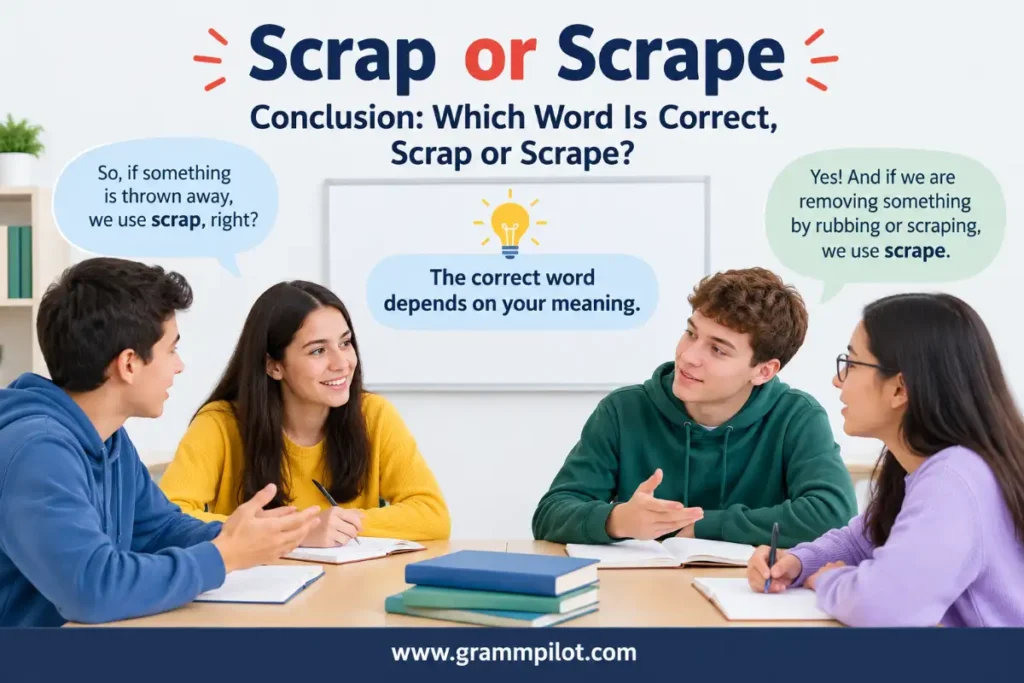
Conclusion: Which Word Is Correct, Scrap or Scrape?
Choosing between scrap and scrape becomes much easier once you focus on meaning instead of spelling. Use scrap when you mean to discard something, abandon a plan, or refer to leftover material. Use scrape when you mean to rub against a surface, cause an abrasion, or remove something with friction. The difference also matters in professional writing. A company may scrap an outdated policy, while a technician scrapes residue from a machine. Both sentences are correct because each verb describes a different action. Remember the past-tense forms, too: scrapped and scraped. A quick check of the object and the action will usually help you choose correctly. With practice, you’ll recognize these words naturally in emails, essays, conversations, and workplace documents. You don’t need a complicated grammar rule; you just need to match the word to the action you want to describe.
Frequently Asked Questions
1. What is the main difference between scrap and scrape?
Scrap means to discard something or abandon a plan, while scrape means to rub against a surface or remove material. The correct word depends on the action in your sentence.
2. Is it scrap or scrape a project?
Use scrap a project when you mean to abandon or cancel it. For example, “The team decided to scrap the project after reviewing the costs.”
3. Is it scraped my knee or scrapped my knee?
Use “scraped my knee” when describing a surface injury. Scrapped usually refers to discarding something or, informally, having a fight.
4. What’s another way to say scrape?
Depending on the meaning, you can use scratch, rub, scuff, abrade, or remove. For example, “Remove the paint” may sound clearer than “Scrape the paint” when the exact method isn’t important.
5. Is scrap metal the correct expression?
Yes, scrap metal is the standard expression for discarded metal that may be recycled or reused. Scraped metal describes metal that has been scraped and has a different meaning.
6. What is the past tense of scrap or scrape?
The past tense of scrap is scrapped, and the past tense of scrape is scraped. For example, “They scrapped the plan” and “She scraped the ice off the window.”
7. Can scrap and scrape be used as nouns?
Yes, both words can function as nouns. Scrap can mean a leftover piece of material or an informal fight, while scrape can mean a shallow injury, a surface mark, or a difficult situation.