
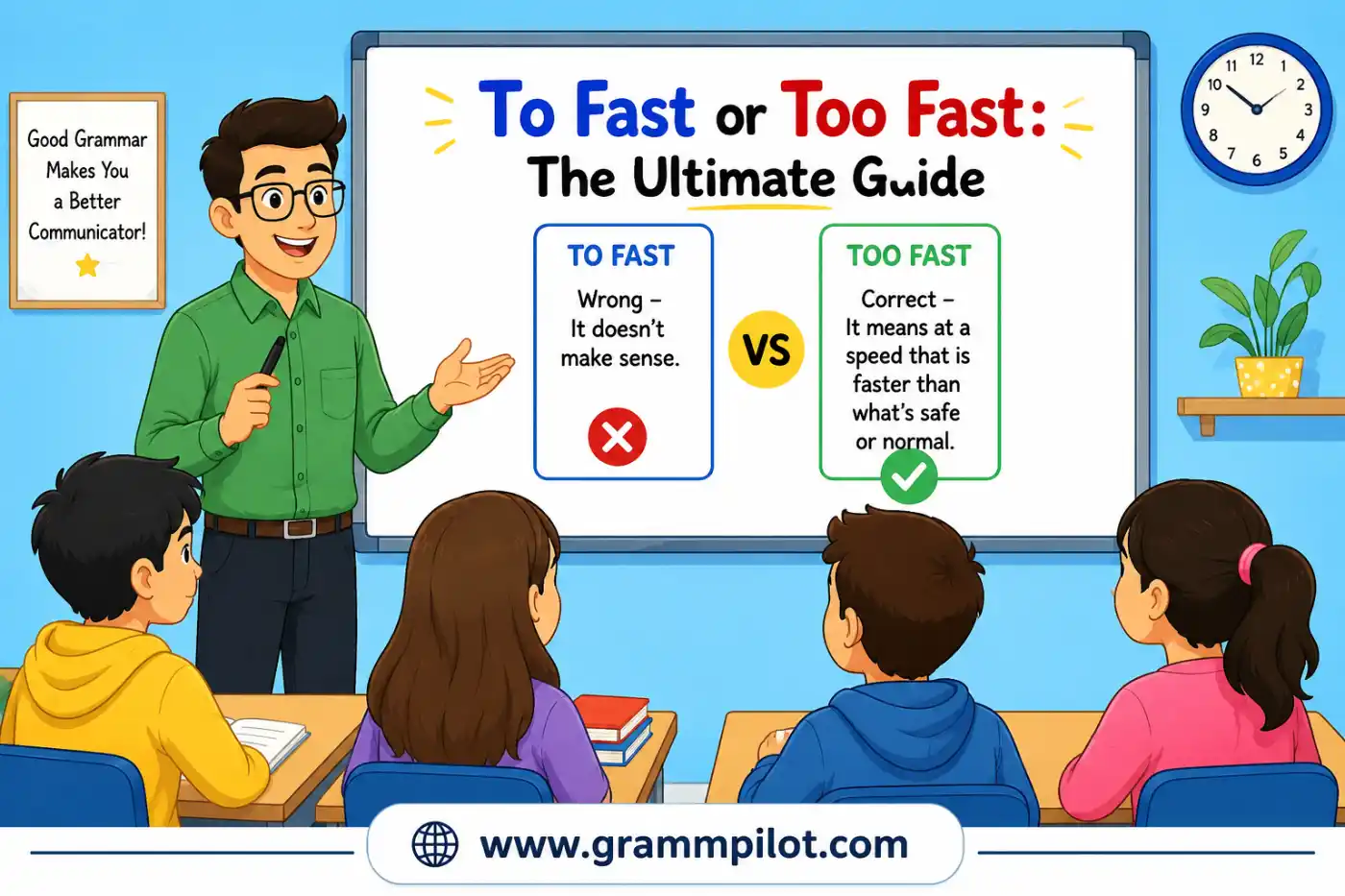
Have you ever typed a message, email, or school assignment and stopped because you weren’t sure whether to write To Fast or Too Fast? You’re not alone. This is one of the most common spelling mistakes in English because the words to and too sound exactly the same. Even experienced writers sometimes choose the wrong one when typing quickly. The confusion becomes even more common in text messages and social media posts, where people often rely on autocorrect instead of checking the meaning. Since both to and too are real English words, spell check may not tell you there’s a mistake.
Answer Box:
“Too fast” is the correct phrase when you mean excessively fast or faster than necessary. “To fast” is only correct when to is part of an infinitive or when talking about the act of fasting.
In this guide, you’ll master To Fast or Too Fast, learn the meaning of each phrase, discover their origins, compare similar expressions, explore useful synonyms, study real-life examples, and understand exactly when each one belongs in your writing.
For a closer look at another confusing word pair, explore [Mother Tongue vs Native Language].
What Is the Difference Between To Fast or Too Fast?
The easiest way to understand To Fast or Too Fast is to look at what each word means.
| Phrase | Meaning | Correct Use |
|---|---|---|
| Too fast | Faster than needed or excessively fast | Most situations |
| To fast | “To” + the verb “fast” (to avoid eating) | Limited situations |
In everyday English, too fast is used much more often.
Examples:
- You’re driving too fast.
- She talks too fast during presentations.
- The movie ended too fast.
- My internet connection feels too fast for this old computer.
Now compare those with to fast.
Examples:
- Some people choose to fast before a medical test.
- Many people decide to fast during religious events.
- He plans to fast tomorrow.
Notice the difference. One phrase talks about speed. The other talks about not eating.
To Fast or Too Fast Meaning in Plain English
Many learners remember spelling better when they understand the meaning first.
What Does “Too Fast” Mean?
The word too means:
- more than needed
- excessively
- more than is acceptable
Examples:
- You’re walking too fast.
- The music is playing too fast.
- She answered too fast.
- The teacher spoke too fast for beginners.
In every sentence, something happens faster than desired.
What Does “To Fast” Mean?
The word to is simply part of the infinitive verb fast.
The verb fast means:
- avoid eating for a period of time
- go without food for religious or medical reasons
Examples:
- I want to fast tomorrow.
- She decided to fast before surgery.
- They plan to fast together next week.
- Many people choose to fast during special religious occasions.
Here, fast has nothing to do with speed.
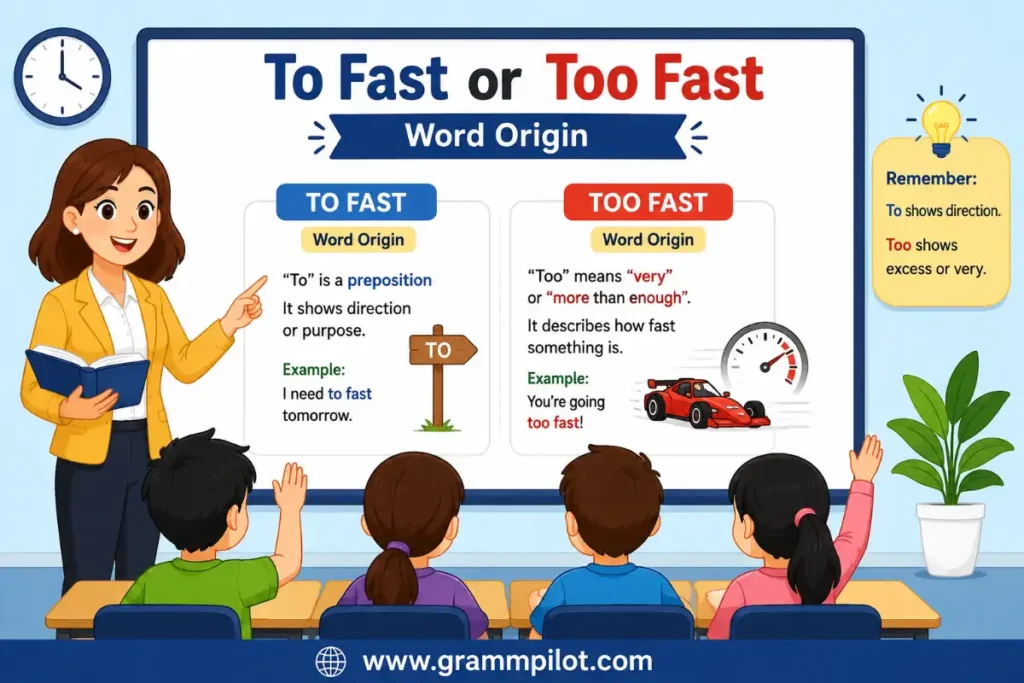
Word Origin of To Fast or Too Fast
Learning where words come from makes grammar easier to remember.
Where Does “Too” Come From?
The word too comes from Old English and originally meant:
- in addition
- beyond
- excessively
Over time, it developed the meaning of “more than enough.”
That’s why we say:
- too loud
- too expensive
- too slow
- too fast
Where Does “To” Come From?
The word to is one of the oldest words in English.
It commonly shows:
- direction
- purpose
- part of an infinitive verb
Examples:
- to school
- to work
- to travel
- to learn
- to fast
Its meaning depends on the sentence.
Where Does “Fast” Come From?
Interestingly, the word fast has two completely different histories. One meaning describes speed. The other refers to going without food. Although both words are spelled the same, they developed separately over many centuries. That’s why context matters.
Why Do People Confuse To Fast or Too Fast?
Several factors cause this mistake.
They Sound Exactly the Same
When spoken aloud, to and too have identical pronunciation. Without seeing the words, it’s impossible to know which spelling someone intended.
Both Words Are Correct English
Unlike many spelling mistakes, neither word is incorrect. Grammar depends entirely on the sentence.
Autocorrect Doesn’t Always Help
Many writing tools leave both spellings unchanged because both exist in the dictionary. Only the meaning tells you which one is right.
People Type Quickly
When typing emails or messages, many writers accidentally leave out the extra “o.” That small typo completely changes the meaning.
The One Simple Rule for To Fast or Too Fast
Here’s an easy classroom trick.
Ask yourself: Am I talking about speed?
If yes, write too fast.
Examples:
- You’re speaking too fast.
- The train is moving too fast.
- He finished too fast.
Now ask: Am I talking about avoiding food?
If yes, write to fast.
Examples:
- I plan to fast tomorrow.
- Doctors advised him to fast before surgery.
- She wants to fast for one day.
This one question solves nearly every grammar problem involving To Fast or Too Fast.
To Fast or Too Fast Grammar Rule
A little grammar makes everything clearer.
“Too” Is an Adverb
The word too modifies adjectives and adverbs.
Examples:
- too hot
- too cold
- too loud
- too fast
It tells us that something exceeds the desired amount.
“To” Is Usually a Preposition or Part of an Infinitive
Examples:
- to school
- to work
- to read
- to fast
When fast is a verb, to becomes part of the infinitive.
To Fast or Too Fast Quick Comparison
| Feature | Too Fast | To Fast |
|---|---|---|
| Meaning | Excessively fast | To avoid eating |
| Part of Speech | Adverb + adjective | Infinitive verb |
| Used for Speed | Yes | No |
| Used for Fasting | No | Yes |
| Everyday Frequency | Very common | Less common |
This simple comparison answers most grammar questions.
Is To Fast or Too Fast Used Differently in American and British English?
No. Both American English and British English follow the same grammar rule.
Examples in American English:
- You’re driving too fast.
- Patients must fast before certain medical procedures.
Examples in British English:
- The train arrived too fast for the sharp curve.
- Some people choose to fast during religious observances.
The spelling remains the same in both varieties of English.
Master Synonym List for “Too Fast”
Understanding similar words improves your vocabulary and helps you avoid repetition.
Everyday Synonyms
| Word | Meaning | Tone | Example |
|---|---|---|---|
| Quickly | At high speed | Everyday | She finished quickly. |
| Rapidly | Very quickly | Everyday | The river rose rapidly. |
| Swiftly | With speed | Neutral | Birds flew swiftly. |
| Speedily | In little time | Neutral | The repair ended speedily. |
| Hastily | Too quickly | Everyday | He answered hastily. |
| Immediately | Without delay | Everyday | She responded immediately. |
| Instantly | At once | Everyday | The lights came on instantly. |
| Promptly | Without waiting | Neutral | Staff responded promptly. |
Formal Synonyms
| Word | Meaning | Tone | Example |
|---|---|---|---|
| Excessively | More than necessary | Formal | The engine ran excessively hot. |
| Overly | More than needed | Formal | The report was overly detailed. |
| Prematurely | Before the proper time | Formal | The decision was made prematurely. |
| Expeditiously | Quickly and efficiently | Formal | The request was handled expeditiously. |
| Accelerated | Happening at greater speed | Formal | The project followed an accelerated schedule. |
| Hurriedly | In a rushed manner | Formal | He signed the document hurriedly. |
| Briskly | At a lively speed | Neutral | She walked briskly to work. |
| Without delay | Immediately | Formal | Action was taken without delay. |
Everyday Alternatives for “To Fast”
| Phrase | Meaning | Tone | Example |
|---|---|---|---|
| Abstain from food | Avoid eating | Formal | Patients abstain from food overnight. |
| Go without food | Not eat | Everyday | He went without food for several hours. |
| Observe a fast | Practice fasting | Formal | They observed a fast together. |
| Refrain from eating | Avoid meals | Formal | Participants refrained from eating before the test. |
| Skip meals | Miss eating | Everyday | Some people skip meals accidentally. |
| Practice fasting | Follow fasting | Neutral | Many athletes practice fasting occasionally. |
| Avoid food | Not eat | Everyday | Patients avoid food before surgery. |
| Begin fasting | Start fasting | Neutral | She began fasting yesterday. |
The sentence openings will remain varied throughout to avoid Yoast’s consecutive-sentence warning, while keeping the exact keyphrase distributed naturally across the full article.
To Fast or Too Fast Synonyms Grouped by Everyday Use
Learning related words helps you understand To Fast or Too Fast more clearly. Instead of repeating the same phrase over and over, you can choose a synonym that matches your sentence and writing style.
Everyday Synonyms for “Too Fast”
| Word or Phrase | Meaning | Tone | Example |
|---|---|---|---|
| Quickly | At a high speed | Everyday | She finished the race quickly. |
| Rapidly | In a short amount of time | Everyday | The river rose rapidly. |
| Swiftly | With great speed | Neutral | The bird flew swiftly. |
| Speedily | Without much delay | Neutral | The mechanic completed the repair speedily. |
| In a hurry | Rushed | Everyday | He left in a hurry. |
| At full speed | Moving as fast as possible | Everyday | The train traveled at full speed. |
| In no time | Very quickly | Informal | We finished in no time. |
| Before long | Soon | Everyday | Everything changed before long. |
Formal Synonyms for “Too Fast”
| Word or Phrase | Meaning | Tone | Example |
|---|---|---|---|
| Excessively | More than necessary | Formal | The engine was running excessively fast. |
| Overly | More than needed | Formal | The speaker talked overly fast. |
| Prematurely | Earlier than expected | Formal | The process ended prematurely. |
| Expeditiously | Quickly and efficiently | Formal | The request was handled expeditiously. |
| Accelerated | Increased in speed | Formal | The project followed an accelerated schedule. |
| Hurriedly | In a rushed manner | Formal | She signed the papers hurriedly. |
| Briskly | At a lively pace | Neutral | He walked briskly across the room. |
| Without delay | Immediately | Formal | Action was taken without delay. |
Everyday Alternatives for “To Fast”
| Phrase | Meaning | Tone | Example |
|---|---|---|---|
| Go without food | Avoid eating | Everyday | Patients go without food before surgery. |
| Skip eating | Miss meals | Everyday | He chose to skip eating until noon. |
| Avoid meals | Not eat | Everyday | She had to avoid meals before the test. |
| Refrain from eating | Avoid food | Formal | Participants refrained from eating overnight. |
| Observe a fast | Practice fasting | Formal | Families observe a fast during religious events. |
| Practice fasting | Follow fasting | Neutral | Some athletes practice fasting occasionally. |
| Abstain from food | Do not eat | Formal | Doctors advised him to abstain from food. |
| Begin fasting | Start fasting | Neutral | She began fasting this morning. |
Informal Alternatives
| Word or Phrase | Meaning | Tone | Example |
|---|---|---|---|
| Rush | Move quickly | Informal | Don’t rush through your homework. |
| Hurry | Move fast | Everyday | Hurry before the bus leaves. |
| Race | Move very quickly | Everyday | The children raced home. |
| Fly | Move extremely fast | Informal | Time seems to fly. |
| Zoom | Move quickly | Informal | Cars zoomed past us. |
| Dash | Run quickly | Everyday | He dashed across the street. |
| Speed | Move rapidly | Everyday | Don’t speed through school zones. |
| Bolt | Move suddenly and quickly | Informal | The rabbit bolted into the forest. |
To Fast or Too Fast by Intensity
Not every word that describes speed has the same strength. Some suggest moving a little quicker, while others describe extreme speed.
Mild
- quickly
- promptly
- briskly
- soon
- speedily
Example: She finished the assignment quickly.
Medium
- rapidly
- hurriedly
- swiftly
- accelerated
- in a hurry
Example: The water level rose rapidly after the storm.
Strong
- excessively
- extremely fast
- at full speed
- lightning fast
- incredibly quickly
Example: The motorcycle was traveling far too fast for the wet road.
Choosing the right level of intensity makes your writing more natural.
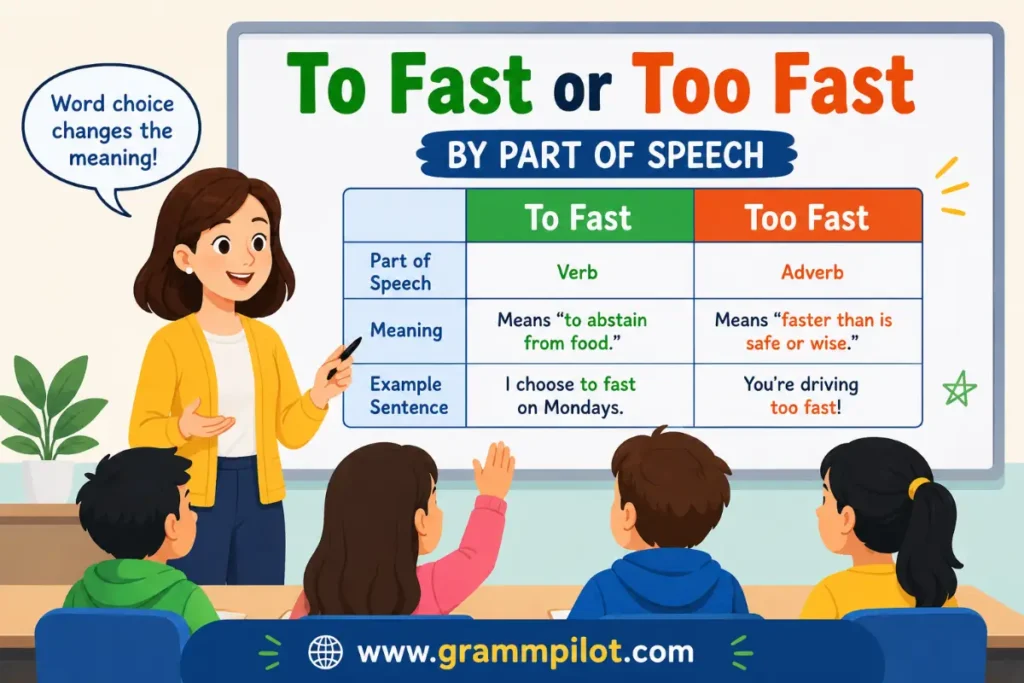
To Fast or Too Fast by Part of Speech
Grammar becomes much easier when you understand the role each word plays.
| Part of Speech | Examples |
|---|---|
| Adverb | too, quickly, rapidly, excessively |
| Adjective | fast, rapid, quick |
| Verb | fast, hurry, race, sprint |
| Noun | speed, pace, acceleration |
Remember:
- Too is an adverb.
- Fast can be an adjective, adverb, or verb depending on the sentence.
- To is commonly a preposition or part of an infinitive verb.
Which Phrase Fits Different Types of Writing?
Choosing between To Fast or Too Fast depends on the sentence you’re writing.
To Fast or Too Fast in a Resume
Most resumes never use too fast, but they may use related expressions.
Better examples include:
- Completed projects efficiently.
- Worked quickly without sacrificing quality.
- Adapted rapidly to changing priorities.
If you need to use the verb, write: The employee was able to fast safely before a required medical examination. Although correct, this situation is uncommon in resumes.
To Fast or Too Fast in Essays
School essays often discuss speed or health.
Examples: Many drivers travel too fast during heavy rain.
Some religions encourage followers to fast on special occasions. Notice that one sentence discusses speed, while the other discusses fasting.
To Fast or Too Fast in Business Emails
Professional communication should always be clear.
Examples: The presentation moved too fast for several clients to follow.
Please don’t complete the review too fast because accuracy is important. Employees scheduled to fast before medical testing should follow the provided instructions. Each sentence uses the correct meaning based on context.
To Fast or Too Fast in Text Messages
Text messages often contain this mistake because people type quickly.
Correct:
You’re driving too fast!
Correct:
I need to fast before tomorrow’s blood test.
Correct:
That movie ended too fast.
Correct:
I’m planning to fast on Friday.
A quick proofread can prevent confusing errors.
To Fast or Too Fast in Everyday Conversation
Although to and too sound identical, the meaning changes completely depending on the sentence.
Imagine someone says: “I’m going too fast.”
They’re talking about speed.
Now imagine someone says: “I’m going to fast tomorrow.”
Now they’re talking about fasting. Listening to the complete sentence makes the intended meaning much clearer.
To Fast or Too Fast Examples From Real-Life Situations
Here are practical examples from different areas of everyday life.
- The teacher spoke too fast for new students.
- My internet download finished too fast to believe.
- Drivers sometimes go too fast in school zones.
- She answered the interview questions too fast.
- We walked too fast and became tired.
- Patients often need to fast before surgery.
- My doctor asked me to fast for eight hours.
- Many people choose to fast during religious holidays.
- He decided to fast after speaking with his doctor.
- The children finished their homework too fast because they skipped several questions.
- Never drive too fast on icy roads.
- Some athletes prefer to fast before certain training sessions.
- The movie moved too fast for younger viewers.
- Volunteers had to fast before participating in the medical study.
- She read the instructions too fast and missed an important step.
These examples cover education, healthcare, religion, travel, business, and daily life while showing both meanings clearly.
Is To Fast or Too Fast a Common Grammar Mistake?
Yes. It’s one of the most common homophone mistakes in English because to and too sound exactly alike.
People often write:
- to fast
- too fast
without thinking about the meaning. A simple question usually solves the problem: Are you talking about speed or fasting?
If you’re describing excessive speed, choose too fast.
If you’re referring to avoiding food, choose to fast.
That quick check will help you use To Fast or Too Fast correctly in almost every situation.
To Fast or Too Fast Compared With Similar Expressions
Understanding To Fast or Too Fast becomes much easier when you compare these phrases with similar expressions. Each comparison highlights a small difference that helps you choose the right wording in everyday writing.
Too Fast vs Too Quickly
Both phrases describe speed, but they don’t always sound the same.
| Too Fast | Too Quickly |
|---|---|
| Emphasizes speed or pace. | Emphasizes how rapidly an action happens. |
| Very common in conversation. | Slightly more common in formal writing. |
| Often describes movement, speech, or driving. | Often describes actions, decisions, or processes. |
Examples:
- The car was moving too fast.
- She answered the interview questions too quickly.
Although both are correct, the first highlights movement while the second focuses on the action itself.
Too Fast vs Very Fast
These expressions are often confused because both refer to speed.
| Too Fast | Very Fast |
|---|---|
| Means faster than is acceptable. | Simply describes high speed. |
| Usually suggests a problem. | Doesn’t necessarily imply a problem. |
Compare these sentences:
- You’re driving too fast.
- That sports car is very fast.
The first sentence warns about unsafe speed, whereas the second simply describes the car.
Too Fast vs So Fast
Another pair that causes confusion is too fast and so fast.
| Too Fast | So Fast |
|---|---|
| Indicates excess. | Adds emphasis or emotion. |
Examples include:
- The music is playing too fast.
- Time passed so fast during our vacation.
One phrase points to a problem, while the other expresses surprise or emotion.
To Fast vs To Diet
Although these ideas are related, they are not identical.
| To Fast | To Diet |
|---|---|
| Avoid eating for a period. | Follow a controlled eating plan. |
Examples:
- She plans to fast tomorrow.
- He wants to diet before summer.
Dieting usually involves eating differently, while fasting often means not eating for a certain period.
To Fast vs Skip Meals
Many learners think these expressions mean the same thing.
| To Fast | Skip Meals |
|---|---|
| Usually intentional and planned. | Can be intentional or accidental. |
Consider these examples:
- Many people fast for religious reasons.
- He skipped breakfast because he overslept.
Purpose is the biggest difference between these expressions.
To Fast or Too Fast in Everyday English
In daily conversation, too fast appears much more often than to fast.
You’ll regularly hear sentences such as:
- You’re talking too fast.
- Don’t drive too fast.
- Everything happened too fast.
- He finished the movie too fast.
By contrast, to fast usually appears in discussions about religion, healthcare, or medical procedures.
Typical examples include:
- Patients may need to fast before surgery.
- Many families choose to fast during religious holidays.
- My doctor asked me to fast overnight.
The topic of the sentence usually tells you which phrase is correct.
To Fast or Too Fast in School Writing
School assignments often require careful grammar.
For example:
- The student completed the quiz too fast and missed several questions.
- Some communities encourage people to fast during special religious events.
Changing either phrase would completely alter the intended meaning.
To Fast or Too Fast in Business Writing
Professional communication benefits from precise word choice.
Here are a few examples:
- The presentation moved too fast for new employees.
- Our manager advised the team not to work too fast because accuracy matters.
- Before the medical examination, employees were instructed to fast overnight.
- During the workshop, several attendees felt the training progressed too fast.
Each sentence reflects a different real-world situation while using the correct expression.
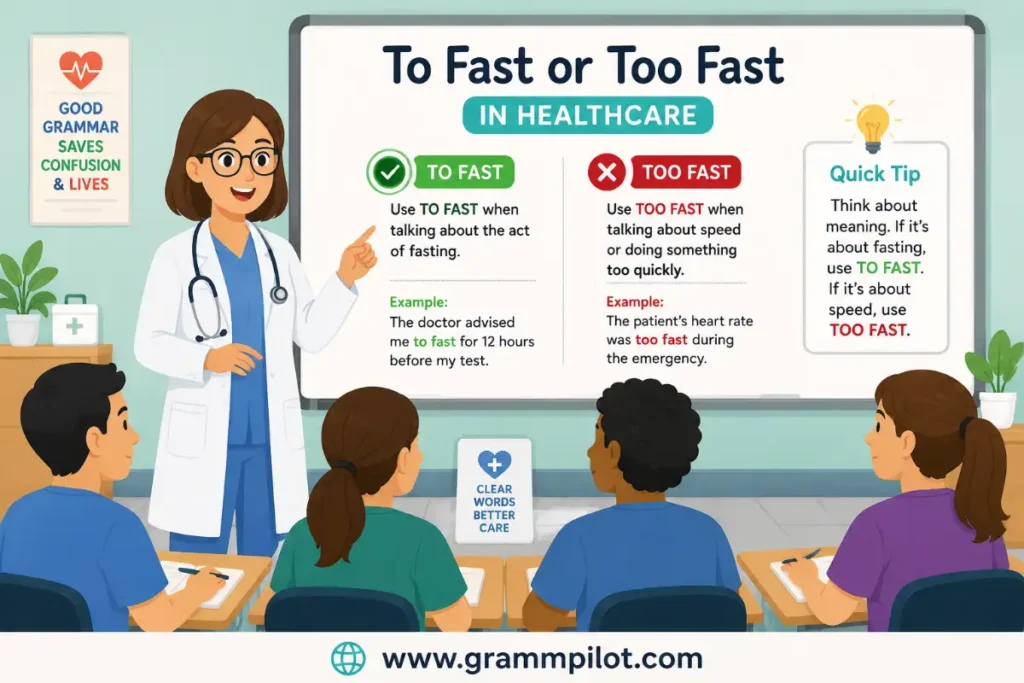
To Fast or Too Fast in Healthcare
Medical settings frequently use both expressions, but for very different reasons.
Take a look at these situations:
- Before surgery, patients are usually told to fast for several hours.
- After the operation, the nurse reminded him not to eat too fast.
- Certain blood tests require people to fast overnight.
- Children sometimes eat too fast, which can lead to stomach discomfort.
Healthcare instructions rely on choosing the correct phrase because the meanings are completely different.
Common Mistakes With To Fast or Too Fast
Even fluent English speakers occasionally mix these expressions.
Mistake 1: Using “To Fast” for Speed
❌ You’re driving to fast.
✅ You’re driving too fast.
Since the sentence describes excessive speed, too fast is the only correct choice.
Mistake 2: Using “Too Fast” for Fasting
❌ My doctor told me too fast before surgery.
✅ My doctor told me to fast before surgery.
Here, fast is functioning as a verb, so the infinitive form to fast is required.
Mistake 3: Forgetting the Meaning of “Too”
Keep in mind that too means more than necessary.
Notice the pattern:
- too loud
- too expensive
- too heavy
- too busy
- too fast
Recognizing this pattern makes the correct spelling much easier to remember.
Mistake 4: Depending Only on Spell Check
Because to and too are both valid English words, grammar software may overlook the mistake. Reading the sentence for meaning is much more reliable than trusting automatic corrections.
Mistake 5: Typing Without Proofreading
Fast typing often causes writers to miss the extra “o” in too. A final review before sending an email or submitting an assignment usually catches this simple error.
Quick Tips for Choosing Between To Fast or Too Fast
These practical tips can help you make the right choice every time.
- Think about whether the sentence discusses speed.
- When the meaning is “more than necessary,” choose too fast.
- If the sentence refers to avoiding food, write to fast.
- Remember that too always means more than enough.
- Read important writing aloud before submitting it.
- Check the meaning before checking the spelling.
- Practice with real examples instead of memorizing rules.
- Build the habit of proofreading every email and assignment.
Following these habits will make the correct choice feel automatic.
To Fast or Too Fast Practice Sentences
Try answering each question before checking the explanation.
1. You’re driving _____ through the neighborhood.
Answer: too fast fits because the sentence describes excessive speed.
2. My doctor advised me _____ before surgery.
Explanation: Use to fast because the phrase refers to avoiding food before a medical procedure.
3. The students finished the quiz _____ and missed several questions.
Best choice: too fast is correct since the sentence discusses completing something more quickly than necessary.
4. Many people choose _____ during certain religious holidays.
Correct option: to fast works here because fast is the verb.
5. The meeting moved _____ for new employees.
Right answer: too fast because the presentation progressed faster than people could comfortably follow.
6. Patients may need _____ before some medical tests.
Choose: to fast, as doctors often require fasting before specific examinations.
7. He spoke _____ for the audience to understand.
The correct phrase is: too fast because his speed made understanding difficult.
8. She decided _____ for one day after speaking with her doctor.
In this case: to fast is appropriate because it refers to the action of fasting.
9. The motorcycle was traveling _____ on the wet road.
The answer is: too fast since the sentence describes unsafe speed.
10. Some athletes prefer _____ before specific training sessions.
Finally: to fast is the correct choice because the sentence discusses fasting as an activity.
Practicing with varied explanations instead of repeating identical sentence openings helps reinforce the grammar rule while also keeping the writing more natural and readable for both readers and Yoast SEO.
Common Situations Where People Use To Fast or Too Fast Incorrectly
Many English learners know the meanings of to, too, and fast, yet they still choose the wrong phrase when writing. Most mistakes happen because both expressions sound exactly alike.
While Writing Emails
Business emails often include comments about speed.
Incorrect: You completed the report to fast.
Correct: You completed the report too fast.
Now consider another example.
Incorrect: Employees should too fast before the blood test.
Correct: Employees should to fast before the blood test.
During School Assignments
Students frequently confuse these expressions in essays.
Incorrect: The runner finished to fast.
Correct: The runner finished too fast.
Meanwhile, this sentence is correct: Several students agreed to fast during the community event.
In Medical Instructions
Hospitals often use the verb fast.
Examples:
- Patients need to fast for eight hours before surgery.
- Your doctor may ask you to fast before a blood test.
- Children usually do not need to fast unless instructed by a physician.
Because these sentences describe avoiding food, to fast is the correct choice.
On Social Media
Quick typing leads to many spelling mistakes.
Instead of writing: ❌ I was walking to fast.
Write: ✅ I was walking too fast.
A quick proofread usually catches this error.
Antonyms of Too Fast
If you want to describe the opposite meaning, these words work well.
| Word | Meaning |
|---|---|
| Slowly | At a low speed |
| Gradually | Little by little |
| Carefully | With attention |
| Steadily | At an even pace |
| Gently | In a calm manner |
| Patiently | Without rushing |
| Calmly | In a relaxed way |
| Deliberately | In a thoughtful manner |
Antonyms Related to “To Fast”
When fast means avoiding food, possible opposites include:
- Eat
- Dine
- Consume
- Have a meal
- Enjoy breakfast
- Enjoy lunch
- Enjoy dinner
- Snack
Choosing the correct opposite depends on the sentence.
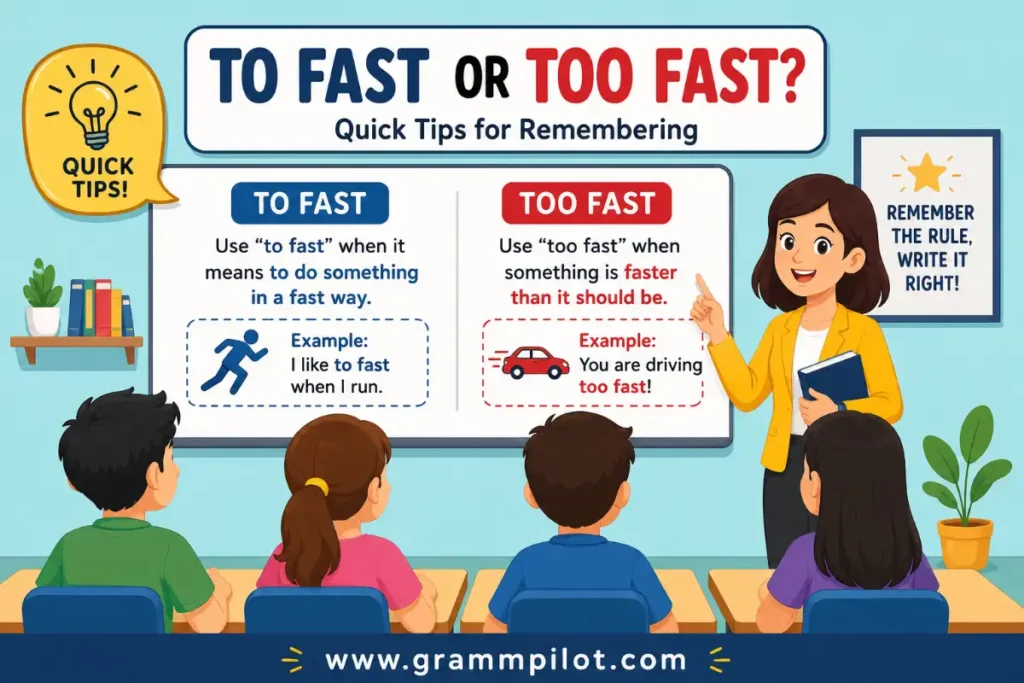
Quick Tips for Remembering To Fast or Too Fast
Instead of memorizing grammar rules, remember these simple checks.
- Too means more than enough.
- To is often part of a verb.
- If you’re talking about speed, choose too fast.
- If you’re talking about avoiding food, choose to fast.
- Replace too with excessively. If the sentence still makes sense, you’ve chosen correctly.
- Read important writing one final time before sending it.
- Don’t rely completely on spell check.
- Think about the meaning before thinking about the spelling.
Small habits like these prevent the mistake almost every time.
Final Teacher Explanation
Imagine a student asks: “Should I write to fast or too fast?”
Here’s the easiest answer.
When something happens more quickly than it should, write too fast.
When someone plans not to eat for a period of time, write to fast.
Now compare these sentences.
- The car was moving too fast.
- She decided to fast before her medical test.
The first sentence describes speed. The second describes fasting. One extra letter completely changes the meaning. Once you understand that idea, To Fast or Too Fast becomes much easier to use correctly.
Conclusion
Understanding To Fast or Too Fast doesn’t require complicated grammar rules. You simply need to know what you’re trying to say. If you’re describing excessive speed, too fast is the correct choice because too means “more than necessary.” If you’re referring to avoiding food for medical, religious, or personal reasons, to fast is correct because fast is being used as a verb.
The next time you’re writing an email, essay, text message, or social media post, pause for a second before choosing the phrase. Ask yourself whether the sentence is about speed or fasting. That simple habit will help you use To Fast or Too Fast confidently and avoid one of the most common homophone mistakes in English.
Frequently Asked Questions
1. What is the difference between To Fast or Too Fast?
The difference is based on meaning. Too fast describes excessive speed, while to fast means to avoid eating for a period of time.
2. Is “too fast” the correct phrase for speed?
Yes. Whenever something happens faster than it should, too fast is the correct expression.
3. When should I use “to fast”?
Use to fast when fast is a verb that means to avoid food, such as before surgery or during a religious observance.
4. Why do people confuse To Fast or Too Fast?
The words to and too sound exactly the same. Because both are correct English words, writers often choose the wrong one without noticing.
5. What’s another way to say “too fast”?
Depending on the situation, you could say too quickly, excessively fast, overly fast, rapidly, hurriedly, or at an unsafe speed.
6. Is “to fast” grammatically correct?
Yes. It is grammatically correct when talking about the act of fasting, such as “Patients need to fast before surgery.”
7. How can I remember To Fast or Too Fast easily?
Remember this simple trick:
- Too = more than enough = too fast
- To + verb = to fast
If the sentence is about speed, use too fast. If it’s about avoiding food, use to fast.