
Imagine you’re replying to a friend who helped you, writing an email to a coworker, or sending a quick text after receiving useful advice. You want to sound grateful without making the message awkward. Thanks a Lot is a familiar expression that can fit many everyday situations.
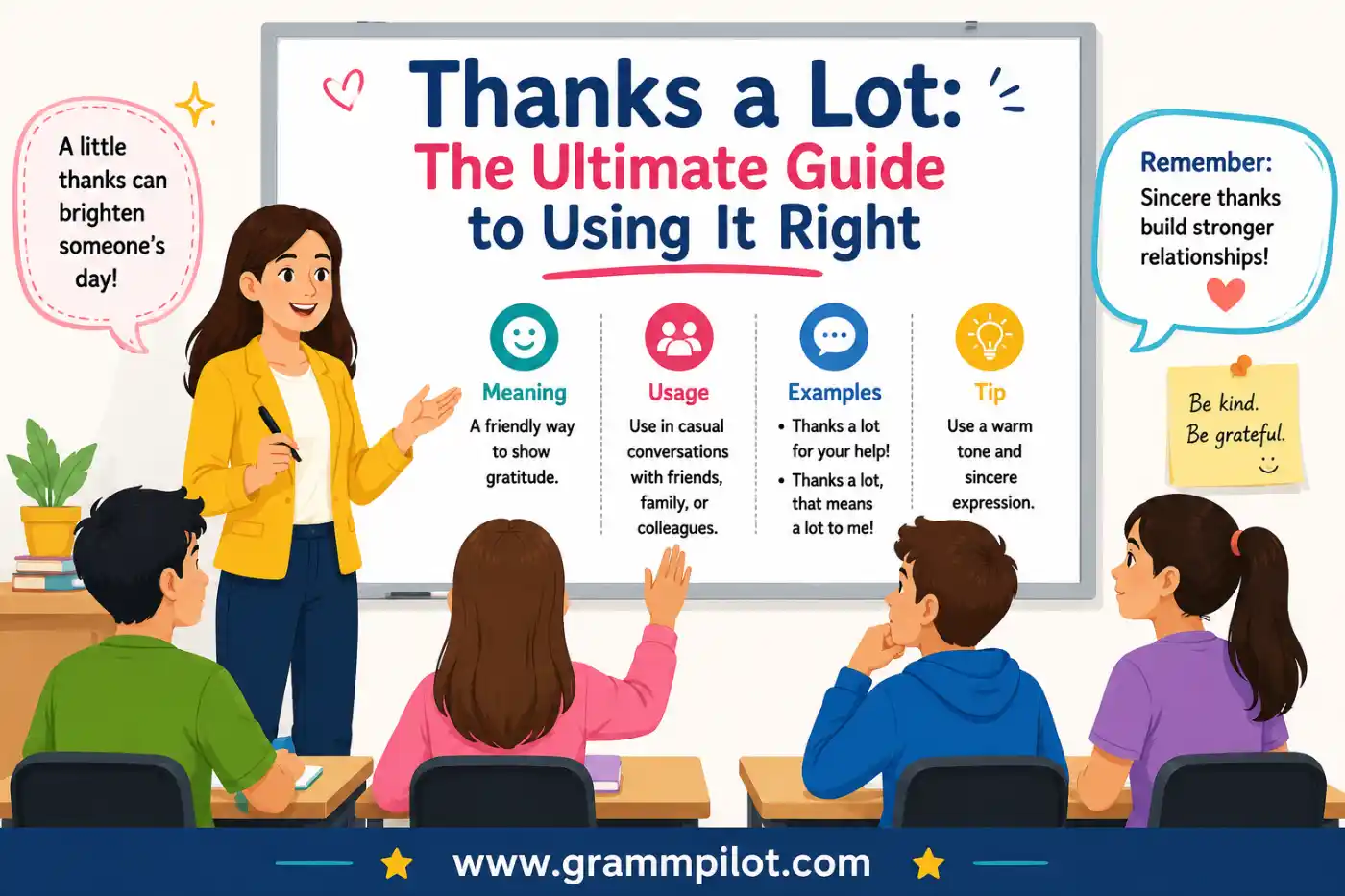
Thanks a Lot means “thank you very much” and is commonly used to show appreciation for someone’s help, kindness, effort, or generosity.
The phrase sounds natural in casual conversations, texts, and friendly emails. A more formal alternative may be better for academic writing, job applications, or official correspondence. This guide explains the meaning, origin, synonyms, intensity, grammar, examples, regional use, common mistakes, and best alternatives.
Having trouble remembering which word fits? See our guide to [Due To or Do To].
What Does “Thanks a Lot” Mean?
Thanks a Lot is an expression of gratitude. Someone may use it after receiving help, advice, information, a favor, a gift, or emotional support.
Example: Thanks a Lot for helping me with my homework.
The speaker is showing genuine appreciation. However, context can completely change the tone. Consider this:
Example: Thanks a Lot for deleting my file.
The sentence may sound sarcastic because the speaker is probably unhappy about what happened. That is why this phrase should always be considered alongside the situation and tone. A friendly voice can make it sound warm, while an annoyed voice can make it sound critical. Written communication needs extra care because readers cannot hear your voice.
Thanks a Lot: Where Did “Thanks a Lot” Come From?
The expression combines the word thanks with the phrase a lot.
“Thanks” is the common shortened form of “thank you.” The words “a lot” indicate a large amount. When combined, they strengthen the speaker’s appreciation. English contains several expressions built in a similar way:
- Thanks so much
- Thank you very much
- Thanks a bunch
- I appreciate it
- Many thanks
The popularity of This word comes from its simplicity. It is short, familiar, and easy to use in everyday communication.
Although the phrase is widely understood, it generally sounds more conversational than highly formal.
What Are the Best Synonyms for “Thanks a Lot”?
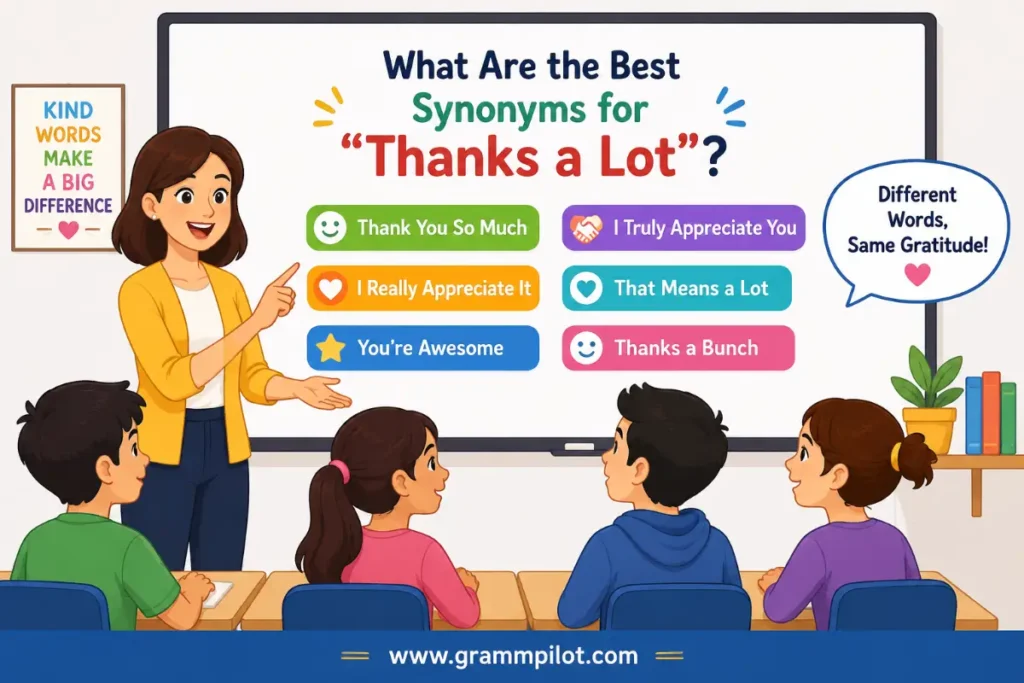
The best substitute depends on your audience, relationship, and purpose. A close friend may appreciate casual wording, while a manager or professor may expect something more polished.
Simple Alternatives
Thanks — short and casual.
Example: Thanks for your help.
Thank you — neutral and widely appropriate.
Example: Thank you for coming.
Many thanks — polite with a slightly formal feel.
Example: Many thanks for your assistance.
Thanks so much — warm and friendly.
Example: Thanks so much for helping me.
Thank you very much — polite and stronger.
Example: Thank you very much for your time.
Thanks a bunch — relaxed and cheerful.
Example: Thanks a bunch for the ride.
Thanks loads — very informal.
Example: Thanks loads for helping me.
Everyday Alternatives
I appreciate it — natural and sincere.
Example: I appreciate it.
I really appreciate it — warmer and more personal.
Example: I really appreciate your help.
Much appreciated — short and neutral.
Example: Much appreciated for the quick response.
That’s very kind of you — focuses on someone’s kindness.
Example: That’s very kind of you.
I owe you one — suggests you’ll return the favor.
Example: I owe you one for covering my shift.
You’re the best — enthusiastic and friendly.
Example: You’re the best for helping me.
You’re a lifesaver — suggests that someone’s help was especially valuable.
Example: You’re a lifesaver for fixing this.
Formal Alternatives
I am grateful — direct and formal.
Example: I am grateful for your guidance.
I am very grateful — stronger formal appreciation.
Example: I am very grateful for your support.
I greatly appreciate it — professional and sincere.
Example: I greatly appreciate your assistance.
I sincerely appreciate it — respectful and formal.
Example: I sincerely appreciate your help.
I appreciate your assistance — useful in professional communication.
Example: I appreciate your assistance with this matter.
Please accept my thanks — highly formal.
Example: Please accept my thanks for your support.
I am deeply appreciative — strong and formal.
Example: I am deeply appreciative of your kindness.
Very Casual Alternatives
- Thanks tons
- Big thanks
- You’re a star
- You’re awesome
- Cheers
- Much love
These expressions work best when the relationship is relaxed. They may sound too casual in academic, legal, or professional writing.
How Strong Is “Thanks a Lot”?
Not every expression of gratitude carries the same emotional strength.
Mild Gratitude
For a small favor, simple wording is usually enough:
- Thanks
- Appreciate it
- Much appreciated
Example: Thanks for holding the door.
Moderate Gratitude
When someone has made a meaningful effort, Thanks a Lot can sound appropriate.
Other options include:
- Thanks so much
- Many thanks
- I really appreciate it
Example: Thanks a Lot for staying late to help me.
Strong Gratitude
A major favor may deserve a stronger expression:
- Thank you very much
- I greatly appreciate your support
- I’m extremely grateful
- I can’t thank you enough
Example: I can’t thank you enough for helping me prepare for the interview.
The strength of Thanks a Lot therefore depends partly on context. A small favor and a major favor can both receive the same phrase, but your tone will communicate the difference.
Thanks a Lot: What Part of Speech Is “Thanks a Lot”?
Thanks a Lot is a phrase rather than one individual word.
The word “thanks” functions as a noun because it refers to an expression of gratitude. The words “a lot” strengthen the amount of appreciation being communicated.
You can use the phrase on its own:
Example: Thanks a Lot!
You can also add a reason:
Example: Thanks a Lot for your help.
The spelling deserves attention. A lot must be written as two words.
Can You Write “Thank a Lot”?
That is not the standard expression.
Use: Thanks a Lot.
Or: Thank you very much.
“Thank you a lot” can be understood, but it sounds less natural than the standard choices above.

What Is the Best Alternative for a Resume?
Resumes and cover letters should normally use professional language. Casual wording may make an otherwise polished application seem less formal.
Best Choice: “I Appreciate Your Consideration”
Example: Thank you for reviewing my application. I appreciate your consideration.
Other suitable choices include:
- Thank you for your time.
- Thank you for considering my application.
- I appreciate your consideration.
- I am grateful for the opportunity.
Using Thanks a Lot in a resume would usually be too conversational.
For example, this sounds inappropriate:
Example: Thanks a Lot for checking out my resume!
A professional application needs a more respectful tone.
What Should You Use in an Essay?
Academic writing generally calls for more formal language.
A personal essay may allow some conversational wording, but research papers and formal assignments usually need a more objective style.
Instead of:
Example: Thanks a Lot to everyone who helped me with this essay.
you could write:
Example: I am grateful to everyone who contributed to this research.
For an acknowledgment section, another natural choice is:
Example: I would like to thank my teachers for their guidance.
Whether Thanks a Lot works depends heavily on the type of essay and the audience.
What Should You Use in a Professional Email?
Professional emails usually benefit from clear and respectful expressions.
Good choices include:
- Thank you.
- Thank you very much.
- I appreciate your help.
- I appreciate your assistance.
- Many thanks.
Example: Thank you for sending the report. I appreciate your help.
A close coworker may receive a more relaxed message:
Example: Thanks a Lot for sending that over.
The relationship between the writer and reader should guide your choice. Thanks a Lot can work in a friendly workplace, but it isn’t the safest option for every professional contact.
What Should You Say in a Text Message?
Text messages generally allow casual language.
You could write:
- Thanks!
- Thanks so much!
- Thanks a Lot!
- You’re the best!
- I really appreciate it!
- Thanks a bunch!
Example: Thanks a Lot for picking me up!
A second option might sound more personal:
Example: Thanks so much. You really saved me today.
With close friends, Thanks a Lot can sound completely natural. There’s usually no reason to use stiff formal wording in a casual text.
What Should You Say When Speaking?
Spoken English gives you an important advantage: your voice communicates emotion.
You might say: Thanks a Lot!
A smile and warm tone make the appreciation clear.
Another possibilities: Thanks so much. I really appreciate it.
When talking to a teacher, manager, customer, or unfamiliar person, “Thank you very much” offers a safe balance between warmth and professionalism.
Thanks a Lot: What Are Some Real-Life Examples?
Different situations can call for slightly different wording.
- After receiving help: Thanks a Lot for carrying these boxes.
- After getting advice: Thanks a Lot for the advice. It really helped.
- After receiving a gift: Thanks a Lot for the birthday present.
- After receiving information: Thanks a Lot for sending me the address.
- At work: Thanks a Lot for helping me finish the report.
- After getting a ride: Thanks a Lot for picking me up.
- After a lesson: Thanks a Lot for explaining that again.
- After technical support: Thanks a Lot for fixing my computer.
- In a text: Thanks a Lot! That link was exactly what I needed.
- After emotional support: Thanks a Lot for listening. It meant a lot to me.
- After receiving directions: Thanks a Lot for showing me the way.
- After a small favor: Thanks a Lot for saving me a seat.
These examples show how the same expression can work across many everyday situations.
“Thanks a Lot” vs. “Thank You Very Much” — What’s Different?
Both expressions show strong gratitude, but their style differs slightly. Thanks a Lot tends to sound conversational and relaxed. “Thank you very much” feels more polished and works comfortably in professional situations.
Compare:
Casual: Thanks a Lot for your help.
More formal: Thank you very much for your assistance.
A friend could receive either version. A professor, client, manager, or unfamiliar professional contact may be better served by the second option.
“Thanks a Lot” vs. “Thanks So Much” — What’s Different?
These two expressions are very close in meaning. “Thanks so much” can sound slightly warmer or more enthusiastic.
Example: Thanks a Lot for coming.
Example: Thanks so much for coming.
Both are correct. Personal style usually determines which one feels more natural. In a cheerful text, either option can work well. A speaker who wants extra warmth may prefer “Thanks so much.”
“Thanks a Lot” vs. “I Appreciate It” — Which Is Better?
“I appreciate it” can sound somewhat more professional.
Compare:
Example: Thanks a Lot for your help.
Example: I really appreciate your help.
The first sentence feels casual. The second can fit friendly conversations as well as many workplace situations. When you’re unsure whether a casual phrase will fit, “I appreciate it” provides a useful middle ground.
“Thanks a Lot” vs. “Many Thanks” — What’s the Difference?
“Many thanks” often feels more polished in writing.
Example: Many thanks for sending the documents.
This expression works particularly well in professional correspondence.
By comparison: Thanks a Lot for sending the documents.
This sounds more conversational. Neither choice is grammatically wrong. The difference is mainly about tone and formality.
Is “Thanks a Lot” Different in US and UK English?
American and British speakers both understand and use This word. Its basic meaning remains the same. Some alternative expressions vary more noticeably between regions. For example, cheers can mean “thanks” in British English and some other varieties. American speakers are more likely to associate “cheers” with a toast, although the thank-you meaning is understandable.
The main expressions discussed here are widely recognized throughout English-speaking regions.
When Should You Not Use “Thanks a Lot”?
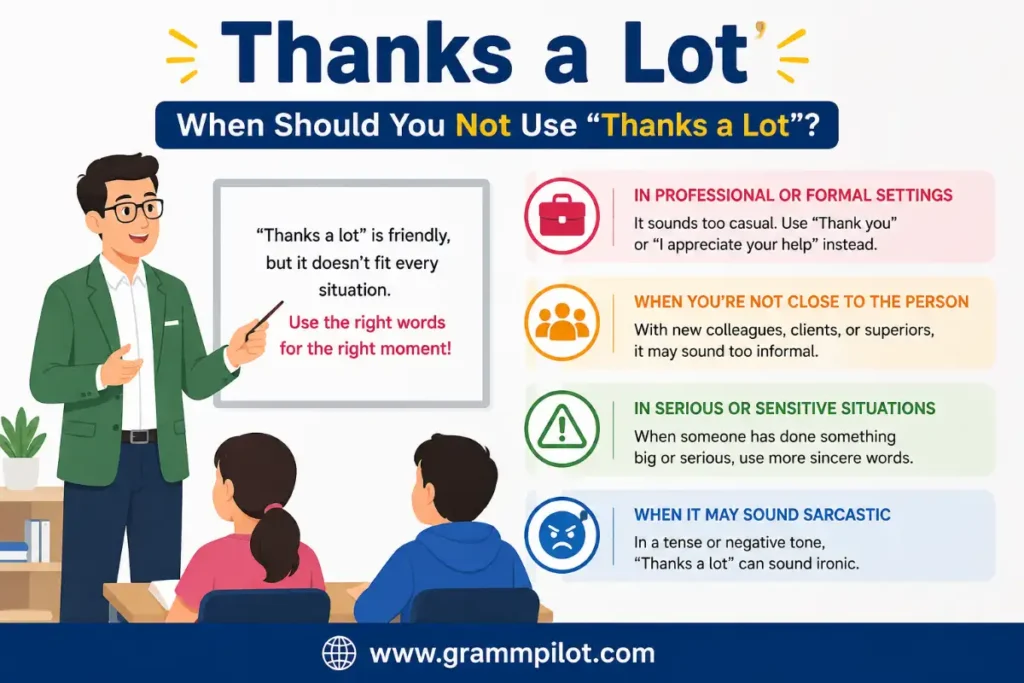
A highly formal setting may require more polished wording.
Instead of: Thanks a Lot for your assistance.
you could write: I greatly appreciate your assistance.
Sarcasm also deserves caution.
Example: Thanks a Lot for making me wait three hours.
A person who doesn’t know the situation might misunderstand the sentence. Job applications, academic papers, formal business letters, and official correspondence generally benefit from professional alternatives.
Thanks a Lot: What Are the Common Mistakes?
Mistake 1: Writing “Alot”
Incorrect: Thanks alot.
Correct: Thanks a Lot.
The phrase a lot contains two separate words.
Mistake 2: Assuming It Is Always Sincere
The phrase can become sarcastic when the situation is negative.
Mistake 3: Using Casual Language Everywhere
A phrase may be grammatically correct but still unsuitable for a particular audience.
Mistake 4: Overusing Exclamation Marks
One mark can show enthusiasm:
Example: Thanks a Lot!
Several marks may look too casual in professional writing:
Example: Thanks a Lot!!!
Mistake 5: Confusing “A Lot” With “Allot”
A lot means a large amount.
Allot means to distribute or assign something.
Example: The teacher will allot ten minutes to each group.
The two terms have completely different meanings.
What Are the Antonyms?
The closest opposite of gratitude is ingratitude.
Related words include:
- criticism
- complaint
- blame
- dissatisfaction
- resentment
- disapproval
For comparison:
Gratitude: Thanks a Lot for your help.
Opposite idea: I don’t appreciate what you did.
How Do You Choose the Right Synonym?
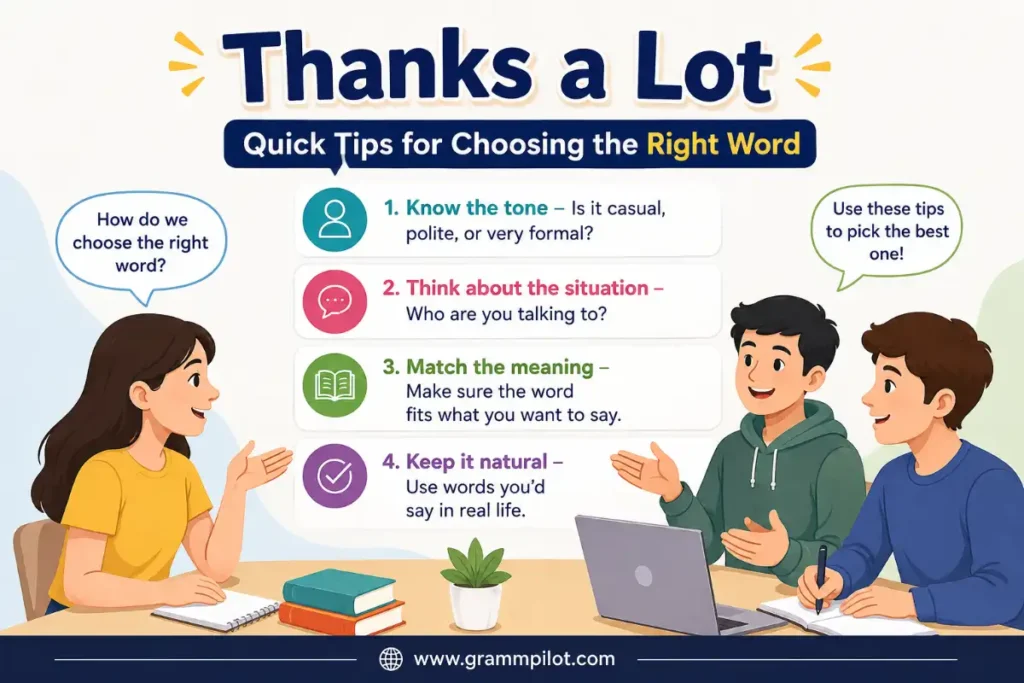
Start with the situation rather than automatically selecting the strongest phrase.
Who Are You Talking To?
A close friend allows relaxed wording. A client, professor, employer, or manager may expect something more formal.
How Much Gratitude Do You Want to Show?
“Thanks” is simple, while “I can’t thank you enough” communicates much stronger emotion.
Are You Speaking or Writing?
Spoken sarcasm is easier to recognize because listeners can hear your voice. Written sarcasm can be misunderstood.
Could the Phrase Sound Too Casual?
When you’re uncertain, “Thank you” is one of the safest choices in English.
Thanks a Lot: Quick Tips for Choosing the Right Word
- Use Thanks for a simple everyday favor.
- Choose Thanks a Lot for friendly, stronger appreciation.
- Pick Thanks so much for a warmer casual tone.
- Use I appreciate it for a professional middle ground.
- Choose Thank you very much for polite formal communication.
- Select Many thanks for polished written messages.
- Use I sincerely appreciate your assistance in highly formal situations.
- Choose I can’t thank you enough for an especially important favor.
- Avoid slang in job applications.
- Always spell a lot as two words.
- Consider possible sarcasm before using the expression.
- Mention the specific favor when you want your gratitude to feel more genuine.
Conclusion
Thanks a Lot is a flexible expression that normally communicates strong appreciation. It works naturally in everyday conversations, friendly texts, casual emails, and relaxed workplace interactions. Context remains important because the same words can become sarcastic when the situation is negative.
Formal communication may sound better with “Thank you very much,” “I appreciate your assistance,” or “I am grateful.” The strongest expression isn’t necessarily the best choice. Think about your audience, relationship, purpose, and desired tone before selecting your wording. With that small adjustment, your English can sound clearer, warmer, and more confident.
Frequently Asked Questions
1. What’s another way to say “Thanks a Lot”?
Common alternatives include “Thanks so much,” “Thank you very much,” “I really appreciate it,” and “Many thanks.”
2. Is “Thanks a Lot” formal or informal?
It is generally informal to neutral. Everyday conversations, texts, and casual messages are its most natural settings.
3. Is “Thanks a Lot” grammatically correct?
Yes. The expression is grammatically correct, and a lot should always be written as two separate words.
4. Can “Thanks a Lot” be sarcastic?
Yes. Depending on context and tone, it can communicate annoyance instead of genuine gratitude.
5. Is “Thanks a Lot” appropriate for a professional email?
It can work with a close coworker, but “Thank you very much” or “I appreciate your help” is usually safer for professional communication.
6. What is the difference between “Thanks a Lot” and “Thanks So Much”?
Both expressions show strong gratitude. “Thanks so much” can sound slightly warmer or more enthusiastic.
7. What is the best formal alternative to “Thanks a Lot”?
“I greatly appreciate your assistance” is a strong formal alternative. “Thank you very much” is simpler and works in many professional situations.