
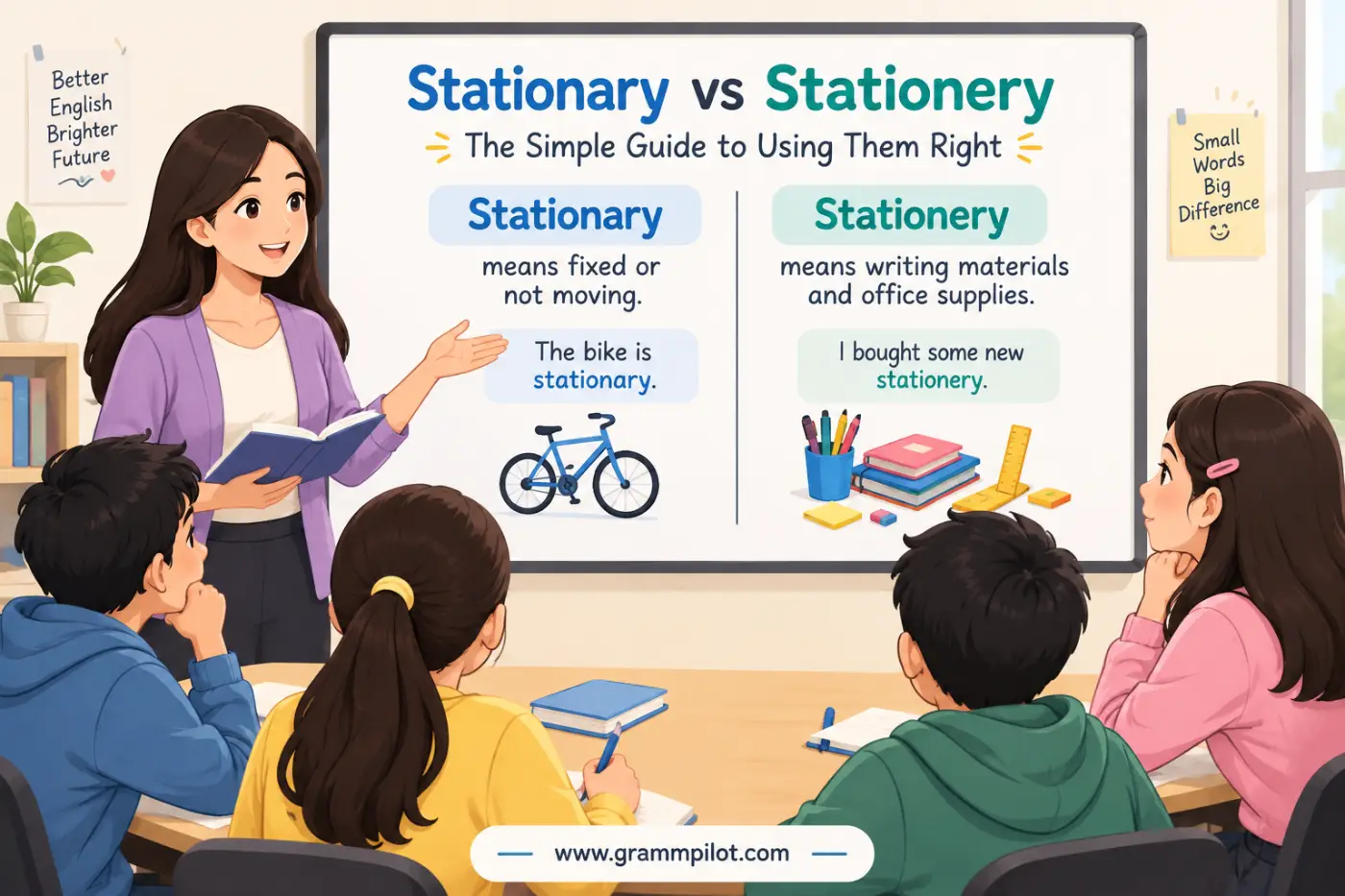
Stationary vs Stationery is a common English spelling confusion because the two words sound almost exactly the same. However, their meanings are completely different. One describes something that is not moving, while the other refers to writing materials such as paper, pens, envelopes, and notebooks. You may see these words in school assignments, office emails, product descriptions, business documents, or everyday writing. Because spell-check tools may not catch the mistake, knowing the meaning of each word is important.
Quick Answer: Stationary means not moving or staying in one place. Stationery means writing materials and office supplies, such as paper, envelopes, pens, and cards.
A simple memory trick makes the difference easier: Stationery has “e” for envelope. Since envelopes are a type of writing supply, the spelling with -ery is the correct choice for paper and related materials. This guide explains the meanings, word origins, pronunciation, examples, synonyms, common mistakes, memory tricks, real-life usage, and simple ways to remember which spelling to use.
For more help with commonly confused words, check out [Who vs Whom]
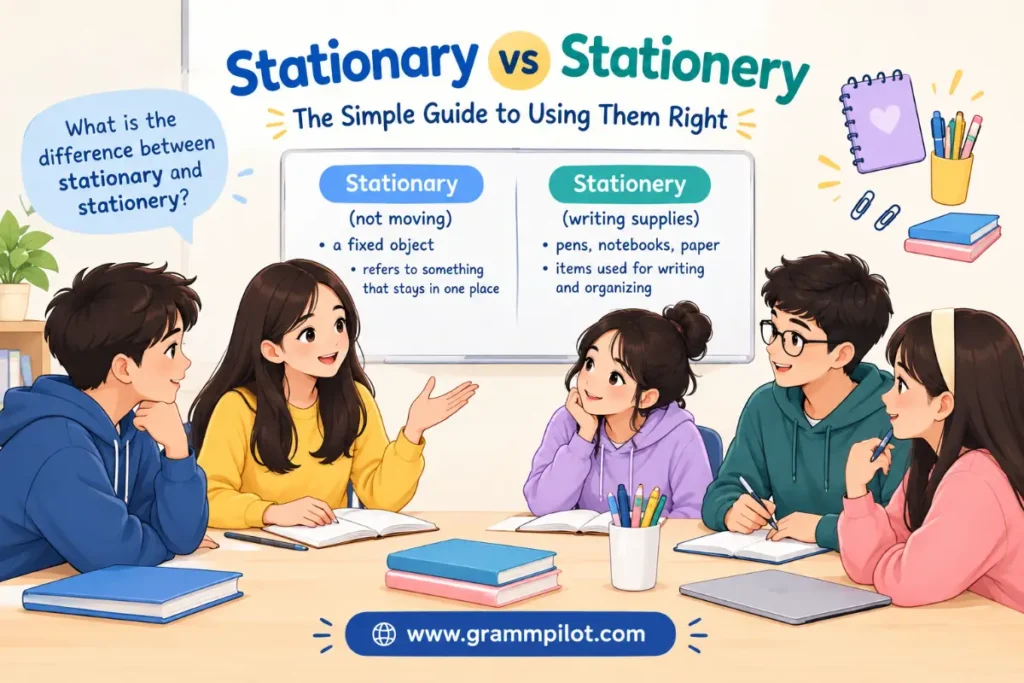
What is the difference between stationary and stationery?
The main difference is meaning.
| Word | Meaning | Example |
|---|---|---|
| Stationary | Not moving; staying in one place | The car remained stationary. |
| Stationery | Writing materials and paper supplies | She bought new stationery for school. |
Although they sound alike, they do different jobs in a sentence.
Stationary is usually an adjective.
Stationery is a noun.
This grammar difference can help you choose the correct spelling.
Ask yourself: Are you describing something that is not moving?
Use stationary.
Are you talking about paper, envelopes, pens, or writing supplies?
Use stationery.
What does stationary mean?
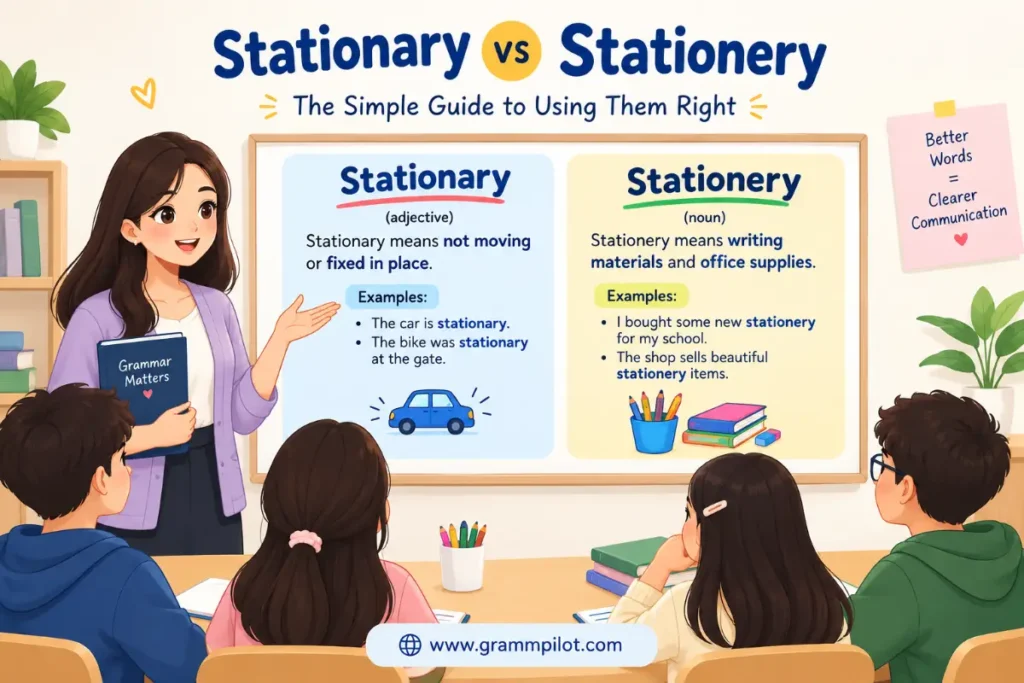
Stationary means not moving or staying in the same place.
Examples:
- The car remained stationary at the red light.
- The bike was stationary when the accident happened.
- Please keep the camera stationary.
- The train stood stationary for several minutes.
- The machine remained stationary during the inspection.
The word is often used to describe vehicles, objects, cameras, machines, or people.
Stationary means not moving
Imagine a car stopped at a traffic light.
The car is not moving.
You can say: “The car is stationary.”
This does not mean the car is broken. It simply means it is not moving at that moment.
What does stationery mean?
Stationery refers to materials used for writing, printing, or office communication.
Common stationery items include:
- Paper
- Envelopes
- Notebooks
- Pens
- Pencils
- Greeting cards
- Letterheads
- Sticky notes
- Writing pads
- Folders
Example: “She bought colorful stationery before starting the school year.”
Another example: “The company ordered new stationery with its logo.”
Unlike stationary, stationery usually refers to supplies or materials.
What is included in stationery?
Stationery can include many paper-based and writing-related products.
Paper products
- Writing paper
- Notepads
- Notebooks
- Journals
- Letter paper
- Printer paper
- Greeting cards
- Invitations
Office items
- Pens
- Pencils
- Envelopes
- Sticky notes
- Folders
- Labels
- Paper clips
- Staplers
Different stores may define stationery differently. Some include a wide range of office supplies, while others focus mainly on paper and writing materials.
In everyday English, however, stationery generally means supplies used for writing, organizing, or communicating on paper.
What is the word origin of stationary?
The word stationary is connected to the word station. A station is a place where something stands, stops, or stays. The word developed from ideas connected to standing in a particular position. That helps explain the modern meaning.
Something that is stationary stays in place.
Examples include:
- A stationary car
- A stationary camera
- A stationary object
- A stationary bicycle
The key idea is simple: stationary = staying still.
What is the word origin of stationery?
Stationery has an interesting history. It is connected to the word stationer. Long ago, stationers were people who had fixed stalls or shops where they sold books, paper, and writing materials. Over time, the word stationery came to refer to the writing materials sold by these stationers. That is why stationery is related to paper and writing, even though it sounds like stationary. The words developed different meanings even though their spellings and pronunciations are very similar.
How do you remember Stationary vs Stationery?
The most popular memory trick is: Stationery has “e” for envelope.
Look at the spelling:
- Stationery
- Envelope
An envelope is a stationery item.
Another easy trick is: Stationery is for writing letters.
The word letter contains the same idea as writing materials, and stationery often includes letter paper and envelopes.
For stationary, think of the letter a in:
- stationary
- stay
A stationary object stays in one place.
How are stationary and stationery pronounced?
In most varieties of English, stationary and stationery sound almost identical.
This is why people often confuse them in writing.
When speaking, listeners usually understand the intended meaning from context.
For example:
“The car is stationary.”
Clearly refers to movement.
“I need new stationery.”
Clearly refers to writing supplies.
The problem usually appears when you have to choose the spelling. That is why meaning matters more than pronunciation.
Is stationary an adjective?
Yes. Stationary is mainly used as an adjective.
It describes something.
Examples:
- a stationary vehicle
- a stationary camera
- a stationary object
- a stationary bike
- a stationary position
You can also say: “The vehicle is stationary.”
Here, stationary describes the vehicle.
Is stationery a noun?
Yes. Stationery is a noun.
It refers to a category of materials.
Examples:
- I need stationery for school.
- The office ordered new stationery.
- She sells handmade stationery.
- The company designed personalized stationery.
In most cases, stationery is treated as an uncountable noun.
You normally do not say:
“Three stationeries.”
Instead, say:
- Three stationery items
- Three pieces of stationery
- Several stationery products
Example:
Correct: “I bought several pieces of stationery.”
Less natural: “I bought several stationeries.”
Stationary vs Stationery: What are the most common examples of stationary?
Here are several real-life examples.
- The car remained stationary at the red light.
- Keep your head stationary while the doctor examines your eyes.
- The camera must remain stationary during recording.
- The truck was stationary when another vehicle hit it.
- The machine stayed stationary during the test.
- She used a stationary bike at the gym.
- The boat appeared stationary from the shore.
- The security camera records a stationary area.
- Please remain stationary for a few seconds.
- The elevator was temporarily stationary between floors.
The common idea is movement—or the lack of it.
What are the most common examples of stationery?
Here are examples using stationery.
- She bought new stationery for school.
- The office needs more stationery.
- I ordered personalized stationery online.
- The invitation was printed on elegant stationery.
- He keeps his stationery in a desk drawer.
- The company ordered branded stationery.
- She loves collecting colorful stationery.
- The teacher asked students to bring basic stationery.
- The store sells notebooks, pens, and other stationery.
- We used formal stationery for the wedding invitations.
- The children chose their favorite stationery supplies.
- The business changed its logo and updated its stationery.
Is it stationary bike or stationery bike?
The correct phrase is stationary bike. A stationary bike stays in one place while you exercise.
Correct: *“I ride a stationary bike for 30 minutes every morning.”
Incorrect: “I ride a stationery bike.”
A bike is not a writing supply, so stationery would not make sense.
Is it stationery store or stationary store?
Usually, the correct phrase is stationery store when the store sells writing supplies.
Examples:
- I went to a stationery store to buy notebooks.
- The stationery store sells pens and greeting cards.
A stationary store would suggest a store that does not move, which is usually unnecessary and not what people mean.
Is it stationary car or stationery car?
The correct phrase is stationary car.
Example: “The police officer noticed a stationary car on the side of the road.”
The car is not moving.
Do not use stationery because a car is not a writing material.
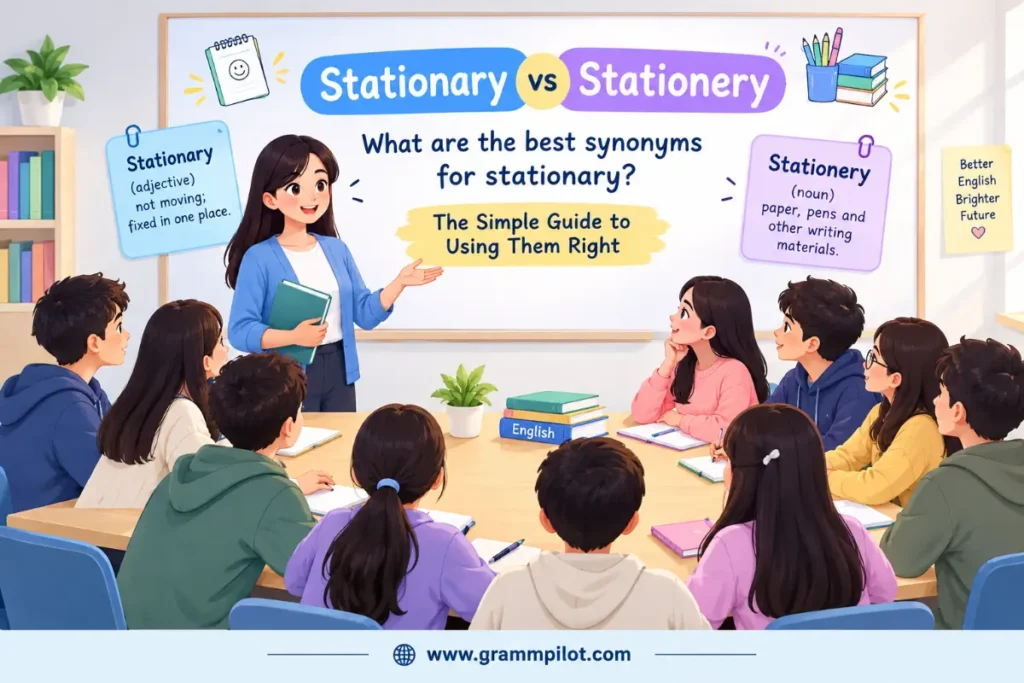
Stationary vs Stationery: What are the best synonyms for stationary?
The best synonym depends on the situation.
Simple synonyms for stationary
| Word | Meaning | Tone | Example |
|---|---|---|---|
| Still | Not moving | Everyday | Please stay still. |
| Stopped | No longer moving | Everyday | The car stopped. |
| Fixed | Attached or kept in place | Neutral | The camera is fixed. |
| Motionless | Completely without movement | Neutral | He stood motionless. |
| Immobile | Unable or not moving | Formal | The vehicle remained immobile. |
Everyday synonyms for stationary
| Word | Meaning | Tone | Example |
|---|---|---|---|
| Still | Without movement | Casual | Keep still. |
| Parked | Left in a place temporarily | Everyday | The car is parked. |
| Stopped | Not moving | Everyday | The train stopped. |
| Unmoving | Not moving | Neutral | The object remained unmoving. |
| In place | Remaining where it is | Casual | Keep the box in place. |
Formal synonyms for stationary
| Word | Meaning | Tone | Example |
|---|---|---|---|
| Immobile | Not moving | Formal | The object remained immobile. |
| Motionless | Completely still | Formal/neutral | She stood motionless. |
| Fixed | Firmly attached | Formal | The device is fixed in position. |
| Static | Not changing or moving | Technical | The image remained static. |
| Inactive | Not operating | Formal | The machine was inactive. |
Be careful: not all of these words mean exactly the same thing.
For example, a parked car is stationary, but a stationary car is not always parked.
Stationary vs Stationery: What are related words for stationery?
Stationery does not have many perfect synonyms because it refers to a specific category.
However, related terms include:
- Writing supplies
- Office supplies
- Paper goods
- School supplies
- Writing materials
- Desk supplies
- Paper products
- Office materials
The best choice depends on the situation.
Stationery vs office supplies
Stationery usually focuses on writing and paper materials.
Office supplies is broader.
Office supplies may include:
- Paper
- Pens
- Staplers
- Calculators
- Printer ink
- Folders
- Desk organizers
Example: “The office ordered new supplies.”
This is broader than: “The office ordered new stationery.”
Stationary vs still — what is the difference?
These words are related but used differently.
Stationary often describes an object or vehicle that is not moving.
“The car remained stationary.”
Still is more common in everyday speech and can describe a person or object.
“Please sit still.”
You would usually say: “Stay still.”
Instead of: “Remain stationary.”
The second sentence is correct but more formal.
Stationery vs office supplies — what is the difference?
It is often part of office supplies.
Stationery may include:
- Paper
- Envelopes
- Pens
- Notebooks
- Cards
Office supplies may also include:
- Staplers
- Printer ink
- Calculators
- Filing equipment
- Labels
- Desk accessories
So all stationery may be considered office supplies in some situations, but not all office supplies are stationery.
Stationary vs Stationery: What words are related by intensity?
Since these words describe different ideas, intensity works differently.
For stationary
Mild:
- Still
- Not moving
Medium:
- Stationary
- Stopped
Strong:
- Motionless
- Completely immobile
Example:
“The car was still.”
“The car remained stationary.”
“The figure stood completely motionless.”
For stationery
There is no real intensity scale because stationery is a category of objects.
However, you can describe the quality:
- Basic stationery
- Useful stationery
- High-quality stationery
- Premium stationery
- Luxury stationery
- Personalized stationery
How do you use stationary in school writing?
Students can use stationary when describing movement, science, vehicles, or physical objects.
Example: “The object remained stationary because no force moved it.”
Another example: “The camera must remain stationary to capture a clear image.”
In science writing, words related to stationary may include:
- At rest
- Fixed position
- Immobile
- Motionless
Choose the word that fits the level of formality.
How do you use stationery in school writing?
Students may use stationery when discussing supplies.
Examples:
“I packed my stationery before the first day of school.”
“The teacher asked students to bring their own stationery.”
“Good stationery can help students stay organized.”
For younger students, the word may include:
- Pencils
- Pens
- Erasers
- Notebooks
- Rulers
- Markers
The exact meaning can vary slightly by school or region.
How do you use stationary in an email?
Use stationary when discussing movement or equipment.
Examples:
“The vehicle was stationary when the incident occurred.”
“Please keep the camera stationary during the recording.”
“The machine remained stationary during the inspection.”
These sentences are common in professional reports, technical messages, and incident descriptions.
How do you use stationery in an email?
Use stationery when discussing office or writing supplies.
Examples:
“Please order more stationery for the office.”
“We need envelopes and other basic stationery.”
“The new company stationery will include the updated logo.”
For business communication, stationery may also refer to branded materials such as:
- Letterhead
- Business cards
- Envelopes
- Printed note cards
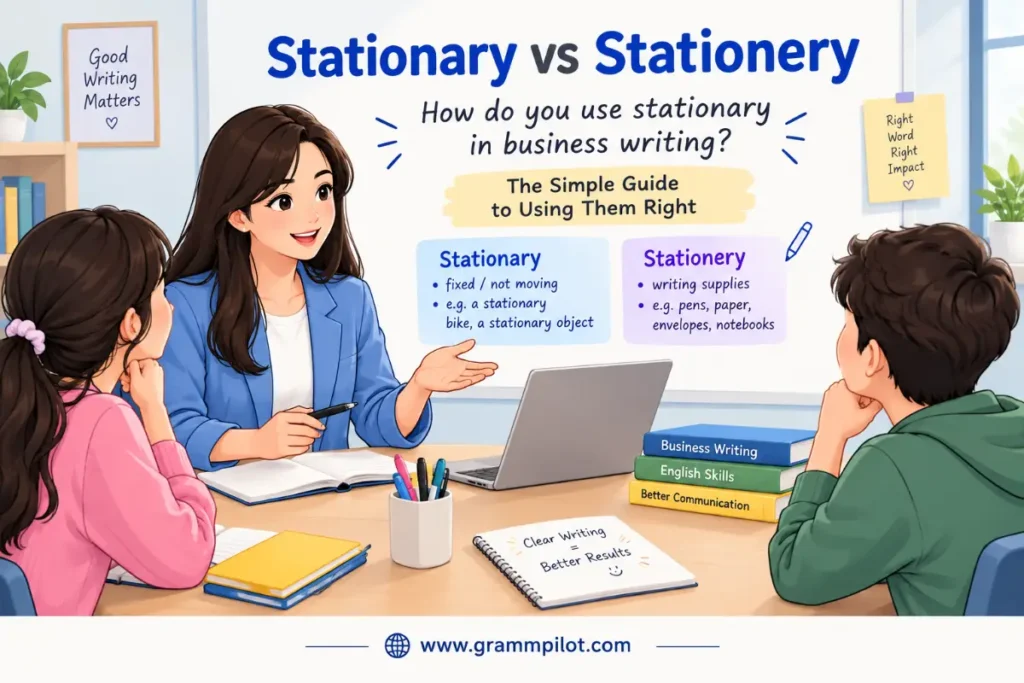
How do you use stationary in business writing?
Business writing may use stationary for:
- Equipment
- Vehicles
- Cameras
- Machines
- Objects
Example:
“The equipment must remain stationary during operation.”
Another example:
“The vehicle was stationary at the time of the incident.”
This language is especially common in:
- Safety reports
- Insurance documents
- Technical manuals
- Transportation reports
How do you use stationery in business writing?
Businesses may use stationery to describe branded printed materials.
Examples:
- Company letterhead
- Branded envelopes
- Business cards
- Printed note cards
- Official writing paper
Example:
“The company ordered new stationery after changing its logo.”
Another:
“Our branded stationery should use the same font and logo as the website.”
Is stationery used more in American or British English?
Both American and British English use the word stationery. However, the exact range of products included under the word can vary. In British English, stationery is often used very broadly for school and office supplies. In American English, people also use office supplies and school supplies very commonly.
For example, an American speaker might say: “I need to buy school supplies.”
A British speaker may be more likely to include many of those items under: “I need to buy stationery.”
Both forms are widely understood.
Is stationary different in American and British English?
The meaning of stationary is largely the same in both American and British English.
It means:
- Not moving
- Remaining in place
- Fixed in position
The main difference is usually not the meaning but the surrounding vocabulary.
For example, different regions may prefer different words for vehicles, traffic situations, or equipment.
The word stationary itself remains consistent.
Stationary vs Stationery: What are the most common mistakes?
Mistake 1: Writing stationery for something that does not move
Incorrect: “The car was stationery.”
Correct: “The car was stationary.”
The car is not moving, so use stationary.
Mistake 2: Writing stationary for pens and paper
Incorrect: “I need to buy stationary.”
Correct: “I need to buy stationery.”
Pens and paper are writing supplies.
Mistake 3: Confusing pronunciation with spelling
The words sound almost identical. You cannot always choose the spelling by sound. Check the meaning.
Mistake 4: Thinking stationery is plural
Stationery is usually uncountable.
Incorrect: “I bought five stationeries.”
Better: “I bought five stationery items.”
Or: “I bought several pieces of stationery.”
Mistake 5: Calling every office item stationery
Not every office supply is stationery. A printer, computer, or office chair may be an office supply or piece of equipment, but it is not usually called stationery.
Mistake 6: Using stationary when you mean stable
These words are related in some situations but are not identical.
A stationary object is not moving.
A stable object is not likely to fall or change.
Example: “The ladder was stationary but not stable.”
It stayed in one place but was still unsafe.
When should you not use stationary?
Do not use stationary when discussing:
- Paper
- Pens
- Envelopes
- Notebooks
- Office writing supplies
Incorrect: “I bought beautiful stationary for invitations.”
Correct: “I bought beautiful stationery for invitations.”
Also avoid using stationary when you specifically mean:
- Stable
- Permanent
- Fixed by design
Choose the word that matches the exact meaning.
When should you not use stationery?
Do not use stationery when describing:
- A stopped car
- A person standing still
- A fixed camera
- A non-moving machine
- A bicycle that stays in one place
Incorrect: “The vehicle remained stationery.”
Correct: “The vehicle remained stationary.”
What are the antonyms of stationary?
Common opposites include:
- Moving
- Mobile
- Active
- Traveling
- In motion
- Dynamic
The best opposite depends on context.
Example: “The vehicle changed from stationary to moving.”
In technical language: “The object was stationary before it began moving.”
Does stationery have an antonym?
Not really.
Stationery is a category of materials, so it does not have a direct opposite.
You might contrast stationery with:
- Electronic communication
- Digital tools
- Paperless materials
But these are not true antonyms.
For example: “Instead of using stationery, the company now uses digital documents.”
Quick tips to remember the difference
Keep these tips in mind:
- Stationary = not moving
- Stationery = writing supplies
- Think: stationary has A like stay
- Think: stationery has E like envelope
- A car can be stationary.
- A pen belongs to stationery.
- A stationary bike does not travel.
- An envelope is stationery.
- Stationery is usually uncountable.
- Always check the meaning before choosing the spelling.
Why do people confuse stationary and stationery?
The biggest reason is pronunciation.
The words sound almost identical.
They also begin with the same letters:
- Station-
The difference comes near the end:
- -ary
- -ery
That small spelling difference can be easy to miss while typing.
Spell-check software may also fail to catch the mistake because both words are correct English words.
Example: “I bought new stationary.”
The sentence may pass a spelling check, but the word choice is wrong. That is why understanding the meaning is more reliable.
Stationary vs Stationery: Can a sentence use both stationary and stationery?
Yes, although the sentence may sound unusual.
Example: “The stationery display remained stationary near the entrance.”
Here:
- Stationery = writing supplies
- Stationary = not moving
Another example:
“The stationery cart was stationary while the teacher organized the supplies.”
This is a useful way to see how the words have completely different jobs.
Practice sentences: can you choose the right word?
Choose stationary or stationery.
- The car remained ________ at the traffic light.
- She bought colorful ________ for writing letters.
- Please keep the camera ________.
- The office ordered more ________.
- The exercise bike stays ________ while you ride it.
- I need envelopes and other ________.
- The truck was ________ when the accident happened.
- The company designed new branded ________.
Answers
- Stationary
- Stationery
- Stationary
- Stationery
- Stationary
- Stationery
- Stationary
- Stationery
A final teacher explanation
The easiest way to remember Stationary vs Stationery is to connect each spelling to its meaning. Stationary describes something that does not move.
Think: Stationary = stay.
A car can be stationary. A person can remain stationary. A camera can stay stationary during filming.
Stationery refers to writing materials.
Think: Stationery = envelope.
Stationery can include paper, envelopes, notebooks, pens, and other writing supplies. When you are unsure, don’t focus on pronunciation. Ask what you are actually describing.
If it stays still, use stationary. If you can write with it, write on it, or send a letter using it, use stationery.
That one simple check can prevent the mistake.
Conclusion
Stationary vs Stationery is easy to understand once you connect each word to its meaning. Stationary means not moving or staying in one place, while stationery refers to writing materials such as paper, pens, notebooks, and envelopes.
The simplest memory trick is to remember that stationery has an “e” for envelope, while stationary has an “a” like stay. Before choosing the spelling, ask yourself whether you are describing movement or writing supplies. With that quick check, you can confidently use the correct word in school assignments, emails, reports, business writing, and everyday communication.
Frequently Asked Questions
1. What is the main difference between stationary and stationery?
Stationary means not moving or staying in one place. Stationery means writing materials such as paper, envelopes, pens, and notebooks.
2. Is a car stationary or stationery?
A car is stationary when it is not moving. Stationery only refers to writing and paper supplies.
3. Is stationery singular or plural?
Stationery is usually an uncountable noun. Say “pieces of stationery” or “stationery items” instead of “stationeries.”
4. What’s another way to say stationery?
Depending on the context, you can say writing supplies, writing materials, office supplies, paper goods, or school supplies.
5. What’s another way to say stationary?
You can use still, motionless, immobile, fixed, or unmoving. The best word depends on the situation.
6. What is the easiest trick for remembering Stationary vs Stationery?
Remember that stationery has an “e” for envelope, while stationary has an “a” like stay. This simple spelling trick works well for most learners.