
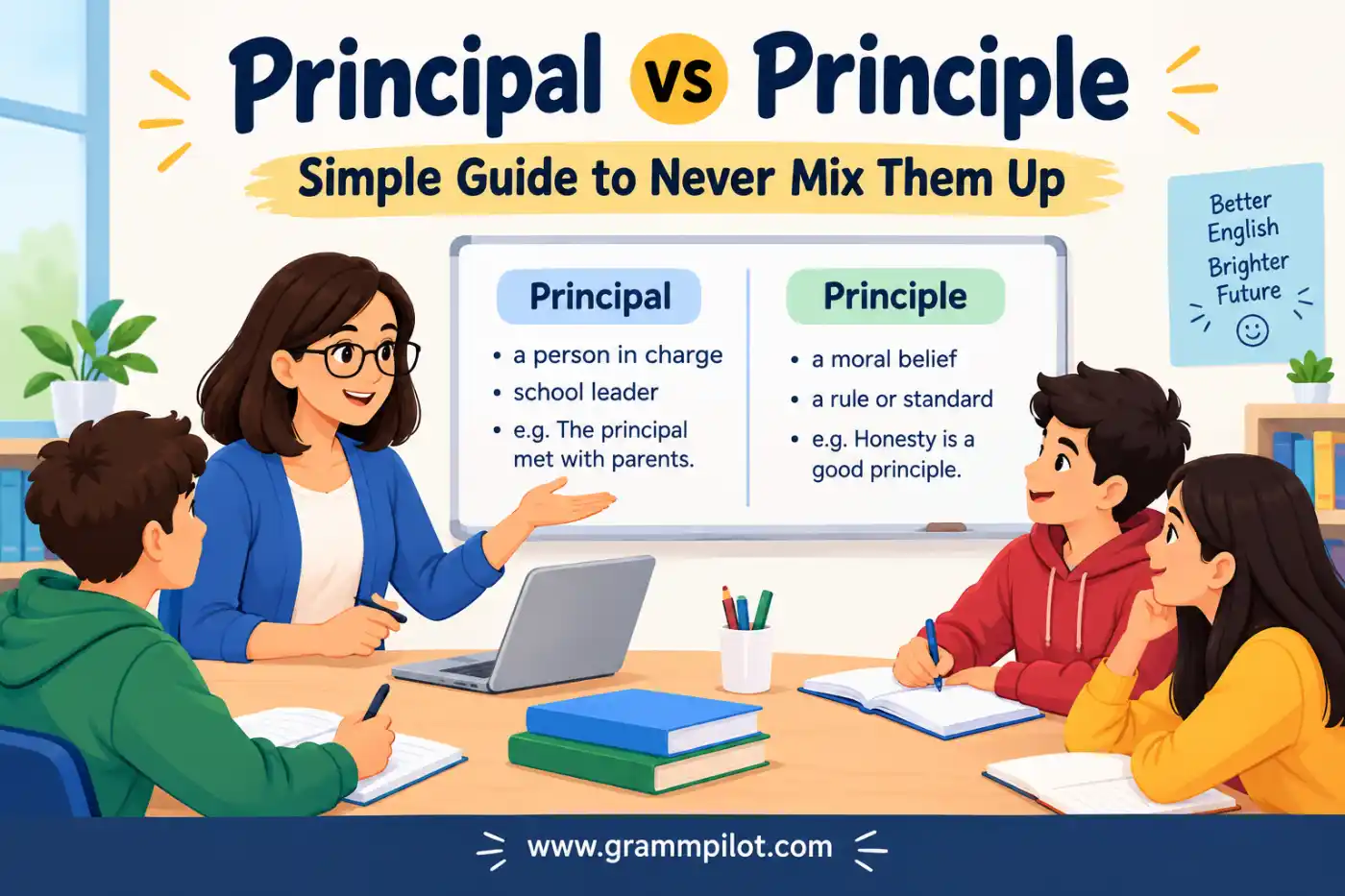
Principal vs Principle is one of the most common word confusions in English. The two words look and sound almost the same, but their meanings are very different. One can refer to a person or something important, while the other refers to a rule, belief, or basic truth. The confusion can appear anywhere. You may be writing an email to your school principal, explaining an important principle in an essay, or checking a sentence before sending it to your boss. A single letter changes the meaning completely.
Quick Answer: Principal usually means the most important person or thing, especially the head of a school. Principle means a rule, belief, or basic idea that guides actions or explains something.
A simple memory trick can help too: The principal is your pal. Both principal and pal contain the letter a. In this complete guide, you’ll learn the meaning, origin, grammar, examples, differences, common mistakes, memory tricks, synonyms, and real-life uses of these two confusing words.
Principal vs Principle: What is the difference between principal and principle?
The easiest way to understand the difference is to look at their main meanings.
| Word | Main Meaning | Example |
|---|---|---|
| Principal | A person or thing that is most important | The school principal spoke at the event. |
| Principle | A rule, belief, or basic truth | Honesty is an important principle. |
The spelling difference is small:
- Principal ends in -pal
- Principle ends in -ple
Their pronunciation is very similar, which makes the mistake even easier.
Think about what you are trying to say.
Are you talking about:
- A person in charge?
- The most important thing?
- A main amount of money?
- A rule or belief?
If you mean a person or something important, principal is often correct.
If you mean a rule, value, belief, or basic truth, principle is the right word.
What does principal mean?
Principal has several meanings. The context tells you which meaning is correct.
Principal as the head of a school
This is probably the most familiar meaning.
A principal is the person who leads or manages a school.
Examples:
- The principal welcomed the new students.
- Our principal announced the holiday schedule.
- The parents met with the school principal.
- The principal gave a speech at graduation.
In this meaning, principal is a noun.
You can usually place the, a, or my before it:
- the principal
- a principal
- our principal
Principal as the most important person or thing
Principal can also mean the main, leading, or most important person or thing.
Examples:
- The principal reason for the delay was bad weather.
- Safety is our principal concern.
- The principal goal of the project is to help students.
- She played a principal role in the company’s success.
In these examples, principal is usually an adjective.
It describes something that is the main or most important part.
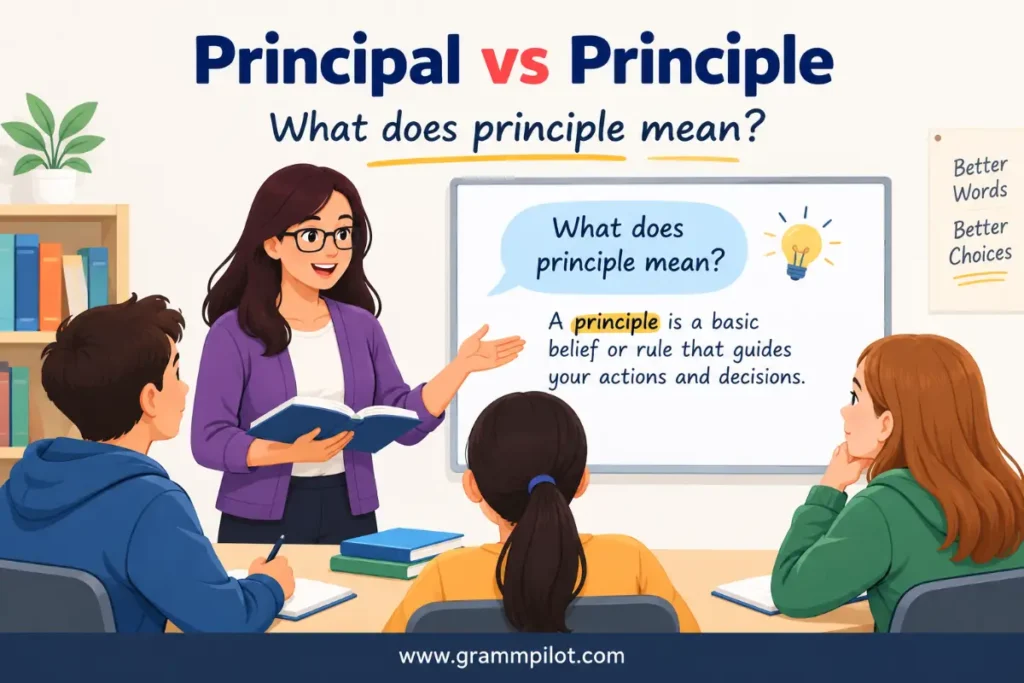
What does principle mean?
A principle is a basic rule, belief, value, or truth.
It often guides how people think or behave.
Examples:
- Honesty is an important principle.
- She refused to lie on principle.
- The company operates according to strong ethical principles.
- Respect is one of his guiding principles.
Unlike principal, principle is almost always connected to ideas, rules, beliefs, or systems.
Principle as a personal belief
People often have principles that guide their decisions.
For example:
- I believe in treating people fairly.
- She believes honesty matters.
- He refuses to cheat, even when nobody is watching.
These beliefs can be described as principles.
Example:
“Fairness is one of my strongest principles.”
Principle as a basic scientific rule
A principle can also explain how something works.
Examples:
- The machine operates on a simple scientific principle.
- Students learned the basic principles of physics.
- The design follows the principles of engineering.
In this context, a principle is a basic idea or law that helps explain a system.
What is the word origin of principal?
Understanding word origins can make confusing words easier to remember. Principal comes from the Latin word principalis, meaning “first,” “chief,” or “most important.”
That explains its modern meanings:
- The principal of a school is the leading person.
- The principal reason is the main reason.
- A principal actor is a leading actor.
- Principal money is the main original amount.
The idea of being first or most important connects all of these meanings.
What is the word origin of principle?
Principle also has roots connected to the idea of beginnings or foundations. It developed from Latin words related to a beginning, source, or foundation. Over time, English speakers began using principle to describe a basic rule or truth that other ideas are built upon.
That is why a principle can be:
- A moral foundation
- A scientific foundation
- A guiding belief
- A basic rule
Although principal and principle have related historical roots, modern English gives them different jobs.
How do you remember principal vs principle?
The most famous memory trick is: The principal is your pal.
Both words contain the letter a:
- principal
- pal
This can help you remember the school meaning.
Another trick is to connect principal with primary.
Both start with the idea of something important:
- Principal = main
- Primary = main
For principle, think about a rule.
A principle is something you believe in or follow.
You can remember: Principle = a rule or belief.
Here is a simple chart:
| If you mean… | Use |
|---|---|
| School leader | Principal |
| Most important | Principal |
| Main reason | Principal |
| Original loan amount | Principal |
| Rule | Principle |
| Belief | Principle |
| Moral value | Principle |
| Scientific law or idea | Principle |
Principal vs Principle: side-by-side comparison
| Feature | Principal | Principle |
|---|---|---|
| Meaning | Main, leading, or most important | Rule, belief, or basic truth |
| Can refer to a person? | Yes | No |
| Used for school leader? | Yes | No |
| Used for beliefs? | No | Yes |
| Used for the main reason? | Yes | No |
| Used in science? | Sometimes in a different context | Yes, for basic rules |
| Used in finance? | Yes | No |
The key question is simple:
Are you describing importance or leadership? Use principal.
Are you describing a belief or rule? Use principle..
Is the school leader principal or principle?
The correct word is always principal.
Correct: “The principal spoke to the students.”
Incorrect: “The principle spoke to the students.”
Why?
Because a school leader is a person in a leading position. Principal can refer to the person who is most important or in charge.
Example in a school email
“Dear Principal Johnson,
Thank you for taking the time to meet with me.”
This is correct because you are addressing the head of the school.
Is it principal reason or principle reason?
The correct phrase is principal reason.
Correct: “The principal reason for the decision was cost.”
Incorrect: “The principle reason for the decision was cost.”
Here, principal means main or most important.
Other common phrases include:
- principal cause
- principal goal
- principal concern
- principal problem
- principal objective
- principal source
Principal vs Principle: What are the best synonyms for principal?
The best synonym depends on the meaning.
Simple synonyms for principal
| Word | Meaning | Tone | Example |
|---|---|---|---|
| Main | Most important | Everyday | The main reason was cost. |
| Chief | Leading or highest | Neutral | The chief concern is safety. |
| Lead | Main or leading | Neutral | She has the lead role. |
| First | Most important in order | Simple | This is our first priority. |
| Top | Highest or most important | Casual | He is a top manager. |
Everyday synonyms for principal
| Word | Meaning | Tone | Example |
|---|---|---|---|
| Major | Very important | Neutral | It was a major issue. |
| Primary | First or most important | Neutral | Safety is our primary goal. |
| Leading | Important or influential | Neutral | She is a leading expert. |
| Central | At the center of importance | Neutral | Trust is central to success. |
| Key | Especially important | Everyday | Communication is a key skill. |
Formal synonyms for principal
| Word | Meaning | Tone | Example |
|---|---|---|---|
| Primary | Main or first | Formal/neutral | The primary objective is growth. |
| Chief | Highest in rank | Formal | The chief objective was safety. |
| Predominant | Most noticeable or important | Formal | The predominant issue was cost. |
| Foremost | Most important | Formal | Education remains a foremost concern. |
| Main | Chief or central | Neutral | The main factor was timing. |
Synonyms for a school principal
A school principal may also be described as:
- School administrator
- Head of school
- School leader
- Headteacher in some regions
- Headmaster or headmistress in traditional usage
The exact title depends on the school system and country.
Principal vs Principle: What are the best synonyms for principle?
Simple synonyms for principle
| Word | Meaning | Tone | Example |
|---|---|---|---|
| Rule | A standard to follow | Everyday | Follow the rules. |
| Belief | Something accepted as true | Neutral | It is her belief. |
| Value | An important moral idea | Neutral | Respect is a core value. |
| Idea | A thought or concept | Simple | The idea is easy to understand. |
| Standard | A level or rule for behavior | Neutral | They follow high standards. |
Everyday synonyms for principle
| Word | Meaning | Tone | Example |
|---|---|---|---|
| Guideline | Advice or direction | Neutral | Follow the safety guidelines. |
| Code | A set of rules | Neutral | The company has a code of conduct. |
| Moral | A lesson about right and wrong | Everyday | The story has a moral. |
| Conviction | A strongly held belief | Strong | She acted on conviction. |
| Ideal | A standard worth aiming for | Positive | Justice is an important ideal. |
Formal synonyms for principle
| Word | Meaning | Tone | Example |
|---|---|---|---|
| Doctrine | An accepted set of beliefs | Formal | The policy follows this doctrine. |
| Tenet | A central belief | Formal | Equality is a key tenet. |
| Precept | A rule that guides behavior | Formal | The lesson teaches a moral precept. |
| Foundation | A basic supporting idea | Formal | Trust is the foundation of teamwork. |
| Ethic | A moral standard | Formal | Professional ethics matter. |
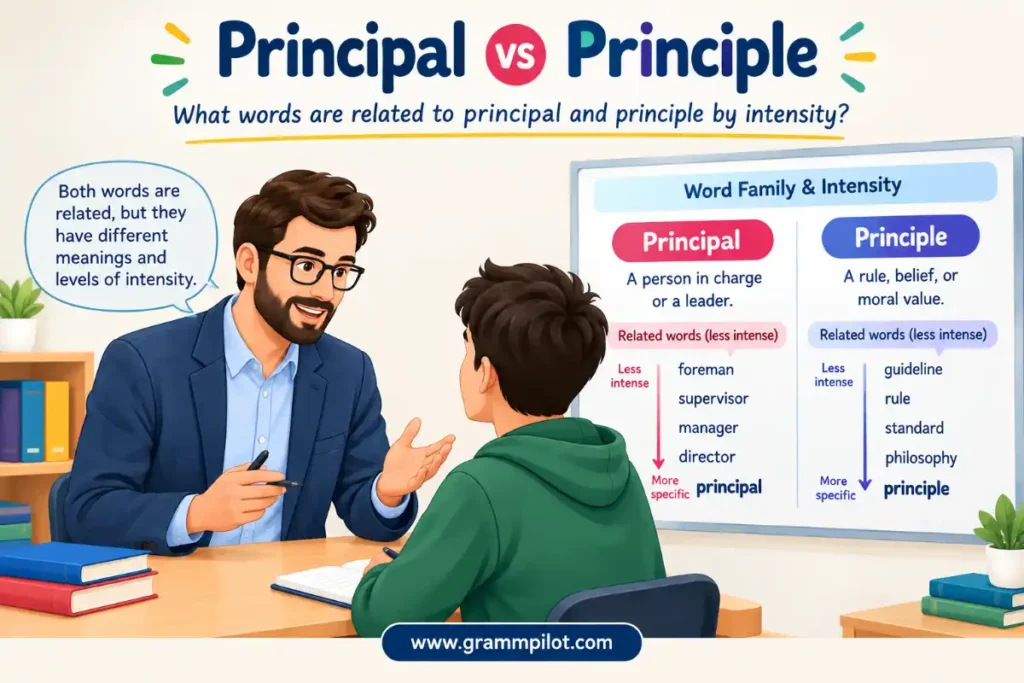
What words are related to principal and principle by intensity?
Not every related word has the same strength.
Mild words for importance
- Important
- Main
- Key
Example: “The main issue is timing.”
Stronger words for importance
- Major
- Primary
- Leading
- Chief
Example: “Safety is the primary concern.”
Strongest or most formal words
- Foremost
- Predominant
- Central
- Paramount
Example: “Public safety is of paramount importance.”
Mild words for beliefs
- Idea
- Opinion
- Preference
These may change easily.
Principal vs primary — what is the difference?
These words are very close. Both can mean main or most important.
Example:
- The principal reason was cost.
- The primary reason was cost.
Both are correct. There can be small differences in tone.
Principal often sounds slightly more formal and may emphasize rank or importance.
Primary can emphasize being first or basic.
Compare:
“The principal concern is safety.”
“The primary concern is safety.”
Both work naturally. In most everyday writing, you can choose the one that sounds best.
Principle vs rule — what is the difference?
A rule is usually specific.
Example: “Students must wear identification badges.”
That is a rule.
A principle is broader.
Example: “Students should be treated fairly.”
That is a guiding principle.
Think of it this way:
- Rule = specific instruction
- Principle = broad guiding idea
Rules may change depending on the situation. Principles often represent deeper values.
Principle vs belief — what is the difference?
These words are related but not identical.
A belief is something a person accepts as true. A principle is a belief or rule that guides behavior.
Example:
Belief: “I believe people can change.”
Principle: “I believe in treating everyone fairly.”
The second statement is more likely to guide actions. A person may have many beliefs but only a few core principles.
How do you use principal on a resume?
When writing a resume, principal can appear in job titles or descriptions.
Examples:
- Principal Engineer
- Principal Designer
- Principal Consultant
- Principal Researcher
In many companies, principal is a senior title. It often means a person has major expertise, responsibility, or leadership.
Example resume sentence: “Led principal design initiatives for major product launches.”
Be careful, though. The meaning depends on the organization. Do not use principal simply as a fancy replacement for “important.”
How do you use principle in an essay?
Essays often discuss principles, especially when the topic involves:
- Ethics
- Politics
- Education
- Science
- Society
- Philosophy
Examples:
“Freedom of speech is a fundamental democratic principle.”
“The experiment demonstrates a basic scientific principle.”
“Equality remains an important principle in discussions about human rights.”
For formal essays, related words such as ethical principle, guiding principle, and fundamental principle are useful.
What are the most common mistakes with these words?
Mistake 1: Writing “principle” for the school leader
Incorrect: “The school principle called my parents.”
Correct: “The school principal called my parents.”
Remember: The principal is your pal.
Mistake 2: Writing “principal” for a moral belief
Incorrect: “Honesty is an important principal.”
Correct: “Honesty is an important principle.”
Honesty is a value or belief, so use principle.
Mistake 3: Forgetting the adjective meaning of principal
Some writers only remember the school meaning.
But these are also correct:
- principal cause
- principal reason
- principal goal
- principal concern
Example: “The principal problem was poor communication.”
Mistake 4: Using the wrong word in finance
Incorrect: “You need to pay the principle.”
Correct: “You need to pay the principal.”
The principal is the original amount of money.
Mistake 5: Confusing “in principle” and “principal”
Correct: “I agree in principle.”
Incorrect: “I agree in principal.”
The phrase refers to an idea or belief, so use principle.
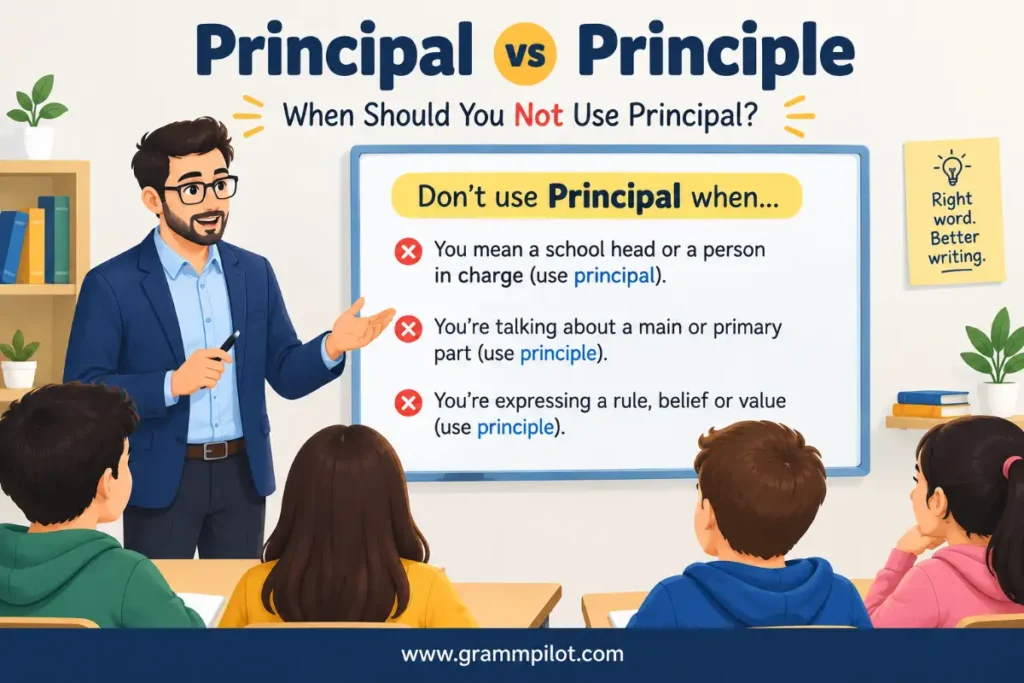
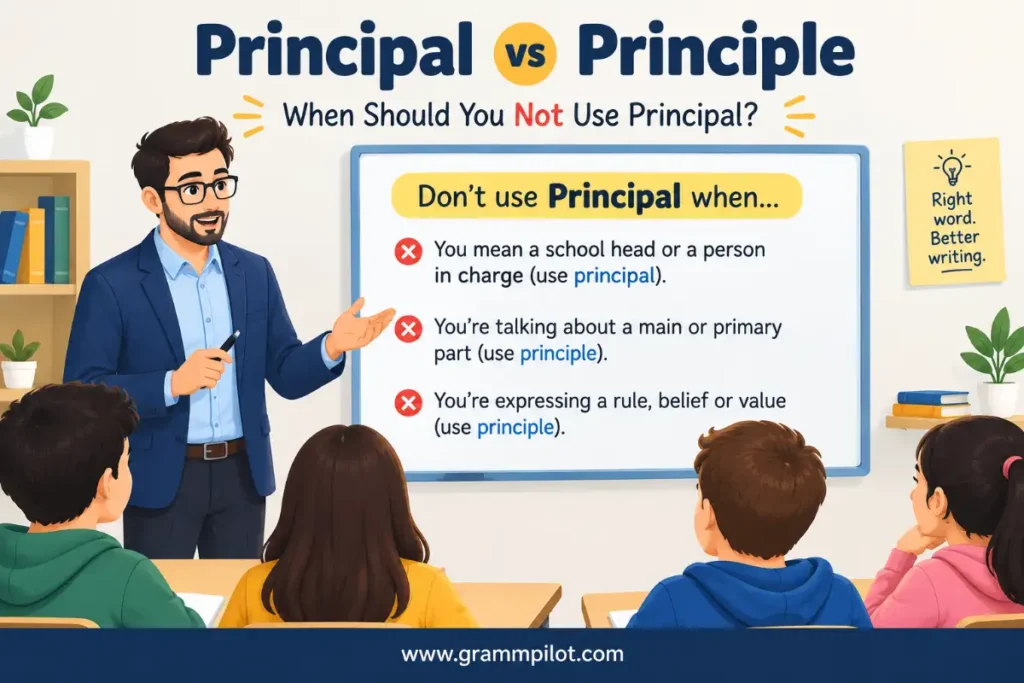
When should you not use principal?
Do not use principal when discussing:
- Moral values
- Personal beliefs
- Ethical rules
- Scientific laws
- General guiding ideas
Incorrect: “My main principal is honesty.”
Correct: “My main principle is honesty.”
You can say: “My principal goal is honesty.”
But this means honesty is your main goal, not your moral rule. That difference can completely change the sentence.
When should you not use principle?
Do not use principle when referring to:
- A school leader
- The main reason
- The most important concern
- The original amount of a loan
- A leading person
Incorrect: “The principle reason was weather.”
Correct: “The principal reason was weather.”
What are the antonyms of principal?
The opposite depends on the meaning.
For principal meaning main:
- Minor
- Secondary
- Lesser
- Unimportant
Example: “The principal issue was cost, while the minor issue was timing.”
For principal meaning leader, possible contrasts include:
- Subordinate
- Assistant
- Junior member
The exact opposite depends on the organizational structure.
What are the antonyms of principle?
A direct opposite is less clear because principle means a rule or belief.
Possible contrasting ideas include:
- Lawlessness
- Lack of standards
- Unprincipled behavior
- Inconsistency
For moral principles, unprincipled describes someone who lacks strong moral standards.
Example:
“His dishonest actions were considered unprincipled.”
Quick tips to avoid the mistake
Keep these tips in mind:
- Principal = person, main, or money.
- Principle = rule, belief, or basic truth.
- Remember: The principal is your pal.
- Use principal reason, not principle reason.
- Use moral principle, not moral principal.
- Use school principal, not school principle.
- Use principal balance in finance.
- Use in principle when discussing agreement with an idea.
- Read the full sentence before choosing.
- Ask what the word actually means in context.
Why do people confuse principal and principle?
The main reason is pronunciation.
In normal speech, both words sound almost exactly the same. That means your ears cannot always help you choose the correct spelling.
The words also look very similar:
- principal
- principle
Both begin with princip-.
The difference appears near the end, where many people may type quickly and choose the wrong version. Spell-check tools may also miss the error because both words are correctly spelled English words.
For example: “The school principle spoke to the students.”
Every word is spelled correctly, but the sentence is wrong. That is why understanding meaning is more useful than relying only on spelling tools.
Practice sentences: can you choose the correct word?
Try these before checking the answers.
- The school ________ welcomed the new students.
- Honesty is an important ________.
- The ________ reason for the delay was traffic.
- The bank explained how much ________ remained.
- Fairness is one of her guiding ________.
- The company follows the ________ of transparency.
- The ________ concern is public safety.
- Our ________ gave a speech during graduation.
Answers
- Principal
- Principle
- Principal
- Principal
- Principles
- Principle
- Principal
- Principal
A final teacher explanation “Principal vs Principle”
The easiest way to master Principal vs Principle is to stop thinking of them as nearly identical words.
Give each word its own clear job.
Principal has three major ideas:
- A person in charge.
- The main or most important thing.
- The original amount of money in finance.
Principle has one central idea:
A rule, belief, value, or basic truth that guides thinking or behavior.
Once you connect each word to its meaning, the spelling becomes easier.
Don’t memorize only one example. Practice with different situations.
Write:
- The principal of the school.
- The principal reason.
- The principal balance.
- A moral principle.
- A guiding principle.
- A scientific principle.
This kind of practice trains your brain to notice context instead of guessing from sound.
Conclusion
Principal vs Principle becomes much easier once you focus on meaning instead of pronunciation. Use principal for a school leader, the main or most important thing, or the original amount of money. Use principle for a rule, belief, value, or basic truth.
The most useful memory trick is simple: the principal is your pal. Then check the rest of the sentence. If you are talking about honesty, fairness, science, or a guiding rule, choose principle. With a little practice, these two confusing words will become easy to separate, If you’re writing an essay, email, school assignment, or professional document.
Frequently Asked Questions
1. What is the main difference between principal and principle?
Principal usually means a person in charge, something most important, or the original amount of money. Principle means a rule, belief, value, or basic truth.
2. Is it school principal or school principle?
The correct phrase is school principal. A principal is the person who leads or manages a school.
3. Is it principal reason or principle reason?
The correct phrase is principal reason. Here, principal means the main or most important reason.
4. What’s another way to say principal?
Depending on the context, you can say main, primary, chief, leading, central, or key. For a school principal, alternatives may include school administrator or head of school.
5. What’s another way to say principle?
Depending on the context, you can use rule, belief, value, standard, guideline, tenet, or guiding idea. The best choice depends on how formal the situation is.
6. What is the easiest trick for remembering Principal vs Principle?
Remember: The principal is your pal. Both principal and pal contain the letter a. Use principle for a rule or belief.
7. Can principal and principle be used in the same sentence?
Yes. For example: “The principal explained that honesty is an important principle.” The first word refers to the school leader, while the second refers to a moral belief.