
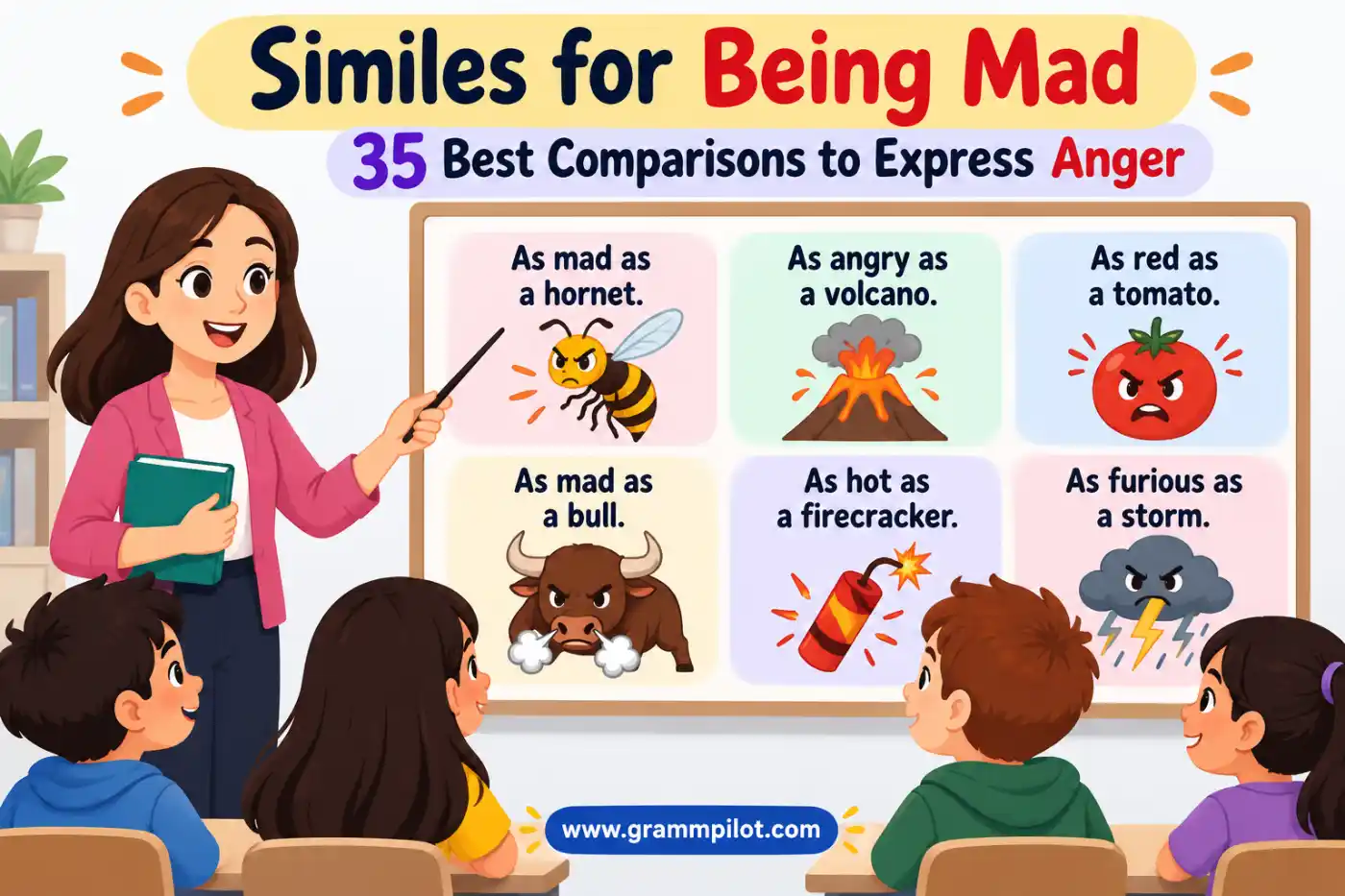
Imagine you’re writing an angry email, describing an argument in an essay, or telling a friend about someone who completely lost their temper. You could simply say, “I was angry.” But what if you want your reader to feel that anger, picture it, and understand how intense it was? That’s where Similes for Being Mad can help. A strong comparison can turn an ordinary sentence into something vivid, memorable, and full of emotion. Instead of saying someone was furious, you might describe them as being “as hot as a volcano ready to erupt.”
Similes for Being Mad compare anger to familiar things, such as a raging storm, a boiling kettle, or a blazing fire. They help readers picture how anger feels, how it builds, and how it affects a person’s words and actions. These comparisons work in stories, poems, school essays, conversations, and even humorous texts. The best choice depends on if you want to express mild irritation, growing frustration, intense rage, or anger that someone is struggling to control. In this guide, you’ll find 35 original comparisons, a useful vocabulary list, examples for different situations, differences between similar expressions, and practical tips for choosing the right words.
You can find more examples of figurative language in Similes for Being Scared.
What Does a Simile for Being Mad Mean?
A simile is a figure of speech that compares two different things using words such as like or as. It helps readers understand an emotion by connecting it to something they already know.
For example:
- He was as angry as a bull in a china shop.
- Her temper flared like a match in the dark.
- I felt like a pressure cooker ready to burst.
Each sentence connects anger with a familiar image. A bull suggests force and unpredictability. A match suggests a sudden reaction. A pressure cooker suggests frustration building under pressure. These comparisons do more than tell readers that someone is upset. They show the possible strength, speed, and effects of that emotion.
What Are Some Examples of Anger Similes?
Here are ten useful examples to get started.
- He was as hot as a volcano ready to erupt.
- She exploded like a firecracker on the Fourth of July.
- I felt like a kettle about to whistle.
- His anger rolled in like a thunderstorm.
- She was as fierce as a lion protecting its cubs.
- My frustration bubbled like boiling water.
- He snapped like a dry twig under pressure.
- Her words flew like sparks from a fire.
- I was as tense as a stretched rubber band.
- He burned with anger like a forest fire spreading through dry leaves.
Some comparisons describe sudden anger, while others show an emotion that builds slowly. Understanding this difference helps you choose the most effective expression for your sentence.
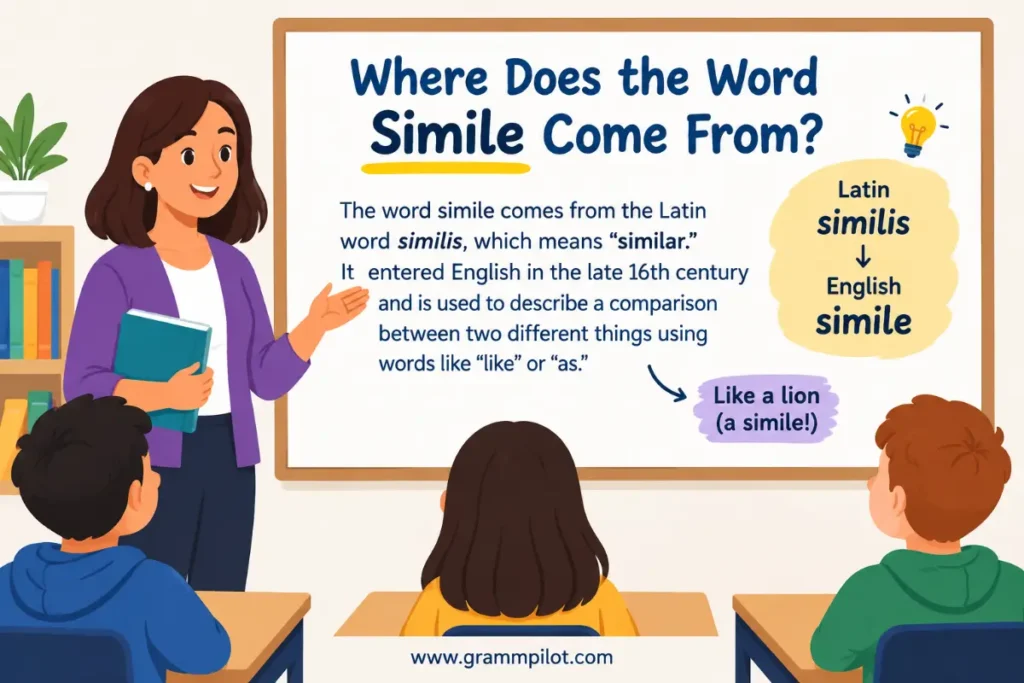
Where Does the Word Simile Come From?
The word simile comes from the Latin word similis, meaning “like” or “similar.” This origin reflects the main purpose of a simile: to show a resemblance between two things. Writers have used comparisons for centuries to explain feelings, describe people, and make stories easier to imagine. Anger is especially suitable for figurative language because it can feel physical, even though it is an emotion. Think about what happens when someone gets angry. Their face may become red, their voice may grow louder, their hands may tighten, and their thoughts may race. These experiences provide familiar images for describing anger.
For example, a writer might compare anger to:
- Fire: The emotion burns and spreads.
- A storm: The emotion arrives with force and noise.
- Boiling water: Pressure builds until a reaction occurs.
- A trapped animal: The person feels cornered or threatened.
- An explosion: The emotion erupts suddenly.
These images are not literal descriptions. An angry person does not become a storm or a fire. The comparison helps the reader imagine the feeling.
What Is the Difference Between a Simile and a Metaphor?
A simile makes a comparison using like or as. A metaphor describes one thing as another without using those comparison words.
| Type | Example | How it works |
|---|---|---|
| Simile | His anger was like a wildfire. | Directly compares anger to a wildfire. |
| Metaphor | His anger was a wildfire. | Describes anger as a wildfire. |
| Literal statement | He was extremely angry. | Names the emotion without a figurative comparison. |
Both similes and metaphors can make writing powerful. However, if your assignment specifically asks for similes, make sure your comparisons use like or as in a meaningful way.
What Are the 35 Best Similes for Being Mad?
The following comparisons cover different forms of anger, from a small flash of irritation to overwhelming fury. Each includes a meaning and an example so you can use it correctly.
1. As Hot as a Volcano Ready to Erupt
Intensity: Very strong
This simile describes someone whose anger has reached a dangerous or explosive level.
Example: After hearing the accusation, Mark was as hot as a volcano ready to erupt.
Use it when a character is close to losing control.
2. Like a Firecracker About to Explode
Intensity: Strong and sudden
A firecracker suggests a quick, noisy burst of emotion. This comparison works when someone reacts sharply to an unexpected problem.
Example: She was like a firecracker about to explode when her brother broke her favorite headphones.
3. Like a Boiling Kettle
Intensity: Building anger
A kettle gradually heats before producing a whistle. The image captures frustration that grows until the person can no longer keep quiet.
Example: I sat through the unfair meeting, feeling like a boiling kettle.
4. Like a Raging Thunderstorm
Intensity: Strong and forceful
A thunderstorm brings noise, movement, and sudden changes. This simile suits someone whose anger fills a room.
Example: His voice crashed through the office like a raging thunderstorm.
5. As Fierce as a Lion Protecting Its Cubs
Intensity: Strong and protective
This comparison describes anger that comes from protecting someone or something important.
Example: She was as fierce as a lion protecting its cubs when a bully targeted her younger sister.
6. Like a Pressure Cooker Ready to Burst
Intensity: Long-lasting and intense
A pressure cooker represents stress that keeps building. This simile is useful when a person has tolerated repeated problems without expressing their frustration.
Example: After weeks of extra work and little appreciation, Daniel felt like a pressure cooker ready to burst.
7. Like Sparks Flying From a Fire
Intensity: Sharp and energetic
Sparks suggest quick, heated reactions. The comparison works particularly well for angry words or a tense conversation.
Example: Their argument grew louder, with accusations flying like sparks from a fire.
8. As Red as a Tomato
Intensity: Visible anger or embarrassment
This familiar comparison focuses on a person’s flushed face. It can describe anger, embarrassment, or a mixture of both.
Example: He turned as red as a tomato when his classmates laughed at his mistake.
9. Like a Wildfire Spreading Through Dry Grass
Intensity: Spreading anger
A wildfire spreads rapidly and can become difficult to control. This comparison describes anger that moves from one person or problem to another.
Example: Rumors spread through the team like a wildfire, and resentment soon followed.
10. Like a Tightly Stretched Rubber Band
Intensity: Tense and frustrated
A stretched rubber band suggests someone under pressure who may react if pushed further.
Example: By the end of the long school day, I felt like a tightly stretched rubber band.
11. As Angry as a Bull Facing a Red Cape
This simile suggests a forceful, dramatic reaction. It works well in playful storytelling, although the idea that bulls are naturally provoked by red is a common misconception; the movement of the cape is what attracts their attention.
Example: He charged into the debate as angry as a bull facing a moving cape.
12. Like a Storm Trapped Behind Closed Windows
This image describes anger that remains inside rather than being openly expressed.
Example: She smiled politely, but inside she felt like a storm trapped behind closed windows.
13. Like Water Bubbling in a Hot Pot
This comparison suggests frustration that grows gradually.
Example: My irritation bubbled like water in a hot pot as the train announcement was delayed again and again.
14. As Sharp as a Thorn
This simile focuses on the way anger can make someone’s words hurt.
Example: His reply was as sharp as a thorn when I asked about the missing report.
15. Like a Match Striking Dry Wood
This comparison describes anger that starts quickly after a small trigger.
Example: One careless joke set off her temper like a match striking dry wood.
16. Like a Caged Tiger
A caged tiger suggests restless, frustrated energy and a feeling of being trapped.
Example: He paced the hallway like a caged tiger while waiting for the unfair decision to be reversed.
17. As Fierce as a Blazing Furnace
A furnace produces intense heat, making this comparison suitable for powerful, sustained anger.
Example: Her determination burned as fierce as a blazing furnace when she challenged the dishonest manager.
18. Like a Pot Left to Boil Too Long
This simile describes irritation that has been ignored until it spills over.
Example: His patience was like a pot left to boil too long; one more complaint made him shout.
19. Like a Thunderclap on a Quiet Night
This image captures anger that arrives suddenly and surprises everyone.
Example: Her angry response landed like a thunderclap on a quiet night.
20. As Unsteady as a Leaf in a Strong Wind
This comparison emphasizes the nervous energy that can accompany anger.
Example: His hands shook as unsteadily as leaves in a strong wind while he tried to explain what had happened.
21. Like a Volcano Smoldering Beneath the Surface
Unlike an erupting volcano, a smoldering one suggests hidden anger that has not yet burst out.
Example: She remained silent, but resentment smoldered like a volcano beneath the surface.
22. Like a Broken Alarm That Won’t Stop Ringing
This humorous comparison describes persistent irritation that keeps returning.
Example: My mind replayed the rude comment like a broken alarm that wouldn’t stop ringing.
23. As Cold as Ice After a Betrayal
Not all anger is loud or hot. Sometimes it appears as distance, silence, or a refusal to forgive.
Example: After discovering the lie, he became as cold as ice toward his former friend.
24. Like a Dark Cloud Blocking the Sun
This simile describes anger that changes someone’s mood and affects the atmosphere around them.
Example: The unfair criticism hung over Maya like a dark cloud blocking the sun.
25. Like a Pressure Gauge Climbing Toward the Red Zone
This comparison suggests anger rising toward a breaking point.
Example: With every interruption, my frustration climbed like a pressure gauge approaching the red zone.
26. As Explosive as Dynamite
This simile conveys a powerful reaction that can occur with little warning.
Example: His temper was as explosive as dynamite when he realized someone had damaged his car.
Use it carefully because it suggests a very intense response.
27. Like a Wave Crashing Against a Cliff
This image describes anger that comes in a powerful rush, often after repeated disappointment.
Example: Her frustration struck like a wave crashing against a cliff when the project was canceled.
28. Like a Drum Beating Faster and Faster
This comparison focuses on the physical tension that may accompany anger.
Example: My heart pounded like a drum beating faster and faster as I prepared to confront the person who had lied.
29. As Fiery as the Sun at Noon
This simile emphasizes heat and intensity without necessarily suggesting an explosion.
Example: His anger was as fiery as the midday sun when he learned that the agreement had been broken.
30. Like a Door Slamming in a Quiet House
This comparison describes an abrupt reaction that interrupts a peaceful moment.
Example: Her refusal came like a door slamming in a quiet house.
31. Like a Pot of Milk Boiling Over
This simile suggests that a person has reached their limit after trying to remain patient.
Example: When the fourth customer complained about the same delay, his patience boiled over like milk in a forgotten saucepan.
32. As Stubborn as a Mule
This comparison focuses on an angry person’s refusal to listen or change their position.
Example: He was as stubborn as a mule during the argument and wouldn’t consider another explanation.
33. Like Ice Cracking Under Pressure
This image suggests that someone’s calm appearance is beginning to break.
Example: Her controlled expression started to crack like ice under pressure as the questions became more personal.
34. Like a Tornado Sweeping Through a Room
This simile describes anger that creates confusion and disruption.
Example: He stormed through the kitchen like a tornado, complaining about everything he saw.
35. Like a Fire That Refuses to Die
This comparison represents anger that continues long after the original disagreement.
Example: Even after they apologized, resentment remained like a fire that refused to die.
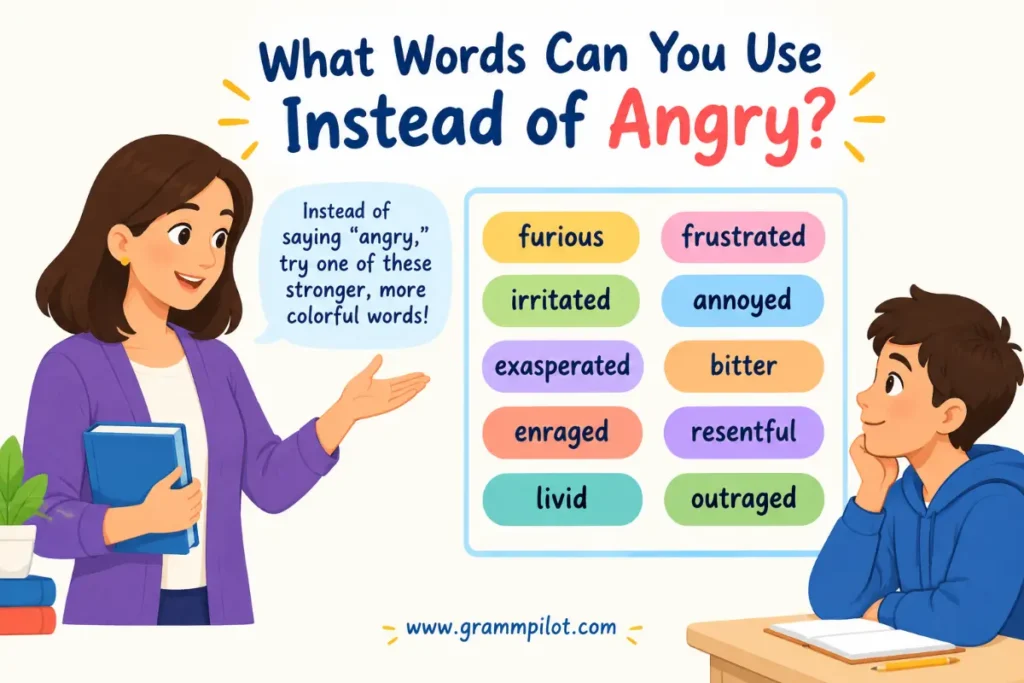
What Words Can You Use Instead of Angry?
A useful vocabulary list helps you choose a precise word instead of repeating angry in every sentence. The best alternative depends on the strength of the emotion, the situation, and the tone of your writing.
The following table includes 30 words and expressions grouped by their usual tone. Their meanings can overlap, so consider the context before replacing one with another.
Simple Words for Anger
| Word | Meaning | Tone | Example |
|---|---|---|---|
| Mad | Angry or upset | Informal | I was mad about the broken promise. |
| Angry | Feeling displeasure or hostility | Neutral | She was angry about the unfair rule. |
| Upset | Emotionally troubled | Mild | He was upset by the comment. |
| Annoyed | Slightly angry | Mild | I was annoyed by the constant noise. |
| Irritated | Made impatient or uncomfortable | Mild to moderate | She felt irritated by the delay. |
| Cross | Angry or annoyed | Common in British English | Dad was cross about the mess. |
| Frustrated | Upset because something is difficult or blocked | Everyday | He felt frustrated by the slow website. |
| Bothered | Troubled or concerned | Mild | She seemed bothered by the decision. |
Everyday Words for Anger
| Word | Meaning | Tone | Example |
|---|---|---|---|
| Furious | Extremely angry | Strong | He was furious about the accusation. |
| Enraged | Filled with intense anger | Very strong | The unfair treatment left her enraged. |
| Livid | Extremely angry | Strong, informal | I was livid when the ticket disappeared. |
| Irrate | Make someone angry | Verb | The repeated delays began to irritate us. |
| Resentful | Angry about unfair treatment or a past event | Lingering | He felt resentful about being overlooked. |
| Bitter | Holding onto anger or disappointment | Lingering | She sounded bitter about the betrayal. |
| Indignant | Angry because something seems unjust | Formal-leaning | He was indignant about the false claim. |
| Outraged | Extremely angry about something offensive or unfair | Strong | Residents were outraged by the decision. |
Formal Words for Anger
| Word | Meaning | Tone | Example |
|---|---|---|---|
| Incensed | Extremely angry | Formal | The director was incensed by the breach. |
| Irate | Very angry | Formal | An irate customer requested a refund. |
| Agitated | Disturbed or emotionally unsettled | Formal | She became agitated during the discussion. |
| Hostile | Unfriendly or antagonistic | Formal | The conversation turned hostile. |
| Exasperated | Extremely frustrated or impatient | Formal | I was exasperated by the repeated errors. |
| Displeased | Not satisfied or pleased | Polite, formal | The supervisor was displeased with the results. |
| Resentful | Feeling lasting bitterness | Formal-leaning | The employee felt resentful after being excluded. |
| Indignant | Offended by perceived unfairness | Formal-leaning | She gave an indignant response to the charge. |
A small distinction matters: irate and incensed describe anger, while hostile describes an unfriendly or aggressive attitude that may result from anger. Likewise, frustrated often describes difficulty or blocked progress rather than anger alone.
Which Words Describe Anger From Mild to Strong?
Anger is not one single feeling. It can begin as a small annoyance, develop into frustration, and eventually become intense rage. Choosing a word that matches the strength of the emotion makes your writing more believable.
| Level | Useful words | Example |
|---|---|---|
| 1. Mild | Bothered, annoyed, displeased | I was annoyed by the late delivery. |
| 2. Moderate | Irritated, frustrated, cross | She felt frustrated by the repeated mistake. |
| 3. Strong | Angry, resentful, indignant | He was indignant about the unfair accusation. |
| 4. Very strong | Furious, livid, irate | The customer was livid about the hidden charge. |
| 5. Extreme | Enraged, incensed, outraged | The community was outraged by the harmful decision. |
These levels are a practical guide, not a strict scientific scale. For example, someone can be deeply resentful without shouting, while another person may shout because of a brief frustration.
What Is the Difference Between Annoyed and Furious?
Annoyed usually describes a mild or moderate reaction. Furious describes extremely intense anger.
Compare these sentences:
- Annoyed: I was annoyed when my brother borrowed my charger without asking.
- Furious: I was furious when my brother deliberately damaged my laptop and blamed me.
The first situation may be irritating but easy to resolve. The second involves greater harm and a stronger emotional response.
What Is the Difference Between Frustrated and Enraged?
Frustrated means upset because something is difficult, delayed, or preventing progress. Enraged means filled with powerful anger.
For example:
- Frustrated: She was frustrated because the application kept crashing.
- Enraged: She was enraged when someone deliberately destroyed her work.
Frustration often comes from obstacles. Rage often comes from a perceived serious wrong, threat, or provocation, though the causes can vary.
What Is the Difference Between Resentful and Indignant?
Resentful describes anger that can last over time, especially after perceived unfair treatment. Indignant describes anger caused by something a person considers unjust or offensive.
Examples:
- Resentful: He remained resentful because his contributions were never recognized.
- Indignant: She was indignant when the manager falsely accused her of cheating.
Resentment often lingers, while indignation can be an immediate response to unfairness.
How Do Similes for Being Mad Change With Context?
The same comparison can sound powerful in a story but exaggerated in a work email. Think about your audience before choosing a figurative expression.
For Mild Irritation
Use comparisons that suggest pressure, discomfort, or a small spark rather than total destruction.
Examples:
- I was like a kettle beginning to warm up after the third interruption.
- Her patience stretched like a rubber band during the long wait.
- His irritation bubbled like water in a small saucepan.
These images are useful when a character is annoyed but still trying to remain calm.
For Sudden Anger
Choose comparisons that suggest speed, surprise, and force.
Examples:
- His temper snapped like a twig.
- Her reply burst out like a firecracker.
- The accusation hit him like a sudden thunderclap.
These expressions work well when a character reacts immediately to shocking news or an insulting remark.
For Hidden Anger
Use images that suggest something held inside, concealed, or slowly building.
Examples:
- Her anger smoldered like a fire beneath a layer of ash.
- He carried resentment like a storm cloud that never moved away.
- She felt like a sealed pot with steam gathering inside.
These comparisons are especially useful for characters who appear calm but have unresolved feelings.
For Uncontrolled Rage
Use powerful images, but avoid making every angry character sound violent.
Examples:
- His temper swept through the room like a tornado.
- She felt as though a volcano were erupting inside her.
- His words came out like sparks from a raging furnace.
Such descriptions are suitable for dramatic scenes. In everyday writing, a simpler word may communicate the situation more naturally.

How Can You Describe Anger by Part of Speech?
The part of speech determines how a word fits into your sentence. You can describe a person, show an action, or explain how something happens.
| Part of speech | Useful words | Example |
|---|---|---|
| Nouns | Anger, rage, fury, irritation, resentment | His anger grew after the accusation. |
| Adjectives | Angry, furious, irate, annoyed, resentful | The furious customer demanded an explanation. |
| Verbs | Fume, seethe, snap, flare, bristle | She began to seethe when she heard the rumor. |
| Adverbs | Angrily, furiously, irritably, bitterly | He replied angrily to the message. |
Some words have more than one grammatical use. Anger can be a noun or a verb, while annoyed is commonly used as an adjective or participle.
How Do You Use Similes With Anger Verbs?
Anger verbs describe how a person reacts or how the emotion develops.
Examples:
- His temper flared like dry grass catching fire.
- She seethed like a pot of water over a hot flame.
- He snapped like a twig under pressure.
- Frustration spread through the group like a fast-moving storm.
- Her anger simmered like soup left on the stove.
Notice that the verb does much of the work. Flared suggests a sudden rise, while simmered suggests a quieter emotion that continues beneath the surface.
How Do You Use Similes With Angry Adjectives?
Adjectives describe the person’s emotional state.
Examples:
- He was as furious as a storm at sea.
- She looked as irritated as a cat disturbed during a nap.
- I felt as tense as a wire pulled too tightly.
- They were as indignant as judges hearing an unfair accusation.
The comparison should add a clear image rather than repeat the adjective’s meaning without adding anything.
What Are the Best Words for Anger in Different Situations?
Different situations call for different levels of formality. A resume, school essay, text message, and conversation do not use language in the same way.
What Should You Write in a Resume?
A resume rarely benefits from emotional descriptions such as furious, livid, or pissed off. Instead, describe the professional action you took.
Weak: I was furious when the team missed its deadline.
Better: I addressed repeated scheduling problems and helped the team establish clearer deadlines.
The second sentence focuses on a useful skill rather than a personal reaction. If you are describing a conflict in an interview, explain the problem, your response, and the result.
What Should You Write in an Essay?
In an academic essay, choose precise words such as indignant, resentful, frustrated, or outraged when the context supports them.
Example: The character becomes increasingly resentful as her family continues to dismiss her concerns.
For a creative essay, a figurative comparison may be more effective.
Example: His anger simmered like a pot left on the stove, growing stronger each time his concerns were ignored.
Avoid using several dramatic comparisons in the same paragraph. One well-chosen image usually has more impact than a long series of them.
What Should You Say in a Text Message?
Text messages can be direct and informal. Phrases such as I’m annoyed, I’m upset, I’m fed up, and I’m really frustrated sound natural.
Examples:
- “I’m pretty annoyed that you canceled at the last minute.”
- “I’m fed up with making plans that never happen.”
- “That comment really upset me.”
- “I’m angry, and I need a little time before we talk.”
You can use a funny comparison with a close friend, such as “I’m a boiling kettle right now.” However, make sure the humor fits the situation.
What Should You Write in an Email?
In professional emails, describe the issue and its effect rather than attacking the person.
Instead of: “I’m furious that you ignored my request.”
Try: “I’m concerned that my earlier request hasn’t been addressed. Could you please provide an update by Friday?”
If you need to be firmer, write: “I’m disappointed that the agreed deadline was missed. Please confirm how we can prevent another delay.”
These alternatives communicate dissatisfaction without escalating the conflict unnecessarily.
What Words Work Best in Everyday Speaking?
In conversation, ordinary expressions are often the clearest choice.
Examples:
- “I’m annoyed about the noise.”
- “That really frustrated me.”
- “I’m upset about what happened.”
- “I was furious when I found out.”
- “I’m fed up with the excuses.”
For storytelling, you can add a comparison: “I was so frustrated that I felt like a pressure cooker.” It sounds conversational because it uses a familiar image to explain a difficult feeling.
What Are More Original Examples of Anger Similes in Real Situations?
The strongest examples connect an emotion to a specific event. These sentences show how figurative comparisons work in everyday life, school, relationships, and fiction.
1. At school: Mia felt like a kettle ready to whistle when her group ignored every suggestion she made.
2. At work: After the fourth change to the schedule, Jamal’s patience stretched like a rubber band pulled to its limit.
3. In a family argument: Dad’s voice rumbled like thunder when he discovered that the garage door had been left open overnight.
4. During a sports game: The coach was as tense as a wire pulled tight after the referee canceled the winning goal.
5. In a friendship: Her disappointment smoldered like a fire beneath the ashes after she learned that her friend had shared a secret.
6. In a crowded store: The customer became as hot as a stove when the cashier charged her twice.
7. While driving: My frustration rose like floodwater as the traffic jam stretched beyond the next exit.
8. During an online meeting: His irritation crackled like electricity when three people interrupted him at once.
9. After a broken promise: Her anger spread through her thoughts like a storm cloud covering the sky.
10. In a mystery story: The detective’s fury burned like a hidden ember when he realized the witness had lied.
These examples show that anger does not always need to look like fire or an explosion. Pressure, coldness, storms, tension, and heavy objects can also communicate the feeling.
What Are the Common Mistakes When Using Anger Similes?
Figurative language can make writing memorable, but an unsuitable comparison may confuse readers or make a sentence sound unnatural.
Mistake 1: Using a Metaphor When a Simile Is Required
Incorrect for a simile-only assignment: His anger was a volcano.
Correct simile: His anger was like a volcano ready to erupt.
The first sentence is a metaphor. The second uses like to make the comparison explicit.
Mistake 2: Choosing a Comparison That Is Too Strong
Not every disagreement involves uncontrollable rage.
Overstated: I was as explosive as dynamite because my tea was slightly cold.
More natural: I was mildly annoyed that my tea had gone cold.
Match the intensity of the comparison to the event.
Mistake 3: Mixing Images Without a Clear Purpose
Confusing: Her anger was a boiling ocean, a blazing refrigerator, and a flying mountain.
Better: Her anger surged like a storm-tossed ocean.
A clear image helps readers understand the emotion. Too many unrelated images distract them.
Mistake 4: Using the Same Fire Comparison Repeatedly
Fire is a natural image for anger, but repeating flames, sparks, wildfires, and volcanoes in every paragraph can make your writing predictable.
Try different images:
- A stretched rubber band for tension.
- A dark cloud for a change in mood.
- A slammed door for an abrupt reaction.
- Ice cracking for a calm appearance beginning to break.
Variety makes your descriptions more interesting.
Mistake 5: Confusing Anger With Other Emotions
Anger can occur alongside sadness, fear, shame, or disappointment, but these emotions are not identical.
For example, “She was as nervous as a rabbit” describes anxiety more clearly than anger. “He was as heartbroken as a person losing a treasured memory” emphasizes sadness.
Choose an image that matches the feeling you actually want to communicate.
What Are the Antonyms of Angry?
Antonyms are words with opposite or contrasting meanings. They can help you show how a character’s mood changes after an argument or how a tense situation becomes peaceful.
| Antonym | Meaning | Example |
|---|---|---|
| Calm | Peaceful and not agitated | She stayed calm during the disagreement. |
| Patient | Able to tolerate delay or difficulty | He remained patient while the issue was resolved. |
| Pleased | Feeling satisfaction or approval | They were pleased with the final decision. |
| Content | Satisfied with a situation | She felt content after the conversation. |
| Friendly | Kind and welcoming | He gave his neighbor a friendly greeting. |
| Forgiving | Willing to let go of resentment | She was forgiving after the honest apology. |
| Peaceful | Free from conflict or disturbance | The room became peaceful again. |
| Relaxed | Free from tension | He looked relaxed after the problem was solved. |
These words are not accurate opposites in every situation. Someone may remain angry while acting calmly, and a person can be friendly without feeling especially pleased. Choose the word that best describes the emotion or behavior in your sentence.
How Can You Choose the Right Simile for Anger?
The best comparison is the one that communicates the emotion clearly without distracting the reader.
Use these practical tips when writing a story, essay, poem, or message.
- Identify the intensity. Decide about the feeling is mild irritation, strong frustration, or overwhelming rage.
- Think about the cause. Anger from betrayal may feel different from anger caused by a small inconvenience.
- Choose a matching image. Use a spark for a sudden reaction, a pressure cooker for growing frustration, or a storm for powerful emotion.
- Consider the character. A quiet character may hide anger, while an outspoken character may express it immediately.
- Match the audience. A school essay may call for a clear comparison, while a humorous text can use a playful one.
- Keep the sentence natural. Read it aloud. If the comparison sounds awkward, simplify it.
- Avoid unnecessary exaggeration. A small annoyance does not always need a volcano.
- Use one strong image. Give readers enough detail to picture the feeling without overwhelming them.
- Vary your vocabulary. Combine figurative language with precise words such as irritated, resentful, or indignant.
- Show what happens next. Describe a clenched jaw, a pause, a sharp reply, or a character walking away to make the emotion feel real.
A useful writing trick is to ask yourself what the anger feels like in that particular moment. Is it hot, heavy, restless, sharp, cold, or explosive? Your answer can lead you to a more original comparison.
For example, instead of writing “She was very angry,” you could write, “Her frustration tightened around her like a rope pulled too hard.” This image suggests pressure and discomfort without relying on a familiar fire comparison.
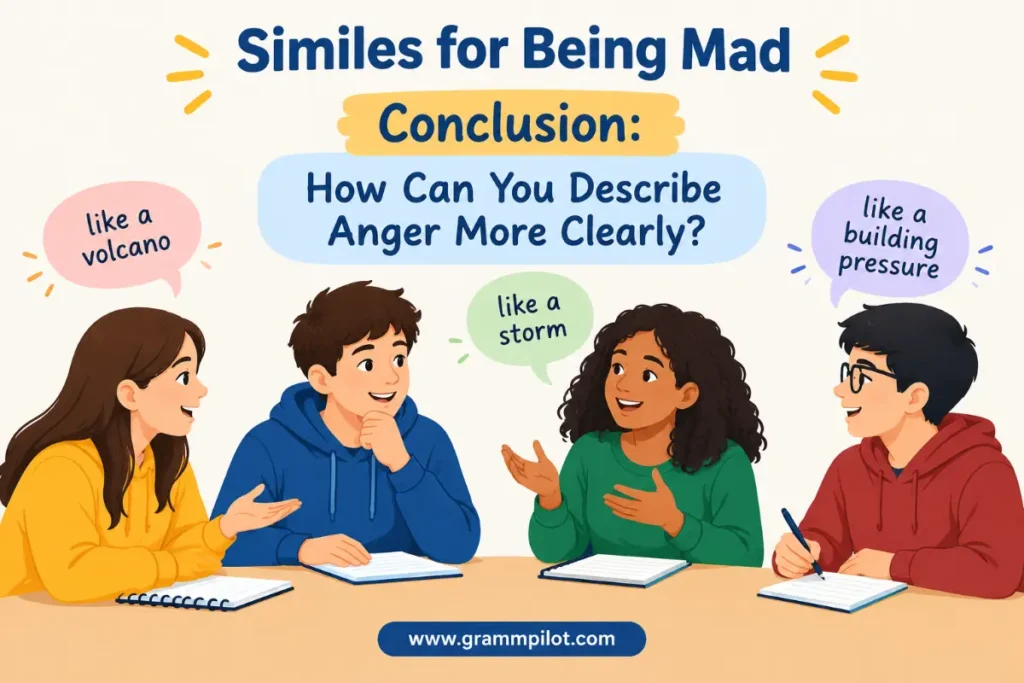
Conclusion: How Can You Describe Anger More Clearly?
Similes for Being Mad help turn a general emotion into a clear picture that readers can understand and remember. A volcano can represent intense rage, a boiling kettle can show growing frustration, and ice cracking under pressure can describe someone whose calm appearance is beginning to break. The most effective comparison depends on the situation. Choose a mild image for everyday irritation, a powerful image for a dramatic confrontation, and a quieter comparison for anger that remains hidden. Remember that anger can involve disappointment, unfairness, fear, or a feeling of being ignored, so the cause matters as much as the intensity. You don’t need to make every sentence dramatic. Sometimes a simple description is best; at other times, one original comparison can transform an ordinary paragraph. Practice matching the image to the emotion, and your writing will become clearer, more expressive, and more natural.
Frequently Asked Questions
1. What are the best similes for being mad?
Some effective examples are “as hot as a volcano ready to erupt,” “like a boiling kettle,” and “like a storm trapped behind closed windows.” Each expresses a different kind of anger, from explosive rage to hidden frustration.
2. What’s another way to say someone is very angry?
You can say someone is furious, enraged, livid, irate, or outraged. Choose the word that best fits the strength and cause of the emotion.
3. How do you describe anger in creative writing?
Describe the person’s feelings, actions, and surroundings, then choose a comparison that fits the moment. For example, “His anger simmered like a pot left on the stove” suggests a growing emotion that has not yet erupted.
4. What is a simile for someone losing their temper?
“She exploded like a firecracker” is a useful simile for someone who suddenly loses their temper. It suggests a quick, intense reaction.
5. Can you use similes for being mad in a school essay?
Yes, similes can make a creative or descriptive essay more vivid. For example, “His frustration rose like a storm over the sea” communicates more than simply saying he was angry.
6. What is the difference between anger and rage?
Anger is a broad emotion that can range from mild irritation to intense displeasure. Rage describes a much stronger form of anger, often involving overwhelming emotional intensity.
7. How can I describe anger without using fire or storms?
Try comparisons involving pressure, tension, silence, coldness, or movement. For example, “Her patience stretched like a rubber band” shows growing frustration without using a fire or storm image.