
Have you ever tried to describe a dog in an essay, story, or text message but struggled to find the right words? You might write that a dog is friendly, fast, playful, or loyal. These words are useful, but a good comparison can make your description much more interesting.Dog Similes help readers picture a dog’s behavior, appearance, and personality. A dog can be as loyal as a best friend, as playful as a child, or as quick as lightning. Each comparison creates a different image in the reader’s mind.
A simile compares two different things using words such as like or as. Instead of simply saying that a dog runs quickly, you could say, “The dog ran like the wind.” This comparison gives the sentence more energy and helps readers imagine the action. Dog similes are comparisons that describe a dog’s looks, actions, or personality using words such as “like” or “as.” They make writing more vivid, emotional, and memorable. In this guide, you’ll discover more than 50 original comparisons, learn where the word simile comes from, explore alternatives by tone and intensity, and see how to use these expressions in essays, stories, emails, and everyday conversations.
For more creative descriptions and comparisons, read Similes for Being Mad.
What Are the Best Dog Similes and What Do They Mean?
The best comparison depends on what you want your reader to imagine. Some expressions describe speed, while others highlight loyalty, excitement, fear, or a dog’s appearance.
Here are 15 useful examples to start with.
| Dog simile | Meaning | Example sentence |
|---|---|---|
| As loyal as a best friend | Very faithful | Max was as loyal as a best friend. |
| Like the wind | Extremely fast | The puppy raced like the wind. |
| As playful as a child | Full of energy and fun | The little dog was as playful as a child. |
| As quiet as a mouse | Very quiet | The nervous dog sat as quiet as a mouse. |
| As brave as a lion | Very courageous | The small dog was as brave as a lion. |
| Like a furry shadow | Always following someone | Our dog followed Dad like a furry shadow. |
| As hungry as a wolf | Extremely hungry | After the walk, the dog was as hungry as a wolf. |
| As gentle as a lamb | Calm and kind | The therapy dog was as gentle as a lamb. |
| As alert as a guard | Quick to notice things | The watchdog was as alert as a guard. |
| Like a furry rocket | Moving very fast | The puppy shot across the yard like a furry rocket. |
Some of these expressions are familiar English comparisons, while others are creative descriptions. Both types can work well when they fit the situation.
Where Does the Word Simile Come From?
The word simile comes from the Latin word similis, meaning “like” or “similar.” This origin explains the main purpose of a simile: to show a similarity between two different things. Writers have used comparisons for centuries to help people understand unfamiliar ideas, picture scenes, and connect with emotions.
For example, imagine reading this sentence: “The puppy was excited.” You understand the meaning, but the sentence doesn’t give you much to picture.
Now consider this version: “The puppy bounced around the room like a rubber ball.” The second sentence gives you a clearer image. You can imagine the puppy jumping, turning, and moving with excitement. A simile doesn’t claim that the puppy is literally a rubber ball. It compares the puppy’s movement to the bouncing action of a ball.
How do similes work in everyday English?
Most everyday similes follow one of these patterns:
- As + adjective + as: The dog was as gentle as a lamb.
- Like + noun: The puppy raced like a rocket.
- Verb + like + noun: The dog slept like a baby.
The comparison should highlight a feature shared by both things. A rocket and a running puppy are different, but both can suggest speed.
What Are 50+ Original Dog Similes for Different Situations?
Different situations call for different comparisons. A children’s story may need playful language, while a school essay may benefit from a more precise description.
The following examples are grouped by meaning so you can find an expression that fits your writing.
1. What similes describe a dog’s loyalty?
Dogs are often associated with companionship and devotion. These comparisons work well when describing a pet’s bond with its owner.
- As loyal as a lifelong friend: The dog stayed beside its owner through every difficult day.
- Like a shadow on a sunny day: Milo followed his owner from the kitchen to the garden.
- As faithful as a trusted companion: The old dog waited patiently for the family to return.
- Like a guardian at the gate: The dog watched the front door carefully.
- As devoted as a loving parent: The mother dog stayed close to her puppies.
- Like a familiar song: The dog’s cheerful greeting made every homecoming feel special.
These expressions can help create emotional connections between readers and characters.
2. What similes describe a playful puppy?
Puppies often jump, tumble, chase toys, and explore everything around them. Comparisons involving movement and familiar objects help readers picture their energy.
- Like a bouncing ball: The puppy bounced across the grass after its favorite toy.
- As energetic as a child on a holiday: Bella ran around the yard all afternoon.
- Like a tiny whirlwind: The puppy scattered its toys across the living room.
- As lively as a spring morning: The young dog greeted everyone with wagging tails and happy jumps.
- Like popcorn in a hot pan: The excited puppies jumped in every direction.
- As curious as a little explorer: The puppy sniffed every corner of the garden.
- Like a dancer on four paws: The dog spun around when its owner picked up the leash.
Use these comparisons when you want your writing to feel cheerful, active, and full of movement.
3. What similes describe a dog’s speed?
Speed comparisons are useful in action scenes, sports stories, and descriptions of dogs chasing balls.
- Like the wind: The greyhound raced like the wind across the track.
- As fast as lightning: The dog dashed toward the open gate.
- Like a racing car: The puppy sped across the yard to reach its owner.
- As quick as a flash: The dog caught the ball before it touched the ground.
- Like an arrow from a bow: The energetic dog shot forward when the race began.
- As swift as a deer: The dog moved easily across the open field.
- Like a furry rocket: The puppy launched itself toward the squeaky toy.
Remember that these expressions describe speed figuratively. They don’t mean the dog literally travels as fast as lightning.
4. What similes describe a dog’s appearance?
Visual comparisons make descriptions more specific. Think about the dog’s size, fur, color, and shape before choosing an expression.
- Like a fluffy cloud: The white puppy looked like a fluffy cloud resting on the rug.
- As black as midnight: The dog’s dark coat blended into the shadows.
- Like a teddy bear with paws: The fluffy puppy sat beside the fireplace.
- As white as fresh snow: The dog’s coat shone in the winter sunlight.
- Like a golden cushion: The sleepy golden retriever rested on the sofa.
- As spotted as a painted canvas: The Dalmatian stood proudly in the garden.
- Like a little lion: The shaggy dog shook its thick mane.
- As round as a furry ball: The tiny dog curled into a circle on its blanket.
Avoid using a comparison that conflicts with the dog’s actual appearance. A white dog may resemble a cloud, but that image might not suit a short-haired black dog.
5. What similes describe a dog’s personality?
Personality comparisons help readers understand how a dog behaves around people and other animals.
- As brave as a lion: The small dog barked when it heard a strange noise outside.
- As gentle as a lamb: The dog carefully approached the frightened child.
- As stubborn as a mule: Rocky refused to leave the muddy pond.
- As curious as a detective: The dog sniffed the unfamiliar bag from every side.
- Like a cheerful host: The friendly dog greeted every visitor at the door.
- As calm as a still lake: The older dog rested peacefully beside the window.
- Like a little comedian: The puppy tilted its head whenever someone laughed.
- As alert as a watchman: The dog lifted its ears at the faintest sound.
These descriptions are most effective when the behavior in the sentence supports the comparison.
6. What similes describe a sleepy or tired dog?
A dog that has spent hours playing may become quiet and relaxed. These comparisons help create a peaceful mood.
- Like a warm blanket: The tired dog settled beside its owner.
- As sleepy as a baby after a long day: The puppy closed its eyes after playing in the garden.
- Like a folded sweater: The little dog curled up on the soft chair.
- As still as a statue: The dog remained motionless in its sunny spot.
- Like a soft pillow with a heartbeat: The sleepy pet rested against its owner’s arm.
- As peaceful as a sleeping village: The dog lay quietly in the afternoon sunshine.
Some of these are imaginative expressions rather than traditional sayings. Their purpose is to create a clear picture or mood.
7. What similes describe a hungry or excited dog?
Dogs often show their feelings through their movements, sounds, and reactions to familiar events.
- As hungry as a wolf: The dog hurried to its bowl after a long walk.
- Like a child waiting for a birthday present: The puppy watched its owner open the treat cupboard.
- As excited as a crowd at a concert: The dogs barked and wagged their tails when their walkers arrived.
- Like a spring released from a trap: The puppy raced outside when the door opened.
- As eager as a student on the last day of school: The dog rushed toward the park.
- Like a firework bursting in the sky: The puppy exploded into a series of happy jumps.
- As impatient as a child in a candy shop: The dog waited beside its food bowl.
- Like a drumroll before a big surprise: The dog tapped its paws while waiting for the ball to be thrown.
The strongest choice depends on the feeling you want to emphasize: hunger, excitement, impatience, or surprise.
8. What similes describe a frightened or nervous dog?
Not every comparison needs to be funny or cheerful. Some help explain fear and uncertainty without making the description harsh.
- As quiet as a mouse: The frightened puppy hid behind the chair.
- Like a leaf in the wind: The nervous dog trembled during the thunderstorm.
- As cautious as a tightrope walker: The dog stepped slowly onto the unfamiliar bridge.
- Like a bird ready to fly: The anxious dog stayed close to its owner’s legs.
- As startled as a person hearing a sudden crash: The dog jumped when the door slammed.
When describing a frightened animal, use language that fits its behavior. A quiet dog isn’t necessarily afraid, and a trembling dog may need comfort rather than a humorous description.
What Are the Best Synonyms and Alternatives for Dog Similes?
A simile is a figure of speech, so it doesn’t have exact synonyms in the same way that a noun or adjective does. However, you can use related literary terms and descriptive techniques to express similar ideas.
The best alternative depends on if you’re discussing the writing technique or describing the dog itself.
| Word or phrase | Meaning | Tone | Example |
|---|---|---|---|
| Comparison | Showing how two things are alike | Simple | The comparison highlights the dog’s speed. |
| Analogy | A comparison that explains a relationship | Formal | The analogy helps explain the dog’s behavior. |
| Metaphor | A direct, nonliteral comparison | Literary | The dog is a little tornado. |
| Simile | A comparison using like or as | Literary | The dog ran like the wind. |
| Sensory detail | Details connected to the senses | Formal | Sensory details make the scene feel real. |
| Descriptive analogy | A comparison used to explain a quality | Formal | The analogy explains the dog’s speed. |
| Idiom | A common expression with a figurative meaning | Everyday | The phrase has an idiomatic meaning. |
| Adverb | A word that modifies a verb, adjective, or another adverb | Simple | The dog ran quickly. |
| Characterization | The way a writer presents a character’s qualities | Formal | The scene develops the dog’s personality. |
| Colorful language | Lively, expressive wording | Everyday | Colorful language makes the story entertaining. |
| Figurative comparison | A comparison that isn’t meant literally | Formal | The figurative comparison highlights its bravery. |
| Descriptive imagery | Language that builds a detailed mental scene | Formal | The imagery shows the dog resting in the sun. |
These terms aren’t interchangeable. For instance, metaphor names a different literary technique, while imagery describes the mental pictures created by language.
Which descriptive words work best with dog comparisons?
If you need to describe the dog rather than the writing technique, start with an adjective or action word.
| Quality | Useful words |
|---|---|
| Speed | Swift, rapid, quick, speedy |
| Loyalty | Faithful, devoted, dependable |
| Energy | Playful, lively, energetic, spirited |
| Appearance | Fluffy, shaggy, spotted, glossy |
| Calmness | Peaceful, gentle, relaxed |
| Courage | Brave, fearless, bold |
| Curiosity | Inquisitive, alert, observant |
| Hunger | Hungry, ravenous, eager |
| Fear | Nervous, timid, anxious |
| Stubbornness | Headstrong, persistent, determined |
For example, “The dog was energetic” is direct and clear. “The dog bounced like a rubber ball” adds movement and imagery. Neither is always better; the right choice depends on your purpose.
How Do Dog Similes Change From Mild to Strong?
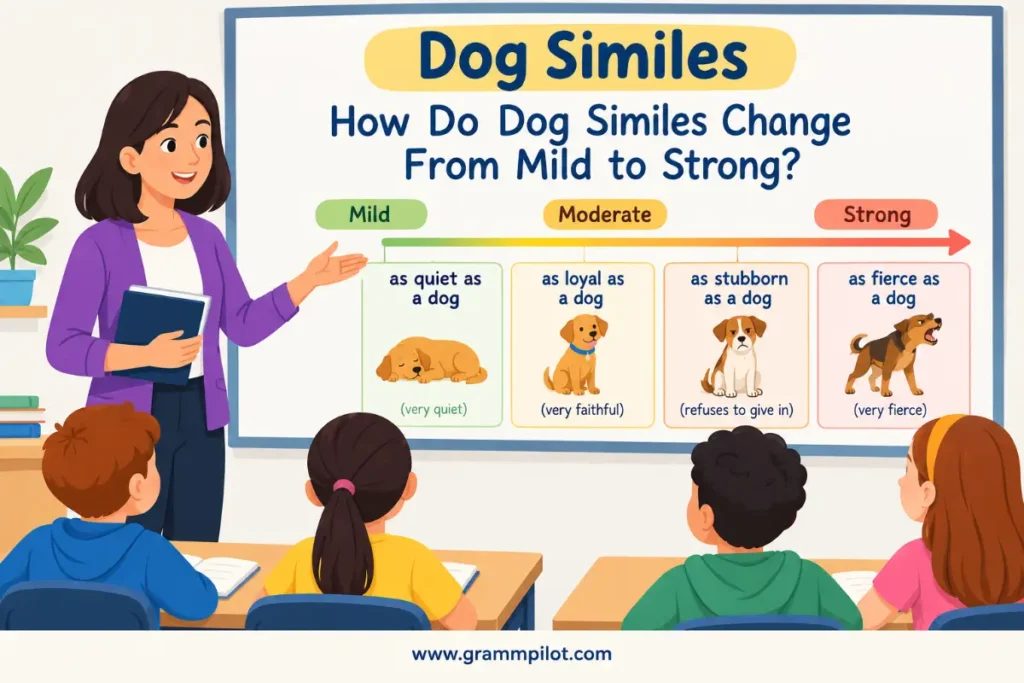
The intensity of a comparison changes how readers understand a scene. A mild expression can feel gentle, while a stronger one can make the action seem dramatic.
Consider these levels of description.
| Intensity | Comparison | Effect |
|---|---|---|
| Mild | The dog moved like a sleepy turtle. | Slow and relaxed |
| Mild | The puppy was as quiet as a mouse. | Gentle and restrained |
| Moderate | The dog ran like the wind. | Fast and energetic |
| Moderate | The puppy bounced like a ball. | Playful and lively |
| Strong | The dog raced like a rocket. | Extremely fast |
| Strong | The puppy charged like a little tornado. | Wild and energetic |
| Very strong | The dog burst through the yard like a firework. | Explosive movement |
| Very strong | The excited puppy leaped like a spring released from a trap. | Sudden, powerful energy |
How can you make a comparison stronger?
You can increase intensity by choosing a more dramatic image, a more forceful verb, or a more specific detail.
Mild: The dog ran like the wind.
Stronger: The dog shot across the field like a rocket.
The second version feels more explosive because shot across suggests sudden movement and rocket suggests speed.
However, stronger wording isn’t always better. A quiet scene may need a gentle comparison. Too many dramatic expressions can make ordinary actions sound unbelievable.
Which Dog Similes Work Best for Different Parts of Speech?
The term simile names a figure of speech, not a part of speech. Still, you can combine comparisons with nouns, verbs, adjectives, and adverbs to make your sentences more effective.
How do you use similes with nouns?
A noun names a person, place, thing, or idea. A comparison can add detail to a noun phrase.
Examples:
- The puppy was a ball of energy, bouncing around the room.
- A furry shadow followed me through the house.
- The dog was like a little guardian at the gate.
The first two examples use metaphorical descriptions, while the third uses a simile.
How do you use similes with verbs?
Verbs show actions or states. Pairing an action with a comparison can make movement easier to picture.
- The puppy bounced like a rubber ball.
- The dog raced like a speeding train.
- The old dog rested like a stone in the sunshine.
Choose a verb that matches the comparison. Raced works with a rocket, while rested works better with a peaceful or still image.
How do you use similes with adjectives?
Adjectives describe qualities such as size, color, mood, or personality.
- The dog was as gentle as a lamb.
- The puppy was as fluffy as a cloud.
- The watchdog was as alert as a guard.
These sentences place the adjective between as and the second as.
Are Dog Similes Different in American and British English?
Most dog comparisons are understood in both American and British English. Expressions such as “as brave as a lion” and “run like the wind” are widely recognizable.
The main differences often involve vocabulary, spelling, and local expressions rather than the structure of the simile itself.
| Feature | American English | British English |
|---|---|---|
| Common word for a young dog | Puppy | Puppy |
| Informal word for a dog | Doggie, pup | Doggie, pup |
| Common word for a dog walking area | Dog park | Dog park or dog-walking area |
| Informal word for a dog | Pooch | Pooch |
| Familiar speed comparison | Like the wind | Like the wind |
| Familiar bravery comparison | As brave as a lion | As brave as a lion |
Regional expressions may differ, but there’s no need to change a standard simile simply because you’re writing for an American or British audience.
For school assignments, professional writing, and general articles, use clear expressions that readers in either region can understand. Save highly local slang for dialogue or situations where it fits the speaker.
Which Dog Simile Should You Use in an Essay?
An essay usually needs clear descriptions that support its main point. A comparison should explain something meaningful about the dog rather than decorate every sentence.
For example, if you’re writing about why dogs make good companions, a comparison about loyalty may be more useful than one about speed.
Example: “A loyal dog can feel like a steady friend who stays close during difficult times.”
If you’re writing a descriptive essay, you have more room for sensory details.
Example: “The fluffy puppy looked like a white cloud resting on the green grass.”
How do you use dog comparisons in a school essay?
Choose one clear comparison and explain what it shows.
Weak: Dogs are like everything good in the world.
Better: “The dog stayed beside the frightened child like a loyal guardian.”
The second sentence gives readers a specific image and supports a point about companionship. Avoid stacking several comparisons into one sentence. One strong image is usually enough.
Which Dog Similes Work Best in Creative Writing?
Creative writing gives you more freedom to build mood, develop characters, and create memorable scenes.
How can you describe a dog in a short story?
Choose a comparison that reflects the scene’s mood.
- For a cheerful scene: “The puppy bounced through the kitchen like a ball on a trampoline.”
- For a tense scene: “The watchdog stood as still as a statue, listening to the noise outside.”
- For a peaceful scene: “The old dog slept like a warm stone in the afternoon sun.”
- The best comparison does more than describe the animal. It helps establish the atmosphere of the scene.
Which Dog Similes Are Best for Texting and Social Media?
Text messages and social posts often benefit from short, playful expressions. You can use a familiar comparison or invent one that suits the dog’s behavior.
Examples:
- “My puppy is bouncing like a rubber ball today!”
- “He’s as sleepy as a baby after a big meal.”
- “She ran like a rocket when I grabbed the leash.”
- “That fluffy dog looks like a walking cloud.”
- “My little tornado just rearranged the living room.”
- “He’s as stubborn as a mule when it’s bath time.”
- “The dog greeted me like I’d been away for a hundred years.”
Informal writing can use exaggeration and humor. Just make sure the meaning is clear to your audience. For a professional post about dog training or animal care, a direct description may be more appropriate than a playful comparison.
What Are Some Dog Similes for Emails and Professional Writing?
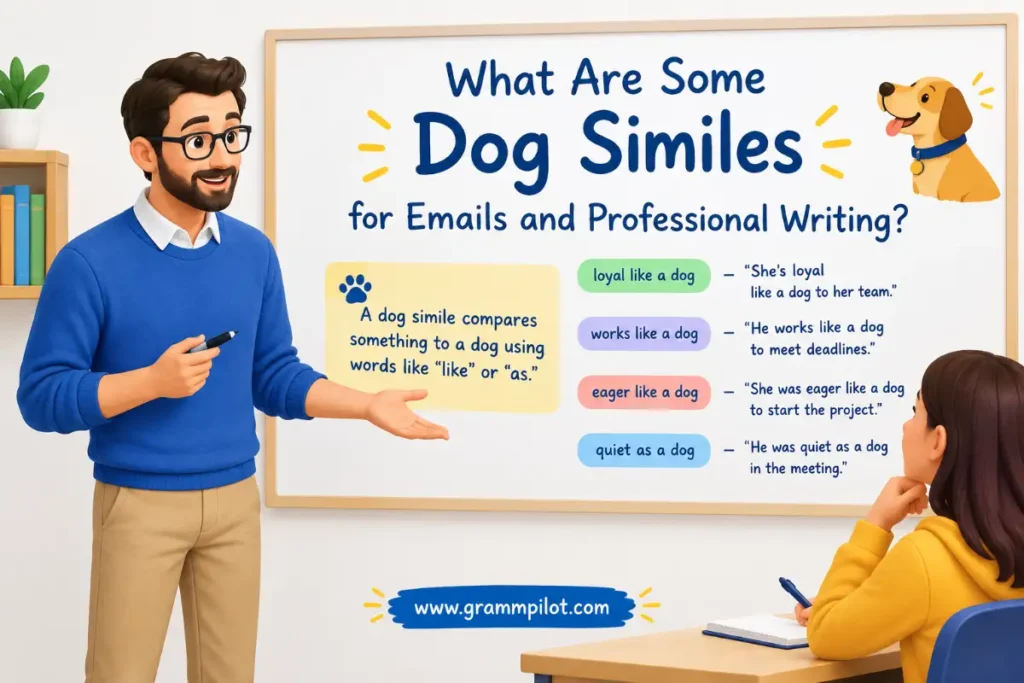
Professional writing doesn’t forbid similes, but clarity should come first. In a work email, use comparisons sparingly and only when they make the message easier to understand.
For example, a trainer might write: “The new puppy was as curious as a young explorer, so we introduced each training activity slowly.” This comparison adds personality while keeping the point clear.
For a more formal report, you might write: “The dog remained alert throughout the training session.” That sentence is more direct and may be preferable when reporting observations. Use comparisons in professional writing when they help explain behavior, describe an experience, or make an article more engaging. Avoid them when accuracy and brevity matter more than style.
What Is the Difference Between Common Dog Similes?
Some comparisons appear similar but communicate different qualities. Understanding the difference helps you choose the expression that fits your sentence.
“As brave as a lion” vs. “as fierce as a lion” — what’s different?
Both expressions use the lion as an image, but they emphasize different qualities.
| Expression | Main meaning | Best context |
|---|---|---|
| As brave as a lion | Willing to face danger or difficulty | Describing courage |
| As fierce as a lion | Intense, forceful, or aggressive | Describing a threatening display |
Example of bravery: “The small dog was as brave as a lion when it protected its owner.”
Example of fierceness: “The watchdog looked as fierce as a lion when a stranger approached.”
A dog can be brave without being aggressive. Choose the comparison based on the behavior you want to describe.
“Like a furry shadow” vs. “like a loyal friend” — what’s different?
A furry shadow emphasizes closeness and constant presence. A loyal friend emphasizes trust, affection, and dependable companionship.
- “The puppy followed me like a furry shadow” describes where the puppy goes.
- “The puppy stayed beside me like a loyal friend” emphasizes the emotional bond.
The difference is subtle, but it can change the feeling of the sentence.
What Are the Most Common Mistakes When Using Dog Similes?
Even a creative comparison can weaken a sentence if it’s unclear or poorly matched to the situation.
1. Confusing similes with metaphors
A simile makes a comparison using like or as. A metaphor makes a direct figurative statement.
- Simile: The puppy was like a tornado.
- Metaphor: The puppy was a tornado.
Both can be correct, but they use different structures.
2. Choosing an image that doesn’t fit
A sentence such as “The sleepy dog ran like a rocket” may confuse readers if nothing explains the sudden action.
Match the comparison to the behavior. If the dog is resting, use a peaceful image. If it’s racing toward a ball, use a speed comparison.
3. Mixing too many comparisons
Consider this sentence: “The dog was like a rocket, a cloud, a lion, and a bouncing ball.”
Each image suggests a different quality. Together, they make the description confusing.
A better version would be: “The puppy raced like a rocket across the yard.”
Save the other comparisons for different moments.
4. Using familiar expressions without adding detail
Common comparisons are useful, but a story can become predictable if every character is described in the same way.
Instead of always writing “as fast as lightning,” add a detail from the scene: “The dog raced like a rocket toward the red ball lying beside the fence.”
The added detail makes the sentence more specific.
5. Treating a figurative comparison as a fact
A dog described as “as hungry as a wolf” isn’t literally a wolf. The phrase simply emphasizes hunger.
In scientific writing, veterinary records, or factual reports, describe observable behavior rather than relying on figurative language.
What Are the Antonyms of Dog Similes?
A simile doesn’t have a direct antonym because it’s a literary device, not a quality with an opposite. However, you can contrast the qualities used in dog comparisons.
| Quality in the comparison | Opposite or contrast |
|---|---|
| Fast | Slow |
| Brave | Fearful |
| Gentle | Rough or harsh |
| Quiet | Noisy |
| Playful | Inactive |
| Loyal | Unfaithful |
| Calm | Restless |
| Friendly | Unfriendly |
| Curious | Uninterested |
| Patient | Impatient |
| Energetic | Tired |
| Careful | Careless |
For example, “The puppy raced like a rocket” emphasizes speed. A contrasting sentence might say, “The tired dog moved as slowly as a clock’s minute hand.”
These are contrasting descriptions, not antonyms of the word simile itself.
How Can You Choose the Right Dog Simile?
Use these practical tips to make your descriptions clearer and more original.
- Identify the quality first. Decide if you’re describing speed, loyalty, appearance, fear, or excitement.
- Picture the action. Imagine what the dog is doing before selecting a comparison.
- Match the mood. A peaceful scene needs a different image from a dramatic chase.
- Keep the meaning clear. Readers should understand why the two things are being compared.
- Consider your audience. Simple images work well for children and beginner writers.
- Use one strong comparison. Avoid filling every sentence with figurative language.
- Add a specific detail. Mention the garden, a favorite toy, a barking sound, or a person’s reaction.
- Read the sentence aloud. If it sounds awkward, choose a more natural expression.
- Don’t force a rhyme. A clear comparison is more useful than one chosen only because it sounds catchy.
- Stay accurate in factual writing. Use direct descriptions when precision matters.
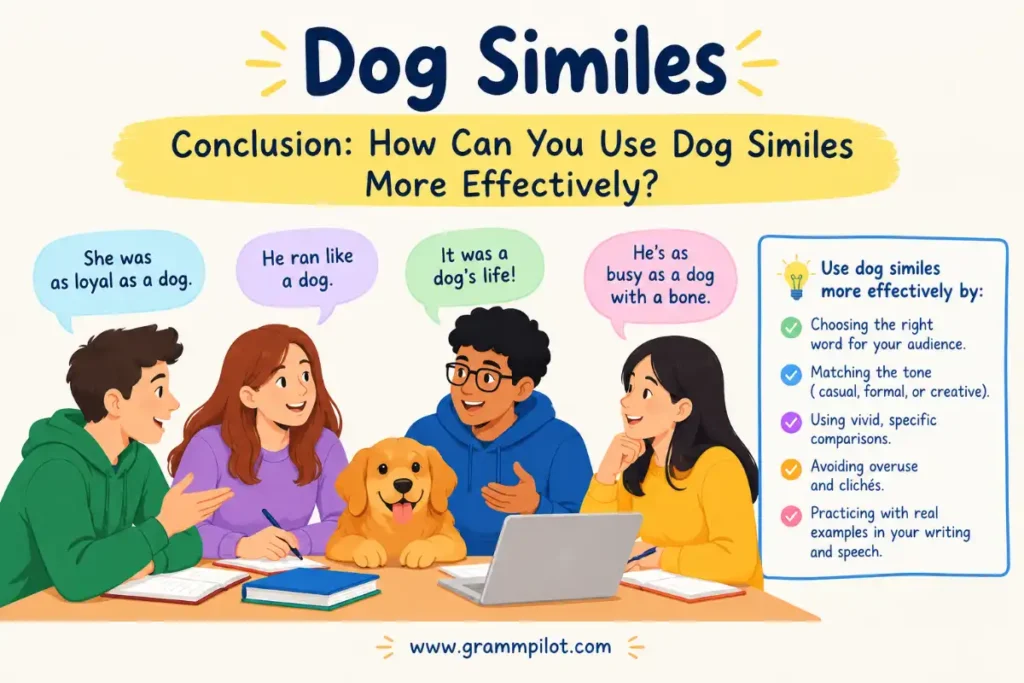
Conclusion: How Can You Use Dog Similes More Effectively?
Dog Similes can turn a plain description into a lively picture that readers remember. Instead of saying that a dog is fast, you can compare it to the wind or a rocket. Instead of calling a puppy playful, you can describe it bouncing like a rubber ball. Each expression helps readers imagine a different quality. The most effective comparison is the one that fits your meaning. Think about the dog’s behavior, the mood of the scene, and the reader you’re trying to reach. Use simple expressions for everyday writing, and try more original images when telling stories or creating vivid descriptions. You don’t need to use a simile in every sentence. One thoughtful comparison can do more than several unrelated ones. Practice noticing similarities between a dog’s actions and familiar things around you. With time, you’ll find it easier to create natural, clear, and memorable descriptions.
Frequently Asked Questions
1. What are dog similes?
Dog similes are figurative comparisons that describe a dog’s appearance, behavior, or personality using words such as like or as. For example, “The puppy bounced like a rubber ball” compares its movement to a bouncing ball.
2. What is a good simile for a dog?
“As loyal as a best friend” is a useful simile for describing a dog’s devotion. For a playful puppy, “like a bouncing ball” may be a better choice.
3. What is a simile for a fast dog?
“The dog ran like the wind” is a common way to describe a fast dog. You can also write, “The puppy raced like a rocket across the yard.”
4. What’s another way to say a dog is playful?
You could say the dog is lively, energetic, spirited, or full of fun. For a more vivid description, write, “The puppy bounced around like a rubber ball.”
5. What is a simile for a fluffy dog?
“The puppy looked like a fluffy cloud” is a simple simile for a dog with soft, thick fur. You could also compare a small, fluffy dog to a teddy bear.
6. How do you write a simile about a loyal dog?
Compare the dog’s loyalty to something known for staying close or offering support. For example, “The dog stayed beside its owner like a faithful friend.”
7. What is the difference between a dog simile and a dog metaphor?
A dog simile uses like or as to make a comparison, while a metaphor makes a direct figurative statement. “The puppy was like a tornado” is a simile, while “The puppy was a tornado” is a metaphor.
Meta Description: Dog Similes: Discover 50+ vivid comparisons, creative examples, and simple tips to make your stories and descriptions stand out.