
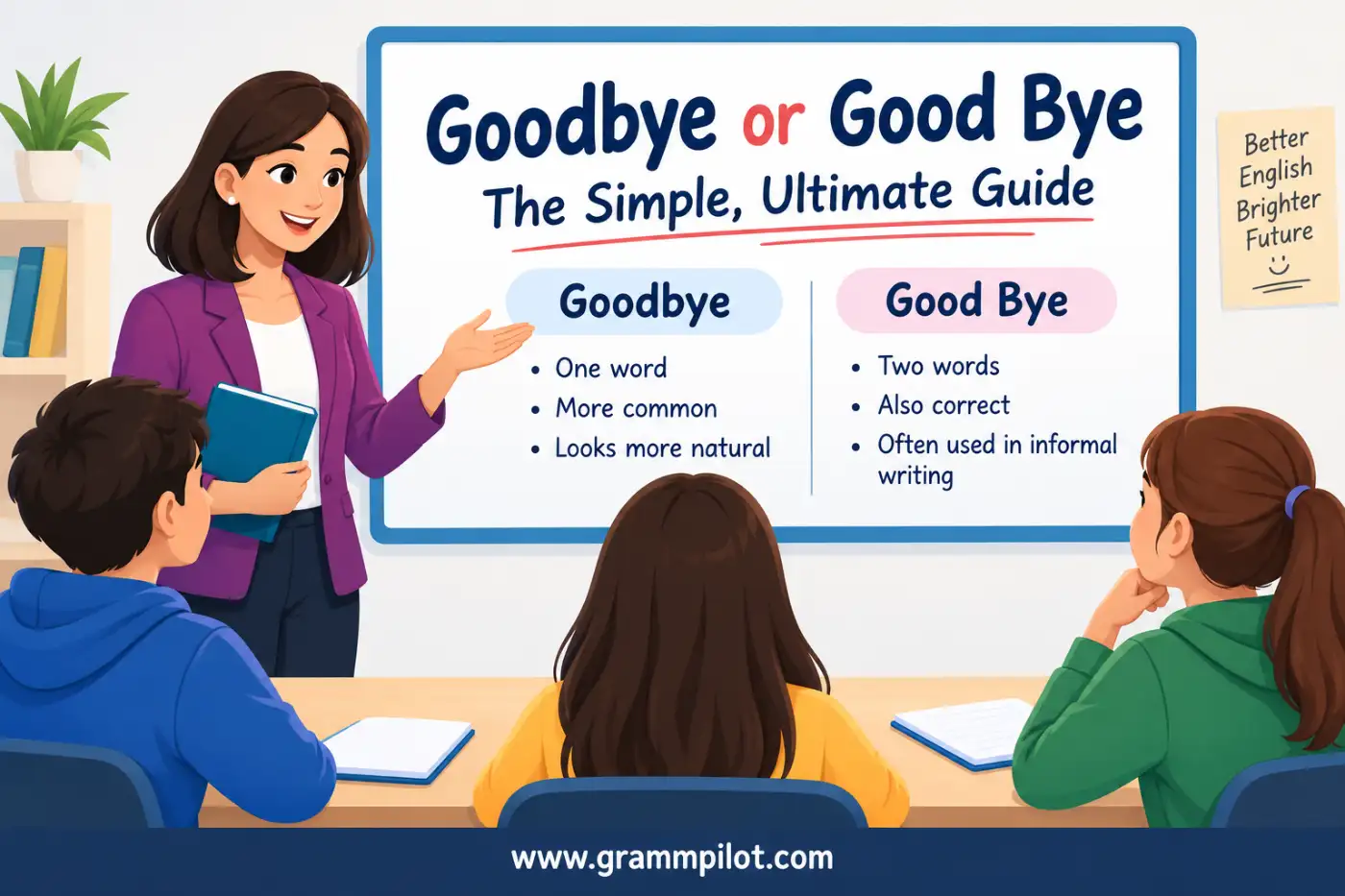
You’re finishing an email, wrapping up an essay, or sending a quick text. Then you pause over one small question: Goodbye or Good Bye—which one is correct? The short answer is simple, but the details are worth knowing. English has several ways to say farewell, and the right choice can depend on spelling, tone, relationship, and situation.
Answer: “Goodbye” is the standard spelling when you mean a farewell. “Good bye” as two words is uncommon in modern standard English, though it may appear in older writing or for special stylistic effect.
This guide explains the meaning and history of the word, the correct spelling, more than 30 alternatives, differences in tone, real-life examples, common mistakes, regional notes, and the best farewell words for emails, texts, essays, and conversations.
For more help with commonly confused words, check out [Beloved or Loved].
What does goodbye mean in plain English?
Goodbye is a word used when leaving someone or ending a conversation, meeting, visit, phone call, or relationship.
It can be used as:
- A spoken farewell
- A written closing
- A noun referring to the act of leaving
- An emotional expression of separation
The basic meaning is: I am leaving now, and I wish you well.
Examples:
- Goodbye, everyone. See you tomorrow.
- She said goodbye before getting into the car.
- We had a long goodbye at the airport.
- It was difficult to say goodbye.
The word can sound casual, polite, warm, sad, formal, or final. Its meaning often depends on the situation and the speaker’s tone.
For example:
- “Goodbye! See you next week!” sounds friendly and temporary.
- “Goodbye, and take care of yourself” can sound warm and emotional.
- “This is goodbye” sounds serious and final.
So, the word itself is simple, but context gives it emotional weight.
Is “Goodbye” one word or two?
In modern standard English, goodbye is normally written as one word.
Correct:
- Goodbye, Sarah.
- We said goodbye after dinner.
- He waved goodbye.
- It was time to say goodbye.
The two-word form, good bye, is generally not the preferred modern spelling.
You may occasionally see it in:
- Older books
- Historical writing
- Poetry
- Song titles
- Creative writing
- Special visual or emotional emphasis
For everyday writing, schoolwork, professional communication, emails, and messages, use goodbye.
Where did the word “goodbye” come from?
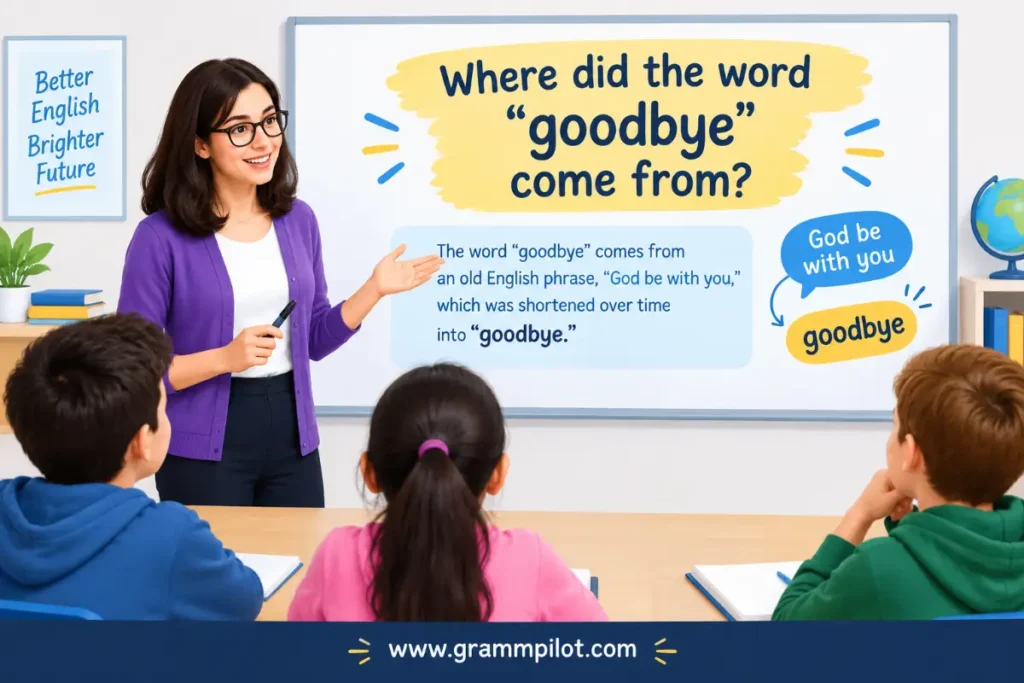
The history of goodbye is more interesting than many people expect. The word developed from an older farewell expression connected to the idea of: “God be with you.” Over time, English speakers shortened and changed the phrase. A historical form such as “God be with ye” gradually developed into a farewell expression that sounded more like “goodbye.” Language historians generally connect the modern word to this process of shortening and changing pronunciation over several centuries. That history explains something important: goodbye did not originally mean simply “have a good day.” Its older meaning carried a deeper wish for protection and well-being. Today, however, most people do not think about that history when using the word. Modern English speakers simply understand it as a common way to say farewell.
How did “goodbye” become one word?
Words often change when people use them frequently. Imagine a long phrase repeated again and again in everyday speech. People naturally shorten it. Pronunciation becomes faster. Parts of the phrase blend together. Eventually, writers begin spelling the new form as one unit. That is why modern goodbye feels like a complete word rather than a phrase. This also helps explain why spelling can sometimes be confusing. The history of a word may look different from the way we use it today.
For practical writing, though, the rule remains easy: Use “goodbye” as one word for a standard farewell.
What is the difference between goodbye and good bye?
When comparing Goodbye or Good Bye, the modern answer is mostly about standard spelling rather than a major difference in meaning.
| Form | Modern Status | Meaning | Best Use |
|---|---|---|---|
| Goodbye | Standard | Farewell | Everyday and formal writing |
| Good bye | Uncommon/nonstandard in most modern contexts | Farewell | Historical or deliberate stylistic use |
In most situations, there is no reason to write good bye.
Use:
- Goodbye in an email
- Goodbye in a school essay
- Goodbye in a story
- Goodbye in a text
- Goodbye in a speech
- Goodbye in professional writing
The single-word spelling is the safe and standard choice.
Is goodbye formal or informal?
Goodbye sits somewhere in the middle. It is not extremely formal, but it is also not slang. You can use it in many situations.
Casual use
- Goodbye! See you later.
- Okay, goodbye!
- Bye, Mom!
Polite use
- Goodbye, and thank you for your help.
- It was nice speaking with you. Goodbye.
Formal use
Goodbye can be used in formal situations, but another closing may sound more natural in professional writing.
For example:
- Thank you for your time. I look forward to hearing from you.
- Best regards,
- Kind regards,
- Sincerely,
In a formal email, writing only “Goodbye” before your name can sometimes sound unusual or abrupt. That does not make it wrong. It simply may not be the best fit.
Master list of synonyms and alternatives for goodbye
English gives you many ways to say farewell. The best choice depends on how formal, friendly, emotional, or casual the situation is. The table below groups common alternatives by style.
| Word or Phrase | Meaning | Tone | Example |
|---|---|---|---|
| Bye | Short form of goodbye | Casual | Bye! See you later. |
| Bye-bye | A friendly farewell | Very casual | Bye-bye, kids! |
| See you | Farewell with expectation of meeting again | Casual | See you tomorrow. |
| See you around | Meet again sometime | Casual | See you around. |
| Take care | Wish someone well | Warm | Take care of yourself. |
| Have a good one | Wish someone well | Casual | Have a good one! |
| Have a nice day | Friendly farewell | Polite | Have a nice day. |
| Have a great day | Positive farewell | Friendly | Have a great day! |
| Have a good night | Evening farewell | Friendly | Have a good night. |
| Good night | Farewell before sleep or late evening | Warm | Good night, everyone. |
| So long | Farewell | Old-fashioned/casual | So long for now. |
| Farewell | Goodbye, often for a longer time | Formal/emotional | Farewell, my friend. |
| All the best | Wish someone success | Polite/formal | All the best with your new job. |
| Best wishes | Wish someone well | Formal/warm | Best wishes for the future. |
| Safe travels | Wish safety during a journey | Warm | Safe travels! |
| Godspeed | Wish success and safety | Formal/literary | Godspeed on your journey. |
| Adieu | Farewell, often final or dramatic | Literary/formal | Adieu, old friend. |
| Keep in touch | Continue communicating | Warm | Keep in touch! |
| Until then | Goodbye until a future time | Neutral | Until then, take care. |
That variety is useful because one farewell does not fit every situation.
Goodbye alternatives grouped by simple, everyday, formal, and slang language
Simple farewell words
These are easy, clear choices:
- Goodbye
- Bye
- See you
- Take care
- Good night
- See you soon
- Have a nice day
- Until next time
These work well for most English learners because they are widely understood.
Everyday alternatives
These sound natural in normal conversation:
- See you later
- Talk soon
- Catch you later
- Have a good one
- Take care
- See you around
- Keep in touch
- See ya
Use these with friends, classmates, coworkers, and people you know well.
Formal alternatives
These work better in serious, professional, or ceremonial situations:
- Farewell
- All the best
- Best wishes
- Be well
- Until we meet again
- Until next time
- Safe travels
- Sincerely, in written correspondence
Be careful with very formal expressions. Some may sound overly dramatic in a casual conversation.
Slang and playful alternatives
These are best used with people who understand the tone:
- Later
- Peace
- I’m out
- Later, gator
- Catch ya later
- See ya
- Take it easy
Avoid slang in a formal interview, business email, or academic paper unless you are quoting someone.
Which goodbye word is mild, warm, emotional, or final?
Not all farewell expressions carry the same emotional strength.
Here is a useful intensity scale.
Mild and casual
These usually feel temporary:
- Bye
- See you
- Later
- See ya
- Talk soon
Example: “Bye! I’ll call you tonight.”
Friendly and warm
These show kindness:
- Take care
- See you soon
- Have a great day
- Keep in touch
- Safe travels
Example: “Take care, and let me know when you get home.”
Meaningful and emotional
These suggest stronger feelings:
- Until we meet again
- I’ll miss you
- Farewell
- Take good care of yourself
Example: “I’ll miss working with you. Take good care of yourself.”
Strong or final
These can suggest a permanent ending:
- Farewell
- This is goodbye
- Goodbye forever
- A final farewell
Example: “This is goodbye. I hope your future is full of happiness.”
The same word can also become stronger because of the situation. A simple “goodbye” at an airport can feel much more emotional than the same word at the end of a short phone call.
Goodbye vs bye — what’s the difference?
Goodbye and bye have nearly the same basic meaning, but they differ slightly in length and tone.
| Goodbye | Bye |
|---|---|
| Full word | Short form |
| Can sound more complete | More casual |
| Works in many situations | Best for relaxed conversation |
| Can sound emotional or final | Usually lighter |
| Common in writing and speech | Very common in speech and texts |
Examples:
- “Goodbye, Mr. Lee. Thank you for your help.”
- “Bye, Mr. Lee!”
Both are correct. The second sounds more casual.
Farewell vs goodbye — what’s different?
These words are close, but they do not always feel the same.
| Goodbye | Farewell |
|---|---|
| Common in daily life | More formal or emotional |
| Natural in ordinary conversation | Less common in casual speech |
| Can be temporary | Often suggests a longer separation |
| Simple and direct | Can sound serious or literary |
Example: “Goodbye, I’ll see you on Monday.”
This sounds normal.
Now compare: “Farewell, I’ll see you on Monday.”
That sounds overly dramatic because the separation is short Use farewell for situations with greater emotional weight.
Examples:
- A retirement speech
- A graduation ceremony
- A final departure
- A historical or literary story
Example: “The captain gave a farewell speech before leaving the ship.”
Take care vs goodbye — what’s different?
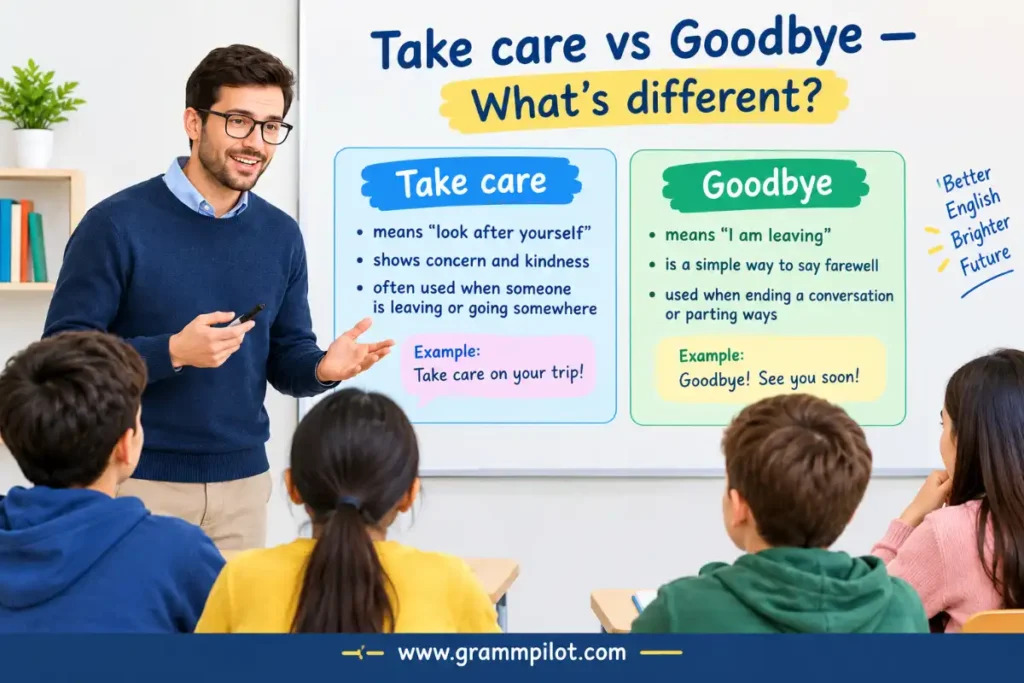
“Take care” does more than announce your departure. It also expresses concern or kindness.
Compare:
- Goodbye.
- Take care.
The first simply ends the interaction.
The second means something closer to: I hope you stay safe and well.
You can also combine them:
- Goodbye, and take care.
- Take care! See you soon.
This makes the farewell warmer.
US vs UK: Are there regional differences?
The standard spelling goodbye is used in both American and British English.
However, other farewell expressions can vary by region.
Common in the United States
- Bye
- See you later
- Take care
- Have a good one
- Catch you later
- Talk soon
- Peace
Common or recognizable in the United Kingdom
- Bye
- Cheers
- Cheerio
- Ta
- Ta-ta
- See you later
Some expressions are strongly connected with particular regions, generations, or social groups.
For example, “cheerio” may sound stereotypically British to American audiences. It is recognized widely, but not everyone in the UK uses it every day.
“Have a good one” is very common in American English but may sound less natural in some other English-speaking regions.
The safest international choices are:
- Goodbye
- Bye
- See you later
- Take care
- See you soon
What is the best word for a resume?
A resume usually does not need a farewell.
Do not end a resume with:
- Goodbye
- Bye
- See you soon
- Take care
A resume is a professional document, not a conversation.
Instead, simply end the document after the appropriate final section, such as:
- Education
- Skills
- Experience
- Certifications
If you are sending your resume by email, your email can use a professional closing.
Example: Thank you for considering my application.
Best regards,
Jordan Smith
Best choice for a resume
No farewell inside the resume itself. Use a professional sign-off in the email.
What is the best word for an essay?
Most essays do not need “goodbye” either.
Academic writing usually ends with a conclusion, not a personal farewell.
Avoid:
- Goodbye, readers.
- Bye for now.
- See you later.
These phrases can make a formal essay sound conversational.
Instead, finish with a strong concluding sentence.
Example : “Understanding how language changes over time helps us become more careful and confident writers.
What is the best word for texting?
Texting allows much more freedom.
Good options include:
- Bye!
- Byeee!
- See ya!
- Later!
- Talk soon!
- Catch you later!
- Take care!
- GN for “good night” in very informal texting
Examples:
- Okay, bye!.
- I’m heading out. Talk soon!
- See ya tomorrow!
- Catch you later!
What is the best word for an email?
The best closing depends on the type of email.
Casual email
You can use:
- Take care
- Talk soon
- See you soon
- All the best
Example:
Take care,
Maya
Professional email
Better choices include:
- Best regards
- Kind regards
- Sincerely
- Best
- Thank you
Example:
Thank you for your time.
Kind regards,
Maya
What is the best word for speaking?
Speaking gives you more flexibility because tone and body language add meaning.
With friends:
- Bye!
- Later!
- See ya!
With coworkers:
- See you tomorrow.
- Take care.
- Have a good evening.
To someone you may not see again:
- It was great meeting you. Take care.
- All the best.
- Goodbye, and good luck.
In speech, the words around the farewell often matter as much as the farewell itself.
More than 10 real-life examples of goodbye
Here are original examples across different situations.
- “Goodbye, Grandma. I’ll call you when I get home.”
- “We said goodbye outside the restaurant after dinner.”
- “Bye! Don’t forget your keys.”
- “It was great meeting you. Take care.”
- “See you later after class.”
- “The students waved goodbye to their teacher.”
- “She struggled to say goodbye before moving to another country.”
- “Have a safe flight and safe travels!”
- “Okay, I have to go. Talk to you soon.”
- “He gave his coworkers a warm farewell on his last day.”
- “Until next time, thanks for listening.”
- “I’m heading out now. Catch you later.”
- “Good night, everyone. Sleep well.”
- “The family shared a tearful goodbye at the airport.”
- “All the best in your new position.”
These examples show how the best choice changes with tone and context.
What are the antonyms of goodbye?
A direct opposite of “goodbye” is usually a greeting or expression of arrival.
Common opposites include:
- Hello
- Hi
- Welcome
- Greetings
- Good morning
- Good afternoon
- Good evening
The simplest opposite pair is:
- Hello = used when meeting or starting contact
- Goodbye = used when leaving or ending contact
Example: “Hello, nice to meet you.”
Later: “Goodbye, it was nice meeting you.”
Some words, however, can change meaning depending on context. “Good night,” for example, can be used as a greeting in limited situations but is more commonly a farewell before sleep or late at night.
Common mistakes people make with goodbye
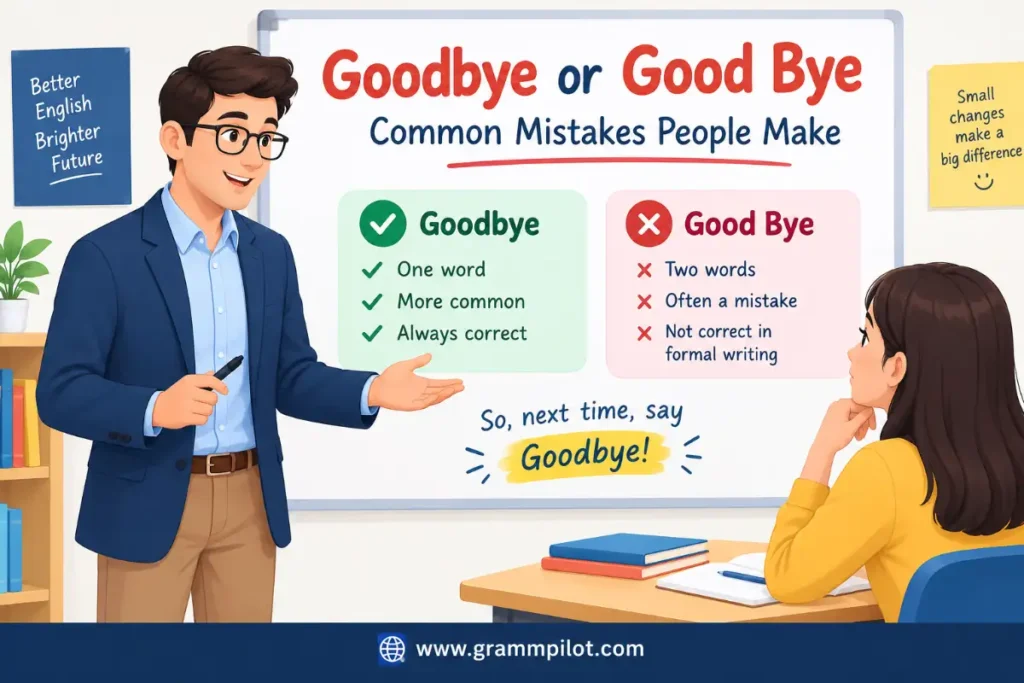
Mistake 1: Writing “good bye” in standard modern writing
For normal modern English, use: Goodbye
Not: Good bye
The two-word version may appear in special or historical contexts, but it is not the standard choice for everyday writing.
Mistake 2: Using “goodbye” as a professional email sign-off
It is not grammatically wrong, but it can sound unusual.
Less natural:
Goodbye,
Alex
More natural:
Best regards,
Alex
Mistake 3: Using “farewell” in a casual situation
“Farewell” can sound too serious.
Overly dramatic: “Farewell, Josh. See you after lunch.”
More natural: “See you later, Josh.”
Mistake 4: Using slang in formal situations
Avoid expressions like these in a job-related email:
- Later!
- Peace!
- I’m out!
Choose a professional closing instead.
Mistake 5: Forgetting the situation
The best farewell depends on about you expect to see the person again.
If someone is moving away:
- I’ll miss you. Take care.
- All the best in your new home.
If the goodbye is final:
- Farewell.
- Goodbye.
- Wishing you all the best.
When should you NOT use goodbye?
Do not use goodbye automatically just because you are ending something.
Do not use it inside a formal essay
A conclusion should summarize or finish the argument instead.
Do not use it as a random resume ending
A resume should remain focused on qualifications and experience.
How do you choose the right farewell?
Ask yourself a few simple questions.
Who am I talking to?
For friends:
- Bye
- See ya
- Later
Will I see the person again soon?
If yes:
- See you soon
- Talk soon
- See you later
If you are not sure:
- Take care
- All the best
Is the situation emotional?
If yes, use warmer language:
- I’ll miss you.
- Take care of yourself.
- Until we meet again.
- Goodbye.
Is it professional?
Choose:
- Best regards
- Kind regards
- Sincerely
- Best wishes
Quick tips for choosing the right word
Use this quick guide when deciding what to say.
- Need a standard farewell? Use “goodbye.”
- Talking casually? Use “bye” or “see you.”
- Texting a friend? Use “talk soon” or “see ya.”
- Ending a work email? Use “best regards” or “kind regards.”
- Wishing someone safety? Use “safe travels” or “take care.”
- Expecting to meet again? Use “see you later.”
- Ending something emotional? Use “goodbye,” “farewell,” or “until we meet again.”
- Writing an essay? Usually skip the farewell and write a strong conclusion.
- Writing a resume? Do not add a farewell inside the document.
- Unsure about spelling? Write “goodbye” as one word.
How should students remember the correct spelling?
Use a simple rule:
When you mean a farewell, write “goodbye” as one word.
You can remember it by thinking of it as a complete modern word, similar to:
- Sometimes
- Maybe
- Already
You do not need to separate it into “good” and “bye.”
If you are writing a school assignment, email, or message and want the standard form, choose goodbye.
Final teacher explanation
Here is the simplest way to understand the issue.
English spelling does not always show a word’s full history. “Goodbye” developed from older farewell expressions and gradually became the single standard word we know today.
That is why trying to split it into “good” + “bye” can lead to confusion.
Modern usage is straightforward:
- Goodbye = standard spelling
- Bye = shorter, more casual version
- Farewell = more formal or emotional
- See you later = casual and temporary
- Take care = warm and caring
Choosing the right farewell is mostly about context.
You do not need to memorize every synonym. Learn the common ones first, then notice how native speakers use them in real conversations.

Conclusion
The question Goodbye or Good Bye has a clear answer for modern English: goodbye is the standard one-word spelling. Still, choosing the right farewell involves more than spelling. Tone, relationship, situation, and how soon you expect to meet again can all change the best word to use.
Keep the main rule simple: write “goodbye” as one word when you need a standard farewell. Then choose alternatives such as “bye,” “take care,” “see you later,” or “farewell” when they better match the situation. A small word can carry a lot of meaning, so the right choice can make your message sound natural, warm, professional, or memorable.
Frequently Asked Questions
1. Is goodbye one word or two words?
Goodbye is normally one word in modern standard English. “Good bye” as two words is uncommon and usually appears only in older or intentionally stylized writing.
2. Is “good bye” ever correct?
It can appear in historical texts, poetry, or creative writing for stylistic reasons. However, for normal modern writing, goodbye is the preferred spelling.
3. What’s another way to say goodbye?
You can say “bye,” “see you later,” “take care,” “talk soon,” “farewell,” or “all the best.” The best choice depends on how casual, formal, or emotional the situation is.
4. Which is more formal: goodbye or bye?
Goodbye is generally more complete and slightly more formal than “bye.” “Bye” is very common in casual conversation and texting.
5. Can I use goodbye in a professional email?
You can, but it is usually not the most natural email sign-off. Professional emails often end with “Best regards,” “Kind regards,” or “Sincerely.”
6. Does goodbye mean you will never see someone again?
No, goodbye does not automatically mean a permanent farewell. You can say, “Goodbye, see you tomorrow,” for a temporary departure.