
Have you ever been writing a text, email, or work message and stopped to wonder about to say “I appreciate it” or “I appreciated it”? Both expressions are grammatically correct, but they don’t mean exactly the same thing. The main difference is time. “I appreciate it” usually describes how you feel now, while “I appreciated it” describes how you felt about something in the past. Choosing the right form depends on when the appreciation happened.
Quick Answer: Use “I appreciate it” when you feel thankful now. Use “I appreciated it” when you’re talking about gratitude you felt in the past.
This guide explains the difference, verb forms, common situations, examples, tone, mistakes, and the best choice for texts, emails, essays, resumes, and everyday speech.
You can also learn about common plural forms in [Goodbye or Good Bye].
What Does “I Appreciate It” Mean?
“I appreciate it” is a present-tense expression of gratitude.
It means:
- I’m thankful for it.
- I value what you did.
- I’m grateful for your help.
- Your action means something to me.
For example: “Thanks for helping me finish the report. I appreciate it.”
The help may have happened already, but the speaker’s gratitude is still present. That’s why the present tense works.
You can use I appreciate it after someone:
- Helps you
- Gives you advice
- Does you a favor
- Sends you something
- Takes time to help
- Offers support
- Makes an effort
Examples:
“Thanks for staying late. I appreciate it.”
“I appreciate your help with this project.”
What Does “I Appreciated It” Mean?
“I appreciated it” uses the simple past tense.
It means that you felt grateful or valued something at a particular time in the past.
For example: “When I was struggling last year, you helped me a lot. I really appreciated it.”
The speaker is looking back at a past situation.
The appreciation belongs to that earlier period.
It doesn’t necessarily mean the speaker is no longer grateful. It simply places the feeling in the past. This distinction is important.
Appreciate It or Appreciated It: What’s the Difference?
The easiest way to remember the difference is present versus past.
| Phrase | Tense | Basic Meaning | Example |
|---|---|---|---|
| I appreciate it | Present | I am thankful now | Thanks for your help. I appreciate it. |
| I appreciated it | Past | I was thankful then | I appreciated your help yesterday. |
Consider these two situations.
Present
Your coworker helps you today.
“Thanks for your help. I appreciate it.”
You’re expressing gratitude now.
Past
You’re telling someone about help you received last month.
“You helped me during the move. I really appreciated it.”
You’re talking about your past reaction.
Is “I Appreciate It” Correct?
Yes.
“I appreciate it” is a standard and natural English expression.
It is commonly used to thank someone without saying the more direct phrase “thank you.”
For example: “Thanks for picking me up. I appreciate it.”
It can sound warm, sincere, and slightly more personal than simply saying “thanks.” It is also common in professional communication.
“I appreciate your quick response.”
“I appreciate your assistance with this matter.”
Is “I Appreciated It” Correct?
Yes.
“I appreciated it” is also grammatically correct.
The important question is if you’re talking about a past situation.
For example: “When you checked on me after the accident, I appreciated it.”
The speaker is referring to a specific event that happened in the past.
Another example: “You gave me useful advice during my first week, and I appreciated it.”
The appreciation is connected to that earlier experience.
Can You Say “I Appreciate It” After Something Already Happened?
Yes, and this is very common.
This can confuse English learners because the action itself may already be finished.
For example: “Thanks for helping me yesterday. I appreciate it.”
The help happened yesterday, but the speaker feels thankful now. So the present tense is completely natural. The tense doesn’t always match the exact moment when the helpful action happened. It can describe the speaker’s current feeling about that past action.
Can You Say “I Appreciated It” About Something That Just Happened?
Yes, but the context matters.
For example: “I appreciated it when you gave me a few minutes to think.”
The speaker is describing their reaction to a particular event. However, if someone has just helped you and you’re thanking them directly, this is usually more natural: “Thanks. I appreciate it.”
Rather than: “Thanks. I appreciated it.”
The past version can sound as if you’re already looking back on the situation.
What Is the Difference Between “I Appreciate It” and “Thank You”?
Both can express gratitude, but they have slightly different tones.
Thank you is the most direct and universal expression of thanks.
I appreciate it emphasizes that you value someone’s action, effort, or help.
Compare:
“Thank you for helping me.”
“I appreciate your help.”
Both are polite.
The second can sound especially natural in professional settings.
You can also combine them: “Thank you for your help. I really appreciate it.”
This is warm and common.
Appreciate It vs Appreciated It in Texting
Text messages are usually informal, so both forms may appear.
If someone has just done something for you, use: “Thanks! I appreciate it.”
If you’re talking about something that happened earlier, use: “You helped me a lot last month. I really appreciated it.”
Short forms are also common:
- Appreciate it!
- Really appreciate it!
- Appreciate your help!
- I appreciated that.
In casual texting, appreciate it often sounds friendly and natural.
Which One Is Better for Email?
For most emails where you’re thanking someone now, use I appreciate it.
Examples:
“Thank you for sending the information. I appreciate it.”
“I appreciate your quick response.”
For a formal email discussing a previous event, appreciated can be appropriate.
“I appreciated your guidance during the training session last month.”
The choice depends on if you’re expressing current gratitude or describing past appreciation.
Which One Is Better for a Professional Email?
I appreciate it is usually the better choice when responding to a current favor or action.
For example: Thank you for reviewing the document. I appreciate it.”
You can also make the sentence more specific: “I appreciate your careful review of the document.”
Specific wording often sounds more professional than a vague expression.
If you’re discussing an earlier event: “I appreciated your guidance throughout the project.”
That places the gratitude in the past.
Which One Is Better for an Essay?
For an academic essay, neither phrase is usually needed unless you’re writing dialogue, a personal narrative, or a reflection.
Instead of: “I appreciate it when people help others.”
A formal essay might say: “Support from others can have a significant effect on a person’s confidence.”
However, in a personal essay, I appreciate may be accurately suitable.
Example: “I appreciate the teachers who encouraged me to keep writing.”
If you’re describing a past experience: “I appreciated the encouragement I received during that difficult period.”
Which One Is Better for a Resume?
Neither expression is normally used on a resume.
A resume should show appreciation through professional language rather than conversational thanks.
Instead of: “I appreciate teamwork.”
You could write: “Collaborated effectively with team members to complete projects on schedule.”
If you’re describing a quality, words such as valued, recognized, and respected may work better.
How Does “I Appreciate It” Work Grammatically?
In “I appreciate it,” the structure is simple: I + appreciate + it
- I = subject
- appreciate = present-tense verb
- it = object
The word it usually refers to an action, favor, effort, kindness, or piece of help.
For example: “Thanks for driving me home. I appreciate it.”
Here, it refers to the person’s act of driving the speaker home.
You can replace it with a specific noun:
“I appreciate your help.”
“I appreciate your kindness.”
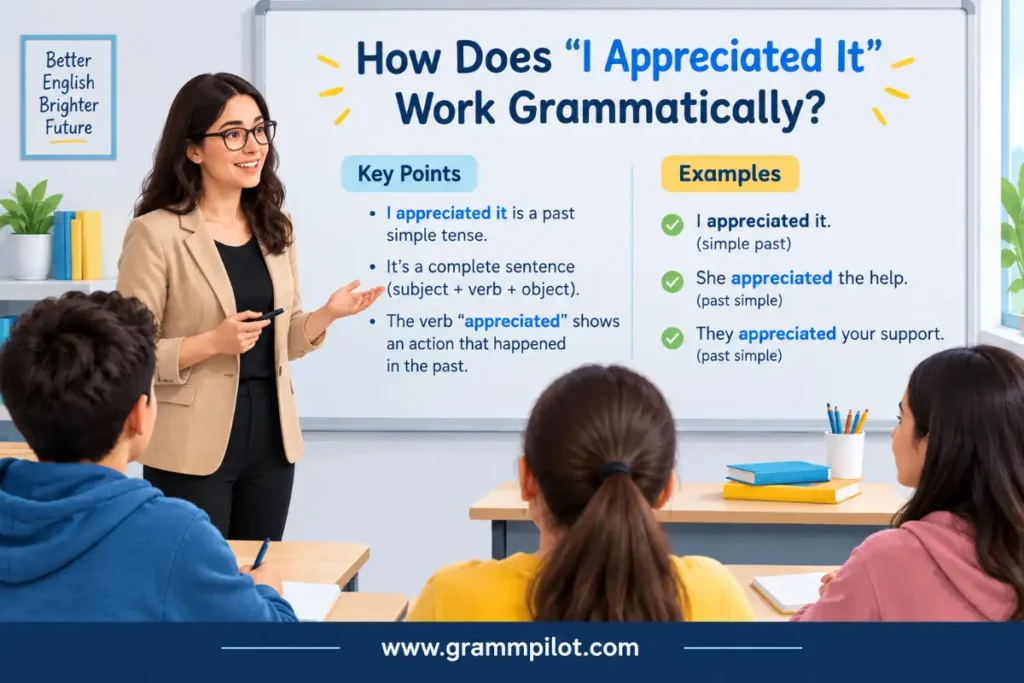
How Does “I Appreciated It” Work Grammatically?
The structure is similar: I + appreciated + it
The only major difference is the verb tense.
- I = subject
- appreciated = past-tense verb
- it = object
What Words Commonly Follow “Appreciate”?
You can use appreciate with several kinds of nouns and phrases.
Appreciate + Noun
“I appreciate your help.”
“We appreciate your patience.”
“She appreciates your honesty.”
Appreciate + Gerund
A gerund is an -ing form functioning as a noun.
“I appreciate you helping me.”
“I appreciate you taking the time.”
“We appreciate you coming today.”
A more formal version is also possible:
“We appreciate your taking the time to meet with us.”
In everyday English, “I appreciate you helping me” is common.
Is “I Appreciate You” Correct?
Yes, but it has a slightly different meaning from I appreciate it.
“I appreciate you” means that you value the person, their character, or what they bring to your life.
For example:
“You’re always there when I need you. I appreciate you.”
This sounds personal and warm.
“I appreciate it” usually focuses on a specific action.
“Thanks for helping me. I appreciate it.”
So:
I appreciate you = I value you.
I appreciate it = I value what you did.
Is “I Appreciated You” Correct?
Yes, grammatically, but it can sound unusual without context.
For example:
“I appreciated you during those difficult years.”
This means the speaker valued the person at that time.
However, if you’re talking about a specific favor, I appreciated it or I appreciated your help is usually clearer.
Compare:
“I appreciated you helping me.”
“I appreciated your help.”
The second is often smoother.
What Are the Best Synonyms for “Appreciate”?
The best alternative depends on what you mean.
| Word or Phrase | Meaning | Tone | Example |
|---|---|---|---|
| Thank | Express gratitude | Neutral | I thank you for your help. |
| Value | Consider important | Neutral | I value your advice. |
| Be grateful for | Feel thankful | Warm | I’m grateful for your support. |
| Be thankful for | Feel gratitude | Neutral | I’m thankful for your help. |
| Admire | Respect highly | Positive | I admire your dedication. |
| Respect | Hold in high regard | Neutral | I respect your honesty. |
| Treasure | Value deeply | Warm | I treasure our friendship. |
| Acknowledge | Recognize something | Formal | We acknowledge your contribution. |
| Recognize | Notice or credit | Professional | We recognize your effort. |
| Praise | Express approval | Positive | The manager praised her work. |
| Applaud | Strongly approve | Positive | We applaud your efforts. |
| Commend | Praise formally | Formal | The director commended his work. |
| Esteem | Regard highly | Formal | She is highly esteemed. |
| Prize | Value highly | Formal/literary | He prized their friendship. |
| Cherish | Value deeply | Emotional | I cherish those memories. |
| Credit | Recognize someone’s role | Professional | The team credited her leadership. |
| Honor | Show great respect | Formal | We honor their service. |
| Enjoy | Take pleasure in | Everyday | I appreciate the quiet. |
| Like | Have a positive feeling toward | Casual | I really like your idea. |
| Love | Feel strong affection | Strong | I love what you’ve done. |
| Value highly | Consider very important | Neutral | We value your feedback. |
| Be indebted to | Feel that you owe someone | Formal | I’m indebted to you for your support. |
Synonyms by Intensity
Not every alternative expresses the same level of gratitude.
Mild
- Like
- Enjoy
- Value
- Respect
Example: “I value your opinion.”
Moderate
- Appreciate
- Thank
- Be grateful
- Recognize
Example: “I really appreciate your support.”
Strong
- Treasure
- Cherish
- Admire deeply
- Be indebted to
Example: “I treasure the friendship we’ve built.”
Choose the intensity that matches the emotion.
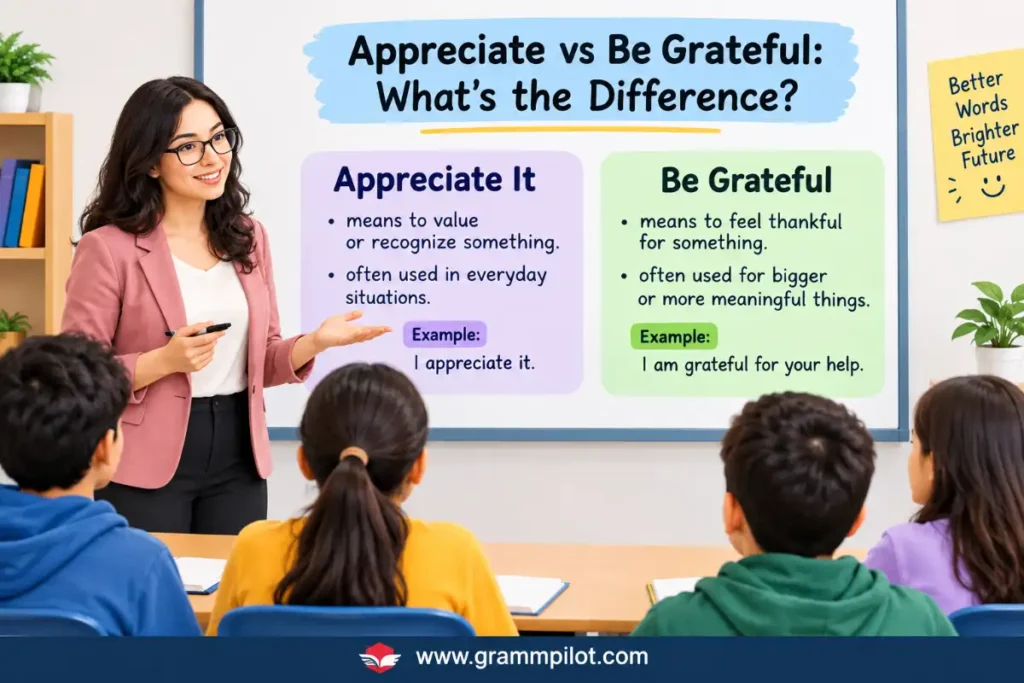
Appreciate vs Be Grateful: What’s the Difference?
Be grateful often sounds more emotional or heartfelt.
Appreciate can sound more conversational and practical.
For example:
“I appreciate your help with this project.”
This fits a workplace.
“I’m deeply grateful for everything you’ve done for me.”
This sounds more emotional.
Neither is automatically better.
Common Mistakes With Appreciate and Appreciated
Mistake 1: Using the Past Tense When You Are Thanking Someone Now
Less natural: “Thanks for helping me. I appreciated it.”
Better in a direct thank-you: “Thanks for helping me. I appreciate it.”
The past form isn’t always grammatically wrong, but it can sound like you’re talking about an earlier reaction.
Mistake 2: Thinking the Action Must Be Happening Now
You can still say: “I appreciate it.”
after an action has finished.
Your gratitude is current even if the favor happened earlier.
Mistake 3: Confusing Appreciation With Agreement
If you say: “I appreciate your opinion.”
you aren’t necessarily saying: “I agree with your opinion.”
You’re saying that you recognize or value their willingness to share it.
Mistake 4: Overusing “I Appreciate It”
In professional writing, repeating the same phrase can make your emails sound mechanical.
Instead, vary your wording:
- Thank you for your help.
- I appreciate your assistance.
- I’m grateful for your support.
- Thank you for taking the time.
- Your help means a lot.
Mistake 5: Using “Appreciated It” Without a Clear Past Context
If someone has just done you a favor, I appreciate it is usually clearer.
Use I appreciated it when you’re clearly discussing a previous situation.
When Should You Use “I Appreciate It”?
Use it when:
- Someone has just helped you.
- You’re thanking someone for an effort.
- You want to sound polite.
- You’re expressing current gratitude.
- You’re responding to a favor.
- You’re writing a friendly or professional message.
Examples:
“Thanks for staying late. I appreciate it.”
“I appreciate your patience.”
When Should You Use “I Appreciated It”?
Use it when:
- You’re describing a past event.
- You’re telling a story.
- You’re reflecting on previous support.
- You’re explaining how you felt at an earlier time.
- You’re discussing something that happened before.
Examples:
“I appreciated your help during my first week.”
“When you called me last month, I really appreciated it.”
“I appreciated everything you did for the team.”
15 More Examples in Real Situations
- “Thanks for picking me up. I appreciate it.”
- “I appreciate your honest feedback.”
- “She appreciated the advice her teacher gave her.”
- “We appreciate your patience while we resolve the issue.”
- “I appreciated your support when I started the new job.”
- “Thanks for explaining that. I appreciate it.”
- “He appreciated the extra time his manager gave him.”
- “I appreciate you checking on me.”
- “They appreciated the team’s hard work.”
- “I really appreciate your kindness.”
- “I appreciated everything you did during the project.”
- “We appreciate your continued support.”
- “She appreciated the opportunity to speak.”
- “I appreciate your taking the time to meet with me.”
- “I appreciated how calmly you handled the situation.”
Quick Tips for Choosing the Right Form
Use these simple rules:
- I appreciate it = I feel thankful now.
- I appreciated it = I felt thankful then.
- A completed favor can still receive present-tense appreciation.
- Use I appreciate your help for a current expression of gratitude.
- Use I appreciated your help when reflecting on a past situation.
- Thank you is more direct.
- I appreciate it emphasizes value and gratitude.
- I appreciate you focuses on the person.
- I appreciated it often needs a past context to sound natural.
- In formal writing, choose the form based on the timeline, not just the action.
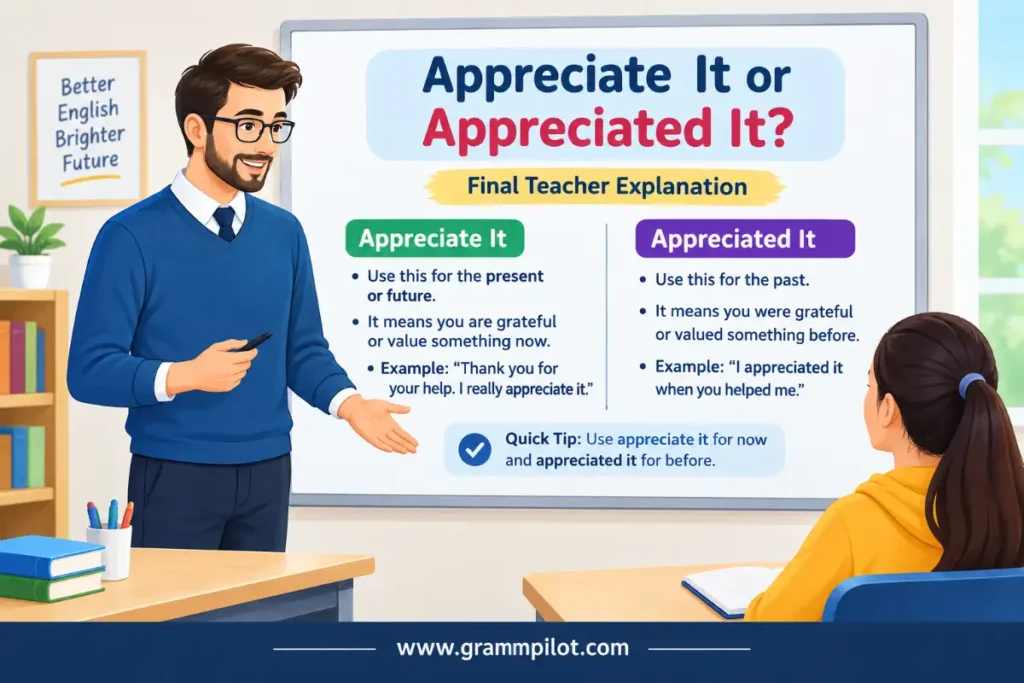
Final Teacher Explanation
The difference between these two expressions is mainly about tense and time.
I appreciate it uses the present tense. It tells someone that you currently value or feel thankful for something they did. That’s why it’s very common after a favor, helpful action, or kind gesture.
I appreciated it uses the past tense. It describes appreciation connected to a previous situation. It works especially well when you’re telling a story, reflecting on an experience, or describing how you felt at a certain point in the past.
One important point is that a past action doesn’t automatically require the past tense. Someone might have helped you yesterday, but you can still say, “I appreciate it,” because your gratitude exists now. When in doubt while directly thanking someone, I appreciate it is usually the natural choice.
Conclusion
Choosing between Appreciate It or Appreciated It depends on the time you are talking about. Use I appreciate it when your gratitude is current, even if the helpful action happened earlier. Use I appreciated it when you’re looking back at a past situation and describing the gratitude you felt then. Both forms are grammatically correct, so the issue isn’t correctness alone; it’s choosing the tense that matches your meaning. In everyday conversations and professional messages, “I appreciate it” is especially common when thanking someone for help, time, advice, or effort. If you’re telling a story about something that happened before, “I appreciated it” may be the better fit. Once you focus on the timeline, the choice becomes much easier.
Frequently Asked Questions
1. Is it “I appreciate it” or “I appreciated it”?
Both are correct. Use I appreciate it for current gratitude and I appreciated it when referring to appreciation in the past.
2. Can I say “I appreciate it” for something that happened yesterday?
Yes. You can use the present tense because you still feel thankful now.
3. Is “I appreciated it” grammatically correct?
Yes. It is the simple past form of appreciate and works when you’re discussing a past situation.
4. Which sounds more natural when thanking someone?
I appreciate it usually sounds more natural when you’re directly thanking someone for something they just did.
5. What’s another way to say “I appreciate it”?
You can say thank you, I’m grateful, I value your help, thanks a lot, or I really appreciate your help depending on the situation.
6. Can I say “I appreciate you”?
Yes. I appreciate you means that you value the person, while I appreciate it usually refers to a specific action or favor.
7. Does “I appreciate it” mean “I agree”?
No. It expresses gratitude or recognition, not necessarily agreement.