

Have you ever been writing an email, school assignment, text message, or social media post and stopped to wonder whether Did You Had or Did You Have is correct? You’re not alone. This is one of the most common grammar mistakes in English because both phrases sound possible at first. The good news is that the rule is very simple. Once you understand how the helping verb did works, you’ll never have to guess again.
Answer Box:
“Did you have” is correct because the helping verb “did” already shows the past tense. “Did you had” is grammatically incorrect because it uses the past tense twice.
In this guide, you’ll learn the difference between these two phrases, where the rule comes from, why people make this mistake, and how to use the correct form with confidence in everyday English.
You can also learn how similar expressions are used in [Thanks a Lot].
Is It “Did You Had” or “Did You Have”?
The correct phrase is: ✅ Did you have
The incorrect phrase is: ❌ Did you had
Whenever you use did to ask a question in the simple past tense, the main verb must stay in its base form.
Examples:
- Did you have breakfast?
- Did you finish your homework?
- Did you watch the movie?
- Did you call your parents?
Notice that the verbs have, finish, watch, and call are all in their base forms.
Why Is “Did You Had” Incorrect?
The helping verb did already changes the sentence into the past tense. Because of this, the main verb should not also be in the past tense.
Incorrect: ❌ Did you had fun?
Correct: ✅ Did you have fun?
Think of did as carrying all the past-tense work for the sentence. Adding had creates a double past tense, which standard English does not allow.
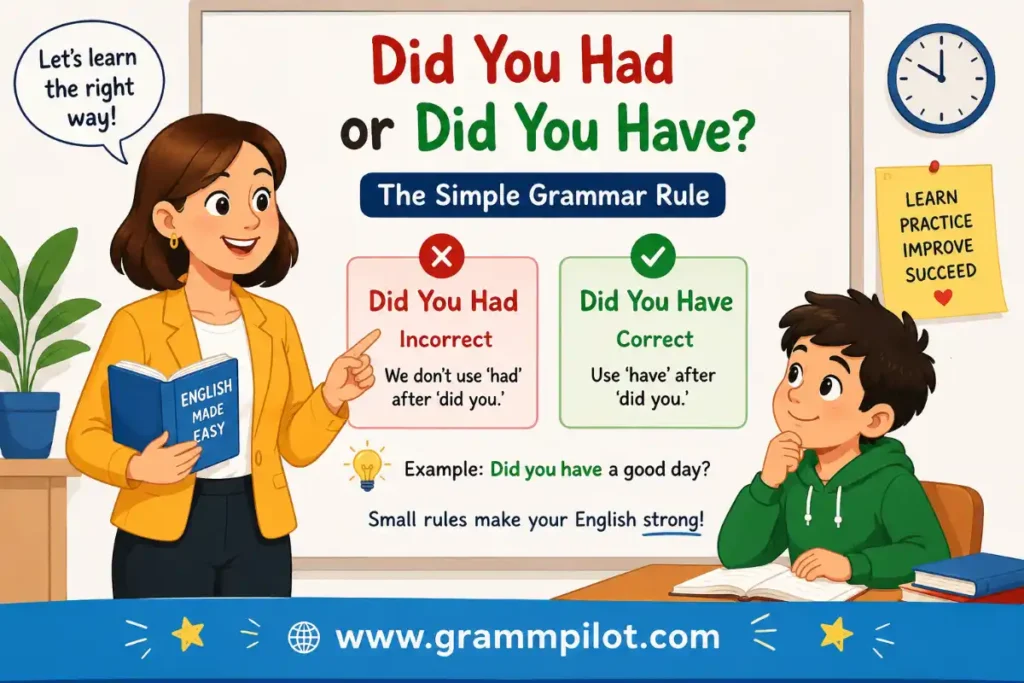
Did You Had or Did You Have: The Simple Grammar Rule
Here’s the rule you should remember: Did + Base Verb
Never use: Did + Past Tense Verb
Examples:
| Correct | Incorrect |
|---|---|
| Did you have lunch? | Did you had lunch? |
| Did she arrive early? | Did she arrived early? |
| Did they leave yesterday? | Did they left yesterday? |
| Did he buy a car? | Did he bought a car? |
| Did we see the game? | Did we saw the game? |
This one rule works with almost every regular and irregular verb.
The Easy Test
If your sentence begins with did, check the next verb.
Ask yourself: Is this the base form?
Correct: Did you have time?
Incorrect: Did you had time?
Correct: Did she go home?
Incorrect: Did she went home?
Correct: Did they eat dinner?
Incorrect: Did they ate dinner?
This simple check can prevent many grammar mistakes.
Word Origin of “Have” and “Had”
Many grammar guides explain the rule but skip the history. The verb have comes from the Old English word habban, which meant to possess, hold, or own. Over time, have became one of the most common verbs in English. The past tense form had developed naturally as English evolved. Today, English uses:
- have (base form)
- has (third-person singular)
- had (past tense and past participle)
When did appears in a question, English grammar always returns the main verb to its original base form.
That’s why we say:
- Did you have…
- Did he have…
- Did they have…
instead of using had.
Why Do So Many People Say “Did You Had”?
This mistake usually happens because people know the event happened in the past. They naturally think the verb should also be in the past tense. However, they forget that did already marks the sentence as past tense.
For example:
Someone may think: Past event → use had
So they write: ❌ Did you had breakfast?
But English grammar says: Past helper (did) + base verb (have)
So the correct sentence is: ✅ Did you have breakfast?
Did You Had Did You Have: Why Does This Grammar Rule Matter?
Using the correct form makes your English sound natural and professional.
It also helps you write better:
- school assignments
- essays
- emails
- job applications
- reports
- presentations
- social media posts
- everyday messages
Because did questions appear so often in English, learning this rule improves your speaking and writing immediately.
Common Situations Where People Get Confused
Let’s look at some everyday examples.
At School
Correct: Did you have homework last night?
Incorrect: Did you had homework last night?
At Work
Correct: Did you have the meeting this morning?
Incorrect: Did you had the meeting this morning?
At the Doctor’s Office
Correct: Did you have any pain?
Incorrect: Did you had any pain?
While Traveling
Correct: Did you have a good trip?
Incorrect: Did you had a good trip?
The correct form is always did + have.
Quick Practice
Choose the correct answer.
1.Did you ______ breakfast today?
Answer: have
2. Did she ______ enough time?
Answer: have
3. Did they ______ any questions?
Answer: have
4. Did he ______ fun at the party?
Answer: have
Every answer uses the base verb have because the helping verb did already shows the past tense.
What Words Are Related to Did You Had or Did You Have?
There are no true synonyms for Did You Had or Did You Have because this is a grammar question, not a vocabulary word. However, many related verbs, grammar terms, and sentence patterns help you understand and use the correct structure.
Learning these related words will also improve your understanding of English question forms.
Master List of Related Grammar Terms and Expressions
Simple Words
| Word or Phrase | Meaning | Tone | Example |
|---|---|---|---|
| Have | Base form of the verb | Simple | Did you have lunch? |
| Had | Past tense of have | Simple | I had lunch yesterday. |
| Did | Helping verb for past questions | Simple | Did you call me? |
| Do | Helping verb for present questions | Simple | Do you have time? |
| Does | Helping verb for third-person singular | Simple | Does she have a car? |
| Has | Present tense of have | Simple | She has two brothers. |
| Own | To possess something | Simple | Do you own a bicycle? |
| Possess | To have or own | Simple | They possess great talent. |
Everyday Expressions
| Expression | Meaning | Tone | Example |
|---|---|---|---|
| Did you get | Asking if someone received something | Everyday | Did you get my email? |
| Did you see | Asking about seeing something | Everyday | Did you see the movie? |
| Did you go | Asking about visiting a place | Everyday | Did you go shopping? |
| Did you find | Asking about discovering something | Everyday | Did you find your keys? |
| Did you enjoy | Asking about enjoyment | Everyday | Did you enjoy the concert? |
| Did you finish | Asking about completion | Everyday | Did you finish your homework? |
| Did you receive | Asking about receiving something | Everyday | Did you receive the package? |
| Did you remember | Asking about memory | Everyday | Did you remember the meeting? |
Formal Grammar Terms
| Word or Phrase | Meaning | Tone | Example |
|---|---|---|---|
| Base Verb | Original form of a verb | Formal | Have is the base verb. |
| Helping Verb | Verb that supports the main verb | Formal | Did is a helping verb. |
| Auxiliary Verb | Another name for a helping verb | Formal | Did functions as an auxiliary verb. |
| Main Verb | The action verb | Formal | Have is the main verb. |
| Past Simple | A tense for completed actions | Formal | Did you have breakfast? |
| Question Form | Structure used to ask questions | Formal | Did + subject + base verb |
| Subject | Person doing the action | Formal | You is the subject. |
| Predicate | The verb and remaining sentence | Formal | Have breakfast is the predicate. |
Informal Expressions
| Expression | Meaning | Tone | Example |
|---|---|---|---|
| Had a good time | Enjoyed yourself | Informal | Did you have a good time? |
| Have fun | Enjoy yourself | Informal | Did you have fun yesterday? |
| Catch up | Meet and talk | Informal | Did you catch up with your friends? |
| Hang out | Spend time together | Informal | Did you hang out after work? |
| Grab a bite | Eat a quick meal | Informal | Did you grab a bite? |
| Check out | Look at or visit | Informal | Did you check out the new café? |
| Stop by | Visit briefly | Informal | Did you stop by the office? |
| Drop in | Visit without planning | Informal | Did you drop in yesterday? |
Related Words by Grammar Function
Instead of grouping these expressions by intensity, it’s more useful to group them by grammar function.
| Function | Examples |
|---|---|
| Helping Verbs | Do, Does, Did |
| Base Verbs | Have, Go, Eat, Buy, See |
| Past Tense Verbs | Had, Went, Ate, Bought, Saw |
| Auxiliary Verbs | Do, Does, Did |
| Main Verbs | Have, Play, Visit, Study |
Understanding these groups makes the rule behind {Did You Had or Did You Have} much easier to remember.
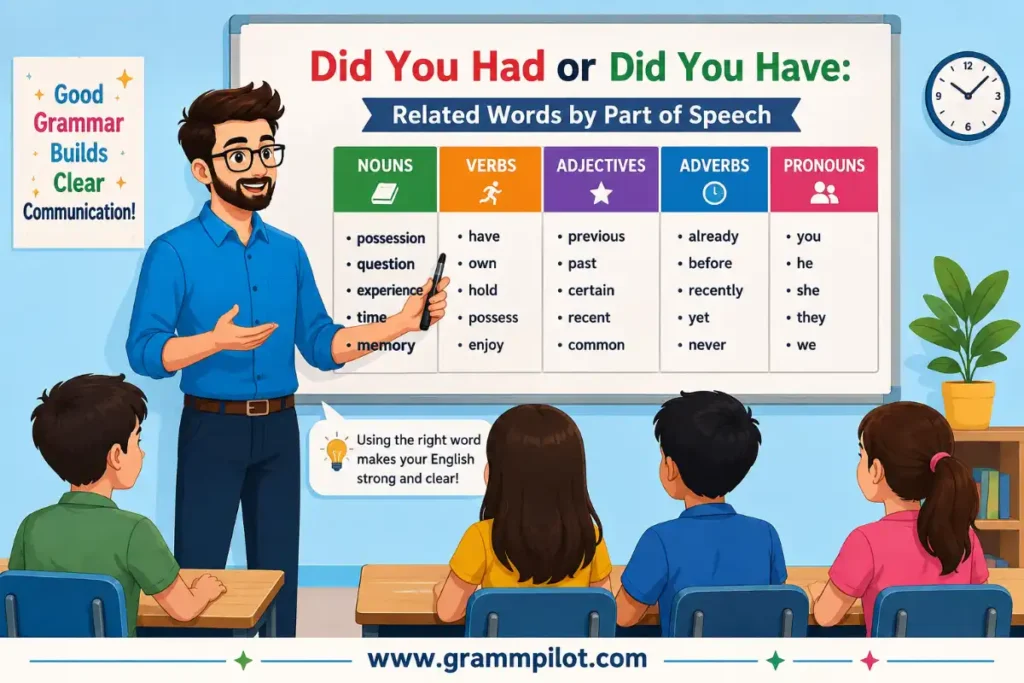
Related Words by Part of Speech
| Part of Speech | Examples |
|---|---|
| Verb | Have, Had, Go, Eat |
| Auxiliary Verb | Did, Do, Does |
| Noun | Question, Grammar, Sentence |
| Pronoun | You, He, She, They |
| Adverb | Yesterday, Already, Never |
Examples:
Verb
Did you have enough money?
Auxiliary Verb
Did she finish the project?
Pronoun
Did they arrive on time?
Is There a Difference Between American and British English?
No. American English and British English follow exactly the same grammar rule. Both varieties of English use:
- Did you have breakfast?
- Did you have any questions?
- Did you have enough time?
Neither standard American English nor standard British English accepts: ❌ Did you had breakfast?
This means the rule for Did You Had or Did You Have is universal across standard English.
Did You Had Did You Have: Which Form Fits Best in Different Situations?
Best Choice for a Resume
Resumes rarely use direct questions, but if you’re writing interview notes or training materials, always use the correct grammar.
Example: “Did you have previous leadership experience?”
Correct grammar reflects professionalism.
Best Choice for an Essay
Academic writing should always use the standard question form.
Example: “The researcher asked, ‘Did you have any previous experience with this software?'”
Using the correct form avoids grammar mistakes that can reduce the quality of your writing.
Best Choice for Text
People often shorten messages, but the grammar should remain the same.
Examples:
- Did you have fun?
- Did you have dinner?
- Did you have class today?
Never write: ❌ Did you had fun?
Best Choice for Emails
Professional emails should always follow standard English.
Examples:
- Did you have a chance to review the report?
- Did you have any questions after the meeting?
- Did you have time to complete the assignment?
These questions sound natural and professional.
Best Choice for Speaking
Native speakers always use Did you have in standard English.
Examples:
- Did you have a nice weekend?
- Did you have enough sleep?
- Did you have any luck?
Whether you’re talking to a friend, teacher, customer, or interviewer, the correct form never changes.

Did You Had or Did You Have: Which Form Should You Choose?
Use this quick guide whenever you’re unsure.
| Situation | Correct Form |
|---|---|
| Past simple question | Did you have |
| School writing | Did you have |
| Business email | Did you have |
| Formal speech | Did you have |
| Casual conversation | Did you have |
| Grammar exam | Did you have |
| Interview question | Did you have |
| Everyday English | Did you have |
Remember this simple formula: Did + Subject + Base Verb
If you follow this pattern, you’ll never struggle with {Did You Had or Did You Have} again.
Real-Life Example Sentences “Did You Had Did You Have”
One of the best ways to master {Did You Had or Did You Have} is by seeing the correct form in everyday situations. The examples below cover school, work, travel, conversations, and professional writing.
Examples Using “Did You Have”
- Did you have a good weekend?
- Did you have breakfast this morning?
- Did you have enough sleep last night?
- Did you have time to finish your homework?
- Did you have any questions during the meeting?
- Did you have fun at the party?
- Did you have a chance to read the report?
- Did you have your passport with you?
- Did you have trouble finding the address?
- Did you have coffee before work?
- Did you have lunch with your coworkers?
- Did you have an opportunity to speak with the manager?
- Did you have any problems during the trip?
- Did you have everything you needed?
- Did you have a great vacation?
Every one of these examples is grammatically correct because did is followed by the base verb have.
Did You Had vs Did You Have
This is the comparison that causes the most confusion.
| Did You Had | Did You Have |
|---|---|
| ❌ Incorrect grammar | ✅ Correct grammar |
| Uses the past tense twice | Uses the helping verb correctly |
| Not accepted in standard English | Accepted in American and British English |
| Common learner mistake | Correct in all formal and informal situations |
Examples:
❌ Did you had breakfast?
✅ Did you have breakfast?
❌ Did you had enough time?
✅ Did you have enough time?
Whenever you see the question {Did You Had or Did You Have}, remember that only Did you have is correct.
Have vs Had
Many learners also confuse have and had.
| Have | Had |
|---|---|
| Base form of the verb | Past tense and past participle |
| Used after did | Used without did in simple past statements |
| Used in present-tense sentences | Used for completed actions |
Examples:
Present
I have two sisters.
Past
I had two meetings yesterday.
Question
Did you have a meeting yesterday?
Notice that had changes back to have after did.
Did Have vs Had
Both forms are correct, but they are used differently.
| Did Have | Had |
|---|---|
| Used in questions and emphasis | Used in normal past-tense statements |
| Requires the helping verb did | Does not use a helping verb |
| Base verb follows did | Past-tense verb stands alone |
Examples:
Did you have dinner?
I had dinner.
Did she have enough money?
She had enough money.
The helping verb changes everything.
Do You Have vs Did You Have
Another common comparison is between present and past questions.
| Do You Have | Did You Have |
|---|---|
| Present tense | Past tense |
| Asks about now or a regular habit | Asks about a completed past event |
Examples:
Do you have any free time today?
Did you have any free time yesterday?
Do you have a driver’s license?
Did you have a driver’s license when you lived there?
Did You Had or Did You Have: Common Mistakes People Make
Many English learners make the same mistakes when using {Did You Had or Did You Have}.
Mistake 1: Using Two Past-Tense Verbs
Incorrect: ❌ Did you had lunch?
Correct: ✅ Did you have lunch?
Only did shows the past tense.
Mistake 2: Using “Had” After Every “Did”
Some learners believe every past question needs had.
Examples:
❌ Did she had a meeting?
✅ Did she have a meeting?
❌ Did they had enough money?
✅ Did they have enough money?
The main verb always returns to its base form.
Mistake 3: Forgetting the Base Verb Rule
Remember this simple pattern: Did + base verb
Examples:
Did you go?
Did you see?
This rule works with regular and irregular verbs.
Mistake 4: Mixing Statements and Questions
Statement: I had a wonderful vacation.
Question: Did you have a wonderful vacation?
Changing a statement into a question requires changing had back to have.
Mistake 5: Copying Informal Grammar
Sometimes learners repeat grammar mistakes they hear online or in casual conversations.
For example: ❌ Did you had fun?
Although you might hear it occasionally from non-native speakers or in informal speech, it is still grammatically incorrect.
Standard English always uses: ✅ Did you have fun?
When Should You Avoid “Did”?
Do not use did if another helping verb is already in the sentence.
Incorrect: ❌ Did you had been waiting?
Correct: ✅ Had you been waiting?
Incorrect: ❌ Did you have been working?
Correct: ✅ Had you been working?
Choose the helping verb that matches the tense.
Antonyms and Related Opposites
Since have is a verb, it doesn’t have a direct opposite in every context. However, these words often express the opposite idea.
| Word | Meaning |
|---|---|
| Lack | To not have something |
| Lose | To stop having something |
| Miss | To fail to experience something |
| Without | Not having |
| Need | To require something because you do not have it |
| Give away | To no longer keep something |
| Surrender | To hand something over |
| Forfeit | To lose the right to something |
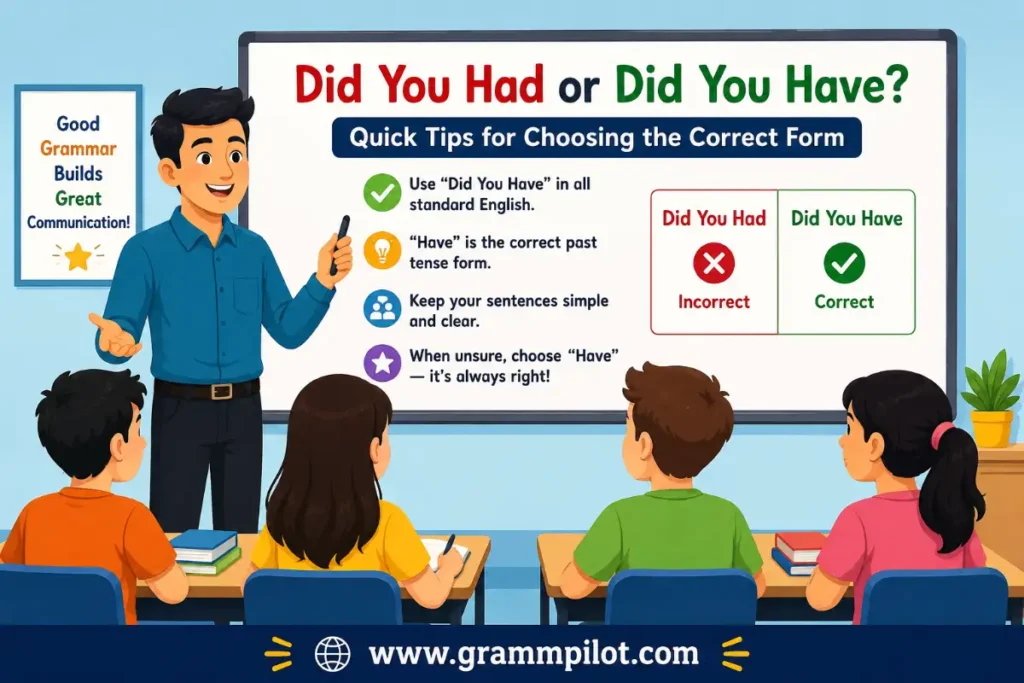
Quick Tips for Choosing the Correct Form
- Always remember the formula Did + base verb.
- Never write Did you had in standard English.
- The helping verb did already shows the past tense.
- After did, use have, go, eat, buy, see, write, or another base verb.
- If you’re writing an essay or business email, double-check every question that starts with did.
- Read the sentence aloud. If you hear two past-tense verbs together, something is probably wrong.
- Think of did as carrying the past tense, so the main verb doesn’t have to.
- Practice changing statements into questions to reinforce the rule.
- Remember that this grammar rule is the same in American English and British English.
- Whenever you hesitate between {Did You Had or Did You Have}, choose Did you have—it is the only grammatically correct option.
By following these simple rules and practicing with real-life examples, you’ll quickly develop the habit of using Did you have naturally in both speaking and writing. In the final part, you’ll find a concise conclusion, numbered FAQs, a search-friendly Meta Title, and a click-worthy Meta Description.
Conclusion
Understanding {Did You Had or Did You Have} is much easier once you know one simple grammar rule: did already shows the past tense, so the main verb must stay in its base form. That is why Did you have is always correct, while Did you had is grammatically incorrect. This rule applies to both regular and irregular verbs, making it one of the most useful grammar patterns to learn.
The next time you write an email, answer a grammar question, or have a conversation in English, remember the formula Did + base verb. With a little practice, choosing the correct form will become automatic, and your speaking and writing will sound more natural and accurate.
Frequently Asked Questions
1. Is “Did you had” or “Did you have” correct?
Did you have is correct. Did you had is incorrect because the helping verb did already marks the sentence as past tense. This is the most important rule to remember when choosing {Did You Had or Did You Have}.
2. Why is “Did you had” grammatically incorrect?
It is incorrect because it uses the past tense twice. The helping verb did already shows the past tense, so the main verb must return to its base form, have.
3. Why do we use “have” after “did”?
English grammar requires the structure Did + base verb. The helping verb did carries the past tense, so the main verb remains unchanged.
4. Can I ever use “Did you had” in English?
No. In standard American and British English, Did you had is always considered incorrect. The correct form is Did you have.
5. What’s another easy way to remember the rule?
Remember this simple formula: Did + Have
Never write: Did + Had
If a question starts with did, the next verb should always be in its base form.
6. Does this rule apply to other verbs too?
Yes. The same rule works with every verb.
Examples:
- Did you go?
- Did she eat?
- Did they buy?
- Did he write?
The verb after did is always in its base form.
7. Is the rule different in American and British English?
No. American English and British English follow exactly the same grammar rule. Whether you’re writing an essay, sending a business email, or speaking in everyday conversation, Did you have is the correct choice.
The verb after did is always in its base form.