
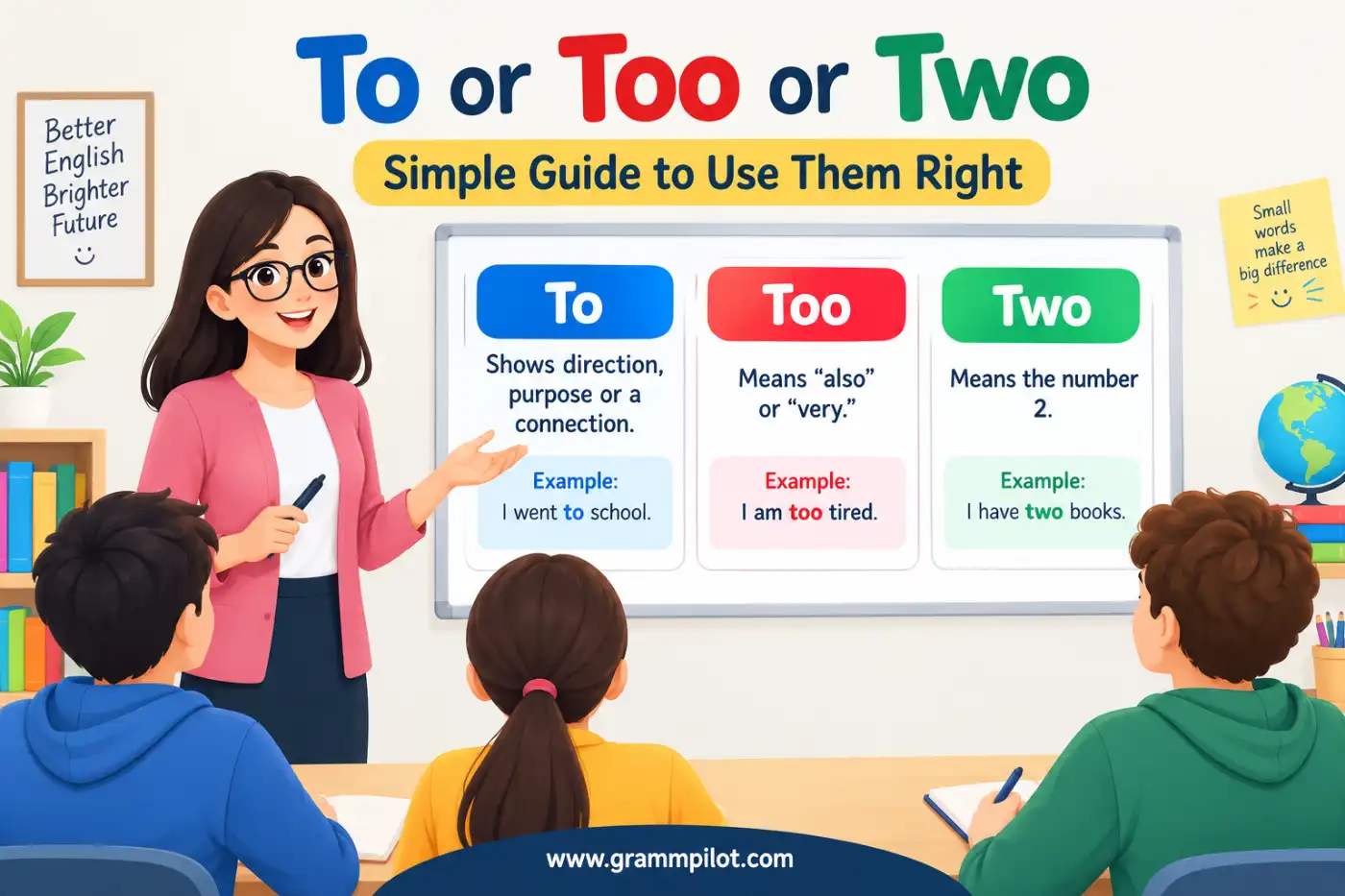
To or Too or Two may look like a small grammar problem, but these three words cause mistakes in emails, essays, text messages, schoolwork, and professional writing. They sound the same, yet each one has a completely different job. A single wrong spelling can change the meaning of a sentence. For example, “I want too go” is incorrect because too cannot show direction or form an infinitive. The correct sentence is “I want to go.”
Quick Answer: To usually shows direction, connection, or an infinitive verb. Too means “also” or “more than needed.” Two is the number 2.
The easiest way to remember them is to connect each word with its purpose instead of relying on pronunciation. Since all three sound alike, your ears cannot always help you choose the correct spelling. This guide explains the meaning, history, grammar, examples, common mistakes, memory tricks, real-life uses, comparisons, and quick tests for choosing the right word.
Another common grammar mistake is covered in [Who vs Whom].
What is the difference between to, too, and two?
Here is the basic difference.
| Word | Main Job | Example |
|---|---|---|
| To | Direction, relationship, or infinitive | I want to learn. |
| Too | Also or excessively | I want to come too. |
| Two | The number 2 | I have two books. |
The key is meaning.
Ask yourself:
- Am I showing direction or connecting words? Use to.
- Do I mean “also” or “more than necessary”? Use too.
- Am I talking about the number 2? Use two.
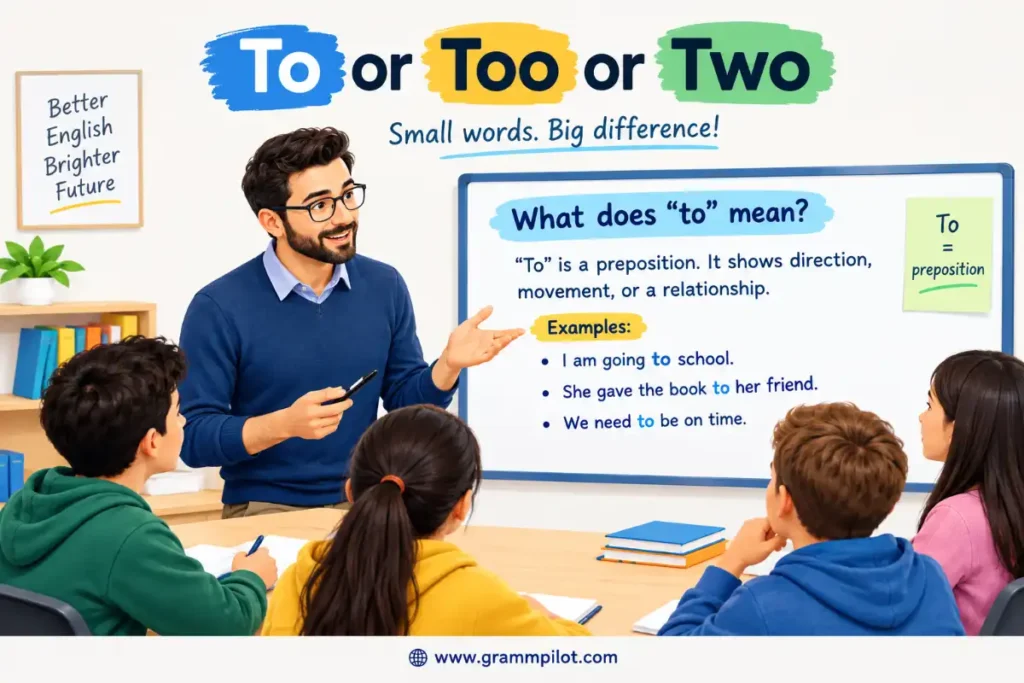
What does “to” mean?
To is one of the most common words in English. It has several important jobs.
To can show direction
Use to when something moves toward a person, place, or thing.
Examples:
- I am going to school.
- She walked to the store.
- We traveled to London.
- Please send the file to me.
- He gave the book to his friend.
The word often answers the question: Where is someone or something going?
To can show a relationship
To can connect people or things.
Examples:
- This answer is important to me.
- She is married to him.
- The key belongs to my sister.
- The solution to the problem was simple.
- His reaction to the news surprised everyone.
Here, to does not always show physical movement. Instead, it shows a relationship or connection.
To can come before a verb
One of the most common uses of to is before the base form of a verb.
Examples:
- I want to sleep.
- She plans to study.
- They hope to travel.
- We need to leave.
- He decided to call.
This structure is called an infinitive.
The pattern is: to + base verb
Examples:
- to eat
- to write
- to learn
- to work
- to improve
To can show comparison
Examples:
- I prefer tea to coffee.
- This method is better than the old one.
- She is married to her childhood friend.
In some comparisons and relationships, to helps connect the two ideas.
What does “too” mean?
Too has two main meanings.
Too can mean “also”
When too means also, it adds another person or thing to the idea.
Examples:
- I want to go too.
- She likes pizza too.
- Can I come too?
- He speaks Spanish too.
- We are excited too.
In this meaning, too often appears near the end of a sentence.
Compare:
“I like coffee.”
“I like tea too.”
The second sentence means: “I also like tea.”
Too can show an excessive amount
Examples:
- There are too many people here.
- I have too much work.
- She spends too much money.
- We waited too long.
- He talks too loudly.
The word adds the idea of “more than necessary.”
What does “two” mean?
Two is the written form of the number 2.
Examples:
- I have two sisters.
- She bought two notebooks.
- We waited for two hours.
- The baby has two shoes.
- They live two streets away.
You can usually replace two with the number 2.
Example:
“I need two tickets.”
“I need 2 tickets.”
The meaning stays the same.
What is the word origin of to, too, and two?
These three words have different histories, even though modern pronunciation makes them sound alike.
Where does “to” come from?
To comes from Old English and has long been used to show direction, purpose, and relationships. Its meaning has changed and expanded over time, but the basic idea of movement toward something remains important.
Where does “too” come from?
Too developed from an older English form connected to the meaning “in addition” or “also.” Over time, it also gained the meaning of “more than enough.”
That is why too can mean:
- Also
- Excessively
Where does “two” come from?
Two comes from an old word for the number 2. Its spelling changed over time, but its meaning has remained clear: it represents a quantity of two. The three words now sound alike in most common forms of English, which is why spelling mistakes are so common.
How do you remember To or Too or Two?
A few simple memory tricks can help.
Remember “too” has an extra O
Too has one more letter than to.
That extra O can remind you of:
- Extra
- Also
- More than needed
Think: Too = something extra.
Examples:
- I want to come too.
- This box is too heavy.
Remember “two” is the number 2
This one is the easiest.
Two = 2
Whenever you are talking about quantity, choose two.
What are the most common uses of “too”?
Too meaning also
Examples:
- I agree too.
- My brother is coming too.
- She wants one too.
- We watched that movie too.
Too meaning excessively
Examples:
- The music is too loud.
- The test was too difficult.
- It is too late.
- The road is too narrow.
- The screen is too bright.
Too much vs too many
Use too much with uncountable nouns.
- Too much water
- Too much noise
- Too much sugar
- Too much work
Use too many with countable plural nouns.
- Too many people
- Too many emails
- Too many mistakes
- Too many books
Example:
“There is too much traffic.”
“There are too many cars.”
What are the most common uses of “two”?
Two always refers to the number 2.
It can describe:
Two people
- Two students arrived early.
- I invited two friends.
Two things
- She bought two pens.
- We need two chairs.
Two periods of time
- Wait two minutes.
- The trip took two hours.
Two choices
- There are two options.
- You have two chances.
Common phrases with two
- Two years ago
- Two weeks later
- Two at a time
- Two by two
- In two days
- Twice a day
To vs Too — what is the difference?
This is the most common comparison.
To
Usually shows direction or comes before a verb.
- I need to go.
- Send it to me.
Too
Means also or excessively.
- I want to go too.
- It is too late.
Compare:
“I want to eat.”
Here, to comes before a verb.
“I want pizza too.”
Here, too means also. The sentence meaning tells you which one is correct.
Too vs Two — what is the difference?
These words are easier to separate.
Too
Means:
- Also
- More than needed
Example: “I am tired too.”
Example: “It is too cold.”
Two
Means: The number 2
Example: “I have two cats.”
A quick test is simple.
Can you replace the word with also?
If yes, use too.
Can you replace it with 2?
If yes, use two.
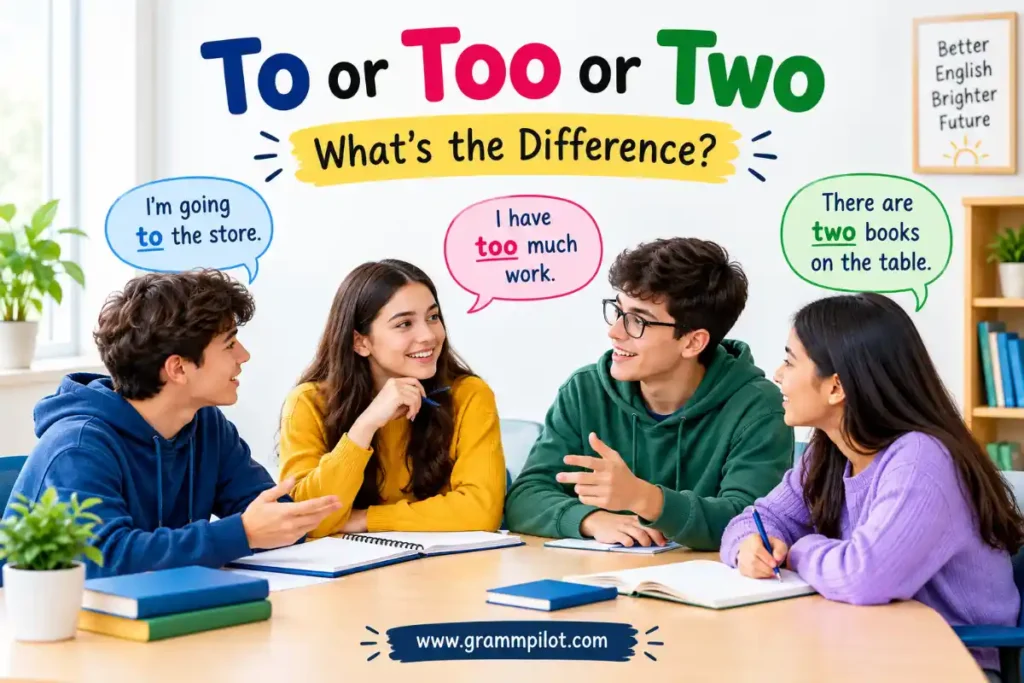
To vs Two — what is the difference?
These two are completely different in grammar.
To
Often works as a preposition or part of an infinitive.
Examples:
- Go to bed.
- I want to sleep.
Two
Is a number.
Examples:
- I have two dogs.
- She bought two dresses.
If you are counting, the answer is always two.
What are some real-life examples?
Here are original examples from different situations.
School
- I need to finish my homework before dinner.
- My friend wants to study too.
- We have two tests next week.
- Please bring your project to class.
- Two students volunteered to help.
Work
- I need to send the report to my manager.
- Maria wants to join the meeting too.
- We have two important deadlines this week.
- The file is too large to attach.
- Please speak to the client before noon.
Text messages
- “I’m going to the mall.”
- “Can I come too?”
- “Sure, invite two more friends.”
- “I’m too tired to go tonight.”
- “I want to see you tomorrow.”
Travel
- We drove to the airport early.
- The hotel was too expensive.
- We booked two rooms.
- I want to visit Paris too.
- The flight is scheduled to leave at noon.
Everyday conversation
- I need to buy milk.
- I need eggs too.
- Please buy two cartons.
- It is too late to call.
- Give the package to your neighbor.
How do you use “to” in an email?
To is extremely common in emails.
Showing the recipient
“Please send the document to the marketing team.”
Showing purpose
“I am writing to ask for more information.”
Before a verb
“I would like to schedule a meeting.”
Showing direction
“Please forward this to the correct department.”
Professional emails often contain many uses of to, so checking each sentence can help prevent mistakes.
Incorrect: “I would like too schedule a meeting.”
Correct: “I would like to schedule a meeting.”
How do you use “two” in an email?
Use two when you are counting.
Examples:
“I have attached two documents.”
“We need two signatures.”
“The meeting has two main goals.”
For formal writing, numbers from one to nine are often written as words, depending on the style guide. Larger numbers may use numerals.
Example:
“We have two options.”
“We have 12 participants.”
Different organizations may follow different style rules.
How do you use these words in an essay?
Academic writing requires careful spelling because these homophones are easy to miss.
Using to
“The researcher attempted to explain the results.”
Using too
“The sample size was too small to support a strong conclusion.”
Using two
“The study examined two different groups.”
Read the sentence based on meaning, not sound.
To or Too or Two: How do you use these words when texting?
Text messages are casual, but the meaning still matters.
Correct:
“I want to go too. Can we invite two more people?”
This sentence uses all three words correctly.
Breaking it down:
- to go = infinitive
- too = also
- two = number 2
This type of sentence is a good practice tool.
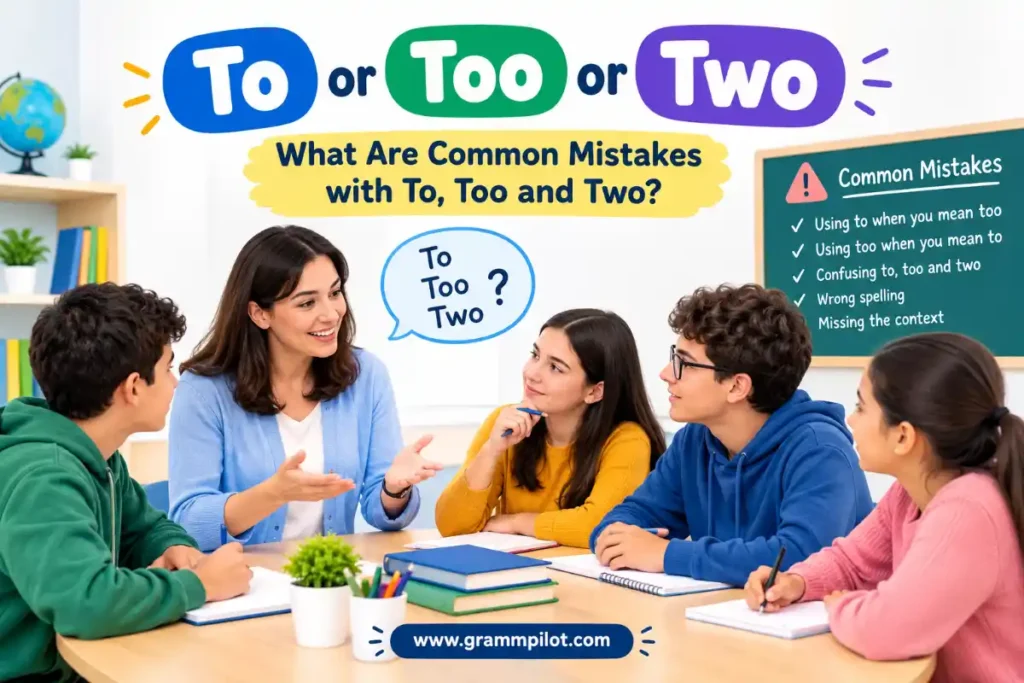
What are common mistakes with to, too, and two?
Mistake 1: Writing “too” before a verb
Incorrect: “I want too leave.”
Correct: “I want to leave.”
When to comes before a base verb, it helps form an infinitive.
Mistake 2: Using “to” instead of “too” for “also”
Incorrect: “I want to come to.”
Correct: “I want to come too.”
The final word means “also.”
Mistake 3: Using “too” for the number 2
Incorrect: “I have too brothers.”
Correct: “I have two brothers.”
If you can write the number as 2, use two.
Mistake 4: Forgetting the meaning of “too”
Some writers think too only means “also.”
It can also show excess.
Correct: “The coffee is too hot.”
This means the coffee is hotter than desired.
Mistake 5: Confusing “to” and “too” in short messages
Fast typing often causes errors.
Incorrect: “Me to!”
Correct: “Me too!”
Here, the meaning is “also me.”
Mistake 6: Assuming spell-check will fix everything
All three are correctly spelled English words.
A spelling checker may not notice the wrong choice.
Example: “I have to cats.”
Every word is spelled correctly, but the sentence should say: “I have two cats.”
What are useful synonyms for “to”?
The word to has different meanings, so its alternatives depend on the context.
To showing direction
Possible alternatives:
- Toward
- Into
- Onto
- In the direction of
Example: “She walked toward the door.”
This is similar to: “She walked to the door.”
To showing a relationship
Possible alternatives may include:
- With
- For
- Toward
The exact replacement depends on the sentence. Because to is a grammar word, it often cannot be replaced directly.
What are useful synonyms for “too”?
Too meaning also
Possible alternatives:
- Also
- As well
- In addition
Examples:
“She is coming too.”
“She is also coming.”
Too meaning excessively
Possible alternatives:
- Excessively
- Overly
- More than necessary
Examples:
“The room is too cold.”
“The room is excessively cold.”
The first sentence is more natural in everyday conversation.
What are useful alternatives for “two”?
Because two is a number, it has very few true synonyms.
Possible expressions include:
- A pair
- A couple
Examples:
“I bought a pair of shoes.”
“We waited a couple of hours.”
Be careful. A couple often means approximately two in casual English.
What are the antonyms?
Does “to” have an antonym?
Usually, no.
To is mainly a preposition or infinitive marker, so it does not have one simple opposite.
In some directional contexts, from may act as a contrast.
- Go to school.
- Come from school.
What is the opposite of “too”?
When too means “more than needed,” possible opposites include:
- Not enough
- Insufficiently
- Too little
Example:
“The room is too hot.”
“The room is too cold.”
However, the exact opposite depends on context.
What is the opposite of “two”?
The number two does not have a direct antonym.
It can be contrasted with:
- One
- Three
- Zero
But these are different numbers, not true opposites.
To or Too or Two: How can you choose the right word quickly?
Use this simple test.
Step 1: Are you talking about the number 2?
Use two.
“I have two tickets.”
Step 2: Do you mean “also”?
Use too.
“I want one too.”
Step 3: Do you mean “more than needed”?
Use too.
“This box is too heavy.”
Step 4: Are you showing direction or placing a word before a base verb?
Use to.
“I want to leave.”
“Go to the store.”
Quick tips to remember the difference
Keep these ideas in mind:
- To = direction or verb connection
- Too = also or extra
- Two = number 2
- Too has an extra O for something extra.
- Two is easy to remember because it equals 2.
- To often appears before a base verb.
- Use too when you can replace it with also.
- Use two when you can replace it with 2.
- Never rely only on pronunciation.
- Read the meaning of the full sentence.
To or Too or Two: Why do people confuse these words?
The biggest reason is that all three are homophones.
Homophones are words that sound the same but have different spellings and meanings.
Examples of other common homophones include:
- Their, there, and they’re
- Your and you’re
- Its and it’s
- Here and hear
- Right and write
The same issue happens with To or Too or Two.
When speaking, context usually makes the meaning clear.
When writing, you need to choose the correct spelling.
That is why these words appear so often in grammar lessons.
Practice sentences: which word should you choose?
Choose to, too, or two.
- I want ________ go with you.
- Can I come ________?
- She bought ________ new books.
- The box is ________ heavy to carry.
- Please send the email ________ your teacher.
- We need ________ more chairs.
- I want ________ learn Spanish.
- He wants one ________.
- It is ________ late to call.
- They walked ________ the store.
Answers
- To
- Too
- Two
- Too
- To
- Two
- To
- Too
- Too
- To
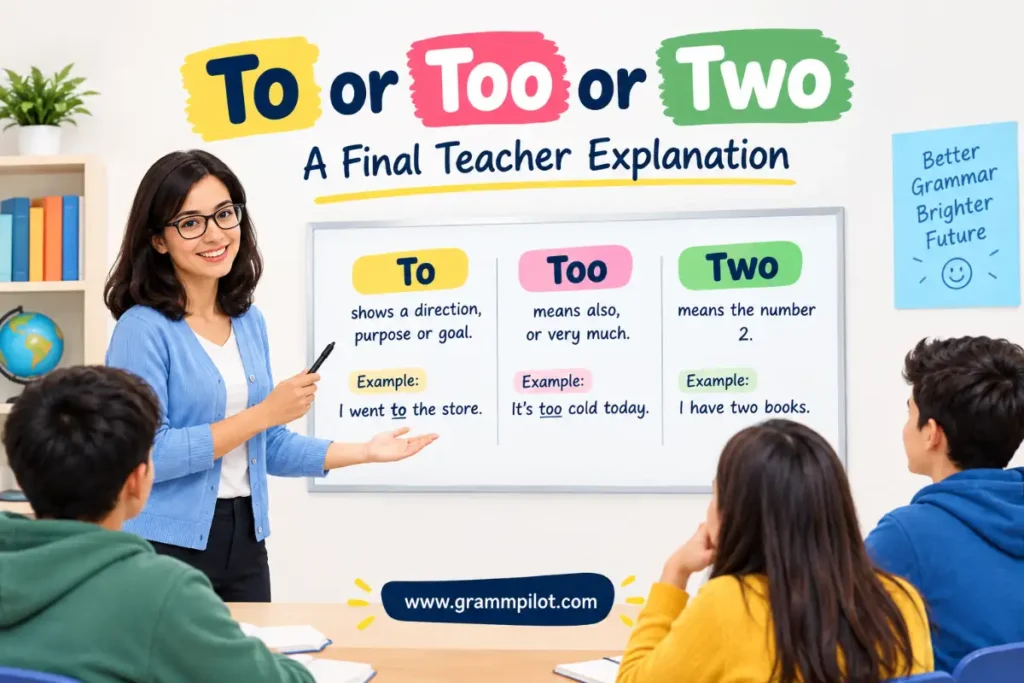
To or Too or Two: A final teacher explanation
The easiest way to master these three words is to give each one a clear job.
To usually connects ideas. It can show direction or come before a base verb.
“I want to learn.”
“She walked to school.”
Too adds the idea of “also” or “more than needed.”
“I want to learn too.”
“This lesson is too difficult.”
Two is always about the number 2.
“I have two notebooks.”
Once you stop thinking about pronunciation and start looking at meaning, the choice becomes much easier.
When checking your writing, pause for a moment and ask:
Am I showing direction?
Am I adding something?
That quick check can prevent most mistakes.
Conclusion
To or Too or Two may sound identical, but their meanings are easy to separate once you know what each word does. Use to for direction, relationships, and infinitive verbs. Choose too when you mean “also” or “more than necessary.” Use two only for the number 2.
The best habit is to check the meaning instead of trusting the sound. Remember that too has an extra “O” for something extra, while two equals 2. With a little practice, these three homophones become much easier to use correctly in essays, emails, text messages, schoolwork, and everyday writing.
Frequently Asked Questions
1. What is the main difference between to, too, and two?
To usually shows direction or comes before a verb. Too means “also” or “more than needed,” while two means the number 2.
2. Is it “me too” or “me to”?
The correct phrase is “me too.” Here, too means “also.”
3. Is it “too much” or “to much”?
The correct phrase is “too much.” In this phrase, too means more than needed or desired.
4. What’s another way to say too?
When too means “also,” you can use also or as well. When it means “more than necessary,” alternatives include overly or excessively.
5. When do I use two?
Use two when referring to the number 2. For example: “I have two brothers” or “We need two tickets.”
6. Why are to, too, and two so confusing?
They are homophones, which means they sound the same but have different spellings and meanings. Context helps you choose the correct word.
7. Can I use to, too, and two in one sentence?
Yes. For example: “I want to buy two tickets too.” Each word has a different meaning and job in the sentence.