

If you’ve ever paused while writing an email and wondered about to say “Who should I contact?” or “Whom should I contact?”, you’re not alone. The difference can feel tricky because both words refer to people, and everyday speech often treats them the same way. The good news is that the rule is simpler than it first appears. Who generally works as the subject of a clause, while whom traditionally works as the object. In casual American English, though, who is often preferred even where formal grammar would use whom.
Quick Answer: Use who for the person doing an action and whom for the person receiving an action or following a preposition. If you’re unsure in everyday English, who is usually the more natural choice.
You’ll learn how the two words work, where they came from, how to use the famous “he/him” test, when formal writing calls for whom, and when using who sounds more natural.
If you’re working on choosing the right word, explore [Adapt vs Adopt].
Who vs Whom: What is the difference between who and whom?
The basic distinction is grammatical.
| Word | Main role | Simple test | Example |
|---|---|---|---|
| Who | Subject | Replace it with he/she/they | Who called you? |
| Whom | Object | Replace it with him/her/them | Whom did you call? |
Consider these two questions: Who called Maria?
The person referred to by who performed the action. That makes who the subject.
Whom did Maria call?
The person referred to by whom received the action. That makes whom the object.
A useful shortcut is:
Who → he/she/they
Whom → him/her/them
If the answer would be he, choose who.
If the answer would be him, choose whom.
Who vs Whom: What does “who” mean?
Who is a pronoun used when you’re asking about or referring to a person. f ,It commonly introduces questions and clauses.
Examples:
- Who is at the door?
- Who wrote this report?
- Who wants coffee?
- Who called earlier?
- I know who wrote the message.
- The student who won the award is my cousin.
In each example, who refers to a person.
Who as the subject
The most important use is as the subject of a verb.
Example: “Who broke the window?”
The answer might be: “Sarah broke the window.”
Sarah performed the action, so who is correct.
Another example: “Who sent this email?”
Answer: “David sent it.”
David is the subject of sent, so the question uses who.
Who vs Whom: What does “whom” mean?
Whom is traditionally used as the object form of who. It usually refers to the person receiving an action or the person affected by it.
Examples:
- Whom did you invite?
- Whom did she call?
- Whom are you helping?
- To whom should I send the form?
- Whom did they choose?
In each case, the person is not performing the main action. Instead, the person receives or is affected by it.
Whom as the object
Look at this sentence: “Whom did you invite?”
The hidden statement is: “You invited him.”
You performed the action. Him received it.
Because him is an object pronoun, the traditional grammatical choice is whom.
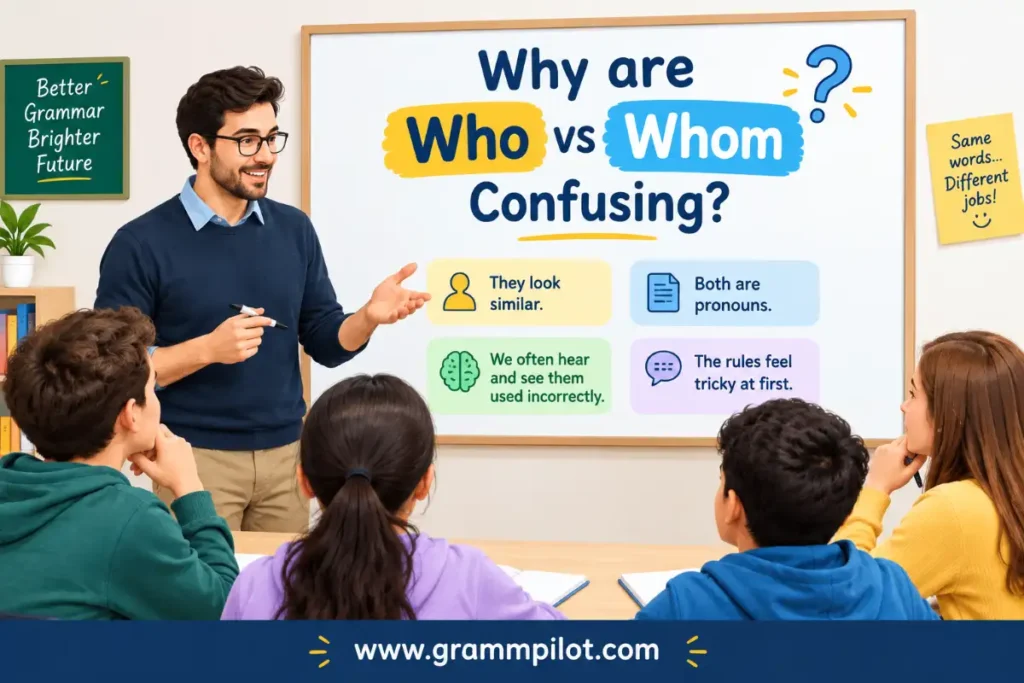
Why are who vs whom confusing?
The problem comes from English pronouns having different forms.
Compare:
| Subject | Object |
|---|---|
| I | me |
| He | him |
| She | her |
| We | us |
| They | them |
| Who | whom |
Nobody normally says: “Me called you.”
We say: “I called you.”
Likewise: “Who called you?”
But English speakers don’t always maintain the same distinction with who vs whom, especially in conversation.
That’s why the formal rule can seem more complicated than it actually is.
Who vs Whom: What is the easiest way to choose between who vs whom?
Use the he/him test.
Step 1: Find the person being referred to
Ask yourself who the sentence is talking about.
Step 2: Turn the question into a statement
Example: “Who did you meet?”
Change it mentally to: “You met ___.”
Step 3: Try “he” or “him”
“You met him.”
That sounds right.
Therefore: “Whom did you meet?”
For another example: “Who called you?”
Turn it into: “___ called you.”
“He called me.”
You need he, so the correct formal choice is: “Who called you?”
This test is one of the fastest ways to solve the problem.
How do you use who in questions?
Use who when the person is doing the action.
Examples:
- Who opened the door?
- Who wrote this note?
- Who made dinner?
- Who wants to come?
- Who knows the answer?
- Who took my pen?
- Who sent the package?
- Who designed the website?
Try answering:
“Who designed the website?”
“The designer designed the website.”
The person performs the action, so who is appropriate.
How do you use whom in questions?
Use whom when the person is receiving the action.
Examples:
- Whom did you invite?
- Whom did she call?
- Whom did they hire?
- Whom did he choose?
- Whom are you helping?
- Whom did the teacher praise?
For example: “Whom did you invite?”
Answer: “I invited Jessica.”
Jessica receives the action of invite, so whom is the formal grammatical choice.
Is “who” replacing “whom”?
In many situations, yes. Modern English increasingly favors who in places where older formal grammar would have used whom.
You may hear: “Who did you talk to?”
Much more often than: “To whom did you talk?”
The first version is natural and completely normal in everyday American English. This doesn’t mean whom has disappeared. It still appears in formal writing, careful speech, fixed expressions, and after certain prepositions.
Who vs Whom: Is whom necessary in everyday American English?
Usually, no. In casual conversation, who is often the better choice because it sounds natural.
For example: “Who did you see at the party?”
This is normal conversational English. “Whom did you see at the party?”
This is grammatically traditional, but it can sound formal or stiff in casual conversation. The choice should depend on your audience and the setting.
When should you use whom in formal writing?
Whom can be useful when you want a formal or traditional tone.
It is especially common after prepositions.
Examples:
- To whom it may concern
- The candidate to whom we offered the position
- The person with whom I worked
- The client for whom we prepared the report
Legal, academic, official, and highly formal writing may preserve this distinction more often. Even there, clarity matters more than forcing whom into every possible sentence.
Who vs whom in an email?
The best choice depends on the tone.
Casual or everyday email
Use who naturally.
“Who should I contact about this issue?”
“Who did you speak with?”
These sound friendly and professional.
Formal email
You may use whom where the traditional object form fits.
“To whom should I address the application?”
“Whom should I contact regarding the contract?”
Still, don’t assume that whom automatically makes an email better. A clear, natural sentence is often preferable to an unnecessarily formal one.
Who or whom on a resume?
Resumes generally favor direct, active language.
Instead of: “Whom should employers contact for references?”
A resume might simply say: “Professional references available upon request.”
If you do use one of these pronouns, choose according to the grammatical role rather than trying to sound impressive.
Example: “I worked with a manager who mentored junior employees.”
Here, who is correct because the manager performed the action.
Who or whom in academic writing?
Academic writing may preserve the distinction more carefully than casual conversation.
Examples: “The researcher interviewed participants whom the committee had selected.”
Here, participants receive the action selected, so whom fits the traditional rule.
Who or whom in texting?
For texting, who is almost always the natural choice.
Examples:
- Who are you with?
- Who did you call?
- Who sent that?
- Who are you talking to?
- Who do you want to invite?
Using whom in a casual text isn’t necessarily wrong, but it can sound unusually formal.
For example: “Whom are you texting?”
Most people would naturally write: “Who are you texting?”
Who or whom in speaking?
Everyday speech strongly favors who.
Native speakers commonly say:
“Who did you invite?”
“Who are you going with?”
These forms are normal.
You don’t need to force whom into ordinary conversation simply because you learned the traditional grammar rule.
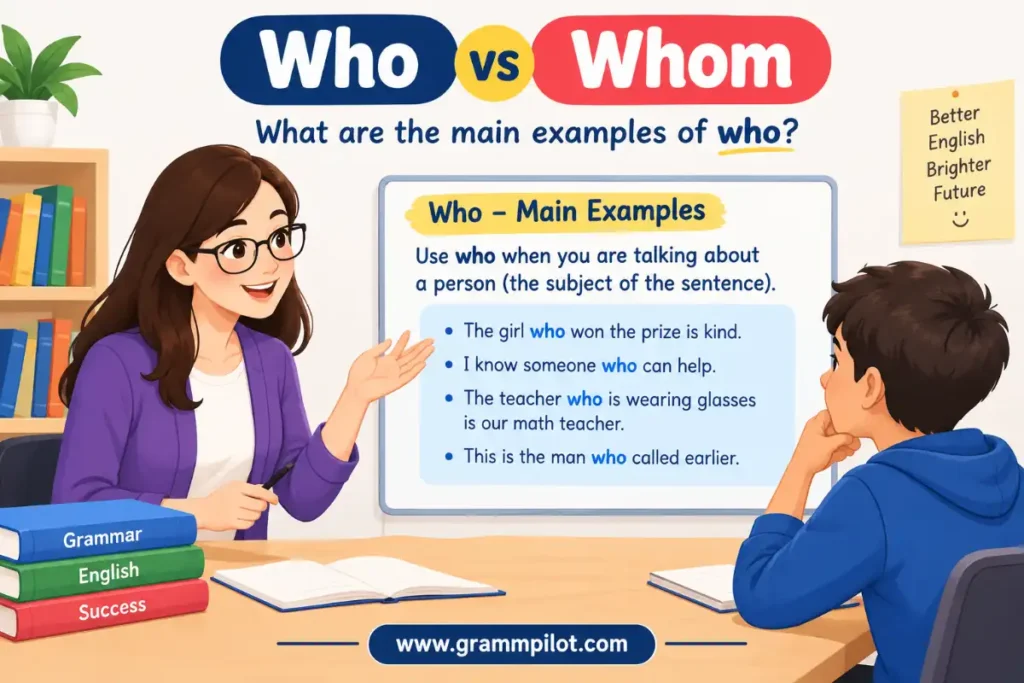
Who vs Whom: What are the main examples of who?
Here are several examples where who is the subject.
- Who called me last night?
- Who made this cake?
- Who wants to join us?
- Who knows the answer?
- Who left the door open?
- Who wrote the report?
- Who is coming to dinner?
- Who helped you with the project?
- Who designed this building?
- Who told you the news?
In every case, the person referred to by who performs the action.
Who vs Whom: What are the main examples of whom?
These examples show traditional object usage.
- Whom did you invite?
- Whom did she call?
- Whom did the manager hire?
- Whom did you meet yesterday?
- Whom are they supporting?
- Whom did the committee select?
- To whom should I send this document?
- With whom did you travel?
- For whom was the gift purchased?
- From whom did you receive the message?
The person referred to by whom receives or is affected by an action, or follows a preposition.
What is the difference between “who did you call?” and “whom did you call?”
Both are widely understood, but they differ in formality and traditional grammar.
Who did you call?
This is common modern English and sounds natural in conversation.
Whom did you call?
This follows the traditional subject/object distinction and sounds more formal.
The hidden answer is: “I called him.”
Because the answer uses him, traditional grammar favors whom. But in ordinary American English, who did you call? is completely normal.
What is the difference between “who called you?” and “whom called you?”
Only the first is correct.
Who called you?
The person performed the action.
“He called me.”
Whom called you?
This is incorrect because whom cannot serve as the subject of called in traditional grammar. This is an important distinction. You shouldn’t replace every occurrence of who with whom.
Who vs whom after “to”
The traditional rule is straightforward: Use whom after to when it refers to a person.
Examples:
- To whom did you send the letter?
- To whom should I speak?
- To whom does this belong?
But everyday English usually places to at the end:
- Who did you send the letter to?
- Who should I speak to?
- Who does this belong to?
The second pattern is natural in conversation.
Who vs whom after “with”
Formal writing: “Whom are you going with?”
More traditionally formal: “With whom are you going?”
Casual English usually prefers: “Who are you going with?”
The preposition-at-the-end version is not a mistake. English commonly allows this structure.
Can you leave out whom?
Often, yes.
This can make a sentence sound more natural.
Formal: “The person whom I met yesterday was helpful.”
Natural: “The person I met yesterday was helpful.”
The pronoun can disappear because the grammatical relationship remains clear. This is especially useful when whom makes a sentence sound unnecessarily stiff.
Who vs Whom: What are common mistakes with who and whom?
Mistake 1: Using whom as the subject
Incorrect: “Whom called you?”
Correct: “Who called you?”
The person performed the action.
Mistake 2: Using who in a highly formal construction
In traditional formal writing: “Whom did you contact?”
is preferred over: “Who did you contact?”
However, the second version is common and natural in modern American English.
Mistake 3: Using whom just to sound intelligent
Some writers assume whom always sounds more educated. That’s not true.
Incorrect: “Whom is coming to dinner?”
Correct: “Who is coming to dinner?”
Using the formal form in the wrong place creates an actual grammatical error.
Mistake 4: Forgetting the he/him test
When you’re uncertain, don’t guess. Turn the sentence into a statement.
“Who did you meet?”
“I met him.”
That points to whom in traditional grammar.
Mistake 5: Thinking every preposition requires whom
Formal grammar favors whom after prepositions, but modern English often uses who when the preposition moves to the end.
“Who are you talking to?”
is completely natural.
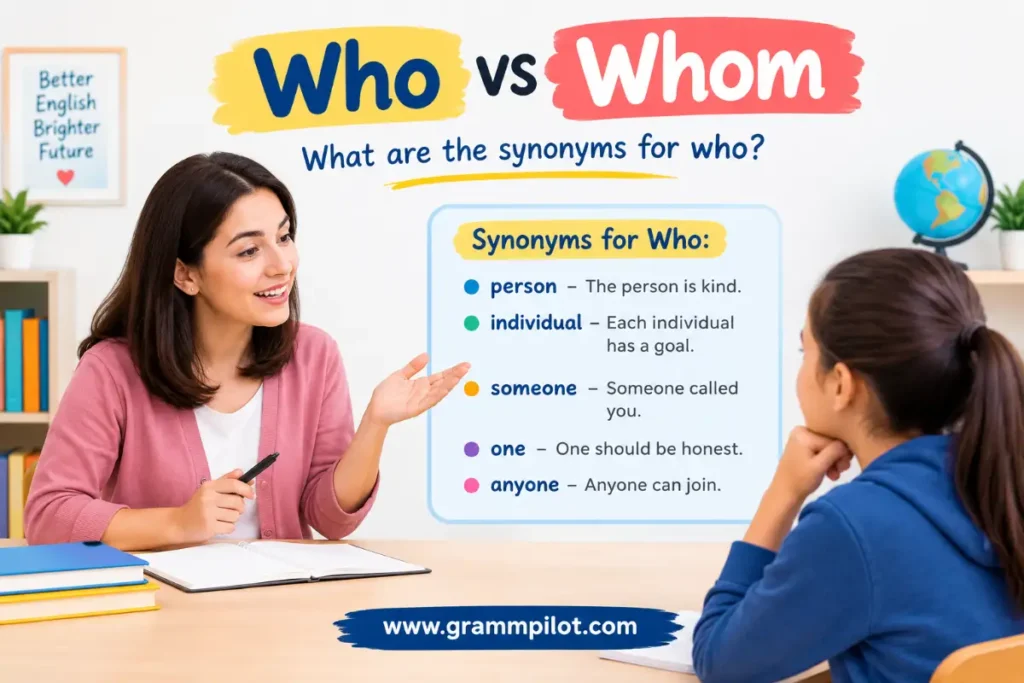
What are the synonyms for who?
There isn’t always a direct synonym for who, because it is a pronoun that performs a specific grammatical role.
Depending on context, you can sometimes rewrite the sentence using:
- Which person
- What person
- The person who
- The individual who
Examples:
“Who called?”
“Which person called?”
The second version is grammatically possible but usually less natural.
What are the synonyms for whom?
Like who, whom has no accurate replacement in every sentence.
Depending on context, alternatives include:
- Which person
- Which individual
- The person
- The individual
Example:
“Whom did you invite?”
“Which person did you invite?”
The second sentence is possible, but whom is shorter.
How do who and whom compare by formality?
| Situation | More natural choice |
|---|---|
| Texting | Who |
| Casual conversation | Who |
| Friendly email | Who |
| General workplace writing | Usually who |
| Academic writing | Who or whom, depending on structure |
| Legal writing | Whom may appear more often |
| Formal letters | Whom may be appropriate |
| Traditional formal phrases | Whom |
The goal isn’t to use whom as often as possible. The goal is to match the grammar and tone.
How does regional English affect who and whom?
The distinction is weakening in many varieties of modern English. American English, especially in conversation, frequently uses who where traditional grammar would use whom. British English also commonly uses who in everyday speech, although whom remains familiar in formal contexts. Across both varieties, fixed phrases such as “to whom it may concern” continue to preserve the traditional form.
Who vs Whom: What is the easiest way to remember the rule?
Use the pronoun substitution trick.
If you can answer with he, use who.
“Who opened the door?”
“He opened the door.”
Therefore: who.
If you can answer with him, use whom.
“Whom did you invite?”
“I invited him.”
Therefore: whom.
You can expand this to:
- She → who
- Her → whom
- They → who
- Them → whom
This works better than memorizing a long grammar definition.
Quick decision chart “Who vs Whom”
| Ask yourself | Choose |
|---|---|
| Is the person doing the action? | Who |
| Is the person receiving the action? | Whom |
| Can you answer with he? | Who |
| Can you answer with she? | Who |
| Can you answer with they? | Who |
| Can you answer with him? | Whom |
| Can you answer with her? | Whom |
| Can you answer with them? | Whom |
| Is it a formal phrase after a preposition? | Often whom |
| Is it casual conversation? | Usually who |
A final teacher explanation”Who vs Whom”
Think of who as the person doing the action.
“Who opened the door?”
The answer is: “She opened the door.”
Think of whom as the person receiving the action.
“Whom did you invite?”
The answer is: “I invited her.”
That is the traditional rule.
Modern English adds one important point: who has become very common as the object in ordinary conversation. So “Who did you call?” is natural, even though traditional grammar would prefer “Whom did you call?” For everyday communication, prioritize clarity and naturalness. Save whom for situations where the object form is useful, especially formal writing, traditional constructions, and sentences after prepositions.

Conclusion
The key to choosing between these pronouns is to identify the person’s role in the sentence. Who normally refers to the person performing an action, while whom traditionally identifies the person receiving it. The fastest check is to replace the word with he/she/they or him/her/them.
Modern English doesn’t always preserve the distinction in casual speech. That’s why “Who did you call?” sounds accurately natural to most American English speakers. In formal writing, however, knowing the traditional rule can help you make deliberate choices. Learn the grammar, then consider your audience, tone, and context before deciding which form sounds best.
Frequently Asked Questions
1. What is the simple rule for who and whom?
Who is generally used for the subject, while whom is traditionally used for the object. Use the he/him test when you’re unsure.
2. Is it “who did you call” or “whom did you call”?
Both are understood, but “whom did you call?” follows traditional formal grammar. “Who did you call?” is more common in everyday American English.
3. Who or whom should I use in an email?
Use who for a natural conversational or professional tone, while whom can fit formal constructions such as “To whom should I address this letter?”
4. What’s an easy trick for knowing when to use whom?
Replace the word with him, her, or them. If one of those works, whom is the traditional choice.
5. Is “whom” still used in modern English?
Yes. It remains common in formal writing, after certain prepositions, and in established expressions. However, who is increasingly used as an object in everyday English.
6. Is “whom is calling?” correct?
No. The correct sentence is “Who is calling?” The person doing the calling is the subject, so traditional grammar requires who.
7. Do Americans still use whom?
Yes, but everyday American English often favors who where traditional grammar would use whom. The formal form remains useful in certain settings.