

Have you ever paused while writing an email, school assignment, or social media post because you couldn’t decide between Flew or Flown? It’s a common problem. These two words come from the same verb, but they don’t work the same way in a sentence. Many English learners—and even native speakers—search for Flew or Flown because both forms sound familiar. The good news is that the difference is much simpler than it first appears. Once you learn one grammar rule, you’ll know which word fits almost every situation.
Answer Box
“Flew” is the simple past tense of fly. “Flown” is the past participle and must be used with a helping verb such as has, have, or had.
By the end of this guide, you’ll understand the grammar, the history behind these words, common mistakes, real-life examples, and practical tips that make choosing the correct form easy every time.
If this expression is new to you, you may also enjoy [Double Check or Double Confirm].
Flew or Flown: What’s the Difference?
The biggest difference between Flew or Flown is the verb tense. Although both words come from the verb fly, each one has its own job. You cannot swap them without changing the grammar of the sentence.
| Word | Verb Form | Example |
|---|---|---|
| Fly | Base form | Birds fly south in winter. |
| Flew | Simple past | We flew to Boston yesterday. |
| Flown | Past participle | We have flown to Boston before. |
A quick rule makes the choice much easier.
- Use flew for an action that happened in the past.
- Use flown after a helping verb.
This small difference is the reason many writers become confused.
Flew or Flown: What Do These Words Mean?
Both words describe movement through the air. Most often, they refer to birds, airplanes, insects, drones, or people traveling by plane. The verb fly can also describe something moving quickly through the air or even time passing quickly.
For example:
- The bird flies across the lake every morning.
- We fly home during the holidays.
- That baseball flew over the fence.
- Time flies when you’re having fun.
Even though the meaning stays almost the same, the grammar changes depending on the sentence.

Flew or Flown: Why Do People Mix Them Up?
English has hundreds of irregular verbs. Unlike regular verbs that simply add -ed, irregular verbs change their spelling. Compare these examples.
| Regular Verb | Past | Past Participle |
|---|---|---|
| Walk | Walked | Walked |
| Clean | Cleaned | Cleaned |
| Play | Played | Played |
Now look at some irregular verbs.
| Base Verb | Past | Past Participle |
|---|---|---|
| Fly | Flew | Flown |
| Write | Wrote | Written |
| Speak | Spoke | Spoken |
| Break | Broke | Broken |
| Drive | Drove | Driven |
Notice that the past participle often looks different from the simple past. That’s why many people accidentally write sentences like: ❌ I have flew to Chicago.
The correct sentence is: ✅ I have flown to Chicago.
Another common mistake looks like this: ❌ Yesterday I have flown home.
Instead, write: ✅ Yesterday I flew home.
Understanding Flew or Flown becomes much easier when you remember that each form belongs to a different tense.
Flew or Flown: Where Did These Words Come From?
The history of Flew or Flown goes back more than one thousand years. The verb fly comes from the Old English word flēogan, which meant to move through the air, soar, or travel quickly. As English developed over the centuries, the verb kept its irregular forms instead of changing into a regular verb. That is why modern English uses three different forms.
- Fly
- Flew
- Flown
Many of the oldest English verbs kept unusual patterns because people had already been using them for hundreds of years before grammar became standardized. Other old verbs follow similar patterns.
| Base Verb | Past | Past Participle |
|---|---|---|
| Go | Went | Gone |
| Eat | Ate | Eaten |
| Take | Took | Taken |
| See | Saw | Seen |
| Fly | Flew | Flown |
This history explains why we never say flyed, even though it might seem logical.
Flew or Flown: Why Is “Fly” an Irregular Verb?
Many of the most common English verbs are irregular because they are also some of the oldest. Words like be, go, come, eat, write, see, and fly were spoken long before today’s grammar rules existed. Instead of adding -ed, these verbs developed their own past forms over time.
That is why English uses:
- fly
- flew
- flown
rather than:
- fly
- flyed
- flyed
Although irregular verbs require practice, they become much easier once you recognize their patterns.
Flew or Flown: When Should You Use “Flew”?
Choose flew when talking about an action that happened and ended in the past. This form usually appears with time expressions such as:
- yesterday
- last night
- last week
- last year
- two days ago
- in 2024
Here are some examples.
- We flew to New York yesterday.
- Sarah flew home after graduation.
- The eagle flew above the mountains.
- My brother flew a drone over the park.
- The pilot flew through heavy rain.
- Our family flew across the country last summer.
Each sentence describes a completed action. Notice something important. None of these examples contains a helping verb before flew.
Flew or Flown: When Should You Use “Flown”?
Use flown only when another verb comes before it. These helping verbs include:
- has
- have
- had
- is
- are
- was
- were
- be
- been
Look at these examples.
- I have flown to Canada twice.
- She has flown this route many times.
- They had flown home before the storm arrived.
- The helicopter has flown over the city all morning.
- Supplies were flown into the village.
- The flag had been flown at half-staff.
Without the helping verb, flown is incorrect.
Incorrect: ❌ I flown to Texas.
Correct: ✅ I have flown to Texas.
Learning this one rule will solve most Flew or Flown mistakes.
Flew or Flown: An Easy Rule to Remember
You don’t need to memorize dozens of grammar rules.
Instead, ask yourself one simple question.
Is there a helping verb before the word?
If the answer is yes, use flown.
- has flown
- have flown
- had flown
- was flown
- were flown
If the answer is no, use flew.
- flew yesterday
- flew home
- flew across town
- flew over the lake
- flew into the clouds
This quick check works in most everyday situations.
Flew or Flown: Can “Flown” Stand Alone?
No. In standard English, flown almost never works by itself as the main verb.
Look at these examples.
❌ She flown home.
✅ She has flown home.
❌ They flown to Paris.
✅ They had flown to Paris.
❌ We flown together before.
✅ We have flown together before.
Whenever you see flown without a helping verb, the sentence is usually incorrect.
Flew or Flown: Can You Say “Has Flew”?
No. This is one of the most common grammar mistakes. Never combine has, have, or had with flew.
Incorrect combinations include:
- has flew
- have flew
- had flew
The correct forms are:
- has flown
- have flown
- had flown
The same grammar rule appears with many other irregular verbs.
| Incorrect | Correct |
|---|---|
| has wrote | has written |
| have drove | have driven |
| had broke | had broken |
| has spoke | has spoken |
| has flew | has flown |
If you remember these patterns together, choosing between Flew or Flown becomes much easier.
Flew or Flown: Which Form Do Native Speakers Use?
Native speakers use both forms every day because each one serves a different purpose. Someone describing a completed trip might say: We flew to Miami last weekend. Someone talking about life experience would naturally say: We’ve flown to Miami several times. Neither form is more formal or more correct than the other. The sentence simply determines which one belongs there. Understanding Flew or Flown is less about memorizing vocabulary and more about recognizing the correct verb tense. Once you can spot a helping verb, you’ll rarely choose the wrong word. In the next part, you’ll explore a complete master synonym reference, grouped alternatives, regional notes, and the best word choices for different writing situations.
Flew or Flown: Master Synonym List
Many people searching for Flew or Flown also want better ways to describe air travel or fast movement. While no synonym replaces these grammar forms in every sentence, many related words can make your writing more interesting. The tables below group useful alternatives by tone so you can choose the right word for every situation.
Simple and Everyday Synonyms
| Word | Meaning | Tone | Example |
|---|---|---|---|
| Traveled | Went from one place to another | Neutral | We traveled to Texas by plane. |
| Went | Moved to another place | Everyday | She went to New York yesterday. |
| Left | Departed | Everyday | They left early this morning. |
| Arrived | Reached a place | Everyday | He arrived before noon. |
| Visited | Went to see a place | Everyday | We visited Chicago last summer. |
| Journeyed | Traveled over a distance | Neutral | The family journeyed across the country. |
| Departed | Left a location | Neutral | The plane departed on time. |
| Landed | Came down safely | Neutral | The aircraft landed smoothly. |
Formal Synonyms
| Word | Meaning | Tone | Example |
|---|---|---|---|
| Traveled | Moved from one location to another | Formal | She traveled overseas for work. |
| Transported | Carried from one place to another | Formal | Supplies were transported by air. |
| Conveyed | Carried or moved | Formal | Emergency equipment was conveyed quickly. |
| Delivered | Taken to a destination | Formal | The package was delivered by air. |
| Relocated | Moved to a new place | Formal | The workers relocated last year. |
| Navigated | Guided through a route | Formal | The pilot navigated difficult weather. |
| Operated | Controlled an aircraft | Formal | He operated the helicopter safely. |
| Piloted | Flew an aircraft | Formal | She piloted the rescue plane. |
Everyday Action Words
| Word | Meaning | Tone | Example |
|---|---|---|---|
| Soared | Flew high | Neutral | The eagle soared above the hills. |
| Glided | Moved smoothly | Neutral | The swan glided across the lake. |
| Drifted | Moved slowly | Neutral | The balloon drifted away. |
| Floated | Stayed in the air gently | Neutral | The feather floated downward. |
| Hovered | Stayed in one position | Neutral | The drone hovered above us. |
| Swept | Moved quickly | Neutral | The hawk swept across the sky. |
| Raced | Moved very fast | Casual | The jet raced overhead. |
| Shot | Moved suddenly | Casual | The ball shot across the field. |
Informal and Slang Alternatives
| Word | Meaning | Tone | Example |
|---|---|---|---|
| Took off | Began flying | Casual | The plane took off on time. |
| Headed out | Left a place | Casual | We headed out after lunch. |
| Zoomed | Moved very fast | Casual | The drone zoomed across the yard. |
| Whizzed | Moved quickly | Casual | A bird whizzed past us. |
| Zipped | Traveled fast | Casual | The plane zipped through the clouds. |
| Dashed | Moved quickly | Casual | He dashed to catch his flight. |
| Bounced | Left quickly | Slang | They bounced before sunset. |
| Hit the skies | Started flying | Informal | The pilots hit the skies early. |
These words add variety to your writing, but they do not replace the grammar difference explained in Flew or Flown.
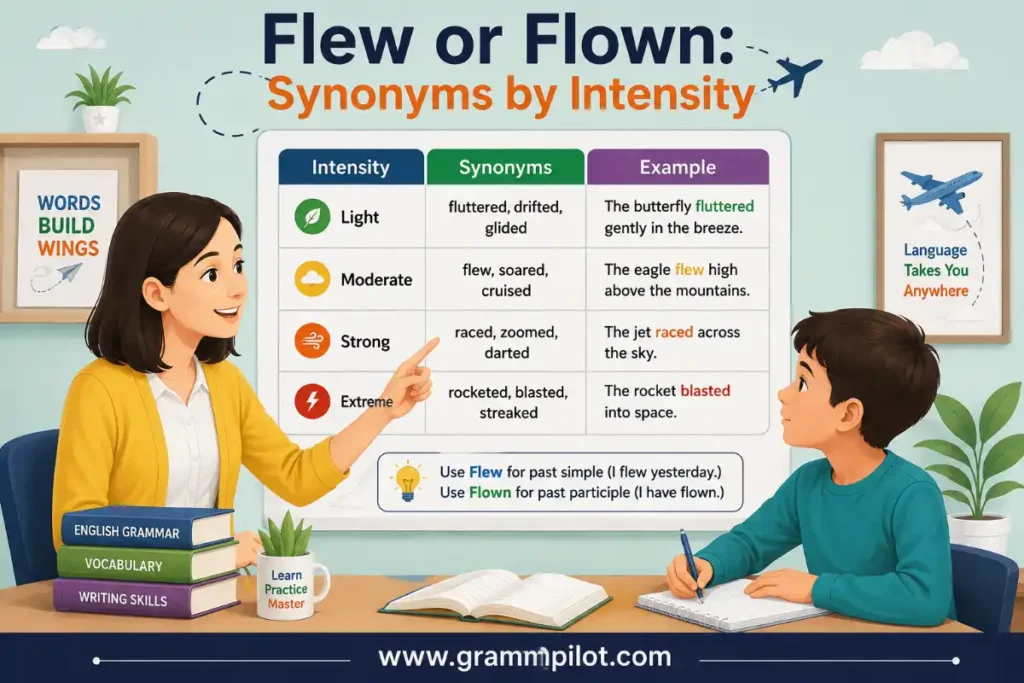
Flew or Flown: Synonyms by Intensity
Sometimes you want to describe movement that feels calm. Other times, you want readers to picture speed or excitement. These groups help you choose the best word.
| Mild | Moderate | Strong |
|---|---|---|
| Floated | Glided | Soared |
| Drifted | Flew | Swept |
| Hovered | Traveled | Raced |
| Moved | Journeyed | Zoomed |
| Left | Departed | Shot |
The stronger the word, the more energy it adds to the sentence.
Compare these examples.
- The balloon floated over the park.
- The eagle soared above the mountains.
Both sentences describe movement through the air, but the second creates a much stronger picture.
Flew or Flown: Related Words by Part of Speech
Understanding related words also improves vocabulary.
Verbs
- Fly
- Flew
- Flown
- Soar
- Glide
- Hover
- Land
- Depart
- Travel
- Navigate
- Pilot
Nouns
- Flight
- Flyer
- Pilot
- Airplane
- Aircraft
- Journey
- Passenger
- Airport
- Aviation
- Departure
- Arrival
Adjectives
- Airborne
- Flying
- Aerial
- High-flying
- Winged
- Fast
- Swift
- Elevated
Learning related words makes it easier to understand Flew or Flown in different situations.
Flew or Flown: Is There a Difference Between American and British English?
Good news—there is almost no difference.
Both American English and British English use the same verb forms.
| Base | Past | Past Participle |
|---|---|---|
| Fly | Flew | Flown |
Examples in American English:
- She flew to California.
- They have flown to Canada.
Examples in British English:
- She flew to London.
- They have flown to Scotland.
The spelling stays the same on both sides of the Atlantic.
Only surrounding vocabulary may change.
For example:
| American English | British English |
|---|---|
| Airplane | Aeroplane |
| Vacation | Holiday |
| Round trip | Return journey |
| Airport | Airport |
The grammar rule behind Flew or Flown never changes.
Flew or Flown: Which Word Works Best in Different Situations?
Choosing the correct form depends on the sentence rather than the type of writing. Still, different situations often use different verb tenses.
Flew or Flown in a Resume
Resumes usually describe completed responsibilities or achievements.
Examples:
- Flew company aircraft safely for five years.
- Has flown more than 8,000 accident-free hours.
Choose the tense that matches the timeline.
Flew or Flown in an Essay
School essays often discuss past events.
Example: Amelia Earhart flew across the Atlantic Ocean.
If discussing life experiences or completed actions connected to the present, use the past participle.
Example: Many astronauts have flown into space.
Flew or Flown in a Text Message
Text messages usually sound casual.
Examples:
- I flew home today.
- We’ve flown this route before.
Keep the sentence short and natural.
Flew or Flown in an Email
Professional emails should use standard grammar.
Examples:
- I flew to Dallas yesterday for the meeting.
- Our team has flown to several client locations this year.
Correct grammar creates a stronger impression.
Flew or Flown in Everyday Conversation
Native speakers switch naturally between both forms.
Examples:
- We flew out early this morning.
- I’ve flown there three times.
Listening to everyday conversations helps these patterns become automatic.

Flew or Flown: Which Verb Tense Should You Choose?
A quick chart can save time.
| If your sentence has… | Use |
|---|---|
| Yesterday | Flew |
| Last week | Flew |
| Last year | Flew |
| Two hours ago | Flew |
| Has | Flown |
| Have | Flown |
| Had | Flown |
| Been | Flown |
When you pause while writing, check for a helping verb first.
That single step solves most Flew or Flown questions.
Flew or Flown: Real-Life Example Sentences
Learning grammar rules is helpful, but seeing them in real situations makes them much easier to remember. These original examples show how Flew or Flown works in everyday English.
Examples Using Flew
- We flew to Seattle during spring break.
- My sister flew home after finishing college.
- The eagle flew across the valley.
- A colorful kite flew high above the beach.
- Our drone flew over the football field.
- Dad flew to New York for an important meeting.
- The rescue helicopter flew through heavy rain.
- The little bird flew into the open window.
- She flew first class for the first time.
- The baseball flew over the fence and landed in the parking lot.
- They flew across the ocean last summer.
- My uncle flew military aircraft for twenty years.
Examples Using Flown
- I have flown to Canada several times.
- She has flown this route before.
- They had flown home before the snowstorm began.
- The supplies were flown into the mountain village.
- The company has flown employees overseas for training.
- We have flown together many times.
- That pilot has flown more than 10,000 hours.
- Emergency doctors were flown to the disaster area.
- Every flag had been flown at half-staff.
- The aircraft has flown safely through difficult weather.
- The astronauts have flown on several space missions.
- Valuable artwork was flown to the museum under tight security.
Reading examples aloud helps your brain recognize the correct pattern naturally.
Flew or Flown: Which Sentence Is Correct?
Try these quick comparisons.
| Incorrect | Correct |
|---|---|
| I have flew to Boston. | I have flown to Boston. |
| She has flew before. | She has flown before. |
| Yesterday we have flown home. | Yesterday we flew home. |
| He flown to Chicago. | He has flown to Chicago. |
| They had flew together. | They had flown together. |
| Last Friday we flown there. | Last Friday we flew there. |
| The bird has flew away. | The bird has flown away. |
| My brother flown yesterday. | My brother flew yesterday. |
If a helping verb appears before the main verb, flown is almost always the correct choice.
Flew or Flown: “Flew” vs. “Traveled”
These words sometimes describe similar situations, but they are not identical.
| Flew | Traveled |
|---|---|
| Always involves flying. | Can include any form of transportation. |
| More specific. | More general. |
| Refers to air travel or flying movement. | May involve driving, walking, sailing, or flying. |
Examples:
- We flew to Florida yesterday.
- We traveled across Florida by car.
The second sentence doesn’t tell you how the journey happened until more details are added.
Flew or Flown: “Flown” vs. “Gone”
Many learners confuse these words because both appear with helping verbs.
| Flown | Gone |
|---|---|
| Refers specifically to air travel. | Refers to leaving or moving away. |
| Comes from fly. | Comes from go. |
| Always suggests flying. | Doesn’t explain the method of travel. |
Examples:
- She has flown to Japan.
- She has gone to Japan.
Both sentences are correct.
The first tells us she traveled by plane.
The second simply says she went there.
Flew or Flown: Common Grammar Mistakes
Many mistakes happen because writers mix the simple past with the past participle.
Here are the most common errors.
Mistake 1: Using Flew After a Helping Verb
❌ I have flew there before.
✅ I have flown there before.
Mistake 2: Using Flown Without a Helping Verb
❌ She flown home yesterday.
✅ She flew home yesterday.
Mistake 3: Mixing Two Past Tenses
❌ Yesterday we have flown to Dallas.
✅ Yesterday we flew to Dallas.
Mistake 4: Forgetting the Helping Verb
❌ They flown together last week.
✅ They have flown together before.
Mistake 5: Writing “Flyed”
Some learners try to make fly regular.
❌ He flyed home.
✅ He flew home.
English does not use flyed as the past tense of fly.
Flew or Flown: When Should You Avoid Each Word?
Sometimes neither word is the best choice.
Don’t use flew or flown when someone traveled by:
- car
- train
- bus
- bicycle
- boat
- subway
Instead, choose a more accurate verb.
Examples:
- We drove to Chicago.
- They rode the train.
- She traveled by bus.
- He walked home.
Using the correct verb keeps your writing clear.
Flew or Flown: Common Expressions
English includes many expressions with the verb fly.
These phrases follow the same grammar rules.
Simple Past
- Flew under the radar
- Flew into a rage
- Flew off the handle
- Flew by quickly
- Flew the flag
Past Participle
- Has flown under the radar
- Has flown the flag
- Had flown into danger
- Have flown overseas
- Had flown safely
Learning these expressions also improves your understanding of Flew or Flown.
Flew or Flown: Antonyms
Antonyms describe the opposite idea.
| Word | Opposite Meaning |
|---|---|
| Landed | Came down safely |
| Arrived | Reached a destination |
| Stayed | Did not leave |
| Remained | Continued to be somewhere |
| Settled | Came to rest |
| Stopped | Ended movement |
| Parked | Left a vehicle in place |
| Docked | Reached a port |
| Rested | Stopped traveling |
| Returned | Came back |
These words don’t replace flew or flown, but they help describe the opposite action.
Flew or Flown: Quick Tips for Choosing the Right Word
Remember these simple tips whenever you write.
- Look for a helping verb first.
- Use flew after words like yesterday or last week.
- Use flown after has, have, or had.
- Never write has flew.
- Never write have flew.
- Avoid using flown by itself.
- Don’t write flyed.
- Read the sentence aloud if you’re unsure.
- Replace the verb with another irregular verb to test the pattern.
- Practice with real examples every day.
Flew or Flown: A Memory Trick That Really Works
Imagine a simple traffic light.
Red Light: Stop and check for a helping verb.
Green Light: If you see has, have, or had, choose flown.
If there isn’t a helping verb, move ahead with flew.
Here are a few practice examples.
- We flew home after the concert.
- She has flown across the Atlantic many times.
- My grandparents flew to Arizona last winter.
- The medical team had flown into the area before sunrise.
- The eagle flew above the river.
- Several rescue helicopters have flown through dangerous conditions.
This quick check takes only a few seconds and helps you avoid one of the most common English grammar mistakes.

Conclusion
Understanding Flew or Flown doesn’t have to be difficult. The key is remembering that flew is the simple past tense, while flown is the past participle that always needs a helping verb such as has, have, or had. Once you know this rule, you’ll make fewer grammar mistakes in emails, essays, reports, and everyday conversations.
The next time you pause to choose between Flew or Flown, check your sentence for a helping verb before making your decision. With regular practice and real-life examples, the correct form will soon feel natural. Keep this guide handy whenever you need a quick reminder, and you’ll use these two verb forms with confidence.
Frequently Asked Questions
1. Which is correct: Flew or Flown?
Both are correct, but they are used in different grammar structures. Flew is the simple past tense, while flown is the past participle used with helping verbs such as has, have, or had.
2. Is it “I have flew” or “I have flown”?
I have flown is correct. Never use flew after has, have, or had.
3. Can I use “flown” without “has” or “have”?
Usually, no. Flown normally needs a helping verb such as has, have, had, was, or were to form a complete and correct sentence.
4. Do native English speakers confuse Flew or Flown?
Yes, sometimes they do, especially in casual speech or quick writing. However, standard English grammar follows the same rule every time.
5. What’s another way to say “flew”?
Depending on the context, you can use words such as traveled, journeyed, departed, soared, glided, or took off. The best choice depends on what you’re describing.
6. Why is “fly” an irregular verb?
The verb fly comes from Old English and kept its historical forms instead of adding -ed like regular verbs. That’s why the correct forms are fly, flew, and flown.
7. How can I remember the difference between Flew or Flown?
Use this simple rule: if your sentence contains a helping verb like has, have, or had, choose flown. If there is no helping verb and you’re talking about a completed action in the past, choose flew.