

Have you ever written Segway or Segue and wondered which spelling was correct? You’re not alone. These two words sound exactly the same, but they have completely different meanings. One belongs to the world of transportation, while the other belongs to writing, speaking, music, and smooth transitions. Because they are pronounced alike, many people accidentally choose the wrong spelling.
The confusion between Segway or Segue appears in emails, blog posts, business presentations, social media, and even published articles. Spell check often misses the mistake because both words are real. The only way to choose the correct one is by understanding what each word actually means and when it should be used. Learning the difference is easier than most people think. Once you know the simple rule behind these homophones, you’ll never hesitate again. This guide explains the meanings, origins, examples, and common mistakes in clear, everyday English, making it useful for students, teachers, writers, and professionals alike.
To avoid similar grammar mistakes, check out [Flew or Flown].
Quick Answer
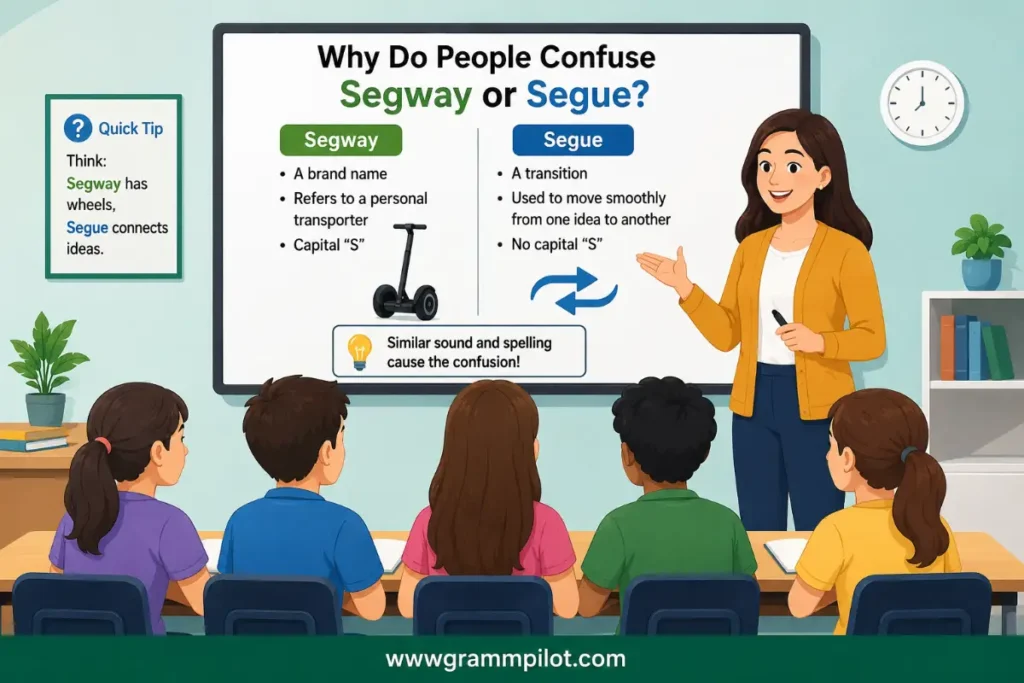
If you mean a smooth transition from one topic, idea, or activity to another, the correct word is segue. If you mean the two-wheeled self-balancing electric vehicle, the correct word is Segway. The easiest way to remember Segway or Segue is this: segue connects ideas, while Segway carries people.
Why Do People Confuse Segway or Segue?
The biggest reason people mix up Segway or Segue is pronunciation. Both words are pronounced exactly the same:
SEG-way
Since English has many words that sound alike but have different meanings, this pair often causes confusion. Your ears hear the same sound, but your brain must decide which spelling matches the meaning. Another reason is that the word segue is used more often in writing than in everyday conversation. Many people hear presenters or teachers say it but never see it written down. Later, when they try to write it themselves, they naturally choose the familiar spelling Segway, which they recognize from the famous personal transporter. Autocorrect adds to the problem. Because Segway and segue are both legitimate words, most spelling tools won’t flag the mistake. A sentence like this looks perfectly correct to a computer: Let’s Segway into our next topic. Unfortunately, it is still incorrect because the sentence is talking about a transition, not a vehicle.
The correct sentence is: Let’s segue into our next topic.
This is why understanding the meaning matters much more than memorizing the spelling.
What Does “Segue” Mean?
The word segue means to move smoothly from one topic, activity, scene, or idea to another without interruption. It can also describe the transition itself. You will often hear this word during presentations, classroom lectures, interviews, podcasts, speeches, television programs, and conversations where someone shifts naturally from one subject to another.
For example:
- The teacher segued from vocabulary to grammar.
- I’d like to segue into our next discussion.
- Her story provided the perfect segue to the final lesson.
- The documentary segued smoothly into historical footage.
- His question created a natural segue for the audience discussion.
Notice that none of these examples involve transportation. They all describe moving smoothly between ideas.
When discussing Segway or Segue, remember that segue is about communication, organization, and flow.
Is “Segue” a Noun or a Verb?
One interesting feature of segue is that it works as both a noun and a verb.
Segue as a Verb
As a verb, segue means to transition smoothly.
Examples:
- The speaker segued into the next topic.
- Can we segue to another question?
- She segues naturally between different ideas.
Segue as a Noun
As a noun, segue refers to the transition itself.
Examples:
- That joke was a perfect segue.
- The video used a clever segue between scenes.
- His introduction served as an effective segue into the lesson.
Whether used as a noun or a verb, the meaning always relates to a smooth connection rather than a physical object.
What Does “Segway” Mean?
Unlike segue, Segway is the name of a personal transportation device. It is a two-wheeled, self-balancing electric vehicle designed for short-distance travel. Because Segway is a brand name, it begins with a capital letter.
Examples include:
- We rented a Segway during our city tour.
- The security guard patrolled the mall on a Segway.
- Learning to ride a Segway takes practice.
- She parked her Segway outside the museum.
- The tourists explored the waterfront by Segway.
These examples show that Segway always refers to transportation, never to writing or speaking.
A simple question can help you choose between Segway or Segue: Are you talking about moving people or moving ideas?
- Moving ideas → segue
- Moving people → Segway
That one question prevents almost every mistake.
The Origins of Segue and Segway
Understanding where these words come from makes remembering their meanings much easier. Although Segway or Segue sound identical, their histories are completely unrelated.
The History of “Segue”
The word segue comes from the Italian verb seguire, which means “to follow.” In Italian sheet music, segue was used to tell musicians that one section should continue directly into the next without stopping. English later adopted the word, and its meaning expanded beyond music. Today, segue describes any smooth transition between ideas, topics, scenes, conversations, or activities.
For example:
- The host used humor to segue into the interview.
- The novel segues naturally between different time periods.
- The presenter gave a short summary before segueing into the next section.
Although its original use was musical, segue is now common in everyday English.
The History of “Segway”
The word Segway has a much more modern origin. It is the brand name of the self-balancing electric personal transporter introduced in 2001. The creators chose the name because it sounds like segue, suggesting smooth movement from one place to another. Ironically, this branding decision created today’s spelling confusion. Many people hear the word spoken and automatically think of the famous vehicle, even when the conversation is actually about making a smooth transition. Knowing the origins of Segway or Segue makes it clear that the two words developed independently despite sharing the same pronunciation.
Segway or Segue: Side-by-Side Comparison
The easiest way to understand Segway or Segue is to compare them directly.
| Feature | Segue | Segway |
|---|---|---|
| Meaning | A smooth transition | A personal electric transporter |
| Part of Speech | Noun and verb | Proper noun |
| Pronunciation | SEG-way | SEG-way |
| Used In | Writing, speaking, music, presentations | Transportation |
| Capital Letter | Usually no | Always yes |
| Main Purpose | Connect ideas smoothly | Move people from one place to another |
Looking at the two words side by side shows that their only similarity is how they sound.
Segway or Segue: Why Are Segway and Segue Pronounced the Same?
Many English learners wonder why Segway or Segue are pronounced identically despite their different spellings. English contains many homophones—words that sound the same but have different meanings and spellings.
Some familiar examples include:
- there / their
- right / write
- flour / flower
- pair / pear
- brake / break
- peace / piece
Segway and segue belong to this same group.
Because pronunciation cannot help you choose the correct spelling, you must rely on the sentence’s meaning instead.
When Should You Use “Segue”?
Choose segue whenever you’re talking about moving smoothly from one thing to another.
This includes:
- speeches
- presentations
- essays
- books
- podcasts
- conversations
- classroom lessons
- interviews
- television programs
- videos
Examples:
- Let’s segue into today’s grammar lesson.
- The professor segued from history to economics.
- Her story became the perfect segue to the main topic.
- The documentary segues into modern events.
- That question provides a natural segue for our discussion.
Notice that every example involves communication or ideas rather than transportation.
When Should You Use “Segway”?
Use Segway only when referring to the personal transporter or the company that makes it.
Examples:
- We rented a Segway during our vacation.
- The guide showed everyone how to ride a Segway safely.
- Police officers sometimes patrol parks on Segways.
- He bought a new Segway for commuting.
- The tour lasted two hours on Segways.
If the sentence is about a vehicle, the correct choice in Segway or Segue is always Segway.
Common Situations Where People Make the Wrong Choice
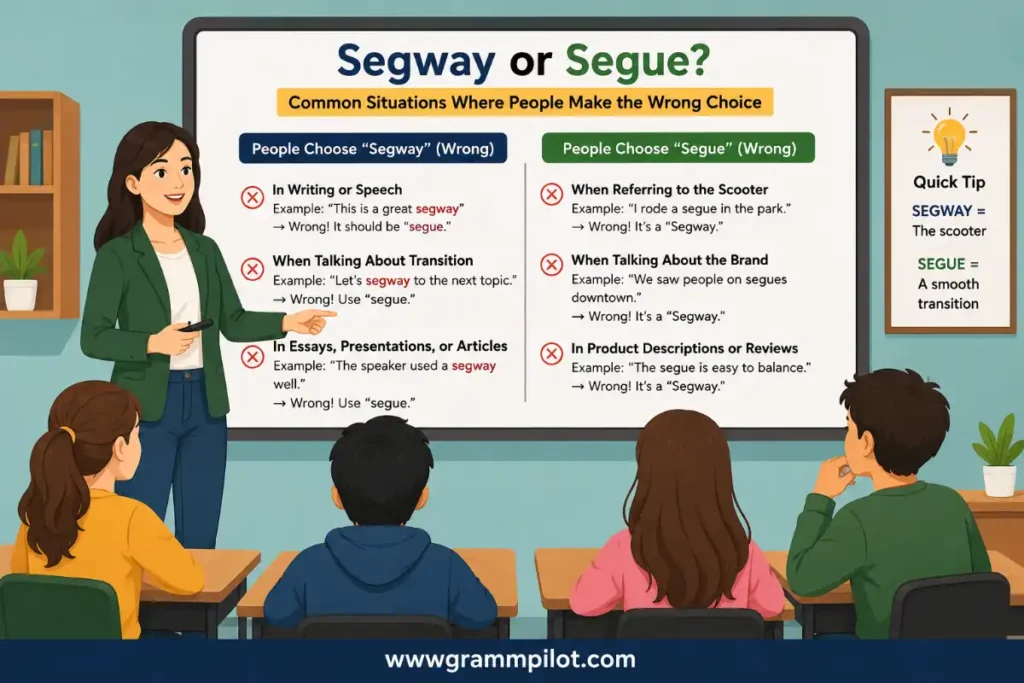
Because the pronunciation is identical, writers often substitute one word for the other without realizing it.
Here are some common mistakes.
Mistake 1
❌ Let’s Segway into our next point.
✅ Let’s segue into our next point.
Mistake 2
❌ She made a smooth Segway between topics.
✅ She made a smooth segue between topics.
Mistake 3
❌ The teacher Segwayed into another lesson.
✅ The teacher segued into another lesson.
Mistake 4
❌ We rented a segue downtown.
✅ We rented a Segway downtown.
Reading these examples carefully will help you avoid the most frequent errors involving Segway or Segue.
Why Spell Check Doesn’t Catch This Error
Many writers trust spelling software to find mistakes, but it usually cannot help with Segway or Segue. That’s because both words exist in English. Spell check only looks for words that aren’t in the dictionary. It doesn’t always understand what you intended to say.
For example: Let’s Segway into the final chapter.
Every word is spelled correctly. However, the sentence is still wrong because it refers to a transition rather than a vehicle. Only the writer can decide which word fits the context. That’s why learning the meanings of Segway or Segue is much more useful than depending on technology.
Real-Life Examples of Segue in Sentences
One of the best ways to master Segway or Segue is by seeing the words used in everyday situations. Since segue is connected with smooth transitions, you’ll often hear it in classrooms, meetings, interviews, presentations, and conversations.
Here are some correct examples using segue.
- The teacher segued from spelling to grammar without confusing the students.
- I’d like to segue into another important point.
- The host used a funny story to segue into the next interview.
- Her introduction served as the perfect segue to the main discussion.
- The documentary segues from ancient history to modern discoveries.
- The speaker paused briefly before segueing into the final topic.
- That question created a natural segue for the audience discussion.
- The meeting segued from sales results to future plans.
- The writer used the final paragraph as a segue into the conclusion.
- Our conversation segued from travel to education.
In each sentence, segue connects one idea smoothly to another.
Real-Life Examples of Segway in Sentences
Now let’s look at examples using Segway, the electric personal transporter.
- We explored the city on a Segway.
- She learned how to ride a Segway in less than an hour.
- The guide provided helmets before everyone boarded a Segway.
- Several security officers patrolled the shopping mall on Segways.
- My cousin bought a Segway for short trips around town.
- The tourists stopped to take photos beside their Segways.
- He carefully parked his Segway outside the museum.
- Riding a Segway requires good balance.
- The company introduced a newer Segway model.
- They enjoyed a guided Segway tour through the historic district.
Every example refers to transportation rather than communication.
Easy Memory Tricks for Segway or Segue
Many learners remember the difference with a simple memory trick.
Trick 1: Ideas vs. Wheels
Think of this question: Are you moving ideas or moving people?
- Moving ideas → segue
- Moving people → Segway
This simple question answers almost every Segway or Segue situation.
Trick 2: The Capital Letter
Notice that Segway starts with a capital S because it’s a brand name. If you’re writing about a presentation or conversation, you probably don’t need a brand name. That means segue is likely the correct choice.
Trick 3: The Letter “U”
The word segue contains the letter U.
You can remember it like this: U = Understanding between ideas.
A segue helps listeners understand how one topic connects to another.
Trick 4: Picture the Object
If you can imagine someone standing on two wheels, the word is Segway.
If there’s no vehicle involved, choose segue instead.
Common Grammar Mistakes
Even experienced writers sometimes make mistakes with Segway or Segue because the words sound identical. Here are some of the most common errors.
Using Segway Instead of Segue
Incorrect:
- Let’s Segway into today’s lesson.
- She made a smooth Segway between paragraphs.
- The speaker Segwayed to another subject.
Correct:
- Let’s segue into today’s lesson.
- She made a smooth segue between paragraphs.
- The speaker segued to another subject.
Using Segue Instead of Segway
Incorrect:
- We rented a segue during our vacation.
- He rides his segue to work.
- The officer patrols on a segue.
Correct:
- We rented a Segway during our vacation.
- He rides his Segway to work.
- The officer patrols on a Segway.
The meaning of the sentence always tells you which spelling belongs there.

Related Words You Should Know About “Segway or Segue”
If you’re learning Segway or Segue, these related words can also improve your vocabulary.
Words Related to “Segue”
- transition
- shift
- move
- bridge
- connect
- continue
- flow
- lead into
- progress
- carry over
These words all describe moving smoothly between ideas or events.
Words Related to “Segway”
- scooter
- transporter
- vehicle
- mobility device
- electric ride
- personal transporter
These words are associated with transportation instead of communication.
Keeping these word groups separate makes choosing between Segway or Segue much easier.
Segway or Segue in Business Writing
Business professionals frequently use segue when giving presentations or writing reports.
Examples include:
- Let’s segue into this quarter’s financial results.
- I’d like to segue to our next agenda item.
- This chart provides a good segue into the marketing discussion.
- The manager smoothly segued from customer feedback to future goals.
In contrast, Segway would only appear if the discussion involved the transportation device itself.
Segway or Segue in Everyday Conversation
Although segue sounds formal, people use it regularly in casual conversations.
For example:
- That reminds me—let me segue into another story.
- Before we finish, I’d like to segue into one last question.
- Your comment gives me a good segue to my next point.
You may not notice the word often because it blends naturally into conversation, but it remains a common part of spoken English.
A Teacher’s Simple Explanation
Imagine you’re teaching a class. You finish explaining nouns and want to begin verbs. You don’t suddenly change the subject without warning. Instead, you connect the two lessons smoothly. That smooth connection is called a segue. Now imagine leaving school and riding a two-wheeled electric vehicle home. That vehicle is a Segway.
One helps your ideas travel smoothly.
The other helps you travel smoothly.
Once you remember that difference, choosing between Segway or Segue becomes simple every time.
Final Answer
When choosing between Segway or Segue, think about the meaning of your sentence instead of the pronunciation.
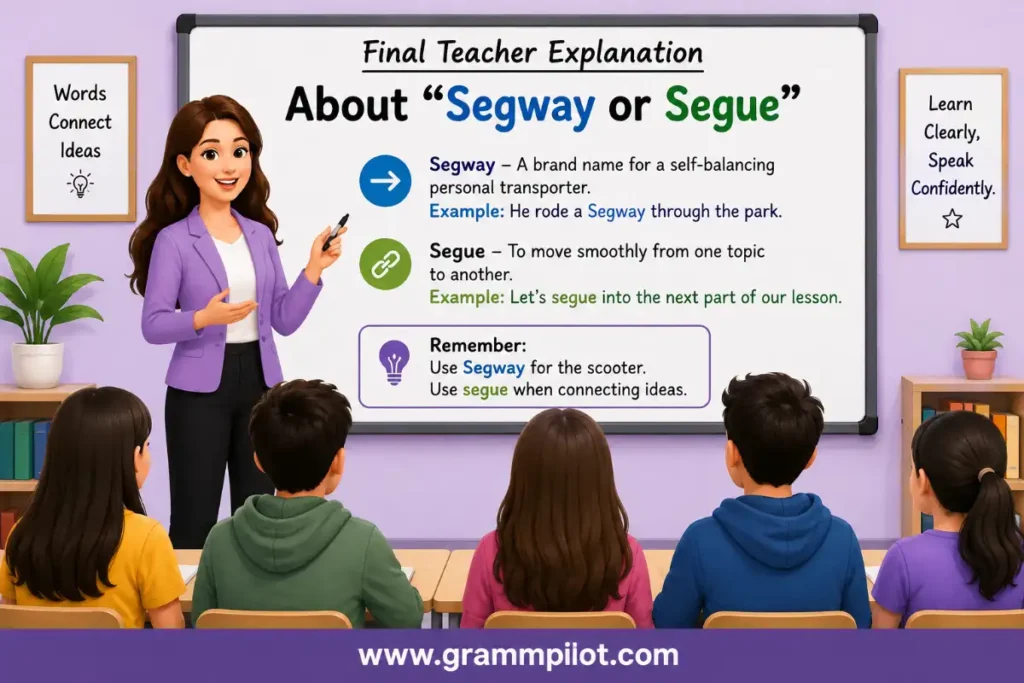
Use segue when you mean a smooth transition between ideas, topics, conversations, scenes, or activities.
Use Segway only when referring to the well-known two-wheeled self-balancing personal transporter.
Although the words sound exactly alike, they are unrelated in meaning. Understanding this simple distinction will help you avoid one of the most common homophone mistakes in English.
Conclusion
Segway or Segue is a pair of words that often confuses writers because both are pronounced the same way. However, their meanings are entirely different. Segue belongs to the language of communication and smooth transitions, while Segway belongs to the world of personal transportation.
The next time you write one of these words, ask yourself a simple question: Am I connecting ideas or talking about a vehicle? If you’re connecting ideas, choose segue. If you’re talking about the electric transporter, choose Segway. With that simple habit, you’ll get it right every time.
Frequently Asked Questions
1. Which is correct: Segway or segue?
Both words are correct, but they have different meanings. Segue means a smooth transition between ideas or topics, while Segway is a brand name for a two-wheeled self-balancing personal transporter.
2. Why do people confuse Segway and segue?
People confuse Segway or Segue because both words are pronounced SEG-way. Since they sound identical, many writers accidentally choose the wrong spelling.
3. Can “segue” be used as both a noun and a verb?
Yes. As a verb, segue means to transition smoothly. As a noun, it refers to the transition itself.
4. Is Segway always capitalized?
Yes. Segway is a registered brand name, so it should begin with a capital S whenever it refers to the vehicle or the company.
5. Is it correct to say, “Let’s Segway into the next topic”?
No. The correct sentence is “Let’s segue into the next topic.” Since you’re talking about moving from one idea to another, segue is the correct word.
6. Where did the word “segue” come from?
Segue comes from the Italian word segue, meaning “it follows.” It was first used in music to indicate a continuous transition and later became common in writing and speaking.
7. Does spell check catch mistakes between Segway and segue?
Usually not. Both words are correctly spelled English words, so spelling software often cannot detect when the wrong one has been used.
8. What’s the easiest way to remember the difference?
Remember this simple rule:
- Segue connects ideas.
- Segway carries people.
If you’re talking about a transition, choose segue. If you’re talking about the personal transporter, choose Segway.