
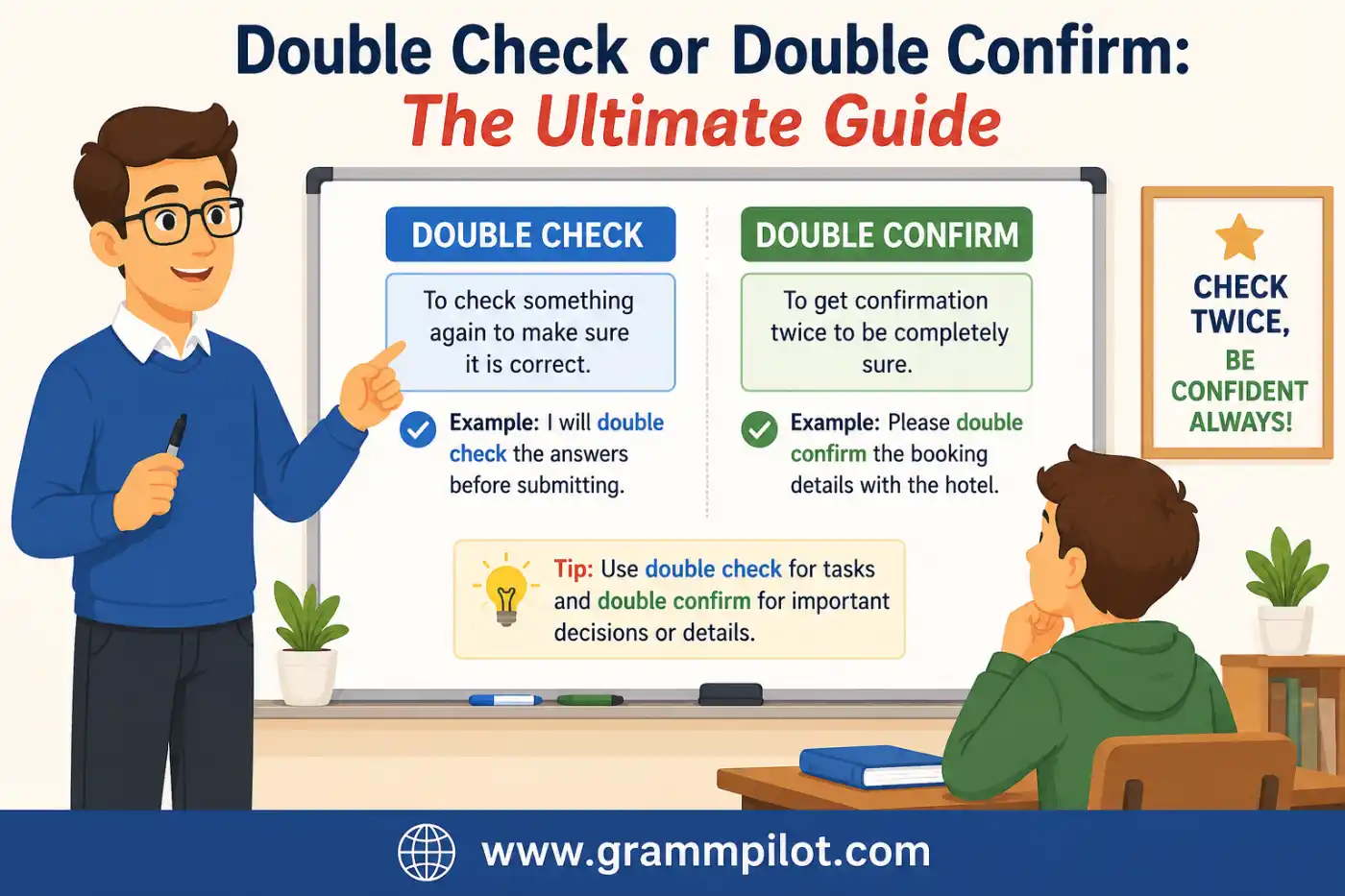
Imagine you’re about to send an important email. You read it once, notice a date, and suddenly wonder if you entered it correctly. You open the message again and inspect the details because you don’t want a small mistake to cause a bigger problem. That’s a accurate situation for understanding Double Check or Double Confirm. The two expressions may seem interchangeable because both suggest extra certainty. However, they don’t sound equally natural in standard American English. Double-check is a common, established expression, while double confirm is understandable but often sounds redundant.
Answer box: Double-check means to check something again for accuracy, while double confirm means to confirm something again but is less natural in standard American English. Depending on the situation, reconfirm, confirm again, or verify may be better choices.
Understanding Double Check or Double Confirm can help you write clearer emails, essays, resumes, messages, and workplace instructions. This guide covers their meanings, origins, synonyms, regional differences, examples, common errors, and the best choice for different situations.
If you’re learning how to use comparisons effectively, take a look at [Similes of Kindness].
What does Double Check or Double Confirm mean?
The basic idea behind Double Check or Double Confirm is simple: both expressions involve an extra effort to make sure information is correct.
Double-check means to examine something again. You may have already looked at it, but you want another review before making a decision. For example: Please double-check the address before mailing the package. The speaker isn’t necessarily saying the address is wrong. The request simply asks for another review.
Double confirm, on the other hand, means to confirm something again. The listener can usually understand it, but many American English speakers would choose a different expression.
A more natural sentence would be: Please reconfirm the appointment time.
You could also write: Please confirm the appointment time again.
The important distinction is that double-check centers on another examination, while reconfirm centers on another confirmation.
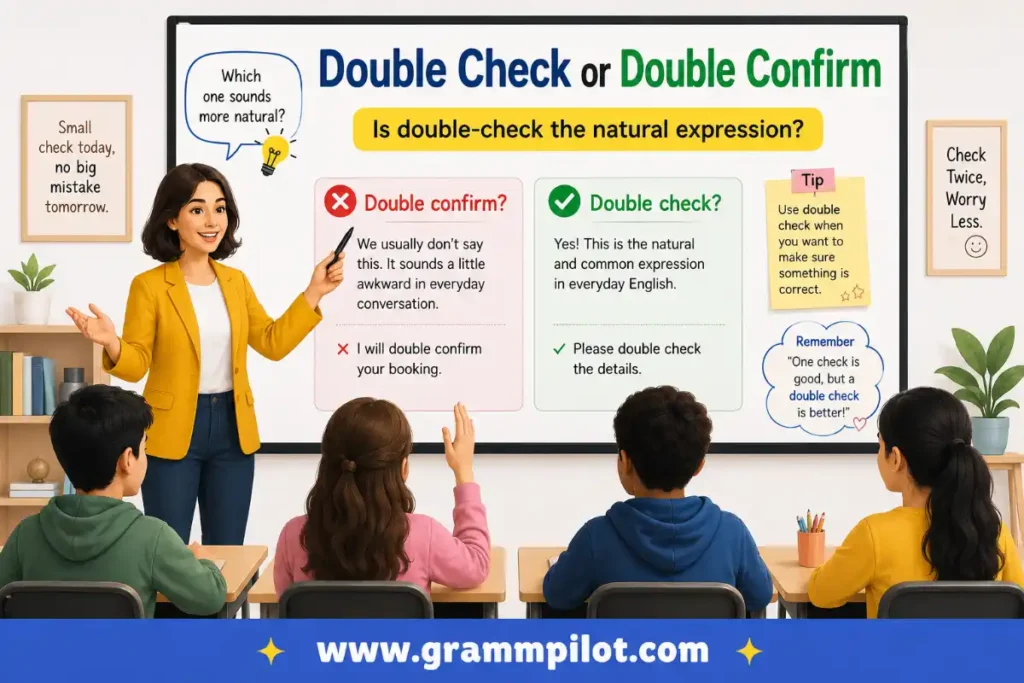
Is double-check the natural expression?
Yes. Double-check is a standard and widely used English expression. It works especially well when someone wants another look at information, a document, calculation, address, answer, or plan.
Consider these examples:
- Double-check your spelling.
- I’ll double-check the schedule.
- She double-checked the figures.
- Please double-check the attachment.
- We should double-check the measurements.
The phrase fits casual conversation and professional communication.
Is double confirm grammatically correct?
Double confirm can be understood, but it isn’t usually the strongest choice in polished American English. The reason is partly semantic. Confirm already means to establish that something is correct, true, settled, or agreed. Adding double can therefore feel unnecessary.
Instead of: Can you double confirm the booking?
Try: Can you confirm the booking?
If the booking was already confirmed once, this is better: Can you reconfirm the booking?
Or: Can you confirm the booking again?
The preferred wording depends on what you actually want the other person to do.
Where did these expressions come from?
The history behind Double Check or Double Confirm helps explain why the two expressions feel different. The English word check developed through several historical uses associated with stopping, controlling, examining, and preventing problems. Its modern sense of examining something for accuracy became firmly established in everyday English. The expression double-check naturally developed from the idea of performing a check twice. The word “double” emphasizes repetition. Confirm has a different history. It comes from Latin roots associated with making something firm, established, or certain. English eventually developed the modern sense of confirming information, arrangements, beliefs, or decisions.
That distinction remains visible today.
- Check focuses on examination.
- Double-check focuses on another examination.
- Confirm focuses on establishing certainty.
- Reconfirm focuses on establishing that certainty again.
This is one reason reconfirm is usually more idiomatic than double confirm when repetition is important.
Double-check vs. confirm: what’s the difference?
The difference becomes easier to see when the two actions are placed side by side.
| Expression | Main meaning | Typical situation | Example |
|---|---|---|---|
| Check | Examine something | Basic review | Check the spelling. |
| Double-check | Examine something again | Preventing mistakes | Double-check the spelling. |
| Confirm | Establish that something is true | Arrangements or facts | Confirm the appointment. |
| Reconfirm | Confirm something again | Previously settled information | Reconfirm the appointment. |
| Verify | Establish accuracy | Professional or factual checking | Verify the figures. |
| Cross-check | Compare with another source | Research or data review | Cross-check the numbers. |
When choosing between Double Check or Double Confirm, ask yourself one question: Am I looking at something again, or am I asking for confirmation?
That question usually gives you the answer immediately.
Master synonym list: 28 useful alternatives
A strong vocabulary gives you more precise ways to express checking and confirmation. The best substitute depends on tone, purpose, and context.
Simple alternatives
| Word or phrase | Meaning | Tone | Example |
|---|---|---|---|
| check | Examine for errors | Neutral | Check your answer. |
| recheck | Check again | Neutral | Recheck the total. |
| review | Examine something carefully | Neutral | Review the document. |
| look over | Examine generally | Casual | Look over my draft. |
| go over | Examine or discuss | Everyday | Let’s go over the plan. |
| make sure | Ensure correctness | Everyday | Make sure the form is complete. |
| check again | Repeat an examination | Neutral | Check the date again. |
Everyday alternatives
| Word or phrase | Meaning | Tone | Example |
|---|---|---|---|
| confirm | Establish correctness or agreement | Neutral | Confirm the meeting time. |
| reconfirm | Confirm again | Neutral/Formal | Reconfirm the reservation. |
| verify | Establish accuracy | Neutral/Formal | Verify the account details. |
| cross-check | Compare with another source | Neutral | Cross-check the figures. |
| go through | Examine each part | Everyday | Go through the list. |
| make certain | Ensure something is true | Neutral | Make certain the details are right. |
| take another look | Examine again | Casual | Take another look at page two. |
Formal alternatives
| Word | Meaning | Tone | Example |
|---|---|---|---|
| validate | Establish that something meets standards | Formal | Validate the data. |
| authenticate | Prove something is genuine | Formal | Authenticate the document. |
| substantiate | Support a claim with evidence | Formal | Substantiate the claim. |
| corroborate | Support information independently | Formal | Corroborate the witness statement. |
| inspect | Examine closely | Formal | Inspect the equipment. |
| audit | Examine records systematically | Formal | Audit the accounts. |
| certify | Officially confirm | Formal | Certify the results. |
Informal alternatives
| Phrase | Meaning | Tone | Example |
|---|---|---|---|
| sanity-check | Do a quick reasonableness review | Informal | Sanity-check these numbers. |
| look twice | Examine carefully | Casual | Look twice before submitting it. |
| run through | Review quickly | Casual | Let’s run through the list. |
| give it another look | Review again | Casual | Give it another look. |
| make extra sure | Take additional care | Conversational | Make extra sure the door is locked. |
| check it out | Examine or investigate | Casual | Check it out before deciding. |
| take a second look | Examine again | Casual | Take a second look at the figures. |
This broad vocabulary prevents your writing from becoming repetitive. It also lets you match the word to the seriousness of the task.
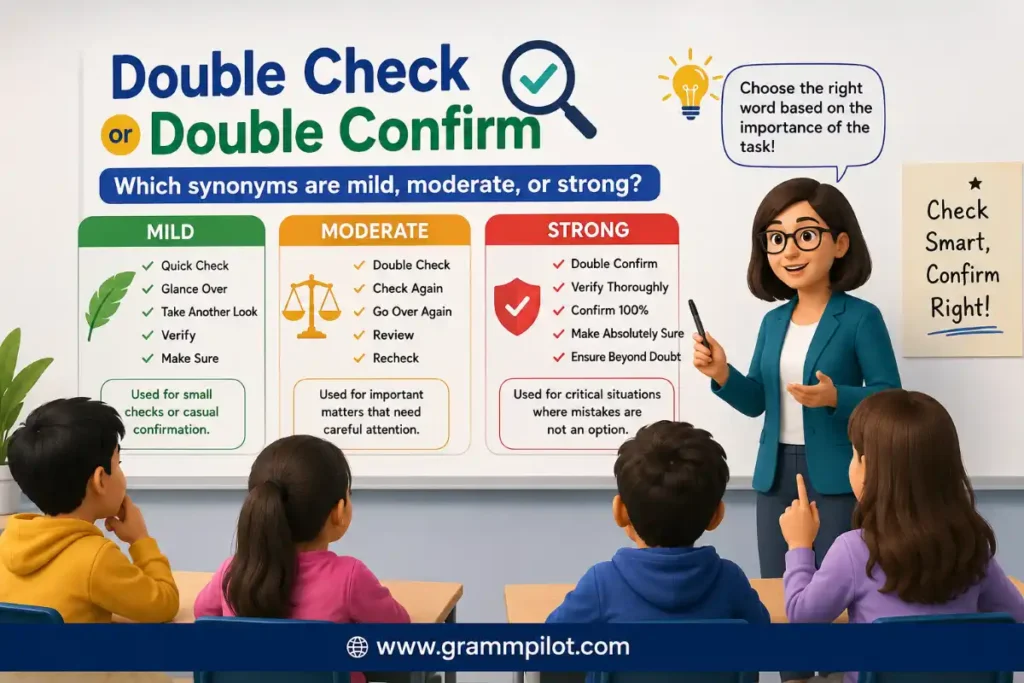
Which synonyms are mild, moderate, or strong?
Not every checking situation requires the same level of intensity.
Mild checking
Use these for simple reviews:
- look over
- take a look
- review
- check
- go through
- look at again
For example: Could you look over my paragraph before class?
This sounds relaxed and doesn’t suggest that a serious error is expected.
Moderate checking
These choices suggest greater attention:
- double-check
- recheck
- verify
- confirm
- cross-check
- make certain
For example: Please verify the account number before submitting the form.
The wording tells the reader that accuracy matters.
Strong or formal checking
These terms describe specialized or systematic procedures:
- audit
- authenticate
- validate
- corroborate
- substantiate
- certify
- inspect
For example: The laboratory must validate the results before publication.
A quick second look would not accurately describe that process.
Which alternatives work as verbs and nouns?
Most of the useful expressions in Double Check or Double Confirm discussions are verbs, but several have noun forms.
Common verbs
- check
- double-check
- confirm
- reconfirm
- verify
- review
- inspect
- authenticate
- validate
- cross-check
Examples:
I need to verify the address.
She reconfirmed the reservation.
Common nouns
- check
- review
- confirmation
- verification
- inspection
- validation
- audit
- cross-check
Examples:
We completed a final verification.
The manager requested another review.
Useful adjectives
- checked
- confirmed
- verified
- validated
- authenticated
- certified
Examples:
The information has been verified.
Your reservation is confirmed.
Knowing the grammatical form prevents awkward constructions and helps you create more varied sentences.
Is the phrase different in US and UK English?
Double-check is common and easily understood in both American and British English.
Double confirm may also appear in international English and in some regional varieties, especially in workplace communication. However, its acceptability doesn’t make it the most natural choice everywhere.
If your audience includes Americans, British speakers, international readers, or professional clients from different countries, safer options include:
- double-check
- confirm
- reconfirm
- verify
- check again
For broad international communication, simple established expressions usually create fewer problems.
What should you use on a resume?
A resume should use precise, professional verbs rather than vague descriptions.
Verify works well when accuracy is part of your responsibility. Verified customer records and corrected data-entry errors.
Review is useful for documents or reports. Reviewed monthly reports for accuracy before submission.
Audit is appropriate for formal financial or operational checking. Audited account records and identified reporting discrepancies.
Cross-check works when you compare information from different sources. Cross-checked inventory records against purchase orders.
Although double-check isn’t incorrect, it can sound less impressive when a more specific professional verb is available.
Instead of: Double-checked everything.
Write: Verified customer information before processing orders.
The second version tells the reader what you actually did.
What works best in an essay?
Academic writing usually benefits from precise and moderately formal vocabulary.
Use verify when discussing factual accuracy:
Researchers should verify information before citing it.
Use confirm when evidence supports a conclusion
The results confirm the study’s main hypothesis.
Use cross-check when comparing sources:
The researcher cross-checked the statistic with government records.
A conversational sentence such as “I double-checked my facts” isn’t grammatically wrong, but “I verified the facts against reliable sources” is often stronger for formal academic prose.
Double Check or Double Confirm: What sounds natural in texting?
Texting doesn’t require formal vocabulary. Double-check, check again, and confirm are usually enough.
You might write: I’ll double-check and let you know.
Another natural option is:Let me check again.
When you need the other person to answer: Can you confirm the time?
A formal term such as corroborate would sound strange in most casual messages.
Double Check or Double Confirm: What is best for professional email?
Email wording should match the relationship and purpose.
For a friendly coworker:
Could you double-check the attached file before we send it?
For a more formal request:
Could you please verify the figures before submission?
For a previously arranged booking:
Could you please reconfirm the reservation?
Each version has a slightly different meaning. When you’re writing a business email, Double Check or Double Confirm isn’t really a choice between two equal expressions. The better wording depends on you if you want another review or another confirmation.
What should you say when speaking?
Everyday conversation favors short, familiar expressions.
Let me double-check the schedule. I’ll check again.Can you confirm that we’re meeting at six? These sentences sound natural because they clearly communicate the action. If you are asking someone else to establish if information is correct, confirm is often better. If you plan to examine the information yourself, double-check usually fits.
Double Check or Double Confirm: What are some real-life examples?
Practical examples make the distinction easier to remember.
1. Sending an email
I’ll double-check the recipient’s address before sending the message.
You’re reviewing information yourself to prevent a mistake.
2. Completing homework
Jamal double-checked his answers before handing in the assignment.
He had already completed the work and wanted another review.
3. Booking a hotel
Please confirm your reservation before your arrival date.
The guest needs the hotel to establish that the booking exists.
4. Changing an appointment
I called the office to reconfirm my appointment.
The appointment had already been arranged, so repeated confirmation makes sense.
5. Editing a resume
I always double-check my resume for spelling errors.
The writer is personally reviewing the document again.
5. Change block type or style
Move Heading block from position 168 up to position 167 Move Heading block from position 168 down to position 169 Change alignment Change text alignment Displays more block tools
6. Checking research
The author cross-checked the statistic with two independent sources.
The author compared evidence rather than merely reading the same information again.
7. Workplace safety
Before operating the machine, check that every safety cover is secure.
The instruction calls for a direct inspection.
8. Online shopping
I double-checked the shipping address before placing the order.
Another look can prevent an expensive delivery mistake.
9. Group work
Let’s go over the presentation before we submit it.
The group wants a general review of the entire project.
10. Financial records
The accountant verified the figures before preparing the report.
The professional setting makes verified especially suitable.
11. A quick text
Can you confirm what time we’re leaving?
The sender wants another person to provide the information.
12. An official document
The agency authenticated the certificate before accepting it.
The important issue here is about the certificate is genuine.
13. A travel plan
I’ll double-check the departure gate before we leave for the airport.
The traveler is personally reviewing changing information.
14. A classroom assignment
Please recheck the last three answers before turning in your worksheet.
The student is being asked to inspect existing answers again.
15. A business contract
The legal team verified the dates against the original agreement.
The process involves accuracy and reliable source material. These examples show why one replacement word can’t always serve every situation.
Double-check vs. reconfirm: what’s the difference?
The distinction between Double Check or Double Confirm becomes especially clear when comparing double-check with reconfirm.
| Double-check | Reconfirm |
|---|---|
| Examine something again | Confirm something again |
| Often involves your own review | Often involves another person or source |
| Common in conversation | Neutral to formal |
| Focuses on possible mistakes | Focuses on previously established information |
| “I double-checked the date.” | “I reconfirmed the reservation.” |
Suppose you look at your flight details one more time. I double-checked the flight number. Now imagine you contact the airline to make sure your reservation remains active. I reconfirmed my reservation. Both actions increase certainty, but they aren’t exactly the same process.
Double-check vs. verify: what’s the difference?
The words double-check and verify overlap, yet their tone and focus differ.
| Double-check | Verify |
|---|---|
| Usually neutral or conversational | Neutral to formal |
| Suggests another review | Suggests establishing accuracy |
| Often quick | Can involve evidence |
| Common in everyday speech | Common in professional writing |
Compare these sentences: Double-check the spelling.
The instruction suggests taking another look.
Verify the applicant’s identity.
This suggests a formal process for establishing who the person is. For that reason, verify often sounds better in technical, academic, legal, and professional settings.
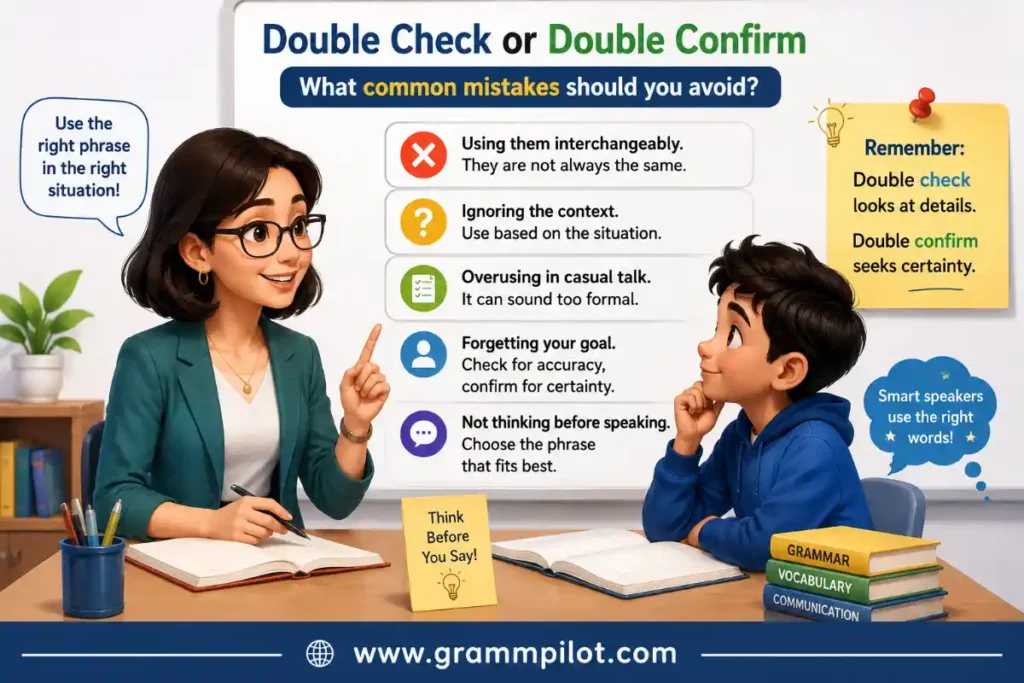
What common mistakes should you avoid?
Mistake 1: Using double confirm for every situation
Please double confirm the details.
Most readers will understand it, but a smoother version is: Please confirm the details.
If the details were already confirmed: Please reconfirm the details.
Mistake 2: Thinking double-check means something is wrong
A second check doesn’t prove that an error exists.
I double-checked the report.
This simply means the report received another review.
Mistake 3: Using verify when you mean review
If you want someone to improve a document’s organization or readability, review is more precise.
Instead of: Please verify my essay.
Try: Please review my essay for clarity and grammar.
Verification is about correctness; reviewing can cover quality, organization, and overall effectiveness.
Mistake 4: Confusing confirmation with examination
Compare: Please confirm the spelling.
This asks someone to tell you if the spelling is correct.
Now consider: Please double-check the spelling.
This asks the person to examine it again. The difference is subtle, but the intended action changes.
Mistake 5: Stacking unnecessary checking words
Avoid sentences such as: Please double-check and double-confirm and verify everything.
That sounds repetitive and unclear.
A cleaner version is: Please verify all the information.
Choose the single verb that best describes the task.
Double Check or Double Confirm: What are some real-life examples?
Double-check isn’t the right word for every type of verification.
If you’re proving that an item is genuine, use authenticate. The researcher substantiated the claim with primary sources. If you’re comparing information from different places, use cross-check. The editor cross-checked the quotation against the original transcript. when you’re conducting a systematic financial review, use audit. The company audited its annual accounts. Precise vocabulary makes your writing more informative because the verb tells the reader what actually happened.
Double Check or Double Confirm: What are the antonyms?
There isn’t one exact opposite of double-check, but several words express the failure to check carefully.
| Antonym | Meaning | Example |
|---|---|---|
| ignore | Pay no attention | Don’t ignore the warning. |
| overlook | Fail to notice | She overlooked the error. |
| assume | Accept without checking | Don’t assume the date is correct. |
| neglect | Fail to give proper attention | He neglected the final review. |
| guess | Decide without enough information | Don’t guess the answer. |
| skip | Leave out a step | Don’t skip the safety check. |
These words are useful when explaining why careful verification matters.
How can you choose the right expression quickly?
Use the following questions as a simple decision tool.
Do you want another look?
Choose double-check. Double-check the address before you send it.
Do you want someone to establish a fact?
Choose confirm. Please confirm the meeting time.
Was the fact already confirmed?
Choose reconfirm. Please reconfirm your reservation.
Do you need reliable accuracy?
Choose verify. Verify the figures before publication.
Are you comparing two sources?
Choose cross-check. Cross-check the totals with the original records.
Are you examining a document generally?
Choose review. Please review the proposal.
Are you proving something is genuine?
Choose authenticate. The office authenticated the certificate. Thinking about the action first is more useful than memorizing a long grammar rule.
What is the easiest memory trick?
The simplest memory trick for Double Check or Double Confirm is to connect each word with its action.
Check = look.
Double-check = look again.
Confirm = establish certainty.
Reconfirm = establish certainty again.
Verify = establish accuracy.
Cross-check = compare sources.
This gives you a quick mental test. when you are staring at your own document for a second time, think double-check.
If you are contacting someone to make sure an arrangement still stands, think reconfirm.
If you’re comparing records or evidence, think cross-check or verify.
Once you focus on the action rather than the number of times it happens, the choice becomes much easier.
Double Check or Double Confirm:Which expression is best for each context?
The best answer to Double Check or Double Confirm changes according to the situation.
| Context | Recommended expression | Reason |
|---|---|---|
| Homework | double-check | You review your answers |
| double-check | You catch possible errors | |
| Text message | check again | Natural and casual |
| Appointment | confirm | You establish the arrangement |
| Existing reservation | reconfirm | The arrangement was already confirmed |
| Resume | verify/review | Professional and precise |
| Essay | verify/review | Better for formal writing |
| Research | verify/cross-check | Evidence matters |
| Financial records | audit/verify | Systematic accuracy matters |
| Official certificate | authenticate | Genuineness matters |
| Everyday conversation | double-check | Familiar and natural |
| International business | confirm/reconfirm | Clear across varieties of English |
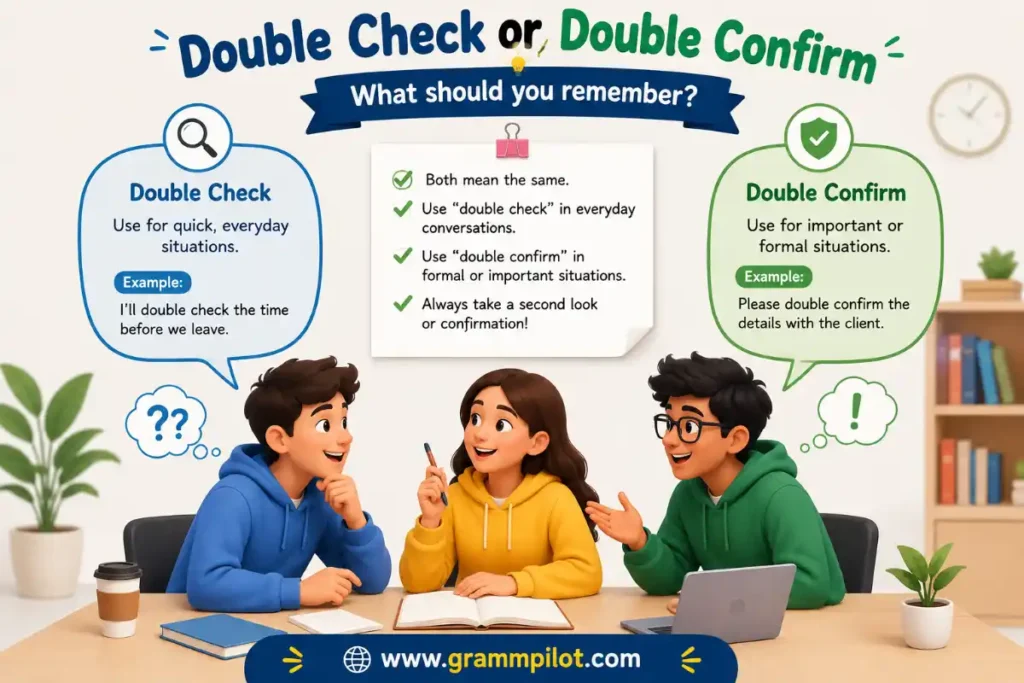
What should you remember?
The main lesson from Double Check or Double Confirm is that understandable English isn’t always the same as the most natural English.
Double-check is the usual choice when you want another examination. Confirm works when you want someone to establish that information is correct or an arrangement is settled. Reconfirm is a strong choice when that confirmation has already happened once.
Verify fits situations where accuracy needs to be established, while cross-check is useful when information is compared against another source. Review works when the task involves examining a document, plan, or piece of work more broadly.
For everyday American English, choosing double-check instead of double confirm will usually make your sentence sound more natural. When the situation involves a previous confirmation, reconfirm can express the intended meaning more precisely.
Conclusion
Double Check or Double Confirm may look like a simple vocabulary choice, but the distinction becomes clearer when you focus on the action behind each expression. A second examination is a double-check, while another confirmation is better expressed as reconfirmation or confirming again.
For most everyday and professional situations, double-check is the natural choice when you want someone to look at information one more time. Use confirm for establishing a fact or arrangement, and choose reconfirm when that fact or arrangement was already confirmed. If evidence, comparison, or formal accuracy matters, verify or cross-check may be more precise.
With this simple approach, you can choose the expression that sounds clear, natural, and appropriate for your audience.
Frequently Asked Questions
1. Is Double Check or Double Confirm more natural in American English?
Double-check is more natural in standard American English. Double confirm is understandable, but confirm, reconfirm, or confirm again usually sounds smoother.
2. Is Double Check or Double Confirm correct for an email?
Double-check is usually the better choice when you’re asking someone to inspect information again. For a previously arranged appointment or booking, reconfirm may be more precise.
3. What’s another way to say Double Check or Double Confirm?
Useful alternatives include check again, recheck, verify, confirm, reconfirm, review, cross-check, and take another look. The right option depends on if you’re reviewing, confirming, or comparing information.
4. Can I use Double Check or Double Confirm in formal writing?
Double-check can appear in formal writing, but verify, confirm, reconfirm, review, or cross-check may sound more precise depending on the task. Double confirm is generally less polished.
5. Is Double Check or Double Confirm the same as verify?
No. Double-check usually means examining something again, while verify means establishing that information is accurate or true. Verification can involve evidence or another reliable source.
6. Should I say double-check the information or double confirm the information?
Double-check the information is the more natural choice when you want another review. If you need someone to confirm information that was already established, reconfirm the information is usually better.
7. What’s the easiest way to remember Double Check or Double Confirm?
Double-check means look again; reconfirm means confirm again. Think about if you are reviewing something yourself or asking for repeated confirmation.