
Have you ever wanted to describe someone who was worried without simply saying, “He was worried” or “She looked nervous”? A good simile can make that feeling much easier to imagine. Instead of using plain words, you can compare the person’s emotions to something familiar. That’s why many writers use Similes for Worried to make their writing more interesting and expressive. Students, English learners, and creative writers often search for Similes for Worried because they want to describe fear, stress, anxiety, or uncertainty in a more colorful way. If you’re writing a school essay, a short story, a poem, or a speech, the right simile helps readers understand exactly how someone feels.
Quick Answer: Similes for Worried compare a person’s anxious or nervous feelings to another person, object, or situation by using the words “like” or “as.” These comparisons make emotions easier to picture and make your writing more vivid.
In this guide, you’ll learn the meaning of Similes for Worried, discover over 100 useful examples, understand when to use them, and see how they can improve both your writing and everyday English.
For more figurative expressions you can use in your writing, explore [Similes for Awkward].
What Are Similes for Worried?
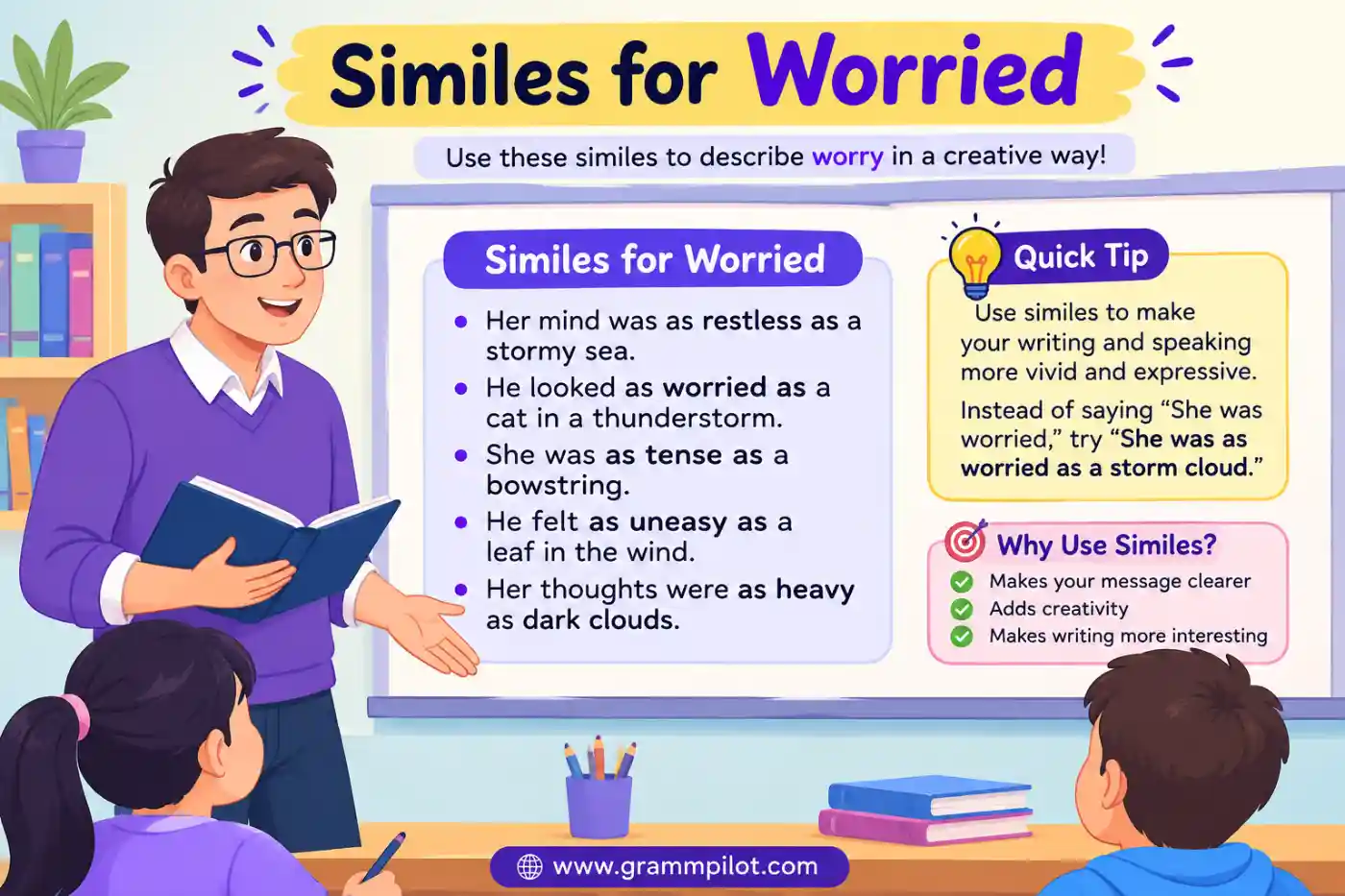
Similes for Worried are figures of speech that compare the feeling of worry to something else using like or as.
Instead of writing: She looked worried.
You could write: She looked as nervous as a cat in a room full of rocking chairs.
The second sentence paints a much stronger picture of her feelings. Here are a few simple examples of Similes for Worried:
- As nervous as a cat.
- Like a deer caught in headlights.
- As restless as the wind.
- Like someone waiting for important news.
- As anxious as a student before an exam.
Each example helps readers imagine the emotion instead of simply reading the word worried.
Why Are Similes for Worried Important?
Strong writing helps readers feel what a character is experiencing. Similes for Worried make emotions more realistic by giving readers a clear image. Here are some reasons writers use Similes for Worried:
- They make stories more engaging.
- They add emotion to writing.
- They improve descriptive language.
- They help readers connect with characters.
- They make essays and poems more expressive.
- They improve creative writing skills.
A well-chosen simile can say much more than simply writing “someone was worried.”
How Similes for Worried Work
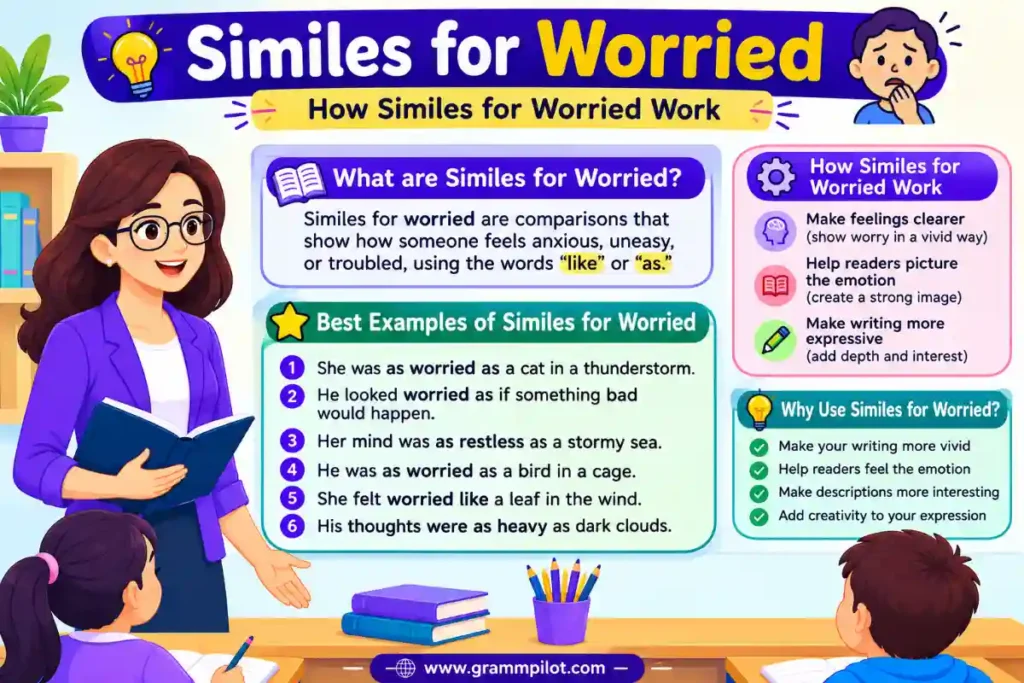
Every simile compares one thing with another by using like or as.
For example: He was as nervous as a cat before a thunderstorm.
This comparison shows fear and uncertainty because many people know how a frightened cat behaves.
Another example: She waited like a traveler lost in the desert.
This suggests worry mixed with uncertainty and hope. The best Similes for Worried create a clear mental picture while remaining easy to understand.
Common Types of This Word
People worry in different ways. Some become quiet, while others cannot sit still. That’s why Similes for Worried describe many different emotions.
Similes for Nervous Worry
These comparisons describe someone who feels tense or uneasy.
Examples:
- As nervous as a cat.
- Like a deer caught in headlights.
- As jumpy as a rabbit.
- Like a bird trapped indoors.
- As shaky as a leaf in the wind.
These similes suggest fear, uncertainty, or tension.
Similes for Quiet Worry
Some people keep their worries inside. These Similes for Worried describe silent anxiety.
Examples:
- As quiet as still water before a storm.
- Like a candle flickering in the wind.
- As pale as the morning mist.
- Like clouds gathering before rain.
- As still as a frozen lake.
These comparisons show hidden concern without loud emotions.
Similes for Constant Worry
Some worries continue for a long time. These Similes for Worried describe ongoing anxiety.
Examples:
- Like a clock that never stops ticking.
- As restless as the ocean tide.
- Like leaves blowing in the wind.
- As busy as bees before rain.
- Like waves that never stop rolling.
These examples suggest thoughts that keep returning.
Best Similes for Worried and Their Meanings
Below are some of the most common Similes for Worried and what they mean.
As Nervous as a Cat
Meaning: Extremely nervous or cautious.
Example: She was as nervous as a cat before giving her first speech.
Like a Deer Caught in Headlights
Meaning: Suddenly frightened and unsure what to do.
Example: He stood like a deer caught in headlights when the teacher called his name.
As Restless as the Wind
Meaning: Unable to relax because of worry.
Example: She felt as restless as the wind while waiting for the test results.
As Shaky as a Leaf
Meaning: Trembling because of fear or anxiety.
Example: The boy was as shaky as a leaf before stepping onto the stage.
Like Someone Waiting for Bad News
Meaning: Feeling anxious because something unpleasant may happen.
Example: They sat quietly like someone waiting for bad news.
As Anxious as a Student Before an Exam
Meaning: Feeling stressed about an important event.
Example: He was as anxious as a student before an exam on the morning of his interview.
Like a Bird Trapped in a Room
Meaning: Feeling frightened and unable to escape.
Example: She looked like a bird trapped in a room when everyone stared at her.
As Uneasy as Dark Clouds Before a Storm
Meaning: Feeling that something bad is about to happen.
Example: The whole family felt as uneasy as dark clouds before a storm while waiting for the doctor’s call.
When Should You Use Similes for Worried?
Knowing when to use Similes for Worried is just as important as knowing the examples.
They are especially useful in:
- Short stories
- Narrative essays
- Fiction writing
- Poems
- Personal journals
- Speeches
- Creative writing assignments
- Children’s stories
- Everyday conversations
The right Similes for Worried help readers understand not only that someone is concerned but also how deeply they are worried and what kind of worry they are feeling.
More Than 100 Similes for Worried
The following Similes for Worried include common, creative, and expressive comparisons. You can use them in stories, essays, speeches, poems, and everyday conversations.
| Simile | Meaning |
|---|---|
| As nervous as a cat | Extremely nervous |
| Like a deer caught in headlights | Suddenly frightened |
| As shaky as a leaf | Trembling with worry |
| As restless as the wind | Unable to relax |
| Like a bird trapped in a room | Feeling helpless |
| As anxious as a student before an exam | Feeling stressed |
| Like someone waiting for bad news | Expecting trouble |
| As uneasy as dark clouds before a storm | Sensing something wrong |
| Like a rabbit hearing a loud noise | Easily startled |
| As tense as a stretched rope | Under great pressure |
| Like a fish out of water | Feeling uncomfortable |
| As jumpy as a grasshopper | Easily frightened |
| Like a mouse near a cat | Feeling unsafe |
| As uncertain as a traveler without a map | Confused and worried |
| Like a candle flickering in the wind | Feeling insecure |
| As busy as bees before rain | Restless with concern |
| Like waves before a storm | Growing anxiety |
| As pale as morning mist | Looking worried |
| Like leaves blowing in the wind | Constantly uneasy |
| As quiet as still water before a storm | Silent worry |
Similes for Worried That Show Quiet Anxiety
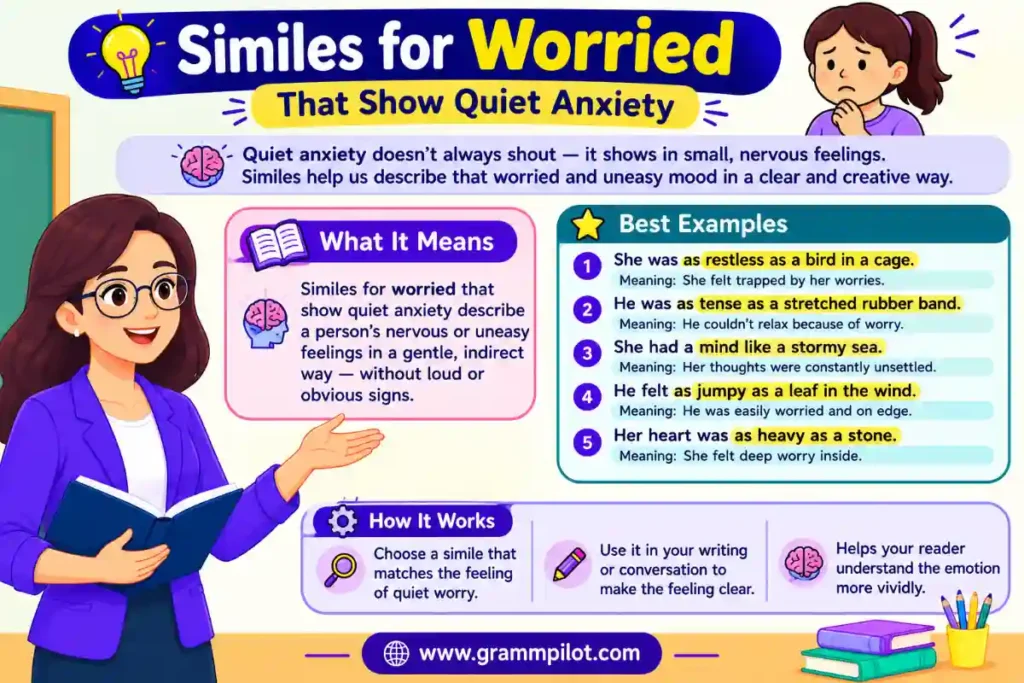
Not everyone shows worry in a loud way. Some Similes for Worried describe calm but hidden anxiety.
Like a Candle Flickering in the Wind
Meaning: Feeling uncertain or insecure.
Example: She sat quietly like a candle flickering in the wind.
As Quiet as Still Water Before a Storm
Meaning: Calm on the outside but worried inside.
Example: He remained as quiet as still water before a storm during the meeting.
As Pale as Morning Mist
Meaning: Looking frightened or concerned.
Example: She became as pale as morning mist after receiving the phone call.
Like Clouds Gathering Before Rain
Meaning: Feeling that trouble is coming.
Example: The team felt like clouds gathering before rain before the final match.
As Still as a Frozen Lake
Meaning: Staying silent because of worry.
Example: The room became as still as a frozen lake while everyone waited for the doctor’s answer.
Similes for Worried That Show Constant Stress
Some worries stay with us for a long time. These Similes for Worried describe ongoing concern.
As Restless as the Wind
Meaning: Unable to stay calm.
Example: She was as restless as the wind while waiting for her family to arrive safely.
Like a Clock That Never Stops Ticking
Meaning: Worry that keeps returning.
Example: His thoughts were like a clock that never stopped ticking.
Like Waves That Never Stop Rolling
Meaning: Continuous anxiety.
Example: Her worries came like waves that never stopped rolling.
Like Leaves Blowing in the Wind
Meaning: Thoughts moving from one worry to another.
Example: His mind felt like leaves blowing in the wind before the interview.
As Busy as Bees Before Rain
Meaning: Restless because something important is about to happen.
Example: The students were as busy as bees before rain before the science competition.
Funny Similes for Worried
Not every situation is serious. Some Similes for Worried add humor to stories or conversations.
- He looked as worried as someone who forgot their homework.
- She was as nervous as a cat during bath time.
- He looked like a child waiting outside the principal’s office.
- She was as worried as someone who misplaced their phone.
- He looked like a cook who forgot the birthday cake.
- She was as anxious as a driver stuck in traffic before an interview.
- He looked like someone who sent a text to the wrong person.
- She was as nervous as a contestant before the final question.
- He looked like a puppy waiting at the vet.
- She was as worried as a traveler who missed the last train.
These lighthearted Similes for Worried work well in humorous stories and everyday conversations.
Similes for Worried in Literature
Many authors use Similes for Worried to show fear, suspense, or uncertainty. Instead of directly saying a character was worried, they compare that feeling to something readers already understand.
For example, instead of writing: “She waited nervously.”
A writer might say: “She waited like a bird watching the sky before a storm.”
Or instead of writing: “He couldn’t relax.”
A writer could say: “He was as restless as the sea before strong winds.”
These comparisons make readers feel the character’s emotions instead of simply reading about them.
Similes for Worried in Everyday English
You don’t have to be writing a novel to use Similes for Worried. Many of these comparisons fit naturally into everyday conversations.
For example:
- “I was as nervous as a cat before my driving test.”
- “She looked like a deer caught in headlights when the teacher asked her a question.”
- “He was as shaky as a leaf before giving his presentation.”
- “We were as restless as the wind while waiting for the flight announcement.”
- “They looked like someone waiting for bad news outside the hospital.”
Using Similes for Worried in daily English can make your speech sound more vivid and expressive while helping others understand exactly how you feel.
How to Use Similes for Worried in Your Writing
Learning Similes for Worried is useful, but using them correctly is what makes your writing stronger. A good simile should match the situation and the level of worry. When the comparison feels natural, readers can easily understand the emotion.
Here are a few simple tips.
Match the Level of Worry
Some situations involve mild concern, while others involve serious fear. Choose Similes for Worried that fit the moment.
For small worries:
- As nervous as a student before a quiz.
- Like someone waiting for a phone call.
For serious worries:
- Like a deer caught in headlights.
- As tense as a stretched rope.
The right Similes for Worried make the emotion believable.
Keep Your Similes Simple
Simple comparisons are often the most effective because readers understand them immediately.
Instead of writing: “She was as worried as a storm, a river, a broken clock, and a frightened bird.”
Write: “She was as worried as a cat during a thunderstorm.”
One clear comparison creates a stronger image.
Avoid Overusing Similes
Using Similes for Worried in every sentence can make your writing feel repetitive.
Instead, use them only when they improve the description. A well-placed simile has a greater impact than several weak ones.
Similes for Worried in Different Situations
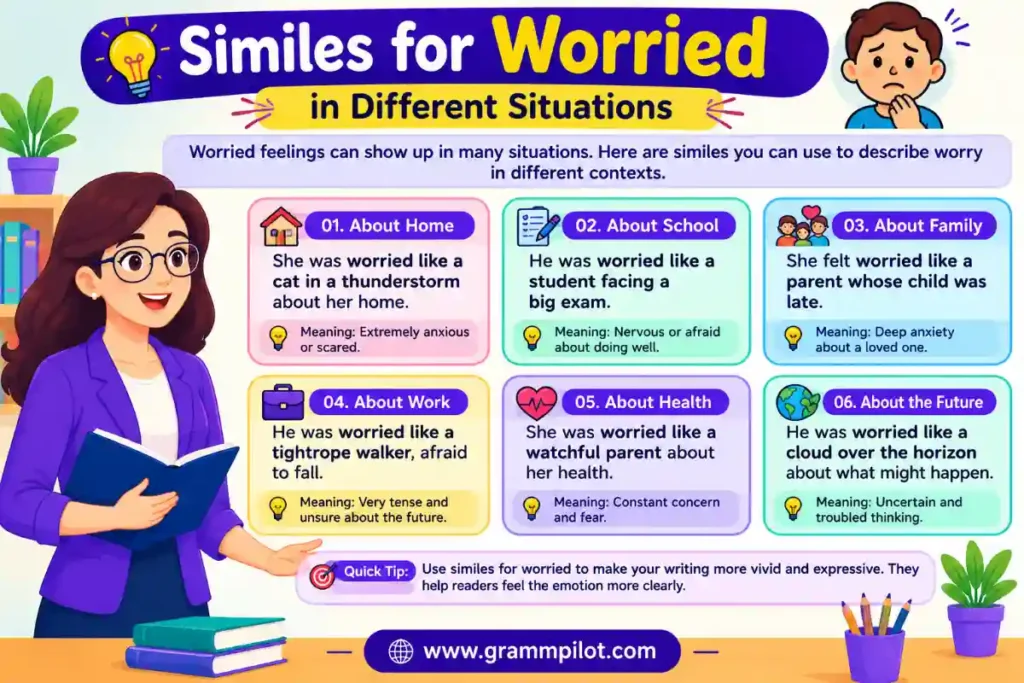
Different kinds of worry require different Similes for Worried. Here are some examples.
Before an Important Exam
- As nervous as a student before the final test.
- Like someone waiting for the exam papers to be handed out.
Before a Job Interview
- As shaky as a leaf.
- Like a traveler standing at the edge of a new journey.
Waiting for Medical Results
- Like someone watching dark clouds gather.
- As quiet as still water before a storm.
Waiting for a Loved One
- As restless as the wind.
- Like a lighthouse searching through the fog.
Before Speaking in Public
- Like a bird trapped indoors.
- As tense as a stretched rope.
Choosing the right Similes for Worried helps readers connect with each situation.
Common Mistakes When Using Similes for Worried
Many English learners make small mistakes when using Similes for Worried. Avoiding these errors will make your writing clearer.
Using Too Many Comparisons
❌ He was as nervous as a cat, as shaky as a leaf, like a rabbit, and like a bird.
✅ He was as nervous as a cat before giving his speech.
One comparison is usually enough.
Choosing an Unclear Simile
A good simile should be easy to imagine. Instead of creating confusing comparisons, use familiar images that readers understand.
Mixing Similes and Metaphors
Remember that Similes for Worried always use like or as.
Simile: She was as nervous as a cat.
Metaphor: She was a frightened bird.
Both are useful, but they are different figures of speech.
Repeating the Same Simile
If every character is “as nervous as a cat,” your writing becomes predictable. Try using different Similes for Worried depending on the situation.
Similes for Worried vs. Metaphors for Worried
Many learners confuse similes with metaphors because both compare one thing with another.
The difference is simple.
| Similes for Worried | Metaphors for Worried |
|---|---|
| Use like or as | Do not use like or as |
| She was as nervous as a cat. | She was a frightened cat. |
| He looked like a deer caught in headlights. | He was a trapped deer. |
| They were as tense as stretched ropes. | They were stretched ropes ready to snap. |
Similes for Worried are usually easier for beginners because the comparison is clear and direct.
Tips for Creating Your Own Similes for Worried
You don’t have to memorize every comparison. You can create your own Similes for Worried by thinking about how worry looks or feels.
Ask yourself:
- Does the person look nervous?
- Are they shaking?
- Are they waiting for something?
- Do they seem quiet or restless?
- What in nature behaves in a similar way?
For example:
- Shaking with fear → like a leaf in the wind.
- Waiting anxiously → like dark clouds before rain.
- Feeling trapped → like a bird in a cage.
- Constant worry → like waves that never stop.
Creating your own Similes for Worried makes your writing more accurate.
Practice Sentences
Complete these sentences with your own Similes for Worried.
- She was as worried as __________________.
- He waited like __________________.
- They looked as nervous as __________________.
- I felt like __________________ before my interview.
- The children were as restless as __________________.
Sample Answers
- She was as worried as a cat during a thunderstorm.
- He waited like someone expecting important news.
- They looked as nervous as deer caught in headlights.
- I felt like a bird trapped in a room before my interview.
- The children were as restless as the wind before the school trip.
These exercises help you remember Similes for Worried and use them naturally in your speaking and writing.
How Similes for Worried Improve Your Writing
Good writers don’t just tell readers that someone is worried—they show it. That’s why Similes for Worried are so useful. They create clear pictures and help readers understand a character’s feelings without long explanations.
Compare these two sentences:
- She was worried about the interview.
- She was as nervous as a cat before the interview.
The second sentence is much more vivid. Readers can immediately imagine how nervous she feels. If you’re writing a story, essay, speech, or poem, Similes for Worried can make your descriptions more natural and memorable.
Related Figures of Speech
If you’re learning Similes for Worried, it’s helpful to understand a few related figures of speech.
Metaphor
A metaphor compares two things without using like or as.
Example: His mind was a storm of worries.
Personification
Personification gives man qualities to non-human things.
Example: The shadows whispered their worries through the room.
Hyperbole
Hyperbole uses exaggeration to emphasize a feeling.
Example: She worried enough to move mountains.
Learning these figures of speech will improve your descriptive writing and help you choose the best expression for every situation.
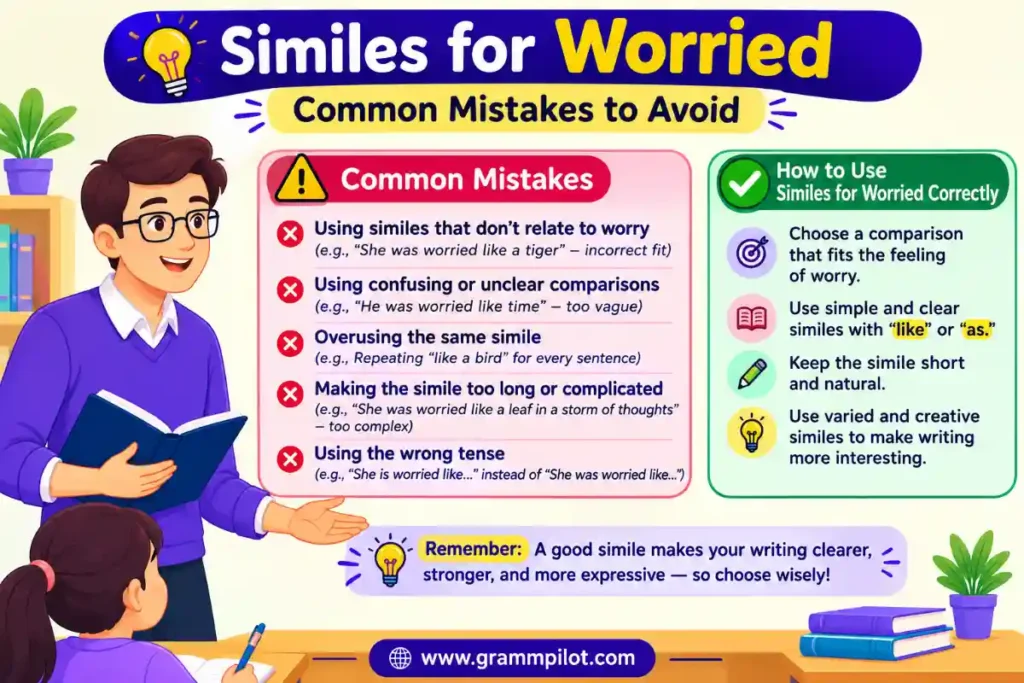
Common Mistakes to Avoid
When using Similes for Worried, avoid these common mistakes.
- Using several similes in one sentence.
- Repeating the same comparison throughout your writing.
- Choosing a comparison that doesn’t match the situation.
- Using funny similes during serious scenes.
- Creating comparisons that are difficult to understand.
The best Similes for Worried are simple, natural, and appropriate for the context.
Final Teacher Explanation
Think of Similes for Worried as tools that help readers see emotions instead of simply reading about them. They make nervousness, fear, stress, and uncertainty easier to picture. Someone waiting for exam results may be as nervous as a cat. A person facing unexpected news may look like a deer caught in headlights. Someone quietly thinking about a problem may seem as still as water before a storm. The more you practice using Similes for Worried, the more expressive and engaging your writing will become. Start with familiar comparisons, then create your own as your confidence grows.
Conclusion
Similes for Worried help transform ordinary descriptions into vivid and memorable ones. By comparing worry to familiar people, animals, or situations, you allow readers to feel the emotion instead of simply reading about it.
If you’re writing a school essay, a poem, a story, or improving your everyday English, learning Similes for Worried will strengthen your vocabulary and descriptive skills. Practice using different comparisons, choose the ones that fit each situation, and your writing will become more natural, expressive, and enjoyable to read.
Frequently Asked Questions
1. What are Similes for Worried?
Similes for Worried compare feelings of worry or anxiety to another person, object, or situation using the words like or as.
2. Why should I use Similes for Worried?
They make your writing more descriptive, help readers understand emotions, and improve stories, essays, poems, and speeches.
3. What is the most common simile for being worried?
One of the most common Similes for Worried is “as nervous as a cat.” It describes someone who is extremely cautious or anxious.
4. Can Similes for Worried describe everyday situations?
Yes. They can describe interviews, exams, speeches, medical appointments, family concerns, and many other real-life situations.
5. What’s the difference between a simile and a metaphor?
A simile uses like or as, while a metaphor makes a direct comparison without using those words.
6. Can I make my own Similes for Worried?
Absolutely. As long as the comparison is clear, natural, and easy to understand, you can create your own accurate Similes for Worried.