
Everyone experiences awkward moments. Maybe you waved back at someone who wasn’t waving at you. Perhaps you walked into the wrong classroom or forgot someone’s name during an introduction. These situations can be hard to describe with ordinary words. That’s where Similes for Awkward become useful. They help you paint a clear picture of uncomfortable, embarrassing, or clumsy moments in a way that readers immediately understand. If you’re writing a story, preparing for school, improving your English, or simply looking for better expressions, learning Similes for Awkward can make your writing more vivid and enjoyable. Instead of saying someone felt embarrassed, you can compare that feeling to something familiar that creates a stronger image.
Similes for Awkward are popular in books, movies, conversations, speeches, and even social media because they make descriptions more memorable. They add humor, emotion, and creativity without making sentences difficult to read.
In this complete guide, you’ll discover the meaning of Similes for Awkward, their word origin, why they matter, how to use them correctly, common mistakes to avoid, and more than 120 examples that you can use in everyday writing.
For another collection of creative expressions, explore [Similes for Red].
Quick Answer: What Are Similes for Awkward?
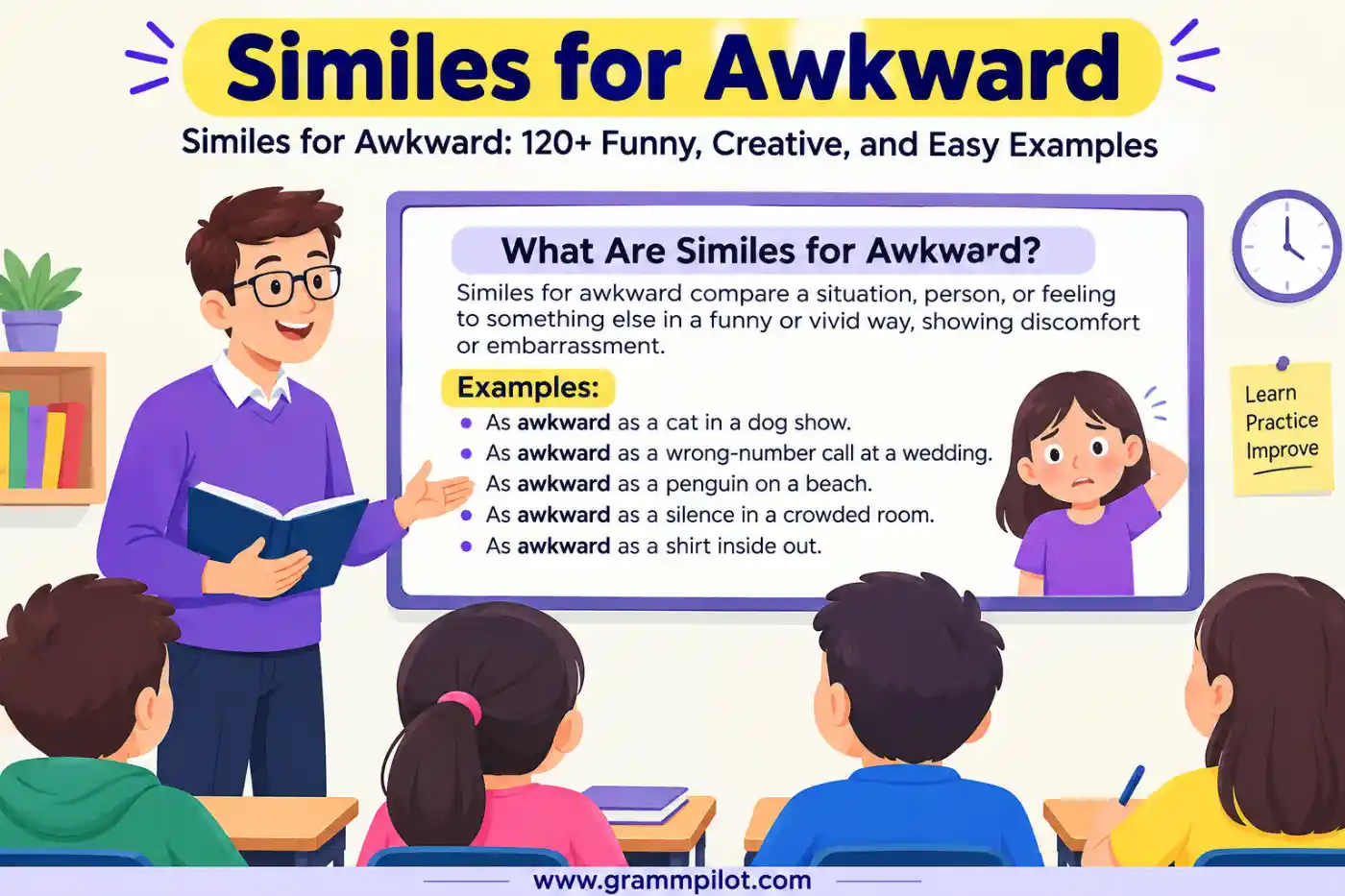
Similes for Awkward are comparisons that describe uncomfortable, embarrassing, clumsy, or socially uneasy situations by using words like “as” or “like.” They help readers imagine exactly how a person feels by comparing that feeling to something familiar.
Example:
- He stood there like a deer in headlights.
- She felt as awkward as a fish out of water.
These comparisons make writing more interesting, expressive, and easier to visualize.
What Does “Awkward” Mean?
Before exploring Similes for Awkward, it’s helpful to understand the word awkward itself.
The adjective awkward describes someone or something that is:
- Uncomfortable in a social situation.
- Clumsy in movement.
- Difficult to handle.
- Embarrassing.
- Not smooth or natural.
For example:
- The silence after his joke was awkward.
- I felt awkward meeting my teacher at the grocery store.
- She gave an awkward smile before answering.
Because awkward situations are easy to recognize but sometimes difficult to explain, writers often rely on Similes for Awkward to make those moments feel real.
Word Origin of Similes for Awkward
Understanding where the word comes from helps you appreciate why Similes for Awkward work so well in English. The word awkward comes from the Middle English form awk, meaning turned the wrong way or backward. Over time, English speakers began using it to describe people who seemed uncoordinated, uncomfortable, or unable to act naturally. Today, the meaning has expanded far beyond physical clumsiness. Someone can experience an awkward conversation, an awkward silence, an awkward smile, or an awkward situation without moving at all. The word simile comes from the Latin word similis, meaning similar or like. A simile compares two different things using words such as like or as. When these two ideas come together, Similes for Awkward become a powerful writing tool that helps readers picture uncomfortable moments through familiar comparisons.
Why Writers Use Similes for Awkward
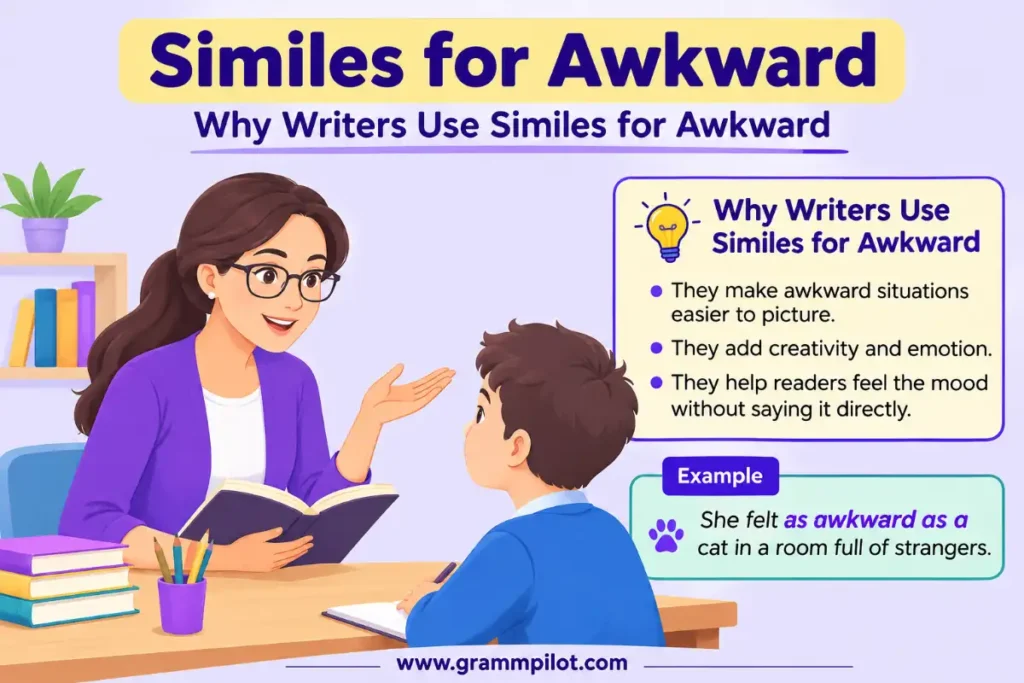
Simple descriptions often fail to show how uncomfortable a moment truly feels.
Compare these examples:
Plain sentence
The meeting was awkward.
Better sentence
The meeting was as quiet as a library at midnight. The second sentence creates an immediate picture in the reader’s mind.
Writers use Similes for Awkward because they:
- Create vivid mental images.
- Add humor to embarrassing situations.
- Make stories more engaging.
- Help readers connect with characters.
- Replace repetitive descriptions.
- Improve creative writing.
- Make conversations sound more natural.
If you’re writing fiction or nonfiction, Similes for Awkward make emotions easier to understand.
Characteristics of Good Similes for Awkward
Not every comparison makes a strong simile. The best Similes for Awkward usually have these qualities:
They Are Easy to Imagine
Readers should instantly understand the comparison.
Example: As awkward as a fish out of water.
They Match the Situation
The comparison should fit the level of embarrassment or discomfort.
Example: Like wearing shoes on the wrong feet.
They Feel Natural
A good simile shouldn’t confuse readers. Instead of using an overly complicated comparison, choose one that’s familiar.
They Add Emotion
The best Similes for Awkward help readers feel the embarrassment instead of simply reading about it.
When Should You Use It?
You can naturally include Similes for Awkward in many kinds of writing, including:
- Creative writing
- Short stories
- School essays
- Speeches
- Classroom activities
- Blog posts
- Personal journals
- Social media captions
- Dialogue
- Children’s stories
- Character descriptions
- Narrative writing
Used correctly, these comparisons make your writing more colorful without making it harder to read.
Similes vs. Metaphors for Awkward
Many English learners confuse similes and metaphors.
Here’s the difference.
| Simile | Metaphor |
|---|---|
| Uses like or as | Does not use like or as |
| He was like a fish out of water. | He was a fish out of water. |
| Makes a direct comparison | Treats one thing as another |
If your sentence uses like or as, it is usually a simile.
That’s why Similes for Awkward are often easier for beginners to recognize and use than metaphors.
Why this word Make Writing Better
Imagine reading a story that simply repeats the word awkward again and again. It quickly becomes boring.
Now compare these sentences.
- The room became awkward.
- The room became as silent as an empty theater.
- He stood like a statue that forgot how to move.
- She smiled like someone who knew they had said the wrong thing.
These comparisons help readers experience the moment instead of merely reading about it. That is why experienced writers often rely on Similes for Awkward whenever they want to create stronger emotional scenes.
120+ Similes for Awkward with Meanings and Examples
The heart of this guide is this collection of Similes for Awkward. These comparisons describe embarrassing moments, uncomfortable conversations, clumsy actions, and situations where someone feels out of place.
Each example includes its meaning and a sentence to show how it works in everyday English.
| Simile | Meaning | Example |
|---|---|---|
| As awkward as a fish out of water | Feeling completely out of place | I felt as awkward as a fish out of water at the reunion. |
| Like a deer in headlights | Frozen by surprise or fear | He stood like a deer in headlights when everyone looked at him. |
| Like a cat in a bathtub | Extremely uncomfortable | He looked like a cat in a bathtub during the interview. |
| As awkward as a square wheel | Not working naturally | Their conversation was as awkward as a square wheel. |
| Like a robot learning to smile | Looking forced | His smile was like a robot learning to smile. |
| Like trying to hug a cactus | Difficult interaction | Talking to him felt like trying to hug a cactus. |
| As awkward as wet cardboard | Stiff and unnatural | His introduction felt as awkward as wet cardboard. |
| Like a balloon losing air | Losing confidence | He stood like a balloon losing air. |
| Like a chicken trying to swim | Clumsy attempt | He looked like a chicken trying to swim. |
| Like a broken zipper | Embarrassing problem | The situation felt like a broken zipper. |
| Like an umbrella indoors | Clearly out of place | He stood like an umbrella indoors. |
| Like an actor forgetting every line | Completely embarrassed | She froze like an actor forgetting every line. |
Funny Similes for Awkward
Sometimes, These Similes are meant to make readers laugh while describing an uncomfortable situation.
Here are some humorous examples.
- As awkward as a giraffe in a phone booth.
- Like a penguin wearing flip-flops.
- As awkward as a cow on roller skates.
- Like a camel riding a bicycle.
- As awkward as a squirrel at a swimming competition.
- Like a duck wearing high heels.
- As awkward as a pirate using chopsticks.
- Like a chicken giving a speech.
- As awkward as a flamingo playing football.
- Like a goldfish climbing a tree.
These aren’t traditional sayings, but they work well in creative writing because readers instantly understand the comparison.
Similes for Awkward Conversations
One of the most common uses of this word is describing uncomfortable conversations.
Examples include:
- As awkward as a long pause during a speech.
- Like waiting for bad news.
- As awkward as an unanswered question.
- Like two strangers trapped in an elevator.
- As awkward as introducing someone whose name you forgot.
- Like laughing at the wrong moment.
- As awkward as speaking into a silent room.
- Like a microphone that suddenly stops working.
- As awkward as hearing your own voice echo.
- Like trying to continue a conversation after an embarrassing mistake.
These comparisons work well in stories, dialogue, and personal experiences.
Similes for Awkward Situations at School
Students often search for Similes for Awkward because school creates many embarrassing moments.
Here are some examples.
- As awkward as answering the wrong question.
- Like entering the wrong classroom.
- As awkward as forgetting your homework on presentation day.
- Like calling your teacher “Mom.”
- As awkward as dropping your books in a silent hallway.
- Like sitting in someone else’s seat.
- As awkward as waving at someone who wasn’t waving at you.
- Like giving the wrong answer with confidence.
- As awkward as reading the wrong page aloud.
- Like arriving after everyone else.
These examples feel realistic because many students have experienced them.
Similes for Awkward in Everyday Life
You can also use Similes for Awkward outside school.
Examples include:
- As awkward as meeting your ex unexpectedly.
- Like wearing winter clothes on a hot day.
- As awkward as knocking on the wrong door.
- Like sending a message to the wrong person.
- As awkward as forgetting someone’s birthday.
- Like arriving an hour early.
- As awkward as arriving an hour late.
- Like opening a door that says “Pull.”
- As awkward as walking into a glass door.
- Like realizing everyone is staring at you.
These comparisons make everyday experiences much easier to describe.
Tips for Creating Your Own Similes for Awkward
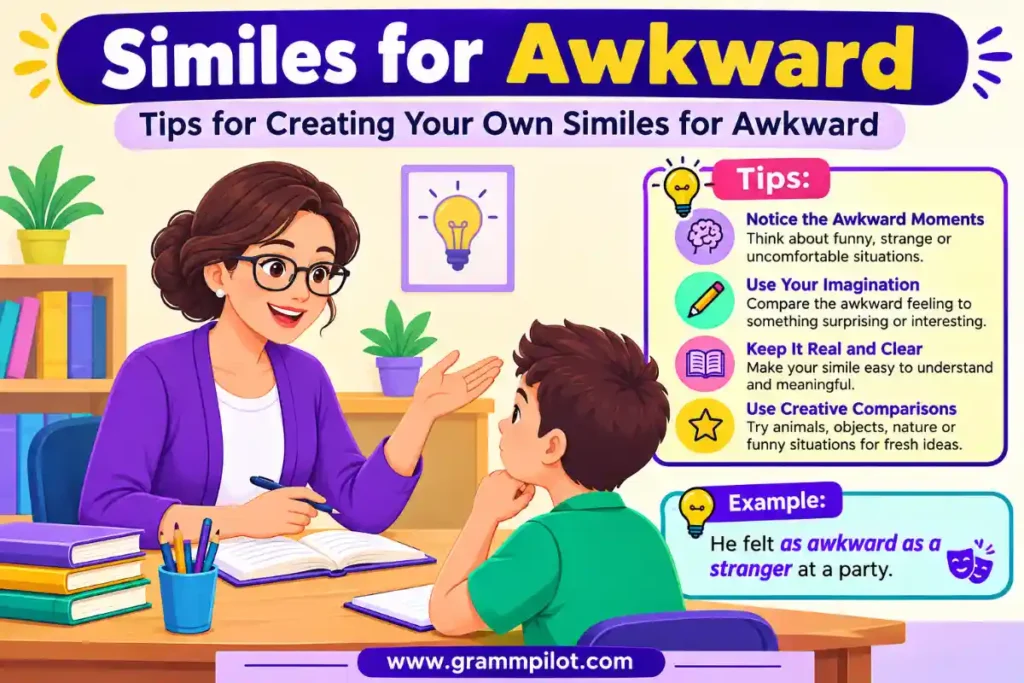
You don’t have to memorize every example. You can create your own Similes by following a few simple tips.
Think of uncomfortable experiences.
Ask yourself what situation instantly reminds you of embarrassment.
Compare it to something familiar.
The comparison should be easy for readers to picture.
Keep it short.
Simple similes are usually the strongest.
Match the tone.
A funny story can use silly comparisons, while a serious story should use more realistic ones.
Common Mistakes When Using It
Even though Similes for Awkward are simple to understand, many learners make small mistakes when using them. Avoiding these errors will make your writing sound more natural.
1. Mixing Similes with Metaphors
A simile uses like or as, while a metaphor does not.
Correct:
- She was like a fish out of water.
- He felt as awkward as a broken robot.
Incorrect:
- She was as a fish out of water.
2. Using Too Many Similes
Adding several Similes for Awkward in one paragraph can make your writing feel crowded.
Less Effective: He was like a fish out of water, like a deer in headlights, like a turtle on roller skates, and like a penguin in the desert.
Better: He stood like a deer in headlights, unsure what to say next.
One strong simile is usually enough.
3. Choosing Confusing Comparisons
The best Similes for Awkward are easy to picture. Instead of creating a comparison that readers may not understand, choose something familiar.
4. Using the Wrong Situation
Some Similes for Awkward describe physical clumsiness, while others describe social discomfort.
For example:
- Like a deer in headlights usually describes someone who suddenly freezes.
- As awkward as a fish out of water describes someone who doesn’t belong.
Choosing the right comparison makes your writing stronger.
Use in Daily Conversations
People naturally use Similes for Awkward in everyday speech because they quickly explain uncomfortable moments.
Here are some examples.
At School
Emma: How was your presentation?
Lucas: I felt like a deer in headlights when everyone looked at me.
At Work
Manager: How did the meeting go?Employee: It started as awkward as a silent elevator, but everyone relaxed after a few minutes.
At a Family Gathering
“I hadn’t seen my cousins in years, so I felt as awkward as a fish out of water.”
Meeting New People
“The first few minutes were like trying to hug a cactus because neither of us knew what to say.”
These examples show how Similes for Awkward make conversations more expressive.
Similes for Awkward in Creative Writing
Writers often use Similes for Awkward to help readers feel what a character is experiencing.
Example 1
Jacob stepped onto the stage like a deer caught in headlights, unable to remember his first sentence.
Example 2
The room fell as silent as an empty library, and Mia suddenly felt as awkward as a fish out of water.
Example 3
Oliver smiled like a robot learning to laugh, hoping nobody noticed his embarrassment.
Example 4
The dinner conversation became as awkward as a broken handshake, with everyone avoiding eye contact.
These examples create stronger scenes than simply saying someone felt embarrassed.
Similes for Awkward in Literature
Authors have always looked for creative ways to describe uncomfortable situations. Although famous writers don’t always use the exact phrase , they often compare embarrassment, silence, nervousness, and social discomfort to familiar images.
Classic and modern literature frequently includes comparisons such as:
- Like a frightened animal.
- As still as a statue.
- Like someone caught in a spotlight.
- As quiet as an empty church.
- Like a visitor who entered the wrong room.
These comparisons help readers connect emotionally with the characters.
Similes for Awkward in Movies and TV
Movies often rely on body language instead of words, but this word are still useful when reviewing or describing scenes.
For example:
- He stood like a statue waiting to fall.
- Their first date felt as awkward as a silent elevator.
- She smiled like someone hiding a secret.
- The interview became as awkward as forgetting your own name.
These comparisons make reviews more engaging.
Similar Expressions Related to Similes for Awkward
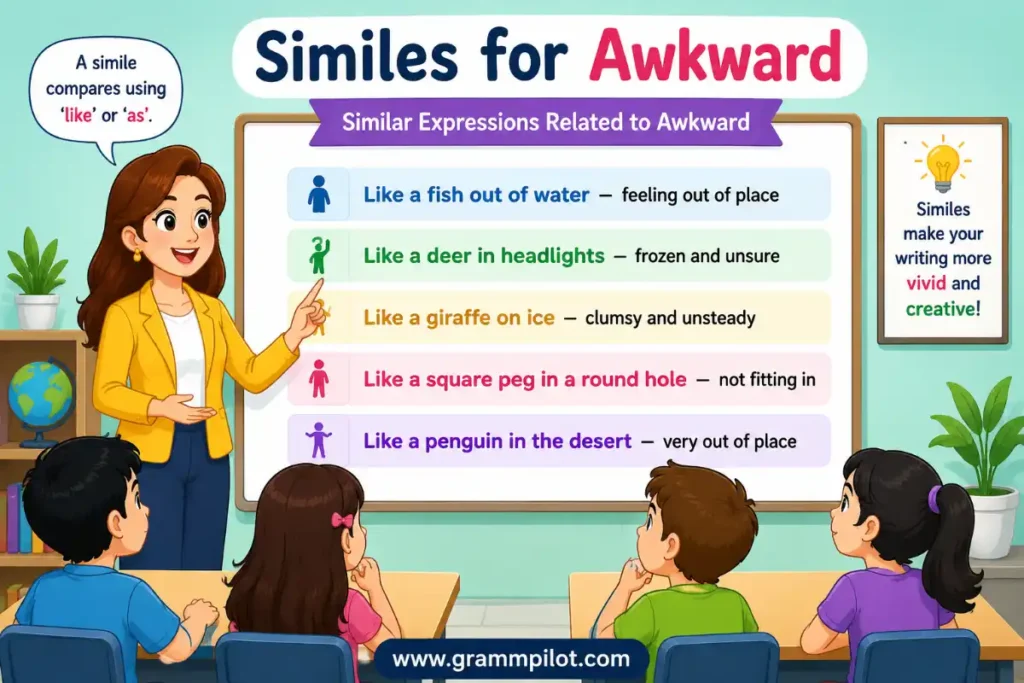
If you want variety, these expressions have meanings close to Similes for Awkward.
Idioms
- Fish out of water
- Deer in headlights
- Stick out like a sore thumb
- Put your foot in your mouth
- Break the ice
- Caught off guard
- On the spot
- Out of your comfort zone
- In hot water
- Walking on eggshells
Related Adjectives
- Embarrassed
- Uncomfortable
- Clumsy
- Uneasy
- Nervous
- Self-conscious
- Shy
- Stiff
- Tense
- Unnatural
Related Verbs
- Fumble
- Stumble
- Freeze
- Hesitate
- Blush
- Tremble
- Misjudge
- Misread
- Panic
- Flinch
Using these alongside Similes for Awkward keeps your writing interesting without sounding repetitive.
How to Teach Similes for Awkward
Teachers often introduce Similes for Awkward because students remember comparisons more easily than long definitions.
Here are a few classroom activities.
Guess the Simile
Read a situation aloud and ask students to choose the best simile.
Complete the Sentence
Example: “I felt as awkward as __________.”
Students create their own endings.
Story Challenge
Ask students to write a short story using at least five Similes for Awkward naturally.
Picture Prompt
Show an embarrassing picture and ask students to describe it using creative comparisons. These activities improve vocabulary, creativity, and descriptive writing.
Practice Exercise: Fill in the Blanks
Choose the best answer.
1.
I felt __________ during my first speech.
A. like a deer in headlights
B. faster than light
C. full of sunshine
Answer: A
2.
The conversation became __________.
A. as awkward as a silent elevator
B. as sweet as honey
C. as bright as gold
Answer: A
3.
He looked __________ after forgetting everyone’s name.
A. like a fish out of water
B. like a superhero
C. like a champion
Answer: A
Practicing with examples helps you remember Similes for Awkward more easily and use them naturally in your own writing.
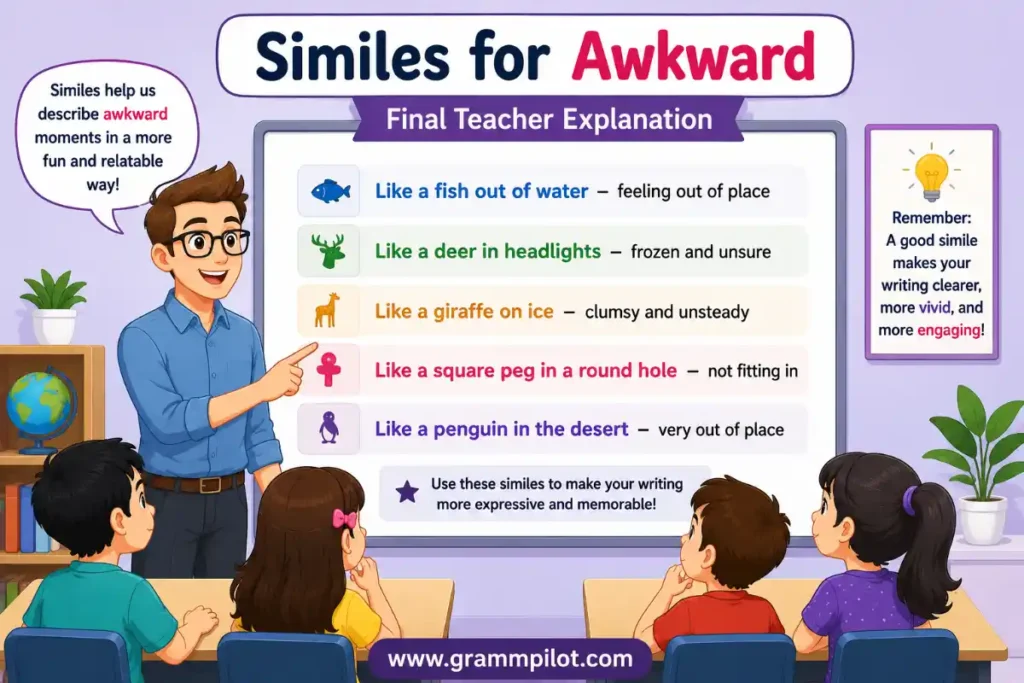
Final Teacher Explanation
Learning Similes for Awkward is about more than memorizing a list of comparisons. It’s about understanding how language creates pictures in a reader’s mind. A well-chosen simile can instantly show embarrassment, nervousness, or discomfort without needing a long explanation.
When you use Similes for Awkward, think about the situation first. Is the person feeling out of place? Are they frozen with fear? Are they physically clumsy or simply uncomfortable in a social setting? Once you understand the feeling, choosing the right comparison becomes much easier.
Remember these simple tips:
- Use like or as correctly.
- Pick comparisons that readers will recognize.
- Avoid adding too many similes in one paragraph.
- Match the simile to the emotion you want to describe.
- Practice using Similes for Awkward in your own sentences.
The more you read and write, the more naturally these comparisons will become part of your vocabulary.
Final Answer
Similes for Awkward are comparisons that describe embarrassing, uncomfortable, clumsy, or socially uneasy situations by using like or as. They help readers picture emotions clearly, make writing more engaging, and add humor or personality to everyday descriptions. If you’re writing a story, giving a speech, or improving your English, using Similes for Awkward can make your writing more vivid and memorable.
Conclusion
Similes for Awkward make ordinary descriptions far more expressive. Instead of simply saying someone felt uncomfortable, you can create a memorable picture that readers immediately understand. If you choose a classic comparison like “as awkward as a fish out of water” or create your own real expression, these similes add life to your writing.
Keep practicing Similes for Awkward in conversations, essays, stories, and daily writing. The more you use them naturally, the easier it becomes to describe embarrassing or uncomfortable moments with confidence and creativity.
Frequently Asked Questions
1. What are Similes for Awkward?
Similes for Awkward are comparisons that use like or as to describe uncomfortable, embarrassing, or clumsy situations in a vivid and creative way.
2. Why should I use Similes for Awkward?
Using Similes for Awkward makes your writing more descriptive, interesting, and easier for readers to imagine.
3. What is the most common example of Similes for Awkward?
One of the best-known Similes for Awkward is: “As awkward as a fish out of water.”
It describes someone who feels out of place or uncomfortable.
4. Are Similes for Awkward suitable for students?
Yes. Similes for Awkward are commonly taught in schools because they improve descriptive writing, vocabulary, and creative thinking.
5. Can I create my own Similes for Awkward?
Absolutely. As long as your comparison clearly explains an awkward feeling and uses like or as, you can create accurate Similes for Awkward for stories, essays, or conversations.
6. What’s the difference between a simile and a metaphor?
A simile uses like or as, while a metaphor makes a direct comparison without those words.
Simile: She was like a fish out of water.
Metaphor: She was a fish out of water.
7. Where can I use Similes for Awkward?
You can use Similes for Awkward in creative writing, school assignments, speeches, blogs, social media captions, stories, journals, and everyday conversations.
8. How can I remember Similes for Awkward more easily?
Practice writing your own sentences, read stories that use descriptive language, and try to connect each simile with a real-life experience. This makes Similes for Awkward easier to remember and use naturally.