
Have you ever read a story where a character cried, but the writer made you feel that sadness? Instead of saying, “She cried,” the writer may have written, “She cried like rain pouring from dark clouds.” That simple comparison creates a stronger picture in your mind. That’s the power of Similes for Crying. Many students, writers, and English learners look for Similes for Crying because they want their writing to sound more interesting. These comparisons help readers imagine emotions instead of just reading about them. If you’re writing a school essay, a short story, a poem, or even a social media caption, the right simile can make your words stand out.
Quick Answer: Similes for Crying compare someone’s tears or emotions to something else by using like or as. They help describe sadness, happiness, fear, relief, or other strong feelings in a vivid and easy-to-understand way.
In this complete guide, you’ll learn the meaning of Similes for Crying, discover more than 100 examples, understand when to use them, and see how they can improve your speaking and writing.
You can find more examples of figurative language in [Similes for Worried].
What Are Similes for Crying?
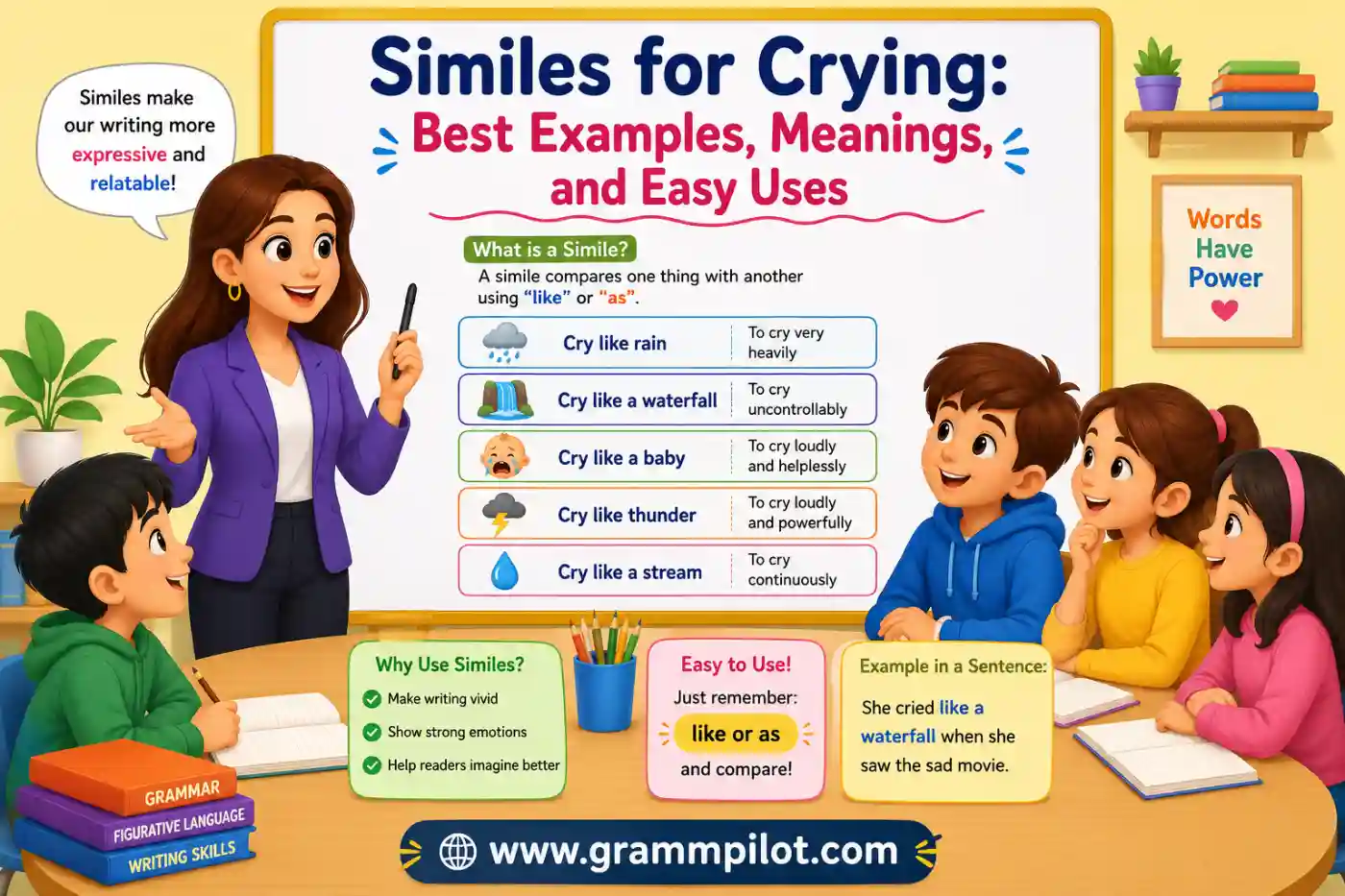
Similes for Crying are figures of speech that compare crying to another person, object, or natural event using the words like or as. These comparisons make emotions easier to picture.
Instead of writing: The little girl cried.
You could write: The little girl cried like a river after losing her favorite toy.
The second sentence helps readers imagine continuous tears and deep sadness.
Here are a few simple examples of Similes for Crying:
- She cried like a baby.
- His tears flowed like a river.
- They cried like rain falling from heavy clouds.
- She sobbed like a child who was lost.
- Tears rolled down his face like tiny pearls.
Each comparison gives extra meaning without using many words.
Why Are Similes for Crying Important?
Good writing helps readers see, hear, and feel what is happening. Similes for Crying make emotional scenes stronger because they create clear mental pictures.
Here are a few reasons writers use Similes for Crying:
- They make stories more emotional.
- They improve descriptive writing.
- They help readers connect with characters.
- They make poems more expressive.
- They add creativity to essays and narratives.
- They make English sound more natural.
Without similes, many emotional scenes can feel plain. A good comparison brings those scenes to life.
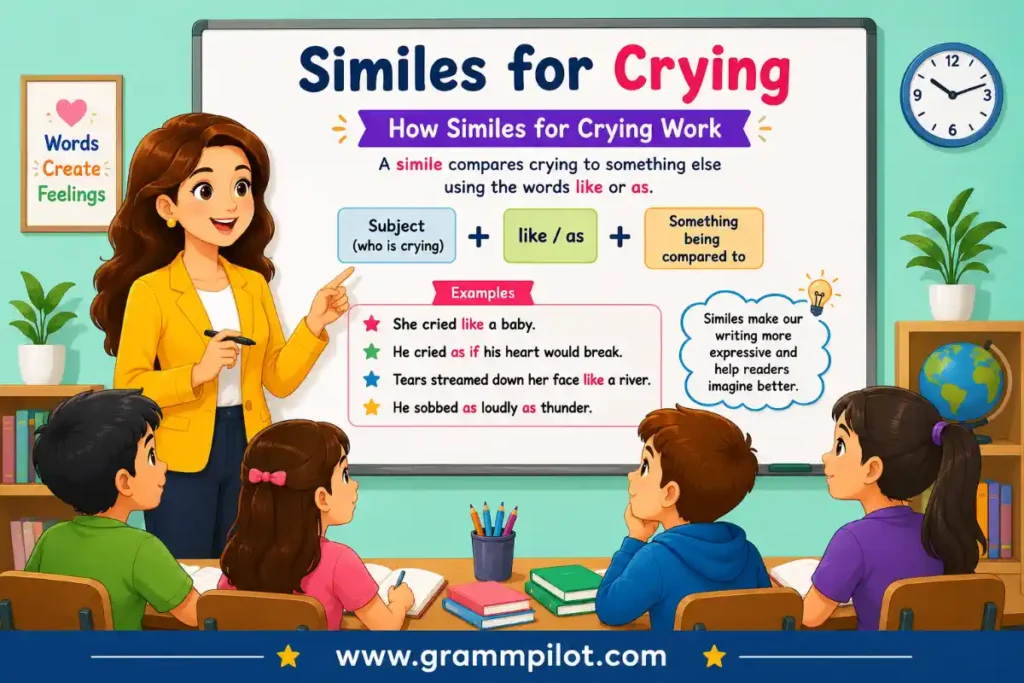
How Similes for Crying Work
Every simile has two parts:
- The action of crying.
- A comparison using like or as.
For example: She cried like a waterfall.
Here, crying is compared to a waterfall because both involve a heavy flow.
Another example: He was as quiet as falling snow while crying.
This comparison shows silent sadness instead of loud sobbing. The best Similes for Crying are easy to understand and create a clear picture in the reader’s mind.
Common Types of Similes for Crying
Not everyone cries in the same way. Some people cry quietly, while others sob loudly. That’s why Similes for Crying can describe many different emotions.
Similes for Loud Crying
These comparisons describe powerful emotions.
Examples:
- Cry like a baby.
- Cry like thunder after lightning.
- Cry like a storm.
- Cry like a waterfall.
- Cry like waves crashing on rocks.
These similes suggest loud sobbing or strong emotional pain.
Similes for Quiet Crying
Some people hide their emotions. These Similes for Crying show silent tears.
Examples:
- Cry like morning dew.
- Cry as softly as falling snow.
- Cry like gentle rain.
- Cry like melting ice.
- Cry like leaves drifting to the ground.
These comparisons describe calm and peaceful sadness.
Similes for Endless Tears
Sometimes people cry for a long time. These Similes for Crying show continuous tears.
Examples:
- Cry like a river.
- Cry like endless rain.
- Cry like a flowing stream.
- Cry like an overflowing fountain.
- Cry like the sea during a storm.
These examples suggest tears that do not stop easily.
Best Similes for Crying and Their Meanings
Below are some of the most popular Similes for Crying and what they mean.
Cry Like a Baby
Meaning: To cry loudly and openly without hiding emotions.
Example: The little boy cried like a baby after dropping his ice cream.
Cry Like a River
Meaning: To cry with many tears for a long time.
Example: She cried like a river when her best friend moved away.
Cry Like Rain
Meaning: Tears fall continuously.
Example: He cried like rain after hearing the heartbreaking news.
Cry Like a Waterfall
Meaning: Heavy and nonstop crying.
Example: The child cried like a waterfall after losing her favorite pet.
Cry Like a Storm
Meaning: Strong emotions that suddenly burst out.
Example: She cried like a storm after months of hiding her feelings.
Cry Like a Lost Child
Meaning: Feeling scared, helpless, or lonely.
Example: He cried like a lost child in the crowded airport.
Cry Like Morning Dew
Meaning: Soft and gentle tears.
Example: Her tears fell like morning dew as she remembered her grandmother.
Cry Like Melting Ice
Meaning: Slow tears caused by quiet sadness.
Example: He cried like melting ice while reading the old letters.
Cry Like Falling Leaves
Meaning: Calm sadness that slowly grows.
Example: She cried like falling leaves as autumn memories returned.
Cry Like a Broken Heart
Meaning: Deep emotional pain after loss or disappointment.
Example: He cried like a broken heart after saying goodbye to his family.
When Should You Use Similes for Crying?
Knowing when to use Similes for Crying is just as important as knowing them.
They work best in:
- Short stories
- Narrative essays
- Poems
- Children’s books
- Personal journals
- Emotional speeches
- Creative writing assignments
- Fiction writing
- Dialogue between characters
Using the right simile helps readers understand not only that someone is crying but also how they are crying and why the emotion feels so strong.
More Than 100 Similes for Crying
The following list of Similes for Crying includes common, creative, and expressive comparisons. You can use them in stories, essays, poems, speeches, and everyday writing.
| Simile | Meaning |
|---|---|
| Cry like a baby | Cry loudly and openly |
| Cry like a child | Show innocent sadness |
| Cry like a river | Cry with many tears |
| Cry like rain | Cry without stopping |
| Cry like a waterfall | Heavy crying |
| Cry like a storm | Strong emotions |
| Cry like thunder | Loud sobbing |
| Cry like waves | Repeated crying |
| Cry like a broken heart | Deep emotional pain |
| Cry like a lost puppy | Feel lonely |
| Cry like a lost child | Feel helpless |
| Cry like morning dew | Gentle tears |
| Cry like melting ice | Slow, quiet tears |
| Cry like falling leaves | Calm sadness |
| Cry like soft rain | Peaceful crying |
| Cry like an overflowing fountain | Endless tears |
| Cry like winter rain | Cold, lonely sadness |
| Cry like a cloudy sky | Heavy emotions |
| Cry like a dripping faucet | Tears that keep coming |
| Cry like a wounded bird | Hurt and frightened |
Similes for Crying That Express Deep Sadness
Some Similes for Crying are accurate when a character experiences heartbreak, loss, or disappointment.
Cry Like a River
Meaning: Tears continue flowing for a long time.
Example: She cried like a river after saying goodbye to her childhood home.
Cry Like a Broken Heart
Meaning: Deep emotional pain.
Example: He cried like a broken heart when he lost his best friend.
Cry Like Winter Rain
Meaning: Quiet sadness filled with loneliness.
Example: The old man cried like winter rain while looking through old photographs.
Cry Like a Storm
Meaning: Powerful emotions that cannot be controlled.
Example: She cried like a storm after hearing the unexpected news.
Cry Like an Empty House
Meaning: Feeling lonely and forgotten.
Example: After everyone left, he cried like an empty house.
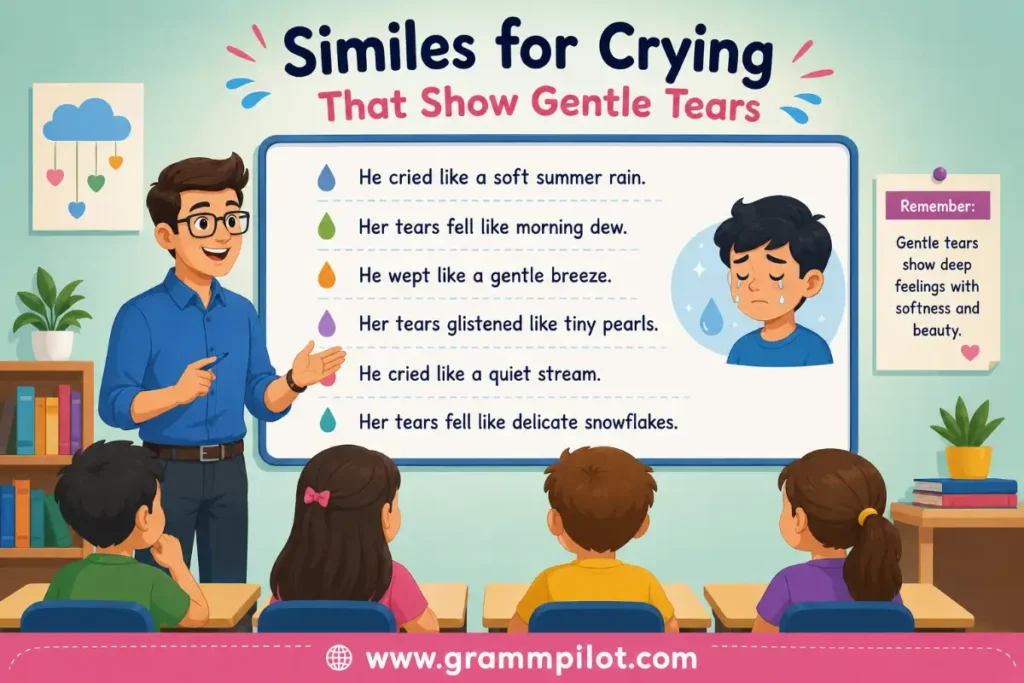
Similes for Crying That Show Gentle Tears
Not every emotional moment is loud. Many Similes for Crying describe silent tears.
Cry Like Morning Dew
Meaning: Soft tears that quietly appear.
Example: Her tears rested on her cheeks like morning dew.
Cry Like Falling Snow
Meaning: Silent crying without making noise.
Example: He cried like falling snow while sitting beside the window.
Cry Like Melting Ice
Meaning: Slow tears caused by hidden emotions.
Example: She cried like melting ice after reading the letter.
Cry Like Gentle Rain
Meaning: Calm but emotional crying.
Example: The little girl cried like gentle rain when her teacher moved away.
Cry Like Falling Leaves
Meaning: Quiet sadness that grows over time.
Example: His tears came like falling leaves during the farewell ceremony.
Similes for Crying That Show Happiness
People don’t cry only because they are sad. Some Similes for Crying describe joyful tears.
Cry Like Sunshine After Rain
Meaning: Tears of happiness after a difficult time.
Example: She cried like sunshine after rain when she graduated.
Cry Like a Proud Parent
Meaning: Tears filled with pride.
Example: His mother cried like a proud parent during the award ceremony.
Cry Like a Winner
Meaning: Emotional tears after success.
Example: The athlete cried like a winner after crossing the finish line.
Cry Like Someone Finding Home
Meaning: Relief and happiness.
Example: After many years abroad, she cried like someone finding home.
Cry Like Flowers After Rain
Meaning: Joy returning after sadness.
Example: He smiled and cried like flowers after rain when his family surprised him.
Funny Similes for Crying
Not every comparison has to be serious. Some Similes for Crying add humor to a story.
- He cried like someone who dropped the last slice of pizza.
- She cried like her phone battery died at one percent.
- He cried like a kid whose video game stopped working.
- She cried like someone who missed the school bus.
- He cried like a cat waiting for dinner.
- She cried like a puppy begging for attention.
- He cried like his favorite team lost the championship.
- She cried like someone whose ice cream fell on the ground.
- He cried like a child told to clean his room.
- She cried like a cartoon character after losing a contest.
These examples work well in light-hearted stories and conversations.
Similes for Crying in Literature
Many authors use Similes for Crying to help readers connect with characters. A simple comparison often creates a stronger emotional image than a plain sentence.
For example, instead of writing: “She cried all night.”
A writer might say: “She cried like rain beating against the windows.”
Or instead of writing: “His tears would not stop.”
They may write: “His tears flowed like a river after the spring thaw.”
These descriptions make scenes more vivid because readers can easily imagine what the character is feeling.
Similes for Crying in Everyday English
You don’t have to be a novelist to use Similes for Crying. People use simple comparisons in everyday conversations too.
For example:
- “He cried like a baby after watching the movie.”
- “She was crying like rain when she lost her necklace.”
- “The little boy cried like a waterfall after falling off his bike.”
- “I nearly cried like a child when I saw my old school again.”
- “They cried like proud parents during the graduation ceremony.”
These everyday Similes for Crying make conversations more expressive while still sounding natural.
How to Use Similes for Crying in Your Writing
Learning Similes for Crying is helpful, but knowing how to use them correctly is even more important. A good simile should match the emotion and the situation. If the comparison feels natural, your writing becomes stronger and easier to imagine.
Here are a few simple tips.
Match the Emotion
Choose a simile that fits the feeling.
For deep sadness:
- She cried like a river.
- He cried like a broken heart.
quiet sadness:
- Her tears fell like morning dew.
- He cried as softly as falling snow.
For happiness:
- She cried like sunshine after rain.
- He cried like a proud parent.
Using the right Similes for Crying helps readers understand the exact emotion.
Keep It Natural
Don’t force a comparison into every sentence. Too many similes can make writing feel crowded.
Instead of writing: “She cried like rain, like a river, like a waterfall, and like a storm.”
Write: “She cried like a river after hearing the news.”
One clear comparison is usually enough.
Think About Your Readers
Simple Similes for Crying are often the most effective because everyone can understand them.
For example:
- Cry like a baby.
- Cry like rain.
- Cry like a child.
These are easier to picture than complicated comparisons.
Similes for Crying in Different Situations
Different situations call for different Similes for Crying. Here are some examples.
During a Sad Goodbye
- She cried like rain on a cold evening.
- He cried like a river that would never run dry.
After Losing Something Important
- The child cried like a lost puppy.
- She cried like a broken toy left behind.
During a Happy Reunion
- They cried like sunshine after rain.
- He cried like someone who had finally found home.
After Achieving a Dream
- She cried like a proud champion.
- He cried like a traveler reaching the finish line.
Choosing the right Similes for Crying makes every scene feel more believable.
Common Mistakes When this Phrase
Many learners make small mistakes when using Similes for Crying. Avoiding these errors will improve your writing.
Using Too Many Similes
Adding several comparisons in one sentence can confuse readers.
❌ She cried like rain, like a river, like a waterfall, and like the sea.
✅ She cried like a waterfall after hearing the heartbreaking news.
Choosing the Wrong Comparison
Make sure the comparison matches the emotion.
For example, a funny simile may not fit a serious funeral scene.
Mixing Similes and Metaphors
Remember that Similes for Crying use like or as.
Example of a simile: She cried like a child.
Example of a metaphor: She was a storm of tears.
Both are useful, but they are not the same.
Repeating the Same Simile
If every character cries “like a baby,” readers may become bored. Instead, try different Similes for Crying throughout your writing.
Similes for Crying vs. Metaphors for Crying
Many people confuse similes and metaphors because both compare one thing with another.
The difference is simple.
| Similes for Crying | Metaphors for Crying |
|---|---|
| Use like or as | Do not use like or as |
| She cried like rain. | Her tears were rain. |
| He cried like a river. | His tears became a river. |
| She cried as softly as snow. | Her sadness was silent snow. |
Both styles make writing more descriptive, but Similes for Crying are usually easier for beginners to understand.
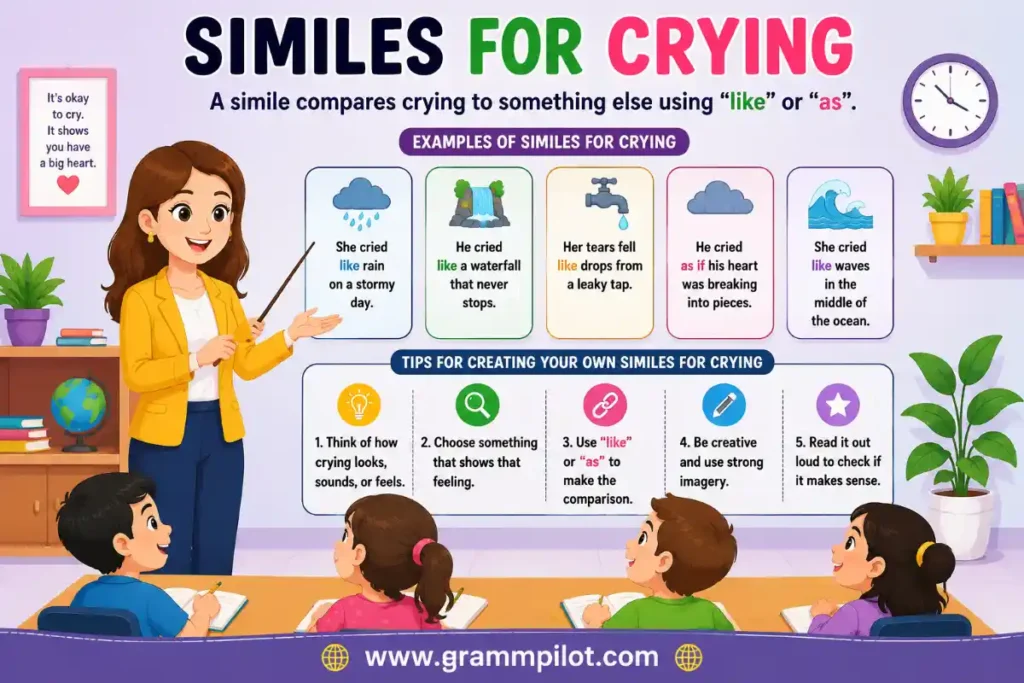
Tips for Creating Your Own Similes for Crying
You don’t always have to use ready-made examples. You can create your own Similes for Crying by thinking about how tears look, sound, or feel.
Ask yourself questions like:
- Does the crying sound loud or quiet?
- Are the tears fast or slow?
- Is the emotion happy or sad?
- What in nature looks similar?
For example:
- Tears falling slowly → like melting ice.
- Loud sobbing → like crashing waves.
- Happy tears → like sunshine after rain.
- Silent crying → like morning dew.
The more you observe people and nature, the easier it becomes to create actual Similes for Crying.
Practice Sentences
Complete these sentences by adding your own Similes for Crying.
- The little girl cried like __________________.
- His tears flowed like __________________.
- She cried as softly as __________________.
- They cried like __________________ after winning the competition.
- The boy cried like __________________ when he lost his puppy.
Sample Answers
- The little girl cried like a baby.
- His tears flowed like a river.
- She cried as softly as falling snow.
- They cried like proud parents after the victory.
- The boy cried like a lost puppy when he couldn’t find his pet.
These practice exercises help you remember Similes for Crying and use them naturally in your own writing.
How Similes for Crying Are Used in Stories and Poems
Writers use Similes for Crying to help readers feel a character’s emotions. A simple comparison can turn an ordinary sentence into one that readers remember.
For example, compare these two sentences:
- She cried after hearing the news.
- She cried like rain falling from dark clouds after hearing the news.
The second sentence creates a much clearer picture. Readers can almost see the tears and understand the character’s sadness. Poets also use this word because they add emotion without using many words. A well-chosen simile can make a poem feel more powerful and meaningful.
Related Figures of Speech
If you’re learning Similes for Crying, it also helps to know a few related figures of speech.
Metaphor
A metaphor compares two things without using like or as.
Example: Her tears were a river.
Personification
Personification gives mans qualities to non-human things.
Example: The rain cried with her.
Hyperbole
Hyperbole is an exaggerated statement used for emphasis.
Example: He cried enough tears to fill an ocean.
Understanding these figures of speech will make your writing even more creative.
Common Mistakes to Avoid
Even experienced writers can misuse this phrase. Here are some mistakes to watch for.
- Using too many similes in one paragraph.
- Repeating the same simile throughout your writing.
- Choosing a comparison that doesn’t match the emotion.
- Using a funny simile during a serious scene.
- Making comparisons that are confusing or unrealistic.
The best Similes for Crying are simple, clear, and appropriate for the situation.
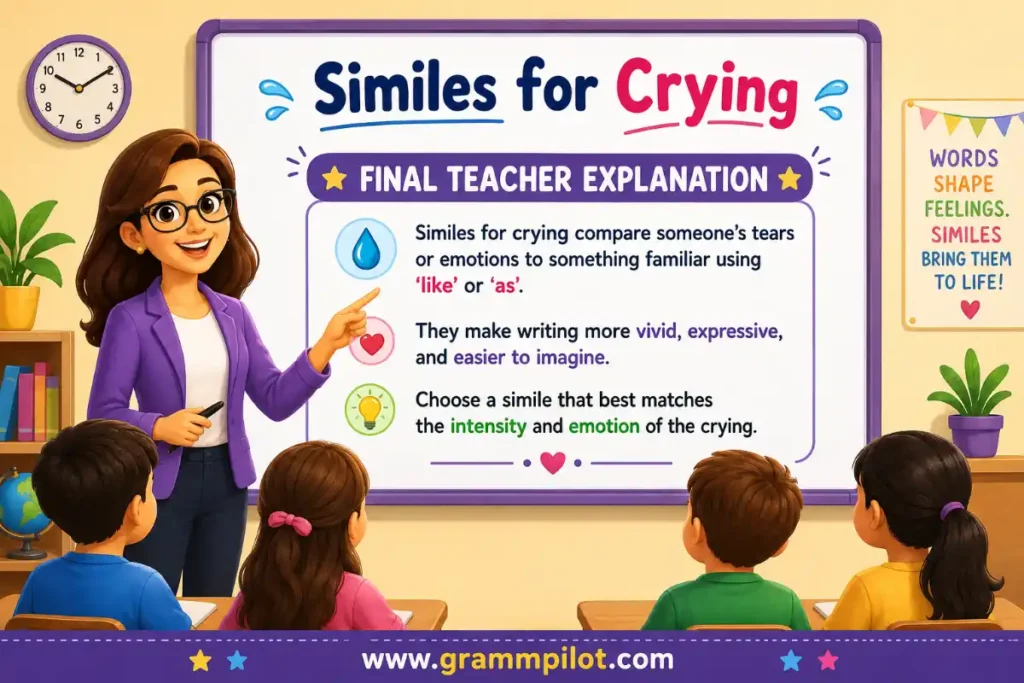
Final Teacher Explanation
Think of Similes for Crying as a way to help readers see emotions instead of simply reading about them. Rather than saying someone cried, you show how they cried. A child may cry like a baby. Someone who is heartbroken may cry like a river. A person filled with joy may cry like sunshine after rain.
When you choose the right comparison, your writing becomes more vivid, emotional, and enjoyable to read. Start with familiar similes, then try creating your own as your writing skills grow.
Conclusion
Similes for Crying make writing richer by turning simple descriptions into memorable images. They help readers understand sadness, happiness, fear, relief, and many other emotions through easy comparisons.
if you’re writing a school assignment, a poem, a short story, or simply improving your English, learning Similes for Crying will make your descriptions more natural and expressive. Practice using different similes, match them to the right emotions, and soon they’ll become a natural part of your writing.
Frequently Asked Questions
1. What are Similes for Crying?
Similes for Crying are comparisons that describe crying by using the words like or as. They make emotions easier to imagine and understand.
2. Why are Similes for Crying important?
They make writing more descriptive, help readers connect with emotions, and improve stories, poems, and essays.
3. What is the most common simile for crying?
One of the most common Similes for Crying is “cry like a baby.” It describes loud, open, and emotional crying.
4. Can Similes for Crying describe happy tears?
Yes. Examples include “cry like sunshine after rain” and “cry like a proud parent.” These describe tears caused by joy or relief.
5. What’s the difference between a simile and a metaphor?
A simile uses like or as, while a metaphor compares two things directly without those words.
6. Can I create my own Similes for Crying?
Absolutely. As long as the comparison is clear and meaningful, you can create accurate Similes for Crying for your own writing.
7. Are Similes for Crying suitable for school essays?
Yes. They are widely used in creative writing, narrative essays, speeches, and poems because they make descriptions more engaging.
8. How can I use Similes for Crying naturally?
Choose a simile that matches the emotion and use it only when it adds value to your sentence. One strong comparison is usually better than several weak ones.