
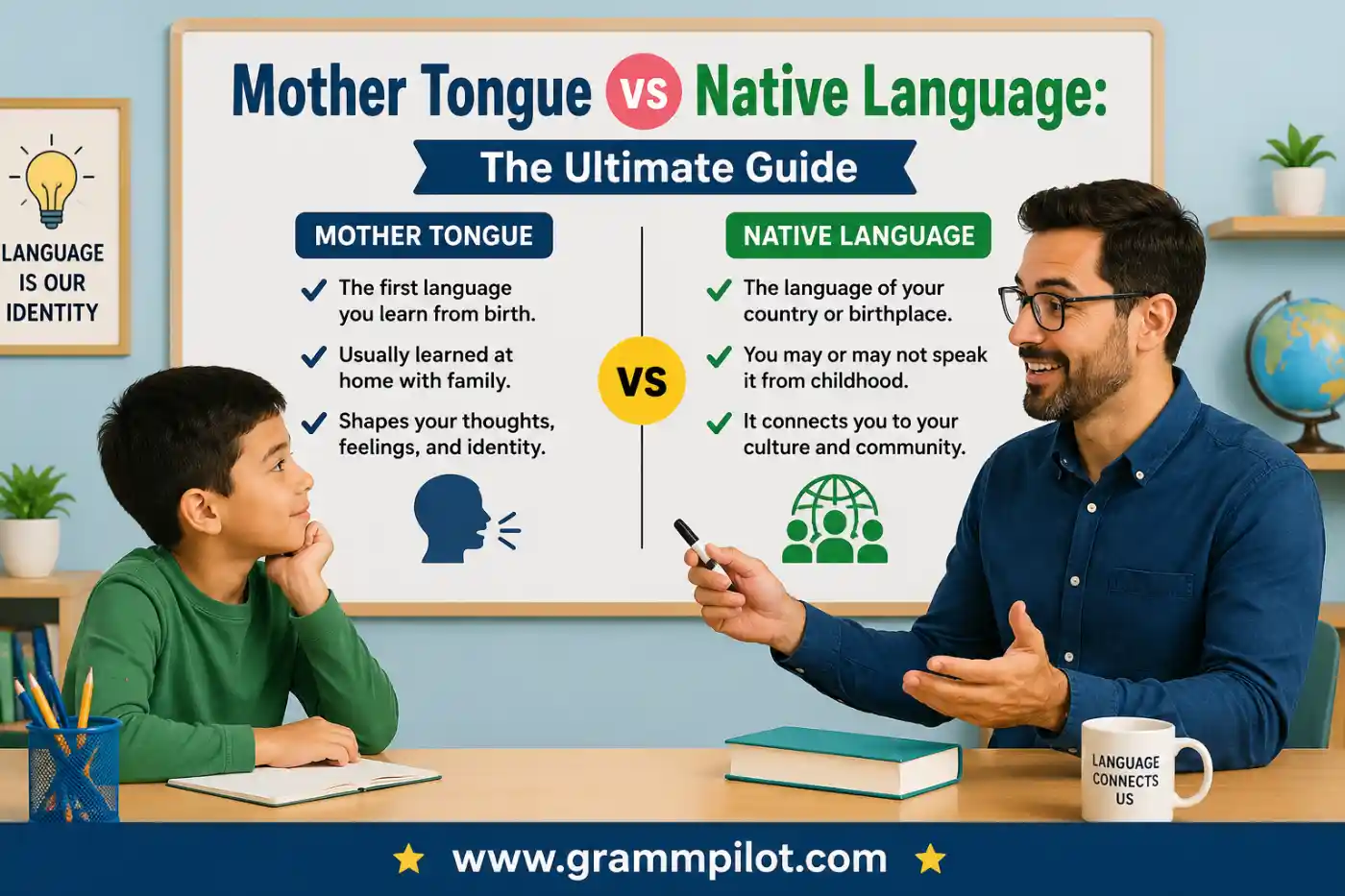
Have you ever filled out a job application, school form, or immigration document and stopped at the language section? Many people wonder whether they should write Mother Tongue vs Native Language because the two terms seem to mean the same thing. While they often overlap, there are situations where one expression fits better than the other. The confusion comes from the fact that both phrases describe the first language a person learns. However, culture, education, and personal experience can make their meanings slightly different. Understanding those differences will help you choose the right term in conversations, essays, forms, and professional writing.
Answer Box:
Mother tongue usually refers to the first language learned from parents or family during childhood. Native language generally means the language a person learned naturally from birth or early childhood. In most everyday situations, the two expressions can be used interchangeably, but context sometimes matters.
This guide explains Mother Tongue vs Native Language in simple English. You’ll learn the meanings, history, grammar, examples, common mistakes, regional differences, and practical tips for choosing the right expression with confidence.
For a closer look at another tricky spelling pattern, read [Swap vs Swop].
What Is the Difference Between Mother Tongue vs Native Language?
The easiest way to understand Mother Tongue vs Native Language is to examine what each expression emphasizes.
| Expression | Basic Meaning | Most Common Focus |
|---|---|---|
| Mother tongue | The first language learned from childhood | Family, culture, heritage |
| Native language | The language learned naturally from birth or early childhood | Fluency, natural ability |
In many conversations, both expressions refer to the same language.
Examples:
- English is my mother tongue.
- English is my native language.
Both sentences are correct if English was the first language the speaker learned. Sometimes, however, culture creates a small difference. Someone may grow up speaking one language at home but receive education in another language. In those cases, people may explain their background more carefully instead of treating the expressions as completely identical.
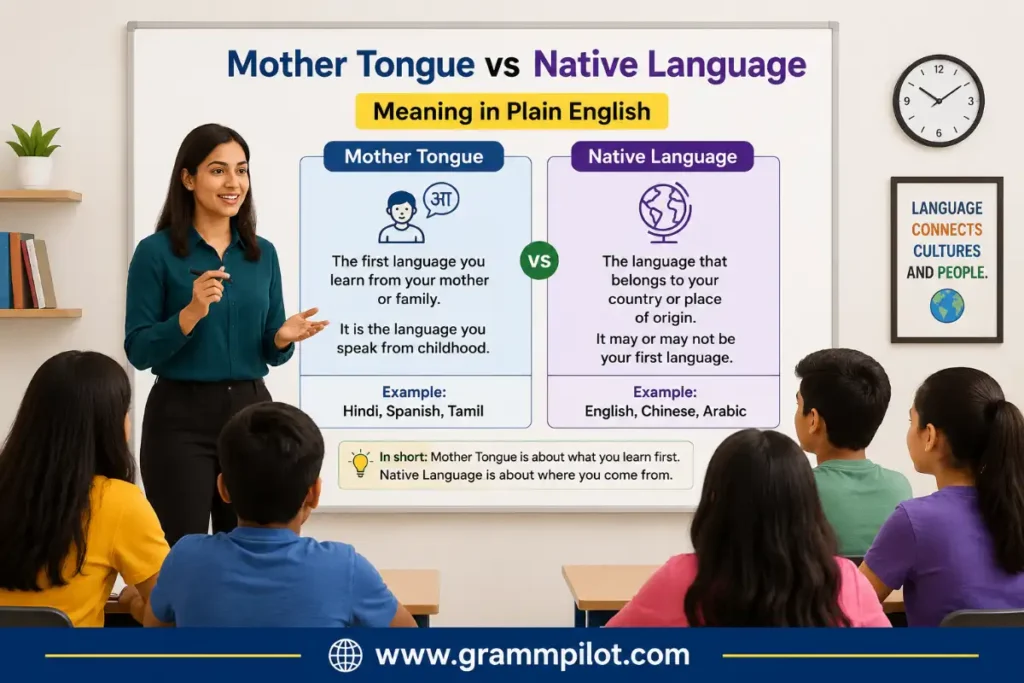
Mother Tongue vs Native Language Meaning in Plain English
Learning the meanings first makes everything else easier.
What Does “Mother Tongue” Mean?
The phrase mother tongue refers to the first language a child learns naturally from parents or family members.
Examples:
- Spanish is her mother tongue.
- My mother tongue is Urdu.
- Children usually learn their mother tongue before starting school.
- He speaks his mother tongue at home every day.
The expression often highlights family traditions and cultural identity.
What Does “Native Language” Mean?
The expression native language describes the language someone learned naturally during early childhood.
Examples:
- French is his native language.
- My native language is Arabic.
- She speaks her native language fluently.
- Most children become comfortable using their native language before attending school.
The focus here is usually on natural fluency rather than cultural heritage.
Word Origin of Mother Tongue vs Native Language
Knowing where these expressions came from helps explain why both still exist today.
Where Does “Mother Tongue” Come From?
The expression mother tongue has been used for hundreds of years. Long ago, children usually learned their first words from their mothers or other close family members. Because of that tradition, people began calling the first language a child’s mother tongue. Today, the phrase no longer suggests that only mothers teach language. Instead, it represents the language learned naturally within the family.
Where Does “Native Language” Come From?
The word native comes from the Latin word nativus, meaning born or by birth. Over time, English speakers began using native language to describe the language learned naturally from birth or early childhood. Unlike mother tongue, this expression focuses less on family relationships and more on natural language development.
Why Does the History Matter?
Although both phrases often describe the same language, they emphasize different ideas.
- Mother tongue highlights cultural roots and family background.
- Native language highlights natural acquisition and lifelong fluency.
Understanding that difference helps explain why both expressions remain common today.
Why Do People Confuse Mother Tongue vs Native Language?
Several reasons explain why these expressions are mixed up so often.
They Usually Describe the Same Language
For many people, the language spoken at home is also the language learned naturally from birth. As a result, both expressions seem interchangeable.
Dictionaries Give Similar Definitions
Many dictionaries define the two phrases using almost the same wording. That similarity makes learners believe there is no difference at all.
Modern Families Are More Multilingual
Today, many children grow up hearing two or even three languages.
For example:
- Parents may speak Hindi at home.
- School instruction may be in English.
- Friends may speak another local language.
Situations like these make the choice between the two expressions less obvious.
Forms and Applications Use Different Terms
Some school forms ask for your mother tongue.Others ask for your native language. Since both questions often expect the same answer, people assume the expressions are always identical.
The One Simple Rule for Mother Tongue vs Native Language
Here’s an easy classroom rule.
Ask yourself: Are you talking about family language and cultural background?
If yes, mother tongue usually fits best.
Examples:
- Urdu is my mother tongue.
- She teaches children in their mother tongue.
- Stories are often passed down in a family’s mother tongue.
Now ask yourself: Are you talking about the language someone learned naturally first?
If yes, native language is often the better choice.
Examples:
- English is his native language.
- Applicants should list their native language.
- She communicates naturally in her native language.
Most everyday conversations accept either expression, but understanding the focus helps you sound more precise.
Mother Tongue vs Native Language Grammar Rule
Grammar also explains why these expressions behave similarly.
“Mother Tongue” Is a Noun Phrase
The main noun is tongue.
Examples:
- Her mother tongue is Korean.
- My mother tongue helps me understand local traditions.
- Every child deserves education in their mother tongue.
“Native Language” Is Also a Noun Phrase
Here, language is the noun, while native describes it.
Examples:
- His native language is Japanese.
- Students should practice reading in their native language.
- She writes confidently in her native language.
Since both are noun phrases, they often appear in similar sentence structures.
Mother Tongue vs Native Language Quick Comparison
| Feature | Mother Tongue | Native Language |
|---|---|---|
| Focus | Family and heritage | First learned language |
| Refers to childhood language | Yes | Yes |
| Highlights culture | Often | Sometimes |
| Highlights natural fluency | Sometimes | Often |
| Common on official forms | Yes | Yes |
| Widely understood | Yes | Yes |
Keeping these differences in mind helps you choose the expression that best matches your purpose.
Is Mother Tongue vs Native Language Used Differently Around the World?
Both expressions appear in English-speaking countries, but usage varies slightly.
American English
People commonly say:
- native language
- first language
Although mother tongue is understood, native language appears more often in education and official writing.
Examples:
- Please list your native language.
- English is my native language.
British English
British English uses both expressions regularly.
Examples:
- Welsh is her mother tongue.
- His native language is English.
Many schools, language programs, and government documents still use mother tongue, especially when discussing bilingual education or cultural identity.
International English
Around the world, organizations, schools, and language researchers often use both expressions. In multilingual countries, mother tongue frequently emphasizes cultural identity, while native language focuses on language ability. Neither expression is wrong. The best choice depends on the context and the point you want to emphasize.
Master Synonym List for “Mother Tongue” and “Native Language”
Using related words helps your writing sound more natural while expanding your vocabulary.
Everyday Synonyms
| Word or Phrase | Meaning | Tone | Example |
|---|---|---|---|
| First language | The earliest language learned | Everyday | English is my first language. |
| Home language | Language spoken at home | Everyday | The child speaks a home language different from school. |
| Family language | Language used within the family | Everyday | Their family language is Punjabi. |
| Birth language | Language learned from birth | Neutral | Spanish is her birth language. |
| Primary language | Main language used | Everyday | French is his primary language. |
| Original language | Earliest language learned | Neutral | She still remembers her original language. |
| Main language | Most frequently spoken language | Everyday | English is his main language. |
| Childhood language | Language learned while growing up | Everyday | She enjoys reading in her childhood language. |
Formal Synonyms
| Word or Phrase | Meaning | Tone | Example |
|---|---|---|---|
| First-acquired language | Language learned first | Formal | Researchers studied the participants’ first-acquired language. |
| Primary linguistic system | Main language framework | Academic | Children develop their primary linguistic system early. |
| Heritage language | Language connected to family heritage | Formal | Many schools support heritage language education. |
| Dominant language | Most frequently used language | Formal | English became his dominant language over time. |
| Indigenous language | Original local language | Formal | Communities work to preserve indigenous languages. |
| Ancestral language | Language of earlier generations | Formal | She hopes to relearn her ancestral language. |
| Linguistic heritage | Family language tradition | Academic | The project celebrates linguistic heritage. |
| Community language | Language shared within a community | Formal | The community language remains widely spoken. |
Mother Tongue vs Native Language Synonyms Grouped by Everyday Use
Building a stronger vocabulary helps you understand Mother Tongue vs Native Language from different angles. Although these expressions are widely accepted, related terms can make your writing more precise depending on the audience and situation.
Everyday Synonyms
| Word or Phrase | Meaning | Tone | Example |
|---|---|---|---|
| First language | The first language learned | Everyday | English is her first language. |
| Home language | Language spoken at home | Everyday | His home language is Urdu. |
| Family language | Language used by family members | Everyday | Their family language is Arabic. |
| Main language | Most commonly spoken language | Everyday | Spanish is my main language. |
| Childhood language | Language learned while growing up | Everyday | She still reads books in her childhood language. |
| Birth language | Language learned from birth | Neutral | French is his birth language. |
| Primary language | Main language used daily | Everyday | My primary language is English. |
| Everyday language | Language regularly spoken | Informal | They use their everyday language at home. |
Formal Synonyms
| Word or Phrase | Meaning | Tone | Example |
|---|---|---|---|
| Heritage language | Language connected to family heritage | Formal | The school supports heritage language programs. |
| Dominant language | Most frequently used language | Formal | English became her dominant language. |
| Indigenous language | Original language of a region | Formal | The organization protects indigenous languages. |
| Ancestral language | Language spoken by earlier generations | Formal | He wants to relearn his ancestral language. |
| First-acquired language | Language learned first | Academic | Researchers examined each child’s first-acquired language. |
| Community language | Language shared within a community | Formal | The community language remains widely spoken. |
| Linguistic heritage | Family language tradition | Academic | Students explored their linguistic heritage. |
| Native speech | Natural spoken language | Formal | Children develop native speech early. |
Informal Alternatives
| Word or Phrase | Meaning | Tone | Example |
|---|---|---|---|
| Language I grew up with | First language learned | Informal | English is the language I grew up with. |
| Language from home | Family language | Informal | Punjabi is our language from home. |
| My own language | Personal language | Informal | I enjoy speaking my own language. |
| Home speech | Everyday family speech | Informal | Their home speech is Bengali. |
| Original language | Earliest language | Neutral | She returned to learning her original language. |
| Family tongue | Family language | Informal | Their family tongue is still spoken daily. |
| Local language | Language used in the local area | Everyday | Many children learn the local language first. |
| Household language | Language used at home | Neutral | Their household language differs from school. |
Mother Tongue vs Native Language by Intensity
Not every related expression emphasizes the same idea. Some focus on family identity, while others emphasize language ability.
Mild Emphasis
- home language
- household language
- family language
- community language
- local language
Example: Many children speak a home language that differs from the language used at school.
Moderate Emphasis
- first language
- primary language
- native language
- dominant language
- childhood language
Example: English became her primary language after several years of schooling.
Strong Emphasis
- mother tongue
- heritage language
- ancestral language
- indigenous language
- first-acquired language
Example: Families often work hard to preserve their heritage language across generations.
Selecting the right expression helps readers understand exactly what you mean.
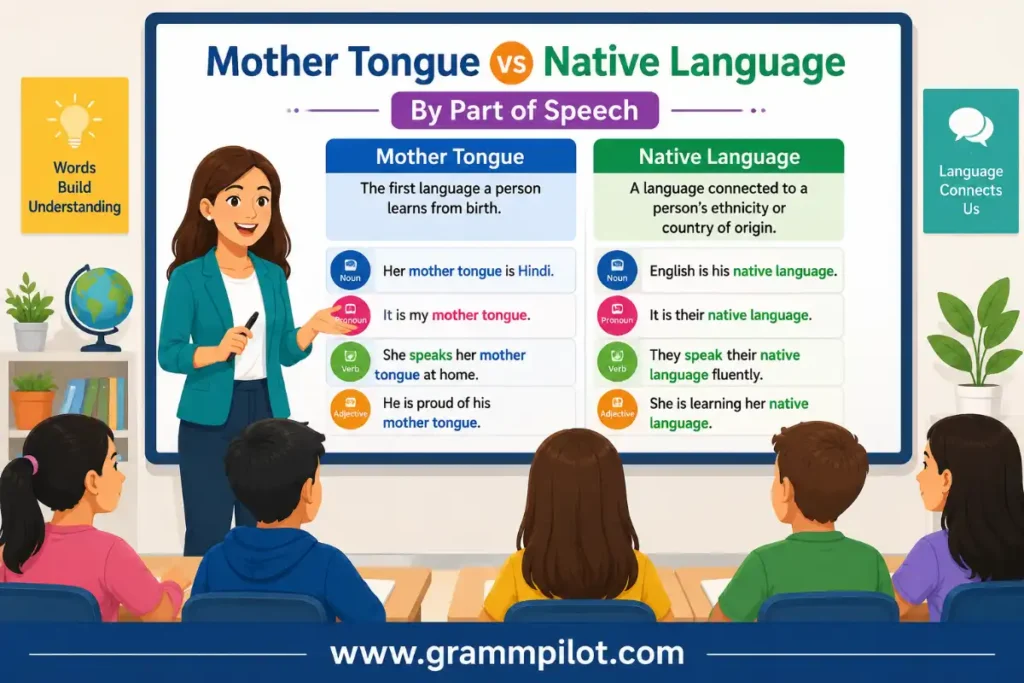
Mother Tongue vs Native Language by Part of Speech
Both expressions are noun phrases, but the individual words have different grammatical roles.
| Part of Speech | Examples |
|---|---|
| Noun | tongue, language, heritage, speech |
| Adjective | native, primary, dominant, indigenous |
| Verb | speak, learn, acquire, preserve |
| Adverb | naturally, fluently, traditionally |
Remember these simple grammar points.
- Mother tongue functions as a noun phrase.
- Native language also functions as a noun phrase.
- Both can serve as the subject or object of a sentence.
Which Expression Works Best in Different Situations?
The best choice depends on who you’re writing for and why you’re writing.
Mother Tongue vs Native Language on a Resume
Most resumes rarely mention either expression unless language skills are important.
Professional examples include:
- Native language: English
- Mother tongue: Hindi
- Fluent in English and Urdu; Arabic is my mother tongue.
When applying internationally, many employers understand both expressions.
Mother Tongue vs Native Language in Essays
Academic writing commonly uses both terms.
Examples: Many educators believe children learn concepts more easily in their mother tongue.
Researchers examined how students develop reading skills in their native language. Choosing one expression consistently throughout an essay improves readability.
Mother Tongue vs Native Language in Business Emails
Business communication usually favors clear, direct language.
Examples:
Please indicate your native language on the registration form.
Applicants may include their mother tongue if additional language skills are relevant. Our training materials are available in several native languages. Translation services support employees whose mother tongue is not English. Using the appropriate term depends on the organization’s preferred wording.
Mother Tongue vs Native Language in Text Messages
Casual conversations often use whichever expression feels more natural.
Examples: What’s your native language?
My mother tongue is Turkish.
Is English your first language?
She still speaks her mother tongue with her grandparents.
Friends usually understand either expression without confusion.
Mother Tongue vs Native Language in Everyday Conversation
People naturally switch between these expressions depending on what they want to emphasize.
Imagine someone asks: Where did you learn Spanish?
You might answer: Spanish is my mother tongue because everyone in my family speaks it.
Now imagine another question: Do you speak English fluently?
A natural reply could be: No, my native language is Japanese.
Although the meaning is similar, each response highlights a different aspect of language.
Mother Tongue vs Native Language Examples From Real-Life Situations
The following examples show how both expressions appear in everyday communication.
- My mother tongue is Bengali, but I also speak English fluently.
- French is her native language, so pronunciation comes naturally.
- Many children begin school using their mother tongue.
- The application asked for my native language.
- He enjoys reading novels in his mother tongue.
- Their native language is Korean, but they study in English.
- Teachers encouraged students to value their mother tongue.
- She translated the document into her native language.
- Grandparents often pass stories down in their mother tongue.
- His native language helped him learn similar languages more quickly.
- Schools sometimes offer classes in students’ mother tongue.
- The interviewer asked about my native language during the conversation.
- Music sounds especially meaningful in your mother tongue.
- Reading in your native language can improve comprehension.
- Families often preserve traditions through their mother tongue.
These examples cover education, travel, business, family life, and daily conversations while showing how naturally both expressions fit into different situations.
Is Mother Tongue vs Native Language a Common Language Question?
Yes. Students, travelers, teachers, job seekers, and language learners ask about Mother Tongue vs Native Language regularly because the expressions are so similar.
An easy way to remember the distinction is this:
- Choose mother tongue when emphasizing family background, cultural identity, or the language passed down through generations.
- Choose native language when emphasizing the language learned naturally during early childhood or discussing language ability and fluency.
Thinking about the purpose of your sentence—not just the words themselves—will help you select the most appropriate expression with confidence.
Mother Tongue vs Native Language Compared With Similar Expressions
Understanding Mother Tongue vs Native Language becomes much easier when you compare these expressions with other common language-related terms. Although they are closely connected, each one has a slightly different meaning and purpose.
Mother Tongue vs First Language
These expressions are often treated as synonyms, but they emphasize different ideas.
| Mother Tongue | First Language |
|---|---|
| Focuses on family, culture, and heritage. | Focuses on the language learned first in life. |
| Often connected with identity. | Mainly describes the order of language learning. |
Examples:
- Urdu is my mother tongue because my family speaks it at home.
- English was my first language, even though I later became fluent in Spanish.
The first expression highlights cultural roots, while the second focuses on when the language was learned.
Mother Tongue vs Home Language
These two phrases sound similar, yet they are not always identical.
| Mother Tongue | Home Language |
|---|---|
| Usually refers to the original family language. | Refers to the language currently spoken at home. |
Consider these examples:
- Punjabi is her mother tongue.
- English is the home language in her family today.
A family’s home language can change over time, but a person’s mother tongue usually does not.
Native Language vs Primary Language
People often confuse these expressions because both relate to everyday communication.
| Native Language | Primary Language |
|---|---|
| Language learned naturally during childhood. | Language used most often today. |
Examples:
- Arabic is his native language.
- English is now his primary language for work.
Someone’s primary language may change throughout life, while a native language usually remains the same.
Mother Tongue vs Heritage Language
These expressions overlap, but they are not always interchangeable.
| Mother Tongue | Heritage Language |
|---|---|
| First language learned naturally. | Language connected with family ancestry and cultural background. |
Examples:
- Bengali is my mother tongue.
- My grandparents taught me our heritage language, even though I grew up speaking English.
A heritage language may not always be the language someone speaks most fluently.
Native Language vs Second Language
This comparison is one of the easiest to understand.
| Native Language | Second Language |
|---|---|
| Learned naturally from birth or early childhood. | Learned after the first language. |
Examples:
- Japanese is her native language.
- English became her second language in school.
The order of learning is the biggest difference.
Mother Tongue vs Native Language in Everyday English
Most English speakers understand both expressions immediately.
You’ll often hear sentences like these:
- My mother tongue is Portuguese.
- Her native language is Italian.
- Children usually learn their mother tongue before starting school.
- He’s proud of his native language.
Although the wording changes, the listener generally understands the same basic idea.
Mother Tongue vs Native Language in School Writing
Students often use these expressions in essays about culture, language, and education.
Examples include:
- Many schools encourage children to maintain their mother tongue.
- Reading in your native language often improves comprehension.
- Researchers studied how children develop literacy in their mother tongue.
- Teachers recommended practicing vocabulary in the native language before learning additional languages.
Using one expression consistently throughout an essay creates a smoother reading experience.
Mother Tongue vs Native Language in Professional Writing
Workplace communication usually depends on the purpose of the document.
Here are a few examples:
- Applicants should list their native language on the employment form.
- The company offers training materials in several mother tongues.
- Customer support is available in your native language.
- Translation services help employees communicate in their mother tongue.
Choosing the expression that matches the audience makes professional writing more effective.
Mother Tongue vs Native Language in Education
Schools and universities frequently use both terms.
Consider these situations:
- Many educators encourage early reading in a child’s mother tongue.
- International students often receive support in their native language.
- Some bilingual programs begin with the student’s mother tongue before introducing additional languages.
- Teachers recognize that learning through a native language can improve understanding during the early years.
Educational settings often use both expressions depending on the discussion.
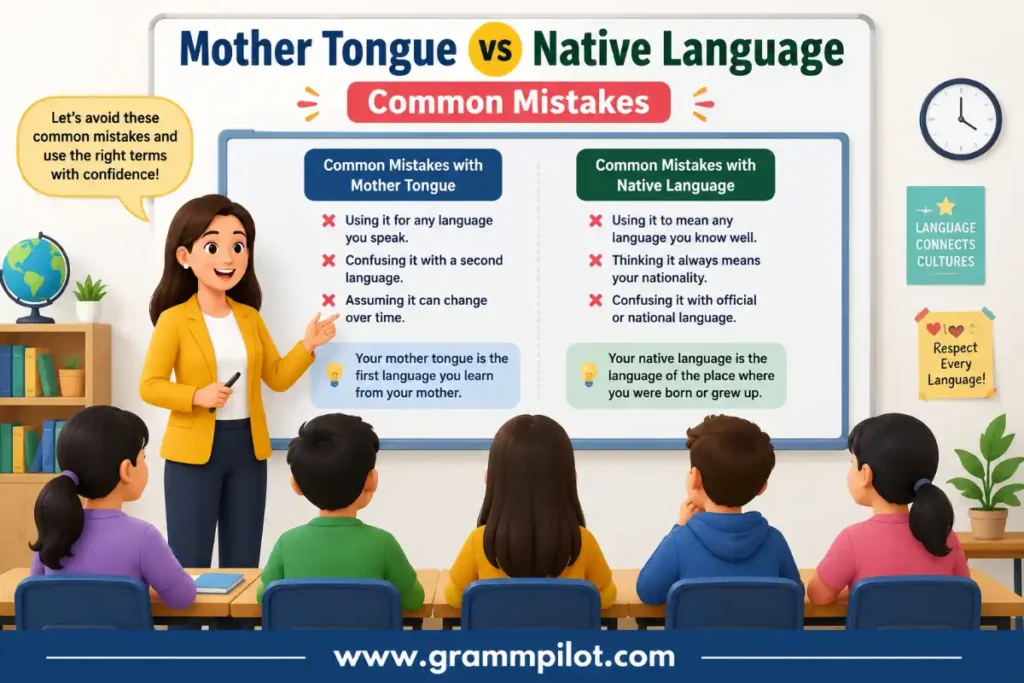
Common Mistakes With Mother Tongue vs Native Language
Even advanced English learners sometimes confuse these terms.
Mistake 1: Thinking They Always Mean Exactly the Same Thing
Many situations allow both expressions, but the emphasis can change.
For example:
- Mother tongue often highlights culture.
- Native language often highlights natural fluency.
Understanding the context helps you choose the better option.
Mistake 2: Using “Mother Tongue” Only for Mothers
Some learners think only mothers teach a child’s first language. Actually, mother tongue is a traditional expression that refers to the family’s first language, regardless of who taught it.
Mistake 3: Assuming a Native Language Can Never Change
Although your native language is usually the first language you learned, your strongest or most frequently used language may change over time. That’s why expressions like primary language and dominant language also exist.
Mistake 4: Confusing Native Language With National Language
These terms describe different ideas.
A native language belongs to an individual.
A national language belongs to a country or nation.
Mistake 5: Ignoring the Audience
Some organizations prefer one expression over the other. Before writing an application, report, or academic paper, check which term your audience commonly uses.
Quick Tips for Choosing Between Mother Tongue vs Native Language
These simple reminders can help you decide quickly.
- Think about the purpose of your sentence.
- Choose mother tongue when discussing family heritage.
- Use native language when talking about natural language ability.
- Stay consistent throughout longer pieces of writing.
- Read official forms carefully before answering.
- Match your wording to your audience.
- Remember that both expressions are accepted in standard English.
- Focus on meaning rather than memorizing complicated rules.
- Review your sentence before submitting important documents.
- Practice using both expressions in everyday writing.
These habits make the correct choice feel natural.
Mother Tongue vs Native Language Practice Sentences
Read each sentence first, then compare it with the explanation.
1. The school encourages children to study in their ________.
Best choice: mother tongue, because the sentence focuses on early education and family language.
2. Please enter your ________ on the application form.
A suitable answer is: native language, since official forms commonly use this expression.
3. My grandparents still tell stories in their ________.
Choose: mother tongue because the sentence emphasizes family tradition and cultural heritage.
4. She learned English after mastering her ________.
The correct expression is: native language, as the sentence discusses the first language learned.
5. Many communities work to preserve their ________.
A natural option is: mother tongue, because preservation is closely connected with culture.
6. The interviewer asked which ________ I spoke from childhood.
The better choice is: native language, since the discussion centers on early language acquisition.
7. Reading books in your ________ often improves understanding.
Use: mother tongue if you’re emphasizing childhood learning and cultural identity.
8. The translation was prepared in the client’s ________.
An appropriate answer is: native language, because the focus is on clear communication.
9. Young children usually become fluent in their ________ before school begins.
Select: native language, as the sentence describes natural language development.
10. Families often pass traditions to the next generation through their ________.
The strongest choice is: mother tongue, because the sentence highlights heritage and family connections.
Working through examples with varied explanations strengthens your understanding of both expressions while helping you choose the right one naturally in conversations, essays, business writing, and everyday English.
Common Situations Where People Use Mother Tongue vs Native Language Incorrectly
Even though Mother Tongue vs Native Language often refers to the same first language, writers sometimes choose the less suitable expression because they don’t consider the context. Looking at real situations makes the distinction much easier to understand.
While Completing School or College Forms
Educational forms frequently ask about language background.
Correct:
- Mother tongue: Hindi
- Native language: Hindi
Both answers are usually acceptable if Hindi was the first language you learned.
However, if the form specifically asks for one term, it’s best to answer using that wording instead of replacing it.
During Job Applications
Employers often ask about language skills.
Examples:
- My native language is English, and I speak Spanish fluently.
- My mother tongue is Bengali, and I also communicate in French.
Either expression works, but native language appears more often in international job applications.
In Academic Writing
Research papers often distinguish between language ability and cultural identity.
Examples:
- Researchers interviewed students in their native language.
- Schools that support instruction in a child’s mother tongue often improve early literacy.
Choosing the correct expression makes your writing more precise.
During Everyday Conversations
People rarely stop to think about the difference.
Examples:
- What’s your native language?
- My mother tongue is Tamil.
- She still speaks her mother tongue with her grandparents.
- English isn’t his native language, but he speaks it fluently.
In casual conversations, both expressions are widely understood.
Antonyms Related to Mother Tongue vs Native Language
Sometimes you need to describe the opposite idea.
Here are useful words and phrases.
| Word or Phrase | Meaning |
|---|---|
| Foreign language | A language learned from another country or culture |
| Second language | A language learned after the first one |
| Additional language | Any language learned later |
| Non-native language | A language that is not learned from birth |
| Acquired language | A language learned through study or experience |
| Target language | The language currently being studied |
| Learned language | A language gained through education |
| International language | A language used across different countries |
Related Opposites in Context
Depending on the sentence, these expressions may also work.
- Second language
- Foreign language
- Non-native speaker
- Language learner
- Additional language
- Imported language
- Academic language
- Working language
The best opposite depends on what you’re trying to describe.
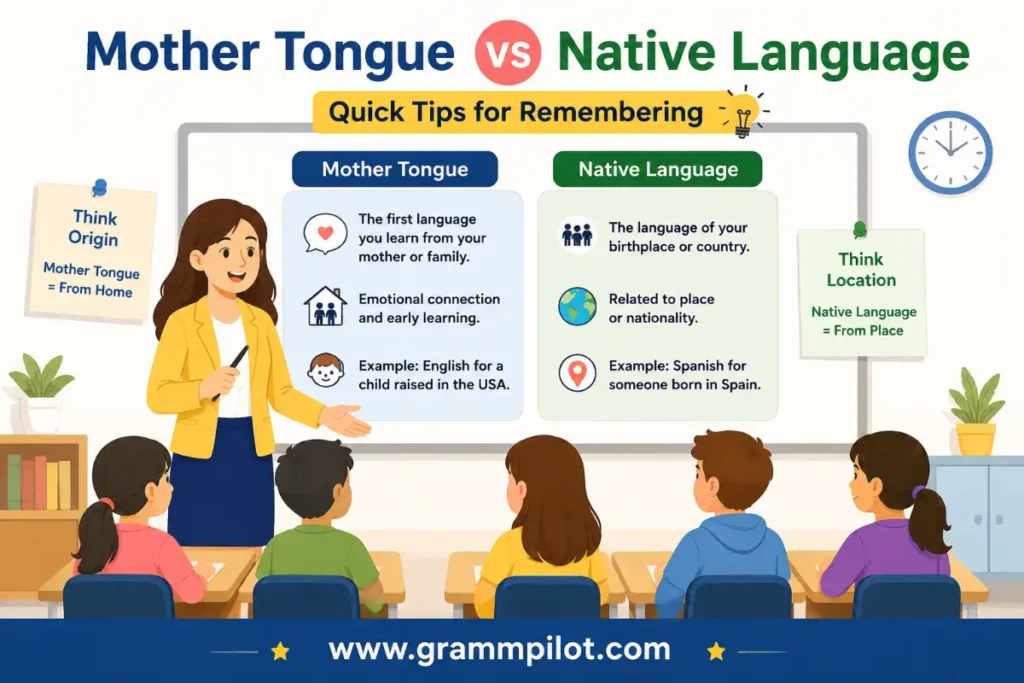
Quick Tips for Remembering Mother Tongue vs Native Language
You don’t need to memorize complicated definitions. Instead, remember these practical guidelines.
- Think about the purpose of your sentence first.
- Use mother tongue when discussing family heritage or cultural identity.
- Choose native language when emphasizing the language learned naturally during childhood.
- Remember that both expressions usually describe the first language someone learned.
- Match your wording to the audience and document.
- Stay consistent throughout essays and reports.
- Read official forms carefully before answering.
- Practice with real-life examples rather than isolated grammar rules.
- Focus on meaning instead of trying to memorize every exception.
These habits make choosing the correct expression much easier.
Final Teacher Explanation
Imagine a student asks:
“Should I say mother tongue or native language?”
The answer depends on what you want to emphasize.
If you’re talking about your family’s language, cultural traditions, or heritage, mother tongue is usually the stronger choice.
If you’re talking about the language you learned naturally as a child or your language ability, native language often fits better.
Now compare these examples.
- Urdu is my mother tongue.
- Urdu is my native language.
Both sentences are correct.
The first highlights family and cultural background.
The second emphasizes the language learned naturally during childhood.
Understanding that small difference makes Mother Tongue vs Native Language much easier to use correctly.
Conclusion
Understanding Mother Tongue vs Native Language helps you communicate more clearly in both personal and professional situations. While the two expressions often refer to the same first language, they emphasize slightly different ideas. Mother tongue usually highlights family, culture, and heritage, whereas native language focuses on the language learned naturally during early childhood. Recognizing that distinction allows you to choose the most appropriate wording for essays, job applications, official forms, and everyday conversations.
As you continue improving your English, pay attention to the purpose of each sentence rather than assuming the expressions are always identical. With regular practice and real-life examples, selecting between Mother Tongue vs Native Language will soon become natural, helping your writing sound more accurate, confident, and polished.
Frequently Asked Questions
1. What is the difference between Mother Tongue vs Native Language?
Mother tongue usually emphasizes family heritage and cultural identity, while native language focuses on the language learned naturally during early childhood. In many situations, they refer to the same language.
2. Are Mother Tongue vs Native Language the same?
Most of the time, yes. Both expressions usually describe a person’s first language, although the emphasis may differ depending on the context.
3. Which term is better for official forms?
Many international forms prefer native language, while schools and cultural organizations may use mother tongue. It’s generally best to use the wording already printed on the form.
4. Can someone have more than one native language?
Yes. A child who grows up learning two languages naturally from birth may be considered a native speaker of both languages.
5. What’s another way to say “mother tongue”?
Common alternatives include first language, native language, home language, primary language, heritage language, and family language, depending on the context.
6. Why do people confuse Mother Tongue vs Native Language?
The expressions often describe the same first language, and many dictionaries define them similarly. The main difference is the emphasis on cultural heritage versus natural language acquisition.
7. How can I remember Mother Tongue vs Native Language easily?
Use this simple memory trick:
- Mother tongue = family and culture
- Native language = first language learned naturally
Thinking about the purpose of the sentence will help you choose the right expression every time.