
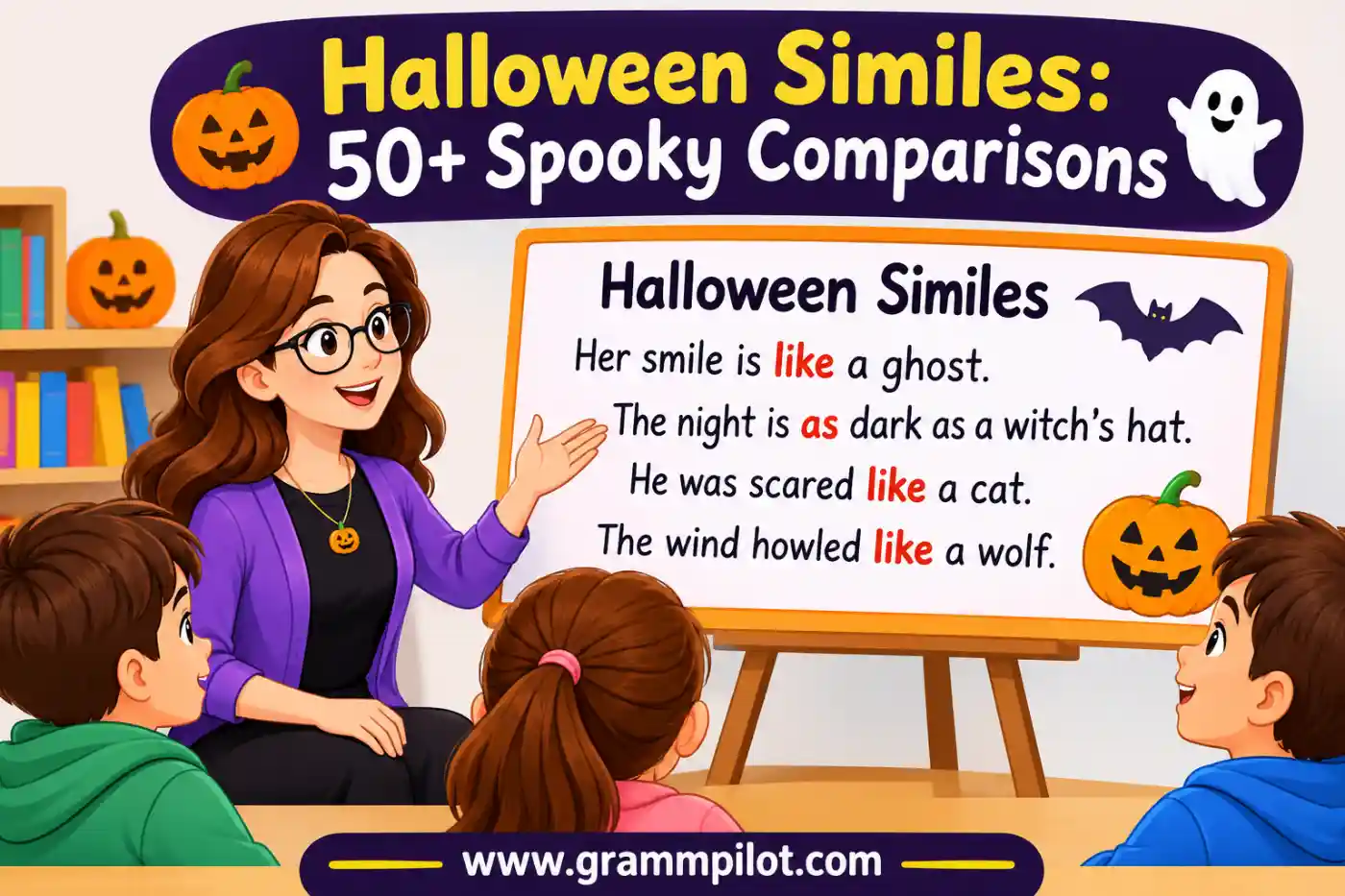
Imagine writing a Halloween story about a haunted house. You describe the hallway as dark, the wind as cold, and the ghost as scary. Your reader understands the scene, but the description may still feel ordinary. A few creative Halloween Similes can make those moments more exciting. A simile compares two different things using words such as like or as. It helps readers picture a scene, understand a feeling, or imagine a character more clearly. Halloween is accurate for similes because it gives writers so many things to describe: glowing pumpkins, creepy shadows, witches, bats, monsters, haunted houses, and mysterious sounds.
Quick Answer: Halloween similes are creative comparisons that describe spooky characters, frightening places, strange sounds, and autumn scenes using like or as. For example, “The ghost floated like a white cloud through the dark hallway.”
If you’re writing a school assignment, a scary story, a Halloween card, or a social media caption, the right comparison can make your words more memorable. This guide includes more than 50 original examples, grouped by theme, with meanings, writing tips, common mistakes, and examples you can use in your own work.You can also explore related examples in Mental Health Similes.
1. What Are Halloween Similes?
A Halloween simile is a comparison that connects a Halloween-related subject to something familiar. It uses like or as to help readers imagine what something looks, sounds, feels, or behaves like.
For example:
- The moon shone like a silver coin.
- The haunted house stood as silent as a graveyard.
- The witch’s laugh sounded like a rusty door.
- The black cat moved as quietly as a shadow.
Each sentence compares two different things. The moon is compared to a silver coin because both can appear bright and round. A witch’s laugh is compared to a rusty door because both can make an unpleasant sound. Similes don’t have to describe something frightening. They can also make Halloween feel funny, magical, mysterious, or exciting.
Why Do Writers Use Spooky Similes?
Writers use comparisons because they help readers experience a scene instead of simply reading a list of details. Consider these two sentences:
Plain: The wind was cold and the trees moved in the darkness.
With a simile: The cold wind howled like a hungry wolf while the trees danced like dark giants.
The second version creates a stronger picture. The wind seems more powerful, and the trees appear almost alive.
Good comparisons can help you:
- Make a scary story more interesting.
- Describe monsters and strange characters.
- Create a mysterious atmosphere.
- Show emotions such as fear, excitement, and surprise.
- Make poems and short descriptions more creative.
- Help readers imagine sounds, colors, and movements.
2. Where Do Halloween Similes Come From?
The word simile comes from the Latin word similis, which means “similar” or “like.” A simile shows how one thing resembles another. Halloween itself has a long history. Its traditions developed from older seasonal customs, including Samhain, a festival associated with the end of the harvest season and the beginning of winter in ancient Celtic communities. Over time, Halloween became connected with costumes, ghost stories, pumpkins, witches, skeletons, and other spooky images. These familiar symbols give writers plenty of material for comparisons.
For example:
- A pumpkin can be compared to a glowing lantern.
- A skeleton can be compared to a pile of dry branches.
- A ghost can be compared to a floating sheet.
- A witch’s broom can be compared to a flying bird.
- A haunted house can be compared to a sleeping monster.
The important point is that a simile doesn’t need to come from an old Halloween tradition. You can create a fresh comparison from ordinary things around you.
3. What Are the Best Halloween Similes for Different Themes?
The best comparisons depend on what you want readers to imagine. Some describe frightening scenes, while others create a playful or magical mood.
3.1 Spooky Halloween Similes
These comparisons work well in horror stories, haunted-house descriptions, and frightening poems.
- The abandoned house stood like a giant waiting for visitors.
Meaning: The house looks large, silent, and frightening. - The hallway was as dark as the bottom of a well.
Meaning: The hallway had almost no light. - The ghost floated like smoke through the broken window.
Meaning: The ghost moved lightly and mysteriously. - The old trees looked like crooked fingers reaching toward the sky.
Meaning: Their branches appeared twisted and strange. - The graveyard was as silent as an empty church.
Meaning: Nothing could be heard in the graveyard. - The shadows crept like spiders across the bedroom wall.
Meaning: The shadows moved slowly and seemed threatening. - The cold air wrapped around me like an icy blanket.
Meaning: The air felt extremely cold. - The strange figure stood like a statue beneath the streetlight.
Meaning: The figure remained completely still. - The wind screamed like a creature trapped in the forest.
Meaning: The wind made a loud, frightening noise. - The old gate groaned like a wounded animal.
Meaning: The gate made a painful, unpleasant sound.
3.2 Halloween Similes for Witches
Witches are classic Halloween characters. These comparisons can make them mysterious, funny, or frightening.
- The witch flew across the moon like a dark bird.
Meaning: She moved quickly through the night sky. - Her eyes glowed like two green flames.
Meaning: Her eyes looked bright and unusual. - The witch’s laugh was as sharp as broken glass.
Meaning: Her laugh sounded unpleasant and harsh. - Her black cloak moved like a storm cloud.
Meaning: The cloak moved dramatically in the wind. - The witch’s fingers were as thin as dry twigs.
Meaning: Her fingers looked narrow and bony. - Her broom raced through the sky like a shooting star.
Meaning: The broom moved quickly. - The bubbling potion looked like a tiny green volcano.
Meaning: The potion was boiling and bubbling. - The witch’s voice sounded like a creaking staircase.
Meaning: Her voice was rough and strange.
3.3 Halloween Similes for Ghosts
Ghosts can be described as pale, quiet, mysterious, or frightening.
- The ghost appeared like a cloud drifting through the room.
Meaning: It seemed to float without effort. - Her white dress was as pale as winter snow.
Meaning: The dress looked extremely white. - The ghost vanished like mist in the morning sun.
Meaning: It disappeared quickly and mysteriously. - His voice was as faint as a whisper in an empty room.
Meaning: His voice was barely audible. - The spirit moved like a feather in the wind.
Meaning: It moved gently and lightly. - The ghost’s face was as white as a blank sheet of paper.
Meaning: Its face looked completely pale. - The figure floated like a balloon above the stairs.
Meaning: It appeared to move through the air.
3.4 Halloween Similes for Monsters and Skeletons
Use these comparisons when describing creatures, scary costumes, or imaginary monsters.
- The monster’s teeth were as sharp as kitchen knives.
Meaning: Its teeth looked dangerous. - The creature’s hands were like branches from a dead tree.
Meaning: Its fingers looked long and twisted. - The skeleton rattled like a box of loose bones.
Meaning: Its bones made a repeated clicking sound. - The monster’s footsteps shook the floor like distant thunder.
Meaning: Its steps were extremely heavy. - His face was as frightening as a nightmare.
Meaning: His appearance caused fear. - The creature’s eyes burned like two red candles.
Meaning: Its eyes appeared bright and threatening. - The zombie walked as slowly as a broken clock.
Meaning: It moved very slowly. - The monster’s roar sounded like an exploding storm.
Meaning: Its roar was extremely loud.
3.5 Halloween Similes for Pumpkins and Decorations
Halloween isn’t only about fear. Colorful decorations, carved pumpkins, and glowing lights create a cheerful atmosphere.
- The pumpkin glowed like a golden lantern.
Meaning: Its light was warm and bright. - The carved smile was as wide as a crescent moon.
Meaning: The pumpkin had a very large smile. - The orange leaves covered the ground like a golden carpet.
Meaning: The leaves spread across the ground. - The Halloween lights sparkled like tiny stars.
Meaning: The decorations looked bright and beautiful. - The pumpkin patch looked like an orange sea.
Meaning: Many pumpkins covered the field. - The candle flickered like a tiny dancing flame.
Meaning: The flame moved gently. - The spiderweb stretched like a silver net between the branches.
Meaning: The web looked thin and shiny.
3.6 Funny Halloween Similes
Not every Halloween description needs to be terrifying. Funny comparisons are great for children’s stories, classroom activities, and playful captions.
- The zombie walked like a sleepy penguin.
Meaning: The zombie moved awkwardly. - The vampire’s hair stood up like a frightened hedgehog.
Meaning: His hair looked messy and spiky. - The witch’s hat was as crooked as a leaning tower.
Meaning: Her hat was tilted to one side. - The pumpkin rolled like a runaway basketball.
Meaning: It moved quickly across the ground. - The little monster screamed like a baby who missed a nap.
Meaning: The monster made a loud, funny noise. - The skeleton danced like a wind-up toy.
Meaning: It moved in a stiff, mechanical way. - The vampire looked as hungry as a child near a candy bowl.
Meaning: The vampire seemed extremely eager to eat. - The ghost chased the children like a puppy chasing a ball.
Meaning: The ghost followed them playfully.
3.7 Halloween Similes for Fear and Emotions
These comparisons describe how people feel during a frightening Halloween moment.
- My heart beat like a drum during the ghost tour.
Meaning: My heart was beating very fast. - My hands were as cold as ice when the door opened.
Meaning: My hands felt extremely cold. - I shook like a leaf when I heard the footsteps.
Meaning: I was very frightened. - Her scream was as loud as a fire alarm.
Meaning: She screamed very loudly. - I froze like a statue when the monster appeared.
Meaning: I couldn’t move because I was scared. - The children ran like frightened rabbits.
Meaning: They ran away quickly because they were afraid. - My stomach twisted like a rope when I entered the haunted house.
Meaning: I felt nervous and uncomfortable.
4. Which Halloween Similes Are Best for Different Levels of Intensity?
Not every Halloween scene should feel equally scary. A children’s poem may need a gentle comparison, while a horror story may need a darker one.
Mild and Playful Comparisons
Use these when describing decorations, costumes, or a friendly Halloween party.
- The pumpkin shone like a little sun.
- The orange leaves danced like tiny butterflies.
- The ghost floated like a white balloon.
- The candy sparkled like colorful jewels.
- The witch’s hat tilted like a sleepy bird.
These comparisons create a cheerful mood without making the scene frightening.
Moderately Spooky Comparisons
Use these when you want to create mystery or suspense.
- The old door creaked like a rusty wheel.
- The shadows stretched like long black fingers.
- The wind whispered like a secret visitor.
- The empty house stood like a forgotten castle.
- The moon watched like a silent eye.
These descriptions make readers curious about what might happen next.
Strong and Terrifying Comparisons
Use these in horror stories or scenes that need a powerful emotional effect.
- The monster’s roar shook the room like an earthquake.
- The darkness swallowed the path like a giant mouth.
- The footsteps followed me like a hunter tracking its prey.
- The scream ripped through the night like a siren.
- The creature’s eyes burned like red-hot coals.
Strong comparisons should be used carefully. If every sentence is extremely frightening, readers may become tired of the same level of intensity.

5. What Types of Words Can You Use in Halloween Similes?
A simile can describe different parts of a scene. You can use nouns, adjectives, and verbs to build a comparison.
Noun-Based Comparisons
Nouns name the objects being compared.
Examples:
- The moon was like a silver plate.
- The haunted house was like a giant tomb.
- The pumpkin was like a glowing lantern.
- The skeleton was like a pile of dry sticks.
Adjective-Based Comparisons
Adjectives describe qualities such as color, size, sound, and feeling.
Examples:
- The night was as black as coal.
- The ghost was as pale as snow.
- The monster was as ugly as a nightmare.
- The wind was as cold as ice.
Verb-Based Comparisons
Verbs show actions. They help describe how something moves or behaves.
Examples:
- The bats flew like dark ribbons across the sky.
- The leaves danced like tiny dancers.
- The ghost drifted like smoke.
- The shadows crawled like insects.
Sound-Based Comparisons
These similes help readers imagine noises.
Examples:
- The door creaked like an old wooden ship.
- The thunder boomed like a giant drum.
- The chains rattled like metal coins in a box.
- The witch cackled like a noisy crow.
6. How Can You Use Halloween Similes in Different Types of Writing?
The best comparison depends on your audience and purpose. A school essay, a scary story, and a social media caption may need different styles.
For a School Essay
Choose clear comparisons that are easy to understand and explain.
Example: The Halloween night was as dark as a deep cave, and the bright pumpkins looked like little lanterns along the path.
Why it works: It creates a clear picture without using complicated language.
For a Halloween Story
Use comparisons that build suspense and help readers imagine the setting.
Example: The door opened slowly like the mouth of a sleeping monster. A cold wind slipped into the room, and the shadows stretched across the floor like long fingers.
Why it works: The comparisons create a mysterious atmosphere and encourage readers to keep reading.
For a Halloween Poem
Choose comparisons with rhythm, strong images, or interesting sounds.
Example: The moon was a silver coin, the stars were candles bright, and ghosts drifted like white feathers through the quiet night.
Why it works: The images create a playful rhythm and a magical mood.
For a Text Message or Social Media Caption
Keep the comparison short, catchy, and easy to understand.
Examples:
- “My costume is as scary as a midnight nightmare!”
- “The pumpkin glows like a little sun.”
- “Our party was as wild as a monster’s dance.”
- “The decorations look like a haunted dream.”
Why it works: Short comparisons are easy to read and share.
For an Email or Invitation
Use friendly and cheerful comparisons rather than frightening language.
Example: Join us for a Halloween night filled with glowing pumpkins, colorful costumes, and treats as sweet as candy clouds.
Why it works: The language makes the invitation sound welcoming.
For Speaking and Classroom Activities
Choose comparisons that children can understand and remember.
Examples:
- The ghost is as white as snow.
- The pumpkin is as round as a ball.
- The witch flies like a bird.
- The monster roars like thunder.
Why it works: Familiar objects help students understand how similes work.
7. What Are Some Halloween Similes in Complete Sentences?
Here are 12 more original sentences showing how comparisons can fit into longer descriptions.
- The children walked toward the haunted house as quietly as mice because they didn’t want to wake the strange creature inside.
- A pale moon hung in the sky like a glowing button on a dark coat.
- The wind rushed through the trees like a crowd of invisible runners.
- The old staircase groaned like a tired man whenever someone stepped on it.
- The vampire’s cape spread behind him like the wings of a giant bat.
- The candles flickered like tiny stars trapped inside the windows.
- The little girl held her mother’s hand as tightly as a kitten holding onto a blanket.
- The fog covered the graveyard like a thick white curtain.
- The black cat slipped across the garden like a shadow with shining eyes.
- The children laughed like a group of playful goblins as they collected candy.
- The thunder crashed like a giant banging on the roof.
- The haunted house looked as lonely as an abandoned ship in the middle of the ocean.
Notice how each comparison adds a detail. Some show movement, others describe sound, and several create an emotional reaction.
8. Halloween Similes vs. Metaphors: What’s the Difference?
Similes and metaphors both compare things, but they do it in different ways.
| Simile | Metaphor |
|---|---|
| Uses like or as | Makes a direct comparison |
| The ghost floated like smoke. | The ghost was smoke. |
| The moon was like a silver coin. | The moon was a silver coin. |
| The monster roared like thunder. | The monster was thunder. |
A simile clearly signals a comparison. A metaphor describes one thing as if it were another.
Simile Examples
- The witch’s hair was as black as coal.
- The pumpkin glowed like a lantern.
- The wind howled like a wolf.
Metaphor Examples
- The witch’s hair was a dark waterfall.
- The pumpkin was a golden lantern.
- The wind was a hungry wolf.
Both techniques can make writing more creative. Choose a simile when you want to show a clear resemblance. Choose a metaphor when you want a stronger, more direct image.

9. What Are the Common Mistakes When Writing Halloween Similes?
A creative comparison should make a sentence clearer, not confusing. Avoid these common mistakes.
Mistake 1: Forgetting Like or As
Incorrect: The ghost floated a cloud.
Correct: The ghost floated like a cloud.
Why? A simile usually uses like or as to show the comparison.
Mistake 2: Writing a Comparison That Makes No Sense
Weak: The pumpkin was like a telephone.
Better: The pumpkin glowed like a golden lantern.
Why? A good comparison should connect two things through a clear shared quality.
Mistake 3: Confusing a Simile With a Metaphor
Simile: The monster was as tall as a tree.
Metaphor: The monster was a tree.
Why? The first sentence uses as to compare height. The second makes a direct comparison.
Mistake 4: Using Too Many Comparisons in One Sentence
Weak: The ghost was like smoke, like snow, like a cloud, and like a balloon.
Better: The ghost floated through the hallway like a cloud of pale smoke.
Why? Too many comparisons can make writing difficult to follow. Choose the strongest one.
Mistake 5: Repeating the Same Words
If every sentence uses as dark as night or as cold as ice, your writing may sound repetitive.
Try different images:
- Dark as a deep cave.
- Cold like a winter storm.
- Silent as an empty street.
- Bright like a golden lantern.
Mistake 6: Using Scary Comparisons in Every Situation
A funny Halloween invitation doesn’t need descriptions of monsters, blood, or nightmares.
Choose a comparison that matches the mood. A children’s party needs cheerful images, while a horror story can use darker ones.
10. What Are the Opposites of Spooky and Scary?
Although similes don’t have direct antonyms, you can use opposite descriptive words to create a different mood.
| Spooky or Scary Word | Opposite or Alternative | Example |
|---|---|---|
| Frightening | Comforting | The friendly ghost looked as comforting as a warm blanket. |
| Dark | Bright | The pumpkin shone like a bright star. |
| Creepy | Cheerful | The decorations looked as cheerful as a birthday party. |
| Silent | Noisy | The children were as noisy as a flock of birds. |
| Cold | Warm | The room felt as warm as a sunny afternoon. |
| Terrifying | Funny | The monster looked as funny as a dancing clown. |
| Lonely | Welcoming | The house looked as welcoming as a family home. |
Using contrasting images can make your writing more interesting. A bright pumpkin in a dark forest, for example, creates a stronger visual effect than a description that uses only dark details.
11. How Can You Create Your Own Halloween Similes?
You don’t need to copy every comparison from a list. You can create original ones by looking at familiar Halloween objects and thinking about what they resemble.
Follow these simple steps.
Step 1: Choose Something to Describe
Start with a Halloween subject.
Examples:
- A pumpkin
- A ghost
- A witch
- A monster
- A black cat
- A haunted house
- A dark forest
Step 2: Think About Its Main Quality
Ask yourself what makes the subject special.
For example, a ghost may be:
- Pale
- Quiet
- Floating
- Mysterious
- Difficult to see
A pumpkin may be:
- Orange
- Round
- Bright
- Heavy
- Glowing
Step 3: Find Something Familiar With the Same Quality
Think about ordinary objects, animals, weather, or natural scenes.
- Pale like snow.
- Round like a ball.
- Bright like a candle.
- Quiet like falling snow.
- Heavy like a stone.
Step 4: Add Like or As
Now connect the two ideas.
- The ghost was as pale as snow.
- The pumpkin was as round as a ball.
- The candle shone like a tiny star.
Step 5: Check If the Comparison Makes Sense
Read your sentence aloud. Ask:
- Is the comparison easy to understand?
- Do both things share a clear quality?
- Does it match the mood?
- Does it help the reader imagine something?
If the answer is yes, your simile is probably working well.
A Simple Practice Activity
Try completing these sentences with your own comparisons:
- The witch flew through the sky like ______.
- The haunted house was as dark as ______.
- The pumpkin glowed like ______.
- The monster’s voice sounded like ______.
- The ghost moved as quietly as ______.
Possible answers:
- A black bird.
- A deep cave.
- A golden lantern.
- A crashing storm.
- Falling snow.
You can create many different answers. The goal is to make a clear and interesting comparison, not to find only one correct sentence.

Conclusion: How Can You Make Halloween Descriptions More Creative?
Strong descriptions help readers imagine a Halloween scene, if it’s a friendly pumpkin patch, a mysterious forest, or a frightening haunted house. Halloween Similes make this easier by connecting familiar images with spooky characters, strange sounds, and powerful emotions. A ghost can float like smoke, a pumpkin can glow like a lantern, and a monster can roar like thunder. The best comparisons are clear, original, and suited to the mood of your writing. Don’t add a simile just to make a sentence longer. Choose one that helps readers see or feel something more clearly. With a little practice, you can turn simple Halloween sentences into memorable descriptions.
Frequently Asked Questions
1. What are Halloween similes?
Halloween similes are comparisons that use like or as to describe spooky characters, decorations, sounds, and scenes. For example, “The ghost floated like smoke.”
2. What are 5 examples of Halloween similes?
Here are five examples:
- The moon was like a silver coin.
- The ghost was as white as snow.
- The wind howled like a wolf.
- The pumpkin glowed like a lantern.
- The skeleton rattled like a box of bones.
3. How do you write a spooky simile?
Choose something frightening, identify one of its qualities, and compare it to something familiar using like or as. For example, “The shadows crawled like spiders across the wall.”
4. What’s another way to make a Halloween description more interesting?
Use sensory details, strong verbs, and comparisons that help readers imagine what they see, hear, or feel. For example, describe a door as groaning like an old wooden ship.
5. What is the difference between a Halloween simile and a metaphor?
A simile compares two things using like or as, while a metaphor makes a direct comparison. “The ghost floated like smoke” is a simile; “The ghost was smoke” is a metaphor.
6. Can Halloween similes be funny instead of scary?
Yes. Funny comparisons work well in children’s stories, party invitations, and playful captions. For example, “The zombie walked like a sleepy penguin.”
7. Why are Halloween similes useful in creative writing?
They make descriptions more vivid and help readers imagine characters, settings, sounds, and emotions. They also make stories and poems more memorable.
Meta Description: Halloween Similes: Explore 50+ spooky, funny, and creative comparisons with meanings and examples for stories, poems, and school writing.