

Have you ever tried to explain how stress feels but couldn’t find the right words? Maybe you wanted to describe the weight of sadness in an essay, explain anxiety in a story, or help someone understand what emotional exhaustion feels like. Sometimes, a simple comparison can express a feeling better than a long explanation. Mental Health Similes help readers understand emotions and inner struggles by comparing them with familiar things. For example, “Anxiety felt like a storm trapped inside my chest” gives a clearer picture than simply saying, “I felt anxious.” A simile uses words such as like or as to connect two different things. It can make difficult feelings easier to picture, discuss, and understand. However, mental health experiences are personal, so comparisons should be thoughtful and respectful. They should describe feelings without making fun of people who experience them.
Quick Answer: Mental health similes compare emotions and psychological experiences with familiar things, such as storms, heavy bags, fog, or waves. They help describe feelings like anxiety, sadness, stress, loneliness, hope, and emotional healing in a clear and memorable way. In this guide, you’ll find more than 30 original comparisons, explanations of what they mean, useful descriptive words, examples for different writing situations, and tips for creating your own similes. Another useful figurative-language technique is explained as Ocean Similes.
.
1. What Are Mental Health Similes?
A mental health simile is a figure of speech that compares an emotional or psychological experience with something familiar. It helps readers imagine a feeling that may be difficult to explain directly.
For example:
- Anxiety is like a storm that refuses to pass.
- Depression can feel like walking through thick fog.
- Hope is like a small light in a dark room.
- Stress can feel like carrying a backpack filled with stones.
These comparisons connect an invisible experience with something readers can picture. Mental health includes emotional, psychological, and social well-being.
This affects how people think, feel, handle challenges, and connect with others.
It isn’t simply about being happy or sad. It can involve many different experiences, including confidence, fear, stress, loneliness, recovery, and emotional balance.
Why Do Writers Use Mental Health Similes?
Writers use comparisons because emotions aren’t always easy to describe. A person might know they’re worried but struggle to explain how that worry affects them. A simile can make the feeling more understandable.
For example:
- Plain description: I felt overwhelmed by my responsibilities.
- With a simile: My responsibilities felt like a mountain standing in front of me.
The second sentence gives readers a picture of how difficult the situation feels.
Similes can help with:
- Creative writing: Making characters’ emotions feel real.
- Personal essays: Explaining difficult experiences.
- Poetry: Expressing feelings with fewer words.
- Classroom discussions: Helping students understand emotional language.
- Everyday communication: Finding words for complicated feelings.
A simile doesn’t explain every part of a person’s experience. It simply offers one way to describe a feeling.
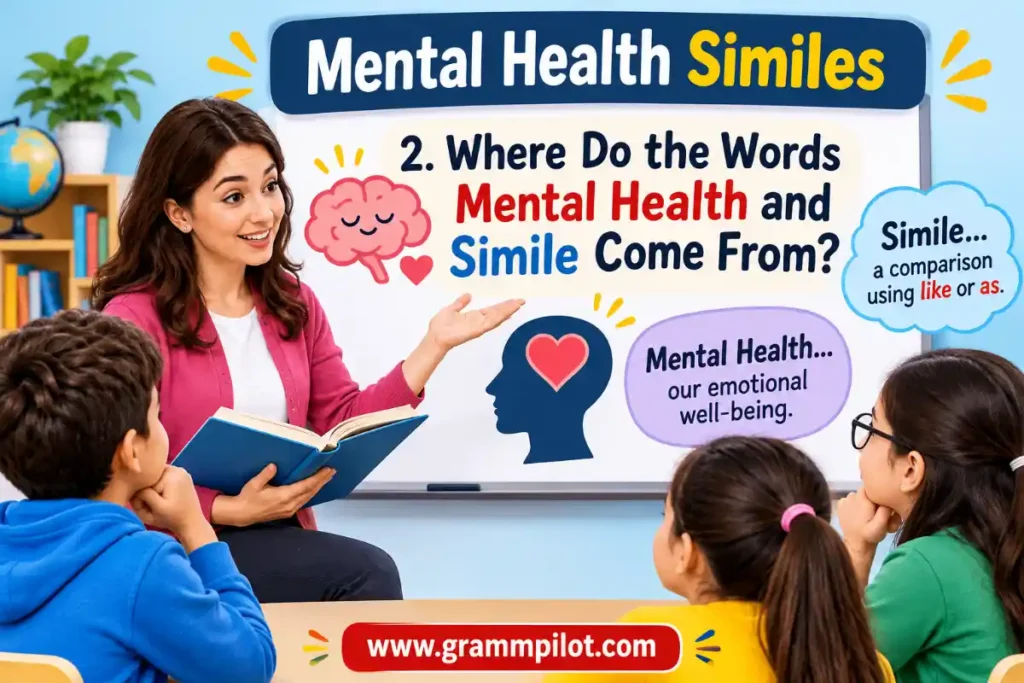
2. Where Do the Words Mental Health and Simile Come From?
Understanding the words helps explain how the expression works.
What Is the Origin of Mental Health?
The word mental comes from Latin mens, meaning mind or thought. The word health has Old English roots and is connected with being whole or sound. Together, mental health refers to a person’s emotional, psychological, and social well-being. It includes more than the absence of a mental health condition. It also involves how people manage everyday pressures, build relationships, make decisions, and find meaning in life.
What Is the Origin of Simile?
The word simile comes from the Latin word similis, meaning similar or like.
A simile compares two different things using words such as:
- Like
- As
- Similar to
For example: “Her thoughts moved like clouds across the sky.”
This sentence compares thoughts with moving clouds. It doesn’t mean thoughts are actual clouds. The comparison helps readers imagine how quickly or gently they change.
3. What Are the Best Similes for Mental Health?
The following comparisons cover different emotional experiences. Each one includes a simple meaning and an example sentence so you can understand when to use it.
Similes for Anxiety and Worry
Anxiety can involve fear, nervousness, racing thoughts, or a sense of uncertainty. These comparisons describe some of those feelings without suggesting that everyone experiences anxiety in the same way.
- Anxiety is like a storm trapped inside a small room.
Meaning: Worry feels intense, with no easy way to escape it.
Example: Before the interview, my anxiety felt like a storm trapped inside a small room. - Worry is like a clock that never stops ticking.
Meaning: Thoughts keep returning even when you want to relax.
Example: Her worry was like a clock that never stopped ticking. - Fear is like a shadow following every step.
Meaning: A sense of danger seems to stay close.
Example: After the accident, fear followed him like a shadow. - An anxious mind is like a radio playing too many stations.
Meaning: Several thoughts compete for attention at once.
Example: My mind felt like a radio playing too many stations before the exam. - Nervousness is like standing at the edge of a diving board.
Meaning: You feel uncertain just before taking an important step.
Example: Giving my first speech felt like standing at the edge of a diving board. - Uncertainty is like walking through a forest without a map.
Meaning: You don’t know what will happen or which direction to take.
Example: Waiting for the final decision felt like walking through a forest without a map.
Similes for Sadness and Depression
Sadness can feel heavy, quiet, or difficult to explain. Depression is a mental health condition and can involve more than sadness. These comparisons describe possible feelings, not a definition or diagnosis.
- Sadness is like rain that lasts all afternoon.
Meaning: A low mood seems to stay for a long time.
Example: After saying goodbye, sadness followed me like rain that lasted all afternoon. - A heavy heart is like a suitcase filled with stones.
Meaning: Emotional pain feels difficult to carry.
Example: She walked into the room with a heart like a suitcase filled with stones. - A difficult day can feel like walking through thick fog.
Meaning: Everything seems unclear and hard to manage.
Example: After the upsetting news, the rest of the day felt like walking through thick fog. - Loneliness is like sitting in a crowded room behind glass.
Meaning: You are around people but still feel disconnected.
Example: Even at the party, his loneliness felt like sitting behind glass. - Emotional pain is like a bruise that no one can see.
Meaning: Someone may be hurting even when there are no visible signs.
Example: Her disappointment was like a bruise that no one could see. - Exhaustion is like a phone battery stuck at one percent.
Meaning: You feel as if you have almost no energy left.
Example: By Friday evening, I felt like a phone battery stuck at one percent.
Similes for Stress and Overwhelm
Stress can build when responsibilities, deadlines, or difficult events become hard to manage.
- Stress is like carrying a backpack full of bricks.
Meaning: Every responsibility adds more weight.
Example: Managing work and school felt like carrying a backpack full of bricks. - An overwhelming day is like a wave rising over your head.
Meaning: Problems seem bigger than your ability to handle them at that moment.
Example: The unexpected deadlines came like a wave rising over my head. - Pressure is like a balloon being filled with too much air.
Meaning: Tension keeps building until it feels difficult to contain.
Example: The pressure before the final match was like a balloon filled too tightly. - A busy mind is like a computer with too many tabs open.
Meaning: Too many thoughts and tasks compete for attention.
Example: My mind was like a computer with too many tabs open during the project. - Burnout can feel like a candle running out of wax.
Meaning: You may feel drained after giving too much energy for too long.
Example: After months without a proper break, she felt like a candle running out of wax. - Tension is like a tightly stretched rubber band.
Meaning: You feel under constant pressure.
Example: The disagreement left everyone feeling like a tightly stretched rubber band.
Similes for Hope and Emotional Strength
Hope and resilience can be described through images of light, growth, and movement. These comparisons can express encouragement without suggesting that difficult feelings disappear instantly.
- Hope is like a candle glowing in a dark room.
Meaning: Even a small positive thought can offer comfort.
Example: Her friend’s message was like a candle glowing in a dark room. - Courage is like a tree standing through strong winds.
Meaning: You keep going even when life becomes difficult.
Example: His courage was like a tree standing through strong winds. - Resilience is like a river finding its way around rocks.
Meaning: You adapt when obstacles appear.
Example: Her resilience was like a river finding its way around rocks. - A fresh start is like opening a window after a long night.
Meaning: A new opportunity can bring a sense of possibility.
Example: Returning to school felt like opening a window after a long night. - Confidence is like learning to ride a bicycle.
Meaning: It can grow through practice and experience.
Example: Speaking in class became easier as my confidence grew, like learning to ride a bicycle. - Healing is like a garden growing after winter.
Meaning: Improvement can happen slowly, with patience and care.
Example: Her emotional healing was like a garden growing after winter.
Similes for Calmness and Inner Peace
These comparisons describe quiet moments, emotional balance, and the comfort that can come from feeling safe.
- A calm mind is like a lake without ripples.
Meaning: Thoughts feel settled and quiet.
Example: After the meditation session, my mind felt like a lake without ripples. - Peace is like sitting beneath a tree on a cool afternoon.
Meaning: You feel relaxed and comfortable.
Example: Spending time with my family felt like sitting beneath a tree on a cool afternoon. - A peaceful moment is like a soft breeze after a hot day.
Meaning: Relief arrives after a stressful period.
Example: Her kind words were like a soft breeze after a hot day. - Emotional balance is like a boat moving steadily across calm water.
Meaning: You can handle changing feelings without feeling completely overwhelmed.
Example: With practice, he learned to manage difficult emotions like a boat moving steadily across calm water.
Similes for Confusion and Racing Thoughts
Sometimes the hardest part of an emotional experience is understanding what you’re thinking or feeling.
- Confusion is like a puzzle with missing pieces.
Meaning: You don’t have enough information to understand a situation.
Example: My feelings after the argument were like a puzzle with missing pieces. - Overthinking is like walking in circles around the same building.
Meaning: You keep thinking about the same issue without reaching a solution.
Example: I was overthinking the conversation like someone walking in circles around the same building. - A restless mind is like a bird that won’t settle on a branch.
Meaning: Thoughts keep moving from one concern to another.
Example: His mind felt like a bird that wouldn’t settle on a branch. - Doubt is like a cloudy window.
Meaning: You struggle to see a situation clearly.
Example: Her doubts were like a cloudy window hiding the way forward. - A sudden thought is like a stone dropped into still water.
Meaning: One idea can disturb an otherwise quiet mind.
Example: The unexpected question was like a stone dropped into still water.
4. What Words Can You Use to Describe Mental Health?
Similes become more effective when you choose words that match the feeling. Here are 28 useful descriptive words and expressions grouped by tone.
Simple Words
| Word | Meaning | Tone | Example |
|---|---|---|---|
| Calm | Free from strong disturbance | Simple | She felt calm after the conversation. |
| Sad | Feeling unhappy | Simple | He felt sad after the farewell. |
| Worried | Concerned about something | Simple | I was worried about the result. |
| Tired | Having little energy | Simple | She felt tired after a stressful week. |
| Happy | Feeling pleasure | Simple | The good news made him happy. |
| Afraid | Feeling fear | Simple | The child was afraid of the dark. |
| Hopeful | Expecting something good | Simple | She felt hopeful about tomorrow. |
Everyday Words
| Word | Meaning | Tone | Example |
|---|---|---|---|
| Anxious | Feeling nervous or uneasy | Everyday | He felt anxious before the interview. |
| Overwhelmed | Feeling unable to manage everything | Everyday | I felt overwhelmed by the workload. |
| Lonely | Feeling disconnected from others | Everyday | She felt lonely after moving away. |
| Relaxed | Free from tension | Everyday | He felt relaxed after his walk. |
| Frustrated | Upset because something is difficult | Everyday | I felt frustrated by the delay. |
| Confident | Trusting your own ability | Everyday | She felt confident during the presentation. |
| Resilient | Able to recover or adapt | Everyday | The team remained resilient after the setback. |
Formal Words
| Word | Meaning | Tone | Example |
|---|---|---|---|
| Distressed | Experiencing serious emotional discomfort | Formal | The sudden change left him distressed. |
| Contentment | A feeling of satisfaction | Formal | She found contentment in a quiet routine. |
| Serenity | A deep sense of calm | Formal | The peaceful setting brought serenity. |
| Equanimity | Calmness during difficulty | Formal | He responded with equanimity. |
| Vulnerable | Emotionally or physically exposed to harm | Formal | The character felt vulnerable after the loss. |
| Apprehensive | Worried about something that may happen | Formal | She was apprehensive about the move. |
| Optimistic | Expecting a positive outcome | Formal | He remained optimistic about recovery. |
Informal and Conversational Words
| Word or Phrase | Meaning | Tone | Example |
|---|---|---|---|
| Stressed out | Feeling under pressure | Casual | I’m stressed out about the deadline. |
| Down | Feeling unhappy | Casual | He’s been feeling down lately. |
| On edge | Nervous or tense | Casual | She was on edge before the meeting. |
| Burned out | Emotionally or mentally exhausted | Casual | I felt burned out after months of overtime. |
| In a good place | Feeling emotionally settled | Casual | She’s in a good place right now. |
| Worn out | Very tired | Casual | He felt worn out after the long week. |
| At ease | Comfortable and relaxed | Casual | I felt at ease with my friends. |

5. How Do Mental Health Descriptions Change From Mild to Strong?
The strength of a word matters. Saying someone feels a little worried is different from saying they’re terrified or deeply distressed.
Use these levels to choose language that fits the situation.
Mild Emotional Experiences
These words describe feelings that may be noticeable but aren’t necessarily intense.
- Uneasy
- Nervous
- Concerned
- Tired
- Uncertain
- Slightly stressed
Example: I felt a little uneasy before speaking in front of the class.
Moderate Emotional Experiences
These words suggest stronger feelings that may affect someone’s focus or daily routine.
- Anxious
- Frustrated
- Overwhelmed
- Discouraged
- Restless
- Emotionally drained
Example: She felt overwhelmed when several responsibilities arrived at once.
Strong Emotional Experiences
These words describe intense feelings. Use them carefully and only when they accurately reflect the situation.
- Deeply distressed
- Terrified
- Devastated
- Emotionally exhausted
- Extremely anxious
- Overcome with grief
Example: He was devastated by the sudden loss of someone he loved.
Remember: Strong descriptive words shouldn’t be used just to make writing dramatic. Choose language that respects the experience you’re describing.
6. Which Parts of Speech Help You Describe Mental Health?
Different parts of speech help you build clear and varied sentences.
Nouns That Describe Feelings
Nouns name emotions, experiences, or states.
Examples:
- Anxiety
- Sadness
- Hope
- Fear
- Stress
- Confidence
- Loneliness
- Resilience
- Relief
- Happiness
Sentence: Her anxiety felt like a storm approaching from the distance.
Adjectives That Describe Emotional States
Adjectives explain how a person feels or what an experience is like.
Examples:
- Anxious
- Calm
- Sad
- Hopeful
- Restless
- Confident
- Overwhelmed
- Peaceful
- Vulnerable
- Frustrated
Sentence: His restless mind was like a train that never stopped.
Verbs That Describe Emotional Experiences
Verbs show what happens to feelings or how people respond.
Examples:
- Worry
- Struggle
- Recover
- Relax
- Cope
- Heal
- Adapt
- Encourage
- Reassure
- Reflect
Sentence: She learned to cope with pressure like a sailor learning to navigate rough seas.
7. Are Mental Health Similes Different in American and British English?
The basic meaning of similes is the same in American and British English. Both varieties use comparisons with like and as to describe feelings.
For example:
American English: After the stressful week, I felt like a phone with a nearly empty battery.
British English: After the stressful week, I felt as if my energy had completely run out.
The wording may change, but the comparison remains understandable.
A few words and expressions may sound more natural in one region than another:
- Stressed out: Common in American English and widely understood elsewhere.
- Knackered: Informal British English for very tired.
- Worn out: Common in both varieties.
- On edge: Common in both varieties.
- Feeling low: Used in both varieties to describe a low mood.
When writing for a broad audience, choose familiar expressions such as tired, worried, overwhelmed, and calm.
8. Which Mental Health Words Work Best in Different Writing Situations?
The best word depends on your audience and purpose. A school essay needs clear language, while a personal message may sound more natural with everyday expressions.
What Words Should You Use in a Resume?
A resume should focus on professional strengths rather than personal emotional struggles. Use words that describe useful work skills.
Good choices include:
- Resilient
- Adaptable
- Focused
- Calm under pressure
- Emotionally intelligent
- Self-aware
Example: “I remain calm under pressure and adapt quickly to changing work demands.”
Avoid using dramatic similes in a resume unless you’re applying for a creative writing position.
What Words Should You Use in an Essay?
Essays can use similes to make emotional experiences easier to understand. Choose comparisons that support your main point.
Example: “For students facing several deadlines, stress can feel like carrying a backpack that becomes heavier with every assignment.”
Useful words include anxiety, resilience, emotional well-being, confidence, and relief.
What Should You Say in a Text Message?
Text messages usually sound better when they’re short and natural.
Examples:
- “I feel like my mind has too many tabs open.”
- “That news was a huge weight off my shoulders.”
- “I’m feeling a little overwhelmed today.”
- “Talking to you feels like a breath of fresh air.”
If someone shares a difficult experience, avoid turning their feelings into a joke. A simple, kind response may be more helpful.
What Should You Write in an Email?
Professional emails should use respectful and clear language. Avoid exaggerated comparisons when discussing a serious issue.
Examples:
- “The recent workload has felt like a mountain to manage.”
- “A clearer schedule would help reduce pressure.”
- “I appreciate your support during this challenging period.”
- “A short break may help the team return with greater focus.”
Useful words include concerned, overwhelmed, support, well-being, and reassurance.
What Should You Say in Everyday Conversation?
When speaking, use comparisons that feel natural and easy to understand.
Examples:
- “My brain feels like it’s running in five directions.”
- “I feel as relaxed as a cat sleeping in the sun.”
- “That problem was a weight off my shoulders.”
- “I’m nervous, like I’m standing on a stage for the first time.”
You don’t need complicated vocabulary to explain a feeling clearly.
9. What Are Some More Original Mental Health Simile Examples?
Here are 12 additional examples from everyday situations. They show how comparisons can make emotional experiences more specific.
- Before an exam: My thoughts were like leaves spinning in a strong wind.
- After a difficult conversation: The silence between us felt like a wall made of ice.
- During a busy week: My schedule was like a crowded train with no empty seats.
- After receiving support: Her kindness felt like a warm blanket on a cold night.
- While waiting for news: Every minute passed like a slow-moving train.
- During a lonely evening: The house felt like an empty theater after the audience had left.
- After completing a difficult task: My relief was like taking off a heavy coat on a warm day.
- When feeling hopeful: A new opportunity appeared like sunlight through a cloudy sky.
- During a period of change: Life felt like a road with unexpected turns.
- After a restful weekend: My mind felt like a room with the windows finally open.
- When facing criticism: His confidence shook like a small boat in rough water.
- While learning to manage stress: She approached each challenge like a climber taking one careful step at a time.
These examples work because each comparison has a clear purpose. It gives the reader a picture of the feeling instead of simply adding decorative language.
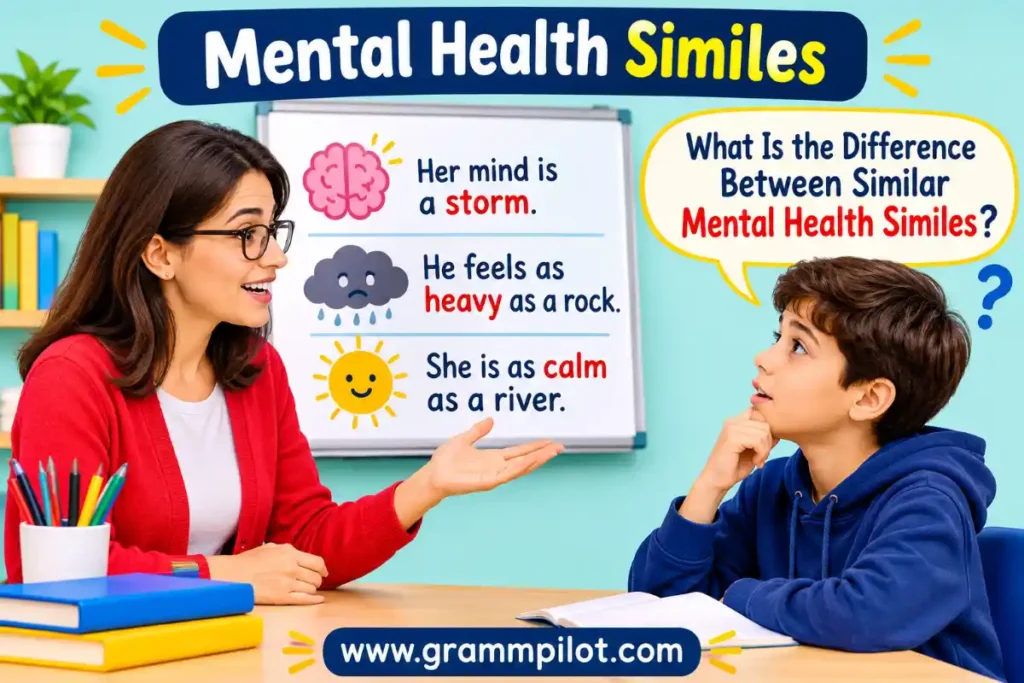
10. What Is the Difference Between Similar Mental Health Similes?
Some comparisons sound alike but communicate different experiences. Understanding the difference helps you choose the right one.
Anxiety Like a Storm vs. Anxiety Like a Clock
| Anxiety Like a Storm | Anxiety Like a Clock |
|---|---|
| Suggests intense emotional pressure | Suggests repeated, ongoing worry |
| Focuses on the strength of a feeling | Focuses on thoughts that keep returning |
| Best for sudden or intense anxiety | Best for constant worrying |
Example: “My anxiety was like a storm before the interview” describes intense nervousness.
“My worry was like a clock that never stopped ticking” describes thoughts that continue throughout the day.
Sadness Like Rain vs. Sadness Like a Heavy Suitcase
| Sadness Like Rain | Sadness Like a Heavy Suitcase |
|---|---|
| Suggests a low mood that lasts | Suggests emotional weight |
| Focuses on the length of a feeling | Focuses on how difficult it feels to carry |
| Creates a quiet, reflective image | Creates an image of emotional burden |
Example: “Sadness followed me like rain all afternoon” describes a lingering mood.
“My grief felt like a suitcase filled with stones” describes the weight of emotional pain.
Hope Like a Candle vs. Hope Like a Sunrise
| Hope Like a Candle | Hope Like a Sunrise |
|---|---|
| Suggests a small but steady source of hope | Suggests a new beginning |
| Works when progress feels uncertain | Works when a positive change begins |
| Focuses on keeping hope alive | Focuses on a fresh opportunity |
Example: “Her message was like a candle in a dark room” describes a small source of comfort.
“Starting again felt like watching the sunrise” describes a new beginning.
11. What Are the Common Mistakes When Writing Mental Health Similes?
A good simile should make an emotion clearer. A poor one can confuse readers or make a serious experience seem less important.
Mistake 1: Using a Comparison That Doesn’t Match the Feeling
Incorrect: My happiness was like a heavy stone pressing on my chest.
This comparison usually suggests emotional weight or distress, not happiness.
Better: My happiness was like sunlight spreading across a quiet room.
Choose an image that matches the emotion.
Mistake 2: Confusing a Simile With a Metaphor
A simile uses like or as to compare two things.
Simile: Anxiety felt like a storm.
A metaphor describes one thing as another without using like or as.
Metaphor: Anxiety was a storm.
Both can be effective, but they are different figures of speech.
Mistake 3: Using Too Many Comparisons in One Sentence
Incorrect: My mind was like a storm, a crowded train, a broken clock, and a dark forest.
The sentence contains too many images. Readers may struggle to understand the main idea.
Better: My mind felt like a crowded train, with too many thoughts competing for space.
One clear comparison is usually stronger than several unrelated ones.
Mistake 4: Making Mental Health Experiences Sound Funny
Humor can work in some personal writing, but jokes about serious emotional struggles may hurt or offend readers.
Avoid comparisons that mock people for experiencing anxiety, depression, or other mental health conditions.
Instead, focus on describing the feeling with care.
Mistake 5: Treating a Simile as a Medical Explanation
A sentence such as “Depression is like walking through fog” is a creative comparison, not a medical definition.
Depression affects people differently. A simile should never replace professional information, diagnosis, or support.
Mistake 6: Assuming Everyone Feels the Same Way
Not everyone experiences anxiety as a storm or sadness as rain. One person may find a comparison accurate, while another may not relate to it.
Use phrases such as:
- It can feel like…
- For some people, it may seem like…
- At times, the experience is similar to…
These phrases leave room for different experiences.
12. What Are the Opposite Feelings of Common Mental Health Experiences?
Opposite words can help you describe emotional changes and contrasts in writing.
| Feeling | Opposite or Contrast | Example |
|---|---|---|
| Anxiety | Calmness | Calmness replaced her nervousness. |
| Sadness | Happiness | The good news brought happiness. |
| Fear | Courage | He found the courage to speak. |
| Loneliness | Connection | Friendship helped her feel connected. |
| Stress | Relaxation | A quiet evening brought relaxation. |
| Confusion | Clarity | The explanation gave me clarity. |
| Hopelessness | Hope | A new opportunity gave him hope. |
| Frustration | Satisfaction | Completing the project brought satisfaction. |
| Self-doubt | Confidence | Practice helped build confidence. |
| Restlessness | Stillness | The quiet room encouraged stillness. |
These are useful contrasts, but emotions aren’t always simple opposites. A person can feel hopeful and worried at the same time.
13. How Can You Create Your Own Mental Health Similes?
You don’t have to memorize every comparison. You can create original ones by following a few simple steps.
Step 1: Name the Feeling
Start with the emotion you want to describe.
For example:
- Anxiety
- Sadness
- Stress
- Hope
- Loneliness
- Relief
Being specific helps you choose a better image.
Step 2: Think About What the Feeling Does
Ask yourself how the emotion affects a person’s thoughts, body, or daily life.
Does it feel:
- Heavy?
- Fast?
- Slow?
- Confusing?
- Quiet?
- Uncomfortable?
- Encouraging?
For example, if stress feels heavy, you might compare it with a full backpack.
Step 3: Choose a Familiar Object or Experience
Think of something readers can easily imagine.
Possible choices include:
- A storm
- A backpack
- A crowded room
- A cloudy window
- A winding road
- A candle
- A quiet lake
- A rising wave
Step 4: Connect the Two Ideas
Use like or as to create the comparison.
For example:
- Stress feels like carrying a heavy backpack.
- Hope shines like a candle in a dark room.
- Confusion is like a road covered in fog.
Step 5: Check If the Meaning Is Clear
Ask yourself:
- Does the comparison match the emotion?
- Can readers picture it?
- Does it sound natural?
- Is it respectful?
- Does it add meaning instead of repeating the same idea?
If the answer is yes, your simile is probably working.
Five New Similes You Can Build Yourself
Here are a few original ideas using the same method:
- Self-doubt is like a whisper that keeps interrupting a conversation. It suggests negative thoughts that interrupt confidence.
- Emotional recovery is like repairing a cracked window. It suggests that improvement takes patience and care.
- A peaceful mind is like a garden after gentle rain. It creates an image of freshness and calm.
- Pressure is like a crowded elevator. It suggests feeling trapped by too many demands.
- A supportive friend is like a handrail on a steep staircase. It suggests having help while facing a difficult situation.

Conclusion: How Can You Describe Mental Health More Clearly?
Good comparisons can make complicated emotions easier to understand. A storm can represent intense anxiety, a heavy backpack can show emotional pressure, and a small candle can represent hope during a difficult time. The best Mental Health Similes are clear, respectful, and connected to the feeling you’re describing. You don’t need complicated words or dramatic images to make your writing meaningful. Choose familiar comparisons that help readers picture the experience. Also remember that emotional experiences are different for everyone. Use similes to express feelings, not to label people or explain medical conditions. With practice, you can create original comparisons that make essays, stories, poems, and everyday conversations more thoughtful.
Frequently Asked Questions
1. What are mental health similes?
Mental health similes are comparisons that describe emotions and psychological experiences using familiar images. For example, “Anxiety is like a storm” helps readers picture an intense feeling of worry.
2. What is a good simile for anxiety?
“Anxiety is like a storm trapped inside a small room” is a useful comparison. It describes a feeling that is intense and difficult to escape.
3. What is a simile for depression?
“Depression can feel like walking through thick fog” is one way to describe a possible experience. However, depression affects people differently and cannot be fully explained by one comparison.
4. What’s another way to describe emotional stress?
You can describe emotional stress as carrying a backpack full of stones or having too many tabs open in your mind. Both comparisons suggest that several pressures are competing for your attention.
5. What is a good simile for hope?
“Hope is like a candle glowing in a dark room” is a common-style comparison that suggests even a small positive feeling can provide comfort.
6. How do you write your own mental health similes?
Choose an emotion, think about how it feels, and compare it with something familiar using like or as. Make sure the image is clear, accurate, and respectful.
7. Can similes help explain mental health?
Yes. Similes can help people express difficult feelings and make emotional experiences easier to picture. However, they are writing tools, not substitutes for professional mental health information or support.