
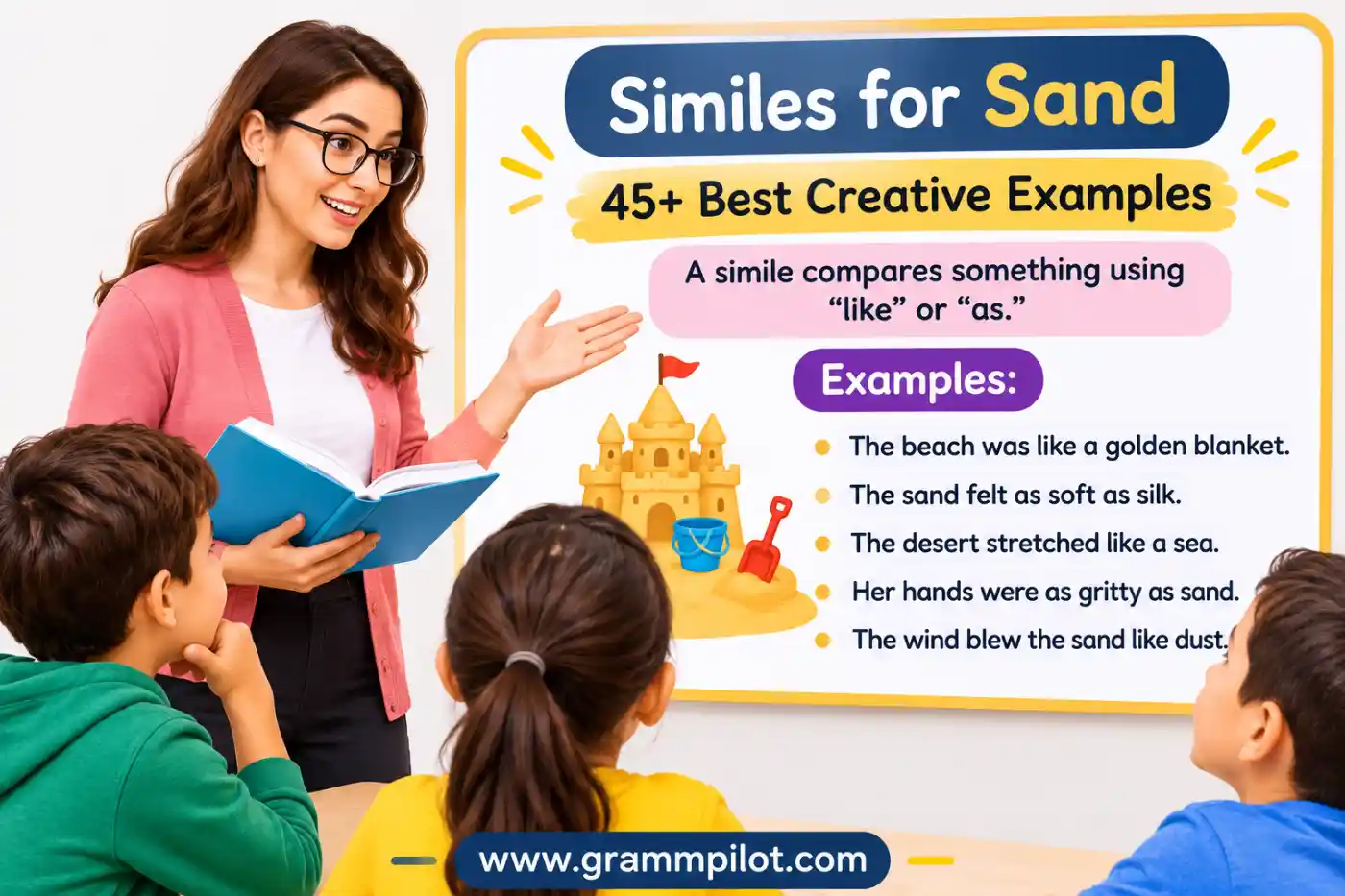
Imagine writing a school essay about a beautiful beach. You write, “The sand was soft and golden.” The sentence is correct, but it doesn’t create a strong picture in the reader’s mind. You want your description to feel more interesting and memorable. That’s where Similes for Sand become useful. You can compare soft sand to powdered sugar, golden sand to scattered gold, or moving desert sand to flowing water. These comparisons help readers imagine what the sand looks and feels like.
Sand appears in many places, including beaches, deserts, playgrounds, and riverbanks. Its texture, color, and temperature can change depending on its surroundings. A creative comparison helps you describe these differences clearly. A simile for sand compares sand with another familiar thing using words such as “like” or “as.” For example, “The sand felt as soft as flour” helps readers imagine its fine texture. In this guide, you’ll find more than 45 creative examples, meanings, and sentences. You’ll also learn about descriptive vocabulary, different writing situations, common mistakes, and ways to choose the right comparison.
You can also explore related examples in Halloween Similes.
What Are Similes for Sand?
A simile is a figure of speech that compares two different things using “like” or “as.” When describing sand, you might compare its texture to flour, its color to gold, or its movement to flowing water.
Examples:
- The beach sand was as soft as powdered sugar.
- The golden grains sparkled like tiny diamonds.
- The desert sand moved like smoke in the wind.
- The hot sand felt like a burning stove beneath my feet.
Each sentence describes a different feature of sand.
Why Do Writers Use Similes to Describe Sand?
Writers use comparisons to make descriptions more interesting and easier to imagine.
Here are some important benefits:
- Create pictures: Readers can imagine the appearance and texture of sand.
- Show feelings: Soft sand can suggest comfort, while burning sand can suggest danger.
- Improve storytelling: Comparisons make settings more memorable.
- Avoid repetition: They provide different ways to describe the same subject.
- Build atmosphere: They can make a beach feel peaceful or a desert feel mysterious.
For example:
- Plain: The wind moved the sand across the desert.
- Creative: The wind carried the sand like golden smoke across the desert.
The second sentence creates a clearer image.

What Is the Origin and Meaning of Sand?
The word sand comes from Old English sand and has related forms in other Germanic languages. It has been used for centuries to describe small, loose grains of natural material. Sand consists of tiny particles of rock, minerals, shells, and other substances. It commonly forms through the breakdown of larger materials by wind, water, and erosion.
What Does Sand Mean in Simple English?
Sand is a natural material made of tiny grains. It is commonly found on beaches, in deserts, near rivers, and in other outdoor environments.
Common types and uses include:
- Beach sand: Found beside oceans and seas.
- Desert sand: Covers large areas of dry land.
- River sand: Collects along riverbanks.
- Construction sand: Used in building materials.
- Playground sand: Used in children’s play areas.
What Makes Sand Different From Other Materials?
| Feature | Description | Comparison |
|---|---|---|
| Texture | Fine or rough | Flour or salt |
| Color | White, yellow, or golden | Gold or honey |
| Movement | Shifts and flows | Water |
| Temperature | Can become very hot | Burning coals |
| Appearance | Made of tiny grains | Seeds or beads |
These features give writers many ideas for creative descriptions.
What Are the 45+ Best Similes for Sand?
Here are 48 original comparisons grouped by the qualities they describe.
1. Similes for Soft Sand
These comparisons work well when describing comfortable beaches and fine sand.
- As soft as powdered sugar: The white beach sand felt as soft as powdered sugar beneath my toes.
- Like a fluffy pillow: The warm sand felt like a fluffy pillow when I lay down.
- As smooth as silk: The shoreline felt as smooth as silk beneath our feet.
- Like sifted flour: The pale desert sand looked like sifted flour.
- As gentle as a feather: The fine sand brushed against my ankles as gently as a feather.
- Like tiny velvet grains: The beach was covered with sand that felt like tiny velvet grains.
2. Similes for Golden Sand
Use these when describing sunny beaches and beautiful landscapes.
- As golden as a treasure chest: The afternoon sunlight made the beach look as golden as a treasure chest.
- Like scattered gold: The shoreline glittered like scattered gold beneath the sun.
- As bright as a sunflower: The yellow sand was as bright as a sunflower.
- Like melted honey: The golden sand stretched beside the ocean like melted honey.
- As shiny as polished coins: The wet grains looked as shiny as polished coins.
- Like a blanket of sunshine: Golden sand covered the beach like a blanket of sunshine.
3. Similes for Hot Sand
These comparisons describe extreme heat and warm surfaces.
- As hot as burning coals: The desert sand felt as hot as burning coals.
- Like a heated frying pan: The beach sand felt like a heated frying pan at noon.
- As warm as freshly baked bread: The evening sand was as warm as freshly baked bread.
- Like a glowing furnace: The desert looked like a glowing furnace beneath the afternoon sun.
- As scorching as a summer road: The sand was as scorching as a summer road.
- Like a sun-heated stone: The dry sand felt like a sun-heated stone against my skin.
4. Similes for Moving Sand
These expressions describe the movement of grains caused by wind or water.
- Flowing like water: The grains flowed like water through the narrow opening.
- Dancing like golden ribbons: The wind made the sand dance like golden ribbons.
- Drifting like falling snow: Fine sand drifted like falling snow across the desert.
- Swirling like a cloud of smoke: The storm sent sand swirling like a cloud of smoke.
- Slipping like tiny beads: The dry sand slipped like tiny beads through my fingers.
- Spreading like a flowing river: The sand spread like a flowing river down the dune.
5. Similes for Rough and Grainy Sand
Use these comparisons for coarse sand and uncomfortable surfaces.
- As rough as coarse salt: The beach sand felt as rough as coarse salt.
- Like crushed crackers: The dry sand broke apart like crushed crackers.
- As gritty as ground pepper: The sand near the rocky shore felt as gritty as ground pepper.
- Like tiny pebbles: The rough grains felt like tiny pebbles beneath my shoes.
- As scratchy as a rough sponge: The coarse sand felt as scratchy as a rough sponge.
- Like crushed shells: The beach was covered with sand that felt like crushed shells.
6. Similes for Wet Sand
Wet sand is darker, sticks together, and is easier to shape.
- Like sticky clay: The wet sand felt like sticky clay between the children’s fingers.
- As dark as chocolate: The wet shoreline looked as dark as chocolate.
- Like damp breadcrumbs: The wet sand gathered like damp breadcrumbs in my palm.
- As smooth as wet paint: The shoreline looked as smooth as wet paint after the waves disappeared.
- Like moldable dough: The children shaped the wet sand like moldable dough into castles.
7. Similes for Endless Desert Sand
These comparisons create pictures of wide and mysterious landscapes.
- Like an endless golden ocean: The desert stretched like an endless golden ocean.
- Like waves frozen in time: The dunes looked like waves frozen in time.
- As endless as the stars: The sandy landscape seemed as endless as the stars.
- Like a golden sea: The traveler stood before a golden sea of sand.
- Like a silent ghost: The wind carried sand like a silent ghost across the dunes.
- As quiet as a sleeping village: The empty desert was as quiet as a sleeping village.
8. Similes for Sparkling Sand
These expressions describe sand reflecting sunlight or moonlight.
- Like sparkling diamonds: The wet sand sparkled like diamonds along the shoreline.
- Like a field of glitter: The beach looked like a field of glitter beneath the sun.
- As bright as a thousand stars: The moonlit sand appeared as bright as a thousand stars.
- Like tiny pieces of crystal: The pale sand looked like tiny pieces of crystal after the rain.
9. Similes for Peaceful Sand
Use these for calm and relaxing descriptions.
- As peaceful as a sleeping baby: The empty beach was as peaceful as a sleeping baby.
- Like a blanket beneath the sky: The pale sand rested like a blanket beneath the sky.
- As still as a sleeping lake: The secluded beach was as still as a sleeping lake before sunrise.
What Are Some Words Related to Sand?
Descriptive vocabulary helps you avoid repeating the same words. Here are 30 useful words grouped by tone.
Sand-Related Vocabulary Table
| Word | Meaning | Tone | Example |
|---|---|---|---|
| Grain | Tiny particle | Simple | A grain of sand stuck to my hand. |
| Dust | Fine dry particles | Simple | Dust covered the sandy road. |
| Silica | Mineral found in sand | Formal | Silica is common in quartz sand. |
| Mineral | Natural solid substance | Formal | The sand contained several minerals. |
| Erosion | Wearing away of material | Formal | Erosion changed the coastline. |
| Granular | Made of small grains | Formal | The material had a granular texture. |
| Grainy | Made of small grains | Everyday | The sand had a grainy texture. |
| Powdery | Fine and soft | Everyday | The dry sand felt powdery. |
| Silky | Smooth and soft | Everyday | The sand felt silky. |
| Crumbly | Easily broken apart | Everyday | The dry sand was crumbly. |
| Sizzling | Extremely hot | Informal | The sand felt sizzling beneath my feet. |
| Beachy | Having a beach-like feeling | Informal | The room had a beachy look. |
Remember that related words aren’t always exact synonyms. For example, a dune is a hill made of accumulated sand, not another name for sand.
How Can You Describe Sand From Mild to Strong?
The strength of a comparison changes the mood of your sentence.
Mild Comparisons
These are useful for gentle descriptions:
- As soft as cotton.
- Like fine flour.
- As warm as sunshine.
- Like tiny sugar grains.
- As smooth as silk.
Example: The beach sand felt as soft as cotton beneath my feet.
Medium Comparisons
These create stronger visual images:
- Like scattered golden coins.
- As gritty as coarse salt.
- Like flowing water.
- As warm as freshly baked bread.
- Like a blanket of golden dust.
Example: The sunlight made the beach shine like scattered golden coins.
Strong Comparisons
Use these for dramatic descriptions:
- As hot as burning coals.
- Like a river of fire.
- As rough as broken shells.
- Like a storm of golden dust.
- As endless as an ocean.
Example: The desert sand felt as hot as burning coals beneath the traveler’s feet.
Choose the strength that matches your scene. Not every description needs to sound dramatic.

What Are the Different Parts of Speech Used to Describe Sand?
The word sand is mainly a noun, but it can also appear in other grammatical forms.
1. Sand as a Noun
Sand is generally an uncountable noun.
Examples:
- The sand covered my shoes.
- We collected sand from the beach.
- The desert sand was hot.
For one individual particle, use “a grain of sand.”
2. Sandy as an Adjective
Sandy describes something containing or covered with sand.
Examples:
- We walked along a sandy path.
- My sandy shoes were covered in dust.
- The children played on the sandy beach.
3. Sand as a Verb
As a verb, sand means to smooth a surface using sandpaper or another abrasive material.
Examples:
- He sanded the wooden table.
- The worker sanded the rough edges.
- She sanded the surface before painting.
4. Common Descriptive Adjectives
| Adjective | Meaning | Example |
|---|---|---|
| Golden | Yellow like gold | Golden sand covered the beach. |
| Grainy | Made of small grains | The grainy surface felt rough. |
| Powdery | Fine and soft | Powdery sand covered the path. |
| Silky | Smooth and soft | Silky sand felt pleasant. |
| Gritty | Rough and coarse | Gritty sand stuck to my feet. |
| Damp | Slightly wet | Damp sand held its shape. |
| Scorching | Extremely hot | Scorching sand covered the desert. |
| Sparkling | Reflecting light | Sparkling sand brightened the beach. |
Are There Any US and UK Differences in Sand Vocabulary?
The word sand has the same basic meaning in American and British English. However, some related words differ.
| American English | British English | Meaning |
|---|---|---|
| Sandbox | Sandpit | Children’s sand play area |
| Vacation | Holiday | Time away from work or school |
| Sidewalk | Pavement | Pedestrian path |
| Sneakers | Trainers | Athletic shoes |
| Beach | Beach | Land beside water |
For example:
- US: The children are playing in the sandbox.
- UK: The children are playing in the sandpit.
The basic sand comparisons work in both varieties of English.
Which Similes for Sand Work Best in Different Writing Situations?
The best comparison depends on your audience and purpose.
1. What Similes Work Best for a Resume?
Resumes usually require clear and professional language rather than poetic comparisons.
If you’re discussing environmental research or construction, use accurate descriptions.
Example: “My research examined how wind moves fine sand across coastal areas.”
Avoid unnecessary expressions such as “the sand danced like golden ribbons.”
2. What Similes Work Best in an Essay?
School essays benefit from simple, memorable comparisons.
Examples:
- As soft as powdered sugar.
- As golden as a treasure chest.
- Like waves frozen in time.
- As hot as burning coals.
Example: The beach was covered with golden sand that sparkled like tiny diamonds.
3. What Similes Work Best in Texting?
Casual messages can use playful expressions.
Examples:
- The sand was hot like a frying pan!
- The beach looked like a golden dream.
- My shoes were full of sand like little sandbags.
Keep the language natural and short.
4. What Similes Work Best in Emails?
For a travel email, a simple comparison can make your description more interesting.
Example: “The beach had beautiful golden sand that looked like scattered sunshine.”
For professional emails, use direct and accurate descriptions instead.
5. What Similes Work Best in Creative Writing?
Creative writing allows you to use imaginative comparisons.
Examples:
- The sand whispered like a secret beneath the wind.
- The desert looked like an ocean made of golden waves.
- Moonlight covered the beach like a blanket of silver dust.
These expressions help build atmosphere.
6. What Similes Work Best in Poems?
Poetry often uses emotional and imaginative comparisons.
Examples:
- Sand like golden memories scattered by time.
- Dunes rising like sleeping ocean waves.
- Grains resting like whispers beneath the moon.
These images can make a poem more expressive.
15+ Original Similes for Sand in Real-Life Situations
Here are additional sentences showing how sand comparisons work in everyday writing.
At the Beach
- The white sand felt like cool flour beneath our feet as we walked beside the ocean.
- The golden beach shone like a field of tiny treasures.
- The wet sand looked as smooth as a polished floor.
- The children dug into the sand like little explorers searching for treasure.
In the Desert
- The desert dunes rose like giant golden waves.
- The wind carried fine sand like a floating cloud.
- The hot ground felt like a giant stove beneath the traveler’s shoes.
- The endless dunes stretched like a golden ocean.
During Outdoor Activities
- The sand slipped through my fingers like tiny drops of water.
- My shoes crunched over the rough sand like crushed crackers.
- The children shaped the wet sand like soft clay.
- A gentle breeze pushed loose sand like a quiet river.
In Stories and Poems
- Moonlight made the pale sand shine like a silver carpet.
- The lonely beach rested like a sleeping animal beside the ocean.
- The grains disappeared like forgotten memories between my fingers.
- The storm sent sand flying like thousands of tiny golden birds.
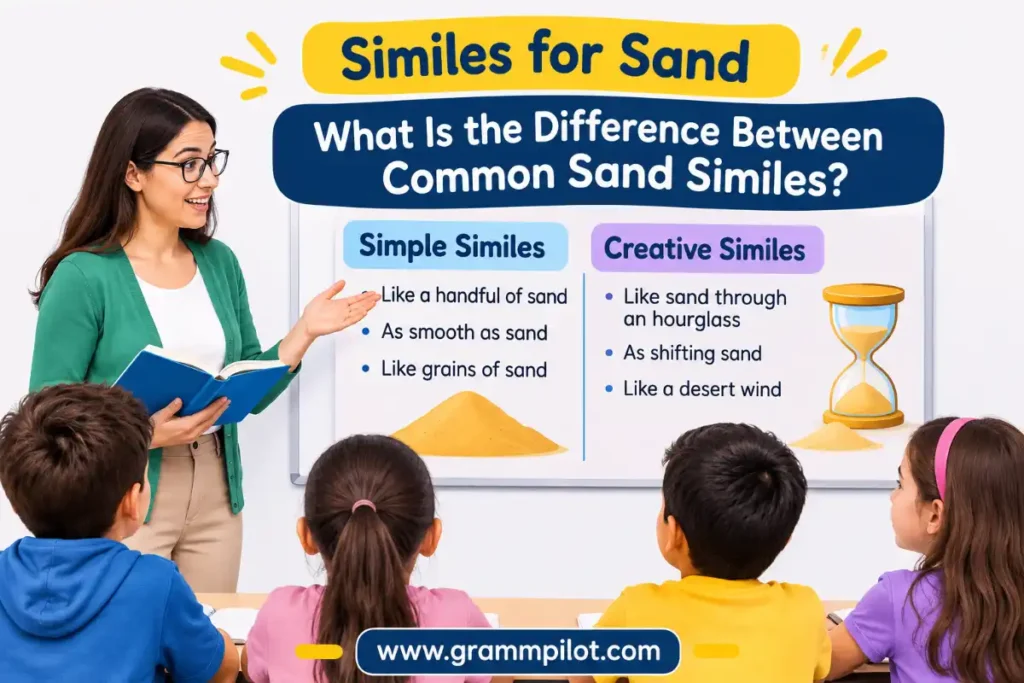
What Is the Difference Between Common Sand Similes?
Some comparisons describe similar features but create different impressions.
1. Sand as Soft as Silk vs. Sand Like Powdered Sugar
| As soft as silk | Like powdered sugar |
|---|---|
| Focuses on smoothness | Focuses on fine particles |
| Suggests a gentle surface | Suggests a powdery texture |
| Creates a luxurious image | Creates a delicate image |
Examples:
- The beach sand felt as soft as silk.
- The pale sand looked like powdered sugar.
Choose silk for smoothness and powdered sugar for fineness.
2. Sand Like Flowing Water vs. Sand Like Falling Snow
| Like flowing water | Like falling snow |
|---|---|
| Suggests continuous movement | Suggests gentle movement |
| Creates a flowing image | Creates a peaceful image |
| Suitable for shifting grains | Suitable for drifting particles |
Examples:
- The sand flowed like water through my fingers.
- Fine grains drifted like falling snow.
3. Sand as Hot as Burning Coals vs. Sand as Warm as Freshly Baked Bread
| Burning coals | Freshly baked bread |
|---|---|
| Extreme heat | Pleasant warmth |
| Creates discomfort | Creates comfort |
| Dramatic description | Gentle description |
Examples:
- The desert sand was as hot as burning coals.
- The evening beach sand felt as warm as freshly baked bread.
4. Sand Like Scattered Gold vs. Sand Like a Golden Blanket
| Scattered gold | Golden blanket |
|---|---|
| Focuses on individual grains | Focuses on a wide surface |
| Suggests sparkle | Suggests coverage |
| Creates a treasure-like image | Creates a peaceful image |
Choose scattered gold for shining details and a golden blanket for a wide landscape.
What Are the Common Mistakes When Writing Sand Similes?
Even a creative comparison can confuse readers if it doesn’t fit the sentence.
1. Using the Wrong Texture
Incorrect: The rough sand felt as soft as silk.
Better: The rough sand felt like tiny pebbles.
Your comparison should match the texture.
2. Confusing Similes With Metaphors
A simile uses “like” or “as.”
Simile: The desert was like a golden ocean.
Metaphor: The desert was a golden ocean.
Both are literary devices, but they use different forms of comparison.
3. Using Too Many Comparisons
Incorrect: The sand was like gold, flour, water, silk, and snow.
Better: The golden sand sparkled like tiny pieces of gold.
One strong image is often enough.
4. Ignoring the Setting
Describing cold winter sand as burning hot may confuse readers.
Instead, write: The cold sand felt like tiny pieces of ice beneath my feet.
5. Repeating the Same Expression
Avoid using “soft as silk” or “golden as gold” in every paragraph.
Try describing different qualities, such as texture, temperature, color, and movement.
6. Making Comparisons Too Complicated
Confusing: The sand resembled a collection of golden particles escaping through a mysterious universe.
Better: The sand drifted like golden smoke across the desert.
Keep your meaning clear.
When Should You NOT Use Similes for Sand?
Creative comparisons aren’t suitable for every situation.
- Scientific writing: Use accurate terms such as grain size, mineral composition, and sediment.
- Construction reports: Describe the material directly, such as fine, dry sand.
- Safety instructions: Say “the sand is dangerously hot” instead of using a poetic comparison.
- Formal research: Choose specific facts rather than imaginative language.
- Short factual messages: Simple descriptions are often enough.
Use figurative language when it improves understanding, not just to decorate a sentence.
What Are the Opposite Words of Sand-Related Descriptions?
Sand itself doesn’t have one exact antonym. However, many adjectives used to describe it have opposites.
| Descriptive word | Opposite |
|---|---|
| Soft | Hard |
| Smooth | Rough |
| Dry | Wet |
| Hot | Cold |
| Fine | Coarse |
| Loose | Compact |
| Bright | Dull |
| Golden | Dark |
| Quiet | Noisy |
| Still | Moving |
Example: The beach was once warm and peaceful, but the cold wind made the sand feel rough and unpleasant.
How Can You Choose the Best Simile for Sand?
Follow these simple tips to create better comparisons.
- Identify the feature: Decide if you’re describing texture, color, heat, or movement.
- Think of familiar objects: Flour, sugar, gold, water, and snow are useful comparisons.
- Use the right connecting word: Build your sentence with “like” or “as.”
- Match the mood: Choose gentle comparisons for peaceful scenes and stronger ones for dramatic scenes.
- Avoid repetition: Use different images throughout your writing.
- Check accuracy: Make sure the comparison matches the sand you’re describing.
- Read aloud: If your sentence sounds unnatural, simplify it.
For example, if you’re describing fine beach sand, “as soft as powdered sugar” works well. If you’re describing a desert storm, “like a cloud of smoke” creates a stronger image.

Conclusion: How Can You Describe Sand More Creatively?
Sand offers many opportunities for creative writing because its texture, color, temperature, and movement can create different images. You can compare soft beach sand to powdered sugar, sparkling grains to tiny diamonds, or moving desert sand to flowing water. The best Similes for Sand are not necessarily the most complicated ones. They’re the comparisons that help readers understand exactly what you’re describing. Think about the setting, choose a familiar image, and make sure your comparison fits the situation. If you’re writing a school essay, a poem, or a short story, a well-chosen simile can turn a simple description into something memorable. Keep experimenting with different images and let your descriptions bring the landscape to life.
Frequently Asked Questions
1. What are some good similes for sand?
Good examples include “as soft as powdered sugar,” “like scattered gold,” and “as hot as burning coals.” They describe different qualities of sand.
2. How do you describe sand creatively?
Compare sand with familiar objects or natural materials. For example, “The desert sand moved like golden smoke across the dunes.”
3. What is a simile for soft beach sand?
“The sand felt as soft as silk beneath my feet” is a good example. It describes a smooth and gentle texture.
4. What’s another way to say sand is golden?
You can describe it as looking like scattered gold, melted honey, or a blanket of sunshine.
5. What are the best Similes for Sand in a poem?
Try “sand like golden memories,” “dunes like frozen ocean waves,” or “grains drifting like falling snow.” These comparisons create emotional and visual images.
6. What is a simile for hot desert sand?
“The desert sand was as hot as burning coals” is a strong comparison that describes extreme heat.
7. Can sand be compared to water in a simile?
Yes. Loose sand can flow in a similar way to water. For example, “The sand flowed like water through my fingers.”