
Have you ever felt so happy that you wanted to dance, so angry that you could hardly speak, or so nervous that your heart seemed ready to jump out of your chest? Sometimes, ordinary words just aren’t enough to describe what we feel. That’s where similes can make a difference. Similes for emotions compare feelings with familiar things, actions, or experiences. They help readers picture an emotion instead of simply reading its name. For example, saying “My heart raced like a wild horse” creates a stronger image than saying “I was nervous.”
Writers use these comparisons in stories, poems, school essays, personal messages, and everyday conversations. A well-chosen simile can make a character feel real, turn a simple sentence into a memorable moment, and help readers connect with an experience they may never have had themselves. In this guide, you’ll discover more than 50 creative similes for happiness, sadness, anger, fear, love, anxiety, loneliness, excitement, embarrassment, and other feelings. You’ll also learn what each comparison means and how to use it naturally in your writing.
If you’re looking for more creative comparisons, see Similes for Smart.
What Is a Simile for Emotions?
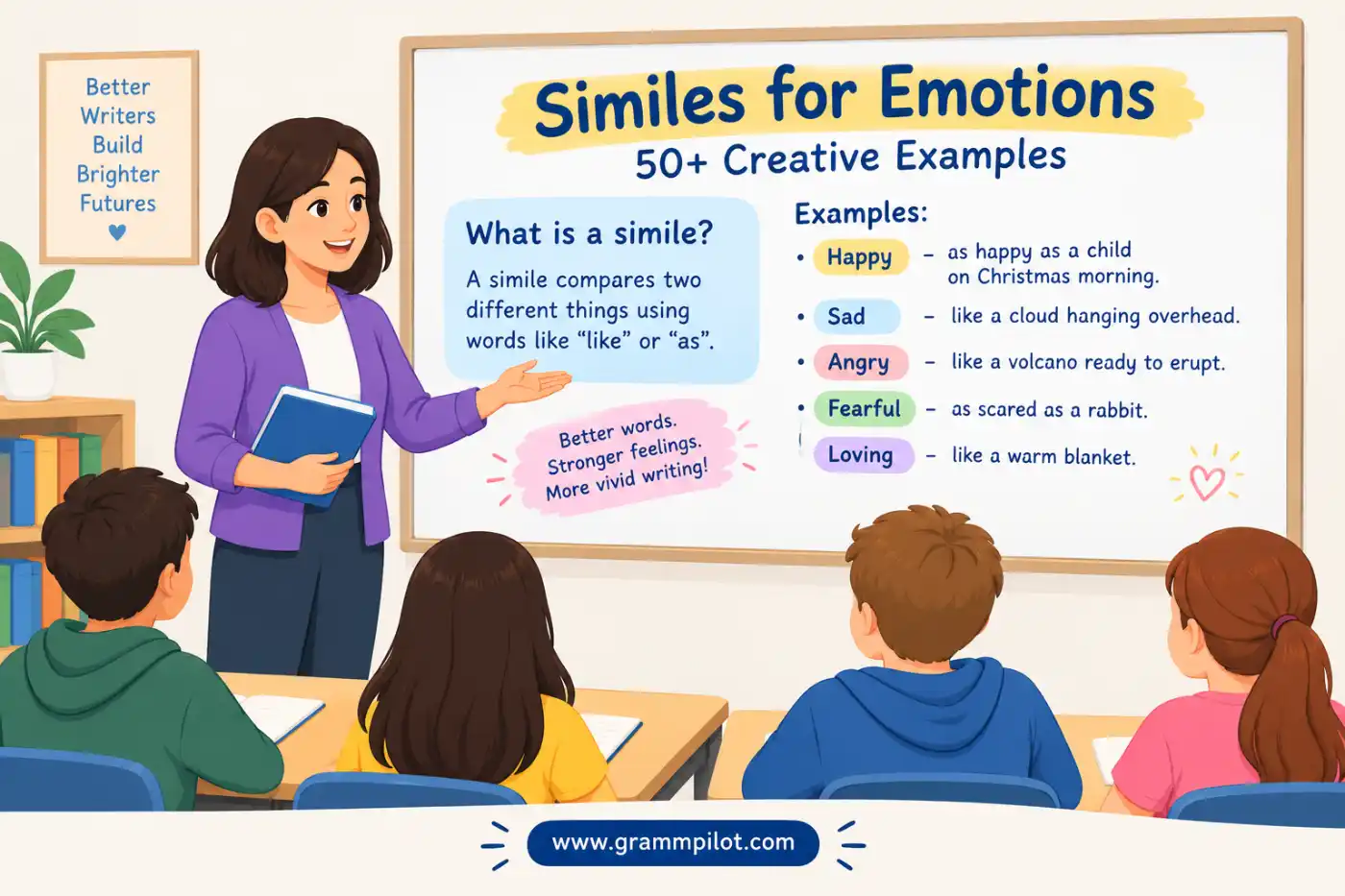
A simile is a figure of speech that compares two different things using words such as like or as. When the comparison describes an emotion, it helps readers understand the feeling through a familiar image.
Consider these examples:
- She was happy.
- She was as happy as a child on Christmas morning.
Both sentences describe happiness, but the second creates a more vivid picture. Readers can imagine the excitement of a child waiting for presents.
Here are two more examples:
- His anger erupted like a volcano.
- Her heart sank like a stone.
The first comparison suggests powerful, explosive anger. The second expresses sudden disappointment or sadness. A good emotional simile doesn’t just decorate a sentence. It helps readers understand how a feeling looks, sounds, or feels.
1. Similes for Happiness
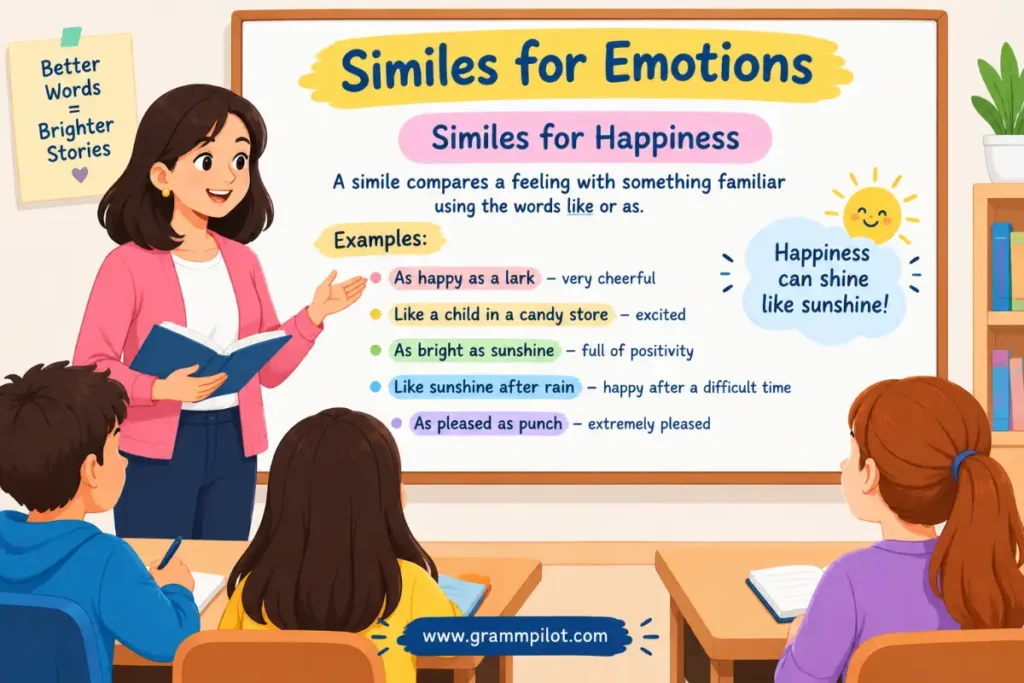
Happiness can be quiet and peaceful, or it can burst out like fireworks. These similes help describe different shades of joy.
- As happy as a lark — cheerful and carefree.
- Like a child in a candy store — excited by wonderful choices.
- As bright as sunshine — full of positivity.
- Like sunshine after a storm — happy after a difficult period.
- As pleased as punch — extremely satisfied.
- Like a bird set free — feeling joyful and unrestricted.
- As light as a feather — free from heavy worries.
- Like fireworks lighting up the sky — bursting with excitement.
Example: When Daniel learned that his family was coming to visit, he was as happy as a child on Christmas morning.
Writing tip: Use cheerful images such as sunshine, flowers, birds, and celebrations when you want readers to feel a character’s happiness. For quiet happiness, choose a gentle image. For overwhelming joy, use something energetic, such as fireworks.
2. Similes for Sadness
Sadness doesn’t always look the same. Sometimes it brings tears; other times, it makes a person quiet or distant. These comparisons help express those differences.
- Like a cloud hanging overhead — feeling gloomy for a long time.
- As lonely as an empty house — feeling alone and forgotten.
- As heavy as a stone — carrying emotional pain.
- Like rain on a summer afternoon — a sudden change from happiness to sadness.
- Like a flower without sunlight — lacking joy or energy.
- As quiet as an abandoned street — withdrawn and silent.
- Like a broken window — feeling damaged or vulnerable.
- Like tears falling into the sea — feeling that one’s sadness is unnoticed.
Example: After her best friend moved away, a cloud seemed to hang over Lily’s day, even when everyone else was laughing.
Writing tip: Rain, empty rooms, fading flowers, and cloudy skies can create a sad atmosphere. However, choose your image carefully. A character who feels disappointed may need a lighter comparison than someone grieving a major loss.
3. Similes for Anger
Anger can begin as a small irritation and grow into an uncontrollable outburst. The right simile helps readers recognize its intensity.
- Like a volcano ready to erupt — anger that is close to bursting out.
- As hot as fire — burning with rage.
- Like a storm breaking loose — expressing anger with great force.
- As fierce as a roaring lion — showing powerful anger.
- Like a boiling kettle — becoming more irritated by the minute.
- As red as a tomato — looking flushed with anger or embarrassment.
- Like thunder shaking the sky — expressing anger loudly.
- Like a spark in dry grass — anger that spreads quickly.
Example: When Max discovered that someone had scratched his new bicycle, his anger spread like a spark in dry grass.
Writing tip: Fire and storms are useful for intense anger. For quiet frustration, a boiling kettle may work better. These different images let you show if a character is annoyed, furious, or about to lose control.
4. Similes for Fear
Fear can make the heart race, the hands shake, or the whole body freeze. These similes make frightening moments more vivid.
- Like a deer caught in headlights — frozen by fear or surprise.
- As scared as a rabbit — easily frightened.
- Like a leaf trembling in the wind — shaking with fear.
- As pale as a ghost — looking extremely frightened.
- Like a trapped bird — feeling helpless and unable to escape.
- As nervous as a cat in a strange room — alert and uneasy.
- Like standing at the edge of a cliff — feeling exposed to danger or uncertainty.
- Like ice running through the veins — experiencing a sudden, chilling fear.
Example: When the old door creaked open by itself, Emma stood like a deer caught in headlights.
Writing tip: Use physical reactions to make fear believable. A character may tremble like a leaf, freeze in place, or feel as if ice is running through their veins. These details help readers experience the scene alongside the character.
5. Similes for Love and Affection
Love can bring warmth, safety, excitement, and deep connection. These comparisons help describe the comfort people find in relationships.
- Like a warm blanket on a cold night — feeling safe and cared for.
- As gentle as a summer breeze — showing soft affection.
- Like sunshine in my life — bringing happiness and hope.
- As sweet as honey — expressing tenderness.
- Like two peas in a pod — being very close or similar.
- As warm as a loving hug — feeling comforted.
- Like a light in the darkness — offering support during hard times.
- As precious as gold — deeply valued.
Example: Whenever Grandma held his hand, the little boy felt as safe as if he were wrapped in a warm blanket on a cold night.
Writing tip: Love doesn’t always need dramatic language. A warm blanket, a gentle breeze, or a light in the darkness can communicate affection in a simple and touching way.
6. Similes for Nervousness and Anxiety
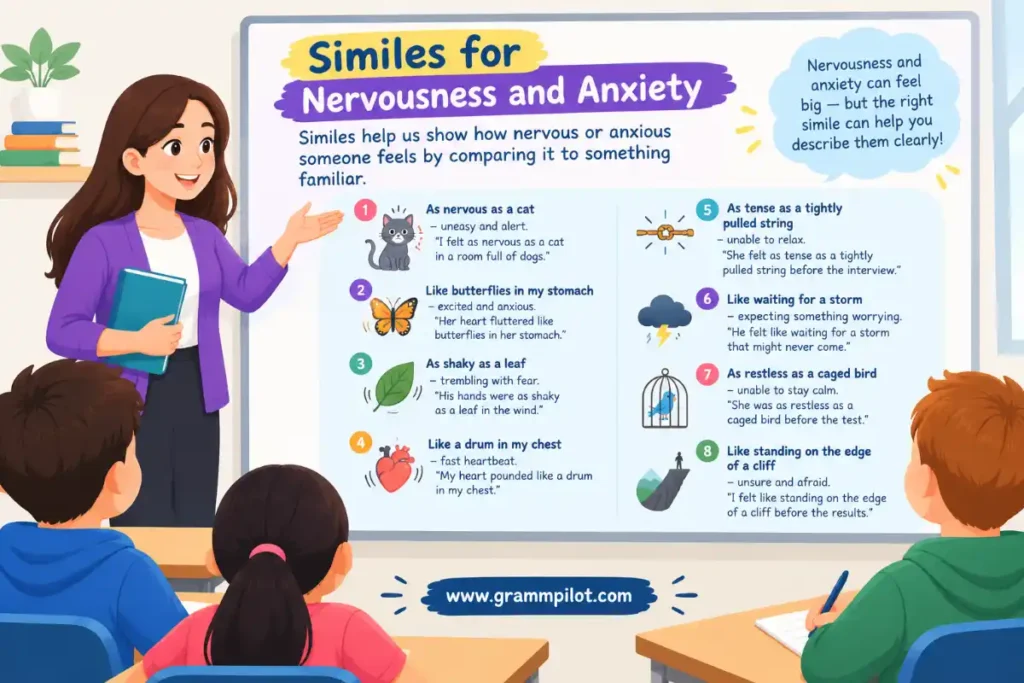
Nervousness often appears before an exam, interview, performance, or difficult conversation. Anxiety may last longer and make it hard to relax.
- Like having butterflies in your stomach — feeling nervous or excited.
- As shaky as a leaf — trembling from nervousness.
- Like a drum beating in my chest — feeling a fast heartbeat.
- As tense as a tightly pulled string — unable to relax.
- Like waiting for a storm — expecting something worrying.
- As restless as a caged bird — unable to stay calm.
- Like walking on thin ice — feeling uncertain about what may happen.
- Like a clock ticking louder and louder — feeling pressure as time passes.
Example: As the principal called her name, Sara felt butterflies in her stomach and heard her heartbeat like a drum.
Writing tip: Nervousness often involves anticipation. A ticking clock can suggest pressure, while butterflies in the stomach may describe the familiar mixture of worry and excitement before an important event.
7. Similes for Loneliness
Loneliness is not always about being physically alone. Someone can feel lonely in a crowded room if they believe nobody understands them.
- As lonely as a deserted island — feeling completely isolated.
- Like a single star in an empty sky — feeling small and alone.
- As silent as an empty classroom — experiencing stillness and separation.
- Like a boat drifting without an anchor — feeling disconnected or without direction.
- As forgotten as an old photograph — feeling overlooked.
- Like a voice lost in a crowd — feeling unheard despite being around others.
Example: Although the party was full of people, Amir felt like a voice lost in a crowd because nobody seemed interested in talking to him.
Writing tip: Empty places, distant stars, and drifting boats can express isolation. Choose a comparison that matches the reason for the loneliness, if it comes from separation, rejection, or feeling misunderstood.
8. Similes for Excitement and Surprise
Excitement makes people eager for what comes next. Surprise can leave them speechless, amazed, or suddenly full of energy.
- Like fireworks bursting in the sky — feeling a rush of excitement.
- As excited as a child on a roller coaster — eagerly anticipating an experience.
- Like opening a mysterious gift — feeling curious and surprised.
- As wide-eyed as an owl — showing amazement.
- Like a bolt from the blue — something happening unexpectedly.
- Like a spark bringing a fire to life — suddenly becoming enthusiastic.
Example: When the concert tickets arrived, excitement burst through Mia like fireworks lighting up the night sky.
Writing tip: Use fireworks for strong excitement and a mysterious gift for curiosity. For an unexpected event, “like a bolt from the blue” is especially useful.
9. Similes for Embarrassment and Shame
Embarrassment often happens when we make a mistake in front of others or receive unexpected attention. Shame can be a deeper feeling connected to regret or a sense of having done something wrong.
- As red as a tomato — looking embarrassed.
- Like a spotlight shining on me — feeling that everyone is watching.
- As awkward as a penguin on ice — feeling uncomfortable in a social situation.
- Like wishing the floor would swallow me — wanting to disappear from embarrassment.
- Like carrying a heavy secret — feeling burdened by guilt or shame.
Example: When he called his teacher “Mom” by mistake, his face turned as red as a tomato.
Writing tip: Embarrassment is often linked to public attention, while shame may involve a private feeling of regret. Keep the distinction in mind when choosing a comparison.
10. Similes for Hope and Relief
Hope helps people believe that something good may happen. Relief comes when worry or danger begins to fade.
- Like a light at the end of a tunnel — seeing a reason to keep going.
- As refreshing as rain after a drought — bringing comfort after a difficult time.
- Like a door opening after a long wait — discovering a new opportunity.
- As free as a bird after a storm — feeling released from worry.
- Like taking a deep breath after holding it too long — feeling sudden relief.
Example: When the doctor said that the test results were normal, relief washed over Nina like rain after a long drought.
Writing tip: Use light, open doors, fresh air, and rain to suggest hope or relief. These images can show a shift from difficulty toward a better situation.

How to Use Similes for Emotions in Your Writing
Knowing a list of similes is useful, but choosing the right one makes your writing more effective. Here are four ways to use them.
In stories and novels
Similes help readers understand a character’s emotional reaction.
Basic sentence: He was frightened.
More vivid sentence: He froze like a deer caught in headlights when the shadow moved.
The second sentence gives readers a clear picture of the character’s fear.
In poems
Poetry often uses comparisons to communicate a feeling in a few words.
Example: My lonely heart drifted like a boat across a silent sea.
The boat suggests isolation, while the silent sea creates a quiet, reflective mood.
In school essays
A carefully chosen simile can make descriptive writing more interesting without making it difficult to understand.
Example: Before the spelling competition, my hands shook like leaves in the wind.
The comparison is easy to picture and fits the situation.
In everyday conversation
Familiar similes can help you explain feelings naturally.
Examples:
- “I had butterflies in my stomach before the interview.”
- “I felt as light as a feather after finishing the project.”
- “The news hit me like a bolt from the blue.”
Choose expressions that fit the setting. A casual conversation usually needs simple language, while a poem or story may allow more imaginative comparisons.
Simile vs. Metaphor: What’s the Difference?
Similes and metaphors both compare things, but they work differently.
| Simile | Metaphor |
|---|---|
| Her happiness was like sunshine. | Her happiness was sunshine. |
| His anger burned like fire. | His anger was a fire. |
| Fear crept over me like a shadow. | Fear was a shadow over me. |
A simile uses a comparison word such as like or as. A metaphor directly describes one thing as another. Both can make emotional writing stronger. Use the form that sounds clearest and best fits your sentence.
Common Mistakes to Avoid
Even creative comparisons can weaken writing if they are used carelessly.
1. Using too many similes
If every sentence contains a comparison, readers may become distracted. Save your strongest similes for the moments that matter.
2. Choosing an image that doesn’t fit
A cheerful image may not suit a scene of grief. Think about the emotion’s intensity before choosing your comparison.
3. Using confusing language
A simile should help readers understand the feeling. If readers must stop and work out what the comparison means, choose a clearer one.
4. Repeating the same comparison
Using sunshine for every happy moment can make your writing predictable. Try birds, celebrations, warm colors, or other images that suit the situation.
5. Forgetting the character’s experience
A simile should fit the character and the scene. A child might compare excitement to a birthday party, while an athlete might compare it to crossing the finish line.
How to Create Your Own Similes for Emotions
You don’t need to memorize every comparison. You can invent original similes by thinking about how an emotion feels.
Follow these three steps:
- Name the emotion. Decide if your character feels joy, fear, anger, loneliness, or something else.
- Think of a matching image. Ask yourself what the feeling reminds you of. Fear might resemble a sudden cold wind; relief might feel like setting down a heavy bag.
- Build the comparison. Use like or as to connect the emotion with the image.
For example, you could write: “Her worry followed her like a shadow.” This comparison suggests that the worry stays with her wherever she goes.
Try another: “His excitement bounced around like a ball in a small room.” The image shows energy that is difficult to contain.
Original comparisons often make writing more memorable than familiar expressions, especially when they connect closely to the scene.

Conclusion: How Can You Describe Emotions More Clearly?
Emotions are a big part of what makes stories and everyday experiences meaningful. Similes help you express those feelings with images readers can understand and remember. Happiness can shine like sunshine, fear can freeze someone like a deer caught in headlights, and loneliness can feel like drifting alone across a wide sea. The best similes for emotions are not always the fanciest ones. They are the comparisons that fit the feeling, the character, and the moment. Use familiar expressions when you want to be clear, and create original comparisons when you want your writing to stand out. If you’re writing a school essay, a poem, a short story, or a personal message, experiment with different images. With practice, you’ll find it easier to turn simple emotions into vivid, engaging descriptions.
Frequently Asked Questions
1. What are similes for emotions?
Similes for emotions compare feelings with familiar things using words such as like or as. For example, “Her happiness shone like sunshine.”
2. What is a good simile for happiness?
“As happy as a child on Christmas morning” is a useful comparison for describing strong joy and excitement.
3. What is a simile for sadness?
“Like a cloud hanging overhead” describes a gloomy feeling that seems difficult to shake.
4. What is a simile for anger?
“Like a volcano ready to erupt” describes anger that has built up and may soon burst out.
5. What is a simile for fear?
“Like a deer caught in headlights” describes someone who freezes because of fear or sudden surprise.
6. How do similes make writing more interesting?
They create mental pictures that help readers imagine a character’s feelings instead of simply being told what the character feels.
7. Can I create my own emotional similes?
Yes. Choose an emotion, think of an image that matches it, and connect them using like or as. For example, “His excitement fizzed like soda bubbles.”
8. What is the difference between an emotional simile and an emotional metaphor?
A simile makes an explicit comparison, such as “Her fear was like ice.” A metaphor makes a direct comparison, such as “Her fear was ice.”