Imagine you’re writing a school essay about a brilliant student. You could write, “She is very smart.” That sentence is correct, but it doesn’t show how quickly she thinks, how well she solves problems, or how easily she understands difficult ideas. A creative comparison can make your writing much more interesting. Similes for Smart help you describe intelligence by comparing a person to something known for speed, wisdom, sharpness, or quick thinking. Instead of simply calling someone clever, you can say, “She is as sharp as a razor” or “He is as quick as lightning.”
A good simile helps readers picture what makes someone intelligent. Some comparisons describe fast thinking, while others suggest deep knowledge, excellent memory, or the ability to solve difficult problems. In this guide, you’ll find 35 useful similes, their meanings, original example sentences, alternatives to the word smart, and advice on choosing the right expression for essays, emails, conversations, and creative writing.
If you’re unsure how to spell or pluralize another word, read Disfunction or Dysfunction.
What Are Similes for Smart?
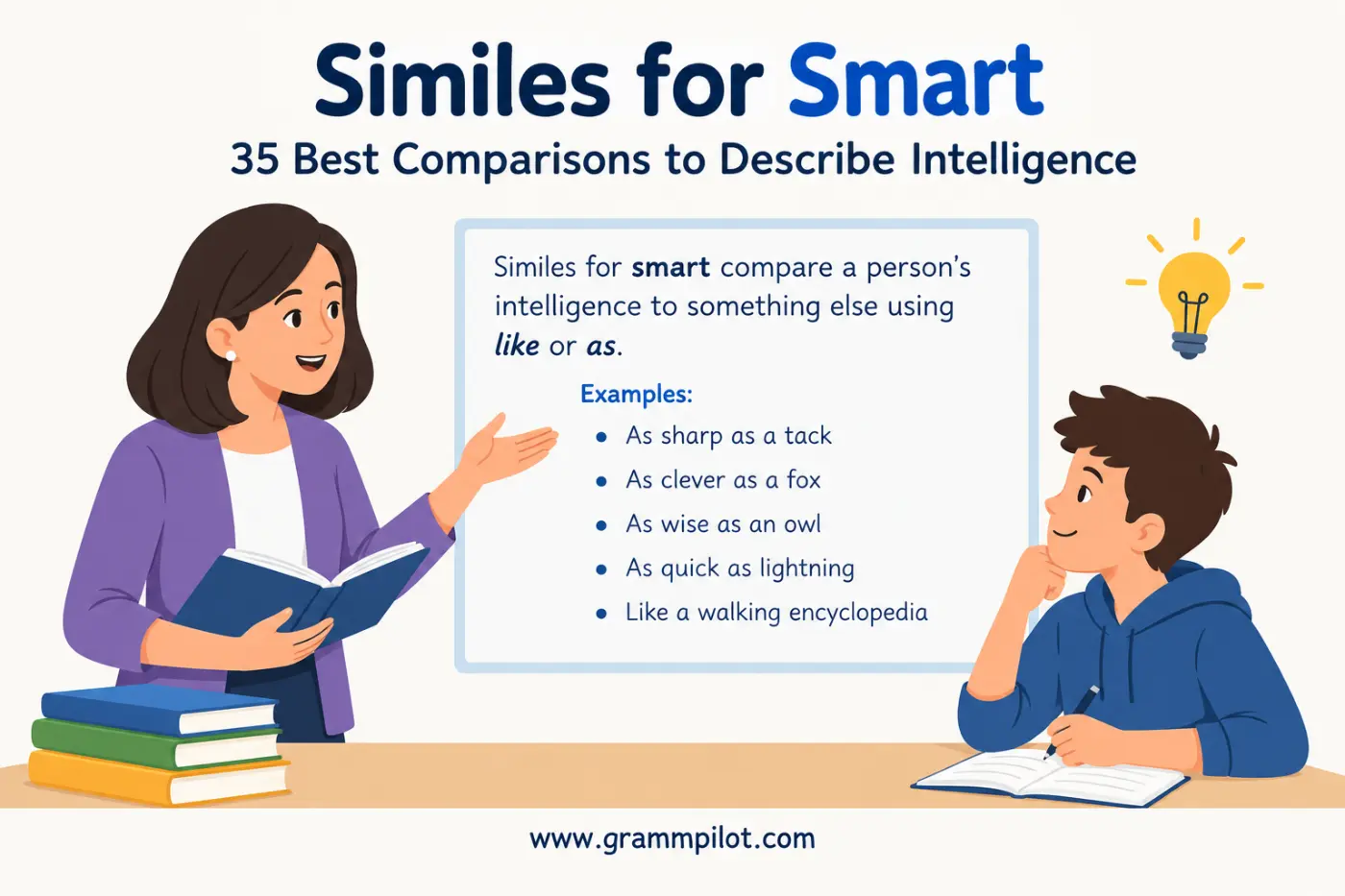
Similes for smart are expressions that compare an intelligent person or their thinking ability to something with a similar quality. They commonly use the words like or as to make the comparison clear.
For example, “He is as sharp as a tack” compares someone’s intelligence to the sharpness of a tack. It means that he understands things quickly and notices details.
Here are a few more examples:
- She is as bright as a star.
- He thinks like a chess champion.
- Her mind works as quickly as lightning.
- The student is as sharp as a razor.
- She is like a walking encyclopedia.
These comparisons make descriptions more vivid than simply repeating smart, clever, or intelligent.
What Is the Origin of Similes?
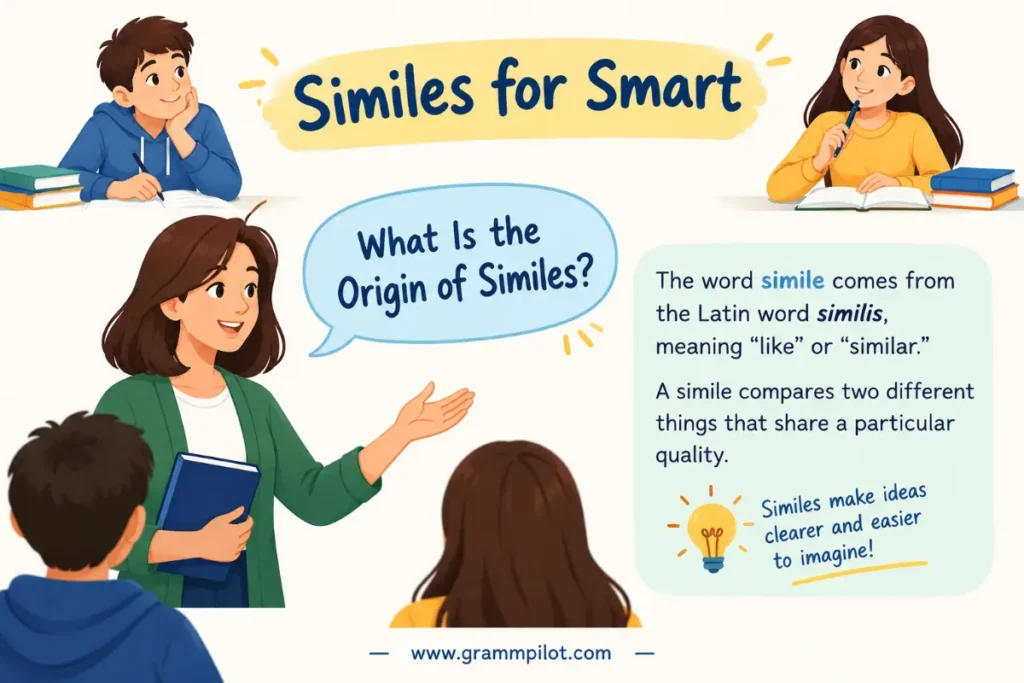
The word simile comes from the Latin word similis, meaning “like” or “similar.” A simile compares two different things that share a particular quality. Writers have used comparisons for centuries to explain difficult ideas, describe people, and make stories easier to imagine. Everyday expressions such as “as wise as an owl” have become familiar because they connect an abstract quality with an image people recognize. Intelligence is difficult to see directly. You cannot look at a person and measure their knowledge just by appearance.
However, you can describe how quickly they solve a problem or how clearly they explain an idea. That is why comparisons work so well. A person who is “as sharp as a tack” seems mentally alert, while someone who is “a walking encyclopedia” appears to know a great deal about many subjects. Remember that a simile is a figure of speech, not a scientific measurement of intelligence.
35 Best Similes for Smart With Meanings
The following examples describe different kinds of intelligence. Some focus on quick thinking, while others highlight knowledge, creativity, logic, or wisdom.
1. As Sharp as a Tack
Meaning: Very clever, alert, and quick to understand things.
Example: Even though Grandpa is eighty years old, he is as sharp as a tack and remembers every detail of his childhood.
Best for: Everyday conversation, storytelling, and informal writing.
2. As Bright as a Star
Meaning: Very intelligent, talented, or promising.
Example: The young scientist was as bright as a star, finding solutions that other researchers had overlooked.
Best for: Positive descriptions of students, children, and talented people.
3. As Clever as a Fox
Meaning: Quick-thinking, resourceful, and good at finding ways around problems.
Example: Mia was as clever as a fox when she found a way to finish the project with the limited materials available.
Best for: Stories and descriptions of people who solve problems creatively.
This comparison can sometimes suggest cunning or trickery, so consider the context.
4. As Wise as an Owl
Meaning: Showing good judgment and understanding.
Example: Our teacher is as wise as an owl because she considers every side of a disagreement before giving advice.
Best for: Describing experienced people, mentors, and thoughtful leaders.
5. As Quick as Lightning
Meaning: Thinking or reacting extremely quickly.
Example: The student was as quick as lightning when the teacher asked a challenging question.
Best for: Describing mental speed, quick answers, and fast problem-solving.
6. As Sharp as a Razor
Meaning: Having an extremely keen mind or noticing small details.
Example: The detective had a mind as sharp as a razor and spotted the clue hidden in the witness’s statement.
Best for: Mystery writing, analytical work, and descriptions of careful thinkers.
7. Like a Walking Encyclopedia
Meaning: Knowing a great deal of information about many subjects.
Example: Ask Daniel about ancient history; he is like a walking encyclopedia.
Best for: Friendly conversation and descriptions of knowledgeable people.
This is technically a comparison using like, although it is also a common figurative expression.
8. As Bright as a Button
Meaning: Clever, lively, and quick to understand.
Example: The new student was as bright as a button and understood the classroom routine on her first day.
Best for: Informal British English and friendly descriptions.
9. Like a Chess Grandmaster
Meaning: Thinking strategically and planning several steps ahead.
Example: The manager handled the difficult negotiation like a chess grandmaster, anticipating every possible response.
Best for: Business writing, leadership, strategy, and problem-solving.
10. As Quick-Witted as a Comedian
Meaning: Able to think of clever responses very quickly.
Example: Aisha was as quick-witted as a comedian and made everyone laugh with her unexpected reply.
Best for: Dialogue, humor, and descriptions of people who respond cleverly.
11. Like a Human Calculator
Meaning: Extremely skilled at mental arithmetic or working with numbers.
Example: My brother is like a human calculator and can work out complicated sums without writing anything down.
Best for: Mathematics, school stories, and numerical skills.
12. As Focused as a Hawk
Meaning: Paying close attention and noticing important details.
Example: The editor was as focused as a hawk while checking the report for errors.
Best for: Studying, editing, research, and careful observation.
13. Like a Master Detective
Meaning: Skilled at examining clues and connecting information.
Example: Priya worked like a master detective to discover why the computer system kept failing.
Best for: Analytical thinking and investigations.
14. As Inventive as an Engineer
Meaning: Able to develop clever ideas and practical solutions.
Example: He was as inventive as an engineer when he turned old cardboard boxes into a working model bridge.
Best for: Creative projects, science, and technical problem-solving.
15. Like a Computer Processing Data
Meaning: Taking in and organizing information quickly.
Example: During the debate, her mind seemed to work like a computer processing data as she answered each argument.
Best for: Modern descriptions of fast information processing.
This comparison is figurative. Human thinking is much more complex than computer processing.
16. As Logical as a Mathematician
Meaning: Thinking carefully and reaching conclusions through reason.
Example: The lawyer was as logical as a mathematician when she explained how each piece of evidence supported her argument.
Best for: Essays, debates, and analytical writing.
17. Like a Library Full of Books
Meaning: Having a large amount of knowledge and information.
Example: My grandmother’s mind is like a library full of books because she remembers stories, recipes, and facts from many different subjects.
Best for: Describing broad knowledge and a love of learning.
18. As Observant as an Eagle
Meaning: Noticing small details that others may miss.
Example: The artist was as observant as an eagle and noticed the tiny change in the painting’s color.
Best for: Creative work, science, investigations, and attention to detail.
19. Like a Light Bulb Switching On
Meaning: Suddenly understanding an idea or discovering a solution.
Example: When the teacher explained the final step, it was like a light bulb switching on in Amir’s mind.
Best for: Learning, discovery, and moments of understanding.
20. As Strategic as a Military Commander
Meaning: Planning carefully to achieve a goal.
Example: The team captain was as strategic as a military commander, assigning each player a role that suited their strengths.
Best for: Leadership, games, and planning.
21. Like a Puzzle Solver
Meaning: Good at connecting separate pieces of information to find an answer.
Example: She approached the research problem like a puzzle solver, testing each clue until the answer became clear.
Best for: Research, mysteries, and complex tasks.
22. As Resourceful as MacGyver
Meaning: Able to solve problems with limited tools or materials.
Example: When the equipment broke, Omar was as resourceful as MacGyver and found a simple way to complete the experiment.
Best for: Informal stories about practical intelligence and improvisation.
MacGyver is a fictional character known for clever improvisation, so this reference may be less familiar to some readers.
23. Like a Sponge Soaking Up Knowledge
Meaning: Learning new information quickly and eagerly.
Example: The young intern was like a sponge soaking up knowledge during her first month at the company.
Best for: Education, training, and personal development.
24. As Quick to Learn as a Duck Takes to Water
Meaning: Learning a new skill naturally and easily.
Example: My sister was as quick to learn as a duck takes to water when she started playing the piano.
Best for: Describing natural ability and an easy start with a new skill.
25. Like a Scientist Testing a Theory
Meaning: Thinking carefully, asking questions, and checking evidence before deciding.
Example: Instead of accepting the rumor, he acted like a scientist testing a theory and looked for reliable evidence.
Best for: Critical thinking, research, and fact-checking.
26. As Precise as a Surgeon
Meaning: Thinking and working with great accuracy.
Example: The programmer was as precise as a surgeon when reviewing the code for tiny errors.
Best for: Technical work, editing, and tasks that require accuracy.
27. Like a Captain Navigating by the Stars
Meaning: Using knowledge and judgment to find the right direction.
Example: During the company crisis, the director guided the staff like a captain navigating by the stars.
Best for: Leadership, planning, and thoughtful decision-making.
28. As Inquisitive as a Curious Child
Meaning: Eager to ask questions and discover new information.
Example: He was as inquisitive as a curious child, asking how every part of the machine worked.
Best for: Learning, scientific curiosity, and creative thinking.
29. Like a Bridge Connecting Ideas
Meaning: Able to link separate concepts and understand how they relate.
Example: The professor explained the difficult theory like a bridge connecting ideas from history, science, and economics.
Best for: Essays, teaching, and interdisciplinary thinking.
30. As Perceptive as a Psychologist
Meaning: Good at noticing patterns in behavior, feelings, or situations.
Example: She was as perceptive as a psychologist and recognized that her friend was upset despite his cheerful words.
Best for: Character descriptions and social awareness.
31. Like a Map That Reveals Every Route
Meaning: Understanding different options and knowing how to approach a challenge.
Example: Our adviser was like a map that revealed every route, helping us compare several paths to graduation.
Best for: Guidance, planning, and decision-making.
32. As Inventive as a Great Storyteller
Meaning: Able to imagine fresh ideas and turn them into engaging results.
Example: The young writer was as inventive as a great storyteller, creating an original ending for the class play.
Best for: Writing, art, and imaginative problem-solving.
33. Like a Detective Connecting the Dots
Meaning: Recognizing relationships between clues or facts.
Example: The analyst connected the sales figures and customer comments like a detective connecting the dots.
Best for: Research, business analysis, and mystery writing.
34. As Quick on the Uptake as a Whip
Meaning: Understanding things very quickly.
Example: The trainee was quick on the uptake as a whip and needed only one demonstration to learn the process.
Best for: Informal descriptions of fast learners.
This is a less common variation of the expression quick on the uptake. In most writing, “quick on the uptake” sounds more natural by itself.
35. Like a Mind That Never Stops Exploring
Meaning: Constantly thinking, asking questions, and discovering new possibilities.
Example: Her mind was like a mind that never stopped exploring, always searching for a better way to solve everyday problems.
Best for: Creative writing and descriptions of curious, independent thinkers.
For a smoother sentence, you could write, “Her mind was an endless landscape of discovery.” That version is a metaphor rather than a direct simile.

What Are the Best Words for Someone Who Is Smart?
A simile makes a comparison, but sometimes a single adjective is clearer. The best alternative depends on the kind of intelligence you want to describe.
Simple Words for Smart
These words work well in everyday conversation and school assignments.
| Word | Meaning | Tone | Example |
|---|---|---|---|
| Clever | Good at thinking of solutions | Everyday | She is clever at solving puzzles. |
| Bright | Quick to learn and understand | Positive | He is a bright student. |
| Sharp | Alert and quick-thinking | Informal | You need a sharp mind for this task. |
| Able | Capable of doing something well | Neutral | She is an able learner. |
| Quick | Fast to understand or react | Everyday | He is quick to grasp new ideas. |
| Wise | Shows good judgment | Respectful | My grandfather is wise. |
Everyday Words for Smart
These alternatives add more detail to casual descriptions.
| Word | Meaning | Tone | Example |
|---|---|---|---|
| Brainy | Very intelligent | Informal | Our brainy friend solved the riddle. |
| Bright-minded | Intelligent and thoughtful | Positive | She is a bright-minded young learner. |
| Resourceful | Finds ways to solve problems | Positive | He is resourceful when supplies run short. |
| Quick-witted | Thinks of clever replies quickly | Informal | Her quick-witted answer made us laugh. |
| Perceptive | Notices and understands important details | Thoughtful | He is perceptive about people’s feelings. |
| Knowledgeable | Knows a lot about a subject | Neutral | The guide is knowledgeable about wildlife. |
| Astute | Understands situations accurately | Formal or everyday | She made an astute observation. |
| Inventive | Creates original ideas or solutions | Positive | The inventive student built a useful model. |
Formal Words for Smart
Use these words in essays, professional writing, reports, and academic discussions.
| Word | Meaning | Tone | Example |
|---|---|---|---|
| Intelligent | Able to learn, reason, and understand | Neutral-formal | She is an intelligent researcher. |
| Brilliant | Exceptionally intelligent or talented | Strong praise | He offered a brilliant solution. |
| Intellectual | Related to thought and reasoning | Academic | The book raises intellectual questions. |
| Analytical | Skilled at examining information logically | Professional | She has strong analytical skills. |
| Astute | Shows sharp judgment | Formal | The manager made an astute decision. |
| Insightful | Shows a deep understanding | Formal-positive | His report provided insightful comments. |
| Erudite | Having extensive knowledge, especially from study | Very formal | The erudite professor discussed ancient texts. |
| Ingenious | Cleverly designed or thought out | Positive-formal | They developed an ingenious system. |
| Discerning | Able to judge quality or differences well | Formal | A discerning reader notices the subtle clues. |
Slang and Informal Alternatives to Smart
These words can sound natural with friends but may not suit academic or professional writing.
| Word | Meaning | Tone | Example |
|---|---|---|---|
| Brainiac | A very intelligent person | Playful | Ask the class brainiac for help. |
| Whiz | Someone highly skilled at something | Informal | She is a math whiz. |
| Genius | Someone exceptionally intelligent; also used casually for a clever idea | Informal or strong praise | That was a genius move. |
| Sharp cookie | A clever person | Casual | He’s a sharp cookie who spots every mistake. |
| Smart cookie | A clever or capable person | Friendly | You’re a smart cookie for noticing that. |
| Brainy | Highly intelligent | Casual | Their brainy teammate solved the challenge. |
Some words describe general intelligence, while others refer to a specific strength. A math whiz may be excellent at mathematics without being an expert in every subject.
Which Words for Smart Go From Mild to Strong?
The strength of a word matters. Calling someone capable is not the same as calling them brilliant.
Here is a practical guide to choosing a word that matches the situation.
| Intensity | Words and expressions | Example |
|---|---|---|
| Mild | Capable, sensible, quick to learn | She is capable of handling the assignment. |
| Moderate | Clever, bright, sharp, resourceful | He found a clever way to save time. |
| Strong | Intelligent, astute, insightful, perceptive | She made an insightful argument. |
| Very strong | Brilliant, ingenious, exceptionally gifted | The team developed an ingenious solution. |
| Specific skill | Analytical, quick-witted, knowledgeable, inventive | He is analytical when examining data. |
These levels are approximate, not fixed rankings. The meaning also depends on context and tone.
For example, wise can be a stronger compliment than intelligent when you’re praising someone’s judgment. A person can know many facts yet still make poor decisions.
Which Words for Smart Fit Different Parts of Speech?
Choosing the correct part of speech helps your sentences sound natural.
Adjectives That Describe an Intelligent Person
Adjectives describe people, ideas, or actions.
Examples include clever, bright, intelligent, sharp, astute, insightful, and resourceful.
- She is an intelligent student.
- He gave a clever answer.
- That was an astute decision.
- The team developed an ingenious solution.
Nouns That Describe an Intelligent Person
Nouns name a person or a quality.
Examples include genius, intellectual, thinker, expert, scholar, and whiz.
- The young genius solved the puzzle.
- She is a respected scholar.
- Our team has a computer whiz.
Be careful with genius. It can be exaggerated in casual speech, so use it thoughtfully in formal writing.
Nouns That Describe Intelligence
These words name abilities rather than people.
Examples include intelligence, wisdom, insight, ingenuity, reasoning, and expertise.
- Her reasoning was easy to follow.
- His insight helped the team avoid a mistake.
- Their ingenuity made the project possible.
Adverbs That Describe Intelligent Thinking
Adverbs explain how someone thinks, speaks, or acts.
Examples include cleverly, intelligently, wisely, logically, and thoughtfully.
- She cleverly rearranged the schedule.
- He logically explained each step.
- They wisely checked the evidence first.
Phrases That Describe Intelligence
Phrases are useful when a single adjective doesn’t express the full meaning.
- Thinks on their feet
- Has a sharp mind
- Learns at lightning speed
- Has a gift for problem-solving
- Sees the bigger picture
- Connects the dots quickly
- Thinks several steps ahead
Example: “Maya thinks on her feet and can handle unexpected questions with confidence.”

How Do Americans and British Speakers Describe Smart People?
The basic meaning of smart is similar in American and British English, but some expressions are more common in one region or setting.
American English
In the United States, these expressions are widely understood:
- As sharp as a tack
- As smart as a whip
- A brainiac
- A math whiz
- Quick-witted
- A smart cookie
Example: “Jordan is as smart as a whip and always finishes the puzzle first.”
In American English, smart can also mean well-dressed or stylish. Context helps readers understand which meaning is intended.
British English
British speakers also use clever, bright, sharp, and quick-witted. The expression as bright as a button is especially associated with British English, although it is understood elsewhere.
Example: “She’s as bright as a button and picks up new skills quickly.”
The expression a clever clogs is an informal British term for someone who shows off their cleverness. Depending on the situation, it may sound teasing rather than complimentary.
Are These Expressions Different Across Regions?
Most of the comparisons in this guide work in both American and British English. Differences usually involve how common, playful, or formal an expression sounds rather than a change in its basic meaning. For school essays, job applications, and professional documents, use familiar expressions such as intelligent, analytical, and resourceful. Save regional slang for situations where it feels natural.
What Is the Best Way to Describe Smart People in Different Situations?
The right expression depends on your audience and purpose. A playful phrase can work in a text message but sound out of place in a resume.
Smart Words for a Resume
On a resume, describe abilities that connect directly to your work. Avoid relying on broad claims such as “I am very smart.”Better choices include analytical, resourceful, strategic, insightful, and innovative.
Example: “Applied analytical thinking to identify reporting errors and improve data accuracy.”
Another example: “Developed an innovative workflow that reduced repetitive tasks.”
Tip: Give evidence of your abilities instead of simply praising yourself.
Smart Words for an Essay
Essays usually benefit from clear, precise language. Choose intelligent, perceptive, insightful, logical, or astute according to the point you want to make.
Example: “The protagonist is perceptive enough to recognize the danger before the other characters.”
A creative essay could use a simile: “Her mind was as sharp as a razor, cutting through the confusing arguments.”
For formal academic writing, avoid filling every paragraph with figurative language. One well-placed comparison is usually more effective than several competing ones.
Smart Words for Texting
Text messages can be relaxed and playful.
Try expressions such as:
- You’re a genius!
- You’re such a brainiac.
- That was a clever move.
- You’re quick on the uptake.
- You’re a smart cookie.
Example: “You figured out the answer already? You’re a genius!”
These expressions can be affectionate or humorous. Make sure the tone suits your relationship with the other person.
Smart Words for Emails
Professional emails should focus on specific strengths rather than exaggerated praise.
Useful choices include insightful, thoughtful, well-reasoned, resourceful, and analytical.
Example: “Your insightful comments helped us identify a better approach.”
Another example: “I appreciate your thoughtful analysis of the proposal.”
If you want to compliment a colleague, describe what they did well. Specific praise sounds more sincere than simply saying they are brilliant.
Smart Words for Speaking
In everyday conversation, familiar phrases often sound more natural than formal vocabulary.
Examples include:
- He’s really sharp.
- She’s quick-witted.
- He’s a clever problem-solver.
- She thinks on her feet.
- He’s as sharp as a tack.
Example: “I was impressed by how quickly she understood the instructions. She’s really sharp.”
For a thoughtful or experienced person, wise may be a better choice than smart.
12 Original Examples of Similes for Smart in Real Situations
Seeing comparisons in context helps you understand when they work best.
1. In the classroom: “Lena was as sharp as a tack and spotted the error in the equation before anyone else.”
2. During a science project: “Arjun was as inventive as an engineer when he designed a filter from inexpensive materials.”
3. At work: “Our new manager planned the launch like a chess grandmaster, considering the risks before making a move.”
4. While studying: “Noah was like a sponge soaking up knowledge during the history lesson.”
5. In a debate: “Her mind was as quick as lightning, and she answered every question with a clear explanation.”
6. Solving a mystery: “The detective connected the clues like a puzzle solver until the missing information made sense.”
7. Helping a friend: “As wise as an owl, Grandma listened patiently before offering advice.”
8. During a job interview: “He was quick-witted enough to turn an unexpected question into a thoughtful answer.”
9. In a group project: “Mina was as perceptive as an eagle and noticed that the team had misunderstood one important instruction.”
10. Learning technology: “My father learned the new software like a student eager to discover every feature.”
11. Planning a trip: “She approached the complicated travel arrangements like a master strategist, comparing routes and backup plans.”
12. Writing a story: “His imagination was like a workshop full of new ideas, with a fresh solution for every problem.”
Notice that not all these sentences use the exact structure as … as. A simile can also use like to connect two things. Choose the construction that makes the sentence clear and natural.
What Is the Difference Between Clever, Intelligent, and Wise?
These words are related, but they describe different strengths.
| Word | Main meaning | Example |
|---|---|---|
| Clever | Good at finding solutions or thinking of ideas | She found a clever shortcut. |
| Intelligent | Able to learn, reason, and understand complex information | He is an intelligent researcher. |
| Wise | Uses knowledge and experience to make good decisions | She wisely waited for more evidence. |
A clever person may find a quick solution. An intelligent person may understand a difficult theory. A wise person knows when and how to use knowledge responsibly.
These qualities can overlap, but they are not identical.
What Is the Difference Between Bright and Brilliant?
Bright often describes someone who learns quickly or shows promise. Brilliant usually expresses stronger praise for exceptional ability, insight, or achievement.
| Bright | Brilliant |
|---|---|
| Often suggests quick learning or strong potential | Often suggests exceptional ability or an outstanding result |
| Suitable for students and everyday descriptions | Suitable for especially impressive ideas or achievements |
| “She’s a bright student.” | “She developed a brilliant solution.” |
Use bright when you want to describe someone’s ability in a general way. Choose brilliant when the person or their work stands out.
What Is the Difference Between Smart and Knowledgeable?
Smart usually refers to the ability to learn, understand, reason, or solve problems. Knowledgeable means having a substantial amount of information about a subject.
For example, a student may be smart enough to understand a new scientific concept quickly but still lack detailed knowledge of the subject. An experienced historian may be highly knowledgeable about a period of history.
Use smart when describing general thinking ability. Use knowledgeable when the main point is what someone knows.
Common Mistakes When Describing Someone as Smart
Even a good comparison can sound awkward if it is used incorrectly.
1. Using Too Many Similes in One Sentence
Weak: “She is as sharp as a tack, bright as a star, and clever as a fox.”
Better: “She is as sharp as a tack and quickly finds solutions to difficult problems.”
One or two related comparisons are usually enough. Too many can make the writing feel exaggerated.
2. Choosing a Simile That Doesn’t Match the Meaning
“As wise as an owl” suggests good judgment, not necessarily quick arithmetic.
If your sentence describes mental speed, use “as quick as lightning.” If it describes deep experience and sound decisions, wise is a better fit.
3. Treating Intelligence as the Same as Education
A person can be intelligent without having an advanced degree. A knowledgeable person may have learned through experience, reading, practice, or formal education.
Choose words that describe the ability you actually mean.
4. Using Slang in Formal Writing
Calling a job candidate a brainiac may sound too casual in a professional report.
Instead, write: “The candidate demonstrated strong analytical and problem-solving skills.”
5. Overusing the Word “Genius”
People often use genius to praise an ordinary clever idea. That can work in conversation, but formal writing benefits from more precise language.
Instead of “He is a genius,” consider “He is highly skilled at mathematical reasoning” if that is what you mean.
6. Assuming a Simile Is a Literal Fact
Saying that someone is “like a human calculator” doesn’t mean their brain performs calculations exactly like a machine.
Figurative comparisons highlight one quality. They do not describe every aspect of a person.
What Are the Opposite Words of Smart?
Antonyms help you understand the range of meanings associated with intelligence.
- Unintelligent: Lacking strong ability in a particular area of reasoning.
- Unwise: Showing poor judgment.
- Careless: Failing to pay enough attention.
- Uninformed: Lacking relevant information.
- Inexperienced: Having limited practice or experience.
- Thoughtless: Failing to consider the effects of an action.
- Foolish: Showing poor judgment in a particular situation.
These words are not interchangeable. Someone may be intelligent but uninformed about a new subject. An experienced person may make a careless mistake without being unintelligent.
Describe the specific behavior rather than using a negative label for the whole person.
How Can You Choose the Right Word for Smart?
Use these practical tips to make your writing more precise.
- Think about the ability: Is the person quick-thinking, knowledgeable, creative, logical, or wise?
- Consider your audience: Use familiar expressions in conversation and precise vocabulary in professional writing.
- Match the intensity: Choose clever for a good idea and brilliant for something especially impressive.
- Use evidence: Explain how the person solved a problem or understood a difficult concept.
- Avoid exaggeration: Not every intelligent person needs to be called a genius.
- Choose natural phrasing: “She is as sharp as a tack” sounds more familiar than an unusual comparison that readers may struggle to understand.
- Read the sentence aloud: If the comparison sounds forced, replace it with a direct adjective.
- Use variety carefully: Alternate between comparisons, specific actions, and precise adjectives rather than repeating the same word.
A simple test is to ask yourself: What exactly makes this person smart? Your answer will usually point you toward the strongest description.
Conclusion: How Can You Describe Intelligence More Clearly?
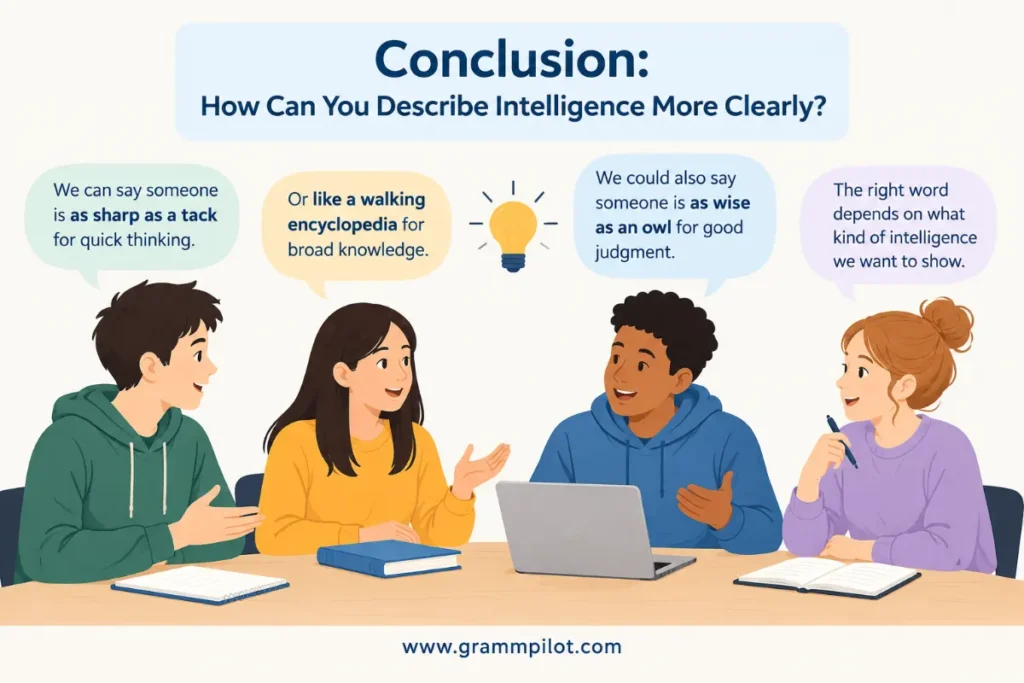
The best descriptions of intelligence show readers what a person can do, not just how smart they are. Similes for Smart can make your writing more vivid by comparing quick thinking to lightning, careful reasoning to a mathematician, or broad knowledge to a walking encyclopedia. choose a comparison that matches the quality you want to highlight. Use clever for inventive solutions, perceptive for noticing details, wise for sound judgment, and brilliant for exceptional ideas. In formal writing, specific evidence is often more convincing than a strong adjective alone. If you’re writing an essay, preparing a resume, or sending a friendly message, a clear and natural expression will make your meaning stronger. Start with the idea you want to communicate, then choose the word or comparison that expresses it best.
Frequently Asked Questions
1. What are the best similes for smart?
Some of the best similes for smart are “as sharp as a tack,” “as clever as a fox,” “as wise as an owl,” and “as quick as lightning.” Each highlights a different quality, such as alertness, resourcefulness, judgment, or mental speed.
2. What’s another way to say someone is smart?
You can call someone clever, bright, intelligent, perceptive, resourceful, or quick-witted. Choose the word that best describes their particular strength.
3. What is a simile for a very intelligent person?
“As sharp as a razor” is a useful simile for someone who thinks clearly and notices small details. “Like a walking encyclopedia” works better for someone with extensive knowledge.
4. What is a simile for a smart student?
“A smart student is like a sponge soaking up knowledge” suggests that the student learns eagerly and absorbs new information quickly.
5. What is a formal word for smart?
Intelligent is a widely accepted formal alternative to smart. Depending on the context, analytical, astute, insightful, or discerning may express a more specific ability.
6. Is “as sharp as a tack” a simile?
Yes, “as sharp as a tack” is a simile because it compares a person’s mental sharpness to a tack’s physical sharpness using the word as.
7. What is the difference between smart and clever?
Smart is a broad word for the ability to learn, understand, and reason. Clever often emphasizes finding an effective solution or thinking of an original idea.