
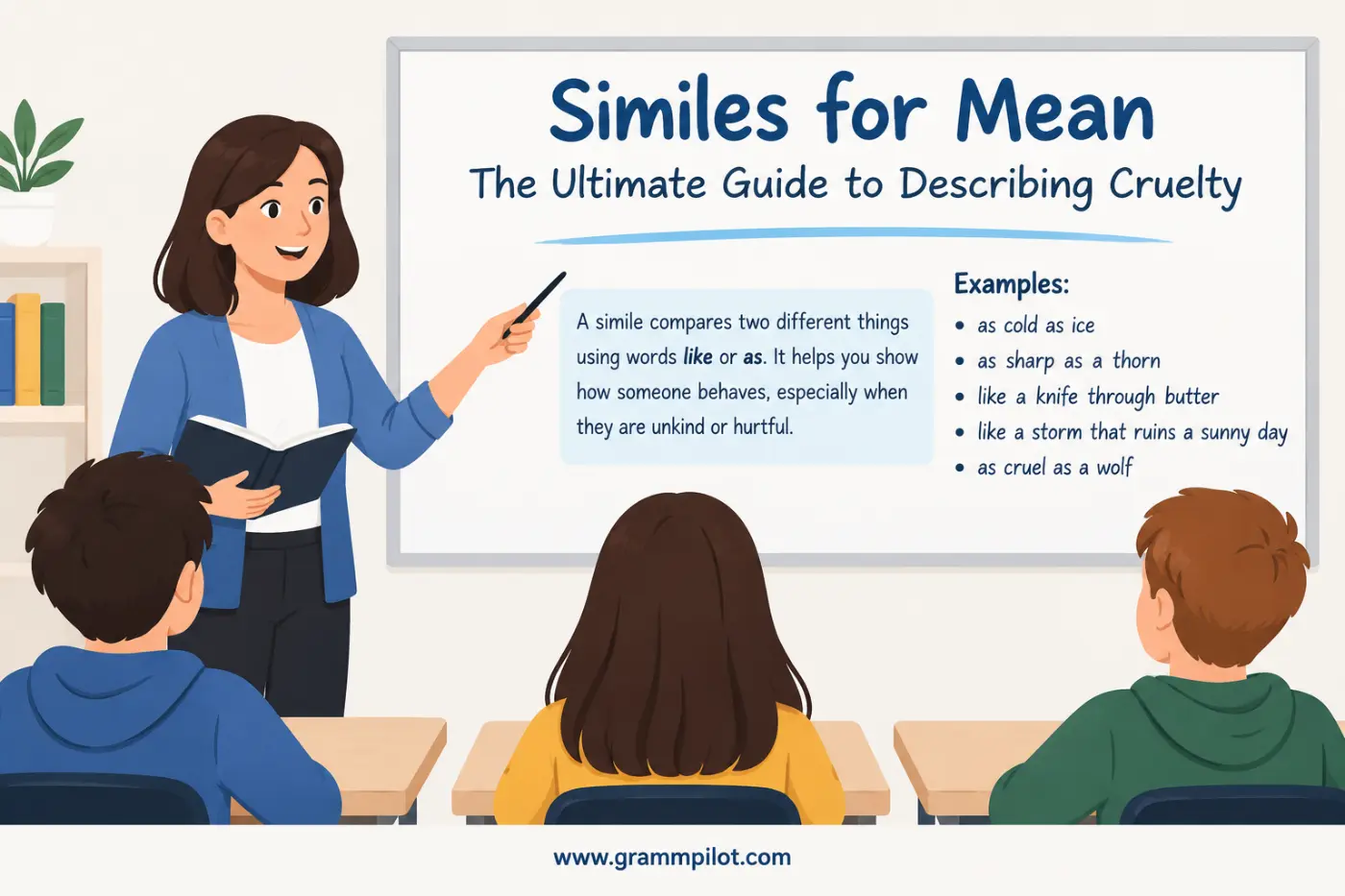
Imagine writing a story about a classmate who laughs when someone makes a mistake. You could call the classmate mean, but that one word might not fully show how hurtful the behavior feels. Using similes for mean behavior can help readers picture cruelty, understand emotions, and connect with a character. A simile compares two different things using words such as like or as. When you describe a mean person as “as sharp as a thorn,” you suggest that their words can hurt others. A comparison like “his comments stung like a bee” makes the emotional pain easier to imagine.
Similes for mean behavior are comparisons that describe cruelty, unkindness, harsh words, or hurtful actions by connecting them to familiar people, objects, animals, or experiences. They help writers show how someone acts instead of simply labeling that person as mean. In this guide, you’ll find more than 30 useful comparisons, explanations of their meanings, examples for school and everyday life, and alternatives ranging from mildly unkind to deeply cruel. You’ll also learn how to choose a comparison that fits your story, essay, conversation, or message.
Looking for more ways to make your writing expressive? Read Similes for Emotions.
What Does Mean Behavior Look Like in a Simile?
Mean behavior happens when someone treats another person in an unkind, hurtful, or disrespectful way. It may involve insults, teasing, exclusion, selfishness, or deliberate attempts to embarrass someone.
A simile makes that behavior easier to picture.
For example:
- She was as prickly as a thorn.
- His words cut like a knife.
- He laughed like a hyena when his friend fell.
- Her reply was as cold as ice.
Each comparison describes a different kind of unkindness. The thorn suggests someone who pushes others away or causes pain. The knife suggests deeply hurtful words. The hyena comparison suggests cruel laughter, while the ice comparison suggests a lack of warmth or sympathy.
Why do writers compare mean people to familiar things?
Comparisons make descriptions more vivid. Instead of telling readers that a character is unpleasant, a writer can show how that character makes other people feel. A strong comparison can communicate several things at once:
- Emotion: Does the behavior create sadness, fear, anger, or embarrassment?
- Intensity: Is the person mildly rude or deliberately cruel?
- Action: Does the person insult, ignore, mock, threaten, or reject someone?
- Effect: Does the behavior leave others feeling hurt, unwanted, or afraid?
The best comparison depends on what you want readers to understand.
What Is the Origin of Similes and the Word Mean?
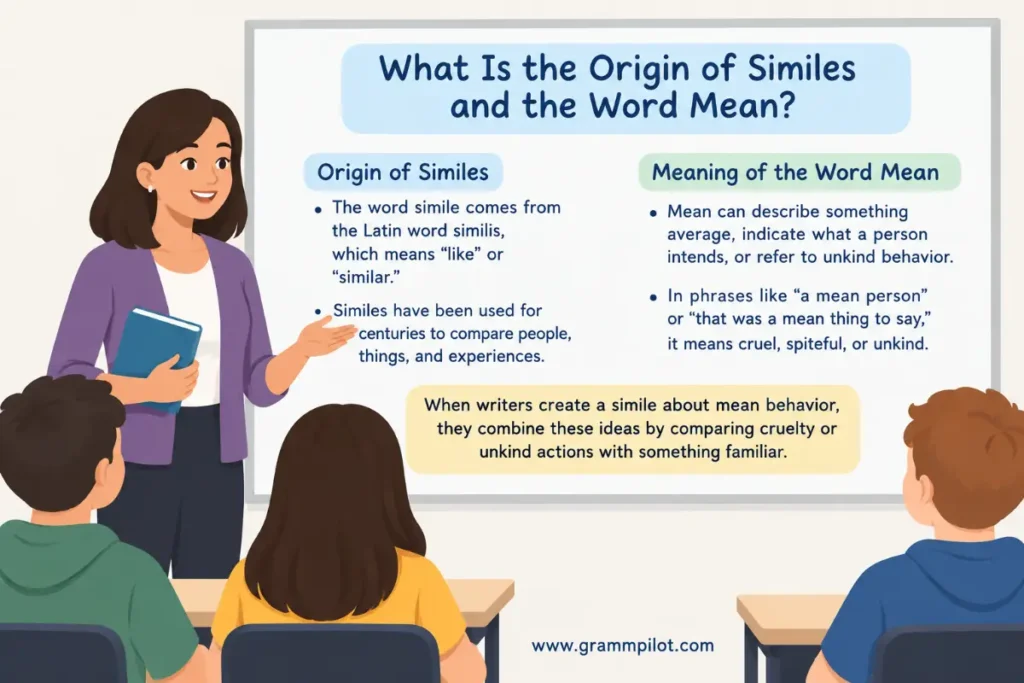
A simile is a figure of speech that compares two different things, often using like or as. The word simile comes from the Latin word similis, meaning “like” or “similar.” People have used comparisons for centuries to describe emotions, human behavior, nature, and everyday experiences. Comparisons make abstract ideas easier to understand because they connect them to something familiar. The English word mean has several meanings. It can describe something average, indicate what a person intends, or refer to unkind behavior. In expressions such as “a mean person” or “that was a mean thing to say,” the word describes someone or something that is cruel, spiteful, or unkind. When writers create a simile about mean behavior, they combine these ideas. They compare unkind actions or personalities with something readers can recognize. For example, “Her words were like broken glass” connects hurtful speech with a sharp object that can cause injury. The comparison doesn’t mean that the words are physically sharp. It shows that they can leave emotional pain.
How is a simile different from a metaphor?
A simile makes a comparison directly, while a metaphor describes one thing as another without using a comparison word.
| Figure of speech | Example | Meaning |
|---|---|---|
| Simile | His words were like knives. | His words caused emotional pain. |
| Metaphor | His words were knives. | His words were deeply hurtful. |
| Literal description | His words were cruel. | He spoke in an unkind way. |
All three sentences describe hurtful speech, but they create different effects. A simile makes the comparison clear, while a metaphor can sound more direct and dramatic.
What Are the Best Similes for Mean People?
The following comparisons describe different forms of unkindness. Some suit a children’s story, while others work better in a serious essay or dramatic scene.
1. As prickly as a thorn
This comparison describes someone who is difficult to approach and quick to hurt others with their words or actions. Example: “Mason was as prickly as a thorn whenever someone tried to help him.” Use it when a character responds to kindness with irritation, rude remarks, or an unfriendly attitude.
2. As cold as ice
This simile describes someone who shows little warmth, concern, or sympathy. Example: “She was as cold as ice when her teammate began to cry.” It works particularly well when someone ignores another person’s feelings or refuses to offer comfort.
3. Like a knife through butter
This comparison can describe words that cut through someone’s confidence or feelings with painful ease. Example: “His insult went through her confidence like a knife through butter.” The expression emphasizes how easily the remark caused damage. It is more dramatic than simply saying that the insult was rude.
4. As sharp as a thorn
This describes someone whose comments are cutting, sarcastic, or deliberately hurtful. Example: “Her replies were as sharp as thorns whenever her brother asked a question.” The comparison works best for verbal cruelty rather than physical behavior.
5. Like a bee that keeps stinging
This simile suggests repeated teasing or insults that continue to hurt someone. Example: “The bully followed him with comments like a bee that kept stinging.” It is useful when the cruelty happens repeatedly instead of in one isolated moment.
6. As bitter as spoiled milk
This comparison describes an unpleasant attitude filled with resentment or bitterness. Example: “His response was as bitter as spoiled milk after he lost the competition.” It can describe resentment, but it doesn’t automatically mean that the person is cruel. Use it when bitterness is the main feeling.
7. Like a storm that ruins a sunny day
This simile describes someone whose harsh behavior suddenly spoils a happy moment. Example: “Her cruel joke arrived like a storm that ruined a sunny day.” It works well in stories where the contrast between happiness and hurt matters.
8. As unforgiving as a stone
This comparison describes someone who refuses to show mercy or understanding.
Example: “The coach was as unforgiving as a stone when the player explained his mistake.”
Use this carefully. Strictness is not always meanness, so the surrounding situation should make the lack of compassion clear.
9. Like a thorn hidden in a rose
This simile describes someone who seems pleasant at first but later reveals a hurtful side.
Example: “His friendly smile hid a cruel streak like a thorn hidden in a rose.”
It is especially useful for characters whose outward appearance differs from their behavior.
10. As biting as a cold winter wind
This comparison describes remarks that feel harsh, unpleasant, or emotionally painful.
Example: “Her criticism was as biting as a cold winter wind.”
It can suit serious writing because it emphasizes the effect of the words rather than simply calling the speaker mean.
11. Like a door slammed in your face
This simile describes rejection delivered in a harsh or humiliating way.
Example: “When he asked to join the group, their response felt like a door slammed in his face.”
It works for stories about friendship, exclusion, and disappointment.
12. As sour as an unripe lemon
This describes someone who responds with irritation, negativity, or an unpleasant attitude.
Example: “He gave everyone an answer as sour as an unripe lemon.”
This is a lighter comparison that may suit humorous writing or a mild description of a grumpy character.
13. Like broken glass underfoot
This simile describes an environment or interaction in which every step feels risky or painful.
Example: “Talking to her after the argument felt like walking over broken glass.”
It focuses on the experience of dealing with someone, rather than labeling the person alone.
14. As cruel as a wolf in a fairy tale
This comparison describes a character who deliberately frightens, deceives, or harms others.
Example: “The villain was as cruel as a wolf in a fairy tale, enjoying the fear he created.”
It works well in fantasy, fables, and stories with a clear villain.
15. Like a match thrown into dry grass
This simile describes someone who makes a tense situation worse with a careless or cruel remark. “His sarcastic comment spread through the argument like a match thrown into dry grass.” Use it when the person’s behavior increases conflict rather than calming it.
What Are Some More Creative Comparisons for Mean Behavior?
If you want a more original description, think about the kind of pain the behavior causes. Physical images can help, but weather, sounds, and everyday experiences can be just as effective.
| Simile | What it suggests | Example sentence |
|---|---|---|
| Like a bell that never stops ringing | Repeated irritating remarks | His teasing followed her like a bell that never stopped ringing. |
| As welcoming as a locked gate | Exclusion or rejection | The group was as welcoming as a locked gate. |
| Like salt rubbed into a wound | Making existing pain worse | Her joke felt like salt rubbed into a wound. |
| As gentle as a falling brick | A complete lack of delicacy | His response was as gentle as a falling brick. |
| Like a shadow on a bright day | Spoiling a happy moment | His sneer followed the celebration like a shadow on a bright day. |
| As warm as a frozen window | Emotional distance | Her greeting was as warm as a frozen window. |
| Like a hammer smashing a fragile cup | Damaging someone’s confidence | His criticism hit her confidence like a hammer smashing a fragile cup. |
| As pleasant as a toothache | An unpleasant personality or experience | The conversation was as pleasant as a toothache. |
| Like a wall built between friends | Creating distance | Their cruel gossip rose like a wall between friends. |
| As sweet as vinegar | Fake or unpleasant friendliness | His praise sounded as sweet as vinegar. |
| Like a cloud covering the sun | Bringing sadness to others | Her mocking laugh passed over the room like a cloud covering the sun. |
| As welcoming as a storm at sea | Making others feel unsafe | His temper was as welcoming as a storm at sea. |
These examples are not all equally severe. Some describe simple unpleasantness, while others suggest deliberate emotional harm. That difference matters when you choose a comparison for a character.
What Words Can Replace Mean? A Master Synonym List
The word mean is useful, but it can be vague. If you want a clearer description, choose a synonym that explains what the person actually does.
The following list groups alternatives by tone and common use.
| Word | Meaning | Tone | Example |
|---|---|---|---|
| Unkind | Not considerate or caring | Simple | That was an unkind comment. |
| Nasty | Very unpleasant or hurtful | Everyday | She made a nasty remark. |
| Cruel | Causing pain without enough concern | Strong | The cruel joke embarrassed him. |
| Hurtful | Causing emotional pain | Everyday | Her hurtful message stayed with me. |
| Selfish | Caring mainly about oneself | Everyday | His selfish choice affected everyone. |
| Thoughtless | Failing to consider others’ feelings | Everyday | That was a thoughtless thing to say. |
| Insensitive | Not noticing or respecting feelings | Everyday | The comment sounded insensitive. |
| Coldhearted | Showing little sympathy | Strong | The coldhearted response shocked us. |
| Hostile | Showing anger or opposition | Formal | He took a hostile tone. |
| Abusive | Using harmful words or actions to control or hurt | Strong | The report described abusive behavior. |
| Heartless | Showing no sympathy | Strong | The heartless joke hurt her deeply. |
| Scornful | Showing strong disrespect | Formal | His scornful reply ended the discussion. |
| Petty | Small-minded or focused on minor grievances | Everyday | They started a petty argument. |
| Mean-spirited | Intentionally unpleasant or unkind | Everyday | The prank was mean-spirited. |
| Jerkish | Behaving like an inconsiderate person | Informal | His jerkish behavior ruined the evening. |
| Bullying | Repeatedly intimidating or harming someone | Serious | The school addressed the bullying behavior. |
| Spiteful-minded | Inclined to act from spite | Uncommon | The story portrays a spiteful-minded rival. |
Some words overlap, but they are not interchangeable in every sentence. For example, thoughtless often describes harm caused without careful thought, while malicious suggests an intention to cause harm.
Which Synonyms for Mean Are Mild, Moderate, or Strong?
The level of intensity matters. Calling a person thoughtless makes a different judgment from calling that person vicious.
Mild: careless or unpleasant behavior
Use these words when someone behaves badly but may not intend to hurt anyone.
- Thoughtless: The person doesn’t consider how others may feel.
- Rude: The person ignores basic manners.
- Unkind: The behavior lacks care or consideration.
- Insensitive: The person overlooks emotional needs.
- Petty: The person focuses on small disputes or minor revenge.
- Snarky: The person makes sharp, mocking comments.
Example: “His thoughtless joke embarrassed his friend.”
This sentence describes a hurtful result without claiming that the speaker planned to cause pain.
Moderate: deliberate disrespect
These words fit situations where someone repeatedly acts disrespectfully or seems aware of the harm they cause.
- Nasty: Unpleasant or hurtful in words or actions.
- Harsh: Severe, blunt, or lacking gentleness.
- Spiteful: Motivated by a wish to upset someone.
- Hostile: Openly unfriendly or opposed.
- Contemptuous: Treating someone as unworthy of respect.
- Mean-spirited: Showing an unkind attitude.
Example: “She made a spiteful comment about his poor test score.”
The word spiteful suggests more than a careless mistake. It points toward an intention to hurt.
Strong: serious cruelty or harmful conduct
Use these words when the behavior is severe, threatening, or deliberately harmful.
- Cruel: Causing suffering without proper concern.
- Heartless: Showing very little sympathy.
- Callous: Unmoved by someone else’s pain.
- Vicious: Extremely aggressive or cruel.
- Malicious: Intended to cause harm.
- Abusive: Harmful behavior used to hurt, intimidate, or control.
- Vindictive: Driven by a desire for revenge.
Example: “He launched a malicious campaign to ruin her reputation.”
A strong word should match the evidence. Don’t describe every disagreement as abuse or every rude comment as vicious. Accurate language makes your writing more credible.

What Are the Best Similes for Mean by Part of Speech?
The word mean can function as an adjective, verb, or noun, depending on the sentence. However, when people ask for comparisons describing a mean person, they usually want alternatives to the adjective.
Adjectives that describe an unkind person
Adjectives describe people, actions, or things.
Examples include:
- Cruel
- Rude
- Spiteful
- Harsh
- Coldhearted
- Nasty
- Callous
- Insensitive
Example: “The spiteful student spread an embarrassing rumor.” You can also use a simile after a linking verb: “The student was as prickly as a thorn.”
Nouns that describe unkind behavior
Nouns name actions, qualities, or experiences.
Useful choices include:
- Cruelty
- Rudeness
- Spite
- Hostility
- Malice
- Insensitivity
- Harassment
- Bullying
Example: “Her cruelty made the other students afraid to speak.” A noun often works better when discussing behavior in an essay or report.
Verbs that describe mean actions
Verbs show what someone does.
Useful options include:
- Mock
- Insult
- Humiliate
- Ridicule
- Taunt
- Belittle
- Exclude
- Intimidate
- Torment
Example: “The older students mocked the boy’s accent.” Verbs are especially helpful because they show the action instead of relying on a general label.
Adverbs that describe how someone acts
Adverbs explain how an action happens.
Examples include:
- Cruelly
- Rudely
- Harshly
- Spitefully
- Mockingly
- Sarcastically
- Callously
Example: “He laughed cruelly when his teammate missed the shot.” Choosing the right part of speech makes your sentence clearer and easier to read.
How Can You Describe Mean Behavior in Different Situations?
A good description depends on where the writing will appear. A funny story may need a playful comparison, while a school report needs precise language.
What should you write in a resume?
A resume usually isn’t the place for figurative descriptions of someone’s personality. If you need to describe a difficult workplace experience, focus on observable conduct and professional effects.
- Instead of writing, “My manager was as cold as ice“
- Write: “My manager often dismissed employee concerns without discussion.”
If you’re describing your own strengths, use positive terms such as respectful, collaborative, patient, and professional. For a workplace complaint, specific examples are more useful than labels. Explain what happened, when it happened, and how it affected the work.
What should you write in an essay?
An essay may benefit from a clear simile when the comparison supports your main point.
Example: “The character’s insults fell like stones, making every conversation harder for his younger brother.” This sentence connects the behavior to its emotional effect. In a formal analytical essay, follow the comparison with evidence from the text.
Avoid filling an academic paragraph with several comparisons that all mean the same thing. One precise image is usually stronger than a long string of adjectives.
What should you write in a text message?
Text messages are often short and informal. You can use a simple description or a light comparison when you want to explain how someone’s words felt.
Examples:
- “That comment was pretty harsh.”
- “Your reply felt as cold as ice.”
- “That joke was uncalled for.”
- “Your message came across as spiteful.”
If you’re trying to solve a disagreement, describe the behavior rather than attacking the person’s whole character. For example, “That comment hurt me” is often more productive than “You’re a terrible person.”
What should you write in an email?
Emails work best when the wording is calm and specific. Example: “The response felt dismissive, and I would appreciate a more respectful discussion.”
For a creative or personal email, a comparison may fit: “Your reply landed like a slammed door and left little room for discussion.”
For a professional complaint, avoid dramatic comparisons unless they serve a clear purpose. State the action, its effect, and the change you want.
What should you say in everyday conversation?
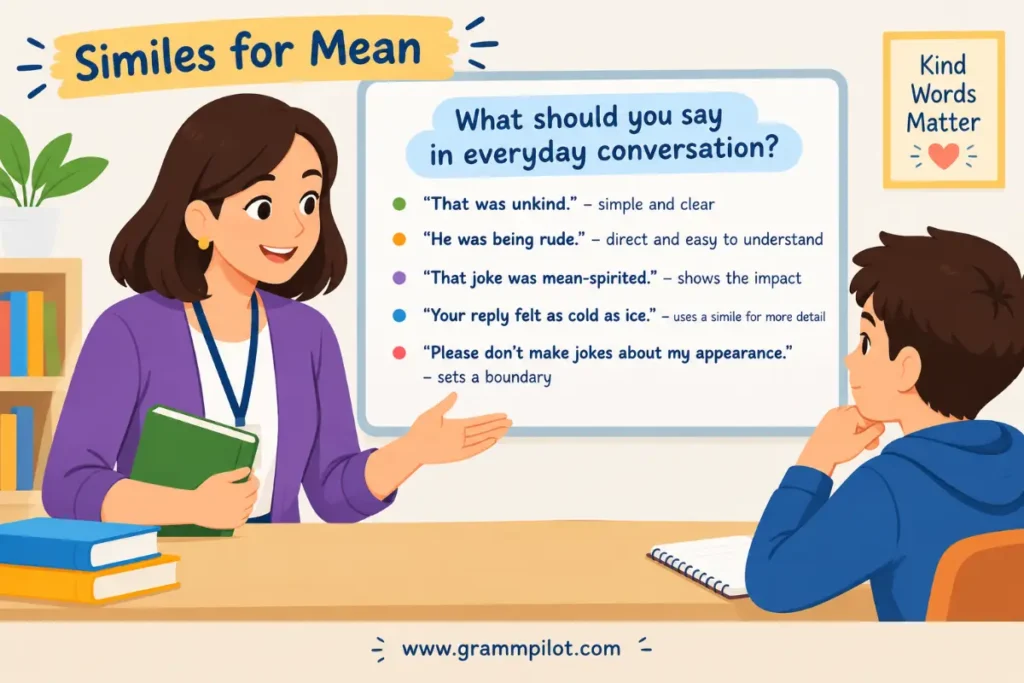
When speaking, choose words people understand immediately.
Examples:
- “That was unkind.”
- “He was being rude.”
- “Her joke was mean-spirited.”
- “His words stung like a bee.”
If you want to set a boundary, focus on the action: “Please don’t make jokes about my appearance.” This approach is direct without adding unnecessary insults.
What are some real-life examples?
Here are additional examples from school, family life, friendships, online conversations, and fiction. Each one shows a different kind of unkindness.
- Classroom teasing: “His laughter was like a siren, drawing everyone’s attention to her mistake.”
- Family argument: “Her words were as sharp as shards of glass.”
- Broken friendship: “Their cold silence stood between them like a locked gate.”
- Online bullying: “The cruel comments arrived like stones thrown at a window.”
- Workplace conflict: “His criticism fell like hail on a fragile idea.”
- Social exclusion: “The group treated her like a stranger outside a locked house.”
- Sarcastic remarks: “His sarcasm was like a thorn hidden inside a compliment.”
- A selfish decision: “He grabbed the last seat like a dog guarding its bone.”
- A cruel joke: “Her joke hit him like a sudden slap of icy water.”
- A hostile argument: “The conversation crackled like a storm ready to break.”
- A dismissive reply: “His answer closed the discussion like a heavy iron door.”
- A bitter rival: “She watched his success like a storm cloud gathering over a sunny field.”
- Repeated insults: “The teasing tapped at his confidence like a leak dripping through the night.”
- A threatening character: “He stood over the frightened child like a thundercloud ready to burst.”
- A fake apology: “His apology sounded as hollow as an empty drum.”
These comparisons are original examples, not fixed expressions that every reader will already know. That gives you room to adjust the imagery to fit your own writing.
What Is the Difference Between Mean, Rude, Cruel, and Spiteful?
These words describe related behaviors, but their meanings differ.
| Word | Main idea | Example |
|---|---|---|
| Mean | General unkindness | “That was a mean thing to say.” |
| Rude | Lack of manners or respect | “He interrupted her and walked away.” |
| Cruel | Causing suffering with little concern | “She enjoyed watching him struggle.” |
| Spiteful | Wanting to hurt or upset someone | “He spread a rumor to get revenge.” |
Mean vs. rude: what’s the difference?
Mean is broader than rude. Rudeness often involves poor manners, such as interrupting, shouting, or ignoring a greeting. Mean behavior may involve those actions, but it can also include teasing, exclusion, and deliberate emotional harm.
For example, someone who forgets to say thank you may be rude or thoughtless. Someone who mocks another person’s failure to make them feel ashamed is behaving meanly.
A useful simile for rude behavior might be “as abrupt as a slammed door.” For deliberate unkindness, “like a thorn hidden in a rose” may communicate more.
Mean vs. cruel: which word is stronger?
Cruel usually suggests more serious suffering or a stronger lack of compassion. Mean can describe something small, such as a sarcastic remark or an unfair joke.
Compare these sentences:
- “He made a mean joke about her haircut.”
- “He cruelly mocked her appearance every day.”
The second sentence describes repeated behavior with a more serious emotional effect.
Mean vs. spiteful: what is the key difference?
Spiteful highlights the desire to hurt someone, often because of anger, jealousy, or revenge. Mean doesn’t always tell us why someone behaved badly.
Compare:
- “She was mean when she criticized his drawing.”
- “She made a spiteful comment because she wanted him to fail.”
The second example gives a motive. Use spiteful when the intention to upset or punish someone is central to the situation.
What Are Common Mistakes When Describing Mean People?
Figurative language can make writing vivid, but an unsuitable comparison can confuse readers or make a sentence sound exaggerated.
Mistake 1: Using a comparison that doesn’t fit
A comparison should connect logically to the behavior.
Weak example: “He was mean like a pencil.”
The reader has little reason to connect a pencil with cruelty.
Better example: “His words were as sharp as a thorn.”
The image of a thorn makes the intended meaning easier to understand.
Mistake 2: Confusing strictness with cruelty
A teacher who gives a difficult assignment isn’t necessarily mean. A parent who sets a reasonable rule isn’t automatically cruel. Describe what the person actually does.
- Instead of: “The teacher was cruel because she gave us homework.”
- Try: “The teacher’s response felt harsh because she refused to listen to our explanation.”
The second sentence explains the problem without treating every unpleasant experience as cruelty.
Mistake 3: Using the strongest word every time
Words such as vicious, malicious, and abusive carry serious meanings. Using them for minor disagreements can make your description less accurate. Choose a word that matches the behavior and the evidence.
Mistake 4: Repeating the same comparison
If every hurtful remark is described as a knife, your writing can become predictable. Vary the image according to the situation. Use weather for an atmosphere of conflict, broken objects for emotional damage, or thorns for a difficult personality.
Mistake 5: Confusing a simile with a literal statement
“Her words cut like knives” is figurative language. It describes emotional pain, not a physical injury. Make sure the surrounding sentences help readers understand the intended meaning.
Mistake 6: Attacking the person instead of describing the action
Calling someone a monster may express anger, but it doesn’t explain what happened.
Compare:
- “He’s a monster.”
- “He laughed at her mistake and encouraged everyone else to join in.”
The second sentence gives readers evidence and lets them understand why the behavior was harmful.
When should you avoid similes for mean behavior?
Avoid elaborate comparisons when accuracy, fairness, or sensitivity matters more than dramatic effect.
For example:
- In a workplace complaint, describe specific conduct.
- In an academic essay, support figurative language with evidence.
- In a serious report, avoid exaggeration.
- In a personal disagreement, explain the effect of the action instead of using a comparison to insult someone.
- When writing about real people, distinguish what you observed from what you assume about their intentions.
Figurative language should clarify your message, not replace the facts.
What Are the Antonyms of Mean?
Antonyms are words with opposite or contrasting meanings. If mean describes unkind behavior, its opposites can help you describe kindness, respect, and compassion.
| Antonym | Meaning | Example |
|---|---|---|
| Kind | Caring and considerate | She was kind to the new student. |
| Gentle | Soft and careful | He gave a gentle reply. |
| Compassionate | Concerned about others’ suffering | The compassionate nurse listened patiently. |
| Thoughtful | Considerate of other people’s needs | Her thoughtful message cheered him up. |
| Friendly | Warm and welcoming | The friendly neighbor offered help. |
| Respectful | Showing regard for others | They had a respectful disagreement. |
| Generous | Willing to give or share | His generous offer surprised everyone. |
| Sympathetic | Showing understanding for another’s feelings | She gave him a sympathetic smile. |
You can also use positive similes to create a clear contrast.
For example, “Her voice was as gentle as a summer breeze” creates a different mood from “Her voice was as biting as a winter wind.”
How Can You Choose the Right Simile for Mean Behavior?
Before choosing a comparison, decide what you want the reader to notice.
- For hurtful words: Choose images involving thorns, knives, nettles, or sharp objects.
- For emotional distance: Use ice, frozen windows, locked gates, or empty rooms.
- For repeated teasing: Consider dripping water, buzzing insects, or a ringing bell.
- For public humiliation: Use images of sudden noise, falling objects, or a crowd turning its attention toward someone.
- For revenge: Choose images that suggest poison, a hidden sting, or a trap.
- For a hostile atmosphere: Try storms, dark clouds, crashing waves, or strong winds.
- For mild unpleasantness: Use an unripe lemon, a toothache, or a grumpy animal.
Then check three things.
First, ask about the comparison matches the behavior. Second, consider how strong the description sounds. Finally, read the sentence aloud. If the image feels confusing or exaggerated, choose a simpler one.
A quick editing checklist
- Does the comparison use like or as naturally?
- Can the reader understand the image without extra explanation?
- Does it describe the person’s action, attitude, or effect on others?
- Is the emotional intensity appropriate?
- Does the comparison add something that an ordinary adjective cannot express?
If the answer is yes to most of these questions, the simile is likely doing useful work.
Conclusion: How Can You Describe Mean Behavior More Clearly?
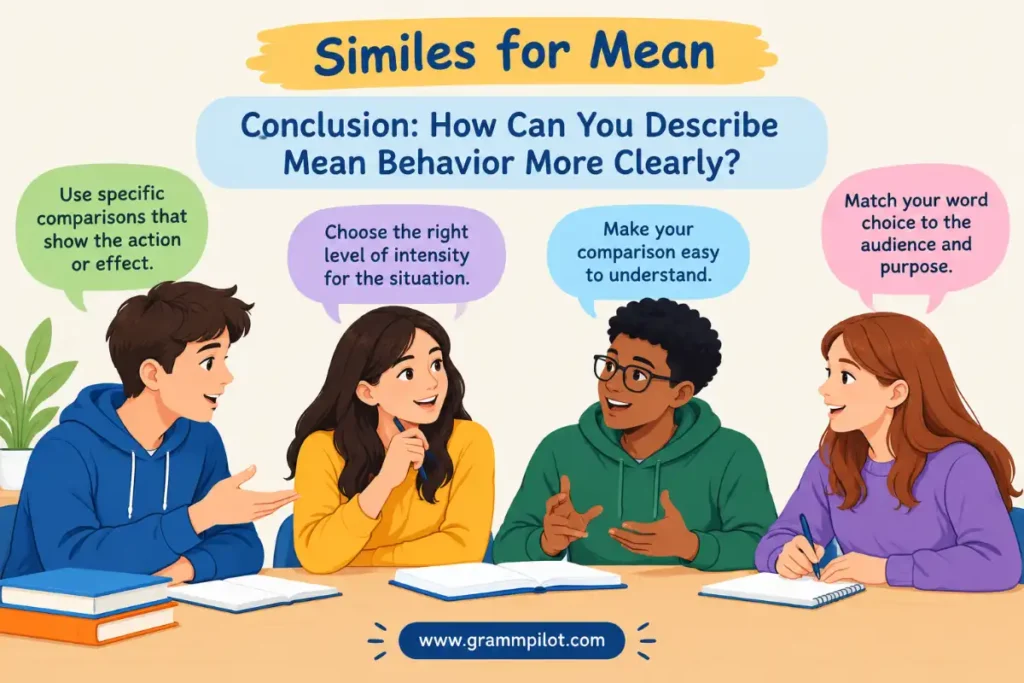
The strongest descriptions explain more than the fact that someone is unkind. They show how that behavior affects other people and why it matters. A comparison such as “as prickly as a thorn” suggests an unfriendly personality, while “like salt rubbed into a wound” shows how a remark can make existing pain worse. When choosing Similes for Mean behavior, consider the situation, the person’s actions, and the effect on the reader. Use mild comparisons for everyday unpleasantness and stronger imagery for deliberate cruelty. If you’re writing a formal essay or reporting a real incident, pair figurative language with clear facts. You don’t need the most dramatic comparison to make a strong point. You need the one that fits. With practice, you’ll be able to describe unkind behavior in a way that feels clear, natural, and memorable.
Frequently Asked Questions
1. What are some good similes for mean people?
Good examples include “as cold as ice,” “as prickly as a thorn,” and “like a thorn hidden in a rose.” Each comparison highlights a different kind of unkindness.
2. What’s another way to say someone is mean?
You can say someone is rude, unkind, nasty, spiteful, harsh, or cruel. Choose the word that best describes the person’s behavior and intention.
3. What is a simile for someone who says hurtful things?
“Her words were as sharp as thorns” is a useful simile for hurtful speech. It suggests that her comments can cause emotional pain.
4. What are some funny similes for a mean person?
You could write “as pleasant as a toothache” or “as welcoming as a locked gate.” These comparisons add humor while showing that someone is unpleasant or unfriendly.
5. What is the difference between a simile and a metaphor about mean behavior?
A simile uses a comparison word such as like or as, while a metaphor describes one thing as another. “His words were like knives” is a simile, while “His words were knives” is a metaphor.
6. How do I describe a mean character without repeating the word mean?
Use precise adjectives such as spiteful, coldhearted, or insensitive, or describe the character’s actions directly. You can also use an original comparison that shows how the character treats others.
7. Can I use similes for mean behavior in a school essay?
Yes, if the comparison supports your point and suits the assignment. In analytical writing, explain how the simile creates meaning and connect it to evidence from the text.