
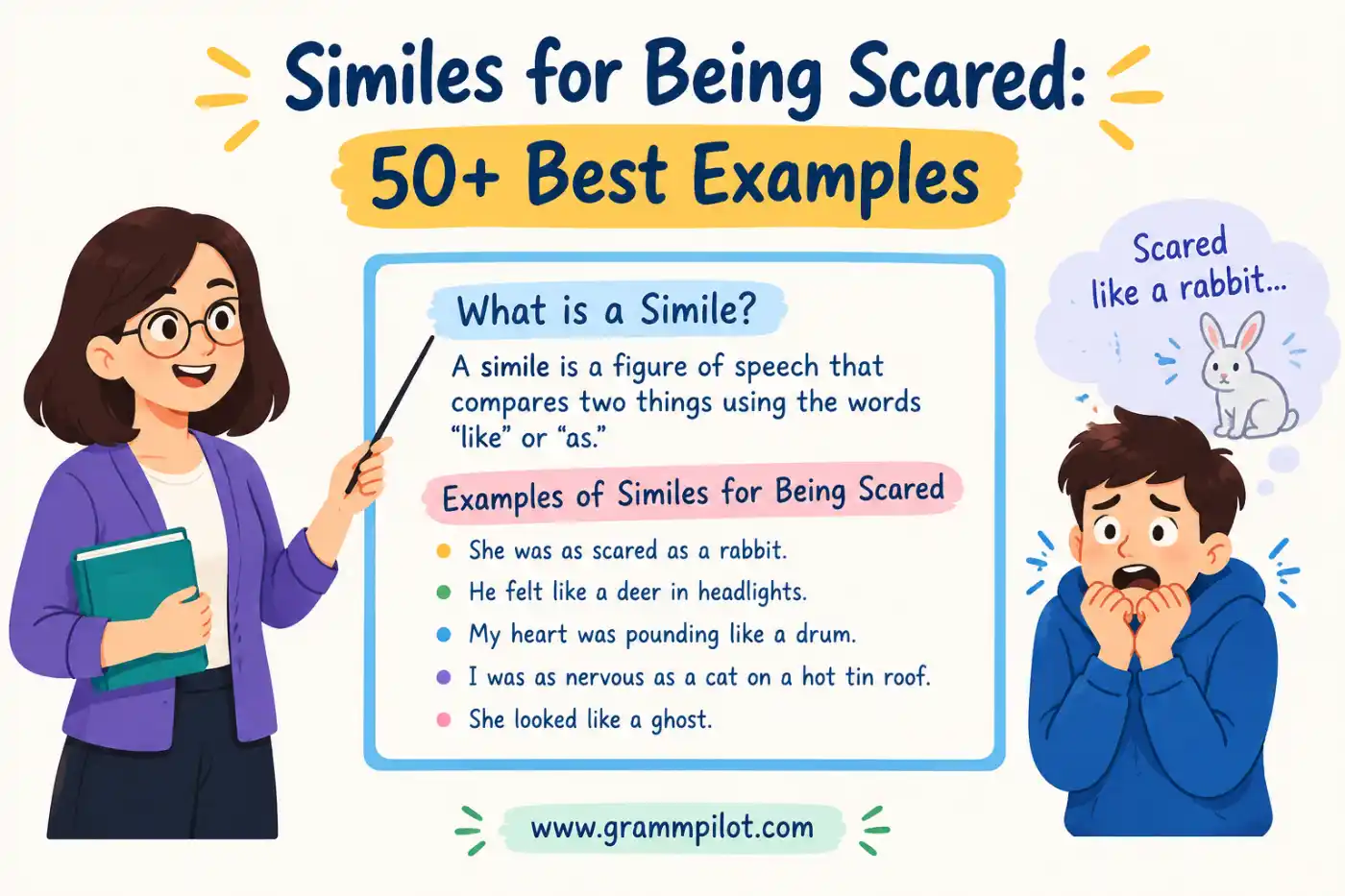
When you’re writing a scary story, describing a nervous moment in an essay, or texting a friend about something frightening, the word scared doesn’t always express how you feel. You might be so nervous that your hands shake, so frightened that you can’t move, or so terrified that your heart seems ready to jump out of your chest. That’s where Similes for Being Scared can help. A well-chosen comparison makes fear easier to imagine. Instead of telling readers that a character is afraid, you can show them what that fear feels like through actions, body language, and vivid images. Similes for Being Scared compare fear or a frightened reaction to something familiar, such as a shaking leaf, a trapped animal, or a frozen statue. They use the words like or as to help readers picture the feeling.
For example, you could write, “My hands shook like leaves in a storm.” This comparison helps readers imagine someone whose fear is difficult to control.
In this guide, you’ll find more than 50 original examples, explanations of how similes work, comparisons arranged by intensity, writing tips, common mistakes, and examples for stories, school essays, everyday conversations, and messages.
What Are Similes for Being Scared?
A simile is a figure of speech that compares two different things using like or as. Writers use similes to describe feelings, people, places, sounds, and experiences in a more vivid way. When you describe fear with a simile, you connect an emotion or physical reaction to something readers already understand.
Consider these two sentences:
- Plain: The boy was very scared.
- With a simile: The boy trembled like a leaf in a winter wind.
The first sentence tells readers how the boy feels. The second gives them a picture of his trembling body and the intensity of his fear. A strong comparison doesn’t need complicated words. An everyday image can be more effective than a long, dramatic description.
How Do Similes Help Describe Fear?
Fear affects people in different ways. Some people shake, some freeze, and others try to escape. A useful comparison helps readers understand the particular reaction you’re describing.
Here are four ways similes can improve your writing:
- Show physical reactions: “Her knees shook like loose branches.”
- Create a mental picture: “He stood as still as a statue.”
- Build suspense: “The silence hung over the room like a dark cloud.”
- Express emotional intensity: “Panic rushed through her like a wildfire.”
The best comparison matches the situation. A person waiting for exam results might feel like a leaf trembling in the wind, while someone facing immediate danger might feel frozen like a statue.
What Is the Origin of the Word Simile?
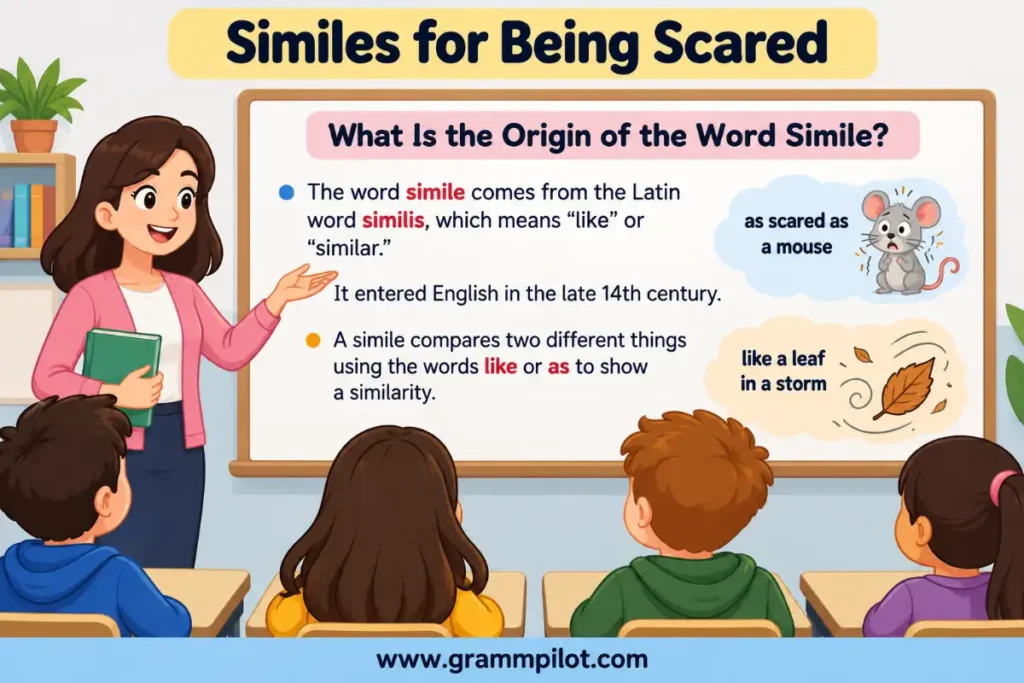
The word simile comes from the Latin word similis, meaning “like” or “similar.” It entered English through a long tradition of literary and rhetorical writing. People have used comparisons for centuries to explain unfamiliar ideas, describe strong emotions, and make stories memorable. Similes appear in poetry, novels, speeches, folktales, and ordinary conversation. Fear is especially suited to comparison because it can be difficult to describe directly. Saying that someone feels afraid gives readers basic information. Comparing that person to a cornered animal or a trembling leaf helps readers picture the reaction. The word scared has a different history.
It developed from an older form of English associated with fright or alarm. Today, it is a common word for feeling fear, if the cause is a loud noise, an upcoming test, or a genuinely dangerous situation. When you combine fear with a simile, you turn an abstract feeling into a more concrete experience.
What Are the 50+ Best Similes for Being Scared?
The following examples cover different types of fear, from mild nervousness to overwhelming terror. Each comparison includes a simple explanation and a sentence showing how to use it naturally.
Similes for Shaking and Trembling
These examples work when fear causes someone to shake, shiver, or lose control of their movements.
| No. | Simile | Meaning | Example sentence |
|---|---|---|---|
| 1 | Like a leaf in the wind | Shaking with fear | My hands fluttered like a leaf in the wind. |
| 2 | Like a rabbit in a thunderstorm | Nervous and easily startled | The little boy looked like a rabbit in a thunderstorm. |
| 3 | Like a branch in a storm | Trembling under pressure | Her knees shook like a branch in a storm. |
| 4 | As shaky as a newborn foal | Unsteady with fear | He stood as shaky as a newborn foal. |
| 5 | Like jelly on a plate | Unable to keep still | My legs felt like jelly on a plate. |
| 6 | Like a candle flame in a draft | Shivering and unsteady | His voice flickered like a candle flame in a draft. |
| 7 | Like a bird trapped indoors | Frightened and restless | She moved like a bird trapped indoors. |
| 8 | As jumpy as a cat near a strange dog | Easily startled | I was as jumpy as a cat near a strange dog. |
These comparisons are especially useful when you want readers to notice the physical effects of fear. The leaf and branch examples suggest shaking, while the trapped bird suggests restless movement.
Similes for Freezing in Fear
Use these when a character becomes still, struggles to react, or feels unable to move.
| No. | Simile | Meaning | Example sentence |
|---|---|---|---|
| 9 | As still as a statue | Completely motionless | He stood as still as a statue when the door creaked. |
| 10 | Like a deer caught in headlights | Shocked and unable to react | I stared at the stranger like a deer caught in headlights. |
| 11 | As frozen as ice | Unable to move from fear | She was as frozen as ice when she heard the scream. |
| 12 | Like a photograph come to life | Stiff and strangely motionless | He stood like a photograph come to life. |
| 13 | Like a mouse hiding in its hole | Too frightened to come out | The child stayed behind the sofa like a mouse hiding in its hole. |
| 14 | As stiff as a wooden board | Rigid with nervousness | His shoulders became as stiff as a wooden board. |
| 15 | Like a shadow nailed to the floor | Unable to move | I stood like a shadow nailed to the floor. |
| 16 | As silent as a graveyard | Frighteningly quiet | The frightened children sat as silent as a graveyard. |
The deer comparison is particularly useful for sudden danger. The statue and ice comparisons work when fear seems to stop every movement.
Similes for Heart-Pounding Fear
These examples describe the racing heart, tight chest, and sudden rush of adrenaline that can accompany fear.
| No. | Simile | Meaning | Example sentence |
|---|---|---|---|
| 17 | Like a drum beating wildly | A rapidly pounding heart | My heart hammered like a drum beating wildly. |
| 18 | Like a racehorse at the starting line | Full of nervous energy | Her heart raced like a racehorse at the starting line. |
| 19 | Like thunder in my chest | Loud, powerful heartbeats | I could feel my heart pounding like thunder in my chest. |
| 20 | Like a trapped bird beating its wings | A restless, pounding heart | His heart fluttered like a trapped bird beating its wings. |
| 21 | Like a roller coaster plunging downward | A sudden rush of fear | My stomach dropped like a roller coaster plunging downward. |
| 22 | Like a fire alarm going off inside me | Sudden, intense alarm | Panic rang through me like a fire alarm going off inside me. |
These comparisons help readers feel the physical side of fear. They’re useful in suspense stories, first-person narratives, and scenes where a character is waiting for something frightening to happen.
Similes for Nervousness and Worry
These comparisons suit everyday worries, school presentations, difficult conversations, and uncertain situations.
| No. | Simile | Meaning | Example sentence |
|---|---|---|---|
| 23 | Like a cat on a hot tin roof | Restless and anxious | I felt like a cat on a hot tin roof before the interview. |
| 24 | Like a ticking clock | Tense while waiting | The minutes passed like a ticking clock before the results arrived. |
| 25 | Like a storm gathering on the horizon | Expecting trouble | A feeling of dread grew like a storm gathering on the horizon. |
| 26 | Like a tight knot | Emotionally tense | Fear sat in my stomach like a tight knot. |
| 27 | Like walking on thin ice | Afraid of making a mistake | I felt like I was walking on thin ice during the meeting. |
| 28 | Like a small boat on rough water | Uncertain and unsettled | She felt like a small boat on rough water before her speech. |
| 29 | Like a balloon about to burst | Struggling to contain anxiety | I felt like a balloon about to burst as the teacher called my name. |
These comparisons are not all equally intense. Walking on thin ice suggests caution, while a balloon about to burst suggests mounting pressure.
Similes for Deep Terror and Panic
Use these stronger comparisons for frightening discoveries, sudden danger, nightmares, and suspenseful scenes.
| No. | Simile | Meaning | Example sentence |
|---|---|---|---|
| 30 | Like a mouse facing a hungry cat | Powerless and terrified | He felt like a mouse facing a hungry cat. |
| 31 | Like a bird facing a storm | Helpless in danger | The stranded traveler felt like a bird facing a storm. |
| 32 | Like a candle about to go out | Fragile and overwhelmed | Her courage flickered like a candle about to go out. |
| 33 | Like a prisoner in a dark room | Trapped and frightened | He felt like a prisoner in a dark room. |
| 34 | Like a ship caught in a hurricane | Overwhelmed by danger | Their small boat tossed like a ship caught in a hurricane. |
| 35 | Like a shadow following me | Unable to escape a frightening feeling | The memory followed me like a shadow. |
| 36 | Like being chased by a wild animal | Driven by panic | I ran like someone being chased by a wild animal. |
| 37 | Like standing at the edge of a cliff | Terrified by uncertainty | Waiting for the verdict felt like standing at the edge of a cliff. |
| 38 | Like a scream trapped in the throat | Too frightened to speak | My words felt like a scream trapped in my throat. |
Strong comparisons should fit the danger in the scene. A cliff or hurricane can suggest overwhelming fear, while a trapped scream emphasizes the inability to express it.
Similes for Fear in Dark or Haunted Places
These examples help create atmosphere in horror stories, ghost stories, and nighttime adventures.
| No. | Simile | Meaning | Example sentence |
|---|---|---|---|
| 39 | As dark as a moonless night | Extremely dark and unsettling | The hallway was as dark as a moonless night. |
| 40 | Like a whisper from the grave | Strange and frightening | A voice drifted through the room like a whisper from the grave. |
| 41 | Like footsteps following me | Feeling watched or pursued | Every sound echoed like footsteps following me. |
| 42 | Like ice creeping down my spine | A sudden chill of fear | A strange noise sent a feeling like ice creeping down my spine. |
| 43 | Like a ghost moving through fog | Unnatural and eerie | A pale figure moved like a ghost through fog. |
| 44 | As quiet as a room waiting for a scream | Tense, unnatural silence | The house was as quiet as a room waiting for a scream. |
| 45 | Like a door opening into the unknown | Fear of what cannot be seen | The basement stairs felt like a door opening into the unknown. |
These comparisons focus on the setting as well as the character’s feelings. In a scary story, darkness, silence, and unexplained sounds can make a scene frightening before anything dangerous appears.
Similes for Fear of Failure or Embarrassment
These comparisons are useful for school, work, sports, and social situations where someone fears making a mistake.
| No. | Simile | Meaning | Example sentence |
|---|---|---|---|
| 46 | Like standing under a spotlight | Feeling exposed or judged | I felt like I was standing under a spotlight during the presentation. |
| 47 | Like a tightrope walker without a net | Afraid of making a serious mistake | She felt like a tightrope walker without a net during the final round. |
| 48 | Like a glass about to fall off a table | Nervous about an approaching mistake | I felt like a glass about to fall off a table as I read my answer aloud. |
| 49 | Like a runner waiting for the starting gun | Nervous before an important event | He stood like a runner waiting for the starting gun. |
| 50 | Like a student facing an unexpected test | Unprepared and anxious | I felt like a student facing an unexpected test. |
| 51 | Like a tight knot ready to snap | Under intense pressure | My nerves felt like a tight knot ready to snap. |
| 52 | Like a balloon caught in a thorn bush | Fragile and afraid of being hurt | Her confidence felt like a balloon caught in a thorn bush. |
These examples make fear relatable without relying on monsters or dangerous settings. They work well in realistic fiction, personal essays, and descriptions of everyday anxiety.
Which Words Describe Different Levels of Fear?
Not every frightened person feels the same degree of fear. Someone who feels uneasy before a meeting is experiencing something different from someone who believes they’re in immediate danger.
Choosing the right intensity makes your writing more accurate.
| Intensity | Useful words | What the person may feel |
|---|---|---|
| Mild | Uneasy, concerned, nervous | Slight discomfort or worry |
| Moderate | Anxious, apprehensive, frightened | Clear worry or fear |
| Strong | Scared, alarmed, terrified | Powerful fear or a strong urge to escape |
| Extreme | Petrified, horrified, panic-stricken | Overwhelming fear or shock |
How Can You Describe Strong Fear?
Strong fear can affect breathing, movement, speech, and decision-making.
Useful comparisons include:
- Like a deer caught in headlights.
- Like a ship caught in a hurricane.
- Like a trapped bird beating its wings.
Example: “When the dog charged toward him, he froze like a deer caught in headlights.” The comparison makes the reaction immediate and easy to picture.
How Can You Describe Extreme Terror?
Extreme terror suits moments when someone believes danger is close or escape is impossible.
Useful comparisons include:
- Like a prisoner trapped in a burning building.
- Like a small boat swallowed by a violent storm.
- Like a scream locked inside the chest.
Example: “As the footsteps approached the locked door, she felt like a scream trapped inside her chest.” use extreme comparisons sparingly. If every scene contains overwhelming terror, readers may stop noticing the difference between ordinary nervousness and genuine danger.
What Words Can Replace “Scared”? A Master Synonym List
The best alternative depends on what the person feels and the situation in which the word appears. Some words describe ordinary worry, while others suggest shock, panic, or deep terror.
The following 30 alternatives are grouped by tone and typical use. Some are close synonyms; others describe a related feeling rather than exactly the same emotion.
| Word | Meaning | Tone | Example |
|---|---|---|---|
| Afraid | Feeling fear | Simple | I was afraid of the dark. |
| Nervous | Worried about what may happen | Simple | She was nervous before the test. |
| Uneasy | Slightly uncomfortable or uncertain | Everyday | I felt uneasy in the empty house. |
| Alarmed | Suddenly worried about danger | Everyday | We were alarmed by the warning. |
| Startled | Suddenly surprised or frightened | Everyday | I was startled by the crash. |
| Apprehensive | Worried about something ahead | Formal | He was apprehensive about the interview. |
| Panicked | Overcome by sudden fear | Everyday | The passengers panicked when the alarm sounded. |
| Horrified | Filled with fear, shock, or disgust | Strong | He was horrified by what he saw. |
| Dreadful | Causing dread or great discomfort | Formal | A dreadful feeling filled the room. |
| Trepidatious | Nervous or apprehensive | Formal | She was trepidatious before the speech. |
| Shaken | Emotionally upset after an event | Everyday | I was shaken by the accident. |
| Spooked | Suddenly frightened | Informal | The strange sound spooked us. |
| Creeped out | Made to feel uneasy or frightened | Slang | That empty house creeps me out. |
| On edge | Tense and easily startled | Informal | Everyone was on edge before the announcement. |
| Shaky | Physically or emotionally unsteady | Everyday | My voice sounded shaky. |
| Wary | Cautious because of possible danger | Everyday | She was wary of the stranger. |
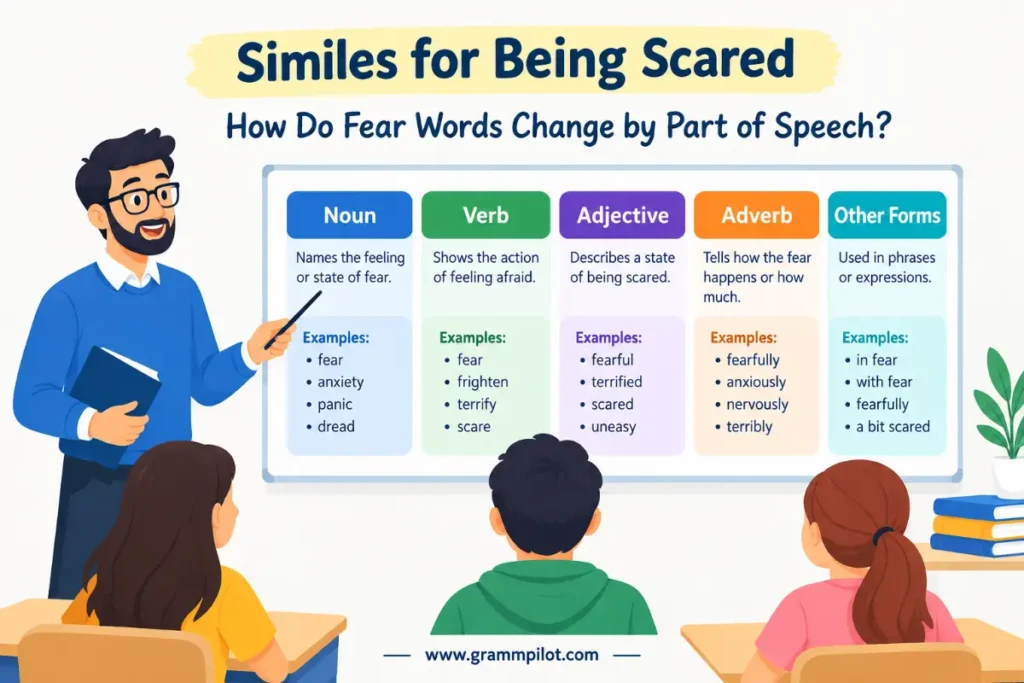
How Do Fear Words Change by Part of Speech?
Understanding grammar helps you use a synonym correctly. Some words describe a person, some name an emotion, and others describe the way someone acts.
| Part of speech | Word | Example |
|---|---|---|
| Adjective | Afraid | I am afraid of heights. |
| Adjective | Frightened | The frightened child hid. |
| Adjective | Apprehensive | She felt apprehensive about speaking. |
| Noun | Fear | His fear was easy to understand. |
| Noun | Anxiety | Her anxiety increased before the test. |
| Noun | Terror | Terror spread through the crowd. |
| Verb | Frighten | Loud noises frighten the dog. |
| Verb | Startle | The sudden bang startled me. |
| Verb | Alarm | The warning alarmed everyone. |
| Adverb | Nervously | He laughed nervously. |
| Adverb | Fearfully | She looked fearfully toward the door. |
| Adverb | Anxiously | They waited anxiously for the news. |
Notice the difference between afraid and fear. In “I am afraid,” the word describes a feeling. In “I feel fear,” the word names the emotion.
Also, remember that scared is usually an adjective in sentences such as “I am scared.” It can also function as the past tense and past participle of scare, as in “The loud noise scared me.”
Are There US and UK Differences in Fear Expressions?
Most common fear words and similes work in both American and British English. Words such as afraid, nervous, frightened, terrified, and petrified are widely understood in both varieties.
The main differences involve informal expressions, spelling preferences, and regional speech.
| Expression | Typical use | Notes |
|---|---|---|
| Scared stiff | Informal | Commonly understood in the US and UK |
| Freaked out | Casual | Especially familiar in American informal speech, but also understood in the UK |
| Spooked | Informal | Used in both varieties |
| Petrified | Strong fear | Common in formal and informal contexts in both varieties |
| Shaken up | Emotional distress after an event | Widely understood in both varieties |
| Jump out of my skin | Sudden fright | Common in both varieties |
There is no need to change a simile simply because you’re writing for a US or UK audience. Focus on if the expression sounds natural for your intended readers and if it matches the character’s voice.
For school essays and professional writing, choose clear expressions such as anxious, frightened, or apprehensive. In dialogue, informal phrases can sound more natural.
Which Fear Expression Works Best in Different Situations?
The setting determines which word or comparison works best. A phrase that sounds natural in a text message may feel out of place in a resume or academic essay.
What Should You Write on a Resume?
A resume should focus on your skills, actions, and ability to handle challenges. Avoid describing yourself as scared unless fear is directly relevant to a personal statement or a specific experience.
Instead of writing, “I was scared of managing a team,” explain how you handled the challenge.
Example: “Although I was initially apprehensive about leading the team, I developed a clear plan and completed the project successfully.”
This wording shows growth and responsibility rather than focusing only on fear.
How Should You Describe Fear in an Essay?
In an essay, choose language that explains the emotion without distracting from your main point.
Example: “Before my first public speech, I felt like a small boat on rough water, uncertain of what would happen next.”
For a more formal essay, you could write, “I felt apprehensive before addressing the audience.”
Use figurative language when it strengthens the description. If your essay is analytical or research-based, a direct description may be more suitable.
What Is a Natural Way to Describe Fear in a Text Message?
Text messages often use simple, casual language. You can choose an informal phrase if it fits the conversation.
Examples:
- “That noise scared me stiff!”
- “I’m freaking out about tomorrow’s exam.”
- “I got so spooked when the lights went out.”
- “I was jumpy the whole time we watched that movie.”
For a lighter situation, humor can make the message feel friendly. For a serious situation, choose words that communicate the level of fear clearly.
How Can You Describe Fear in an Email?
The best wording depends on who will receive the email. A message to a friend can be casual, while an email to a teacher or manager should usually be measured and direct.
Casual example: “I was pretty nervous before the presentation, but it went better than I expected.”
Professional example: “I was initially apprehensive about the new responsibility, but I prepared carefully and completed the assignment.”
You generally don’t need a dramatic simile in a professional email. Clear language helps the reader understand your concern without distracting from the purpose of the message.
How Can You Describe Fear While Speaking?
When speaking, use expressions that are easy to understand immediately.
Examples:
- “I was shaking like a leaf.”
- “My heart was pounding like a drum.”
- “I froze like a statue.”
- “I was so nervous that my stomach felt like a knot.”
Short comparisons work well in conversation because listeners don’t have time to reread a sentence. Choose a familiar image and deliver it naturally.
What Are Some Original Sentences Using Fear Similes?
Here are 12 examples showing how comparisons can work in different situations. Each sentence describes a specific reaction instead of simply repeating that someone is scared.
1. Before a job interview: My stomach twisted like a rope as I waited outside the office.
2. During a thunderstorm: The little dog trembled like a leaf each time lightning flashed.
3. In a horror story: The old staircase groaned like a wounded animal, and I stopped halfway up.
4. Before an exam: My thoughts raced like horses as the teacher placed the test papers on our desks.
5. After hearing a strange noise: I stood as still as a statue, hoping whatever was outside would go away.
6. During a speech: My voice shook like a loose windowpane when I faced the audience.
7. In an unfamiliar place: The empty corridor stretched before me like a tunnel leading into the unknown.
8. When facing a difficult conversation: I felt like a tightrope walker without a net as I prepared to tell the truth.
9. During a suspenseful moment: Every second ticked by like a clock counting down to disaster.
10. After a sudden crash: My heart pounded like a drum as I rushed to see what had happened.
What Is the Difference Between Similar Fear Expressions?
Some words appear interchangeable but communicate different shades of meaning. Understanding those differences helps you choose a comparison that fits the scene.
Scared vs. Terrified: What’s the Difference?
Scared describes fear at many levels, while terrified usually means extremely frightened.
| Scared | Terrified |
|---|---|
| Can describe mild or strong fear | Usually describes intense fear |
| Fits everyday situations | Fits powerful or overwhelming reactions |
| “I was scared of the barking dog.” | “I was terrified when the dog charged at me.” |
Use scared when you don’t need to emphasize intensity. Choose terrified when the character’s reaction is much stronger.
Nervous vs. Anxious: What’s the Difference?
Nervous often describes short-term tension before an event. Anxious can describe that same feeling but may also suggest deeper or longer-lasting worry.
| Nervous | Anxious |
|---|---|
| Often linked to an upcoming event | Can involve an event or ongoing worry |
| “I’m nervous about my speech.” | “I’m anxious about how the meeting will go.” |
| Often sounds conversational | Can sound more serious, depending on context |
Both words are useful for mild to moderate fear. Neither automatically means that someone is in danger.
Afraid vs. Wary: What’s the Difference?
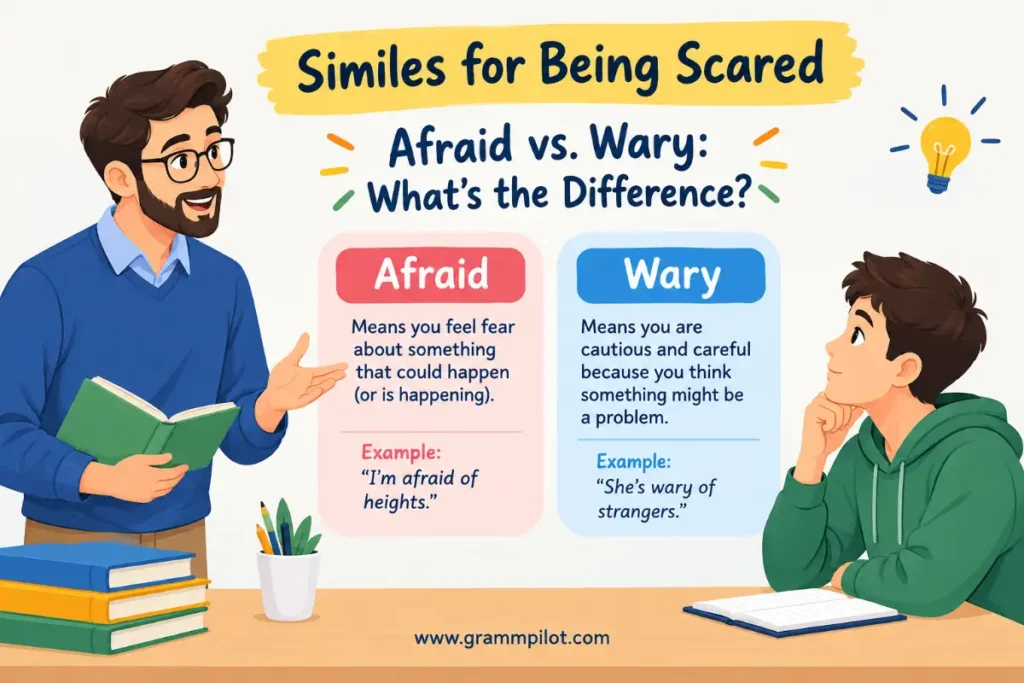
Afraid means feeling fear. Wary means being careful because you suspect something may be unsafe or untrustworthy.
| Afraid | Wary |
|---|---|
| Focuses on the emotion | Focuses on caution |
| “She was afraid of the barking dog.” | “She was wary of the unfamiliar dog.” |
| May involve a strong reaction | Can involve calm, sensible caution |
A person can be wary without being frightened. For example, someone may keep their distance from an unfamiliar animal because they don’t know how it will behave.
Startled vs. Frightened: What’s the Difference?
Startled describes a sudden reaction to something unexpected. Frightened describes a state of fear that may continue after the initial surprise.
Example: “The door slammed and startled me, but the strange footsteps afterward frightened me.”
This distinction is useful when writing suspense. A sudden sound can startle a character, while the uncertainty that follows can make the character afraid.
What Are Common Mistakes When Describing Fear?
A strong comparison makes a sentence clearer. A weak or confusing one can distract readers from the emotion you’re trying to describe.
1. Using a Comparison That Doesn’t Fit
Incorrect or confusing: “He was scared like a delicious cake.”
The image doesn’t have a clear connection to fear.
Better: “He trembled like a leaf in a storm.”
Choose a comparison based on the feeling or reaction you want to show.
2. Mixing Two Different Images
Confusing: “My heart raced like a frozen river on fire.”
This combines images that don’t work together clearly.
Better: “My heart raced like a drumbeat.”
One clear comparison is usually stronger than several unrelated images in one sentence.
3. Using Too Many Similes at Once
Overloaded: “I shook like a leaf, froze like ice, and ran like a frightened rabbit.”
The sentence describes three different reactions without giving any of them enough space.
Better: “I froze like ice when the door opened.”
Choose the comparison that best fits the moment.
4. Making Every Character React the Same Way
Not everyone responds to fear by shaking. Some people become quiet, some look for help, and others act quickly.
Instead of repeatedly writing that characters trembled, show different responses.
Examples:
- Her fingers tightened around the handle.
- He backed away without taking his eyes off the door.
- She swallowed hard and tried to speak.
- He held his breath as the footsteps came closer.
These details can make characters feel more believable.
5. Using Extreme Language for Mild Worry
Calling someone petrified because they’re choosing a restaurant may sound exaggerated unless the sentence is intentionally humorous.
For ordinary uncertainty, nervous, uneasy, or apprehensive may work better.
Match the strength of the word to the strength of the feeling.
6. Forgetting That Similes Use Like or As
A simile directly compares two things using like or as.
Simile: “She shook like a leaf.”
Metaphor: “Fear was a storm inside her.”
Both can be effective, but they are different figures of speech. A metaphor describes one thing as another, while a simile makes the comparison explicit.
What Are the Opposites of Scared?
Antonyms help describe a character whose fear fades or who remains calm in a difficult situation.
| Antonym | Meaning | Example |
|---|---|---|
| Brave | Willing to face danger | She was brave enough to enter the room. |
| Courageous | Showing courage in difficulty | He remained courageous during the crisis. |
| Calm | Peaceful and not agitated | She stayed calm during the storm. |
| Confident | Believing in your ability | He felt confident before the speech. |
| Fearless | Showing little or no fear | The fearless explorer entered the cave. |
| Relaxed | Free from tension | I felt relaxed after the results arrived. |
| Reassured | Made less worried | Her teacher’s advice reassured her. |
These words have different meanings. A brave person can still feel scared, and a calm person may simply be unaware of danger. Use the word that accurately describes the character’s response.
How Can You Choose the Right Fear Simile?
A good comparison is clear, relevant, and suited to the scene. You don’t need the most dramatic expression. You need the one that helps readers understand what is happening.
Follow these practical tips:
- Identify the type of fear. Is the character worried, startled, frozen, or terrified?
- Think about the physical reaction. Are their hands shaking, heart racing, or feet refusing to move?
- Choose a familiar image. A trembling leaf or pounding drum is easy to picture.
- Consider the setting. A dark hallway suits a suspenseful comparison, while a classroom may call for a nervousness-related image.
- Match the tone. A funny story can use playful comparisons, but a serious scene may need restrained language.
- Avoid repetition. If you’ve already used a leaf comparison, describe another reaction in the next sentence.
- Read the sentence aloud. If the comparison sounds awkward, simplify it.
- Don’t force a simile into every sentence. Direct language is often the clearest choice.
A simple test can help: does the comparison show the reader something they couldn’t picture as clearly before? If the answer is yes, it may be worth keeping.

Conclusion: How Can You Describe Fear More Clearly?
Fear can be quiet, sudden, overwhelming, or mixed with uncertainty. The right comparison helps readers understand which kind of fear a character experiences and why the moment matters. The most effective Similes for Being Scared connect an emotion to a familiar image. A shaking leaf can show nervousness, a deer caught in headlights can show a frozen reaction, and a pounding drum can express a racing heart. Each comparison creates a different picture. When writing your own sentences, start by identifying the character’s reaction. Then choose an image that matches the situation and the intensity of the feeling. Avoid piling several comparisons into one sentence, and don’t be afraid to use simple language when it works better. Practice with everyday moments, such as waiting for test results or hearing an unexpected noise. With time, you’ll find it easier to describe fear in a clear, natural, and memorable way.
Frequently Asked Questions
1. What are some good similes for being scared?
Good examples include “shaking like a leaf,” “frozen like a statue,” and “like a deer caught in headlights.” Each describes a different reaction to fear, so choose the one that best fits your scene.
2. What’s another way to say someone is scared?
You can say someone is afraid, nervous, frightened, anxious, alarmed, or terrified. Use nervous for ordinary tension and terrified for much stronger fear.
3. What is a simile for being scared in a horror story?
“Every shadow looked like a hand reaching out of the darkness” is an effective horror-style comparison. It creates an unsettling image without explaining everything, which helps build suspense.
4. What is a simile for being scared and shaking?
“My hands shook like leaves in a storm” is a clear example. It compares trembling hands to leaves moving in strong wind, helping readers picture the physical reaction.
5. What is the difference between a simile and a metaphor for fear?
A simile uses like or as to compare two things, while a metaphor describes one thing as another. “I shook like a leaf” is a simile, while “Fear was a storm inside me” is a metaphor.
6. Can I use fear similes in school essays?
Yes, similes can make descriptive and personal essays more vivid. Choose a comparison that fits the topic, and avoid using too many figurative expressions in a short paragraph.
7. How do I write an original simile about fear?
Think about how fear affects the person, then compare that reaction to something readers can picture. For example, if someone feels trapped, you might write, “My thoughts circled like birds inside a locked room.”