
Writing an email, finishing an essay, or updating a resume can bring you to one tiny question: should you write affect or effect? The words look and sound similar, but they usually play different roles in a sentence. That makes this one of the most common English word-choice problems.
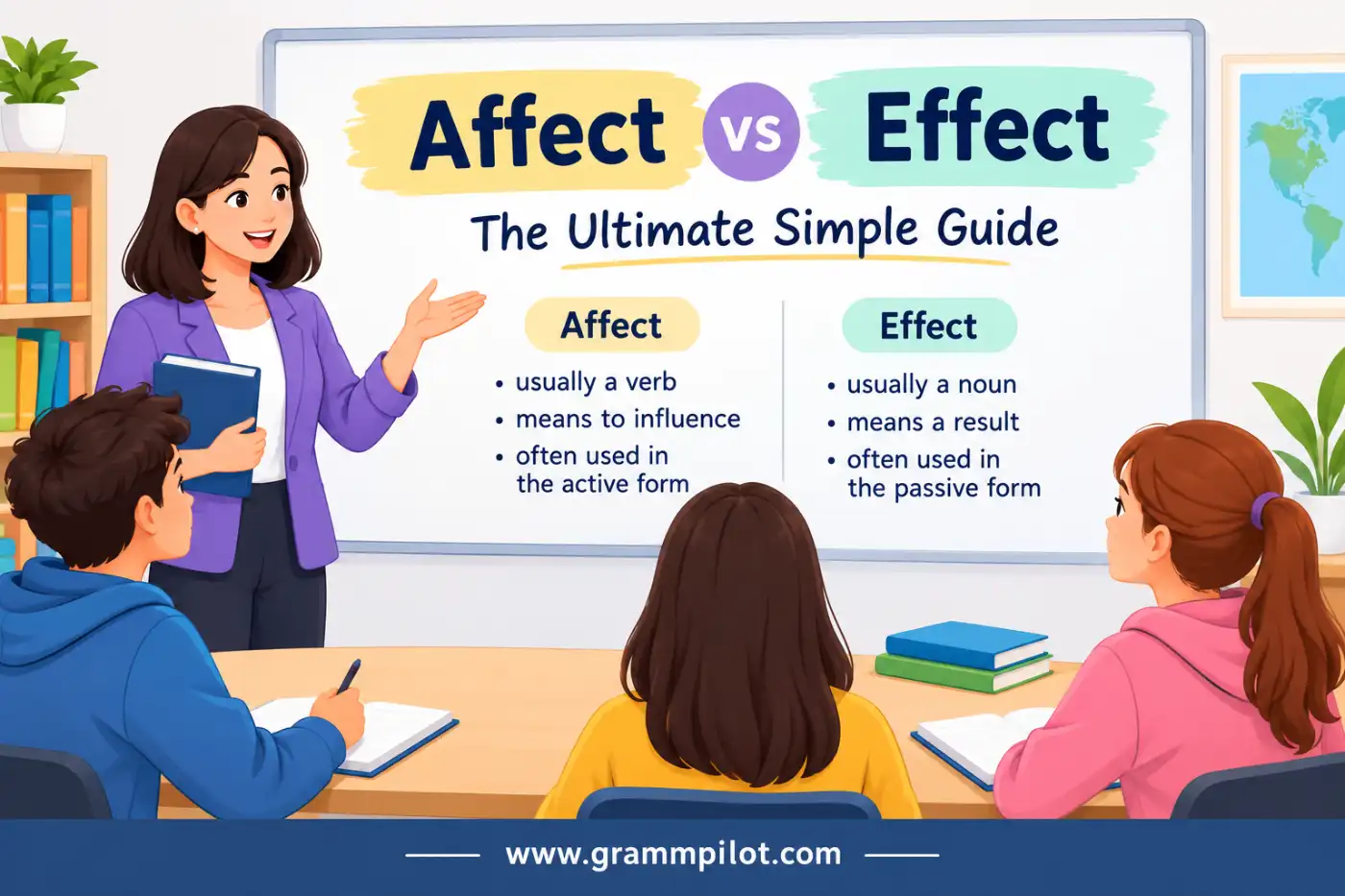
The easiest way to remember Affect vs Effect is this: affect is usually a verb meaning “to influence,” while effect is usually a noun meaning “a result.” For example, “Lack of sleep can affect your focus” means lack of sleep can influence your focus. “Lack of sleep can have an effect on your focus” means it can produce a result in your focus.
Quick answer: Affect usually means to influence or change something. Effect usually means the result or consequence of something. In most everyday sentences, affect is a verb and effect is a noun.
This guide explains the difference in plain English, where the words came from, how their meanings change by context, which alternatives work in formal and casual writing, and how to avoid the mistakes that make these two words confusing.
What is the basic difference between affect and effect?
The main difference is grammatical as well as semantic.
| Word | Most common part of speech | Simple meaning | Example |
|---|---|---|---|
| affect | Verb | influence or change | Stress can affect your sleep. |
| effect | Noun | result or consequence | Stress can have an effect on your sleep. |
Think of a simple chain: Cause → affects → result
For example: Heavy rain affected the game.
The rain changed or influenced the game.
Then: The rain had an effect on the game.
The effect is the result produced by the rain. This pattern works in thousands of everyday sentences.
Is affect a verb or a noun?
Affect is most commonly a verb.
When you use it as a verb, it means to influence something.
Examples:
- The weather affected our travel plans.
- Noise can affect your concentration.
- Her decision affected the whole team.
- Lack of exercise may affect your energy level.
There is also a less common noun affect, especially in psychology and psychiatry. In that specialized use, it refers to a person’s observable emotional expression. For general writing, however, you can safely remember: Affect = influence.
Is effect a verb or a noun?
Effect is most commonly a noun.
As a noun, it means a result, outcome, or consequence.
Examples:
- The new rule had a positive effect.
- The medicine had a strong effect.
- The policy could have a long-term effect.
- Her speech had a powerful effect on the audience.
There is also a formal verb effect, meaning to cause something to happen or bring about a change.
For example:
- The new manager hopes to effect major changes.
- The organization wants to effect reform.
This use is much less common in everyday conversation. For most situations, remember: Effect = result.
Where did affect and effect come from?
The history of these words explains part of the confusion. Both have roots connected to Latin, and their forms became closely related in English. Affect comes from Latin afficere, meaning roughly “to do to,” “to influence,” or “to act upon.” Its history is connected with the idea of something producing an influence on another thing. Effect comes from Latin efficere, meaning “to accomplish,” “to bring about,” or “to produce.” Its history is therefore closely connected with the idea of a result being produced.
That gives you a useful meaning connection:
Affect → influence something
Effect → result produced
The words have changed in use over centuries, but this basic distinction remains useful in modern American English.
What do affect and effect mean in plain English?
If grammar terms feel confusing, forget the grammar for a moment.
Ask what you mean.
If you mean:
- influence
- change
- impact
- alter
- make a difference to
you probably need affect.
If you mean:
- result
- outcome
- consequence
- reaction
- end result
you probably need effect.
Compare these:
The criticism affected her confidence.
The criticism had an effect on her confidence.
Her confidence experienced a result because of the criticism. The meaning is closely connected, but the sentence structure is different.
What are the most useful synonyms for affect and effect?
There isn’t one giant synonym list because the two words have several meanings and grammatical uses. Some alternatives are close matches, while others work only in certain contexts.
The table below groups useful alternatives by tone and purpose.
| Word | Meaning | Tone | Example |
|---|---|---|---|
| Influence | Change how something develops | Everyday/Formal | Sleep can influence your mood. |
| Change | Make something different | Simple | The update changed the system. |
| Alter | Make a change | Formal | The error altered the final result. |
| Modify | Change partly or slightly | Formal | The editor modified the sentence. |
| Touch | Have a small influence | Casual | The news touched everyone. |
| Move | Affect someone emotionally | Everyday | Her story moved the audience. |
| Disturb | Upset or interfere with | Everyday | The noise disturbed my concentration. |
| Result | Something that happens because of a cause | Neutral | The result surprised everyone. |
| Outcome | Final result | Neutral/Formal | The outcome was positive. |
| Consequence | Result, often important or negative | Formal | Every decision has a consequence. |
| Impact | Effect or influence | Everyday/Formal | The policy had a major impact. |
| Result | Final or produced condition | Simple | The result was unexpected. |
| Response | Answer or reaction | Neutral | His response was polite. |
| Aftermath | Situation following an event | Strong/Formal | The aftermath lasted for months. |
| Outcome | What eventually happens | Formal | We don’t know the outcome yet. |
| Ripple | A spreading consequence | Figurative | The decision created a ripple across the industry. |
| Mark | Noticeable lasting influence | Everyday | The experience left a mark on him. |
| Difference | Way something has been altered | Simple | The new rule made a difference. |
| Consequence | Result that follows an action | Formal | The mistake had serious consequences. |
| Fallout | Negative consequences after an event | Informal | The scandal caused political fallout. |
Some words above can replace affect in one sentence and effect in another, depending on grammar. That’s why replacing a word mechanically isn’t always enough. You need to check what role the word plays.
Which synonyms are mild, moderate, or strong?
The intensity of your word matters, especially in essays, reports, resumes, and professional writing.
Mild influence
Use these when the change is small or limited:
- touch
- influence
- nudge
- sway
- alter
- shape
- modify
Example: The new schedule slightly affected employee routines.
A stronger version would be: The new schedule significantly changed employee routines.
Moderate influence
These suggest a clear or noticeable change:
- impact
- change
- shape
- influence
- alter
- disturb
- move
Example: The training program affected employee performance.
Stronger: The training program significantly improved employee performance.
Strong influence
Use these when the change is major:
- transform
- reshape
- revolutionize
- determine
- dramatically change
- deeply influence
Example: The invention transformed modern communication.
The word transform is much stronger than simply saying affect.
Mild result
For a small outcome, you might use:
- response
- reaction
- difference
- impression
- result
Example: The change had a small effect on attendance.
Strong result
For major consequences, consider:
- major impact
- serious consequence
- lasting result
- aftermath
- fallout
- ramification
Example: The decision had serious consequences for the company.
Choosing an intensity-appropriate word makes your writing more precise.
What are the synonyms by part of speech?
Understanding grammar helps you choose alternatives correctly.
Verb alternatives for affect
When affect means “influence,” useful verb alternatives include:
- influence
- change
- alter
- impact
- shape
- modify
- disturb
- sway
- move
- transform
- reshape
- determine
Examples:
The news affected her mood.
Possible alternatives:
The news influenced her mood.
The news changed her mood.
Each version has a slightly different meaning.
Affect vs effect: what’s different in a resume?
For a resume, precision matters because one wrong word can make an otherwise strong sentence look careless.
Use affect when describing how an action influenced something.
Example: Poor communication can affect team productivity.
Use effect when describing a result you achieved.
Example: The new process had a positive effect on team productivity.
A resume often sounds stronger when you describe measurable results rather than vague influence.
Instead of: My work affected customer satisfaction.
Try: My work improved customer satisfaction by 18%.
The second sentence gives a clear result.
Which word is better for professional achievements?
Usually, neither word is automatically better. The better choice is the word that accurately describes your meaning.
Compare: Managed a new scheduling system that affected team efficiency.
This tells the reader that the system influenced efficiency but doesn’t say whether the change was good.
Better: Managed a new scheduling system that improved team efficiency by 20%.
Here, improved is more specific and persuasive.
Affect vs effect: which word is best for an essay?
In an essay, both words can be useful.
Use affect when explaining causes and influences.
Example: Economic conditions can affect consumer behavior.
Use effect when discussing results.
Example: One major effect of inflation is reduced purchasing power.
Academic writing often uses both words in the same paragraph because causes and consequences are closely connected.
For example: A lack of sleep can affect academic performance. One effect is reduced concentration during class.
That sentence shows the difference clearly:
affect = influence
effect = result
Affect vs effect: which word works in texting?
Texting is more flexible, but the normal distinction still applies.
Examples:
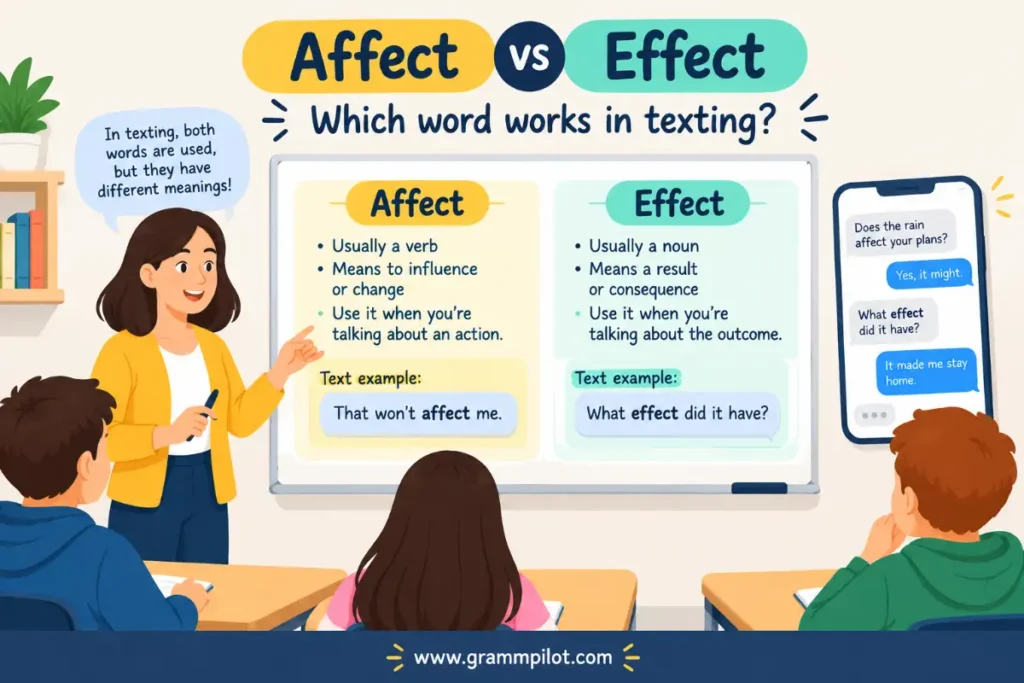
That won’t affect me.
What effect did it have?
Does the weather affect your plans?
The movie had a huge effect on me.
In casual texting, people sometimes make mistakes because the words sound similar. A quick replacement test can help:
Does “influence” fit? → affect
Does “result” fit? → effect
Affect vs effect: which word should you use in an email?
Professional emails benefit from clear wording. Use affect when discussing something that may influence a person, project, deadline, or decision.
Example: The delay may affect our delivery schedule.
Use effect when referring to the resulting outcome.
Example: The delay could have an effect on the delivery schedule.
In many business emails, impact can also work: The delay may impact our delivery schedule. However, affect is often the simpler and safest choice when you mean “influence.”
Affect vs effect: which word is natural in speaking?
In normal conversation, affect and effect appear frequently.
You might hear:
Will that affect your decision?
What effect did it have?
It really affected me.
The experience had a lasting effect on her.
Native speakers don’t always consciously think about grammar while speaking. They simply choose the form that fits the sentence. If you’re unsure while speaking, slow down for a second and ask: Am I talking about the action of influencing, or am I naming the result?
That usually solves the problem.
What are some real-life examples of affect and effect?
- Loud music can affect your ability to concentrate.
Here, affect means influence.
- The loud music had a negative effect on my concentration.
Here, effect means result.
- A late flight affected our dinner plans.
The flight changed the plans.
- The late flight had a frustrating effect on the rest of the evening.
The frustration was the resulting outcome.
- Your attitude can affect how people respond to you.
Your attitude influences their behavior.
- Her kindness had a positive effect on the new employee.
The kindness produced a positive result.
- Too much screen time may affect your sleep.
Screen time can influence sleep.
- One effect of too much screen time may be poor sleep.
Poor sleep is the result.
- The teacher’s feedback affected my approach to writing.
The feedback changed the writer’s approach.
- The teacher’s feedback had a lasting effect on my confidence.
The lasting change is the result.
Affect vs impact: what’s the difference?
Affect and impact are close, but they aren’t always interchangeable. It is a broad word meaning to influence or change.
Impact often suggests a stronger, more noticeable influence.
Compare: The new rule affected employee schedules.
This simply says the schedules were influenced.
The new rule had a major impact on employee schedules.
This emphasizes that the influence was significant.
In everyday American English, impact is widely used as both a noun and a verb.
Examples:
The decision had a major impact on sales.
The decision impacted sales.
If you want a simple, traditional choice for a verb meaning “influence,” affect is usually the clearest option.
Effect vs result: what’s the difference?
Effect and result are very close in meaning. A result is what happens because of something. An effect is also something produced by a cause.
Compare:
The result was better than expected.
The effect of the treatment was noticeable.
The words are often interchangeable, but effect can emphasize the influence produced by a particular cause, while result can refer more generally to the final outcome.
For example:
The effect of the medicine was immediate.
This focuses on what the medicine did to the person.
The result of the treatment was positive.
This focuses on the final outcome.
Affect vs influence: what’s the difference?
Affect and influence are often very close. It can describe a direct or indirect change.
Influence often suggests that something helps shape a person’s thoughts, choices, behavior, or development.
Compare:
The cold weather affected attendance.
The weather caused a change in attendance.
Her mentor influenced her career choice.
The mentor helped shape her decision. You can sometimes use either word, but influence may sound more natural when discussing people, ideas, opinions, or decisions.
When should you NOT use affect?
Don’t use affect simply because you see a cause-and-effect relationship. Look at the grammar first.
Incorrect: The main affect of the policy was higher costs.
Here you’re naming a result, so the word should be effect.
Correct: The main effect of the policy was higher costs.
Another common mistake is using affect after “an.”
Incorrect: It had an affect on sales.
Correct: It had an effect on sales.
The phrase “an effect on” is extremely common.
When should you NOT use effect?
Don’t use effect when you simply mean “influence” as a normal verb.
Incorrect: The weather will effect our plans.
Correct: The weather will affect our plans.
If you mean that something will influence or change your plans, use affect. However, remember that effect can be a verb in formal English when it means “bring about.”
Example: The organization hopes to effect meaningful change.
This is grammatically correct, but it has a specialized, formal meaning.
What are the most common mistakes?
Mistake 1: “It will effect me”
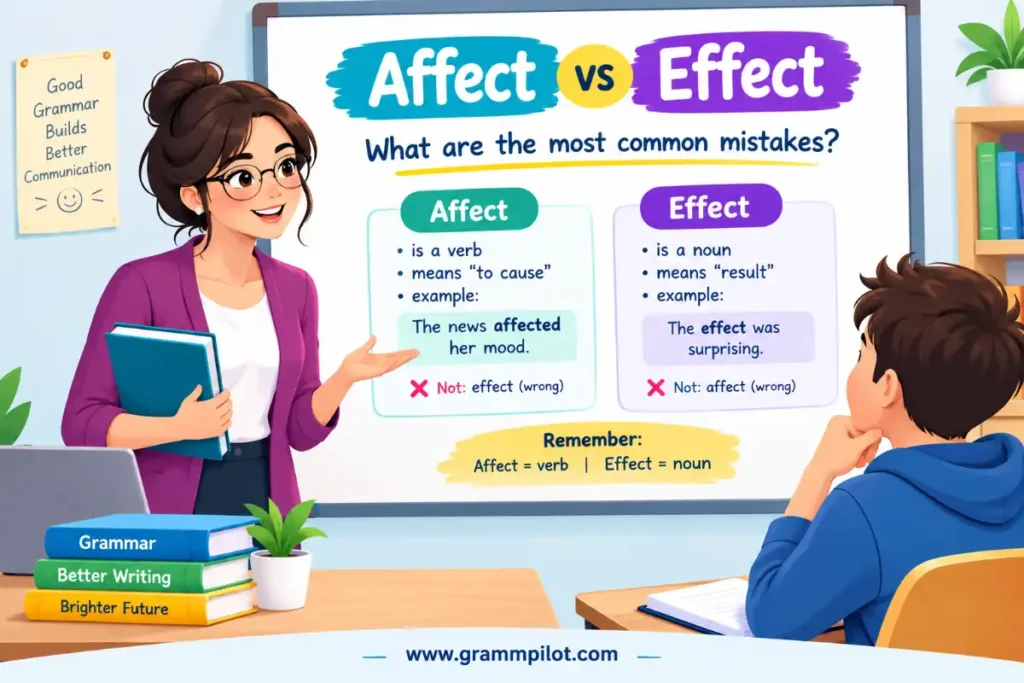
Incorrect: The decision will effect me.
Correct: The decision will affect me.
Why? The decision will influence you.
Mistake 2: “It had a positive affect”
Incorrect: The exercise had a positive affect on my mood.
Correct: The exercise had a positive effect on my mood.
Why? You are naming the result.
Mistake 3: “The affect of”
Incorrect: The affect of stress can be serious.
For the normal meaning of result, use: The effect of stress can be serious.
Mistake 4: Choosing based only on pronunciation
The similar sounds don’t tell you which word to use. Don’t decide by sound. Decide by meaning and grammar.
Mistake 5: Assuming effect is always a noun
Usually it is, but effect can also be a formal verb meaning “bring about.”
Example:
The new leadership plans to effect major reforms.
This is a more advanced use.
What are the antonyms of affect and effect?
Because these words have several meanings, their antonyms depend on context.
For affect meaning “influence,” possible opposites include:
- leave unchanged
- preserve
- maintain
- stabilize
- protect
- ignore
- avoid
Example: The new policy didn’t affect the schedule.
You could say: The new policy left the schedule unchanged.
For effect meaning “result,” possible opposite ideas include:
- cause
- source
- origin
- beginning
But effect doesn’t have one perfect opposite in every sentence.
For example: Cause and effect are a classic pair.
The cause produces something, while the effect is what happens because of it.
What should you remember about these two words?
If you only remember a few rules, remember these:
- Affect is usually a verb.
- Effect is usually a noun.
- Affect usually means influence or change.
- Effect usually means result or consequence.
- Have an effect on is a common phrase.
- Affect something is a common verb structure.
- Cause → effect is a useful relationship to remember.
- Don’t choose based only on pronunciation.
- Use context to decide.
- In formal writing, choose the most precise word rather than automatically choosing a more complicated synonym.
Quick comparison chart for affect and effect
| If you mean… | Usually choose… | Example |
|---|---|---|
| Influence | affect | Noise can affect sleep. |
| Change | affect | The delay affected our plans. |
| Result | effect | The delay had an effect on us. |
| Outcome | effect | The effect was unexpected. |
| Consequence | effect | The policy had several effects. |
| Have an influence on | affect | Stress can affect memory. |
| A result of something | effect | Poor sleep was an effect of stress. |
| Bring about change | effect as a formal verb | They hope to effect reform. |
What is the fastest way to choose the right word?
Use this five-second test.
Step 1: Ask what you mean
Do you mean influence?
Choose affect.
Do you mean result?
Choose effect.
Step 2: Look at the grammar
Does the word describe an action?
The noise affects me.
That’s a verb.
Does the word name a result?
The noise had an effect on me.
That’s a noun.
Step 3: Try the replacement test
Replace the word with influence.
If the sentence still makes sense, affect may be correct.
Replace it with result.
If that meaning fits, effect may be correct.
Step 4: Check for “an”
If you see: an _ on
the answer is usually effect.
Example: an effect on sales
Not: an affect on sales
Step 5: Read the whole sentence
Don’t make your decision from one word alone. The surrounding words usually reveal the intended meaning.
Is affect vs effect different in US and UK English?
The basic distinction is the same in American and British English.
In both varieties:
affect usually means influence as a verb.
effect usually means result as a noun.
There are some differences in vocabulary, pronunciation, style, and usage between US and UK English, but you don’t need a different basic rule for these two words.
For both varieties, these sentences are standard:
The weather affected our plans.
The weather had an effect on our plans.
If you’re writing for a US audience, these forms are completely natural.
A final teacher explanation
Imagine that your friend doesn’t sleep well for a week.
You might say: Lack of sleep affected your mood.
This means lack of sleep influenced your mood.
Then you could say: The effect was that you felt more tired and irritated.
This means tiredness and irritation were results.
Now connect the two: Cause → affect → result
That simple chain is the heart of the distinction.
You don’t need to memorize dozens of grammar rules. Start with the two main meanings:
Affect = influence.
Effect = result.
Then check the sentence structure. If you’re talking about something doing the influencing, use affect in normal everyday English. If you’re naming what came from that influence, use effect. There are exceptions, but they are much less common. Once the basic rule becomes automatic, you’ll recognize the unusual cases more easily.
Quick tips for choosing the right word
- Think A = Action for affect.
- Think E = End result for effect.
- Replace affect with influence when checking a sentence.
- Replace effect with result when checking a sentence.
- Remember the common phrase have an effect on.
- Don’t write an affect on when you mean a result.
- Don’t write will effect when you mean “will influence.”
- Remember that effect can be a formal verb meaning “bring about.”
- Remember that affect can be a specialized noun in psychology.
- In resumes and essays, choose a more specific verb when one is available.
- If you can say changed, influenced, or improved, that may be clearer than a vague use of affected.
- If you can name the actual result, do so. Specific writing is stronger writing.

Conclusion
Affect vs Effect becomes much easier when you stop relying on spelling and start thinking about the job each word performs. In normal English, affect is usually a verb meaning to influence or change something. Effect is usually a noun meaning the result or consequence of that influence. The simplest test is to think affect = influence and effect = result. Then check the grammar of the sentence. Remember that there are less common uses, especially the formal verb effect and the specialized noun affect, but they don’t replace the basic everyday rule. With a little practice, you’ll be able to choose the right word quickly in emails, essays, resumes, conversations, and professional writing.
Frequently Asked Questions
1. What’s the easiest way to remember affect and effect?
Remember affect = influence and effect = result. You can also think A = Action and E = End result.
2. Is affect a verb or a noun?
Affect is usually a verb meaning “to influence or change.” It can also be a specialized noun referring to observable emotional expression.
3. Is effect a verb or a noun?
Effect is usually a noun meaning “result or consequence.” It can also be a formal verb meaning “to bring about or cause.”
4. How do I know whether to use affect or effect?
Use affect when you mean “influence,” and use effect when you mean “result.” The common phrase have an effect on is another useful clue.
5. Can affect and effect be used in the same sentence?
Yes. For example, “Stress can affect your sleep, and poor sleep can be an effect of long-term stress.” The first word describes influence, while the second names a result.
6. What’s another way to say affect?
Depending on the context, you can say influence, change, alter, impact, shape, modify, disturb, sway, or transform. The best choice depends on how strong or formal you want the meaning to be.
7. What’s another way to say effect?
Useful alternatives include result, outcome, consequence, impact, reaction, response, aftermath, impression, and difference. Choose the word that describes the specific kind of result you mean.