
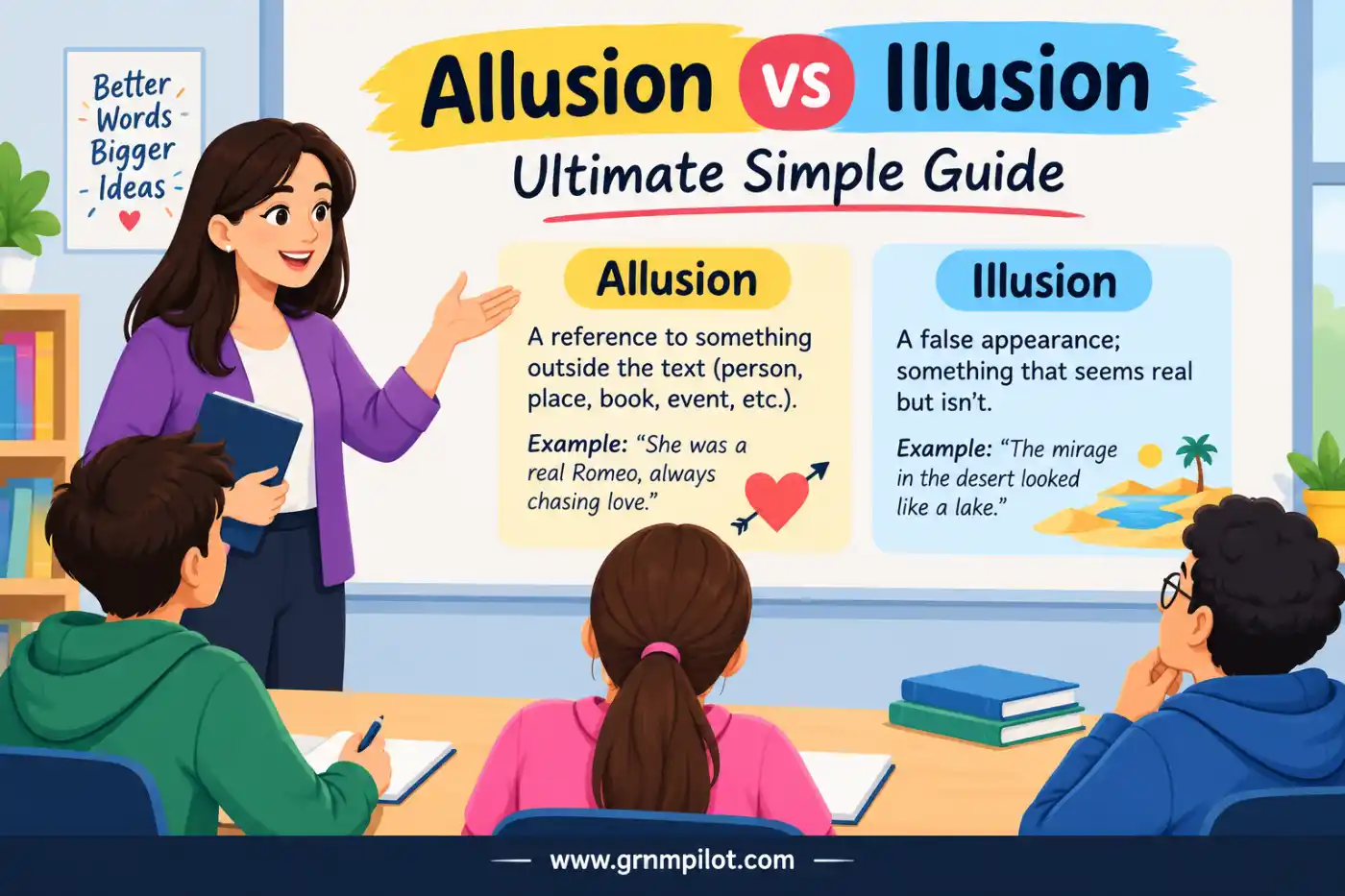
Allusion vs Illusion is confusing because the two words look and sound almost identical. Their meanings are quite different, though. One is about referring to something, while the other is about a misleading appearance, perception, or belief. Have you ever written an essay and wanted to refer to a famous story without explaining the whole story? Maybe you mentioned David and Goliath, Cinderella, or Shakespeare. That kind of indirect reference is an allusion. On the other hand, if something looks real but is not what it seems, it is an illusion.
Quick answer: An allusion is an indirect reference to a person, story, event, work, or idea. An illusion is something that appears real or true but is actually different from reality.
This guide explains their meanings, origins, pronunciation, synonyms, examples, literary uses, common mistakes, and the best choice for essays, emails, resumes, texting, and everyday speech.
This is one of many English word pairs that learners confuse; see [Among vs Between] for another example.
What does allusion mean in plain English?
An allusion is an indirect reference to something that the writer or speaker expects the audience to recognize.
The reference might point to:
- a famous person
- a historical event
- a religious story
- a myth
- a novel
- a poem
- a movie
- a song
- a fictional character
- a famous speech
- a cultural event
- a work of art
For example: The team’s victory was a real David-and-Goliath moment.
The sentence refers to the biblical story of David and Goliath. The writer does not need to explain the entire story because many readers already know the basic idea.
Here is another example: She finally had her Cinderella moment.
The writer is referring indirectly to Cinderella and suggesting a surprising change in fortune. The reference adds meaning without requiring a long explanation.
Is allusion a noun?
Yes. Allusion is a noun.
It commonly appears with words such as:
- literary
- historical
- biblical
- cultural
- political
- subtle
- indirect
- direct
Examples:
The novel contains a literary allusion.
The speech includes a historical allusion.
I noticed an allusion to Greek mythology.
The poem contains several biblical allusions.
Her comment was an allusion to an earlier event.
What does illusion mean in plain English?
An illusion is something that appears real, true, or different from what it actually is.
It can describe:
- a visual effect
- a magic trick
- a misleading appearance
- an incorrect perception
- a false belief
- an imaginary situation
- a deceptive impression
For example: The mirror created an illusion of a larger room.
The room did not actually become larger. Its appearance simply suggested more space.
Another example: The magician created the illusion that the coin disappeared.
The audience sees an effect that does not represent what is actually happening.
The word can also describe a false idea:
The belief that success happens overnight is an illusion.
Here, the illusion is not visual. It is a mistaken belief about reality.
Is illusion a noun?
Yes. Illusion is a noun.
Common expressions include:
- an optical illusion
- create an illusion
- an illusion of control
- an illusion of safety
- an illusion of freedom
- live under an illusion
- break an illusion
Examples:
The painting creates an illusion of depth.
The advertisement creates an illusion of luxury.
He lived under the illusion that the deadline had changed.
The magician’s trick produced an impressive illusion.
Where did allusion come from?
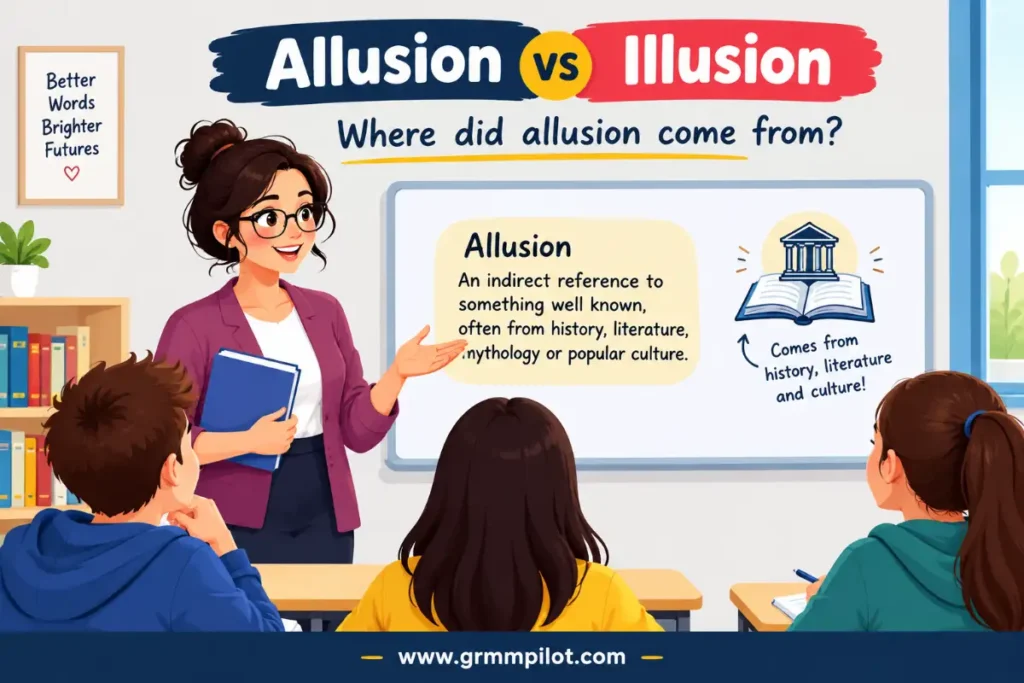
Allusion has roots in Latin and entered English through French. Its history is connected with the idea of referring to something indirectly. That basic idea still fits its modern meaning. When a writer makes an allusion, the writer usually does not explain the entire source. Instead, the writer points toward it and expects the audience to make the connection.
For example: He was no Romeo.
The sentence alludes to Shakespeare’s famous character Romeo. The writer can use the character’s name to suggest romance without explaining the entire story of Romeo and Juliet. This is one reason allusions are useful. A short reference can carry a much larger idea.
Where did illusion come from?
Illusion also has Latin and French roots. Its history is associated with misleading appearances, deception, and things that seem different from reality.
That meaning remains central today.
For example: The lighting created an illusion of depth.
The physical space has not changed. The lighting has changed how the space appears.
The word can also be used figuratively: His confidence was an illusion.
The sentence means that his confidence seemed genuine or strong but was not as real as it appeared. Although the two words have similar histories and spellings, their modern meanings have developed in different directions.
Why do allusion and illusion look so similar?
The words are easy to confuse because they share many letters and have almost the same pronunciation.
Compare:
Allusion
Illusion
The first vowel is the main spelling difference.
A useful way to remember them is to connect each word with an image:
Allusion → author → reference
Illusion → image → appearance
If a writer is pointing toward another story or idea, think allusion. If something is fooling your eyes, mind, or understanding, think illusion.
How do you pronounce allusion and illusion?
The words sound very similar.
Allusion is commonly pronounced approximately uh-LOO-zhun.
Illusion is commonly pronounced approximately ih-LOO-zhun.
| Word | Pronunciation Clue | Meaning |
|---|---|---|
| Allusion | uh-LOO-zhun | Indirect reference |
| Illusion | ih-LOO-zhun | Misleading appearance |
Because the difference is small when spoken, context matters.
For example:
The author made an ___ to mythology.
The correct answer is allusion.
The magician created an ___ .
The correct answer is illusion.
What are the best synonyms for allusion?
Several words are related to allusion, although they do not all have exactly the same meaning.
| Word | Meaning | Tone | Example |
|---|---|---|---|
| Reference | A mention or connection | Neutral | The article contains a reference to history. |
| Mention | A brief statement about something | Everyday | He made a brief mention of the event. |
| Hint | An indirect clue | Casual | Her comment was a hint about the problem. |
| Suggestion | An indirectly presented idea | Neutral | The poem contains a suggestion of loss. |
| Echo | A similarity to an earlier idea | Literary | The scene echoes an ancient myth. |
| Nod | An indirect acknowledgment | Informal | The title is a nod to the classic film. |
| Evocation | Bringing something to mind | Literary | The scene is an evocation of childhood. |
| Invocation | Calling upon a familiar idea or figure | Formal | The speech invokes national history. |
| Callback | A return to an earlier idea | Informal | The ending is a callback to the opening. |
| Literary reference | A reference to another work | Academic | The chapter contains a literary reference. |
| Cultural reference | A reference based on shared culture | Neutral | The joke uses a cultural reference. |
| Historical reference | A reference to history | Formal | The speech contains a historical reference. |
| Biblical reference | A reference to the Bible | Formal | The poem includes a biblical reference. |
| Mythological reference | A reference to mythology | Academic | The story uses a mythological reference. |
| Subtle reference | An indirect connection | Neutral | The writer makes a subtle reference. |
The closest everyday substitute is often reference. However, an allusion usually has a more indirect or literary quality.
What are the best synonyms for illusion?
The best synonym depends on the type of illusion.
| Word | Meaning | Tone | Example |
|---|---|---|---|
| Deception | An attempt to mislead | Strong | The trick was a form of deception. |
| Mirage | A visual phenomenon that appears real | Literary/Neutral | The distant water was a mirage. |
| Delusion | A strongly held false belief | Formal | He lived under a delusion. |
| Misperception | An incorrect perception | Formal | The error resulted from misperception. |
| Fantasy | An imagined situation | Neutral | His accurate plan was a fantasy. |
| Trick | Something used to deceive | Everyday | The magician used a clever trick. |
| Optical illusion | A misleading visual effect | Neutral | The image is an optical illusion. |
| False impression | An inaccurate appearance or idea | Neutral | The photo gave a false impression. |
| Misunderstanding | An incorrect interpretation | Everyday | The argument began with a misunderstanding. |
| Distortion | An inaccurate representation | Neutral | The mirror caused a distortion. |
| Pretense | A false appearance or claim | Formal | His confidence was partly a pretense. |
| Sham | Something presented as genuine when it is not | Strong | The offer was a sham. |
| Make-believe | Something imaginary | Informal | The children entered a world of make-believe. |
| Misrepresentation | An inaccurate presentation | Formal | The advertisement was a misrepresentation. |
| Smoke and mirrors | A misleading display | Idiomatic | The presentation was mostly smoke and mirrors. |
These words are not accurate substitutes in every sentence.
A mirage is a specific type of visual phenomenon.
A delusion concerns a false belief.
A deception focuses on misleading someone.
An optical illusion specifically concerns visual perception.
What are synonyms by intensity?
Related words can vary in directness or strength.
For indirect references, you might think of this rough range: Mention → Hint → Reference → Allusion → Implication
A mention can be direct and simple.
A hint gives the audience a clue.
A reference connects one thing with another.
An allusion usually expects recognition of an outside source.
An implication suggests meaning without directly stating it.
For misleading appearances, consider: Appearance → Misperception → Illusion → Deception → Delusion
This is not a strict scale because these words describe different situations. Still, it helps show why replacing one word with another can change the meaning.
What are the related parts of speech?
Both focus words are nouns, but their word families include useful forms.
| Word | Part of Speech | Example |
|---|---|---|
| Allusion | Noun | The poem contains an allusion. |
| Allude | Verb | The writer alludes to mythology. |
| Illusion | Noun | The magician created an illusion. |
| Illusory | Adjective | The sense of safety was illusory. |
| Reference | Noun | The article contains a reference. |
| Refer | Verb | The writer refers to history. |
| Evocation | Noun | The scene is an evocation of childhood. |
| Evoke | Verb | The image evokes nostalgia. |
The most important related verb is allude.
You can write: The writer alludes to Shakespeare.
Or: The writer makes an allusion to Shakespeare.
Both express closely related ideas.
What does allude mean?
Allude means to refer to something indirectly. It is the verb form related to allusion.
Examples:
The author alludes to Greek mythology. The speaker alluded to the earlier disagreement. The novel alludes to several historical events. The poem alludes to a famous biblical story.
The usual structure is: allude to + person, event, idea, or work
For example: She alluded to her childhood.
The article alludes to an earlier political scandal.
Do not confuse allude with elude.
Allude means to refer indirectly.
Elude means to escape, avoid, or remain difficult to understand or remember.
What does illusory mean?
Illusory is an adjective meaning based on an illusion or not truly real.
Examples:
The promise of instant success was illusory.
His feeling of complete control was illusory.
The sense of safety proved illusory.
This gives you a useful memory pair:
Allusion → allude
Illusion → illusory
Knowing the related forms can make the vocabulary easier to remember.
What is the difference between allusion and reference?
An allusion is a kind of reference, but the two terms are not identical.
A reference can be direct:
The article refers to the 1969 moon landing.
An allusion can be indirect:
The writer describes the event as one small step.
The second sentence can evoke the famous moon-landing phrase without explaining its source.
| Reference | Allusion |
|---|---|
| Can be direct | Usually indirect |
| May clearly identify a source | May require recognition |
| Common in academic writing | Common in literary writing |
| Can simply provide information | Often adds associations |
An allusion often asks the reader to make a connection.
What is the difference between allusion and implication?
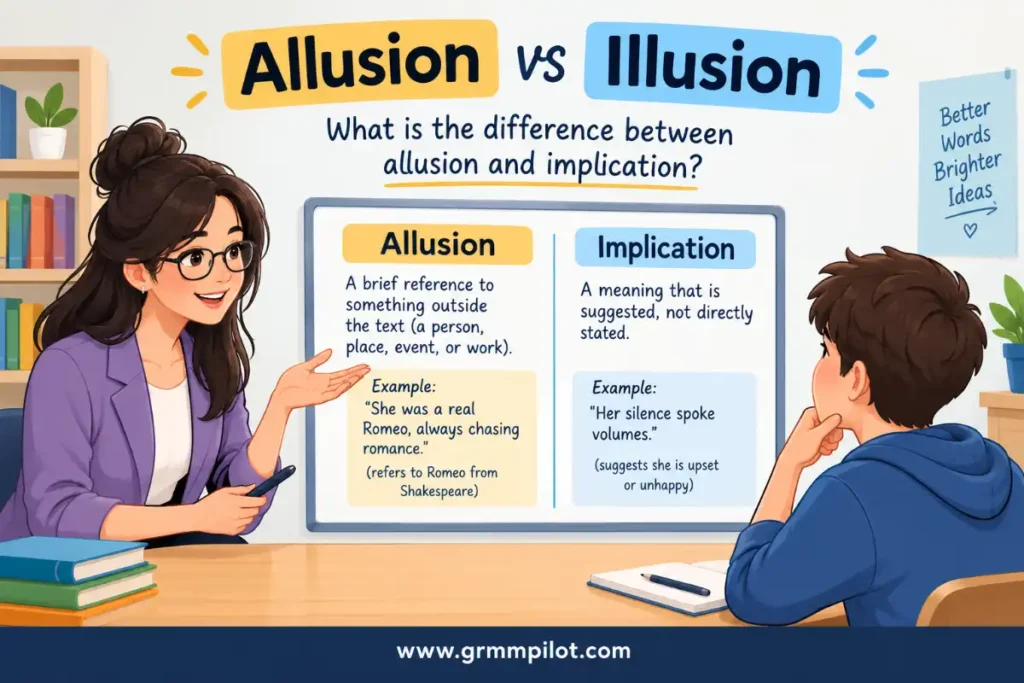
An allusion points toward an outside source.
An implication suggests a meaning.
For example: The writer makes an allusion to the Garden of Eden.
This points toward a specific biblical story.
Now consider: His silence implied that he disagreed. he silence suggests an idea, but it does not point toward an outside story.
So the basic distinction is:
Allusion = connection to another source
Implication = suggested meaning
Both can appear in the same piece of writing, but they serve different purposes.
What is the difference between illusion and delusion?
An illusion is a misleading appearance or perception.
A delusion is generally a strongly held false belief.
For example: The curved lines create an optical illusion.
The issue involves visual perception.
Compare that with:He lived under the delusion that everyone was secretly watching him. That sentence describes a belief rather than a simple visual effect. A magician can deliberately create an illusion. A delusion is not normally used to describe a magic trick.
What is the difference between illusion and mirage?
A mirage is a specific visual phenomenon, often caused by atmospheric conditions.
An illusion is a broader term.
For example: The distant water was a mirage.
But: The magician created an illusion.
The word illusion can also be used metaphorically: His belief in an easy victory was an illusion.
Calling that belief a mirage would be more figurative.
How is allusion used in literature?
Allusion is especially useful in literature because it can add several layers of meaning without lengthy explanation.
Consider: He entered the room like Caesar returning to Rome. The sentence does more than describe a person walking into a room. It connects the character with ideas associated with Julius Caesar, such as power, confidence, leadership, or triumph. Another example is: She finally had her Cinderella moment. The reference can suggest transformation, opportunity, or unexpected success. The reader supplies part of the meaning by recognizing the source.
What are common literary allusions?
Writers often allude to:
- Shakespeare
- Greek mythology
- Roman mythology
- the Bible
- fairy tales
- famous novels
- historical events
- popular films
- famous speeches
- legendary figures
- works of art
For example: He had the patience of Job.
The phrase refers to the biblical figure Job and suggests endurance through difficult circumstances.
Another example: She flew too close to the sun.
This alludes to Icarus and can suggest dangerous ambition.
What is a biblical allusion?
A biblical allusion is an indirect reference to a person, story, place, phrase, or event from the Bible.
For example: He felt like David facing Goliath.
The expression suggests that a weaker person or group is facing a much stronger opponent.
Another example: The family started over after the disaster, like survivors of the flood.
The language can evoke the biblical story of Noah. Biblical allusions appear in literature, speeches, journalism, and ordinary conversation. Their effect depends on if the audience recognizes the source.
What is a mythological allusion?
A mythological allusion refers indirectly to a figure, event, object, or idea from mythology.
Examples include:
He flew too close to the sun like Icarus.
She has an Achilles’ heel.
The businessman seems to have the Midas touch.
Each expression carries associations from a familiar myth. Readers who know the original stories can understand an additional layer of meaning.
Why do writers use allusions?
Writers use allusions for several practical reasons.
To add depth
A short reference can suggest a much larger story.
To create comparison
A character can be compared with a famous figure without a long explanation.
To connect old and new ideas
A modern event can be connected with an older story or historical event.
To create tone
An allusion can make writing humorous, serious, dramatic, romantic, or ironic.
To save space
A familiar name can communicate an idea in only a few words.
To involve the reader
Recognizing a reference can make readers feel more connected to the text.
For example: The meeting felt like Groundhog Day.
The phrase suggests that the same events keep happening repeatedly.
What are examples of allusion in everyday English?
Allusions are common outside literature.
- This project feels like climbing Mount Everest.
- He acted like Sherlock Holmes during the investigation.
- She finally had her Cinderella moment.
- The small company faced a David-and-Goliath challenge.
- He thinks he has the Midas touch.
- The new employee became the office Romeo.
- Their victory was their Rocky moment.
- She treated the challenge like her own Odyssey.
- Opening that file was like opening Pandora’s box.
- The team’s comeback felt like a modern David-and-Goliath story.
Each example relies on a familiar reference to create additional meaning.
What are examples of illusion in everyday English?
Illusions can appear in visual situations, advertising, conversation, and beliefs.
- The mirror created an illusion of a larger room.
- The magician created the illusion that the coin disappeared.
- The photograph gave the illusion of movement.
- The lighting created an illusion of depth.
- He lived under the illusion that the deadline had changed.
- The advertisement created an illusion of effortless success.
- The fog gave the road an illusion of endless distance.
- The calm surface created an illusion that the water was shallow.
- The camera angle created the illusion that the building was taller.
- She realized that her sense of complete control was an illusion.
These examples show that an illusion does not have to involve magic.
What are the most common mistakes?
Because the spelling is so similar, these words are often switched.
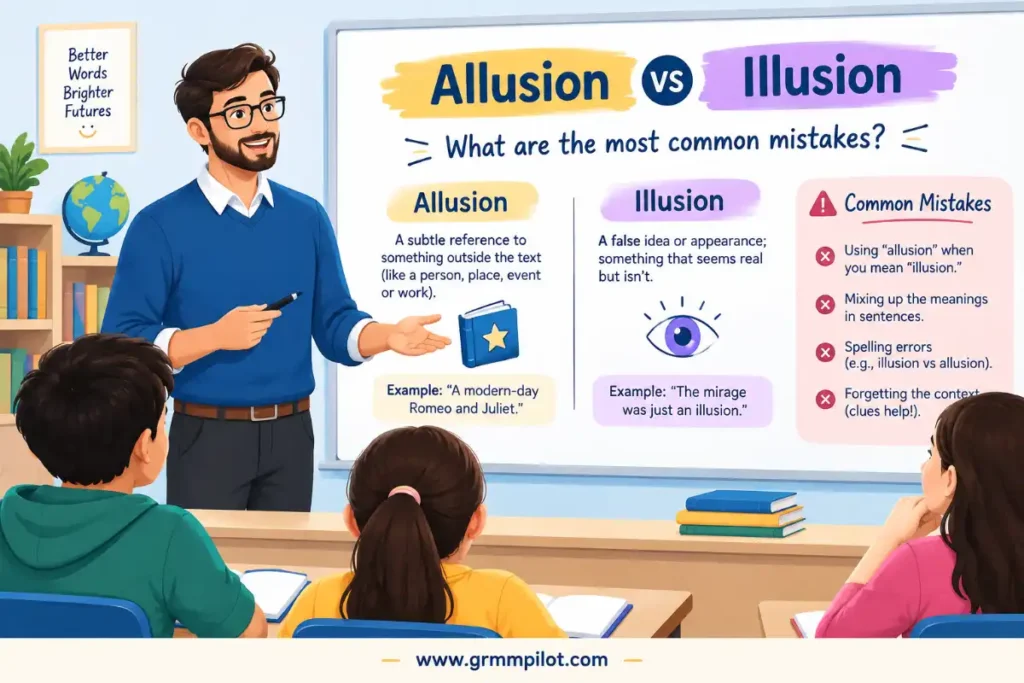
Mistake 1: Using illusion for a reference
Incorrect: The author made an illusion to Shakespeare.
Correct: The author made an allusion to Shakespeare.
The writer is referring indirectly to Shakespeare.
Mistake 2: Using allusion for a false appearance
Incorrect: The magician created an allusion.
Correct: The magician created an illusion.
The magician is creating a misleading appearance.
Mistake 3: Confusing allude and elude
Incorrect: The writer eluded to the historical event.
Correct: The writer alluded to the historical event.
Remember:
allude = refer indirectly
elude = escape or avoid
Mistake 4: Writing “illusion to”
If you mean an indirect reference, write: allusion to
For example: The poem contains an allusion to Greek mythology.
Mistake 5: Calling every reference an allusion
Not every mention qualifies as an allusion.
A direct citation, quotation, or explicit statement may simply be a reference.
An allusion normally involves an indirect connection to something outside the immediate statement.
What are the antonyms of allusion?
There is no single accurate antonym for allusion.
Depending on the context, useful contrasting terms include:
- direct statement
- explicit reference
- clear explanation
- direct mention
- quotation
- literal description
The basic opposite idea is stating something directly rather than referring to it indirectly.
For example: The writer explicitly names Shakespeare.
That is more direct than making an allusion to Shakespeare.
What are the antonyms of illusion?
The clearest opposites of illusion are words connected with reality and truth.
These include:
- reality
- truth
- fact
- certainty
- authenticity
- actuality
- truthfulness
For example: The illusion disappeared when he discovered the truth.
The contrast between illusion and reality is common in both everyday language and literature.
Which word is best for a resume?
Neither word belongs on every resume.
Use allusion when your work genuinely involves literary or cultural references.
For example: Analyzed literary allusions in nineteenth-century novels.
Use illusion when describing visual effects, magic, entertainment, design, or related work.
For example: Designed visual illusions for live performances.
For most professional resumes, however, do not force either word into your writing. Choose vocabulary that accurately describes your actual experience.
Which word is best for an essay?
Both words can be useful in academic writing.
Use allusion when discussing an indirect reference.
The poet uses a biblical allusion to emphasize the character’s suffering.
Use illusion when discussing a false appearance or belief.
The novel presents social status as an illusion of happiness.
These terms are especially useful in literary analysis because they help explain how writers create meaning.
How should you explain an allusion in an essay?
Do more than identify the reference.
Explain its purpose.
Weak: The author alludes to David and Goliath.
Stronger: The author alludes to David and Goliath to portray the smaller group as an unlikely challenger to a much more powerful opponent.
The second version explains why the reference matters.
Which word is best for texting?
You may not need either word often in casual texting. Both can still be correct when the subject requires them.
That’s an allusion to Harry Potter.
That’s an illusion.
For casual messages, simpler alternatives may sound more natural.
Instead of: That’s an allusion to the movie.
You could write: That’s a reference to the movie.
Instead of: That’s an optical illusion.
You might say: Your eyes are being tricked.
The formal terms are not wrong. Simpler alternatives simply fit casual communication better.
Which word is best for an email?
In professional email, reference is often more natural unless you’re discussing literature, culture, media, art, or a related subject.
For example:
The report makes a reference to last year’s findings.
Use illusion when discussing a misleading visual or conceptual effect.
The design creates an illusion of depth.
If your email concerns creative work, both words may be appropriate.
Which word is best for speaking?
Context determines which word sounds natural.
You might say: That was an allusion to the movie.
Or: That was an illusion.
In everyday conversation, simpler wording can sometimes be clearer:
That was a reference to the movie.
It only looked that way.
Use the specialized terms when they express exactly what you mean.
What quick tips help you choose the right word?
Ask yourself these questions: Is someone referring to another story, person, event, or work?
Use allusion.
Does something appear different from reality?
Use illusion.
Can you replace the word with “reference”?
Think allusion.
Can you replace it with “false appearance”?
Think illusion.
Is the writer pointing toward another source?
Choose allusion.
Are your eyes or mind being fooled?
Choose illusion.
Are you formally identifying a source?
You may need citation or reference instead.
Are you describing a false belief?
Consider illusion, delusion, or misperception, depending on the situation.
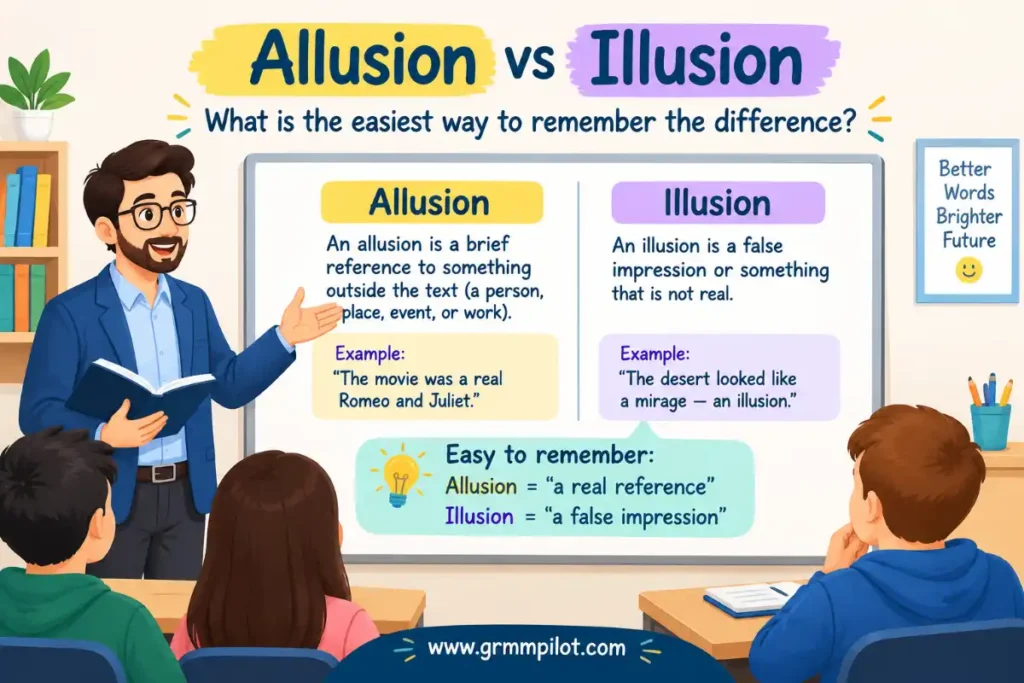
What is the easiest way to remember the difference?
Use this simple rule:
Allusion = reference.
Illusion = false appearance.
An author makes an allusion to mythology. A magician creates an illusion. A poem contains an allusion to Shakespeare. A mirror creates an illusion of space.
The first word points toward another idea.
The second describes something that seems different from reality.
Once you connect each word with its core meaning, the spelling becomes much easier to remember.
Conclusion
Allusion vs Illusion becomes much easier when you connect each word with one clear idea. Allusion refers indirectly to a person, story, event, work, or cultural idea, while illusion describes something that appears real or true even though it is different from reality. Writers use allusions to add meaning without explaining an entire source, while illusions can appear in magic, art, advertising, perception, and everyday beliefs. When you are unsure, ask yourself about the word describes a reference or an appearance. If it points toward another source, choose allusion. If it describes something misleading your senses or understanding, choose illusion. Remembering “allusion = reference” and “illusion = false appearance” is the simplest way to keep them apart.
Frequently Asked Questions
1. What is the difference between allusion and illusion?
Allusion means an indirect reference, while illusion means a misleading appearance or perception. An author can make an allusion to mythology, while a magician can create an illusion.
2. Is an allusion the same as a reference?
Not exactly. An allusion is usually an indirect reference that expects the reader to recognize a connection, while a reference can be direct and explicit.
3. What’s another way to say “allusion”?
Common alternatives include reference, hint, nod, mention, implication, connection, and echo. The best choice depends on the exact context.
4. Is an illusion always a magic trick?
No. An illusion can be a visual effect, misleading appearance, mistaken perception, or false belief. A magic trick is only one type of illusion.
5. How do I use allusion in a sentence?
You can write, “The author makes an allusion to Greek mythology.” The word describes an indirect reference to a familiar source, person, event, or idea.
6. How do you remember the difference between allusion and illusion?
Think allusion = reference and illusion = false appearance. An allusion points toward another idea, while an illusion makes something seem different from reality.
7. Is “illusion to Shakespeare” correct?
No. If you mean an indirect reference to Shakespeare, the correct phrase is “allusion to Shakespeare.” An illusion refers to a misleading appearance or perception.