
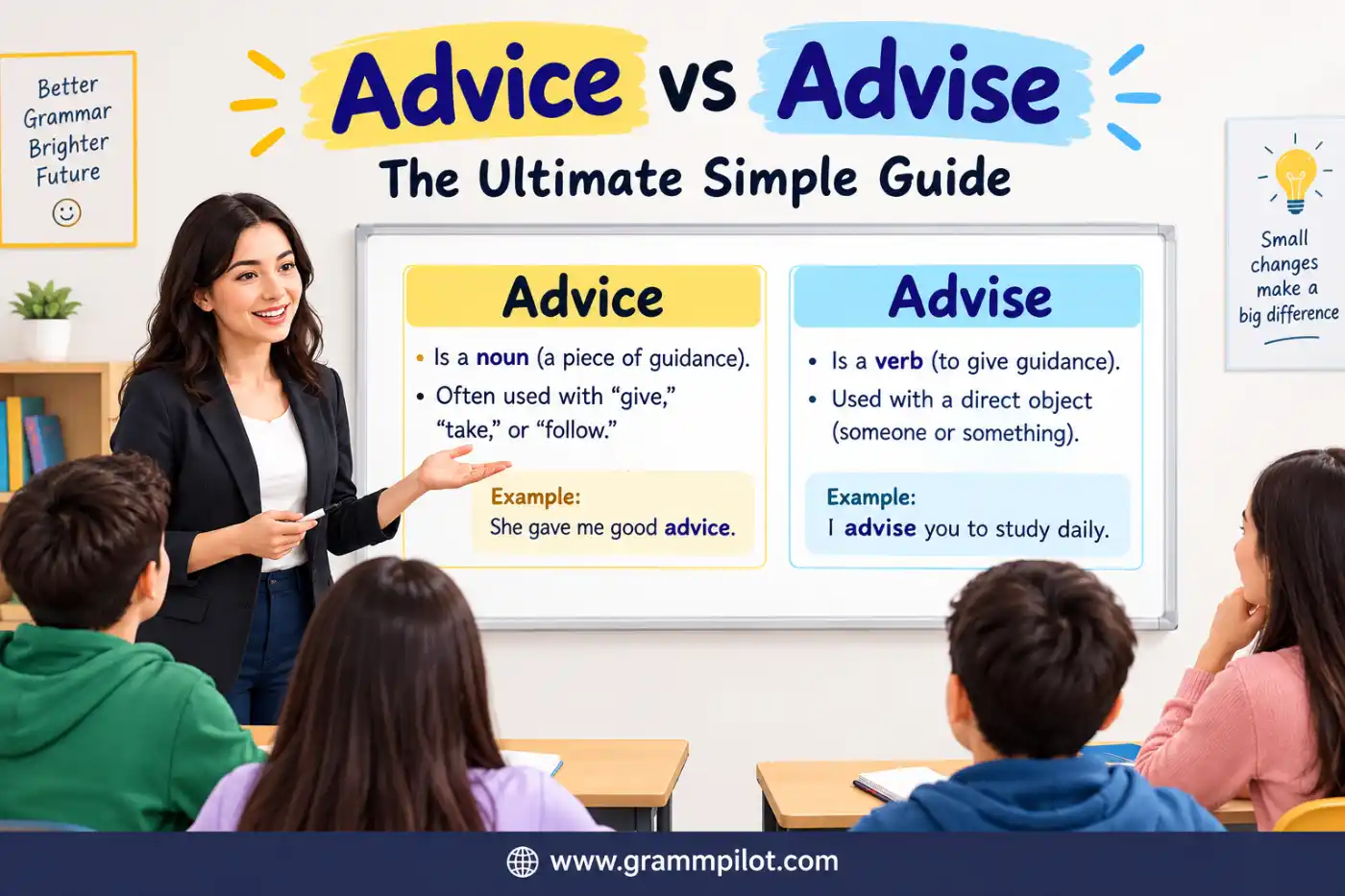
Have you ever been writing an email, essay, resume, or text and suddenly wondered whether you should write advice vs advise? The two words look almost the same, and they are closely related in meaning. That makes the spelling easy to mix up. Advice vs Advise is mainly a grammar question. One word is a noun, while the other is a verb. Once you know what job each word does in a sentence, the difference becomes much easier to remember.
Quick answer: Advice is a noun meaning guidance or a recommendation. Advise is a verb meaning to give guidance or recommend an action.
This guide explains the meanings, origins, pronunciation, synonyms, sentence patterns, regional usage, common mistakes, and the best choice for resumes, essays, texts, emails, and everyday speech.
For a closer look at another confusing word pair, explore [Affect vs Effect].
What is the difference between advice vs advise?
The basic difference is simple:
Advice is a noun.
Advise is a verb.
A noun names a person, place, thing, or idea. A verb describes an action or state. So, advice names the guidance someone gives. Advise describes the act of giving that guidance.
| Word | Part of Speech | Meaning | Example |
|---|---|---|---|
| Advice | Noun | Guidance or a recommendation | Her advice helped me. |
| Advise | Verb | To give guidance or recommend something | She advised me to wait. |
Look at these two sentences:
My teacher gave me useful advice.
My teacher advised me to study harder.
In the first sentence, advice is the thing the teacher gave.
In the second sentence, advised describes what the teacher did.
A simple memory rule is:
Give advice.
Advise someone.
For example:
My brother gave me some advice.
My brother advised me to save money.
That small distinction solves most spelling problems involving these words.
Advice vs Advise: What does advice mean in plain English?
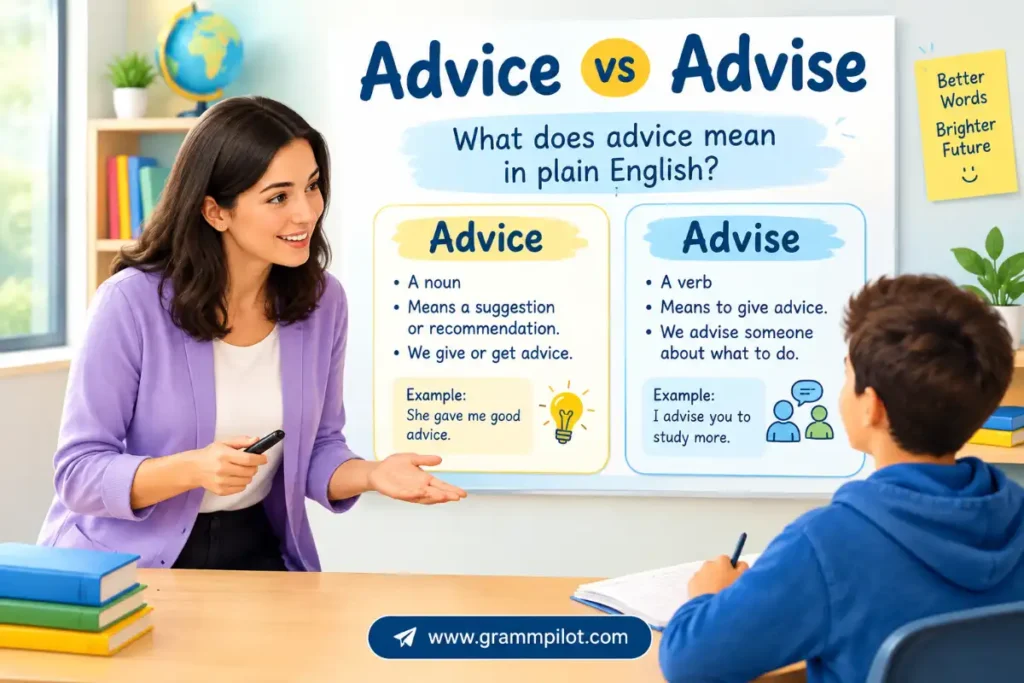
Advice means guidance about what someone should do or consider. It can come from a friend, teacher, parent, manager, counselor, expert, or professional. The subject can be almost anything.
You might ask for advice about:
- choosing a career
- writing an essay
- preparing for an interview
- buying a car
- handling a difficult situation
- studying for an exam
- planning a trip
- managing money
- improving your writing
- making an important decision
Here are some natural examples:
I need your advice.
She gave me excellent advice.
We received professional advice.
The word refers to the guidance itself, not the act of giving it.
That is why this sentence works: My father gave me advice.
The father performed the action of giving, while advice names what he gave.
Is advice a noun?
Yes. Advice is a noun.
It commonly appears after verbs such as:
- give
- receive
- get
- ask for
- seek
- offer
- provide
- follow
- take
- ignore
Examples:
She gave me some advice.
I received helpful advice.
We sought professional advice.
She ignored my advice.
The manager offered useful advice.
These sentence patterns are worth learning because they make the noun form easy to recognize.
Advice vs Advise: What does advise mean in plain English?
Advise is a verb that means to give guidance, recommend an action, or tell someone what you think they should do.
For example:
I advise you to wait.
The teacher advised us to arrive early.
My manager advised me to check the report.
The counselor advised her to apply.
We advise customers to keep their receipts.
The verb changes according to tense and subject.
| Form | Example |
|---|---|
| Advise | I advise you to wait. |
| Advises | She advises students regularly. |
| Advised | He advised me to apply. |
| Advising | They are advising the team. |
The meaning remains connected to guidance. The main difference is grammatical. Advise performs the action of giving guidance, while advice names the guidance.
What sentence patterns are used with advise?
One of the most common structures is: advise + person + to + verb
Examples:
She advised me to wait.
I advised my friend to think carefully.
Another useful structure is: advise + against + noun or -ing form
Examples:
The lawyer advised against signing the contract.
My parents advised against buying an expensive car.
The guide advised against traveling alone.
You can also use advise with on:
The consultant advised us on the best strategy.
The specialist advised the company on the new policy.
A similar structure uses about: The counselor advised me about my options.
These patterns are especially useful in formal and professional English.
Advice vs Advise: Where did advice and advise come from?
The two words have a shared history, which explains why their spelling and meanings are so closely connected. Both words can be traced through Old French to Latin roots associated with seeing, considering, judging, or taking counsel. Over time, English developed related noun and verb forms. The noun became advice, while the verb became advise. Their meanings remained closely connected because both words deal with guidance and recommendations. You do not need to memorize the history to use them correctly. Still, knowing that they are related can explain why the spelling difference is so small.
Why do these words look almost identical?
They look alike because they come from the same linguistic family and describe closely related ideas.
Compare:
She gave me advice.
She advised me to wait.
The first sentence names the guidance. The second sentence describes the action of giving guidance.
English often has related noun and verb forms that differ slightly in spelling. In this case, the final letter is especially important.
How do you pronounce advice vs advise?
The final sounds are different.
Advice ends with an /s/ sound. It sounds roughly like ad-VICE.
Advise ends with a /z/ sound. It sounds roughly like ad-VIZE.
| Word | Final Sound | Simple Pronunciation Clue |
|---|---|---|
| Advice | /s/ | ad-VICE |
| Advise | /z/ | ad-VIZE |
This difference can help English learners who hear the words before seeing them written.
For example:
I need some advice. The final sound is /s/.
I would advise you to wait. The final sound is /z/.
The pronunciation difference is not a substitute for understanding grammar, but it is a helpful memory tool.
What are the best synonyms for advice and related ideas?
English has many alternatives for guidance, recommendations, opinions, and suggestions. However, these words are not perfect replacements in every sentence.
The following list groups useful choices by tone and situation.
| Word | Meaning | Tone | Example |
|---|---|---|---|
| Advice | Guidance about what to do | Neutral | She gave me useful advice. |
| Guidance | Help with decisions or actions | Neutral | He offered career guidance. |
| Tip | A short practical idea | Casual | Here’s a useful tip. |
| Opinion | What someone thinks | Neutral | Can I ask your opinion? |
| Input | An idea added to a decision | Professional | We need your input. |
| Insight | Useful understanding | Professional | Her insight was valuable. |
| Pointer | A practical suggestion | Casual | He gave me a few pointers. |
| Counsel | Serious professional guidance | Formal | She sought legal counsel. |
| Briefing | Information given before an event or task | Formal | The team attended a briefing. |
| Expert opinion | A view from a knowledgeable person | Formal | We requested an expert opinion. |
| Two cents | An informal opinion | Slang/Informal | Here’s my two cents. |
| Take | An informal view or opinion | Slang/Informal | What’s your take on this? |
| Heads-up | A warning or useful advance notice | Informal | Thanks for the heads-up. |
The right synonym depends on what you actually mean. For example, feedback usually concerns work that has already been completed. Warning emphasizes danger or risk. Recommendation often identifies a preferred choice. Using a synonym just to avoid repetition can make writing less accurate. Choose a related word only when it fits the intended meaning.
What are simple alternatives for advice?
For basic everyday English, these words are useful:
- guidance
- suggestion
- tip
- help
- opinion
- hint
- pointer
Examples:
Can I give you a tip?
I have a suggestion.
What’s your opinion?
Here’s a useful pointer.
I need some guidance.
These choices can make a sentence sound more natural in casual conversation.
A tip is usually short and practical.
A suggestion presents an idea for consideration.
An opinion focuses on what someone thinks.
A hint gives only part of the information.
A pointer often suggests a practical technique or useful detail.
What are everyday alternatives?
Everyday English often uses simple expressions rather than formal vocabulary.
For example:
Can I give you a little advice?
Can I give you a tip?
What do you think I should do?
What’s your opinion?
What would you recommend?
These sentences can communicate similar ideas while creating different tones.
Here’s my take: I think you should wait.
A professional might write: I recommend waiting until the results are available.
Both express a judgment, but the second sounds more formal.
What are formal alternatives?
Formal writing gives you several precise choices.
Useful words include:
- guidance
- recommendation
- counsel
- consultation
- expert opinion
- professional input
- strategic direction
- insight
For example:
The consultant provided strategic guidance to the organization.
The legal team offered professional counsel.
The committee requested an expert opinion.
The adviser provided a recommendation based on the available evidence.
Formal alternatives work best when they add precision. Replacing every occurrence of a simple word with a more sophisticated one can make writing sound unnatural.
What synonyms range from mild to strong?
Words connected to guidance can suggest different levels of force.
A useful general progression is: Hint → Suggestion → Tip → Advice → Recommendation → Warning → Instruction
This is not an absolute scale. Context can change the strength of a word. Still, it gives you a useful starting point.
What is a hint?
A hint is usually indirect and mild. My teacher gave me a hint about the answer. The teacher has not directly told the student what to write.
What is a suggestion?
A suggestion offers an idea. My suggestion is to leave early. The listener remains free to accept or reject it.
What is a tip?
A tip is often short, practical, and based on experience. Here’s a tip for remembering new vocabulary.
What is advice?
Advice provides guidance about a situation or decision. My father gave me advice about managing money. It may involve one recommendation or several ideas.
What is a warning?
A warning highlights a possible problem, danger, or negative result. The mechanic gave us a warning about the damaged brakes. The stronger feeling comes from the risk involved.
What is an instruction?
An instruction tells someone what to do. Please follow the instructions carefully. Unlike ordinary guidance, instructions often carry a clear expectation that they should be followed.
Advice vs Advise: What are the related parts of speech?
The central pair is easy:
Advice = noun
Advise = verb
There are also related words for people who give guidance.
| Word | Part of Speech or Role | Example |
|---|---|---|
| Advice | Noun | Her advice was useful. |
| Advise | Verb | I advise you to wait. |
| Advised | Past-tense verb | She advised me to leave. |
| Advising | Present participle | He is advising the team. |
| Adviser | Noun for a person | She is a financial adviser. |
| Advisor | Noun for a person | He is a college advisor. |
Both adviser and advisor are accepted spellings. Some organizations, industries, or institutions may prefer one spelling. The important point is not to confuse either form with advice or advise.

Advice vs Advise: Which word is best for a resume?
A resume should be direct, professional, and specific. The noun advice can be appropriate when it accurately describes your work, but action-oriented wording may be stronger.
Compare: Gave advice to new employees.
with: Advised new employees during onboarding.
The second version uses a clear action verb.
Other useful resume examples include:
- Advised clients on project planning.
- Provided career guidance to university students.
- Delivered strategic recommendations to senior managers
- Consulted with clients about business processes.
- Advised customers on suitable product options.
When should you use advice on a resume?
Use the noun when you are specifically describing guidance as something provided.
For example:
Provided financial advice to clients.
That sentence can work well if giving financial guidance was genuinely part of the position. Still, a stronger action verb may make the responsibility clearer: Advised clients on financial planning options. The best resume language describes what you actually did rather than trying to sound impressive.
Advice vs Advise: Which word is best for an essay?
Both forms can work well in an essay.
Use the noun when discussing guidance: Students often seek advice when choosing a career.
Use the verb when describing the action: Teachers advise students to check their sources.
Academic writing also offers precise alternatives.
For example: Experts recommend further research.
This can be more specific than: Experts give advice about further research.
The best choice depends on the meaning you want to express.
How can you avoid repetition in an essay?
Use related terms only when their meanings fit.
For example:
Experts provide guidance on effective study habits. Their recommendations can help students develop stronger routines. Teachers may also offer practical tips for managing assignments.
Guidance, recommendations, and tips are related but not identical.
That small difference makes the paragraph more precise.
Advice vs Advise: Which word is best for texting?
The noun is very common in casual texts.
For example:
I need your advice. Should I take the job?
You could also write:
What do you think I should do?
Can I get your opinion?
The verb advise is grammatically correct, but it can sound formal in a casual conversation.
For example: I advise you to wait.
A friend might naturally say: Change block type or style
Change alignment. Change text alignment Displays more block tools think you should wait. The second version feels more conversational.
Is advice natural in a text?
Yes. The noun is completely natural in informal messages.
Examples:
Can I ask you for some advice?
I really need your advice right now.
What would your advice be?
These sound normal because people frequently ask friends and family members for guidance.
Advice vs Advise: Which word is best for an email?
Both words are useful in professional emails.
Use the noun when you are asking for guidance: I’d appreciate your advice on this issue.
Use the verb when you are asking someone to tell you what to do or provide information: Please advise me on the next steps.
A friendlier alternative is: Please let me know what you recommend.
The choice depends on the tone of the email.
Is “Please advise” correct?
Yes, Please advise is grammatically correct.
It can mean:
- Please tell me what you recommend.
- Please let me know what I should do.
- Please provide the necessary information.
For example: Please advise whether the proposed schedule works for you.
A softer version is: Please let me know whether the proposed schedule works for you.
The second version can sound warmer and more conversational.
Advice vs Advise: Which word is best in speaking?
Both forms are common in spoken English.
Use the noun when referring to the guidance itself:
Thanks for the advice.
I need some advice.
That was good advice.
Use the verb when describing the action:
I’d advise you to wait.
She advised me to call first.
The coach advised the players to practice more.
The distinction is grammatical rather than simply formal or informal.
Advice vs Advise: What are real-life examples?
Here are original examples from school, work, family life, travel, and everyday situations.
- My sister gave me useful advice before my job interview.
- I would advise you to arrive at least fifteen minutes early.
- My professor offered practical advice about writing the research paper.
- The travel agent advised us to book the hotel in advance.
- She asked her older brother for advice about choosing a college.
- The mechanic advised me to replace the worn tires.
- His father gave him valuable advice about saving money.
- I’d advise checking the train schedule before leaving.
- The counselor provided helpful advice about preparing for the interview.
- Our teacher advised us to read every question carefully.
- My coworker gave me excellent advice before the presentation.
- The coach advised the players to warm up properly.
- I need your advice before I accept the offer.
- The lawyer advised her to read the agreement carefully.
- My grandmother gave me simple advice that I still remember.
- The manager advised the staff to save copies of their work.
These examples show the central pattern repeatedly without changing the underlying rule.
What is the difference between advice and suggestion?
Advice and suggestion overlap, but they are not identical. A suggestion usually presents an idea that someone may consider. Advice often carries a stronger sense of guidance based on knowledge, experience, or judgment.
| Advice | Suggestion |
|---|---|
| Gives guidance | Presents an idea |
| Can involve experience | Can be casual |
| May concern an important decision | Can concern a small choice |
| Often feels more purposeful | Often feels lighter |
Compare:
My doctor gave me advice about exercise.
My friend suggested taking a walk.
The first sentence involves professional guidance.
The second sentence simply presents an idea.
Neither word is automatically stronger in every situation.
What is the difference between advice and recommendation?
A recommendation often points toward a specific choice.
For example:
My teacher recommended this book.
The teacher has identified one particular option.
Advice can be broader: My teacher gave me advice about preparing for the exam.
That advice might include studying earlier, reviewing notes, practicing questions, and getting enough sleep.
A useful distinction is:
Recommendation: Which option is preferred?
Advice: What should I consider doing?
The two concepts can overlap, but recommendation often feels more specific.
What is the difference between advice and guidance?
Guidance often suggests broader or continuing support.
For example: The counselor provided guidance throughout the application process.
That sounds like an ongoing process.
Compare it with: The counselor gave me advice about my personal statement.
That sentence can refer to a specific piece of guidance.
Guidance may include explanations, suggestions, instruction, and support over time.
Advice may be one part of that larger process.

Advice vs Advise: What are the most common mistakes?
These words create several predictable errors.
Is “advise” a noun?
No. In standard English, advise is a verb.
Incorrect: Thank you for your advise.
Correct: Thank you for your advice.
The sentence refers to the guidance received, so the noun is needed.
Can you use advice as a verb?
No. Advice is a noun.
Incorrect: I advice you to wait.
Correct: I advise you to wait.
The sentence describes an action, so the verb is required.
Can you say “an advice”?
No. Standard English normally treats advice as an uncountable noun.
Incorrect: She gave me an advice.
Correct: She gave me some advice.
You can also say: She gave me a piece of advice.
Can you say “advices”?
Normally, no.
Incorrect: He gave me several advices.
Correct: He gave me several pieces of advice.
You can also write: He gave me a lot of advice.
Is “a piece of advise” correct?
No.
Incorrect: That is a useful piece of advise.
Correct: That is a useful piece of advice.
The expression is always a piece of advice
Advice vs Advise: What are the antonyms of advice?
There is no single perfect opposite in every situation.
Depending on context, possible opposites include:
- misinformation
- misleading information
- confusion
- discouragement
- dissuasion.
For example, useful guidance may help someone make a sound choice, while misinformation may lead that person toward an incorrect conclusion. Similarly, advice can encourage an action, while discouragement may persuade someone not to take it. The best antonym depends on the sentence and the intended meaning.
Advice vs Advise: Are there US and UK differences?
The basic grammar is the same in American and British English.
In both varieties:
- advice is the noun
- advise is the verb
The pronunciation distinction also remains. There can be differences in preferred vocabulary, professional terminology, or writing style, but the basic rule does not change.
One related spelling issue concerns the person who provides guidance.
Both adviser and advisor are accepted forms.
For example:
She is a financial adviser.
He is a college advisor.
Some organizations choose one spelling for their official titles.
That preference does not change the noun-versus-verb distinction.
Advice vs Advise: What is the best word for each context?
Choosing a word is easier when you first identify the situation.
| Context | Best Choice | Example |
|---|---|---|
| Asking for guidance | Advice | Can I ask for your advice? |
| Giving a recommendation | Advise | I advise you to wait. |
| Professional email | Advice or advise | I’d appreciate your advice. |
| Formal request | Advise | Please advise on the next step. |
| Resume | Advise or guidance | Advised clients on project planning. |
| Academic essay | Guidance or recommendation | Experts recommend further research. |
| Casual text | Advice or opinion | I need your advice. |
| Professional counseling | Guidance | She provided career guidance. |
| Safety situation | Warning | He gave us a warning. |
| Work review | Feedback | My manager gave me feedback. |
A grammatically correct word may still be a weak choice if another term communicates the idea more precisely.
What are the easiest memory tricks?
You only need a few rules.
Remember the noun
Advice = guidance.
I need your advice.
Remember the verb
Advise = recommend.
I advise you to wait.
Remember the common pair
Give advice.
Advise someone.
Remember the final sounds
Advice ends with an /s/ sound.
Advise ends with a /z/ sound.
Remember the countability rule
Say: some advice
not: an advice
Say: a piece of advice
not: a piece of advise
These patterns cover most everyday situations.
What sentence patterns use advice?
Several common expressions use the noun.
Give advice
My father gave me some advice.
Ask for advice
I asked my teacher for advice.
Get advice
We got legal advice before signing the contract.
Seek advice
She sought professional advice.
Take advice
He decided to take his mother’s advice.
Follow advice
They followed the doctor’s advice.
Ignore advice
He ignored his friend’s advice.
A piece of advice
Let me give you a piece of advice.
Learning these expressions can make your writing sound natural because they are common English combinations.
What sentence patterns use advise?
The verb also follows several useful structures.
Advise someone to do something
She advised me to wait.
Advise against something
He advised against driving in the storm.
Advise someone on something
The consultant advised us on the best approach.
Advise someone about something
The specialist advised her about the available options.
Would advise someone to do something
I’d advise you to check the details.
Learning these structures is more useful than memorizing the spelling alone.
Can you use advise without “to”?
Yes.
Many learners first learn the pattern: advise + person + to + verb
For example: I advise you to wait.
However, other structures are also correct.
For example:
I advise against waiting.
The consultant advised us on the best approach.
The counselor advised me about my options.
So, advise does not always need to be followed by to.
The structure depends on what comes next.
How can you choose the correct word quickly?
Use this checklist when you are unsure.
- Is it the guidance itself? Choose advice.
- Is it the action of giving guidance? Choose advise.
- Can you replace it with guidance? You probably need advice.
- Can you replace it with recommend? You probably need advise.
- Can you say some before it? Use advice.
- Are you describing what someone tells another person to do? Use advise.
- Are you commenting on completed work? Consider feedback.
- Are you identifying a preferred option? Consider recommendation.
- Are you explaining exact steps? Use instructions.
- Are you highlighting danger? Use warning.
- Are you describing broad support? Consider guidance.
- Are you speaking casually? A tip, suggestion, or opinion may sound more natural.
The most reliable method is to identify the grammatical role before thinking about spelling.
What should you remember about these two words?
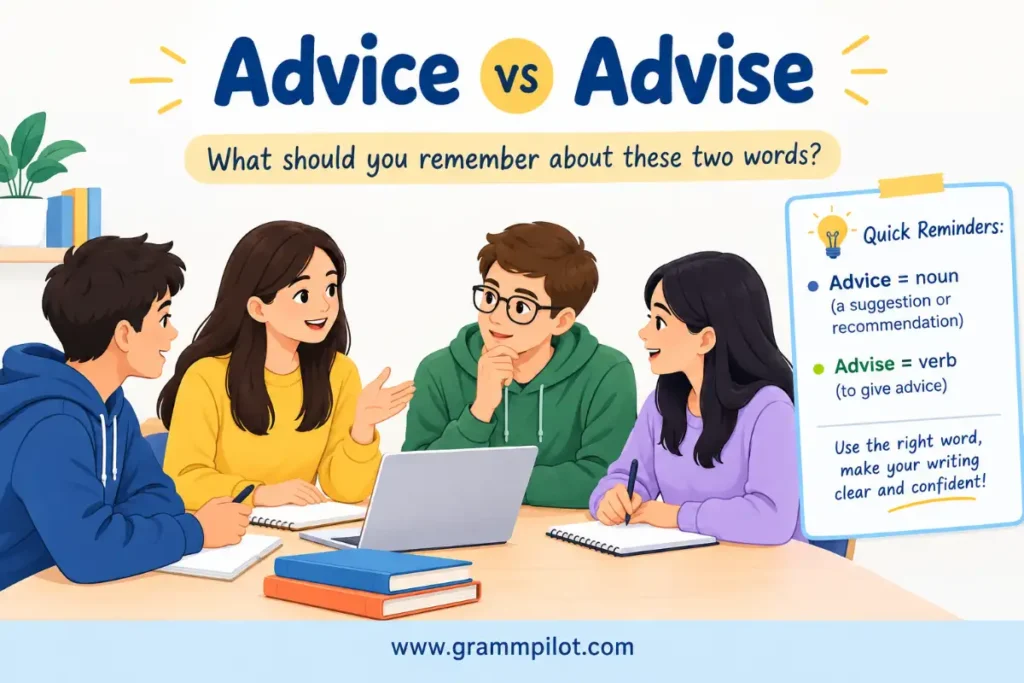
The entire rule can be reduced to a few lines.
Advice is a noun.
Advise is a verb.
You give advice.
You advise someone.
Advice is normally uncountable.
Advice ends with an /s/ sound.
Advise ends with a /z/ sound.
If you remember these patterns, you can handle the difference confidently in schoolwork, professional writing, messages, and everyday conversation.
Conclusion
Advice vs Advise becomes much easier when you focus on grammar rather than spelling alone. Advice is a noun for guidance, recommendations, or helpful suggestions, while advise is a verb meaning to give guidance or recommend an action. The easiest memory trick is to remember that you give advice, but you advise someone to do something. Also remember that advice is normally uncountable, so use expressions such as “some advice” and “a piece of advice.” Pronunciation offers another useful clue: advice ends with an /s/ sound, while advise ends with a /z/ sound. Once these patterns become familiar, choosing the correct form becomes almost automatic. Keep practicing with real sentences, and your writing will become clearer and more confident.
Frequently Asked Questions
1. What is the difference between advice and advise?
Advice is a noun meaning guidance or a recommendation, while advise is a verb meaning to give guidance. You can give advice, but you advise someone to do something.
2. Is it correct to say “an advice”?
No, standard English normally treats advice as an uncountable noun. Say “some advice” or “a piece of advice” instead.
3. Should I say “advice” or “advise someone”?
Use advice for the guidance itself and advise for the action of giving guidance. For example, “She gave me advice” and “She advised me to wait.”
4. What’s another way to say “advice”?
Common alternatives include guidance, suggestion, recommendation, tip, opinion, feedback, counsel, and input. The best alternative depends on the exact meaning and level of formality.
5. Can advice and advise be used in the same sentence?
Yes. For example, “My teacher gave me useful advice and advised me to practice more.” The noun names the guidance, while the verb describes the action.
6. How do you pronounce advice and advise?
Advice ends with an /s/ sound, while advise ends with a /z/ sound. The difference can help you recognize the words when listening.
7. Is “Please advise” correct in a professional email?
Yes, “Please advise” is grammatically correct and means that you are asking someone to provide information, guidance, or a recommendation. A friendlier alternative is “Please let me know what you recommend.”