
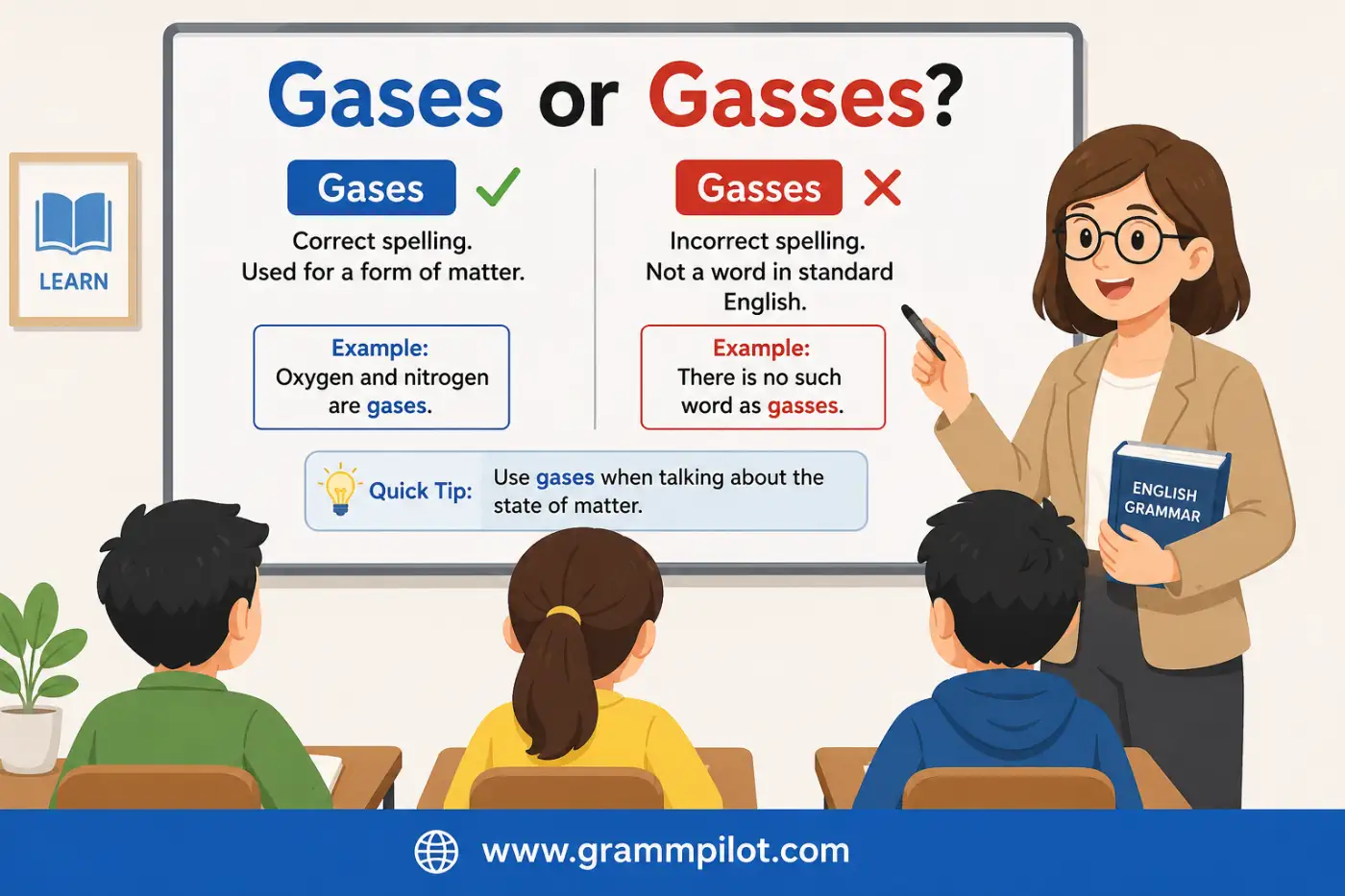
Have you ever paused while writing an email, school essay, or work report because you weren’t sure about to type Gases or Gasses? You’re not alone. This is one of those spelling questions that confuses many English learners and even native speakers.
The confusion usually happens because many English words ending in -s double the last letter before adding -es. But does that rule apply here? Should you write gases or gasses?
Quick Answer: Gases is the correct plural of gas in almost every situation. Gasses is mainly used as a verb meaning “poisons with gas,” “fills with gas,” or “talks a lot” in informal English.
Once you understand why these two spellings exist, the choice becomes easy. In this guide, you’ll learn where each word came from, what each one means, how dictionaries explain them, when to use each spelling, and how to avoid one of the most common English writing mistakes.
Want to strengthen your grammar skills? Explore [Headed vs Heading].
Is It Gasses or Gases?
The short answer is simple.
Gases is the standard plural noun of gas.
Gasses is usually a verb. It is the third-person singular or plural verb form of to gas, depending on the sentence.
Here is a quick comparison.
| Word | Part of Speech | Meaning | Correct Example |
|---|---|---|---|
| Gases | Noun (Plural) | More than one gas | Oxygen and nitrogen are gases. |
| Gasses | Verb | Gives off gas, fills with gas, poisons with gas, or chats a lot (informal) | The machine gasses the containers. |
Most people searching for Gases or Gasses actually want the plural spelling. In that case, gases is almost always the correct answer.
What Does “Gas” Mean?
Before choosing the right spelling, it helps to understand the base word. A gas is one of the basic states of matter. Unlike a solid or a liquid, a gas spreads out to fill the space around it. Common examples include:
- Oxygen
- Nitrogen
- Carbon dioxide
- Helium
- Hydrogen
- Natural gas
The word gas is also used in everyday English with different meanings depending on where you live.
For example:
- Fuel for a car
- Air inside the stomach
- Chemical vapor
- Energy source for cooking
- Pressure inside a container
Because the word has several meanings, people often wonder how its plural should be written. The answer is still the same. The plural noun is gases.
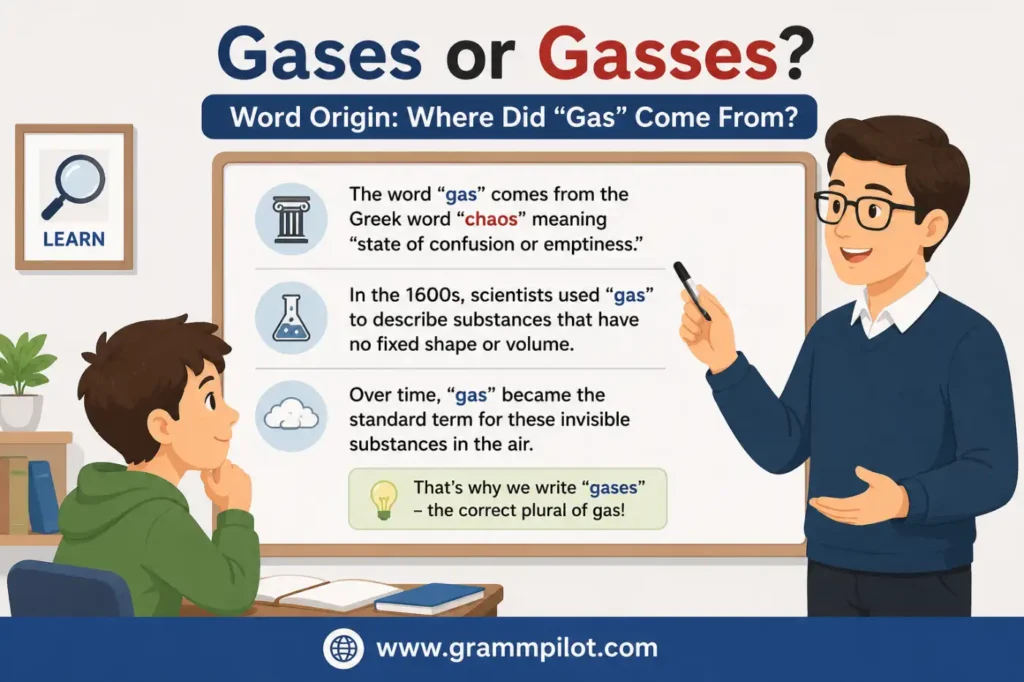
Word Origin: Where Did “Gas” Come From?
Many articles explain which spelling is correct, but very few explain where the word itself came from. The word gas was first introduced in the early 1600s by the Flemish scientist Jan Baptist van Helmont. He wanted a new word for substances that behaved differently from solids and liquids. Experts believe he created the word from the Greek word chaos, although the exact history is still debated. Over time, gas became a scientific term used around the world. As English developed, its normal plural became gases, following standard English spelling rules.
Later, English also created the verb to gas, meaning:
- to expose someone to gas
- to fill something with gas
- to supply gas
- to produce gas
- to talk continuously in informal speech
From that verb came the spelling gasses.
So the two spellings have different jobs.
- Gas → Gases (plural noun)
- To gas → Gasses (verb)
Understanding this history makes the difference much easier to remember.
Why Is “Gases” the Correct Plural?
English forms plurals in different ways. For many words ending in -s, we simply add -es.
Here are some examples.
| Singular | Plural |
|---|---|
| bus | buses |
| class | classes |
| kiss | kisses |
| gas | gases |
| lens | lenses |
Notice something important. The final s is not doubled. Instead, English simply adds -es to create the plural.
That is why:
- gas → gases ✅
- gas → gasses ❌ (when used as a plural noun)
Although gasses looks similar to words like classes, it serves a different purpose because it belongs to the verb to gas.
Gases or Gasses: Why Do People Get Confused?
This spelling mistake happens for several reasons.
The Double “S” Looks Familiar
English has many words with double s.
Examples include:
- classes
- glasses
- passes
- kisses
Because people see these words often, they naturally assume the plural of gas should also double the letter.
It doesn’t. The correct plural is still gases.
Pronunciation Sounds Similar
When spoken aloud, gases and gasses sound almost identical. That means your ears cannot always tell which spelling is correct. Instead, you must think about the job the word is doing.
Ask yourself: “Am I talking about more than one gas?”
If yes, choose gases.
If you’re describing someone filling something with gas or exposing someone to gas, the verb gasses may be correct.
Spell Check Doesn’t Always Explain Why
Many writing tools correct spelling but don’t explain grammar. You might see one spelling accepted without understanding why. Learning the difference helps you avoid mistakes in any writing situation.
Iwhy the question Gases or Gasses doesn’t have a one-word answer. The correct choice depends on if you’re using a noun or a verb.
How Dictionaries Treat These Words” Gases or Gasses”?
Leading English dictionaries agree on the basic rule.
They list:
- gases as the plural form of the noun gas
- gasses as a verb form of gas
That agreement makes this one of the easier spelling questions once you know the grammar behind it.
If you’re writing:
- an essay,
- a research paper,
- a business email,
- a school assignment,
- or a blog article,
the plural noun should almost always be gases.
Using gasses instead may distract readers and make your writing appear less polished.
When Is “Gasses” Correct?
Although much less common, gasses is still a real English word.
It works as a verb.
Here are its main meanings.
1. To Fill Something with Gas
Example: The technician gasses the storage tank before testing it.
2. To Poison with Gas
Example: The story describes how the army gasses enemy tunnels.
This meaning is usually found in historical or military writing.
3. To Produce Gas
Example: Certain foods gasses the stomach in some people.
Today, writers often prefer clearer wording such as causes gas or produces gas instead.
4. Informal Meaning: Talks Too Much
In some varieties of English, especially informal speech, gasses can mean someone chats for a long time.
Example: He gasses with his friends every afternoon.
This usage is much less common than the plural noun gases.
Gases or Gasses: Can Both Words Be Correct?
Yes—but not in the same sentence unless they perform different jobs.
Look at this example.
- The laboratory studies dangerous gases, and the technician gasses each testing chamber before every experiment.
Here:
- gases is the plural noun.
- gasses is the verb.
Both spellings are correct because they have different grammatical roles. This is why the question Gases or Gasses doesn’t have a one-word answer. The correct choice depends on if you’re using a noun or a verb.
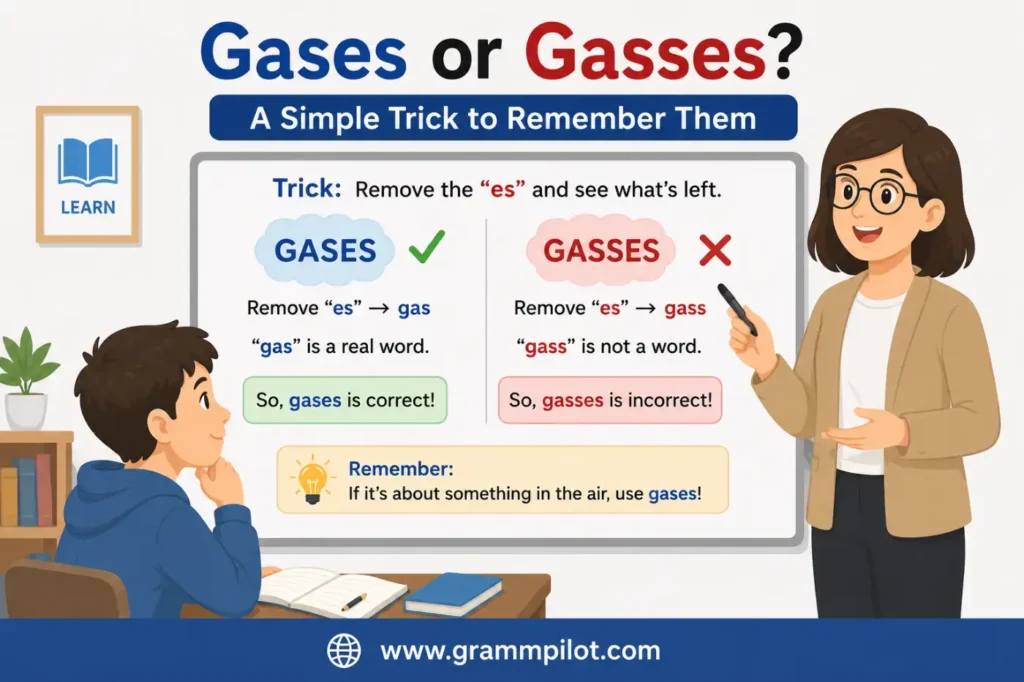
Gasses or Gases: A Simple Trick to Remember Them
If you forget the rule, use this quick memory tip.
Ask yourself: Can I replace the word with “many kinds of gas”?
If yes, write gases.
Examples:
- many gases
- dangerous gases
- invisible gases
- medical gases
If you’re describing an action instead, use the verb.
Examples:
- The machine gasses the container.
- The operator gasses each chamber before testing.
This simple question helps you choose the right spelling every time.
Master Synonym List for “Gas” and Related Words
The words you use instead of gas depend on the topic. In science, you may need technical terms. In daily conversation, simple words often sound more natural.
The table below groups common alternatives by tone and usage.
| Word | Meaning | Tone | Example |
|---|---|---|---|
| Air | The mixture of gases around us | Everyday | Fresh air filled the room. |
| Vapor | Gas formed from a liquid | Formal | Water vapor rose from the pot. |
| Fume | Gas or smoke with a strong smell | Everyday | Paint fumes filled the garage. |
| Steam | Water vapor from heated water | Everyday | Steam escaped from the kettle. |
| Mist | Tiny water droplets in air | Everyday | Morning mist covered the hills. |
| Pollution | Harmful substances in the air | Everyday | Air pollution affects health. |
| Atmosphere | Gases surrounding a planet | Formal | Earth’s atmosphere protects life. |
| Carbon dioxide | Gas produced by breathing and burning fuel | Scientific | Plants use carbon dioxide. |
| Helium | Very light gas | Scientific | Helium filled the balloons. |
| Methane | Natural gas component | Scientific | Methane is a greenhouse gas. |
| Neon | Gas used in signs | Scientific | Neon lights glowed brightly. |
| Argon | Inert gas | Scientific | Argon protects metal during welding. |
| Propane | Fuel gas | Everyday | Propane heated the cabin. |
| Butane | Fuel gas | Everyday | The lighter contains butane. |
| Natural gas | Fuel used in homes | Everyday | Natural gas powers the stove. |
| Fuel | Material burned for energy | Everyday | Fuel prices increased. |
| Wind | Moving air | Everyday | The wind became stronger. |
| Stench | Very bad smell | Strong | The stench was hard to ignore. |
| Whiff | Small amount of smell | Informal | I caught a whiff of smoke. |
| Gases | Multiple gas substances | Scientific | Different gases react differently. |
Notice that these words are not accurate replacements. Each has its own meaning and should be chosen based on content.
Synonyms by Intensity (Mild to Strong)
Sometimes the idea of gas also suggests smell, pollution, or dangerous air. Here are words arranged from mild to strong.
| Intensity | Word | Typical Use |
|---|---|---|
| Very Mild | Air | Normal atmosphere |
| Mild | Breeze | Moving air |
| Mild | Vapor | Gas from liquid |
| Moderate | Steam | Heated water vapor |
| Moderate | Fumes | Strong-smelling gases |
| Moderate | Exhaust | Engine emissions |
| Strong | Smoke | Fire or burning |
| Strong | Emissions | Industrial pollution |
| Very Strong | Toxic gas | Poisonous gas |
| Extreme | Poison gas | Deadly chemical gas |
Choosing the right level helps readers clearly understand what you mean.
Related Words by Part of Speech
Although gas is usually a noun, English uses related forms in different ways.
Noun
A thing or substance.
Examples:
- gas
- gases
- gasoline (US)
- gas supply
- gas station
- gas leak
Example sentence: The scientist collected several gases for testing.
Verb
An action involving gas.
Examples:
- gas
- gassing
- gassed
- gasses
Example sentence: The technician gasses each chamber before the experiment.
Adjective
Words describing something connected to gas.
Examples:
- gaseous
- gas-powered
- gas-filled
- gas-free
- gas-rich
Example sentences:
- Water becomes gaseous when it evaporates.
- We bought a gas-powered generator.
Is There a Difference Between American and British English?
The spelling difference between gases and gasses is not mainly an American versus British English issue. Both American English and British English follow the same basic rule.
- Gases = plural noun
- Gasses = verb
However, the word gas itself can mean different things depending on where you are.
| Region | Common Meaning of Gas |
|---|---|
| United States | Gasoline for cars |
| United Kingdom | Natural gas used in homes |
| Worldwide Science | A state of matter |
For example:
American English: I need to buy gas before work.
British English: We cook with gas.
Scientific English: Oxygen is one of the most important gases for life.
Even though the meanings change, the plural spelling remains gases.
Gases or Gasses: Which Word Should You Use in Different Situations?
The right choice depends on what you’re writing.
Gases or Gasses in a Resume
If you’re writing a resume, you’ll almost never need gasses.
Instead, use gases when talking about laboratory work, engineering, chemistry, healthcare, or manufacturing.
Example: Monitored compressed gases and maintained safety procedures.
This sounds professional and grammatically correct.
Gases or Gasses in a School Essay
School writing usually discusses science, climate, or chemistry.
Correct example: Greenhouse gases trap heat in Earth’s atmosphere.
Incorrect: Greenhouse gasses trap heat.
Teachers commonly mark this as a spelling mistake because gasses is not the plural noun.
Gases or Gasses in an Email
Most workplace emails require the plural noun.
Example: Please store all compressed gases in the approved cabinet.
Only use gasses if you’re describing an action.
Example: The machine automatically gasses each container before shipping.
Gases or Gasses in Text Messages
People often ignore grammar in texts, but using the correct spelling still makes your writing clearer.
Correct: These gases aren’t safe to breathe.
Informal messages rarely need the verb gasses.
Gases or Gasses in Speaking
When speaking, listeners usually cannot hear the spelling difference because both words sound nearly the same.
That means context is everything.
If someone says, “We tested several gases.”
listeners understand they mean multiple kinds of gas.
If someone says, “The technician gasses the room.”
listeners know it’s describing an action.
Because pronunciation is almost identical, careful writing becomes even more important.
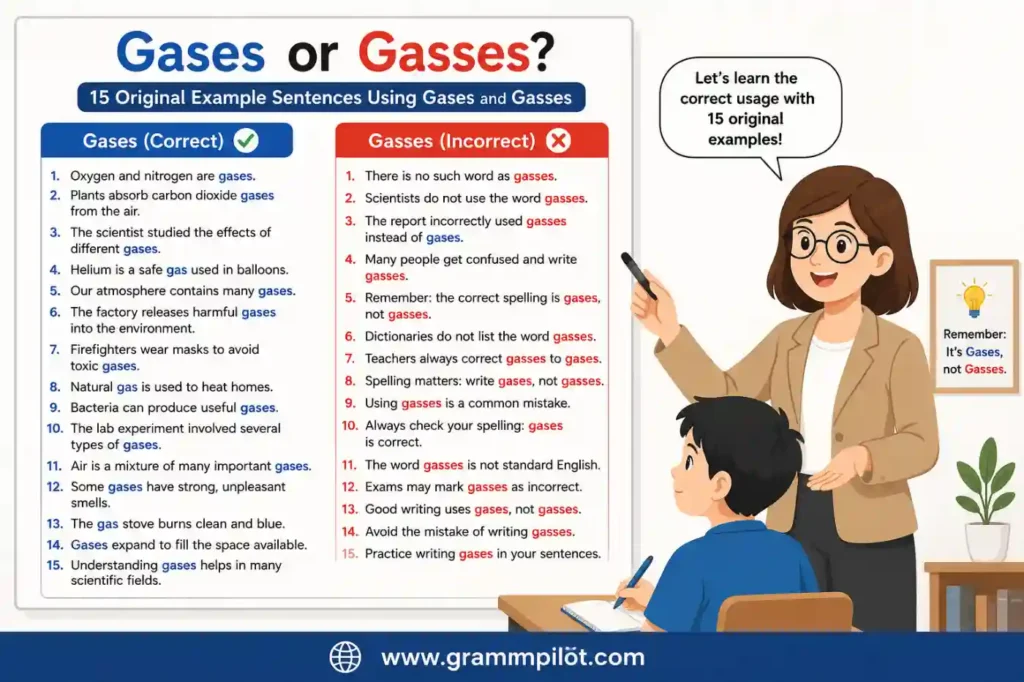
Gasses or Gases:15 Example Sentences Using Gases and Gasses
The best way to remember the difference is to see both words in real situations.
Science
- Oxygen and hydrogen are different gases with unique properties.
- Scientists collected several gases from the experiment.
- Some gases become liquids when cooled enough.
School
- Our teacher explained how greenhouse gases affect Earth’s climate.
- The quiz asked us to name five common gases.
- Students learned that invisible gases still take up space.
Workplace
- The factory stores compressed gases in special tanks.
- Workers wear protective equipment when handling hazardous gases.
- Engineers regularly inspect pipes carrying industrial gases.
Healthcare
- Hospitals use medical gases to help patients breathe.
- Emergency crews checked the building for harmful gases after the leak.
Everyday Life
- Balloons float because they contain lighter gases.
- The warning system detects dangerous gases before they spread.
Using the Verb “Gasses”
- The technician gasses each testing chamber before the inspection.
- The machine automatically gasses the containers during production.
These examples show that gases is far more common because it is the regular plural noun.
Gases vs Vapors — What’s the Difference?
People often think these words mean the same thing, but they don’t.
| Gases | Vapors |
|---|---|
| Exist naturally as gases at room temperature. | Come from liquids or solids that evaporate. |
| Oxygen is a gas. | Steam from boiling water is vapor. |
| Usually remain gases under normal conditions. | May return to liquid when cooled. |
Examples
Correct:
- Oxygen and nitrogen are gases.
- Water vapor rises from hot tea.
Incorrect: Oxygen is a vapor. ❌
Knowing this difference helps when writing about science.
Gas vs Gasoline — What’s the Difference?
This is another common source of confusion.
| Gas | Gasoline |
|---|---|
| A state of matter. | Liquid fuel for cars. |
| Used worldwide in science. | Mainly American English. |
| Can describe many substances. | Refers to a specific fuel. |
Examples:
- Helium is a gas.
- I need more gasoline for the car.
- Americans often shorten gasoline to simply gas.
Because of this shortcut, context matters.
Greenhouse Gases vs Air Pollution
These terms are related but not identical.
| Greenhouse Gases | Air Pollution |
|---|---|
| Trap heat in Earth’s atmosphere. | Harmful substances that reduce air quality. |
| Include carbon dioxide and methane. | Includes smoke, dust, chemicals, and some gases. |
| Affect global climate. | Mainly affects health and visibility. |
Example:
- Carbon dioxide is a greenhouse gas.
- Smoke from a wildfire is air pollution.
Some greenhouse gases are pollutants, but not every pollutant is a greenhouse gas.
Common Mistakes People Make “Gases or Gasses”
Many writers make the same errors again and again.
Mistake 1: Using “Gasses” as the Plural
Incorrect: The lab tested dangerous gasses.
Correct: The lab tested dangerous gases.
Mistake 2: Assuming Double “S” Means Plural
People compare it to words like:
- classes
- glasses
- kisses
But gas follows a different spelling rule.
Correct: gases
Not: gasses
Mistake 3: Using the Verb by Accident
Incorrect: Oxygen and nitrogen are important gasses.
Correct: Oxygen and nitrogen are important gases.
Remember: If the word names more than one gas, always use gases.
Mistake 4: Mixing Science and Everyday Meanings
Sometimes people confuse:
- gas (fuel)
- gas (state of matter)
Example:
- The car ran out of gas.
- Several gases were released.
The meaning changes, but the plural noun remains gases.
Mistake 5: Trusting Pronunciation
Since gases and gasses sound almost identical, many people spell the word incorrectly from memory.
Instead of relying on sound, ask: Am I naming more than one gas?
If yes, write gases.
When Should You NOT Use “Gasses”?
Avoid gasses whenever you’re writing about:
- Chemistry
- Biology
- Physics
- Climate change
- Greenhouse gases
- Air quality
- Laboratory experiments
- Medical gases
- Industrial gases
In all these topics, gases is the correct plural noun.
Only use gasses when describing an action performed by the verb to gas.
Examples:
Correct: The company gasses the containers before shipping.
Correct: The researcher studies greenhouse gases.
Antonyms of Gas
There isn’t one accurate opposite of gas, but depending on the context, these words may work.
| Word | Opposite Context |
|---|---|
| Solid | State of matter |
| Liquid | State of matter |
| Vacuum | No gas present |
| Empty space | Lack of air or gas |
| Condensed matter | Opposite physical state |
Examples:
- Ice is a solid.
- Water is a liquid.
- Oxygen is a gas.
15 Example Sentences Using Gases And Gasses
Remember these simple rules.
- Gases is the plural noun.
- Gasses is usually a verb.
- Science books almost always use gases.
- Climate articles always talk about greenhouse gases.
- Laboratory reports use gases.
- Business writing rarely needs gasses.
- If you mean “more than one gas,” choose gases.
- If someone or something performs the action of adding or exposing gas, gasses may be correct.
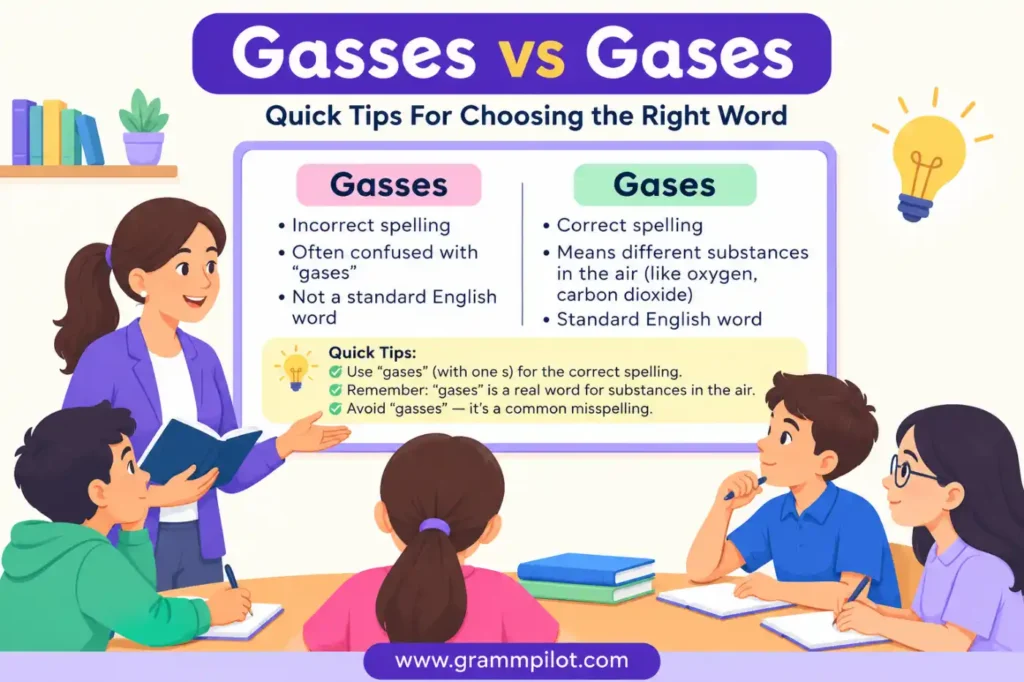
Quick Tips For Choosing the Right Word
Think of this sentence:
Many gases exist, but a machine gasses something.
If the word names things, it’s gases.
If the word describes an action, it’s gasses.
This simple trick helps you choose the correct spelling every time.
Conclusion
Choosing between Gases or Gasses is much easier once you know the grammar behind each word. Gases is the correct plural form of the noun gas and is the spelling you’ll use in almost every science paper, school assignment, email, or professional document. Gasses, on the other hand, is a verb that describes the action of filling something with gas, exposing someone to gas, or, in some informal contexts, talking a lot.
Whenever you’re unsure, ask yourself a simple question: Am I talking about more than one gas, or am I describing an action? If it’s more than one gas, choose gases. If it’s an action performed by someone or something, gasses may be correct. With this simple rule, you’ll avoid a common spelling mistake and write with greater confidence.
Frequently Asked Questions
1. Is it gases or gasses?
Gases is the correct plural form of gas. Gasses is a verb form that means to fill with gas, expose to gas, or, in some informal uses, to chat a lot.
2. Why is the plural of gas “gases” and not “gasses”?
English forms the plural of gas by adding -es, creating gases. The spelling gasses belongs to the verb to gas, not the plural noun.
3. Is “gasses” ever a correct word?
Yes. Gasses is a valid English verb. For example: The technician gasses the chamber before testing. It is not the correct plural spelling of gas.
4. What’s another way to say gas?
Depending on the context, you might use air, vapor, fumes, steam, emissions, exhaust, atmosphere, or a specific gas such as oxygen or carbon dioxide.
5. How do you use “gases” in a sentence?
Here’s a simple example: Different gases expand when heated. In this sentence, gases refers to more than one type of gas.
6. Do American and British English spell gases differently?
No. Both American and British English use gases as the plural noun and gasses as the verb form. The meanings of gas may vary by region, but the spelling rule stays the same.
7. Hey, ChatGPT, should I write “gases” or “gasses” in my essay?
Write gases if you’re referring to more than one gas. In essays about science, chemistry, climate change, or engineering, gases is almost always the correct choice.